


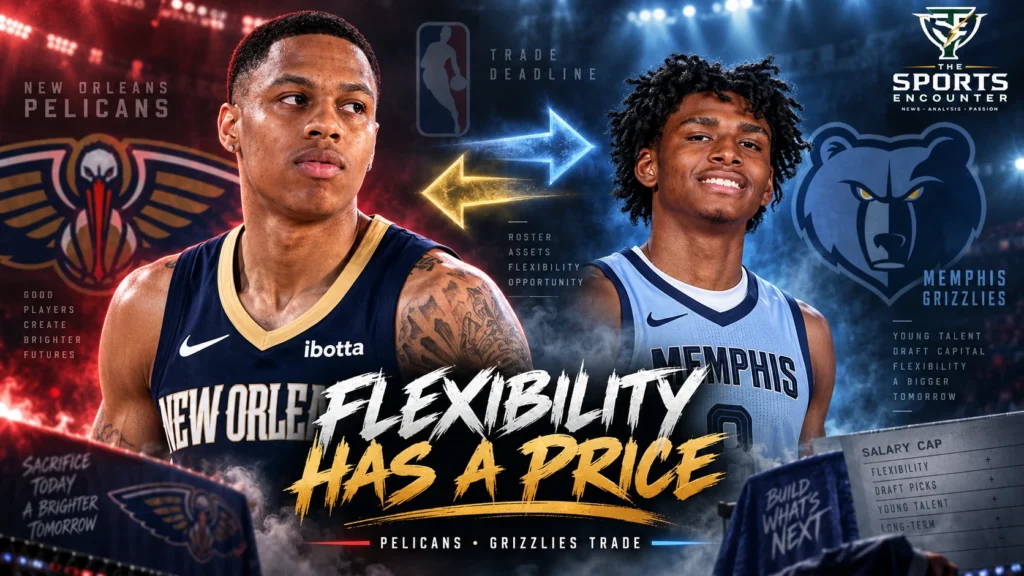
NEW ORLEANS, United States, September 9, 2026: The New Orleans Pelicans did not trade Jordan Hawkins because AJ Johnson was the better player, and they did not acquire Taj Gibson because they suddenly needed a 41-year-old big man in the rotation. The real value of Tuesday’s four-player deal was financial.
New Orleans sent Hawkins, Micah Peavy, a future second-round pick and a future second-round pick swap to the Memphis Grizzlies in exchange for Johnson and Gibson, completing a transaction that looked unusual on basketball value alone but made much more sense once the Pelicans’ remaining roster problem was included.
The deal saved New Orleans roughly $5.7 million in salary and created the flexibility needed to complete its reported two-year, $16 million agreement with Bennedict Mathurin. Gibson’s contract was non-guaranteed, and the Pelicans waived him one day after acquiring him, making the veteran center less of a basketball addition than a piece of salary-matching machinery.
That is the important distinction.
New Orleans gave Memphis the more recognizable young player, another recent draft pick and additional second-round value. In return, the Pelicans received a developmental guard and a contract they could immediately remove from the books.
This was not primarily a talent-for-talent trade.
It was a flexibility trade.
For readers following how NBA teams increasingly treat contracts, draft picks and roster spots as interchangeable forms of value, The Sports Encounter’s NBA hub tracks the league’s biggest trades, cap decisions and roster-building moves throughout the 2026-27 season.
Pelicans-Grizzlies Trade: What Each Team Received
| New Orleans Pelicans Receive | Memphis Grizzlies Receive |
|---|---|
| AJ Johnson | Jordan Hawkins |
| Taj Gibson | Micah Peavy |
| Financial flexibility | Future second-round pick |
| Roster maneuverability | Future second-round pick swap |
The NBA officially recorded the transaction on September 8, with New Orleans acquiring Johnson and Gibson while Memphis received Hawkins, Peavy and draft consideration. The NBA’s official trade report confirmed all four players and both pieces of future draft compensation.
New Orleans also issued its own official announcement confirming the deal with Memphis.
Why Jordan Hawkins Became Expendable
Jordan Hawkins is the name that makes this trade feel expensive.
New Orleans selected him 14th overall in the 2023 NBA Draft after his title-winning season at UConn. His shooting profile made sense for a Pelicans team that needed more spacing around Zion Williamson and its primary creators.
There were flashes.
Across three seasons in New Orleans, Hawkins averaged 8.0 points and 2.3 rebounds while shooting 34.8% from three across 18 minutes per game.
The problem was that his role had already started shrinking before this trade.
Hawkins averaged only 5.1 points across 51 appearances last season, and the Pelicans’ late-August agreement with Mathurin made his path to regular minutes even less secure.
That is where roster value becomes different from player value.
Hawkins still has shooting upside.
He is still young enough to improve.
He may even become more useful to Memphis than he had become in New Orleans.
But the Pelicans were no longer evaluating him in isolation. They were evaluating him against the guards and wings who would actually occupy rotation minutes next season.
Mathurin changed that calculation.
The same basic principle appeared when Oklahoma City traded Aaron Wiggins to Atlanta. The Thunder did not move a useless player. They moved a useful player because the financial and roster math had changed around him.
New Orleans has now made a similar choice.
Bennedict Mathurin Is the Hidden Center of This Trade
Mathurin was not technically part of the four-player transaction.
He was still the reason the trade mattered.
The Pelicans agreed to a reported two-year, $16 million contract with Mathurin on August 26, including a player option. He averaged 17.6 points, 5.4 rebounds and 2.4 assists across 54 games last season with Indiana and the LA Clippers.
The NBA’s official free-agency report confirmed the agreement and the reported contract structure.
That addition immediately created a roster-management issue for New Orleans.
Mathurin is not coming in as a deep reserve.
He is a proven NBA scorer entering his age-24 season with experience both as a starter and a high-usage bench option. If healthy, he is likely to demand a meaningful offensive role from the opening weeks of the season.
Hawkins was therefore no longer just competing with other young guards.
He was competing with a player who had averaged more than three times as many points as he did last season.
New Orleans could keep both.
The larger question was whether keeping both made sense when the salary structure was already tight.
The front office decided it did not.
The Trade Saved New Orleans Roughly $5.7 Million
This is the number that explains the deal.
By exchanging Hawkins and Peavy for Johnson and Gibson, New Orleans reduced its salary commitments by approximately $5.7 million.
That savings mattered because the Pelicans needed room beneath the first apron to complete the Mathurin transaction without creating another roster problem immediately afterward.
The trade did not suddenly give New Orleans traditional salary-cap space.
The Pelicans remain an over-the-cap team.
What it did create was breathing room within the apron structure, which is the practical currency many NBA front offices manage during the offseason.
That difference is easy to miss.
Fans often hear “cap space” and assume a team either has money or does not.
Modern roster building is much more layered than that.
A team can be well above the salary cap and still care intensely about where it sits relative to the luxury-tax line and the first and second aprons. Those thresholds affect which exceptions can be used, how trades can be structured and how much freedom a team retains for later moves.
Boston’s decision to extend Jordan Walsh reflected the opposite side of the same logic. Cheap, controllable contracts become especially valuable when expensive rosters begin running into cap pressure.
The Pelicans were solving that problem from the other direction.
Why Taj Gibson Was More Valuable as a Contract Than a Player
Taj Gibson’s inclusion looked strange if the trade was evaluated as a basketball swap.
New Orleans already had frontcourt options.
Gibson is 41.
He averaged 3.4 points and 2.7 rebounds in 10 appearances for Memphis last season.
He was never likely to become a major part of the Pelicans’ rotation.
His contract was the real asset.
Because Gibson’s 2026-27 salary was non-guaranteed, New Orleans could acquire him to make the trade structure work and then waive him without carrying the full salary commitment.
That is exactly what happened one day later.
The move illustrates one of the least glamorous but most important mechanisms in NBA roster construction.
Sometimes the valuable part of an incoming player is not what he can do on the court.
It is what his contract allows the team to do next.
AJ Johnson Is the Developmental Bet New Orleans Kept
AJ Johnson is the only incoming player who appears likely to have a chance to remain part of New Orleans’ longer-term basketball plan.
The 21-year-old guard was selected 23rd overall in the 2024 NBA Draft and has already moved through several organizations early in his career.
He averaged 3.3 points across 48 appearances last season between Dallas and Washington before being sent to Memphis earlier this offseason.
He never played a game for the Grizzlies.
New Orleans now gets another look at a former first-round pick whose value is based much more on development than immediate production.
That matters because Johnson is cheaper and less established than Hawkins.
The Pelicans do not need to promise him a large role.
They can bring him into camp, evaluate whether his physical tools and ball-handling are worth continued investment, and make another decision without carrying the same financial commitment.
That type of low-cost developmental bet is especially useful for a team trying to build around younger pieces such as Derik Queen and Jeremiah Fears.
Micah Peavy Became Part of the Price of Flexibility
Micah Peavy’s inclusion makes the trade more interesting from Memphis’ perspective.
New Orleans selected Peavy 40th overall in the 2025 NBA Draft, and he averaged 4.3 points and 1.9 rebounds as a rookie.
His offensive efficiency was inconsistent, but his defense gave him a pathway to playing time.
That kind of young wing is exactly the type of player Memphis can afford to examine during a roster reset.
The Grizzlies are not receiving one finished answer.
They are receiving several chances.
Hawkins offers shooting upside.
Peavy offers defensive development.
The second-round pick adds future value.
The pick swap adds another small piece of optionality.
Memphis used its ability to absorb salary to collect multiple assets from a team that needed financial relief.
That is good rebuilding behavior.
The Grizzlies have already changed direction sharply this offseason after moving Ja Morant to Portland. The Sports Encounter’s analysis of Portland’s new backcourt examined how that Morant trade altered the balance for both franchises.
This smaller deal fits the same Memphis transition.
Memphis Used Cap Flexibility as an Asset
The Grizzlies’ side of the transaction is easier to understand once the Pelicans’ urgency is clear.
Memphis did not need Johnson or Gibson badly enough to protect them.
Instead, the Grizzlies used available financial flexibility to absorb Hawkins and Peavy while receiving draft compensation for doing so.
That is one of the most valuable advantages a retooling team can possess.
Cap flexibility can be turned into players.
It can be turned into picks.
It can be turned into leverage when another team needs relief quickly.
Memphis effectively sold New Orleans the solution to a roster problem and charged the Pelicans draft capital for the service.
That does not automatically make Memphis the winner.
It does mean the Grizzlies understood where their leverage came from.
Why This Is Not Simply a Bad Hawkins Trade
The easiest reaction is to look at Hawkins’ draft pedigree and ask why New Orleans gave up a former lottery pick while also attaching draft value.
That reaction is understandable.
The more useful question is what keeping Hawkins would have cost the Pelicans elsewhere.
Mathurin had already agreed to join.
Hawkins’ projected rotation role had become uncertain.
The Pelicans needed financial room to complete the roster they had actually chosen.
Once those three conditions existed, Hawkins’ original draft position mattered less than his current place in the team’s plans.
This is one of the harder truths of NBA roster construction.
Draft status expires faster than fans expect.
A former No. 14 pick is not permanently worth No. 14-pick value.
His value changes with performance, contract size, roster competition and the needs of the team holding him.
That is why the Aaron Wiggins trade is such a useful comparison. Good players can be moved for modest-looking returns when flexibility itself becomes the objective.
The Pelicans Are Choosing Role Clarity Over Developmental Redundancy
New Orleans’ offseason has been relatively quiet compared with many Western Conference rivals, but the Hawkins trade suggests the front office is at least trying to simplify the roster before training camp.
Mathurin adds another scoring guard.
Trendon Watford adds frontcourt versatility.
DeAndre Jordan returns as a veteran big.
Johnson now enters as a low-cost developmental guard.
The Pelicans are also building around an existing core that includes Zion Williamson, Trey Murphy III, Dejounte Murray, Jordan Poole, Derik Queen and Jeremiah Fears.
That is already a lot of players who need touches, developmental minutes or both.
At some point, keeping every young player stops being development and becomes congestion.
The front office appears to have decided Hawkins and Peavy had become part of that congestion.
This kind of roster compression is becoming increasingly common across the league. Philadelphia’s star-heavy roster faces the same problem from a different direction, where talent creates its own questions about touches, roles and sacrifice.
What the Trade Says About New Orleans’ Priorities
The Pelicans are not behaving like a team making one dramatic move to become a contender.
They are behaving like a team trying to make the roster functional before the season starts.
That is a smaller ambition, but it matters.
New Orleans finished 26-56 last season and did not make the playoffs.
Jamahl Mosley now takes over a group that still has major questions around health, fit and long-term direction.
The NBA’s latest Southwest Division outlook identified the same uncertainty, noting that the Pelicans will eventually have to decide how Dejounte Murray, Jordan Poole and Trey Murphy fit into the franchise’s future.
Before those larger decisions arrive, the team needed to solve the immediate roster math.
That is what this trade accomplished.
The Bigger NBA Lesson: Flexibility Has Become a Trade Asset
This move belongs to a broader trend across the league.
Teams no longer trade only for talent.
They trade for tax relief.
They trade for apron room.
They trade for non-guaranteed contracts.
They trade to create roster spots.
They trade to avoid paying a useful player whose role has disappeared.
The Sports Encounter has already seen that dynamic repeatedly this offseason. Phoenix committed heavily to Dillon Brooks because it judged his two-way role worth preserving, while Oklahoma City moved Wiggins because cost and roster congestion had changed his value internally.
Those decisions can look contradictory.
They are not.
Each team is pricing usefulness within its own roster.
New Orleans no longer priced Hawkins highly enough to justify the financial obstacle he represented.
Memphis priced him differently.
That difference created the trade.
The Sports Encounter Verdict
Judged only by the names involved, the Pelicans appear to have given up more.
Jordan Hawkins is the most established young player in the deal.
Micah Peavy still has developmental value.
Memphis also received a future second-round pick and a future swap.
That is a meaningful package.
New Orleans was paying for something that does not show up in a box score.
Flexibility.
The trade removed roughly $5.7 million from the Pelicans’ immediate salary structure, helped clear the path for Mathurin’s contract and allowed the team to replace two players whose roles had become uncertain with one developmental guard and one disposable contract.
Gibson’s waiver one day later confirmed the mechanism.
He was never the point.
Mathurin was.
Hawkins may still become a useful scorer in Memphis. Peavy may develop into a rotation defender. The Grizzlies may eventually turn the draft compensation into something valuable.
None of that would automatically make the Pelicans’ logic wrong.
The real judgment will depend on whether Mathurin provides enough production to justify the assets New Orleans surrendered to make the final roster work.
That is why this small September trade matters.
It was not about who won Hawkins versus Johnson.
It was about which team valued flexibility more, and what New Orleans plans to do with the flexibility it just bought.
Follow The Sports Encounter’s NBA coverage for continuing analysis of trades, contracts, roster construction and the biggest stories shaping the 2026-27 season.