


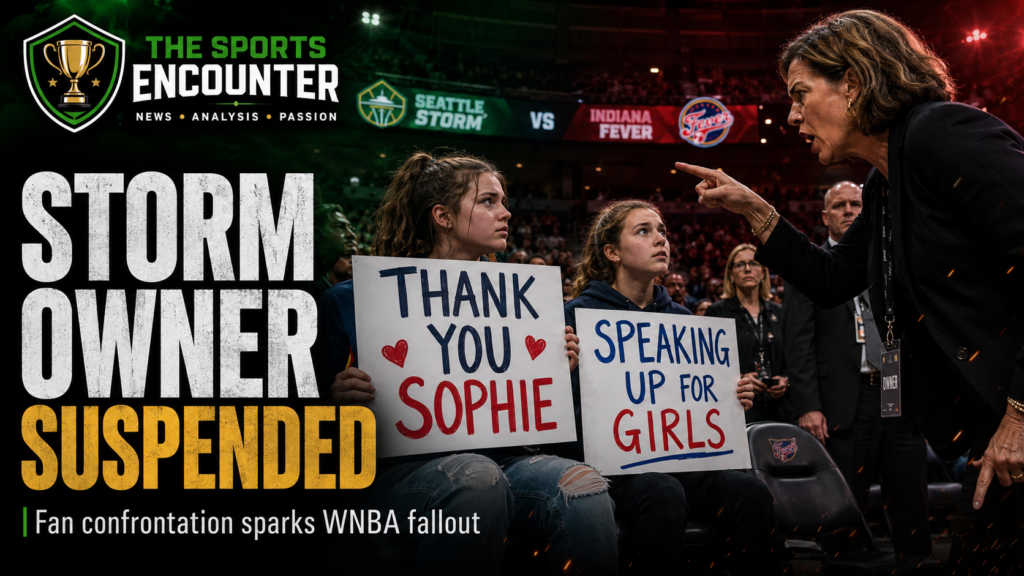
A night that should have centered on the Indiana Fever’s 105-95 victory over the Seattle Storm instead became a test of how professional sports organizations handle disagreement inside their own arenas.
Two teenage girls attended the July 28 game at Climate Pledge Arena carrying signs that supported Indiana guard Sophie Cunningham’s public position on transgender participation in girls’ and women’s sports. One message thanked Cunningham for “speaking up for girls.”
What followed moved rapidly from an arena confrontation to a league disciplinary case.
According to multiple reports, Seattle Storm minority co-owner Celeste Keaton approached the girls and directed profanity at them. The encounter attracted public criticism after independent journalist Brandi Kruse reported on it and identified Keaton as the person involved.
The Storm apologized the following day. The WNBA then fined Keaton an undisclosed amount and barred her from attending Seattle’s next five home games.
The punishment covered all five Storm home dates scheduled for August. Keaton would become eligible to return for Seattle’s September 17 game against the Las Vegas Aces. The Storm said it respected the league’s decision and remained committed to providing a welcoming and respectful environment for everyone attending its games.
The disciplinary action resolved the immediate question of whether the league would respond. It did not settle the larger controversy.
The incident sits at the intersection of several increasingly difficult issues for the WNBA: the treatment of young fans, the responsibilities of team owners, the difference between institutional inclusion and political conformity, athlete expression, transgender participation in female sports, and the growing tendency for every public disagreement to become a national ideological battle.
Readers can follow the wider league through The Sports Encounter’s WNBA and basketball news section and its broader NBA coverage hub.
TL;DR
- The WNBA fined Seattle Storm co-owner Celeste Keaton and suspended her from five home games.
- Multiple reports said Keaton used profanity during an exchange with two teenage girls supporting Sophie Cunningham.
- The Storm apologized and said every fan deserved respectful treatment.
- Cunningham criticized Keaton’s reported conduct while saying people could disagree and still treat each other kindly.
- The Indiana Fever said neither Cunningham nor the organization knew about or helped organize the demonstrations.
- The controversy occurred during a wider national debate over transgender participation in girls’ and women’s sports.
- The central organizational failure was not that disagreement existed, but that a person in authority reportedly confronted young paying spectators in an unacceptable manner.
Seattle Storm Fan Incident: Key Information
| Detail | Information |
|---|---|
| Game | Indiana Fever vs. Seattle Storm |
| Date | July 28, 2026 |
| Venue | Climate Pledge Arena, Seattle |
| Result | Indiana Fever won 105-95 |
| Storm co-owner | Celeste Keaton |
| Fans involved | Two teenage girls |
| Sign message | Support for Sophie Cunningham’s position on girls’ and women’s sports |
| Reported conduct | Keaton allegedly directed profanity at the fans |
| Storm response | Public apology |
| WNBA punishment | Undisclosed fine and five-home-game suspension |
| Suspension period | Seattle’s five home games in August |
| Earliest reported return | September 17 against the Las Vegas Aces |
| Cunningham’s response | Condemned the confrontation and supported respectful disagreement |
| Fever’s position | No prior knowledge of or contact with demonstration organizers |
Official league news, disciplinary announcements, schedules, standings, player information, and competition updates are available through the official WNBA website. Franchise news, schedules, ticket policies, community programs, and fan information can be found on the official Seattle Storm website.
What Happened at Climate Pledge Arena?
The two teenagers entered the arena with signs expressing support for Cunningham. One read, “Thank you Sophie for speaking up for girls.”
Their message referred to comments Cunningham had made during a recent ESPN interview and in subsequent media appearances. The Indiana guard said she did not hate transgender people but believed girls and women should not have to compete against athletes she described as biological males.
The subject had already placed Cunningham at the center of a heated public debate before Indiana arrived in Seattle.
Outside Climate Pledge Arena, supporters of sex-based eligibility rules in female sports gathered alongside activists defending transgender inclusion. The Fever later emphasized that neither Cunningham nor the franchise had advance knowledge of the demonstrations and had not communicated with the organizers.
Inside the arena, the teenage supporters reportedly encountered hostile reactions from some spectators. Kruse said fans booed the girls and that she reminded people around her that they were dealing with teenagers.
She also reported that some Seattle players made thumbs-down gestures in the girls’ direction. That part of the account should be treated carefully because the complete context of any gestures has not been publicly established.
The most serious allegation involved Keaton.
Reports said the Storm co-owner approached the girls and called them “f—ing insane.” Other accounts added further details about the exchange, but the league’s confirmed disciplinary action centered on an inappropriate confrontation between an owner and spectators.
Keaton’s position made the interaction fundamentally different from a disagreement between fans.
She was not simply another person in the crowd expressing an opposing view. She was part of the ownership group responsible for the event environment, the franchise’s public conduct, and the treatment of customers inside the arena.
That imbalance of power shaped the response.
The Storm Apology Came Before the League Punishment
Seattle responded publicly on July 29.
Storm majority owner Ginny Gilder acknowledged that one of the team’s co-owners had made comments to two fans and apologized for what happened. She said everyone attending a Storm game deserved to feel welcome and that the organization remained committed to treating fans respectfully.
The wording was cautious. It did not repeat the alleged profanity or offer a detailed account of the exchange. It nevertheless recognized that the interaction fell below the standard expected at a professional sporting event.
One day later, the WNBA confirmed stronger action.
Keaton received an undisclosed fine and a five-home-game suspension. The Storm accepted the punishment and repeated its commitment to a welcoming environment.
The sequence matters.
Seattle did not wait for the controversy to disappear. The club apologized, the league reviewed the incident, and punishment followed.
Yet the case also raised questions about why an owner needed league intervention to enforce a principle that should already have been obvious: team representatives cannot verbally intimidate young fans because they dislike the political or social meaning of their signs.
Why the WNBA Had to Act
The WNBA’s punishment was necessary for reasons extending beyond the specific policy argument involved.
A professional league cannot promise that every fan will agree with every player, owner, sponsor, or spectator. It can require basic behavioral standards from those who hold institutional authority.
Owners occupy the highest level of that responsibility.
They help shape the culture of the franchise. They are connected to hiring decisions, business partnerships, public messaging, community relationships, and the fan experience. Their behavior carries the weight of the organization even when they speak informally.
The importance of responsible ownership extends across professional sports. The Sports Encounter examined a different type of ownership transition in its report on the Pittsburgh Penguins’ ownership change, where league approval, governance, and long-term institutional responsibility were central to the story.
Had the WNBA ignored the Seattle incident, it would have risked creating a damaging double standard.
A teenage fan who directed abusive language at another spectator could face removal from an arena. An employee who confronted customers that way could face disciplinary action. An owner cannot reasonably receive greater freedom simply because she sits above most of the organization.
The five-game suspension communicated that ownership status does not provide immunity.
It also protected the credibility of the Storm’s apology. Without a meaningful consequence, language about creating a respectful and welcoming arena would have sounded hollow.
The Case Is About Conduct Before It Is About Policy
The broader political subject is unavoidable, but it can obscure the clearest point.
People can disagree deeply over transgender participation in female sports. That disagreement does not justify a team owner reportedly directing profanity at teenage spectators.
The two issues should not be collapsed into one.
Defending the girls’ right to attend a game and display an approved sign does not require endorsing every claim associated with their position. Condemning Keaton’s reported behavior does not require a person to oppose transgender inclusion.
The league’s discipline should therefore be understood primarily as a response to conduct.
A sporting venue can welcome transgender fans, athletes, and advocates while also protecting spectators who support sex-based sporting categories. An inclusive environment cannot function if inclusion applies only to those who hold the institution’s preferred view.
That is the contradiction Seattle now has to address.
The Storm said every fan should feel welcome. The franchise must demonstrate that this promise includes people who enter the building with lawful, non-threatening messages that some members of the organization strongly reject.
Sophie Cunningham’s Position and Response
Cunningham’s original comments had already produced intense reactions.
She said she had received criticism accusing her of hating transgender people, an interpretation she rejected. She described her position as an effort to protect young girls in sports and locker rooms while maintaining that transgender people should be treated with love and dignity.
After learning about the Seattle confrontation, Cunningham criticized Keaton on social media.
She wrote that there should be love and a safe space for everyone, including biological girls and boys, transgender women, and transgender men. She praised the teenagers for expressing their beliefs and argued that people can disagree without abandoning kindness.
Her response served two purposes.
First, it rejected the idea that support for sex-based sports categories must be expressed through hostility toward transgender people.
Second, it placed the focus on how adults in authority respond to young people who enter a contentious debate.
Cunningham’s statement was politically useful to her supporters, but it also carried a broader message that should not be controversial: disagreement does not remove the obligation to treat other people decently.
Indiana Fever Kept Its Distance From the Demonstrations
The Fever did not make Cunningham available for postgame questions.
A team public relations representative instead read a statement explaining that the player and organization had no knowledge of the demonstrations and no contact with the organizers.
That distinction protected the franchise from being portrayed as a participant in the rally.
Cunningham’s public comments had inspired some of the signs and demonstrations, but inspiration is not coordination. The Fever could not control which fans adopted her message or how political groups used the attention surrounding it.
The organization’s approach also reflected the difficulty teams face when an athlete becomes associated with a national political issue.
Silencing Cunningham would create a separate free-expression controversy. Fully aligning the franchise with her policy position could alienate other players, supporters, and members of the LGBTQ+ community. Treating her views as personal allowed the Fever to separate individual expression from organizational endorsement.
That position may be the most sustainable one for professional teams.
Athletes are adults with their own political, religious, and social opinions. A franchise can defend their ability to speak without adopting each opinion as official policy.
The Game Became Secondary
Indiana won 105-95, extending Seattle’s losing streak to seven games and leaving the Storm at 6-24, the worst record in the league at the time.
Cunningham scored 11 points and made three three-pointers.
Those details ordinarily would have formed part of a straightforward regular-season report. Instead, the game became the setting for a conflict that had been building outside basketball.
The crowd’s mixed reaction to Cunningham showed how quickly athlete activism can transform the emotional atmosphere of a sporting event. Cheers and jeers followed her involvement, while competing demonstrations outside framed the game as a stage in a national culture dispute.
For Seattle, the off-court controversy added further pressure during an already disastrous season.
Poor results can damage supporter confidence. An ownership scandal creates a different kind of problem because it reaches into the franchise’s identity and values.
The Storm now have to convince fans that the apology and suspension represent genuine accountability rather than temporary crisis management.
The wider competitive context of the league can be explored in The Sports Encounter’s WNBA Midseason Awards analysis, which examines the players, coaches, and teams shaping the 2026 season.
The National Legal Context Has Changed
The confrontation occurred during an increasingly consequential legal and political debate over transgender participation in school and organized sports.
Recent court decisions and state laws have strengthened the position of jurisdictions adopting sex-based eligibility rules for girls’ school sports. Those legal developments have also intensified campaigning, protests, and public messaging around the issue.
That context helps explain why Cunningham’s comments received immediate national attention and why a regular-season WNBA game attracted demonstrations.
Her remarks arrived when supporters of sex-based categories felt politically and legally strengthened. Advocates of transgender inclusion, meanwhile, viewed the movement toward restrictions as a threat to transgender students’ participation and dignity.
The teenagers’ signs therefore represented more than support for one basketball player. To different observers, they symbolized either the protection of female athletic categories or the exclusion of transgender girls and women.
Those competing interpretations do not excuse mistreatment. They explain why emotions inside and outside the arena were so intense.
Public Opinion Is More Complicated Than One Percentage
Public polling frequently finds substantial support for sex-based eligibility rules in female sports.
Results can still vary depending on wording, competition level, age group, medical requirements, and whether respondents are asked about school, collegiate, Olympic, or professional sports.
A single percentage cannot capture every ethical, legal, medical, and sporting question involved.
Nor does majority opinion determine how individual transgender people should be treated.
Public support for a particular eligibility policy does not authorize humiliation, harassment, or exclusion from the broader sporting community. Likewise, concern for transgender dignity does not eliminate legitimate discussion about competitive fairness, safety, scholarships, records, and category design.
The challenge for leagues is to separate eligibility policy from personal worth.
Sports organizations can debate who qualifies for a category without declaring that people outside that category are unwelcome as fans, employees, community members, or participants in other appropriate structures.
Cunningham attempted to make that distinction in her response by saying that everyone had a place at her table while maintaining her view on female competition.
Whether critics find that distinction persuasive is another question. It remains more constructive than treating every disagreement as proof of hatred.
Inclusion Cannot Become Ideological Enforcement
The Storm’s statement used the language of inclusion.
That language now requires careful examination.
An inclusive arena should protect transgender supporters from abuse. It should also protect teenage girls carrying signs that express a lawful position on sports eligibility.
Inclusion loses credibility when institutions apply it selectively.
A team cannot claim to welcome every fan while allowing owners, employees, players, or influential supporters to intimidate people associated with an unpopular viewpoint. Nor can it protect one group by treating another group’s presence as inherently provocative.
This does not mean teams must permit every sign.
Arenas routinely restrict messages that contain threats, obscenity, commercial promotion, personal attacks, or material likely to create a genuine security risk. The signs described in the Seattle case did not appear to fall within those categories.
They thanked an athlete for speaking.
That message could reasonably upset people who believed Cunningham’s position marginalized transgender athletes. Emotional offense, however, is not the same as a safety threat.
The proper response was disagreement, counter-signage, peaceful protest, or silence.
A co-owner’s reported profanity crossed the line from disagreement into institutional misconduct.
What the Incident Says About Power
The age of the fans matters.
Teenagers entering a professional arena do not carry the same authority as a team owner. They may possess political convictions, but they do not control the venue, the franchise, employment decisions, security policies, or access to games.
Keaton’s reported conduct therefore cannot be analyzed as an equal exchange between two sides.
Leadership changes the standard.
Owners should be capable of encountering messages they dislike without turning the moment into a confrontation. Their responsibility is greater precisely because their power is greater.
A mature response might have involved walking away, asking arena staff whether the signs complied with policy, or engaging in a calm conversation if the fans welcomed it.
Profanity directed at teenagers created the opposite result. It made the owner, rather than the signs, the central problem.
The Reported Player Gestures Require Caution
Kruse said Seattle players made thumbs-down gestures toward the girls.
That claim deserves attention, but the available reporting does not establish the full context. A gesture could have been directed at the signs, the political position, the fans, or something else occurring in the arena.
Without clear video or an official explanation, the allegation should not be expanded beyond what was reported.
Players also have speech rights.
A player who disagrees with Cunningham or the signs can show disapproval, provided that expression does not become targeted harassment or intimidation. The standards governing a brief gesture from the court are not identical to those governing an owner who approaches fans and allegedly curses at them.
This difference is important.
The controversy should not become an excuse to punish every visible disagreement with the teenagers. It should remain focused on proportionality, power, and conduct.
The WNBA’s Progressive Identity Is Being Tested
The WNBA has a long history of player activism on racial justice, voting rights, gender equality, reproductive rights, and LGBTQ+ inclusion.
That history has helped distinguish the league from many other professional competitions. It has also created expectations that the WNBA will take public positions on difficult social issues.
The league’s cultural role was already visible during its 2026 All-Star programming. The Sports Encounter examined that wider identity in its feature on the WNBA’s decision to stage All-Star events at the Obama Presidential Center.
The Cunningham controversy presents a complicated test because the disagreement exists within the broader language of women’s rights.
Supporters of transgender inclusion argue that transgender women are women and should not be excluded from female sport merely because of sex assigned at birth.
Supporters of sex-based categories argue that women’s sport was created to address physical differences between males and females and that those protections lose meaning if eligibility depends primarily on gender identity.
Both sides frequently frame their position as an equality argument.
The league cannot resolve that philosophical conflict through slogans. It can establish behavior standards.
The Keaton suspension suggests the WNBA understands the distinction. The league did not fine the teenagers for their signs or punish Cunningham for expressing her view. It disciplined an owner after a reported confrontation with fans.
That was the appropriate institutional focus.
The WNBA’s Growth Makes These Decisions More Important
The league now attracts larger audiences, deeper sponsorship interest, greater media scrutiny, and stronger emotional investment from fans.
The Sports Encounter’s complete 2026 WNBA All-Star Game guide showed the depth of star power, fan voting, broadcast reach, and commercial attention surrounding the modern league.
Growth increases the consequences of poor leadership.
A small league might once have managed a dispute through a local statement and limited press attention. The WNBA now operates in a national and international media environment where every arena incident can become a test of its culture within hours.
That visibility is part of the league’s progress.
It also means ownership groups must behave like leaders of major public institutions rather than private individuals reacting impulsively in the stands.
Other sports have learned that audience growth is closely tied to trust, narrative strength, and the ability to manage controversy. The Sports Encounter’s analysis of the NHL’s recent ratings growth showed how cultural relevance and fan connection can strengthen a league’s commercial position.
The reverse is also true. Poor treatment of fans can weaken the goodwill that growing leagues depend upon.
What Seattle Must Do Next
A five-game suspension creates accountability, but it does not automatically rebuild trust.
The Storm should clarify the standards expected from owners, staff, players, security personnel, and spectators during politically charged games.
Those standards should be viewpoint-neutral.
Fans supporting transgender inclusion should receive the same protection as fans supporting sex-based competition rules. Arena personnel should intervene when disagreement becomes harassment, regardless of which side initiates it.
Seattle should also communicate directly with the families involved, assuming that has not already happened privately.
A public apology protects the organization. A personal apology acknowledges the people harmed.
Keaton’s own voice is notably important. An organizational statement cannot fully substitute for individual accountability when the misconduct is personal.
A direct apology would not require her to change her beliefs. It would require her to recognize that approaching teenage fans with profanity was incompatible with her position.
What the WNBA Should Learn
The league is likely to face similar incidents again.
Athletes increasingly speak directly to large audiences through podcasts, social media, independent interviews, and personal media companies. Their comments can mobilize supporters and protesters within hours.
Teams need protocols for games likely to attract political demonstrations.
Those plans should cover:
- Sign policies that are clear and consistently enforced
- Protection for peaceful expression
- Separation of competing demonstrations where necessary
- Training for owners and senior executives
- Procedures for interactions involving minors
- Rapid investigation of reported misconduct
- Transparent disciplinary standards
The WNBA also needs to avoid creating the impression that respect depends on political alignment.
A league with a strong social identity may naturally lean toward certain positions. It still operates a public entertainment business serving a diverse audience.
Fans do not surrender their political identities when they buy tickets.
Professional Sports Must Protect the Fan Experience
Fans accept that attending a major sporting event involves noise, emotion, rivalry, and disagreement. They should not have to accept abuse from people connected to team ownership.
The fan experience includes more than seating, food, entertainment, and the result on the scoreboard. It also includes confidence that venue rules will be applied fairly and that senior representatives of the organization will act responsibly.
That principle matters across every major sport. The Sports Encounter’s analysis of the biggest challenges facing World Cup organizers identified safety, access, security, and the treatment of supporters as central tests for modern sports institutions.
The scale of the competition may differ, but the principle is the same.
Fans must be able to trust the people controlling the venue.
Final Analysis: The Suspension Was Necessary, but the Larger Test Remains
The WNBA made the correct decision by fining Celeste Keaton and excluding her from five Seattle home games.
The punishment recognized the seriousness of an owner reportedly confronting teenage fans with profanity. It also supported the Storm’s stated commitment to a respectful arena.
The wider debate over transgender participation in female sports will continue in courts, legislatures, schools, athletic organizations, locker rooms, and families.
This incident did not resolve that debate and should not be used as proof that every person on either side acts in bad faith.
The teenagers had the right to support Cunningham.
Other fans had the right to oppose their message.
Players had the right to hold their own views.
Cunningham had the right to speak publicly.
Keaton also had the right to disagree.
Her position as an owner did not give her the right to treat young spectators in the reported manner.
That is where the line should remain clear.
Professional sports arenas work because people with different backgrounds, beliefs, and identities agree to share the same space. The standard cannot be universal agreement. It must be controlled conduct, basic dignity, and confidence that people in power will behave responsibly.
Seattle’s season has been defined by losses on the court. This controversy created a more consequential loss of judgment away from it.
The apology and suspension were the first steps toward repairing that failure. The next step is proving that “everyone is welcome” means everyone, including those whose signs, politics, or beliefs make the people running the franchise uncomfortable.
For continuing coverage of the WNBA, athlete stories, league governance, and basketball culture, visit The Sports Encounter’s basketball section.