Connect with us
Miley Rumer | The Sports Encounter

Published

on

A night that should have centered on the Indiana Fever’s 105-95 victory over the Seattle Storm instead became a test of how professional sports organizations handle disagreement inside their own arenas.

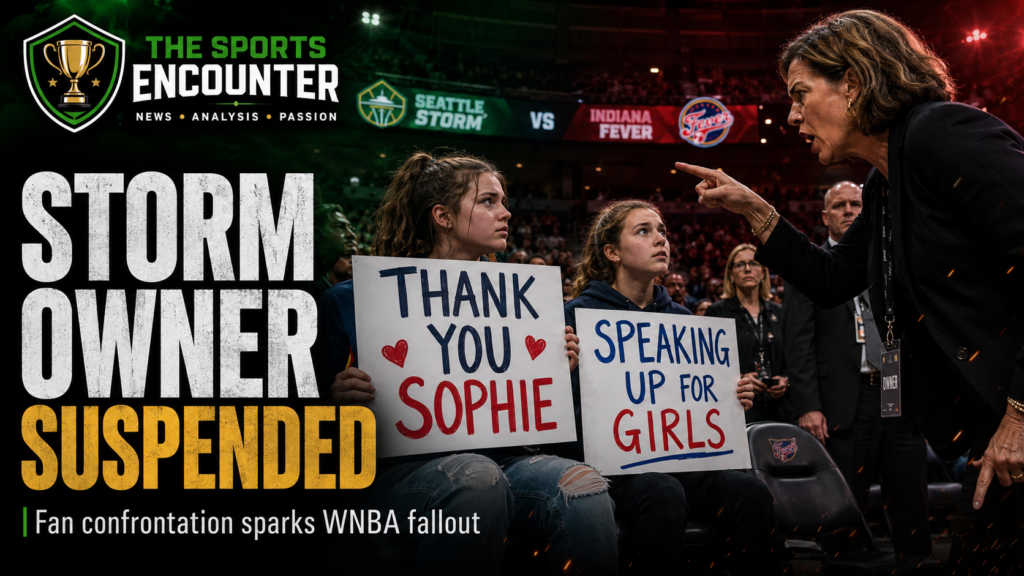
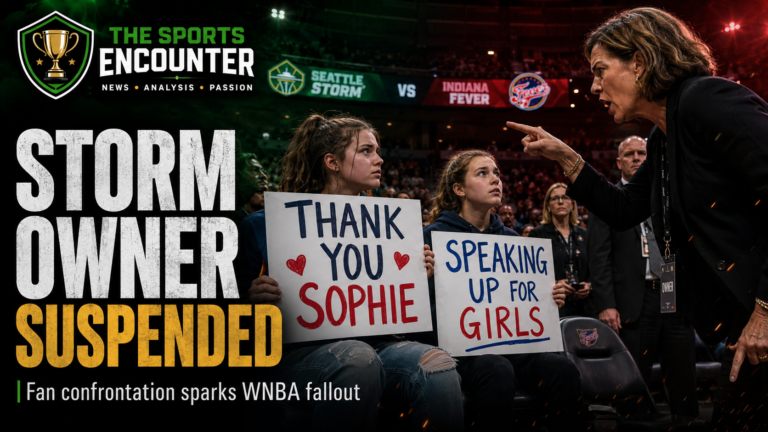
Two teenage girls attended the July 28 game at Climate Pledge Arena carrying signs that supported Indiana guard Sophie Cunningham’s public position on transgender participation in girls’ and women’s sports. One message thanked Cunningham for “speaking up for girls.”

What followed moved rapidly from an arena confrontation to a league disciplinary case.

According to multiple reports, Seattle Storm minority co-owner Celeste Keaton approached the girls and directed profanity at them. The encounter attracted public criticism after independent journalist Brandi Kruse reported on it and identified Keaton as the person involved.

The Storm apologized the following day. The WNBA then fined Keaton an undisclosed amount and barred her from attending Seattle’s next five home games.

The punishment covered all five Storm home dates scheduled for August. Keaton would become eligible to return for Seattle’s September 17 game against the Las Vegas Aces. The Storm said it respected the league’s decision and remained committed to providing a welcoming and respectful environment for everyone attending its games.

The disciplinary action resolved the immediate question of whether the league would respond. It did not settle the larger controversy.

The incident sits at the intersection of several increasingly difficult issues for the WNBA: the treatment of young fans, the responsibilities of team owners, the difference between institutional inclusion and political conformity, athlete expression, transgender participation in female sports, and the growing tendency for every public disagreement to become a national ideological battle.

Readers can follow the wider league through The Sports Encounter’s WNBA and basketball news section and its broader NBA coverage hub.

TL;DR

  • The WNBA fined Seattle Storm co-owner Celeste Keaton and suspended her from five home games.
  • Multiple reports said Keaton used profanity during an exchange with two teenage girls supporting Sophie Cunningham.
  • The Storm apologized and said every fan deserved respectful treatment.
  • Cunningham criticized Keaton’s reported conduct while saying people could disagree and still treat each other kindly.
  • The Indiana Fever said neither Cunningham nor the organization knew about or helped organize the demonstrations.
  • The controversy occurred during a wider national debate over transgender participation in girls’ and women’s sports.
  • The central organizational failure was not that disagreement existed, but that a person in authority reportedly confronted young paying spectators in an unacceptable manner.

Seattle Storm Fan Incident: Key Information

DetailInformation
GameIndiana Fever vs. Seattle Storm
DateJuly 28, 2026
VenueClimate Pledge Arena, Seattle
ResultIndiana Fever won 105-95
Storm co-ownerCeleste Keaton
Fans involvedTwo teenage girls
Sign messageSupport for Sophie Cunningham’s position on girls’ and women’s sports
Reported conductKeaton allegedly directed profanity at the fans
Storm responsePublic apology
WNBA punishmentUndisclosed fine and five-home-game suspension
Suspension periodSeattle’s five home games in August
Earliest reported returnSeptember 17 against the Las Vegas Aces
Cunningham’s responseCondemned the confrontation and supported respectful disagreement
Fever’s positionNo prior knowledge of or contact with demonstration organizers

Official league news, disciplinary announcements, schedules, standings, player information, and competition updates are available through the official WNBA website. Franchise news, schedules, ticket policies, community programs, and fan information can be found on the official Seattle Storm website.

What Happened at Climate Pledge Arena?

The two teenagers entered the arena with signs expressing support for Cunningham. One read, “Thank you Sophie for speaking up for girls.”

Their message referred to comments Cunningham had made during a recent ESPN interview and in subsequent media appearances. The Indiana guard said she did not hate transgender people but believed girls and women should not have to compete against athletes she described as biological males.

The subject had already placed Cunningham at the center of a heated public debate before Indiana arrived in Seattle.

Outside Climate Pledge Arena, supporters of sex-based eligibility rules in female sports gathered alongside activists defending transgender inclusion. The Fever later emphasized that neither Cunningham nor the franchise had advance knowledge of the demonstrations and had not communicated with the organizers.

Inside the arena, the teenage supporters reportedly encountered hostile reactions from some spectators. Kruse said fans booed the girls and that she reminded people around her that they were dealing with teenagers.

She also reported that some Seattle players made thumbs-down gestures in the girls’ direction. That part of the account should be treated carefully because the complete context of any gestures has not been publicly established.

The most serious allegation involved Keaton.

Reports said the Storm co-owner approached the girls and called them “f—ing insane.” Other accounts added further details about the exchange, but the league’s confirmed disciplinary action centered on an inappropriate confrontation between an owner and spectators.

Keaton’s position made the interaction fundamentally different from a disagreement between fans.

She was not simply another person in the crowd expressing an opposing view. She was part of the ownership group responsible for the event environment, the franchise’s public conduct, and the treatment of customers inside the arena.

That imbalance of power shaped the response.

The Storm Apology Came Before the League Punishment

Seattle responded publicly on July 29.

Storm majority owner Ginny Gilder acknowledged that one of the team’s co-owners had made comments to two fans and apologized for what happened. She said everyone attending a Storm game deserved to feel welcome and that the organization remained committed to treating fans respectfully.

The wording was cautious. It did not repeat the alleged profanity or offer a detailed account of the exchange. It nevertheless recognized that the interaction fell below the standard expected at a professional sporting event.

One day later, the WNBA confirmed stronger action.

Keaton received an undisclosed fine and a five-home-game suspension. The Storm accepted the punishment and repeated its commitment to a welcoming environment.

The sequence matters.

Seattle did not wait for the controversy to disappear. The club apologized, the league reviewed the incident, and punishment followed.

Yet the case also raised questions about why an owner needed league intervention to enforce a principle that should already have been obvious: team representatives cannot verbally intimidate young fans because they dislike the political or social meaning of their signs.

Why the WNBA Had to Act

The WNBA’s punishment was necessary for reasons extending beyond the specific policy argument involved.

A professional league cannot promise that every fan will agree with every player, owner, sponsor, or spectator. It can require basic behavioral standards from those who hold institutional authority.

Owners occupy the highest level of that responsibility.

They help shape the culture of the franchise. They are connected to hiring decisions, business partnerships, public messaging, community relationships, and the fan experience. Their behavior carries the weight of the organization even when they speak informally.

The importance of responsible ownership extends across professional sports. The Sports Encounter examined a different type of ownership transition in its report on the Pittsburgh Penguins’ ownership change, where league approval, governance, and long-term institutional responsibility were central to the story.

Had the WNBA ignored the Seattle incident, it would have risked creating a damaging double standard.

A teenage fan who directed abusive language at another spectator could face removal from an arena. An employee who confronted customers that way could face disciplinary action. An owner cannot reasonably receive greater freedom simply because she sits above most of the organization.

The five-game suspension communicated that ownership status does not provide immunity.

It also protected the credibility of the Storm’s apology. Without a meaningful consequence, language about creating a respectful and welcoming arena would have sounded hollow.

The Case Is About Conduct Before It Is About Policy

The broader political subject is unavoidable, but it can obscure the clearest point.

People can disagree deeply over transgender participation in female sports. That disagreement does not justify a team owner reportedly directing profanity at teenage spectators.

The two issues should not be collapsed into one.

Defending the girls’ right to attend a game and display an approved sign does not require endorsing every claim associated with their position. Condemning Keaton’s reported behavior does not require a person to oppose transgender inclusion.

The league’s discipline should therefore be understood primarily as a response to conduct.

A sporting venue can welcome transgender fans, athletes, and advocates while also protecting spectators who support sex-based sporting categories. An inclusive environment cannot function if inclusion applies only to those who hold the institution’s preferred view.

That is the contradiction Seattle now has to address.

The Storm said every fan should feel welcome. The franchise must demonstrate that this promise includes people who enter the building with lawful, non-threatening messages that some members of the organization strongly reject.

Sophie Cunningham’s Position and Response

Cunningham’s original comments had already produced intense reactions.

She said she had received criticism accusing her of hating transgender people, an interpretation she rejected. She described her position as an effort to protect young girls in sports and locker rooms while maintaining that transgender people should be treated with love and dignity.

After learning about the Seattle confrontation, Cunningham criticized Keaton on social media.

She wrote that there should be love and a safe space for everyone, including biological girls and boys, transgender women, and transgender men. She praised the teenagers for expressing their beliefs and argued that people can disagree without abandoning kindness.

Her response served two purposes.

First, it rejected the idea that support for sex-based sports categories must be expressed through hostility toward transgender people.

Second, it placed the focus on how adults in authority respond to young people who enter a contentious debate.

Cunningham’s statement was politically useful to her supporters, but it also carried a broader message that should not be controversial: disagreement does not remove the obligation to treat other people decently.

Indiana Fever Kept Its Distance From the Demonstrations

The Fever did not make Cunningham available for postgame questions.

A team public relations representative instead read a statement explaining that the player and organization had no knowledge of the demonstrations and no contact with the organizers.

That distinction protected the franchise from being portrayed as a participant in the rally.

Cunningham’s public comments had inspired some of the signs and demonstrations, but inspiration is not coordination. The Fever could not control which fans adopted her message or how political groups used the attention surrounding it.

The organization’s approach also reflected the difficulty teams face when an athlete becomes associated with a national political issue.

Silencing Cunningham would create a separate free-expression controversy. Fully aligning the franchise with her policy position could alienate other players, supporters, and members of the LGBTQ+ community. Treating her views as personal allowed the Fever to separate individual expression from organizational endorsement.

That position may be the most sustainable one for professional teams.

Athletes are adults with their own political, religious, and social opinions. A franchise can defend their ability to speak without adopting each opinion as official policy.

The Game Became Secondary

Indiana won 105-95, extending Seattle’s losing streak to seven games and leaving the Storm at 6-24, the worst record in the league at the time.

Cunningham scored 11 points and made three three-pointers.

Those details ordinarily would have formed part of a straightforward regular-season report. Instead, the game became the setting for a conflict that had been building outside basketball.

The crowd’s mixed reaction to Cunningham showed how quickly athlete activism can transform the emotional atmosphere of a sporting event. Cheers and jeers followed her involvement, while competing demonstrations outside framed the game as a stage in a national culture dispute.

For Seattle, the off-court controversy added further pressure during an already disastrous season.

Poor results can damage supporter confidence. An ownership scandal creates a different kind of problem because it reaches into the franchise’s identity and values.

The Storm now have to convince fans that the apology and suspension represent genuine accountability rather than temporary crisis management.

The wider competitive context of the league can be explored in The Sports Encounter’s WNBA Midseason Awards analysis, which examines the players, coaches, and teams shaping the 2026 season.

The National Legal Context Has Changed

The confrontation occurred during an increasingly consequential legal and political debate over transgender participation in school and organized sports.

Recent court decisions and state laws have strengthened the position of jurisdictions adopting sex-based eligibility rules for girls’ school sports. Those legal developments have also intensified campaigning, protests, and public messaging around the issue.

That context helps explain why Cunningham’s comments received immediate national attention and why a regular-season WNBA game attracted demonstrations.

Her remarks arrived when supporters of sex-based categories felt politically and legally strengthened. Advocates of transgender inclusion, meanwhile, viewed the movement toward restrictions as a threat to transgender students’ participation and dignity.

The teenagers’ signs therefore represented more than support for one basketball player. To different observers, they symbolized either the protection of female athletic categories or the exclusion of transgender girls and women.

Those competing interpretations do not excuse mistreatment. They explain why emotions inside and outside the arena were so intense.

Public Opinion Is More Complicated Than One Percentage

Public polling frequently finds substantial support for sex-based eligibility rules in female sports.

Results can still vary depending on wording, competition level, age group, medical requirements, and whether respondents are asked about school, collegiate, Olympic, or professional sports.

A single percentage cannot capture every ethical, legal, medical, and sporting question involved.

Nor does majority opinion determine how individual transgender people should be treated.

Public support for a particular eligibility policy does not authorize humiliation, harassment, or exclusion from the broader sporting community. Likewise, concern for transgender dignity does not eliminate legitimate discussion about competitive fairness, safety, scholarships, records, and category design.

The challenge for leagues is to separate eligibility policy from personal worth.

Sports organizations can debate who qualifies for a category without declaring that people outside that category are unwelcome as fans, employees, community members, or participants in other appropriate structures.

Cunningham attempted to make that distinction in her response by saying that everyone had a place at her table while maintaining her view on female competition.

Whether critics find that distinction persuasive is another question. It remains more constructive than treating every disagreement as proof of hatred.

Inclusion Cannot Become Ideological Enforcement

The Storm’s statement used the language of inclusion.

That language now requires careful examination.

An inclusive arena should protect transgender supporters from abuse. It should also protect teenage girls carrying signs that express a lawful position on sports eligibility.

Inclusion loses credibility when institutions apply it selectively.

A team cannot claim to welcome every fan while allowing owners, employees, players, or influential supporters to intimidate people associated with an unpopular viewpoint. Nor can it protect one group by treating another group’s presence as inherently provocative.

This does not mean teams must permit every sign.

Arenas routinely restrict messages that contain threats, obscenity, commercial promotion, personal attacks, or material likely to create a genuine security risk. The signs described in the Seattle case did not appear to fall within those categories.

They thanked an athlete for speaking.

That message could reasonably upset people who believed Cunningham’s position marginalized transgender athletes. Emotional offense, however, is not the same as a safety threat.

The proper response was disagreement, counter-signage, peaceful protest, or silence.

A co-owner’s reported profanity crossed the line from disagreement into institutional misconduct.

What the Incident Says About Power

The age of the fans matters.

Teenagers entering a professional arena do not carry the same authority as a team owner. They may possess political convictions, but they do not control the venue, the franchise, employment decisions, security policies, or access to games.

Keaton’s reported conduct therefore cannot be analyzed as an equal exchange between two sides.

Leadership changes the standard.

Owners should be capable of encountering messages they dislike without turning the moment into a confrontation. Their responsibility is greater precisely because their power is greater.

A mature response might have involved walking away, asking arena staff whether the signs complied with policy, or engaging in a calm conversation if the fans welcomed it.

Profanity directed at teenagers created the opposite result. It made the owner, rather than the signs, the central problem.

The Reported Player Gestures Require Caution

Kruse said Seattle players made thumbs-down gestures toward the girls.

That claim deserves attention, but the available reporting does not establish the full context. A gesture could have been directed at the signs, the political position, the fans, or something else occurring in the arena.

Without clear video or an official explanation, the allegation should not be expanded beyond what was reported.

Players also have speech rights.

A player who disagrees with Cunningham or the signs can show disapproval, provided that expression does not become targeted harassment or intimidation. The standards governing a brief gesture from the court are not identical to those governing an owner who approaches fans and allegedly curses at them.

This difference is important.

The controversy should not become an excuse to punish every visible disagreement with the teenagers. It should remain focused on proportionality, power, and conduct.

The WNBA’s Progressive Identity Is Being Tested

The WNBA has a long history of player activism on racial justice, voting rights, gender equality, reproductive rights, and LGBTQ+ inclusion.

That history has helped distinguish the league from many other professional competitions. It has also created expectations that the WNBA will take public positions on difficult social issues.

The league’s cultural role was already visible during its 2026 All-Star programming. The Sports Encounter examined that wider identity in its feature on the WNBA’s decision to stage All-Star events at the Obama Presidential Center.

The Cunningham controversy presents a complicated test because the disagreement exists within the broader language of women’s rights.

Supporters of transgender inclusion argue that transgender women are women and should not be excluded from female sport merely because of sex assigned at birth.

Supporters of sex-based categories argue that women’s sport was created to address physical differences between males and females and that those protections lose meaning if eligibility depends primarily on gender identity.

Both sides frequently frame their position as an equality argument.

The league cannot resolve that philosophical conflict through slogans. It can establish behavior standards.

The Keaton suspension suggests the WNBA understands the distinction. The league did not fine the teenagers for their signs or punish Cunningham for expressing her view. It disciplined an owner after a reported confrontation with fans.

That was the appropriate institutional focus.

The WNBA’s Growth Makes These Decisions More Important

The league now attracts larger audiences, deeper sponsorship interest, greater media scrutiny, and stronger emotional investment from fans.

The Sports Encounter’s complete 2026 WNBA All-Star Game guide showed the depth of star power, fan voting, broadcast reach, and commercial attention surrounding the modern league.

Growth increases the consequences of poor leadership.

A small league might once have managed a dispute through a local statement and limited press attention. The WNBA now operates in a national and international media environment where every arena incident can become a test of its culture within hours.

That visibility is part of the league’s progress.

It also means ownership groups must behave like leaders of major public institutions rather than private individuals reacting impulsively in the stands.

Other sports have learned that audience growth is closely tied to trust, narrative strength, and the ability to manage controversy. The Sports Encounter’s analysis of the NHL’s recent ratings growth showed how cultural relevance and fan connection can strengthen a league’s commercial position.

The reverse is also true. Poor treatment of fans can weaken the goodwill that growing leagues depend upon.

What Seattle Must Do Next

A five-game suspension creates accountability, but it does not automatically rebuild trust.

The Storm should clarify the standards expected from owners, staff, players, security personnel, and spectators during politically charged games.

Those standards should be viewpoint-neutral.

Fans supporting transgender inclusion should receive the same protection as fans supporting sex-based competition rules. Arena personnel should intervene when disagreement becomes harassment, regardless of which side initiates it.

Seattle should also communicate directly with the families involved, assuming that has not already happened privately.

A public apology protects the organization. A personal apology acknowledges the people harmed.

Keaton’s own voice is notably important. An organizational statement cannot fully substitute for individual accountability when the misconduct is personal.

A direct apology would not require her to change her beliefs. It would require her to recognize that approaching teenage fans with profanity was incompatible with her position.

What the WNBA Should Learn

The league is likely to face similar incidents again.

Athletes increasingly speak directly to large audiences through podcasts, social media, independent interviews, and personal media companies. Their comments can mobilize supporters and protesters within hours.

Teams need protocols for games likely to attract political demonstrations.

Those plans should cover:

  • Sign policies that are clear and consistently enforced
  • Protection for peaceful expression
  • Separation of competing demonstrations where necessary
  • Training for owners and senior executives
  • Procedures for interactions involving minors
  • Rapid investigation of reported misconduct
  • Transparent disciplinary standards

The WNBA also needs to avoid creating the impression that respect depends on political alignment.

A league with a strong social identity may naturally lean toward certain positions. It still operates a public entertainment business serving a diverse audience.

Fans do not surrender their political identities when they buy tickets.

Professional Sports Must Protect the Fan Experience

Fans accept that attending a major sporting event involves noise, emotion, rivalry, and disagreement. They should not have to accept abuse from people connected to team ownership.

The fan experience includes more than seating, food, entertainment, and the result on the scoreboard. It also includes confidence that venue rules will be applied fairly and that senior representatives of the organization will act responsibly.

That principle matters across every major sport. The Sports Encounter’s analysis of the biggest challenges facing World Cup organizers identified safety, access, security, and the treatment of supporters as central tests for modern sports institutions.

The scale of the competition may differ, but the principle is the same.

Fans must be able to trust the people controlling the venue.

Final Analysis: The Suspension Was Necessary, but the Larger Test Remains

The WNBA made the correct decision by fining Celeste Keaton and excluding her from five Seattle home games.

The punishment recognized the seriousness of an owner reportedly confronting teenage fans with profanity. It also supported the Storm’s stated commitment to a respectful arena.

The wider debate over transgender participation in female sports will continue in courts, legislatures, schools, athletic organizations, locker rooms, and families.

This incident did not resolve that debate and should not be used as proof that every person on either side acts in bad faith.

The teenagers had the right to support Cunningham.

Other fans had the right to oppose their message.

Players had the right to hold their own views.

Cunningham had the right to speak publicly.

Keaton also had the right to disagree.

Her position as an owner did not give her the right to treat young spectators in the reported manner.

That is where the line should remain clear.

Professional sports arenas work because people with different backgrounds, beliefs, and identities agree to share the same space. The standard cannot be universal agreement. It must be controlled conduct, basic dignity, and confidence that people in power will behave responsibly.

Seattle’s season has been defined by losses on the court. This controversy created a more consequential loss of judgment away from it.

The apology and suspension were the first steps toward repairing that failure. The next step is proving that “everyone is welcome” means everyone, including those whose signs, politics, or beliefs make the people running the franchise uncomfortable.

For continuing coverage of the WNBA, athlete stories, league governance, and basketball culture, visit The Sports Encounter’s basketball section.

Miley Rumer is The Sports Encounter’s U.S. correspondent for American sports coverage, focusing on the NHL, NBA, NFL, MLB, MLS, and major sporting stories across North America. Her coverage tracks the moments that shape games, seasons, rivalries, and fan conversations, with a sharp eye on performance, pressure, team identity, and the human stories behind the scoreboard. Based in St. Clairsville, Ohio, Miley brings a grounded American sports voice to The Sports Encounter’s coverage, helping readers follow the biggest developments from arenas, stadiums, locker rooms, and fan communities across the country.

Editor's Choice

Neymar’s World Cup Career: Skill, Pain, and the Rainbow Flick Legacy

Neymar carried Brazil’s World Cup hopes across four tournaments, producing unforgettable goals while enduring injuries, criticism and elimination heartbreak. His final farewell leaves a legacy shaped by skill, pain and the freedom represented by the rainbow flick.

Ruben Santos | The Sports Encounter

Published

on

Cinematic tribute to Neymar Jr.’s World Cup journey, showing his Brazilian flair and rainbow-flick skill on one side and his pain, injuries and emotional heartbreak on the other, with the headline “Skill. Pain. Legacy.” and The Sports Encounter logo.
Neymar’s World Cup Career: Skill, Pain and the Rainbow Flick Legacy

Neymar Junior’s World Cup career will be remembered through two contrasting images.

One shows a footballer lifting the ball over a defender with a rainbow flick, moving through pressure with the imagination of a child who still believes football should be fun.

The other shows him on the ground.

Sometimes he was holding his ankle. In Brazil in 2014, he left the field on a stretcher with a fractured vertebra. In Qatar in 2022, he sat on the grass after the penalty shootout defeat to Croatia, struggling to process how one of the finest goals of his international career had failed to save Brazil. Four years later, his final World Cup ended with another painful elimination, this time against Norway.

Brazil spent more than a decade asking Neymar to carry the nation toward a sixth World Cup. He gave the shirt goals, assists, creativity, personality, controversy and parts of his body that never fully recovered from the punishment.

He never delivered the trophy Brazil wanted most.

That absence will shape every argument about his place in the Seleção’s history. Yet reducing Neymar’s international career to the World Cup he did not win would erase the burden he carried and the football he produced while carrying it.

His final international numbers remain extraordinary: 130 appearances, 80 goals and 58 assists. He left as Brazil’s leading men’s international scorer and one of its most productive creators. His record was built across 16 years, four World Cups and several different versions of a national team that rarely looked capable of matching his individual imagination.

Carlo Ancelotti has now confirmed that Brazil are moving toward a younger generation. Neymar, Casemiro and Danilo are outside the long-term plan as the five-time world champions begin building toward the 2028 Copa América and, eventually, the 2030 World Cup.

The announcement formally closes a generation that had already ended emotionally.

Neymar retired from international football after Brazil’s 2-1 defeat to Norway in the 2026 World Cup Round of 16. He later made his decision unmistakable. His time had passed. He had given his life and blood to the national team. He no longer wanted to continue.

His farewell carried no World Cup medal.

It carried something more complicated: the legacy of a footballer who represented Brazil’s beauty, absorbed Brazil’s frustration and became the face of a national identity struggling to decide whether it still believed in expressive football.

TL;DR

  • Neymar represented Brazil at the 2014, 2018, 2022 and 2026 World Cups.
  • He scored at four World Cups and finished among Brazil’s leading World Cup goalscorers.
  • His 2014 campaign ended with a fractured vertebra before Brazil’s semifinal defeat to Germany.
  • He returned from major injury before the 2018 World Cup but became a target of criticism over his reactions to fouls.
  • In 2022, he scored a magnificent extra-time goal against Croatia before Brazil lost on penalties.
  • His final World Cup appearance came in Brazil’s 2-1 Round of 16 defeat to Norway in 2026.
  • Neymar retired from international football with 80 goals and 58 assists in 130 appearances.
  • The rainbow flick became a symbol of his creativity, confidence and resistance to football’s hostility toward individual expression.
  • Ancelotti’s decision to move beyond Neymar, Casemiro and Danilo confirms the end of a major Brazilian generation.

Neymar’s Brazil and World Cup Career at a Glance

CategoryRecord
Brazil career2010–2026
International appearances130
International goals80
International assists58
World Cups played2014, 2018, 2022 and 2026
Best World Cup finishFourth place in 2014
Senior international title2013 FIFA Confederations Cup
Final Brazil matchBrazil 1-2 Norway, July 5, 2026
Final Brazil goalStoppage-time penalty against Norway
Defining skillRainbow flick and close-control dribbling

Brazil Gave Neymar the Shirt and the Weight of an Era

Neymar arrived in the senior Brazil team in 2010 when the national side was entering an uncertain period.

The great 2002 champions had disappeared. Ronaldo, Rivaldo, Ronaldinho, Cafu and Roberto Carlos belonged to history. Kaká’s generation had fallen short in 2006 and 2010. Brazil still produced gifted footballers, but the team no longer frightened opponents through the same combination of personality, technique and competitive authority.

Neymar became the answer before he had fully become an adult.

At Santos, he dribbled with a freedom that recalled Brazilian street football. His body feints, acceleration and improvised finishes made defenders look as though they had entered the wrong game. He could attack from the left, move centrally, combine in small spaces or turn ordinary possession into a moment worth replaying.

Brazil saw more than a promising forward. The country saw continuity.

Pelé had made Brazilian football global. Garrincha gave it mischief. Zico gave it elegance. Romário gave it sharpness. Ronaldo gave it explosive power. Ronaldinho made joy feel like a competitive weapon.

Neymar inherited pieces of all those traditions without becoming a copy of any of them.

He was lighter than Ronaldo, more direct than Ronaldinho and more emotionally visible than almost every Brazilian superstar before him. Supporters saw every celebration, complaint, injury, tear and argument. Social media turned those reactions into content. Every touch became evidence for one side of an endless debate.

For Brazil, he remained the player most capable of solving a match independently. That dependence became a strength and a structural weakness.

Opponents could prepare for Brazil by preparing for Neymar. Teammates often waited for him to create the decisive action. Coaches changed, systems shifted and supporting forwards came and went, yet the central instruction rarely changed: give Neymar the ball and hope he invents something.

His emotional return to the national team before the 2026 tournament was explored in Neymar’s Last Dance: Brazil’s Prodigal Son Returns for His Fourth World Cup.

2014: The World Cup That Nearly Broke Brazil With One Knee

The 2014 World Cup was supposed to complete Neymar’s rise.

Brazil hosted the tournament carrying national expectation, political tension and the memory of 1950. Neymar was 22 years old and already the team’s emotional center.

He scored twice against Croatia in the opening match and added another two goals against Cameroon. His tournament was not technically perfect, but he gave Brazil the individual moments a nervous team needed.

The pressure surrounding the host nation was visible. Brazil struggled to control matches cleanly and needed penalties to survive Chile in the Round of 16. Neymar converted his kick in the shootout while carrying an injury and the emotional weight of a stadium that feared another national trauma.

Then came Colombia.

Brazil won the quarterfinal 2-1 through goals from Thiago Silva and David Luiz. The result should have sent the country into celebration.

Instead, the defining image came in the closing minutes.

Colombia defender Juan Camilo Zúñiga challenged Neymar from behind, driving a knee into his lower back. Neymar collapsed and left the field on a stretcher. Medical examinations revealed a fractured vertebra.

His World Cup was over.

The injury landed only centimeters away from causing consequences far beyond football. Neymar later spoke about how close the contact came to threatening his ability to walk. Brazil had lost its best attacker, but the human fear exceeded the tactical damage.

Without Neymar and suspended captain Thiago Silva, Brazil faced Germany in the semifinal. The 7-1 defeat became one of the darkest nights in the history of the national team.

Neymar did not play, yet the result became part of his World Cup story. His absence exposed how deeply Brazil had built its identity around one player. The structure collapsed when the central source of confidence disappeared.

The 2014 tournament established the pattern that would follow him. He had played well. He had scored important goals. Brazil had reached the semifinals. Still, Neymar left the tournament in physical pain while the country remembered the failure more loudly than his contribution.

2018: Talent Returned, but the Conversation Changed

Neymar entered the 2018 World Cup after another race against injury.

A fractured metatarsal suffered with Paris Saint-Germain had kept him out for months. His recovery became a daily national story. Brazil needed him available, even if he lacked full rhythm.

He scored against Costa Rica and Mexico, helping Brazil reach the quarterfinals. He created chances, carried the ball through pressure and remained the player opponents feared most.

Yet the football became secondary to the reaction around him.

Neymar was repeatedly fouled. He also exaggerated some of the contact, rolling across the ground and reacting theatrically. Television replays and social media transformed those moments into global ridicule. The “Neymar Challenge” became a meme in which people imitated his falls.

The criticism was not entirely unfair. Neymar sometimes extended a genuine foul into a performance. His frustration became visible in ways that weakened sympathy for the punishment he was actually receiving.

However, the mockery also distorted reality.

Defenders targeted him because ordinary defensive methods often failed. His ability to change direction at speed forced opponents into desperate contact. Repeated fouls accumulated across matches, and officials did not always protect the player consistently.

Neymar became trapped between two truths. He was genuinely fouled at an exceptional rate. He sometimes reacted in a manner that made people doubt him.

Brazil’s quarterfinal defeat to Belgium ended the campaign. Neymar helped create late opportunities, but Thibaut Courtois denied his final attempt and Belgium advanced 2-1.

The post-tournament discussion focused heavily on his behavior. That damaged the public understanding of his performance. Neymar had returned from a significant injury, scored twice and helped Brazil reach the last eight. Those facts could not compete with the memes.

From that point forward, every Neymar injury carried suspicion among part of the audience. His pain had become entertainment.

The Rainbow Flick Became More Than a Skill

A rainbow flick begins with an act of confidence.

The player traps the ball between the feet, rolls or lifts it upward and sends it over the defender’s head. The move has little margin for error. Failure looks foolish. Success can humiliate an opponent and electrify a stadium.

Neymar did not invent the skill. Brazilian football had long embraced the carretilha or lambreta, while players across generations and countries had used variations of it.

He became its most recognizable modern ambassador.

For Neymar, the rainbow flick expressed a larger idea. Football could remain playful at the highest level. A player did not need to remove imagination from his game simply because the stakes had increased.

Critics called it showboating. Defenders often responded with anger. Some believed the trick lacked respect, particularly when Neymar attempted it late in matches or against beaten opponents. Referees occasionally appeared more offended by the skill than by the retaliatory foul that followed.

Neymar’s position was consistent. Skill belonged inside football. A dribble was not disrespectful merely because it embarrassed someone.

That argument touches the heart of Brazilian football culture.

The Seleção’s global identity was built through competitive success and expressive technique. Pelé’s body feints, Garrincha’s dribbling, Rivelino’s elastico and Ronaldinho’s improvisation all made winning feel creative.

Modern football increasingly prizes structure, pressing, physical coverage and risk management. Players are coached to protect possession and occupy defined zones. Individual expression survives, but it often requires permission from the system.

Neymar played as though permission had already been granted.

The rainbow flick therefore became part of his legacy because it captured the tension surrounding him. Fans who loved Neymar saw courage, joy and Brazilian identity. Critics saw vanity and unnecessary provocation.

Both reactions revealed how football had changed.

2022: Neymar Scored the Goal His World Cup Career Deserved

Qatar offered Neymar what looked like his best final chance.

Brazil entered the 2022 World Cup with depth, balance and attacking options. Vinícius Júnior had developed into an elite forward. Casemiro protected the midfield. Richarlison brought movement and finishing. Thiago Silva continued to provide leadership.

Neymar no longer needed to create every moment alone.

Then he injured his ankle against Serbia in the opening match.

Images of the swelling created immediate fear that his tournament was over. Once again, a World Cup had placed Neymar’s body at the center of Brazil’s hopes.

He missed the remaining group matches but returned against South Korea in the Round of 16. Brazil won 4-1, producing one of the tournament’s most fluid attacking performances. Neymar scored from the penalty spot and helped connect the team’s combinations.

The quarterfinal against Croatia became the most painful defeat of his international career.

Croatia slowed the game, controlled emotional rhythms and prevented Brazil from finding clean attacking spaces. The match entered extra time without a goal.

Then Neymar produced a sequence worthy of any World Cup.

He exchanged quick passes through Croatia’s defense, accelerated into the penalty area, moved around goalkeeper Dominik Livaković and finished from a tight angle.

The goal was beautiful, difficult and decisive in appearance. It also equaled Pelé’s official Brazil scoring record at the time.

Brazil failed to protect the lead.

Bruno Petković equalized following a late counterattack, and Croatia won the penalty shootout. Neymar had been scheduled to take Brazil’s fifth penalty. The shootout ended before he could step forward.

He remained on the field in tears.

This was the cruelest summary of his World Cup career. Neymar had produced the required moment. The team had failed to carry it safely to the finish.

2026: A Final World Cup Reduced to 37 Minutes and One Last Goal

Neymar’s path to the 2026 World Cup required another recovery few players could have completed.

An anterior cruciate ligament injury suffered in 2023 kept him away from Brazil for an extended period. His move to Al-Hilal produced little football, and recurring physical problems raised serious questions about whether he could return to elite international competition.

He went back to Santos, the club where his career had begun.

The return carried emotion and practical purpose. Neymar needed matches, fitness and a familiar environment. Ancelotti needed evidence that the 34-year-old could still contribute to Brazil.

He made the squad, but his role had changed.

Vinícius Júnior had become the primary attacking figure. Younger players offered greater physical intensity. Neymar entered the tournament as a veteran option whose creativity remained valuable but whose body could no longer be trusted for a full campaign.

Brazil opened slowly before finding greater authority. Vinícius scored twice as the Seleção defeated Scotland 3-0 and topped Group C. The full match story is available in Brazil Top Group C After Vinícius Júnior Double Sinks Scotland.

Neymar’s return that night created an emotional lift, but the hierarchy had shifted.

Brazil then survived a serious Round of 32 scare against Japan. Casemiro scored before Gabriel Martinelli produced a late winner, as detailed in Brazil Survive Their First Real World Cup Scare as Japan Fall Late.

The wider emotional relationship between Brazilian football and supporters far from South America was captured in Brazil’s Loudest Second Home Is Hidden in Karachi’s Lyari.

The Round of 16 brought Norway and Erling Haaland.

Before the match, attention centered on whether Vinícius Júnior or Haaland would control the knockout contest. The tactical and emotional stakes were examined in Vini Jr vs Haaland Gives Brazil and Norway a World Cup Clash With Bite.

Brazil had an early penalty, but Bruno Guimarães failed to convert. Norway stayed alive, and goalkeeper Ørjan Nyland produced a career-defining performance.

Haaland scored twice late in the match.

Neymar entered and converted a stoppage-time penalty, giving Brazil brief hope. The finish showed the calm and deception examined in Stutter-Step Penalties Divide World Cup Fans.

Brazil still lost 2-1. The full elimination report, including Haaland’s late double and Neymar’s final goal, can be read in Haaland Turns Brazil’s Missed Penalty Into a World Cup Nightmare.

Neymar had played only 37 minutes during the tournament.

His final touch of consequence for Brazil was a goal. His final image was another elimination.

Ancelotti’s Reset Confirms That Brazil Cannot Keep Waiting

Ancelotti’s decision to move beyond Neymar, Casemiro and Danilo reflects football reality rather than personal rejection.

All three players were over 30 at the 2026 World Cup. Each had provided leadership and experience. Their generation, however, failed to return Brazil to a World Cup final.

The coach’s next immediate target is the 2028 Copa América. He wants younger players to enter the squad early enough to develop under competitive pressure before the 2030 World Cup.

Brazil will retain selected veterans, with Marquinhos cited as a possible figure of continuity. The broader direction is clear.

Vinícius Júnior, Endrick, Estêvão and the next wave must inherit responsibility. Rodrygo’s injury complications have created further uncertainty, while Brazil’s midfield also requires renewal after years of depending on Casemiro’s defensive intelligence.

Vinícius’ growing place at the center of Brazil’s next cycle is also reflected in Vinícius Júnior Set to Stay at Real Madrid, which examines how his World Cup performances strengthened his status for club and country.

For Neymar, Ancelotti’s comments confirm what retirement had already established.

There will be no comeback campaign, no fifth World Cup and no final attempt to repair the story in 2030.

Brazil’s next generation must create a different ending without the player who shaped the previous four tournaments.

Did Neymar Fail Brazil, or Did Brazil Fail to Build Around Him?

The fairest answer sits between those extremes.

Neymar was responsible for parts of his own complicated legacy. His reactions to fouls harmed his credibility. His career choices did not always maximize his competitive potential. Injuries were sometimes followed by public appearances that made supporters question priorities, even when the criticism lacked full context.

He also played in Brazilian teams that depended on him excessively.

Brazil never consistently built the kind of collective attacking structure that allowed Lionel Messi to flourish in Argentina’s later years. Neymar often received the ball far from goal and had to dribble through several lines before creating danger.

During his prime, Brazil lacked a stable elite striker comparable to Ronaldo. Midfield creativity fluctuated. Coaches frequently prioritized defensive security and expected Neymar to supply the imagination.

When he succeeded, Brazil advanced. When opponents isolated or injured him, the attack often became predictable.

His World Cup record contains important production, but tournament legacy is judged through decisive rounds. Pelé won three titles. Romário controlled 1994. Ronaldo scored twice in the 2002 final.

Neymar’s defining knockout goal came against Croatia in 2022, and Brazil still lost.

That difference separates him from the country’s most celebrated World Cup icons. It should not remove him from the conversation about Brazil’s greatest players.

How Should Neymar’s World Cup Career Be Ranked?

Neymar belongs below Brazil’s World Cup-winning legends.

Pelé remains in a separate historical category. Garrincha, Romário, Ronaldo, Rivaldo and other champions delivered performances connected directly to the trophy.

Neymar’s case rests on longevity, production and the difficulty of his circumstances.

He scored across four World Cups. He entered tournaments after major injuries. He became the central creative force for a country that often lacked comparable attacking structure. His influence reached beyond goals through chance creation, set pieces, dribbling and the fear he created in defenders.

His limited role in 2026 prevented him from featuring prominently among the tournament’s leading scorers. For comparison, The Sports Encounter’s ranking of the top 10 goalscorers at FIFA World Cup 2026 shows how the tournament’s attacking hierarchy had moved toward a younger generation.

For complete tournament reporting, analysis and legacy coverage, readers can also visit The Sports Encounter’s FIFA World Cup 2026 coverage hub.

Neymar’s World Cup legacy belongs in the category of brilliant careers without completion.

Johan Cruyff never won the World Cup. Cristiano Ronaldo did not reach a final. George Best never played at the tournament. Football history has room for greatness beyond the trophy.

Brazilian history is less forgiving because the country measures itself through championships.

Neymar knew that standard when he accepted the No. 10 shirt.

The Rainbow Flick Legacy Will Outlive the Arguments

Years from now, younger supporters may discover Neymar through short clips.

They will see the acceleration, elastic touches and the ball moving over defenders. They may wonder why such a gifted player generated so much anger.

The answer lies partly in expectation.

Neymar followed Pelé, Ronaldo and Ronaldinho. He played during the era of Lionel Messi and Cristiano Ronaldo. His transfer fees, celebrity, injuries and public personality created a standard no footballer could satisfy consistently.

The rainbow flick survived all of that noise.

It remains the purest image of his football because it had no guarantee of success. Neymar attempted it because he saw a possibility others did not see or did not dare to try.

That instinct created goals and assists. It also invited fouls, accusations of arrogance and demands that he play more safely.

Neymar rarely played safely. His body eventually paid for that choice.

Final Verdict: Skill, Pain and an Unfinished World Cup Story

Neymar Junior leaves international football as Brazil’s record scorer, one of its leading appearance-makers and the central figure of a 16-year era.

He also leaves without a World Cup title or Copa América medal.

Those facts should remain together.

His international career contained genuine shortcomings, but it cannot be described honestly without acknowledging the injuries, tactical dependence and emotional pressure surrounding him.

In 2014, a fractured vertebra removed him before the semifinal.

In 2018, his football disappeared beneath a global argument about fouls and exaggeration.

In 2022, he scored one of his finest goals before Brazil surrendered the lead and lost on penalties.

In 2026, he played 37 minutes, scored one final goal and watched another World Cup leave Brazil behind.

Ancelotti’s generational reset now gives the Seleção a necessary chance to move forward. The Brazilian Football Confederation and its coaching staff must develop a team whose identity does not depend on waiting for one individual to solve every difficult moment.

Neymar’s story has already moved from active hope into history.

The trophy never arrived. The pain often did.

Yet somewhere inside every compilation of his greatest moments, the ball still rises over a defender’s head.

The rainbow flick remains suspended in the air for a fraction of a second, carrying everything Neymar represented: risk, beauty, rebellion and the belief that football should still contain surprise.

Brazil wanted him to win the World Cup.

Neymar gave Brazil a different legacy. He reminded the world that skill could still challenge structure, even when structure, injury and time eventually won.

The Sports Encounter’s World Cup 2026 coverage focuses on fixtures, team news, match analysis, fan stories, tournament trends, and the biggest talking points from football’s global stage.

Continue Reading

Editor's Choice

Is the FIFA World Cup 2030 Not for Sale Anymore?

FIFA’s proposal to sell a minority stake in a $20 billion World Cup commercial company appears to have collapsed after resistance from UEFA, CONCACAF, the AFC and senior FIFA officials. Yet the battle over who controls football’s future has only begun.

Marcos Wetherfield | The Sports Encounter

Published

on

Cinematic FIFA World Cup 2030 graphic showing the golden trophy at the center of a global football revolt, with protesting delegates, distressed executives, collapsing financial charts, torn investment documents, and the headline “World Cup 2030: Not for Sale?” alongside The Sports Encounter logo.

The proposed sale of a stake in FIFA’s most valuable competitions appears to have collapsed under the combined weight of political resistance, internal rebellion and a threat that investors could not ignore: a World Cup without many of its biggest national teams.

For several extraordinary days, the future ownership structure of the World Cup looked as though it could be transformed.

FIFA President Gianni Infantino wanted member associations to consider creating FIFA Forward Enterprise, a new commercial subsidiary reportedly valued at approximately $20 billion. External investors could have acquired a stake of up to 20%, potentially providing FIFA with around $4.2 billion in fresh capital.

The proposal was presented as a way to dramatically increase football development funding. Its critics saw something far more consequential: the partial transfer of football’s most powerful commercial engine into a structure influenced by private capital.

Then the resistance hardened.

UEFA’s 55 national associations unanimously rejected the proposal and threatened to withdraw from FIFA competitions. CONCACAF opposed it. The Asian Football Confederation publicly stood alongside the two confederations. CONMEBOL demanded further information. Carlos Cordeiro, one of Infantino’s senior advisers, resigned and called the idea a bad deal for football. FIFA Chief Operating Officer Kevin Lamour reportedly accused the organization’s president of deceiving staff and described the initiative as the project of one person.

By July 31, the New York Post was reporting that the proposed transaction had been scrapped. Reuters could not independently confirm that report, while FIFA continued to say that it would consult its 211 member associations and would proceed only with majority support.

This leaves world football with an unusual answer to an apparently simple question.

Is the 2030 World Cup no longer for sale?

The proposed transaction appears politically and commercially unviable in its current form. It has not, however, been formally and conclusively buried by FIFA.

That difference matters.

TL;DR

  • FIFA proposed placing the commercial operations of the World Cup and other competitions inside a new subsidiary called FIFA Forward Enterprise.
  • The company was reportedly valued at around $20 billion, with external investors potentially acquiring a stake of up to 20%.
  • The arrangement could have raised approximately $4.2 billion for FIFA.
  • UEFA’s 55 member associations unanimously rejected the proposal and backed a conditional boycott of FIFA competitions.
  • CONCACAF rejected the plan, while the AFC aligned itself with the opposition.
  • Those three confederations represent 143 of FIFA’s 211 member associations, making majority approval extremely difficult.
  • Carlos Cordeiro resigned as Infantino’s adviser, while FIFA COO Kevin Lamour publicly condemned the project.
  • A report says the transaction has been scrapped, but FIFA has continued to defend the consultation process.
  • The current sell-off model may be dead, but the commercial pressure that produced it will continue before the 2030 World Cup.

Key Information: The FIFA World Cup Investment Crisis

IssueKey Detail
Proposed companyFIFA Forward Enterprise
Reported valuationApproximately $20 billion
Potential investor stakeUp to 20%
Potential proceedsApproximately $4.2 billion
Reported lead investorThrive Eternal, linked to Thrive Capital founder Joshua Kushner
FIFA member associations211
Associations represented by UEFA, CONCACAF and AFC143
FIFA’s reported incentiveUp to $40 million for each association if the proposal was approved
Approval deadline initially discussedSeptember 19, 2026
Current statusReportedly scrapped, but not formally withdrawn by FIFA

The Deal Did Not Collapse Because Football Suddenly Rejected Money

Football has lived comfortably alongside commercial expansion for decades.

Broadcasting agreements have turned tournaments into global media products. Sponsors influence schedules, branding, hospitality programs and fan experiences. Wealthy state-linked entities, private investors and financial institutions already have major positions across clubs, leagues, media companies and sporting infrastructure.

The FIFA dispute therefore cannot be reduced to a romantic argument about keeping money out of football.

Money was already inside.

The real conflict concerned ownership, governance and the permanent transfer of future value.

Under the proposed structure, FIFA would have placed commercial assets connected to the World Cup and other events into a new business. A minority investor would not have owned the trophy, written the Laws of the Game or selected national teams. Yet ownership of a significant economic interest could have changed the incentives surrounding FIFA’s competitions.

Private investors usually seek growth, returns and an eventual exit. Those priorities can be rational from a financial perspective. They may also create pressure for more inventory, more premium products, higher prices, new tournament formats, expanded sponsorship categories and greater control over the commercial calendar.

The concerns examined in The Sports Encounter’s earlier analysis of why selling a World Cup stake could be dangerous went beyond symbolism. Once part of the commercial business is transferred, reversing the arrangement can become expensive, legally difficult and politically disruptive.

That is why Cordeiro’s language carried such force.

As a former investment banker and senior football official, he could not easily be dismissed as someone who failed to understand finance. He argued that FIFA risked mortgaging football’s future without a compelling justification, especially when the organization reportedly had substantial revenue, strong reserves and no urgent debt problem requiring emergency capital.

The proposal did not fail because football rejected business.

It failed because many of football’s most powerful institutions believed FIFA was offering investors too much long-term value in exchange for money the governing body had not proved it desperately needed.

UEFA Found the Weak Point in the Financial Model

UEFA’s response changed the entire equation.

Its 55 member associations unanimously declared that they would not participate in FIFA competitions if the proposal moved forward. The official UEFA statement said the associations rejected any transfer of ownership interests in the World Cup and other FIFA competitions to private investors.

The threat had moral language, but its decisive power was commercial.

An investor purchasing a minority stake in FIFA’s tournament business would be paying for future cash flows. Those cash flows depend heavily on the presence of globally followed national teams, elite players, competitive credibility and enormous broadcasting audiences.

A men’s World Cup without England, Spain, France, Germany, Italy, Portugal, the Netherlands and other European nations would lose much of its sporting and commercial value. Women’s and youth tournaments would face similar problems. Sponsors, broadcasters and commercial partners would immediately reassess the value of their agreements.

The boycott threat therefore attacked the investment proposition at its foundation.

Private capital could tolerate supporter criticism, political noise or reputational pressure if the underlying business remained strong. It could not easily ignore the possibility that the product being purchased might lose many of its most valuable participants.

UEFA’s 55-0 boycott decision turned an internal FIFA proposal into an existential commercial risk.

For any potential investor, a new question replaced the optimistic projections in the pitch materials:

What is a stake in the World Cup worth if Europe refuses to play?

The answer was almost certainly far below $20 billion.

The Revolt Became Global Rather Than European

FIFA could initially have framed UEFA’s opposition as another chapter in the long struggle between Europe and the global governing body.

That interpretation became harder to sustain once CONCACAF and the AFC moved against the proposal.

CONCACAF represents North America, Central America and the Caribbean. Its opposition was especially damaging because the United States, Canada and Mexico had just hosted the expanded 2026 World Cup. North America is also central to FIFA’s commercial growth ambitions, sponsorship strategy and access to major financial institutions.

CONCACAF’s rejection of the World Cup stake proposal indicated that this was no longer a predictable Europe-versus-FIFA dispute.

The AFC’s intervention widened the crisis further. Asian football has often been considered an important source of political support for Infantino. Yet the confederation said it stood in solidarity with UEFA and CONCACAF, questioned the proposal’s viability and raised concerns about FIFA’s decision-making process.

UEFA, CONCACAF and the AFC collectively represent 143 of FIFA’s 211 member associations.

A simple majority would require at least 106 votes.

Even allowing for the possibility that confederation statements might not translate into identical votes from every national association, the political path to approval had become extremely narrow.

FIFA insisted that no single confederation could speak for every member and that each association deserved the opportunity to examine the proposal independently. That argument was procedurally defensible. It did little to solve the arithmetic.

The investment plan did not merely face vocal critics. It appeared to have lost the voting coalition needed to exist.

Was the Reported $40 Million Offer Development Funding or Political Leverage?

One of the most controversial elements was Infantino’s reported promise that each member association could receive $40 million if the initiative was approved.

For smaller football nations, that amount could transform infrastructure, coaching, youth development, women’s football, domestic competitions and administrative capacity.

FIFA’s central argument was powerful: the commercial value of elite global tournaments should fund football everywhere, including countries that could never generate comparable revenue independently.

The official FIFA position emphasized that FIFA Forward Enterprise could increase development funding beyond $10 billion. FIFA described the proposal as a route toward unprecedented investment, broader participation in football’s commercial opportunities and greater self-determination for member associations.

Critics saw a governance problem.

Offering large financial distributions to the same associations responsible for approving the structure created an unavoidable perception of influence. Even when the money would ultimately support legitimate development projects, the sequence appeared troubling: approve the plan, unlock the payment.

This placed smaller associations in a difficult position.

Rejecting the proposal could mean turning down infrastructure and development funding their football systems genuinely needed. Supporting it could mean accepting a permanent commercial arrangement whose long-term costs were uncertain.

FIFA presented the payment as the benefit of monetizing football more effectively.

Opponents interpreted it as a mechanism designed to secure votes.

Both views can exist simultaneously. Development funding may have been sincere, while the offer also increased political pressure on associations to support Infantino’s preferred outcome.

That ambiguity should never have been allowed to develop around a decision of this magnitude.

The Internal Rebellion May Have Done More Damage Than UEFA

External opposition can sometimes strengthen a FIFA president.

Infantino could portray criticism from UEFA, European politicians or supporter groups as resistance from established powers that did not want football’s wealth distributed more widely.

The rebellion inside FIFA was harder to explain away.

Cordeiro resigned immediately and said he had not been involved in developing the proposal. His departure suggested that one of Infantino’s senior advisers had been excluded from a project with enormous strategic and governance implications.

Lamour’s criticism went further. According to the Associated Press, FIFA’s chief operating officer accused Infantino of deceiving staff and characterized the proposal as a personal project.

Such accusations strike at institutional legitimacy.

A governing body can survive disagreement over valuation, investor selection or commercial strategy. It faces a deeper crisis when senior officials question whether proper processes existed at all.

The Sports Encounter previously examined how the revolt moved inside Infantino’s own operation. That shift changed the story from a political dispute between confederations into a test of how FIFA itself was being governed.

Questions now extend beyond the fate of FIFA Forward Enterprise:

  • Who conceived the proposal?
  • Which FIFA officials reviewed it?
  • What valuation methodology produced the reported $20 billion figure?
  • What rights would the investor have received?
  • What exit mechanisms were being considered?
  • How would conflicts of interest have been managed?
  • Why did senior executives say they lacked meaningful information?
  • What role did JPMorgan and the proposed investor group play in developing the structure?

Even if the deal is dead, those questions remain alive.

Is the World Cup 2030 Safe From Private Ownership?

The proposed transaction was linked to FIFA’s tournament business broadly, rather than being a straightforward sale of the 2030 World Cup itself.

That distinction should be kept clear.

No investor was preparing to purchase the sporting authority to stage the World Cup, choose the hosts or control qualification. FIFA would also have retained majority ownership under the reported plan.

Yet the economic rights attached to future competitions, including the 2030 World Cup, would have formed part of the value investors expected to monetize.

For supporters, the practical concern was therefore legitimate. Private ownership of a share in the commercial entity could have influenced how future World Cups were packaged, expanded, priced and sold.

The 2030 tournament is already structurally unprecedented. Morocco, Portugal and Spain will serve as the main hosts, while centenary matches are expected in Argentina, Paraguay and Uruguay. FIFA is also studying the possibility of expanding the competition to 64 teams, a proposal assessed in The Sports Encounter’s analysis of the proposed 64-team World Cup.

More teams would mean more matches, broadcasting inventory, tickets, sponsorship exposure and hospitality opportunities.

That does not prove that expansion is being designed for investors. It demonstrates why the commercial rights attached to 2030 could be exceptionally valuable.

A tournament spanning three continents, potentially involving 64 nations and producing a record number of games would offer an enormous platform for monetization.

The current revolt has probably protected those commercial rights from the specific 20% sale under discussion.

It has not guaranteed that FIFA will never revisit external investment through a different structure.

Why the Current Plan Is Probably Dead

Several forces now make revival extremely difficult.

1. The voting pathway has collapsed

Opposition from confederations representing 143 associations makes majority approval unlikely without a major reversal.

2. The commercial valuation has been damaged

A threatened European boycott introduces a material risk to future tournament revenue. Any investor would demand a lower valuation, stronger protections or both.

3. The proposed structure has become politically toxic

National associations that might have quietly supported the plan would now have to defend it publicly after resignations, boycott threats and accusations of poor governance.

4. Internal confidence has fractured

Senior officials openly challenging the president indicates that implementation would face resistance inside FIFA even after theoretical approval.

5. The investor would inherit reputational risk

Any fund proceeding after the global backlash would be portrayed as attempting to profit from football against the wishes of major confederations, associations and supporter groups.

6. The original timetable has lost credibility

A proposal involving billions of dollars and the future commercial structure of the World Cup required patient consultation. The reported September 19 deadline reinforced concerns that FIFA wanted a rapid decision before opposition could organize.

These factors explain why reports that the plan had been scrapped were immediately plausible.

The deal may still exist in FIFA documents. In commercial terms, however, its foundations have been severely damaged.

Why FIFA Has Not Formally Declared Defeat

FIFA’s refusal to immediately withdraw the plan also makes strategic sense.

A formal retreat would represent one of the most significant defeats of Infantino’s presidency. It would confirm that UEFA’s boycott threat had forced FIFA to reverse course and could encourage further challenges to his authority.

Continuing the consultation process allows FIFA to preserve several options.

The governing body can argue that the media distorted the proposal. It can modify investor rights, reduce the stake, narrow the assets included in the subsidiary or introduce new governance protections. FIFA could also delay the vote while maintaining that no final decision had been made.

Most importantly, consultation gives Infantino an opportunity to test his remaining political support.

FIFA has insisted that it would not establish the subsidiary without majority backing. It also rejected claims that it intended to sell football, arguing that all associations should be free to assess the facts and shape their future democratically.

That language prepares the ground for repositioning.

If the proposal disappears, FIFA can say member associations chose another direction. If a revised model emerges, FIFA can say consultation improved it.

A direct admission that the plan collapsed would give Infantino’s opponents a much cleaner political victory.

The 2030 Question Is Larger Than One Failed Deal

The phrase “football is not for sale” has emotional power.

It does not settle the financial problem FIFA says it is trying to solve.

Global football development costs money. Smaller associations need pitches, academies, coaching programs, women’s competitions, refereeing systems, administration, technology and travel support. FIFA’s revenue is overwhelmingly generated by a limited number of major competitions, particularly the men’s World Cup.

As the governing body promises more development funding, larger tournaments and broader global participation, pressure to produce additional revenue will intensify.

The 2030 World Cup sits at the center of that pressure.

FIFA can abandon the current investor model and still pursue aggressive commercialization through:

  • Expanded sponsorship packages
  • Higher-value broadcasting agreements
  • Dynamic ticket pricing
  • More hospitality inventory
  • Additional official partners
  • Digital subscriptions and direct-to-consumer products
  • Licensing agreements
  • Expanded tournament formats
  • New data, gaming and technology partnerships

The rejection of a minority stake sale does not return the World Cup to a pre-commercial age.

It sets a boundary around who may own part of the commercial machine.

Could UEFA Really Create Its Own World Cup?

The boycott threat raised an even more disruptive possibility.

If UEFA withdrew from FIFA tournaments, it could theoretically organize an alternative international competition and invite teams from other confederations.

The Sports Encounter previously examined whether UEFA could create its own version of the World Cup. The legal, political and logistical barriers would be enormous, but the threat changed FIFA’s calculations.

UEFA controls the strongest concentration of elite national teams, major stadiums, commercial markets, broadcasters and sponsors in world football. A breakaway tournament involving European teams and selected nations from South America, Africa, Asia or North America could compete for global attention.

FIFA would retain the authority, history and worldwide membership associated with the World Cup. UEFA could offer many of the players and teams that give the event its highest commercial value.

Neither side would benefit from a split.

Investors could not ignore its possibility.

The boycott threat succeeded because it showed that FIFA does not own the entire World Cup product by itself. The value is jointly created by national associations, players, clubs, supporters, broadcasters, sponsors, host nations and confederations.

FIFA controls the competition.

It does not independently create everything that makes the competition valuable.

What This Means for Gianni Infantino

The crisis arrives at a dangerous moment for the FIFA president.

Infantino is expected to seek re-election in 2027. Reports have suggested that CONCACAF President Victor Montagliani could emerge as a challenger, although the political field remains fluid.

The failure of the investment proposal would weaken Infantino in three ways.

First, it challenges his reputation as a leader who can unite FIFA’s diverse membership around global development.

Second, it exposes a possible breakdown between the president and senior officials inside the organization.

Third, it gives opposing confederations a shared cause.

UEFA and CONCACAF do not always have identical interests. The AFC has frequently taken a different approach to disputes involving FIFA. A proposal that pushed all three toward the same side created a coalition that could eventually become electoral.

Infantino still possesses important advantages. FIFA presidents build support through development funding, political relationships and the loyalty of associations that believe the existing leadership serves their interests. No challenger can defeat him through European backing alone.

Yet the crisis has punctured the appearance of inevitability surrounding his authority.

The reported collapse of the deal may protect the World Cup from the immediate stake sale. It could also mark the beginning of a broader contest over who leads FIFA after 2027.

What Should Happen Next?

Abandoning the plan quietly would contain the immediate crisis without addressing its causes.

FIFA should publish a detailed account of the proposal, including the commercial logic, valuation methodology, assets under consideration, investor rights, governance protections, advisory fees and consultation timeline.

An independent review should establish how the initiative was developed and why senior officials claimed they were excluded or misled.

Any future attempt to create a commercial subsidiary should require:

  • Early consultation with all confederations
  • Independent valuation
  • Published conflict-of-interest safeguards
  • Clear limitations on investor influence
  • Protection of tournament format and sporting decisions
  • Transparent use of proceeds
  • Supporter and player representation
  • A supermajority rather than a narrow simple majority
  • Long-term exit and buyback provisions

Football’s commercial future cannot be decided through closed negotiations followed by a rapid vote.

The World Cup is FIFA’s primary revenue generator, but its social value extends far beyond FIFA’s balance sheet.

Supporters build its atmosphere. Players create its drama. National associations provide the teams. Clubs develop and employ the talent. Host countries fund infrastructure and security. Broadcasters carry the event across the world.

A governance model that ignores those stakeholders will continue producing conflict, regardless of how attractive the financial projections appear.

Final Verdict: The Sale Is Dead for Now, the Idea Is Not

The FIFA World Cup 2030 appears to be no longer for sale under the proposal that triggered this revolt.

The reported $20 billion structure has lost political support, internal credibility and much of its commercial logic. UEFA’s boycott threat undermined the value investors were being asked to purchase. Opposition from CONCACAF and the AFC destroyed the idea that resistance belonged only to Europe. The resignation of Cordeiro and condemnation from Lamour turned a confederation dispute into a FIFA governance crisis.

FIFA has not issued the final sentence.

Its public position leaves the consultation process open, and no definitive official withdrawal has yet matched reports that the plan has been scrapped. That means the most accurate conclusion remains conditional.

The current sell-off plan is probably dead. The commercial ambition behind it remains very much alive.

FIFA will continue searching for ways to extract more value from the World Cup, particularly as the organization considers further expansion and prepares for an unprecedented 2030 tournament across Europe, Africa and South America.

The revolt has nevertheless established an important boundary.

Football’s governing body may control the World Cup’s legal and commercial structure. It cannot assume that the competition’s future can be reshaped without the consent of the institutions, players and supporters who create its value.

The most important lesson from this crisis concerns power rather than price.

FIFA discovered that a World Cup stake is difficult to sell when the teams that make the World Cup valuable are prepared to walk away.

The Sports Encounter’s World Cup coverage focuses on fixtures, team news, match analysis, fan stories, tournament trends, and the biggest talking points from football’s global stage.

Continue Reading

Editor's Choice

Glasgow 2026 Day 8 Wrap-Up: Pathirage Stuns the Javelin Giants as Hunter Bell, Hodge and Australia Own the Night

Rumesh Tharanga Pathirage stunned the javelin field with a Commonwealth Games record, while Georgia Hunter Bell, Adaejah Hodge and Sinesipho Dambile claimed major athletics titles on a dramatic Glasgow 2026 Day 8.

Published

on

Cinematic Glasgow 2026 Day 8 wrap-up graphic featuring Sri Lanka's Rumesh Tharanga Pathirage celebrating his record-breaking javelin gold alongside Neeraj Chopra, Yashvir Singh, Georgia Hunter Bell, Adaejah Hodge, and Sinesipho Dambile, with a dramatic stadium backdrop, Glasgow skyline, and The Sports Encounter's official logo.

Rumesh Tharanga Pathirage broke the Commonwealth Games javelin record to defeat Neeraj Chopra and Yashvir Singh, Georgia Hunter Bell controlled the women’s 800m, Adaejah Hodge and Sinesipho Dambile ruled the 200m finals, and Australia extended its commanding medal-table lead on a dramatic Day 8 at Glasgow 2026.

Day 8 delivered the upset Glasgow had been waiting for.

The men’s javelin final had been promoted around Neeraj Chopra and Arshad Nadeem, two of the most recognizable athletes in world track and field. Sri Lanka’s Rumesh Tharanga Pathirage changed the script with a Commonwealth Games-record throw of 89.75 meters.

Chopra took silver with 85.83m, while India’s Yashvir Singh produced a personal-best 85.41m to claim bronze. Nadeem, the defending Commonwealth champion and Olympic record holder, finished outside the medals after struggling to rediscover the rhythm that carried him to global titles.

That result gave Sri Lanka its first gold medal of Glasgow 2026 and transformed Pathirage from a respected challenger into one of the defining athletes of the Games.

The javelin shock was only part of a busy Friday. England’s Georgia Hunter Bell won the women’s 800m, Adaejah Hodge delivered the British Virgin Islands its first gold of the Games in the women’s 200m, South Africa’s Sinesipho Dambile won the men’s 200m, and Australia collected another velodrome gold rush.

For every result, medal-table movement and athlete feature, visit The Sports Encounter’s Glasgow 2026 Commonwealth Games hub.

Glasgow 2026 Day 8 at a Glance

Category Day 8 Highlight Why It Mattered
Performance of the Day Rumesh Tharanga Pathirage, 89.75m Broke the Commonwealth Games javelin record and defeated Chopra and Nadeem
Track Highlight Georgia Hunter Bell won the women’s 800m Secured her first major outdoor title at age 32
Sprint Breakthrough Adaejah Hodge won the women’s 200m in 22.07 Delivered a historic gold for the British Virgin Islands
Men’s Sprint Champion Sinesipho Dambile won the men’s 200m in 19.96 Gave South Africa another major athletics title
Para Athletics Melanie Woods won the rerun of the women’s T54 1500m The Scot retained gold after being asked to race the event again
Combined Events Lindon Victor won a third decathlon title Completed a Commonwealth Games hat-trick for Grenada
Track Cycling Australia swept the men’s 4000m individual pursuit podium Extended Australia’s dominance at the Sir Chris Hoy Velodrome
Judo India won its first two Commonwealth judo gold medals Asmita Dey and Harsh Singh ended a 36-year wait
Medal Table Australia reached 55 golds and 128 medals The overall title race became increasingly one-sided

Pathirage Turns the Javelin Final Into Sri Lankan History

The men’s javelin final arrived with enormous expectations.

Chopra and Nadeem had become the faces of one of athletics’ most compelling rivalries. Chopra brought Olympic, world and Commonwealth success. Nadeem arrived as the defending Commonwealth champion and the man whose 92.97m Olympic-record throw had changed Pakistan’s sporting history.

Pathirage refused to serve as background.

His 89.75m effort broke the Commonwealth Games record and immediately placed pressure on every athlete who followed. It was long enough to survive Chopra’s best response and far enough beyond the rest of the field to turn the final into a landmark moment for Sri Lankan athletics.

This was not a fortunate medal secured through poor competition. Pathirage defeated a field containing Olympic champions, global medalists and three strong Indian throwers.

The quality of the winning mark matters. An 89.75m throw belongs close to the sport’s elite 90-meter territory. It showed that Pathirage can now enter major competitions with a genuine expectation of challenging the established names.

Sri Lanka finished Day 8 with one gold and one silver overall, with Pathirage responsible for the country’s first Glasgow title. His victory also gave the wider Commonwealth a reminder of why field events remain unpredictable.

Reputations can shape the build-up. The runway settles the result.

The javelin final became the natural continuation of a Glasgow campaign covered throughout The Sports Encounter’s Day 7 wrap-up, when athletics and track cycling took control of the Games after swimming ended.

Neeraj Chopra Takes Silver as Yashvir Singh Delivers a Personal Best

Chopra’s silver will feel disappointing because he entered the final expecting gold.

His 85.83m throw would have won many Commonwealth finals. It could not match Pathirage’s record-breaking mark.

The result still extended Chopra’s extraordinary record of reaching major podiums. Even on a night when his technique and rhythm did not produce his highest level, he remained strong enough to finish second.

Yashvir Singh’s bronze carried a different kind of value.

His personal-best 85.41m confirmed that India’s javelin strength now extends beyond Chopra. India placed two athletes on the podium and left Glasgow with evidence that the national system is developing genuine depth.

The outcome pushed India to five golds, 12 silvers and six bronzes in the overall standings after Day 8.

India’s growing medal range had already been visible during earlier competition days. The Sports Encounter’s Day 6 results and medal-table analysis tracked how the nation’s athletes were finding podiums across athletics, weightlifting and other sports.

Arshad Nadeem Leaves Glasgow Without a Medal

For Pakistan, the final produced the night’s deepest disappointment.

Nadeem qualified with a season-best 78.63m and entered the medal round hoping to defend the Commonwealth title he won at Birmingham 2022.

He could not find the technical sequence required to challenge the podium.

Javelin throwing depends on the complete connection between approach speed, crossover steps, block position, release timing and the athlete’s confidence to attack the throw. A small disruption at the front of the runway can remove several meters.

Nadeem’s Glasgow result should not erase his standing as one of the great throwers of his generation. It does, however, create questions about preparation, competition rhythm and how Pakistan manages his workload before the next major championship.

The most useful response will be technical rather than emotional.

Was his approach speed below its normal level? Did he struggle with the changing conditions? Was his body protecting an earlier injury? Did limited competition before Glasgow leave him short of rhythm?

Those questions require careful answers from Nadeem and his coaching team.

Pakistan still leaves Glasgow with historic progress in women’s boxing, a breakthrough examined in The Sports Encounter’s Day 5 wrap-up.

Nadeem’s result will receive more attention because of his stature. The wider Pakistani campaign should still be judged across every athlete who moved the country into new competitive territory.

Georgia Hunter Bell Controls the Women’s 800m

Georgia Hunter Bell entered the women’s 800m final carrying the favorite’s responsibility after Keely Hodgkinson did not compete in Glasgow.

She handled it with authority.

Hunter Bell won in 1:59.51, finishing more than a second ahead of Kenya’s Lilian Odira. Australia’s Sarah Billings collected bronze.

The victory gave the 32-year-old her first major outdoor title and added another chapter to one of British athletics’ most unusual career paths.

Hunter Bell stepped away from elite competition, built a professional career outside sport and later returned to athletics. Her rise since that comeback has included Olympic and world-level success.

The Commonwealth gold carried value because the field included several internationally competitive runners. Hunter Bell did not simply inherit an empty race. She controlled a final containing athletes capable of punishing a tactical mistake.

Her decision-making was excellent.

She remained close enough to cover any move, avoided wasting energy through unnecessary surges and committed decisively when the race entered its final phase.

England ended Day 8 with 17 gold medals and 80 medals overall. Hunter Bell’s victory became the leading track contribution to a campaign built largely through depth across sports.

Adaejah Hodge Gives the British Virgin Islands a Golden Night

Adaejah Hodge won the women’s 200m in 22.07 seconds, defeating a field containing several of the Commonwealth’s strongest sprinters.

The result delivered the British Virgin Islands its first gold medal of Glasgow 2026.

Hodge’s performance showed impressive control through the bend. She built enough speed without tightening, entered the home straight in command and maintained her mechanics while others began losing efficiency.

Trinidad and Tobago’s Shaniqua Bascombe took silver, while Jamaica’s Alana Reid earned bronze.

The result carried national importance far beyond the medal table.

Small Commonwealth territories rarely possess the athlete population or financial structures available to Australia, England or Canada. A single world-class athlete can therefore reshape how a country sees its place in international sport.

Hodge gave the British Virgin Islands that moment.

Sinesipho Dambile Wins the Men’s 200m in 19.96

South Africa’s Sinesipho Dambile produced a sub-20-second performance to win the men’s 200m.

His 19.96 gave South Africa another important athletics gold and confirmed that the country’s sprint program can challenge the traditional Caribbean and British powers.

Nigeria’s Udodi Chudi Onwuzurike won silver, while Jamaica’s Christopher Taylor claimed bronze.

The final punished athletes who failed to control the curve. Dambile built his race without reaching for speed too early, entered the straight with balance and maintained enough relaxation to hold his form through the final 50 meters.

Australia’s Lachlan Kennedy and Torrie Lewis had entered the day with medal expectations after strong sprint performances earlier in the Games, but neither reached the 200m podium.

The result illustrated a recurring Day 8 theme. Glasgow rewarded the athletes who handled the decisive moment rather than those carrying the largest pre-race profile.

Lindon Victor Completes a Decathlon Hat-Trick

Grenada’s Lindon Victor secured his third consecutive Commonwealth Games decathlon title.

Victor entered the second day with enough control to absorb pressure from Canadian Olympic champion Damian Warner. Season-best performances in the pole vault and javelin helped preserve his advantage before the closing 1500m.

The competition included controversy after one of Victor’s discus throws was measured incorrectly and discounted. He responded without allowing the problem to derail the wider event.

Warner took silver, while India’s Tejaswin Shankar won bronze.

Victor’s title completed a remarkable sequence across three Commonwealth Games. Combined events punish inconsistency more severely than almost any discipline. A poor hurdle race, missed pole-vault height or technical breakdown in the throws can erase two days of work.

Victor avoided that collapse and added another gold to Grenada’s distinguished Commonwealth athletics history.

Melanie Woods Wins the T54 1500m Again

Scotland’s Melanie Woods had already crossed the line first in the women’s T54 1500m earlier in the Games.

A crash involving Mauritius’ Noemi Alphonse and Australia’s Eliza Ault-Connell led officials to order a rerun.

Woods returned and won again.

The second victory required a different kind of resilience. Athletes normally prepare their bodies and emotions for one final. Woods had to rebuild both after believing the race had already been settled.

Alphonse won silver in the rerun, while Ault-Connell took bronze.

The result gave the home crowd another reason to celebrate and reinforced the importance of Para athletics within Glasgow’s integrated program.

Scotland’s earlier Glasgow success, including emotional home medals across Para sport, was also central to The Sports Encounter’s Day 4 analysis.

Australia Sweeps the Men’s Individual Pursuit Podium

Australia’s control of the Sir Chris Hoy Velodrome intensified on Day 8.

Oliver Bleddyn won the men’s 4000m individual pursuit, Conor Leahy took silver and James Moriarty completed an Australian podium sweep with bronze.

The result formed part of a triple-gold day for Australia at the velodrome.

Australia has now won six track cycling and Para track cycling gold medals, alongside five silvers and two bronzes.

The nation’s strength lies in depth. Riders are arriving across endurance, sprint and Para classifications with the technical preparation required to win at championship level.

Bleddyn’s victory also extended a track cycling story that began with team events, records and rivalries on Day 7.

Australia’s wider Glasgow dominance has been developing throughout the week. The country passed 100 medals during the program covered in The Sports Encounter’s Day 6 wrap-up and reached 128 after the latest Day 8 results.

India Wins Its First Commonwealth Judo Gold Medals

India waited 36 years for a Commonwealth Games judo gold.

Then two arrived within 20 minutes.

Asmita Dey defeated Canada’s Heidi Quach in the women’s -48kg final after a contest that moved into Golden Score.

Harsh Singh followed by defeating Australia’s Joshua Katz in the men’s -60kg final.

Singh’s title completed a difficult return from a knee injury that required a year of rehabilitation and rebuilding.

India added a third medal when Yamini Mourya took silver in the women’s -57kg division. England’s Acelya Toprak won that final, upgrading the silver medal she earned at Birmingham 2022.

Canada also enjoyed a successful opening judo day. Evelyn Beaton won the women’s -52kg title, while Julien Frascadore defeated defending champion Georgios Balarjishvili in the men’s -66kg final.

India’s double gold gave its Glasgow campaign a fresh source of momentum before the busiest medal day of the Games.

Boxing and Netball Move Toward Their Final Decisions

Day 8 did not decide boxing gold medals, but it established the athletes who will fight for them.

England’s Chantelle Reid reached the women’s 70kg final, while Welsh boxer Rosie Eccles secured bronze.

Several nations added guaranteed medals as the semifinal program narrowed each division toward the weekend finals.

The boxing competition had already produced major stories, including Pakistan’s breakthrough women’s medals and the controversial heavyweight disqualification examined in the Day 7 report.

Netball also moved toward its decisive phase.

Australia remained the standard-setter, while England, Jamaica and New Zealand prepared for the knockout battles that will determine the podium.

The final days will test whether anyone can prevent Australia from adding another major team-sport title to its already overwhelming Games campaign.

Glasgow 2026 Medal Table After Day 8

Position Nation Gold Silver Bronze Total
1 Australia 55 30 43 128
2 England 17 34 29 80
3 Canada 17 15 21 53
4 Scotland 10 8 16 34
5 Nigeria 9 6 3 18

Australia’s lead is now effectively unassailable.

The more interesting battle involves England and Canada, who both held 17 gold medals after the latest Day 8 updates. England remained second because it possessed far more silver medals.

Scotland’s 10 golds have made the host nation one of the Games’ strongest stories, while Nigeria’s nine titles reflect a highly efficient campaign built across Para powerlifting, weightlifting and athletics.

Fans can check live updates through the official Glasgow 2026 Commonwealth Games website.

What Day 8 Changed

Day 8 did not change the identity of the overall medal-table winner.

Australia has controlled that discussion for most of the Games.

It changed the list of athletes Glasgow 2026 will be remembered for.

Pathirage entered the javelin final beside two global superstars and left with the Games record. Hodge gave the British Virgin Islands a title. Dambile ran below 20 seconds. Hunter Bell converted years of persistence into a first major outdoor crown.

Woods won the same Para athletics final twice. Victor remained Commonwealth decathlon champion for a third consecutive edition. India waited decades for judo gold and then won two titles almost immediately.

Those stories gave Day 8 an identity beyond the standings.

The best multi-sport days create connections between athletes who may never share an arena again. A Sri Lankan thrower, a British middle-distance runner, a Caribbean teenager, a Scottish wheelchair racer and two Indian judokas became part of the same sporting narrative.

What to Watch on Day 9

Saturday brings the busiest day of Glasgow 2026, with 44 gold medals scheduled across athletics, boxing, track cycling and judo.

The athletics program will conclude with the men’s 800m, men’s 5000m, women’s mile, long jump finals and the major relay events.

Boxing will crown its champions after a week of qualifiers, controversies and national breakthroughs.

Judo moves into heavier weight categories, while the velodrome continues producing opportunities for Australia, England, Wales, Scotland and the leading Para cycling nations.

Netball’s medal picture will also become clearer as the leading teams move closer to the final.

The next wrap-up will complete the athletics story with the final medal table, records, biggest stars and a detailed assessment of what happened to Nadeem’s title defense.

Final Verdict

Glasgow 2026 Day 8 belonged to athletes who refused to accept the roles assigned to them before competition began.

Pathirage was expected to challenge the famous javelin rivalry. He broke the Games record and won the title.

Hodge entered a strong 200m field and delivered the British Virgin Islands a golden moment. Dambile ran below 20 seconds to place South Africa at the center of the sprint story.

Hunter Bell treated the absence of a celebrated teammate as an opportunity and won the biggest outdoor title of her career.

India’s judokas ended a 36-year wait. Woods proved that asking a champion to repeat her victory does not always change the champion.

Australia continued stacking medals, but the nation’s dominance did not drown out the smaller delegations.

The medal table says Australia owns Glasgow 2026.

Day 8 belonged to Sri Lanka, the British Virgin Islands, South Africa, Grenada and every athlete who changed the expected ending.

The Sports Encounter’s Glasgow 2026 coverage focuses on verified results, medal-table movement, athlete stories, tactical context, national trends and the moments that shape the Commonwealth Games beyond the podium.

Frequently Asked Questions

Who won the Glasgow 2026 men’s javelin gold medal?

Sri Lanka’s Rumesh Tharanga Pathirage won gold with a Commonwealth Games-record throw of 89.75 meters.

Who finished second and third in the men’s javelin final?

India’s Neeraj Chopra won silver with 85.83m, while teammate Yashvir Singh took bronze with a personal-best 85.41m.

Did Arshad Nadeem win a medal at Glasgow 2026?

No. The defending Commonwealth champion finished outside the top three in the men’s javelin final.

Who won the Glasgow 2026 women’s 800m?

England’s Georgia Hunter Bell won gold in 1:59.51, ahead of Kenya’s Lilian Odira and Australia’s Sarah Billings.

Who won the women’s 200m final?

Adaejah Hodge of the British Virgin Islands won in 22.07 seconds.

Who won the men’s 200m final?

South Africa’s Sinesipho Dambile won the men’s 200m in 19.96 seconds.

Who led the Glasgow 2026 medal table after Day 8?

Australia led with 55 gold medals and 128 medals overall.

Which country was second after Day 8?

England ranked second with 17 golds, 34 silvers and 29 bronzes for 80 medals.

Who won India’s first Commonwealth judo gold medal?

Asmita Dey won India’s first Commonwealth Games judo title in the women’s -48kg division. Harsh Singh added a second gold shortly afterward in the men’s -60kg event.

How many decathlon titles has Lindon Victor won?

Victor has won three consecutive Commonwealth Games decathlon titles.

Continue Reading

FIFA World Cup 2026 Hub

Cinematic tribute to Neymar Jr.’s World Cup journey, showing his Brazilian flair and rainbow-flick skill on one side and his pain, injuries and emotional heartbreak on the other, with the headline “Skill. Pain. Legacy.” and The Sports Encounter logo. Cinematic tribute to Neymar Jr.’s World Cup journey, showing his Brazilian flair and rainbow-flick skill on one side and his pain, injuries and emotional heartbreak on the other, with the headline “Skill. Pain. Legacy.” and The Sports Encounter logo.
Editor's Choice49 minutes ago

Neymar’s World Cup Career: Skill, Pain, and the Rainbow Flick Legacy

Neymar carried Brazil’s World Cup hopes across four tournaments, producing unforgettable goals while enduring injuries, criticism and elimination heartbreak. His...

Cinematic FIFA World Cup 2030 graphic showing the golden trophy at the center of a global football revolt, with protesting delegates, distressed executives, collapsing financial charts, torn investment documents, and the headline “World Cup 2030: Not for Sale?” alongside The Sports Encounter logo. Cinematic FIFA World Cup 2030 graphic showing the golden trophy at the center of a global football revolt, with protesting delegates, distressed executives, collapsing financial charts, torn investment documents, and the headline “World Cup 2030: Not for Sale?” alongside The Sports Encounter logo.
Editor's Choice1 hour ago

Is the FIFA World Cup 2030 Not for Sale Anymore?

FIFA’s proposal to sell a minority stake in a $20 billion World Cup commercial company appears to have collapsed after...

A cinematic World Cup 2030 graphic compares a 48-team format with a proposed 64-team expansion, surrounded by national teams, global flags, the trophy, and contrasting calls to grow or protect the tournament. A cinematic World Cup 2030 graphic compares a 48-team format with a proposed 64-team expansion, surrounded by national teams, global flags, the trophy, and contrasting calls to grow or protect the tournament.
Editor's Choice6 hours ago

FIFA Explores 64-Nation World Cup for 2030: Is Another Expansion Worth It?

FIFA is examining whether the 2030 World Cup should expand from 48 to 64 teams. The proposal could increase global...

Gianni Infantino faces mounting internal opposition at FIFA as Carlos Cordeiro resigns and Kevin Lamour publicly challenges the proposed World Cup stake sale. Gianni Infantino faces mounting internal opposition at FIFA as Carlos Cordeiro resigns and Kevin Lamour publicly challenges the proposed World Cup stake sale.
Editor's Choice7 hours ago

FIFA Revolt Moves Inside Infantino’s Office as Cordeiro Quits and Kevin Lamour Condemns World Cup Selloff

FIFA’s World Cup stake crisis has moved inside the organization. Carlos Cordeiro has resigned in protest, while chief operating officer...

Gianni Infantino faces mounting opposition to FIFA’s proposed World Cup stake sale as UEFA officials threaten a boycott and private investors circle the tournament’s commercial future. Gianni Infantino faces mounting opposition to FIFA’s proposed World Cup stake sale as UEFA officials threaten a boycott and private investors circle the tournament’s commercial future.
Editor's Choice8 hours ago

Infantino’s World Cup Selloff Crisis Deepens as Adviser Quits and UEFA Backs FIFA Boycott

Gianni Infantino’s plan to bring private investors into a $20 billion FIFA commercial company has triggered a global soccer revolt....

Cinematic VFX-style featured image showing a cracked FIFA World Cup trophy chained at the center beneath a fractured globe as CONCACAF rejects FIFA’s World Cup stake sale proposal. A CONCACAF flag with a red “Rejected” stamp faces a FIFA flag in a storm-lit stadium, with the headline “CONCACAF Rejects FIFA Stake Plan” and the official The Sports Encounter logo in the top-left. Cinematic VFX-style featured image showing a cracked FIFA World Cup trophy chained at the center beneath a fractured globe as CONCACAF rejects FIFA’s World Cup stake sale proposal. A CONCACAF flag with a red “Rejected” stamp faces a FIFA flag in a storm-lit stadium, with the headline “CONCACAF Rejects FIFA Stake Plan” and the official The Sports Encounter logo in the top-left.
Editor's Choice1 day ago

CONCACAF Rejects FIFA’s World Cup Stake Plan as Infantino Faces a Global Governance Revolt

CONCACAF has unanimously rejected FIFA’s proposal to bring private investors into a new company controlling the commercial business of the...

Cinematic graphic showing a cracked World Cup trophy between UEFA and FIFA, symbolizing Europe’s boycott threat and the possibility of a rival international tournament. Cinematic graphic showing a cracked World Cup trophy between UEFA and FIFA, symbolizing Europe’s boycott threat and the possibility of a rival international tournament.
Breaking News1 day ago

Could UEFA Create Its Own World Cup? Kaveh Solhekol’s Warning Shows How Far the FIFA Crisis Could Go

UEFA’s threat to boycott FIFA competitions has opened a much bigger question for world soccer: if Europe walks away from...

European football representatives confront FIFA’s World Cup investment proposal across a fractured stadium pitch, with the headline “Europe Draws the Line.” European football representatives confront FIFA’s World Cup investment proposal across a fractured stadium pitch, with the headline “Europe Draws the Line.”
Breaking News1 day ago

UEFA Votes 55-0 for FIFA Boycott as Infantino’s World Cup Plan Sparks Open Revolt

UEFA’s 55 member associations have unanimously threatened to withdraw their national teams from FIFA competitions unless Gianni Infantino abandons plans...

Cinematic illustration of a global football trophy caught between passionate fans and private investors, symbolizing FIFA’s proposed $20 billion World Cup commercial stake sale. Cinematic illustration of a global football trophy caught between passionate fans and private investors, symbolizing FIFA’s proposed $20 billion World Cup commercial stake sale.
Editor's Choice2 days ago

Why FIFA Selling Stakes in the World Cup Isn’t a Good Idea

FIFA plans to raise up to $4.2 billion by selling minority stakes in a new commercial company valued at $20...

Cinematic FIFA vs UEFA confrontation with rival soccer executives facing off across a fractured pitch as global federation delegates gather around the World Cup trophy. Cinematic FIFA vs UEFA confrontation with rival soccer executives facing off across a fractured pitch as global federation delegates gather around the World Cup trophy.
Breaking News3 days ago

FIFA and UEFA at Loggerheads: Could the $20 Billion World Cup Plan Trigger a Global Soccer Revolt?

UEFA has opened a direct confrontation with FIFA over its proposed $20 billion World Cup company. The decisive battle will...

VFX cinematic featured image showing Cape Verde’s Sidny Lopes Cabral-inspired footballer celebrating a dramatic long-range goal against Argentina, with The Sports Encounter logo and the headline “Goal of a Nation.” VFX cinematic featured image showing Cape Verde’s Sidny Lopes Cabral-inspired footballer celebrating a dramatic long-range goal against Argentina, with The Sports Encounter logo and the headline “Goal of a Nation.”
Breaking News4 days ago

Sidny Lopes Cabral’s World Cup Wonder Goal Gave Cape Verde a Moment No One Can Take Away

Sidny Lopes Cabral’s stunning 25-yard strike against Argentina gave Cape Verde its defining World Cup 2026 moment. The 23-year-old left-back...

Gianni Infantino angrily addresses reporters at a tense press conference as cameras flash, alongside The Sports Encounter logo and the headline “FIFA Fires Back.” Gianni Infantino angrily addresses reporters at a tense press conference as cameras flash, alongside The Sports Encounter logo and the headline “FIFA Fires Back.”
Editor's Choice4 days ago

Gianni Infantino Defends FIFA World Cup 2026 Decisions in an Open Letter

Gianni Infantino says critics allowed hate to obscure the joy of FIFA World Cup 2026. Fans, players, officials, and national...

FIFA World Cup 2026 Final Viewership Confirms Soccer’s Rise in the US FIFA World Cup 2026 Final Viewership Confirms Soccer’s Rise in the US
Editor's Choice1 week ago

FIFA World Cup 2026 Final Viewership Confirms Soccer’s Rise in the US

The FIFA World Cup 2026 final drew nearly 63 million U.S. viewers across Fox, Telemundo, and Peacock. The record audience,...

Back view of the 11 players selected in the fan-voted FIFA World Cup 2026 Dream Team walking toward the trophy under stadium lights. Back view of the 11 players selected in the fan-voted FIFA World Cup 2026 Dream Team walking toward the trophy under stadium lights.
Editor's Choice1 week ago

Who Made It to the Fan-Voted Dream Team of the FIFA World Cup 2026?

The fan-voted FIFA World Cup 2026 Dream Team features standout performers from Spain, France, Argentina, England, Norway, and Cape Verde,...

Lamine Yamal kisses the FIFA World Cup trophy as his Spain teammates celebrate behind him under gold confetti and bright stadium lights. Lamine Yamal kisses the FIFA World Cup trophy as his Spain teammates celebrate behind him under gold confetti and bright stadium lights.
Editor's Choice2 weeks ago

How Youngster Lamine Yamal Came of Age in the FIFA World Cup 2026

Lamine Yamal arrived at the FIFA World Cup 2026 as football’s most celebrated teenager. He left as a world champion...

Kylian Mbappé celebrates a FIFA World Cup 2026 goal in his signature crossed-arms pose as France teammates and fans react inside a packed stadium. Kylian Mbappé celebrates a FIFA World Cup 2026 goal in his signature crossed-arms pose as France teammates and fans react inside a packed stadium.
Editor's Choice2 weeks ago

Meet the Top 10 Goal Scorers of the FIFA World Cup 2026

Kylian Mbappé’s speed, movement, and ruthless finishing produced 10 goals and another Golden Boot, but the FIFA World Cup 2026...

Rodri lifts the FIFA World Cup 2026 trophy as Spain’s players celebrate on the winners’ podium beneath gold confetti and stadium lights. Rodri lifts the FIFA World Cup 2026 trophy as Spain’s players celebrate on the winners’ podium beneath gold confetti and stadium lights.
Editor's Choice2 weeks ago

Why FIFA Picked Rodri as the Best Player of the FIFA World Cup 2026

Rodri did not lead the FIFA World Cup 2026 scoring charts, but Spain’s captain controlled the spaces, passing lanes, defensive...

Breaking News2 weeks ago

From Johannesburg to New Jersey: Spain’s Two World Cup Heroes

Separated by sixteen years and two different generations, Andrés Iniesta and Ferran Torres delivered the goals that defined Spain's two...

Ferran Torres Ends Argentina’s Resistance as Spain Rule the World Again Ferran Torres Ends Argentina’s Resistance as Spain Rule the World Again
Breaking News2 weeks ago

Ferran Torres Ends Argentina’s Resistance as Spain Rule the World Again

Ferran Torres struck in extra time as Spain’s relentless control overwhelmed Argentina, ended Lionel Messi’s title defense, and delivered La...

Saka Hat-Trick Outshines Mbappé Record in World Cup Bronze Match Saka Hat-Trick Outshines Mbappé Record in World Cup Bronze Match
Breaking News2 weeks ago

Saka Hat-Trick Outshines Mbappé Record in World Cup Bronze Match

Bukayo Saka scored a hat-trick as England survived a fierce French comeback to win a record-breaking 6-4 World Cup third-place...

ASEAN Championship 2026

English Premier League 2026

NHL 2026

The Hundred 2026

Wimbledon 2026

French Open 2026

Lanka Premier League 2026

Global Super League 2026

The World of LeBron James

NFL 2026-27

Boxing Gloves On

US Open 2026

Breaking News