


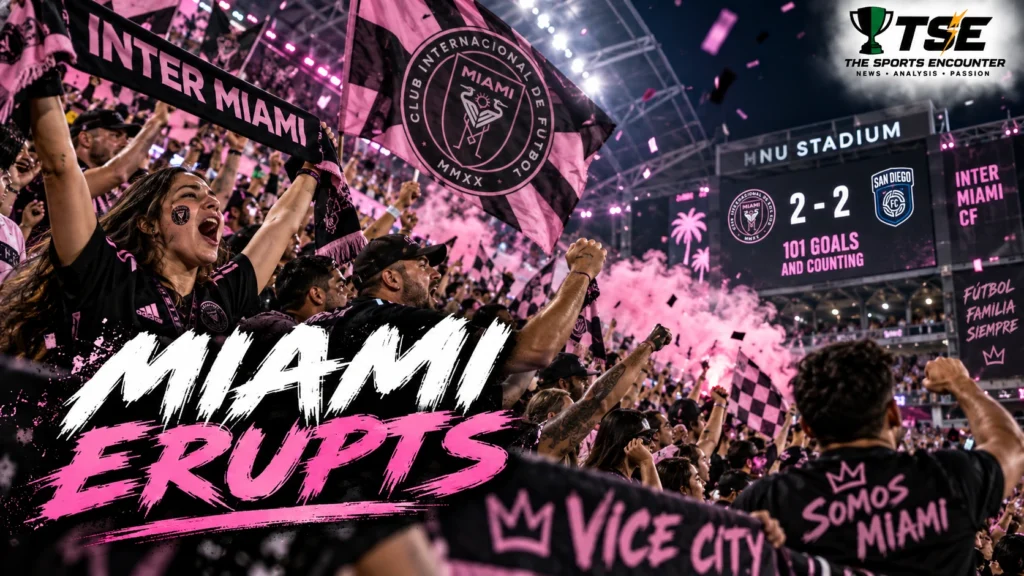
MIAMI, United States, September 20, 2026: Lionel Messi curled home his 101st goal for Inter Miami and Luis Suárez appeared to have completed another comeback at Nu Stadium, but Anders Dreyer struck twice as San Diego FC forced the defending MLS Cup champions into a 2-2 draw and extended Miami’s league winless run to four consecutive ties.
The milestone belonged to Messi. The warning belonged to Inter Miami.
Messi’s 24th-minute free kick was his 20th MLS goal of the season, making him only the second player in league history to score at least 20 goals in three consecutive seasons. He also continues to lead MLS in both goals and assists, with 20 goals and 13 assists through 23 regular-season appearances.
Yet Miami once again failed to turn elite attacking production into three points. Dreyer opened the scoring in the 12th minute, Messi equalized, Suárez put Miami ahead in the 74th, and Dreyer struck again eight minutes later.
That sequence leaves new head coach Cristian “Kily” González with a revealing contradiction only days into his tenure: Miami can still collect trophies and Messi can still rewrite record books, but the reigning champions are surrendering too many points in league games they have opportunities to control.
The result fits into the wider late-career Messi story explored in The Sports Encounter’s examination of Messi’s place among sport’s greatest athletes, but Sunday’s game raised a much more immediate MLS question.
Can Inter Miami become difficult enough to beat when Messi does not personally decide everything?
Inter Miami 2-2 San Diego FC: How the Game Changed
| Minute | Team | Scorer | Score |
|---|---|---|---|
| 12′ | San Diego FC | Anders Dreyer | 0-1 |
| 24′ | Inter Miami | Lionel Messi | 1-1 |
| 74′ | Inter Miami | Luis Suárez | 2-1 |
| 82′ | San Diego FC | Anders Dreyer | 2-2 |
Inter Miami’s official match report confirmed that the club moved to 12 wins, four losses and 10 draws for 46 points.
The night also ended with an important save rather than another Messi winner. In the sixth minute of stoppage time, Dayne St. Clair denied Kieran Sargeant and prevented San Diego from completing the comeback.
How Did Lionel Messi Reach 101 Goals for Inter Miami?
Messi reached 100 only four days earlier.
His milestone century came against Cruz Azul in the Campeones Cup, when his goal and assist helped Miami win 2-0 and gave González a trophy in his first match as head coach.
The next number arrived from a familiar source.
After Miami fell behind to Dreyer, Messi stood over a free kick from the right side in the 24th minute and bent the ball toward the far upper corner. Nobody redirected it. Nobody needed to.
Goal No. 101 had arrived.
MLS confirmed that Messi now has 20 league goals and 13 assists in 2026, giving him a league-leading 33 direct goal contributions.
He has also become only the second MLS player to record 20 or more goals in three consecutive regular seasons, matching the achievement Denis Bouanga produced from 2023 through 2025.
| Season | MLS Goals | MLS Assists |
|---|---|---|
| 2023 | 1 | 2 |
| 2024 | 20 | 16 |
| 2025 | 29 | 19 |
| 2026 | 20 | 13 |
Those numbers reinforce why Messi remains central to the wider Messi vs. Cristiano Ronaldo legacy debate even at 39.
His international career has ended, but his ability to decide club matches has not.
Messi Leads MLS in Goals and Assists, So Why Are Miami Dropping Points?
This is the more important question.
Inter Miami have now drawn four consecutive MLS matches.
They drew 2-2 against Philadelphia Union, 1-1 with Chicago, 2-2 against Nashville and 2-2 against San Diego.
Messi has continued producing throughout that sequence.
The points have not followed at the same rate.
MLS highlighted another statistic that should concern González: Miami have taken only 19 of the 39 league points available at Nu Stadium, with a home record of four wins, two defeats and seven draws.
The stadium opened this season as a major step in the club’s evolution. Messi and Suárez scored its first Miami goals during a 2-2 opening-day draw with Austin, yet home control has remained inconsistent.
For a defending champion expecting home-field advantage in the playoffs, seven draws from 13 home league matches is too much leakage.
San Diego Punished the Space Behind Miami
Miami’s attacking intent naturally pushed players forward.
San Diego knew what could exist behind them.
Dreyer’s two goals came from the kind of direct attacking moments that have made him one of San Diego’s most dangerous players since the club entered MLS.
Miami started Casemiro alongside Maximiliano Falcón in central defense, with Facundo Mura and Fricio Caicedo outside them. Rodrigo De Paul, Yannick Bright and Matías Galarza formed the midfield.
The arrangement gave Miami enormous passing quality through the center of the field.
It also placed significant responsibility on the back line whenever possession was lost and San Diego attacked before Miami could recover its shape.
MLS later described Dreyer’s work as “cold-blooded” on the break while noting that Miami controlled several other areas of the match.
That combination should concern González more than simply conceding two goals.
Miami can dominate long portions of a game and still give opponents a clear route to hurt them.
Why Anders Dreyer Was the Player Miami Could Not Solve
Dreyer entered the match as San Diego’s leading attacking contributor, with nine goals and 11 assists.
He left with a brace.
San Diego needed it badly.
The 2025 expansion sensation entered Nu Stadium after three consecutive defeats, including a 5-0 home loss to Philadelphia Union. San Diego had fallen to ninth in the Western Conference after finishing first in the West during its remarkable inaugural MLS season.
Dreyer gave them the outlet their game plan required.
His opener immediately changed the match because Miami could no longer dictate the tempo from a neutral scoreline.
His second goal was even more damaging.
Suárez had seemingly completed Miami’s recovery eight minutes earlier. Momentum had shifted. Nu Stadium expected the champions to close the game.
Dreyer refused to let that happen.
CJ dos Santos Returned to Miami and Helped Deny His Former Club
Another important San Diego performance came from goalkeeper CJ dos Santos.
The former Inter Miami player made six saves against his old club as Miami repeatedly pushed for another goal.
His contribution helps explain why possession or attacking pressure alone did not produce victory.
Messi scored. Suárez scored. Miami generated enough pressure to believe a third goal was possible.
Dos Santos kept San Diego alive long enough for Dreyer to punish them again.
That is the kind of individual contribution that often disappears beneath a Messi milestone headline.
Luis Suárez and Rodrigo De Paul Nearly Produced the Winner
Miami’s second goal illustrated what still makes this attack so difficult to defend.
De Paul saw the run early and threaded a pass into the right side of San Diego’s penalty area.
Suárez met it first time and finished with his right foot.
The goal was Suárez’s 13th of the MLS season.
De Paul’s assist was his 12th.
That combination matters for González because Miami cannot build every decisive sequence through Messi.
Messi’s gravitational effect on defenders creates space elsewhere. De Paul’s passing range and Suárez’s movement remain among the strongest ways to exploit it.
The challenge is preserving the value of those goals once Miami take the lead.
Kily González Won a Trophy Immediately, but His MLS Problem Is Different
González’s first few days in Miami have already produced a strange contrast.
He arrived in South Florida on September 15 after receiving the work documentation required to begin his contract, which runs through June 2028.
One day later, he led Miami against Cruz Azul.
Messi scored his 100th Inter Miami goal, Casemiro added another, and González began his tenure by lifting the Campeones Cup.
His first MLS match proved more complicated.
The club hired González after an extended period in which Guillermo Hoyos had handled interim duties following Javier Mascherano’s departure in April.
Miami therefore changed coaches while defending an MLS Cup title and remaining involved in multiple competitions.
There is very little transition time.
The title defense demands immediate results.
González’s early task is not discovering whether his team can create goals. Messi, Suárez and De Paul have already answered that.
He must find the balance that allows Miami to attack without making every turnover dangerous.
How Much Did Inter Miami’s Injuries Affect the San Diego Game?
Miami were without several players who would normally provide González with additional rotation and tactical options.
The MLS Matchday 27 player status report listed Tadeo Allende as a long-term absence, Ian Fray out with a groin issue, Telasco Segovia unavailable because of a quad injury and Mateo Silvetti out long term.
Silvetti recently underwent surgery after dislocating his left shoulder.
Those absences matter because Miami are balancing an aging group of elite veterans with younger players expected to provide running power, width and rotation.
Bright still reached an important milestone against San Diego, making his 100th appearance for Inter Miami and becoming only the 10th player in club history to reach that mark.
His development has already been part of a turbulent season, including the stoppage-time incident against Philadelphia that led to MLS disciplinary action involving Messi. TSE covered the fallout in our report on Messi’s fine and the Philadelphia confrontation.
Is Lionel Messi Leading the 2026 MLS Golden Boot Race?
Yes.
Messi leads MLS with 20 goals.
He also leads the league with 13 assists.
That combination gives him 33 direct goal contributions through 23 games.
MLS has also identified Messi as a candidate to become the first player to win the Landon Donovan MLS MVP award three times.
He won the award in 2024 and 2025.
For a player who has now stepped away from international competition after ending his historic Argentina career, the club-only phase of his career has started with little evidence of statistical decline.
Argentina have even arranged an October 6 farewell appearance at the Monumental, a final goodbye covered in TSE’s report on Messi’s planned Buenos Aires farewell.
Miami now benefit from a version of Messi with fewer international travel and tournament demands.
Whether that produces another MLS Cup depends on much more than his personal numbers.
Why Messi’s 101st Goal Fits His Extraordinary 2026
The Miami milestone follows one of the most productive late-career seasons football has seen.
At 39, Messi scored eight goals during Argentina’s run to the 2026 World Cup final and remained central to their chance creation.
He ranked among TSE’s top performers of the 2026 World Cup and created both late goals when Argentina eliminated England in the semifinal.
His World Cup run also strengthened the argument examined in TSE’s deep statistical assessment of his wider sporting legacy.
The significance of goal No. 101 therefore lies partly in its timing.
Messi has moved out of international football and directly into another MLS Golden Boot and MVP race.
The career is narrowing in scope.
The production is not.
What Does the Draw Mean for Inter Miami’s MLS Cup Defense?
Miami moved to 46 points from 26 matches.
The more revealing development is their position in the Eastern Conference race.
They entered Matchday 27 in second place.
After another home draw, MLS reported that the Herons had slipped to third, while Supporters’ Shield leader Nashville had already clinched a playoff berth and continued to create separation at the top.
Miami’s playoff place remains in strong shape.
The race for the very top seed is becoming much less forgiving.
That affects the postseason because home-field advantage has value, even if Nu Stadium itself has not yet become the fortress Miami expected.
The defending MLS Cup champions still have eight regular-season games remaining.
Those games need to become less about Messi rescuing points and more about Miami finishing opponents once they take control.
Why the San Diego Draw May Matter More Than Messi’s Milestone
Messi will score more goals.
Goal No. 101 is unlikely to be the last record attached to his Miami career.
Inter Miami have a narrower window to solve their competitive problem.
They have now followed three previous league draws with another.
San Diego arrived after three consecutive defeats and still found two goals away against the defending champions.
Miami led with eight minutes remaining and still could not close the match.
St. Clair then had to make a stoppage-time save to protect the point.
That sequence should occupy González more than any milestone celebration.
Messi remains capable of supplying championship-level moments.
Miami need to become a championship-level team around those moments again.
What Comes Next for Messi and Inter Miami?
Inter Miami travel to Ohio to face Columbus Crew on Sunday, September 27.
San Diego visit Austin FC on September 26 as they continue fighting to remain above the Western Conference playoff line.
For Miami, Columbus provides another immediate test of González’s ability to convert attacking quality into a complete 90-minute performance.
Messi will arrive with 101 club goals, the MLS Golden Boot lead and another MVP campaign gathering weight.
The next milestone is already within sight.
The more urgent target is three points.
For broader global soccer coverage, records, tactical analysis and major-player stories, visit The Sports Encounter’s soccer desk.
Frequently Asked Questions
How many goals has Lionel Messi scored for Inter Miami?
Lionel Messi has scored 101 goals for Inter Miami across all competitions after his free kick against San Diego FC on September 20, 2026.
What was the Inter Miami vs San Diego FC score?
Inter Miami and San Diego FC drew 2-2 at Nu Stadium. Anders Dreyer scored twice for San Diego, while Lionel Messi and Luis Suárez scored for Miami.
Who scored Messi’s 101st Inter Miami goal?
Messi himself scored goal No. 101 with a curling free kick in the 24th minute against San Diego FC.
How many MLS goals does Messi have in 2026?
Messi has 20 goals in 23 MLS regular-season appearances in 2026.
Is Lionel Messi leading the MLS Golden Boot race?
Yes. Messi leads MLS with 20 regular-season goals and also leads the league with 13 assists.
What record did Messi equal against San Diego?
Messi became only the second player in MLS history to score at least 20 goals in three consecutive seasons, joining Denis Bouanga.
Who is Inter Miami’s new coach?
Cristian “Kily” González is Inter Miami’s new head coach. His contract runs through June 2028, and the San Diego match was his MLS managerial debut.
Why did Inter Miami draw with San Diego?
Miami twice recovered from difficult situations and eventually led 2-1, but San Diego repeatedly threatened in transition and Anders Dreyer scored his second goal in the 82nd minute.
How many straight MLS games have Inter Miami drawn?
Inter Miami have drawn four consecutive MLS regular-season matches.
Who do Inter Miami play next?
Inter Miami visit Columbus Crew on Sunday, September 27, 2026.