


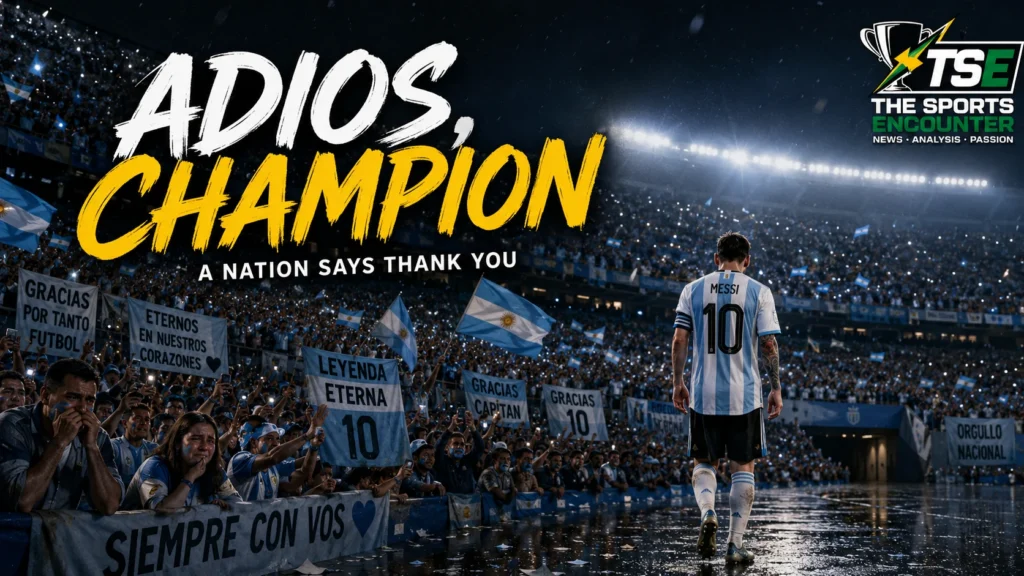
Lionel Messi has retired from international football, closing a 20-year Argentina career that began under impossible expectations, passed through repeated final defeats and a temporary retirement, and ended with the World Cup, two Copa América titles, record-breaking longevity and one final run to another World Cup final at 39.
The announcement brings an end to one of the most scrutinized international careers football has ever seen.
Messi leaves Argentina having played 207 senior internationals and scored 125 goals, according to the latest figures reported following his retirement. He finishes as the country’s all-time appearance leader and record goalscorer, with a career that stretched from his senior debut in 2005 to the 2026 FIFA World Cup final against Spain.
His final appearance came in Argentina’s 1-0 extra-time defeat to Spain in the World Cup final in New York-New Jersey, where Ferran Torres scored the decisive goal in the 106th minute.
That loss denied Messi a second consecutive World Cup title, but it did not leave unfinished business in the way his earlier international defeats once did.
By the time he walked away, Messi had already completed the journey Argentina once feared he might never finish.
He had won the 2022 FIFA World Cup, Copa América in 2021 and 2024, the Finalissima in 2022, Olympic gold in 2008 and the FIFA U-20 World Cup in 2005.
He also transformed his World Cup record during the final phase of his career, becoming the tournament’s all-time leading scorer during the 2026 edition and extending a list of records that had already moved beyond normal comparison.
For Argentina, this is not simply the retirement of a great player.
It is the end of the football era around which the national team has been organized emotionally, tactically and commercially for almost two decades.
Lionel Messi’s Argentina Career at a Glance
| Category | Messi’s Argentina Record |
|---|---|
| Senior international debut | 2005 |
| Final international appearance | 2026 FIFA World Cup final vs Spain |
| Senior caps | 207 |
| Senior goals | 125 |
| FIFA World Cup appearances | 6 tournaments |
| FIFA World Cup title | 2022 |
| Copa América titles | 2021, 2024 |
| Finalissima | 2022 |
| Olympic gold medal | 2008 |
| FIFA U-20 World Cup | 2005 |
| World Cup Golden Ball awards | 2014, 2022 |
| Final World Cup | 2026 |
The Argentine Football Association remains the official source for Argentina national-team records and announcements, while FIFA documents Messi’s World Cup achievements across his six appearances at the tournament.
The Timing Says as Much as the Retirement
Messi’s decision came only weeks after Argentina’s World Cup title defense ended against Spain.
That timing is important because the retirement question had already intensified immediately after the final.
Argentina Football Association president Claudio Tapia had publicly argued that the decision belonged entirely to Messi and that nobody else should decide when his international career ended.
We examined that uncertainty in our August analysis of when Messi might finally retire, where the key point was that his 2026 performances had removed age as the main argument against continuing.
Messi had not looked like a ceremonial presence.
At 39, he remained one of the most productive and influential players at the World Cup.
His decision therefore appears to be personal rather than forced by declining relevance.
That gives the retirement a different character from the one he briefly announced in 2016.
Back then, he walked away in pain.
This time, he leaves after completing the journey.
From Teenage Promise to Argentina’s Biggest Burden
Messi’s international career began under pressure almost immediately.
He had already become one of the world’s most exciting young players at Barcelona before Argentina truly learned what he could become.
His early national-team years were shaped by comparison.
Every dribble invited Diego Maradona comparisons. Every lost final reopened the debate about whether Messi could reproduce his club football for Argentina. Every quiet international game became evidence for people who believed he belonged more naturally to Barcelona than to his own national team.
The expectations were often unreasonable.
Messi was expected to score like a striker, create like a No. 10, control games like a midfielder and carry Argentina through the psychological weight of Maradona’s legacy.
When Argentina failed, the disappointment often became personal.
The criticism grew particularly intense because his Barcelona career was unfolding at the same time.
He was winning Champions League titles, Ballon d’Or awards and domestic trophies while Argentina continued falling short in major tournaments.
The contrast created a damaging narrative.
For years, Messi’s international career was judged less by what he produced and more by what he had not yet won.
The Finals That Nearly Broke the Relationship
Messi’s early international career contains a series of defeats that would eventually make his later triumphs feel much larger.
Argentina lost the 2007 Copa América final to Brazil.
They lost the 2014 World Cup final to Germany in extra time.
They then lost consecutive Copa América finals to Chile in 2015 and 2016, both after penalty shootouts.
The 2016 defeat became the breaking point.
Messi missed his penalty in the shootout and announced afterward that his national-team career was over.
At that stage, he had reached four major senior finals and lost all four.
The emotional exhaustion was obvious.
Argentina had spent years demanding a trophy from him while repeatedly failing to build enough stability around him to make winning one inevitable.
The retirement lasted only briefly.
Messi returned because the relationship with Argentina, however difficult it had become, was never one he could truly abandon.
The 2016 Retirement Was the Lowest Point
The temporary retirement remains one of the most important moments in Messi’s international story.
It showed that the pressure had become bigger than football.
For much of his career, Argentina treated Messi as both solution and explanation.
If they won, he was expected to have delivered it.
If they lost, the question became why he had not delivered enough.
That burden eventually became unsustainable.
His return did not immediately solve anything.
Argentina struggled through World Cup qualification, endured another turbulent tournament in 2018 and continued searching for a team identity that could support rather than depend entirely on Messi.
Scaloni Changed the Relationship Between Messi and Argentina
The turning point came after the 2018 World Cup.
Lionel Scaloni gradually rebuilt Argentina around a younger, more cohesive group.
The team became more aggressive without the ball, more balanced in midfield and less dependent on asking Messi to solve every stage of the game.
Players such as Rodrigo De Paul, Lautaro Martínez, Emiliano Martínez, Cristian Romero and later Julián Álvarez gave Argentina a harder competitive edge.
Messi still remained the central attacking figure.
The structure around him became stronger.
That change mattered enormously.
Instead of needing Messi to rescue Argentina, the team increasingly created conditions in which Messi could decide matches rather than repair them.
Copa América 2021 Changed Everything
The first major breakthrough arrived in Brazil.
Argentina defeated Brazil in the 2021 Copa América final at the Maracanã.
Ángel Di María scored the only goal.
Messi finally lifted a senior international trophy.
The emotional importance went far beyond the medal itself.
The years of criticism lost much of their force immediately.
Messi no longer had to explain why Barcelona had trophies and Argentina did not.
He had won with his country.
More importantly, Argentina had finally built a team that looked capable of sustaining success.
Qatar 2022 Completed the Story
The 2022 World Cup changed Messi’s legacy permanently.
Argentina began the tournament with a shocking defeat to Saudi Arabia.
The reaction became one of the defining sequences of Messi’s career.
He scored against Mexico, helped Argentina move through the group and then influenced every knockout round.
Against Australia, he scored.
Against the Netherlands, he scored and assisted.
Against Croatia, he dominated the semifinal.
Against France in the final, he scored twice before converting in the penalty shootout.
Argentina became world champions.
FIFA officially awarded Messi the Golden Ball as the tournament’s best player, making him the first footballer to win the World Cup Golden Ball twice.
The FIFA account of Messi’s Qatar triumph remains one of the clearest official records of how completely that tournament changed his international legacy.
For decades, the World Cup had been used against him in comparisons with Maradona and Pelé.
Qatar removed the missing trophy.
The 2024 Copa América Proved Qatar Was Not an Ending
Messi could easily have retired after Qatar.
He had already achieved everything.
Instead, Argentina kept winning.
The 2024 Copa América title turned the post-2021 period into a sustained championship era rather than one isolated peak.
Argentina had now won Copa América in 2021, the Finalissima in 2022, the World Cup later that year and Copa América again in 2024.
Messi had moved from being the symbol of Argentina’s frustration to the captain of its most successful modern cycle.
The 2026 World Cup Became a Different Type of Final Chapter
Messi entered the 2026 World Cup at 39.
The question was no longer whether he could win a World Cup.
He had already done that.
The question was whether he could still influence one.
He answered emphatically.
Our ranking of the best players at the 2026 World Cup placed Messi among the tournament’s dominant figures because his influence extended well beyond goals.
He continued linking midfield and attack, creating chances around the penalty area and controlling the tempo of Argentina’s possession.
The AFA also documented several new records during the tournament.
Messi reached 200 international appearances during the competition and became the first footballer to hit that figure while appearing at a World Cup.
He also became Argentina’s oldest international goalscorer.
Later in the tournament, he became the first player to score in seven consecutive World Cup matches.
His 2026 run did not look like a farewell tour.
It looked like another elite tournament.
Messi Rewrote the World Cup Record Book Again
The most remarkable part of Messi’s sixth World Cup was how many records remained available to him after five previous appearances.
The AFA documented him reaching 16 World Cup goals during Argentina’s opening stages, moving into the tournament’s all-time scoring lead.
He also reached 10 World Cup assists later in the competition.
That combination made his World Cup profile historically unusual.
Messi was no longer simply one of the tournament’s greatest scorers.
He had also become its leading creator.
Our wider feature asking whether Messi belongs in the greatest-athlete-ever conversation examined how those late-career achievements strengthened an already extraordinary résumé.
His Semifinal Against England Was One Last Masterclass
The semifinal against England became one of Messi’s defining 2026 performances.
Argentina trailed 1-0 late in Atlanta.
Messi created both goals in the comeback.
His short-corner combination created the space for Enzo Fernández to equalize before his curling delivery found Lautaro Martínez for the stoppage-time winner.
Our full Argentina vs England semifinal report captured how completely the match changed once Argentina pushed Messi closer to the decisive areas.
It was a classic late-career Messi performance.
He did not dominate every minute.
He dominated the moments that decided the game.
The Final Against Spain Became His Last Argentina Match
Argentina reached the final against a Spain team built around control, youth and one of football’s next global stars in Lamine Yamal.
The build-up naturally focused on Messi against Yamal, two generations meeting on football’s biggest stage.
Our World Cup final preview explored that generational contrast before kickoff.
Once the match began, Spain controlled the ball and territory for long periods.
Argentina survived largely through Emiliano Martínez.
Enzo Fernández’s second yellow card made the task even harder.
Ferran Torres eventually scored in extra time as Spain won 1-0.
Our full report from the 2026 World Cup final showed how close Argentina came to forcing penalties despite spending much of the contest under pressure.
Messi walked off without another trophy.
He also walked off without unfinished business.
The Numbers Only Tell Part of the International Story
Messi’s final Argentina totals are extraordinary.
Two hundred and seven caps.
One hundred and twenty-five goals.
Six World Cups.
A World Cup title.
Two Copa América titles.
Two World Cup Golden Balls.
Olympic gold.
An Under-20 World Cup.
Those numbers still fail to capture the full journey.
Messi’s international career matters because of the emotional distance between its lowest and highest points.
He went from being accused of caring more about Barcelona than Argentina to lifting the World Cup as captain.
He went from missing a penalty and retiring in frustration in 2016 to leading the most successful Argentina cycle in decades.
He went from being measured against Maradona’s 1986 World Cup to creating an international résumé that can stand alongside anybody’s.
Messi vs Maradona Is No Longer the Same Debate
For decades, Argentina’s greatest-player debate had one unavoidable problem for Messi.
Maradona had the World Cup.
Messi did not.
That argument disappeared in 2022.
Messi now leaves with greater international longevity, far more appearances, far more goals and a much longer period as Argentina’s central figure.
Maradona’s 1986 tournament remains one of football’s greatest individual World Cup performances.
Messi’s case comes from accumulation.
He reached major finals across different generations, won the World Cup, won multiple continental titles and remained decisive into his late thirties.
The comparison no longer revolves around what Messi failed to achieve.
It revolves around which type of greatness people value.
Messi vs Ronaldo Also Looks Different After 2026
The Messi-Cristiano Ronaldo debate has followed both players for nearly two decades.
Our Messi vs Ronaldo legacy analysis examined how the 2026 World Cup changed that argument again.
Ronaldo’s case remains built around extraordinary scoring, Champions League dominance, physical longevity and success across multiple leagues.
Messi’s international résumé now carries a different level of World Cup weight.
He won the tournament in 2022, reached another final in 2026 and continued breaking World Cup records deep into his late thirties.
The debate will continue because football arguments rarely end cleanly.
Messi’s international career no longer contains the major gap that once powered much of the criticism against him.
Argentina Must Now Learn to Play Without Messi
The biggest football question is what happens next.
Argentina have spent nearly two decades building around Messi’s movement, vision and ability to make the final decision in attacking areas.
Replacing that directly is impossible.
The next Argentina team should not attempt to find another Messi.
It needs to develop a structure that spreads his responsibilities.
Julián Álvarez can provide movement and finishing.
Lautaro Martínez remains an elite penalty-area striker.
Enzo Fernández can influence build-up and passing rhythm.
Alexis Mac Allister can carry more creative responsibility.
Younger attackers will need to take ownership of the spaces Messi occupied around the right half-space and central attacking zones.
Argentina will also need to adjust emotionally.
For an entire generation of players, Messi has been the captain, the reference point and the person opponents organize around first.
That gravitational effect disappears now.
Argentina’s Next Identity Cannot Be a Messi Imitation
The greatest risk is trying to preserve Messi’s system without Messi.
That almost never works when a generational player leaves.
Argentina need more collective creation, more midfield progression and more attacking responsibility shared across the front line.
The team may become faster and more vertical.
It may press more aggressively.
It may also lose the ability to slow matches down through one player who could receive the ball under pressure and change the rhythm instantly.
Scaloni or whoever eventually leads the next cycle will need to accept that change rather than disguise it.
The 2026 Dream Team Showed Messi Was Still Elite at the End
Messi’s retirement cannot be dismissed as a player finally fading from the highest level.
He was still voted into the 2026 World Cup fan-voted Dream Team after helping Argentina reach the final.
That gives the ending unusual weight.
Many legends retire after becoming peripheral.
Messi leaves Argentina after another World Cup in which he remained central.
His Club Career Continues With Inter Miami
International retirement does not mean Messi has stopped playing football.
Inter Miami officially extended his contract through the end of the 2028 MLS season.
The agreement gives Messi the opportunity to continue playing club football without the travel, camps and tournament demands of Argentina duty.
That may extend the final stage of his club career significantly.
It also gives Major League Soccer continued access to one of the biggest commercial and sporting figures in football history.
The Final Version of Messi’s Argentina Story Is Very Different From the First
For much of his career, people asked whether Messi loved Argentina enough.
Later, they asked whether Argentina loved Messi enough.
Both questions now feel distant.
The relationship survived the criticism, the lost finals, the missed penalty, the temporary retirement, another failed World Cup and years of comparison with Maradona.
Then it changed.
Copa América 2021 gave Argentina and Messi relief.
Qatar 2022 gave them completion.
The 2024 Copa América gave them continuity.
The 2026 World Cup gave them one final demonstration that Messi’s relevance had survived even age.
World Cup 2026 Did Not Need Another Trophy to Strengthen His Legacy
The 2026 tournament added something different from Qatar.
Qatar proved Messi could finish the job.
North America proved he could remain decisive at 39.
He became the tournament’s all-time leading scorer.
He expanded his assist records.
He created both goals in a World Cup semifinal comeback.
He helped Argentina return to the final four years after winning the trophy.
Our earlier feature on the World Cup generation saying goodbye after 2026 described Messi’s final tournament as a different kind of farewell.
That now looks even more accurate.
Messi Leaves With Nothing Left to Chase for Argentina
There are careers that end because the player cannot continue.
Others end because the team has moved on.
Messi’s Argentina career appears to have ended because the player finally decided the journey was complete.
The last image will not be the one many imagined.
There was no second consecutive World Cup trophy.
No final celebration.
No perfect goodbye.
Instead, there was defeat to Spain, another long tournament, another final and then a decision made after more than 20 years carrying the most famous shirt in Argentine football.
That ending may fit the story better.
Messi’s Argentina career was never simple.
It contained extraordinary talent, brutal criticism, public doubt, repeated failure, temporary separation, reconciliation, redemption and finally dominance.
The trophy cabinet matters.
The records matter.
The transformation matters more.
The teenager once accused of not being Argentine enough leaves as one of the defining symbols of Argentine football.
For years, Lionel Messi chased acceptance from his country.
By the end, Argentina was the one asking him to stay.