NEW YORK, United States, September 10, 2026: Aryna Sabalenka is one victory away from completing a third consecutive US Open title run after defeating Jessica Pegula 7-5, 6-2 in the women’s semifinal at Arthur Ashe Stadium, but the score alone does not explain why a competitive opening set turned into such a decisive finish.
The most revealing number was Pegula’s 24% success rate behind her second serve.
Sabalenka repeatedly attacked the American whenever the first serve missed, converted three of eight break-point opportunities, and won 23 receiving points overall. Pegula, by comparison, did not convert a break point because she never created one.
That difference turned a semifinal that was balanced at 5-5 in the opening set into another New York victory for the two-time defending champion, who has now beaten Pegula at the US Open in three consecutive seasons.
Story at a glance

The First Set Hid the Problem Pegula Could Not Solve
Pegula stayed with Sabalenka for almost the entire opening set.
The Second Set Became a Different Match
Pegula had pushed Sabalenka through 12 games in the opener. The second set lasted only eight.
Sabalenka Has Turned Pegula Into a New York Roadblock
This matchup now carries unusual US Open history.
The Difference Was Control Under Pressure
Sabalenka hit more aces, seven to four, but this was not simply another victory powered by a dominant first serve.
The Three-Peat Is Now One Match Away
Sabalenka entered the tournament attempting to become the first woman since Serena Williams, who won from 2012 through 2014, to capture three consecutive US Open women’s singles titles.
Sabalenka advances to Saturday’s women’s singles final, where she will face the winner of the second semifinal between Coco Gauff and Elena Rybakina.
For readers following the tournament from the beginning, The Sports Encounter’s US Open 2026 curtain-raiser identified Sabalenka’s attempt to win three consecutive New York titles as one of the defining storylines of the women’s draw.
Sabalenka vs Pegula: US Open Semifinal at a Glance
| Statistic | Aryna Sabalenka | Jessica Pegula |
|---|---|---|
| Final Score | 7-5, 6-2 | 5-7, 2-6 |
| Aces | 7 | 4 |
| Double Faults | 3 | 0 |
| First Serve % | 66% | 72% |
| First-Serve Points Won | 74% | 77% |
| Second-Serve Points Won | 76% | 24% |
| Break Points | 3/8 | 0/1 |
| Receiving Points Won | 23 | 17 |
| Total Points Won | 65 | 54 |
| Games Won | 13 | 7 |
| Service Points Won | 42 | 37 |
| Service Games Won | 10 | 7 |
The First Set Hid the Problem Pegula Could Not Solve
Pegula stayed with Sabalenka for almost the entire opening set.
At 5-5, there was little in the scoreline to suggest that the match would finish in straight sets. Pegula was landing 72% of her first serves and winning 77% of the points when that first delivery went in, slightly better than Sabalenka’s 74% first-serve success rate.
That should normally give a player enough stability to stay competitive.
The problem emerged every time Pegula had to hit a second serve.
She won only 24% of those points. Sabalenka won 76% behind her own second serve.
That 52-percentage-point gap created two very different service environments. Sabalenka could miss a first serve and still begin the next exchange from a position of relative security. Pegula knew that missing hers immediately invited pressure.
Once that pattern became established, the American had less margin for error in every service game.
Sabalenka eventually broke late and closed the first set 7-5.
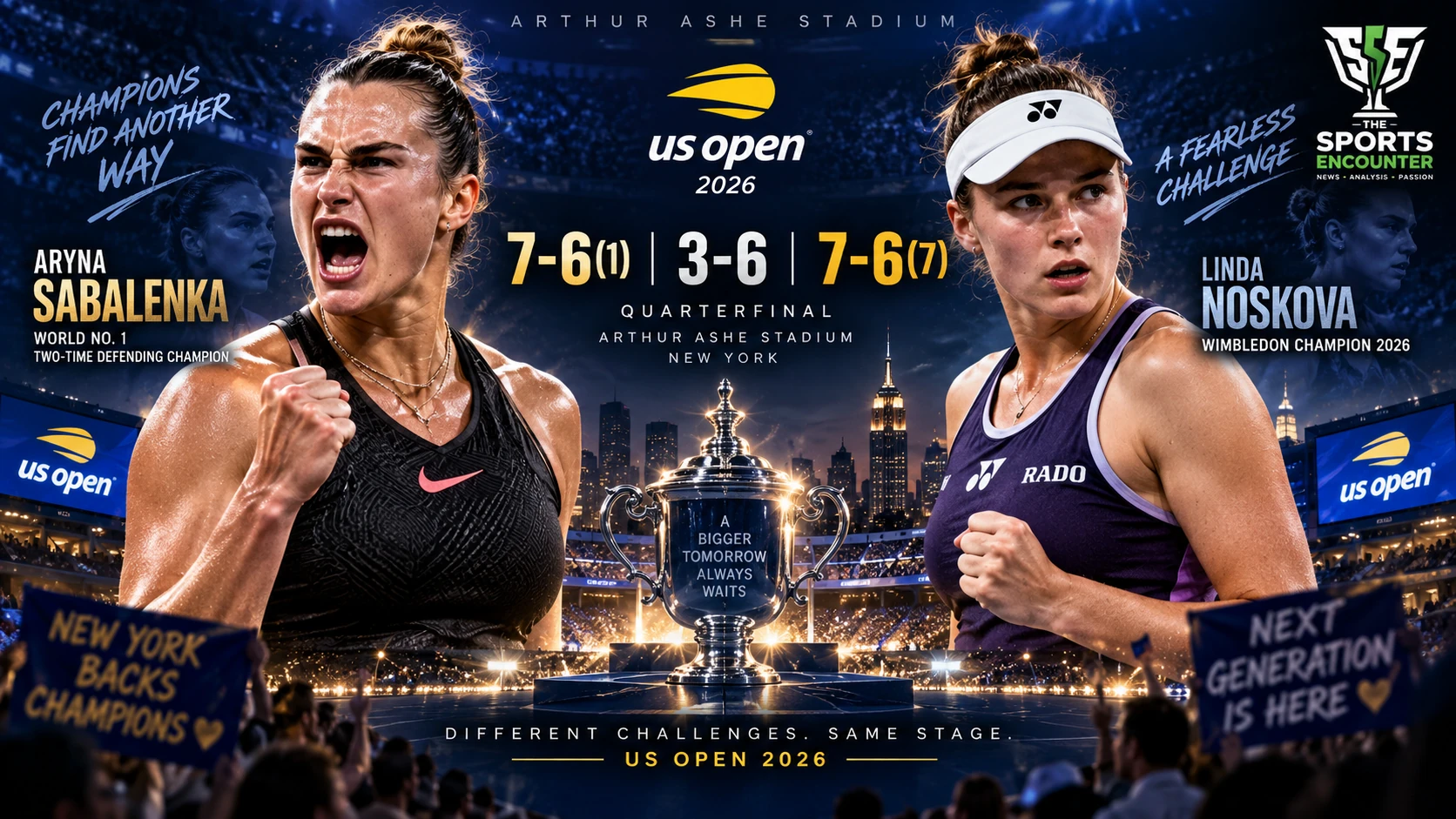
The defending champion had already spent much of the tournament demonstrating her ability to survive difficult passages. She needed a deciding-set tiebreak to escape Wimbledon champion Linda Noskova in the quarterfinals, part of the changing championship picture The Sports Encounter examined in its US Open quarterfinal race analysis.
The Second Set Became a Different Match
Pegula had pushed Sabalenka through 12 games in the opener. The second set lasted only eight.
Once Sabalenka had the first set, she could attack with greater freedom while Pegula carried the additional burden of needing to protect every service game simply to remain in the semifinal.
The statistical separation became visible quickly.
Sabalenka finished the match with 65 points to Pegula’s 54 and won 13 games to seven. She also put together a seven-point winning streak, compared with Pegula’s longest sequence of four.
The break-point numbers tell an equally important story.
Sabalenka generated eight opportunities and converted three. Pegula had only one chance and failed to take it.
That meant Pegula was almost constantly defending her serve without creating equivalent pressure at the other end.
The semifinal eventually became less about Sabalenka overpowering Pegula on every rally and more about one player repeatedly creating high-leverage opportunities while the other could not.
Sabalenka Has Turned Pegula Into a New York Roadblock
This matchup now carries unusual US Open history.
Sabalenka defeated Pegula 7-5, 7-5 in the 2024 final. One year later, Pegula took the opening set of their semifinal before Sabalenka recovered to win 4-6, 6-3, 6-4.
They returned to Arthur Ashe Stadium again Thursday with another place in the final at stake.
The official US Open semifinal preview noted that this was their third consecutive New York meeting in the semifinal or final stage and that Sabalenka entered with a 9-4 career head-to-head advantage.
The result extended that US Open pattern.
Pegula had reason to believe this meeting could be different. She defeated Sabalenka on grass in the Berlin semifinals earlier this season, and her path through New York had again demonstrated why she remains one of the best hard-court players in women’s tennis.
The Sports Encounter tracked that journey when Pegula beat Sorana Cirstea to reach the quarterfinals and again when she rallied past Emma Navarro to book the Sabalenka semifinal.
Against Sabalenka in New York, however, Pegula has repeatedly found herself trying to solve the same problem at increasingly important moments.
The Difference Was Control Under Pressure
Sabalenka hit more aces, seven to four, but this was not simply another victory powered by a dominant first serve.
Pegula actually landed more first serves and won a slightly higher percentage of those points.
The decisive area came after the first serve disappeared.
Sabalenka’s 76% second-serve win rate allowed her to avoid extended pressure in her own service games. Pegula’s 24% left her vulnerable whenever Sabalenka got a look at the second delivery.
That distinction matters because it shows how Sabalenka’s game has evolved beyond raw power.
Her early years at the top level were often defined by the spectacular nature of her best tennis and the volatility that could accompany it. The version that has dominated New York has become much better at protecting weak moments and identifying where an opponent is vulnerable.
The Sports Encounter highlighted that growing stability when Sabalenka opened her title defense in New York after arriving from an uneven North American summer.
Earlier losses in Toronto and Cincinnati had raised legitimate questions. Sabalenka and Pegula both exited Toronto during a volatile week covered in our National Bank Open analysis, while Sabalenka later fell to Sara Bejlek in Cincinnati’s round of 16.
New York has again produced a different version of the defending champion.
The Three-Peat Is Now One Match Away
Sabalenka entered the tournament attempting to become the first woman since Serena Williams, who won from 2012 through 2014, to capture three consecutive US Open women’s singles titles.
She is now one victory away.
The WTA’s semifinal analysis emphasized the historical stakes before Thursday’s match, while the official US Open Day 12 preview placed the matchup at the center of a women’s final four consisting of the tournament’s top four seeds.
That makes Sabalenka’s run especially significant.
The women’s draw did not collapse around her. The strongest seeds survived deep into the tournament, forcing the champion to keep beating elite opposition rather than benefiting from a cleared path.
The Sports Encounter’s US Open draw analysis had identified Pegula as one of the players most capable of stopping Sabalenka before the final.
She could not.
Pegula’s Defeat Should Not Hide Another Deep New York Run
For Pegula, another semifinal loss to Sabalenka will hurt because the opportunity was real.
She reached the final here in 2024, returned to the semifinals in 2025, and made the last four again in 2026.
Her consistency at her home major is no longer in question.
The missing piece remains the final breakthrough.
She entered Thursday knowing Sabalenka had blocked her twice in consecutive New York campaigns. Pegula had also beaten Sabalenka in Berlin this year, evidence that the matchup itself was not impossible.
But Grand Slam matches are often decided by whether a player’s strengths survive when the scoreboard becomes uncomfortable.
Pegula’s first serve did.
Her second serve did not.
What Sabalenka’s Victory Means for the US Open Final
Sabalenka now waits for either Coco Gauff or Elena Rybakina.
Both would create a very different tactical final.
Gauff brings elite defensive movement, counterpunching and the energy of another American crowd favorite. Rybakina brings one of the cleanest first-strike games on the WTA Tour and has already changed the wider ranking landscape during this tournament.
The Sports Encounter examined that additional dimension in our analysis of the US Open world No. 1 ranking race.
Whoever comes through the second semifinal will face a champion who has now learned how to win New York matches in several different ways.
Sabalenka can overwhelm opponents when her power is flowing. Against Pegula, she showed something more valuable for a player pursuing history: she identified the one part of the American’s game that could not withstand sustained pressure and kept returning to it until the semifinal broke open.
One match remains between Sabalenka and a third consecutive US Open championship.
Continue the US Open 2026 Story

Frequently Asked Questions
Who won Sabalenka vs Pegula at the 2026 US Open?
Aryna Sabalenka defeated Jessica Pegula 7-5, 6-2 in the women’s singles semifinal at Arthur Ashe Stadium.
What was the Sabalenka vs Pegula score?
Sabalenka won in straight sets, 7-5, 6-2.
Who will Sabalenka play in the 2026 US Open final?
Sabalenka will face the winner of the semifinal between Coco Gauff and Elena Rybakina.
How many US Open titles has Aryna Sabalenka won?
Sabalenka entered the 2026 tournament as the two-time defending US Open women’s singles champion after winning the 2024 and 2025 titles.
Can Sabalenka win three US Open titles in a row?
Yes. Her semifinal victory over Pegula moved her into the 2026 final, leaving her one win away from completing three consecutive US Open championships.
When did a woman last win three consecutive US Open titles?
Serena Williams won three consecutive US Open women’s singles championships from 2012 through 2014.
What was the key statistic in Sabalenka’s win over Pegula?
Pegula won only 24% of her second-serve points, while Sabalenka won 76% behind her second serve. That gap repeatedly placed Pegula under pressure during her service games.
How many break points did Sabalenka convert?
Sabalenka converted three of eight break-point opportunities. Pegula converted none of her one opportunity.
How many points did Sabalenka win against Pegula?
Sabalenka won 65 total points compared with Pegula’s 54.
How many times have Sabalenka and Pegula met at the US Open?
The 2026 semifinal was their third consecutive US Open meeting. Sabalenka defeated Pegula in the 2024 final, the 2025 semifinal and the 2026 semifinal.