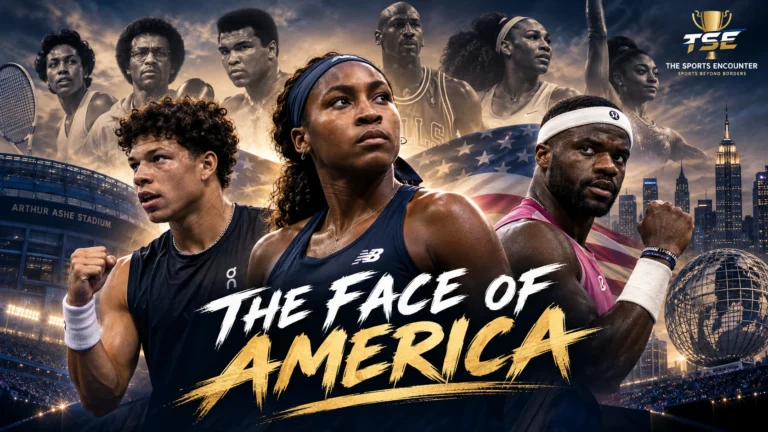
NEW YORK, United States, September 10, 2026: Coco Gauff saved two match points to reach another US Open semifinal. Ben Shelton ended Carlos Alcaraz’s title defense with a 146-mph ace at 3:33 in the morning. Frances Tiafoe recovered from two sets down and a game from defeat to reach his third semifinal in New York. Three Black American tennis players are now carrying some of the loudest home hopes at the country’s biggest tennis tournament, but their significance reaches much further than one remarkable week at Arthur Ashe Stadium.
Their performances belong to a much longer American story.
For nearly a century, Black athletes have represented the United States on stages where millions of people around the world formed impressions not only of the athlete, but of the country whose flag appeared beside their name.
Jesse Owens did it in Berlin in 1936. Jackie Robinson changed American baseball and American society in 1947. Althea Gibson and Arthur Ashe opened doors in tennis. Muhammad Ali became one of the most recognizable people on Earth. Michael Jordan turned basketball into a global cultural language. Serena and Venus Williams reshaped tennis. Tiger Woods changed golf’s audience. LeBron James extended basketball’s international reach. Simone Biles became the most decorated gymnast in history.
Story at a glance
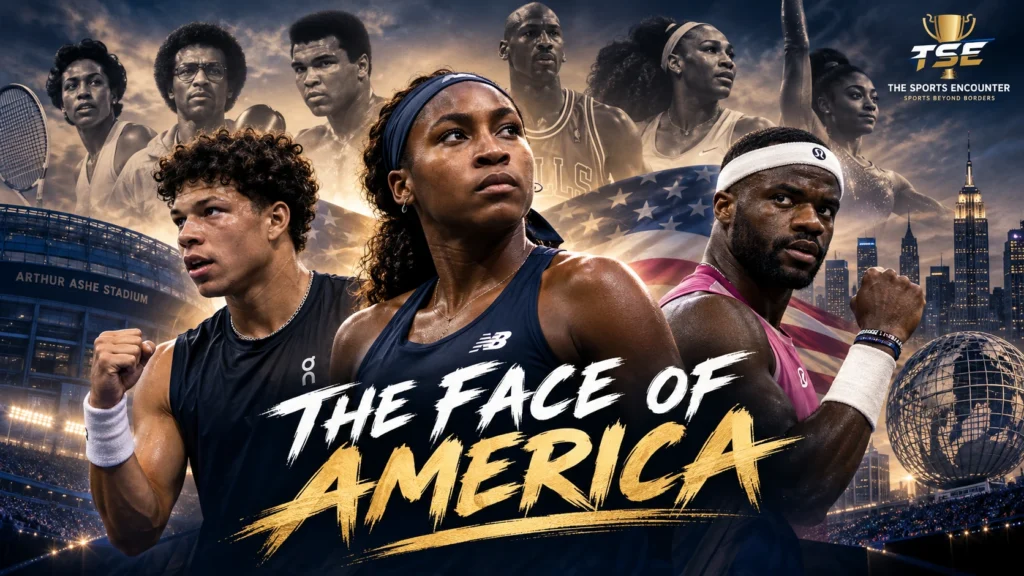
Coco Gauff, Ben Shelton and Frances Tiafoe Have Turned the 2026 US Open Into a Black American Showcase
The timing of this conversation is not accidental.
Arthur Ashe Stadium Is Now Hosting a Story Arthur Ashe Helped Make Possible
There is something almost too neat about the geography of the moment.
Althea Gibson Opened a Door Before Arthur Ashe Walked Through It
The story cannot begin with Ashe.
Coco Gauff Represents a Different Kind of American Global Identity
Coco Gauff first became globally recognizable as a teenager.
Ben Shelton Has Given American Men’s Tennis a New Kind of Energy
Shelton’s appeal is different from Gauff’s.
Gauff, Shelton and Tiafoe are not beginning that story.
They are showing how visible it has become.
The strongest way to understand this is not to say that Black Americans have somehow replaced every other face of the United States. America has always projected many identities through politics, business, film, music, technology and sport. But in international athletics, Black Americans have become some of the country’s most recognizable ambassadors, often carrying the American flag into spaces where their own history at home has been shaped by exclusion, discrimination and struggles for equality.
That contradiction has made their global influence even more powerful.
The Sports Encounter’s Tennis Hub follows the competitive side of the sport, but the current US Open has produced a cultural story that deserves a wider lens.
Coco Gauff, Ben Shelton and Frances Tiafoe Have Turned the 2026 US Open Into a Black American Showcase
The timing of this conversation is not accidental.
Gauff reached the women’s semifinals after defeating Mirra Andreeva 2-6, 7-6(7), 6-2, saving two match points in the second-set tiebreak. The Sports Encounter’s full analysis of Gauff’s comeback showed how she transformed a match that had looked almost lost into one of the strongest pressure performances of her tournament.
The official US Open report added another revealing detail. Gauff said she had been thinking about Frances Tiafoe’s comeback from the previous day while trying to find her own way back into the match.
That means the connection between these players is not something observers are imposing afterward.
They are watching each other.
They are drawing energy from each other.
They are competing in front of the same crowd under the same American flag.
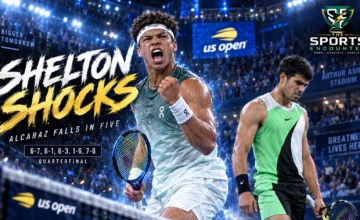
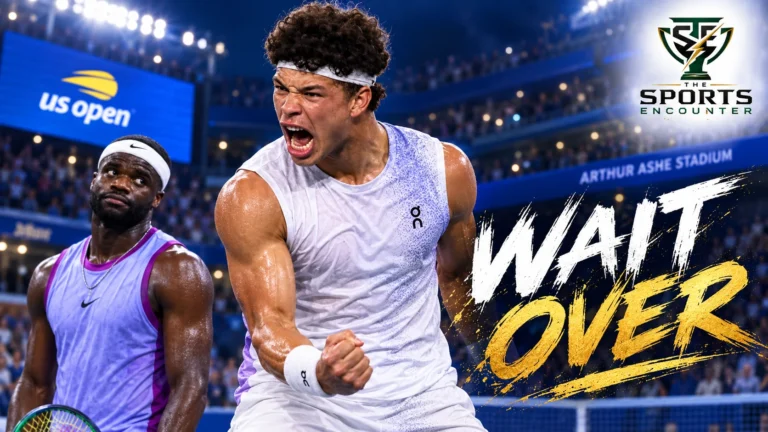
On the men’s side, Shelton produced the biggest victory of his career when he defeated defending champion Carlos Alcaraz 6-7(5), 6-1, 6-3, 1-6, 7-6(7).
The match lasted four hours and 28 minutes and ended at 3:33 a.m., the latest finish in US Open history. Shelton closed it with a 146-mph ace.
The Sports Encounter had already tracked his rise through the tournament in our analysis of his straight-sets victory over Stefanos Tsitsipas, where the most important development was not his power but the growing control around it.
Alcaraz was the next examination.
Shelton passed it.
Tiafoe’s route has been different.
He defeated former champion Daniil Medvedev in straight sets, then found himself two sets down against Alex Michelsen in the quarterfinals.
At one stage, he was a game from defeat.
He won 5-7, 3-6, 7-5, 6-3, 7-6(6) after four hours and 38 minutes.
Our Tiafoe-Michelsen quarterfinal report treated the victory as one of the great recoveries of this tournament because the comeback was built on emotional control after an opening stretch in which Michelsen had repeatedly broken his serve.
Now Shelton and Tiafoe will meet in an all-American semifinal.
That guarantees a Black American man in the US Open final.
The moment carries historical weight because men’s tennis has not always looked like this.
Arthur Ashe Stadium Is Now Hosting a Story Arthur Ashe Helped Make Possible
There is something almost too neat about the geography of the moment.
Gauff, Shelton and Tiafoe are producing their defining performances inside a stadium named after Arthur Ashe.
Ashe won the first US Open men’s championship in 1968 and became the first African-American man to win a Grand Slam singles title. The official US Open account of Ashe’s legacy emphasizes that his significance extended beyond his titles into civil rights, education and public service.
The stadium bearing his name is now the place where a new generation of Black American players is reshaping the American tennis story.
That continuity matters.
Ashe did not merely win trophies.
He occupied spaces where Black American athletes had historically been excluded, then used his position to challenge those exclusions.
Modern players compete in a different environment, but the symbolism remains unavoidable.
Every time Gauff walks onto Arthur Ashe Stadium, the venue itself carries the memory of an athlete who helped make her presence there less extraordinary than it once would have been.
Althea Gibson Opened a Door Before Arthur Ashe Walked Through It
The story cannot begin with Ashe.
Althea Gibson broke one of tennis’s most important racial barriers before him.
She became the first Black player allowed to compete in the U.S. National Championships in 1950 and later became the first Black player to win a major singles title.
Her achievements changed who could imagine belonging at the top of tennis.
The US Open itself has repeatedly acknowledged the line running from Gibson to Ashe and later generations of Black players.
One official US Open feature described the tournament complex as a place where the main stadium carries Ashe’s name and a statue of Gibson stands at the entrance, making the venue an unusually visible monument to Black achievement in American tennis.
That history gives the current tournament a deeper context.
Gauff, Shelton and Tiafoe are competing in an environment built partly on struggles that happened long before they were born.
Coco Gauff Represents a Different Kind of American Global Identity
Coco Gauff first became globally recognizable as a teenager.
Her breakthrough at Wimbledon in 2019 turned her into one of the most watched young athletes in the world almost overnight.
She later won the US Open and established herself as one of the central figures in women’s tennis.
What makes Gauff particularly important to America’s international image is the combination of performance and communication.
She is young enough to belong completely to the social-media generation, but established enough to speak with the authority of a Grand Slam champion.
She communicates naturally about tennis, pressure, race, identity and responsibility without appearing to perform an artificial public role.
That matters because global audiences increasingly experience athletes directly rather than only through newspapers or television commentary.
Gauff does not merely appear in American colors.
She explains herself.
She reacts publicly.
She allows international audiences to see a version of America that is young, Black, articulate, competitive and emotionally open.
Her current US Open run has strengthened that image again.
The Sports Encounter’s report on Gauff’s fourth-round victory over Iva Jovic highlighted how much more settled she has looked in New York compared with the uncertainty around her game a year earlier.
That development is part of the larger appeal.
She is not being marketed as a finished symbol.
People are watching her continue to grow.
Ben Shelton Has Given American Men’s Tennis a New Kind of Energy
Shelton’s appeal is different from Gauff’s.
He plays tennis loudly.
His serve is one of the biggest in the sport.
His left-handed forehand creates unusual angles.
His celebrations are visible.
His emotional energy connects immediately with American crowds.
That style has made him one of the most marketable young American men on tour because the personality does not need translation.
A fan in New York, Melbourne, Paris or Tokyo can understand what Shelton is communicating before he speaks.
His rise has also become increasingly substantial.
He successfully defended his National Bank Open title in 2026, becoming only the fourth man this century to do so. The Sports Encounter examined the historical context in our analysis of Shelton joining Andy Murray, Novak Djokovic and Rafael Nadal in rare Canadian Open history.
At the US Open, the athletic promise has translated into a major result.
His victory over Alcaraz was his first against a Top 3 opponent.
It also made him the first American man to defeat Alcaraz at a Grand Slam.
That is a career-changing statistic because it moves Shelton from “American contender” into a different category.
He has now beaten one of the defining players of his generation at one of the biggest tournaments in the sport.
Frances Tiafoe’s Story Makes His Global Appeal Different Again
Frances Tiafoe’s life story has always carried unusual emotional weight.
His parents immigrated to the United States from Sierra Leone.
His father worked at a tennis center in Maryland, and Tiafoe spent large parts of his childhood around the facility where he learned the game.
That background has made him one of the clearest examples of how American sport can connect immigration, opportunity, race and elite achievement in the same story.
Tiafoe represents the United States while also carrying a family history rooted somewhere else.
That makes him particularly legible to international audiences.
Millions of people outside America recognize that story.
Parents move.
Children grow up between identities.
Opportunity appears in unexpected places.
Sport becomes a route toward belonging.
Tiafoe’s success therefore says something broader about what America can look like.
His tennis matters first because elite sport cannot survive on symbolism alone.
He has now reached three US Open semifinals, all in New York.
His victory over Michelsen this week strengthened an already unusual relationship with the tournament.
Our US Open quarterfinal race analysis had already identified Tiafoe as one of the players reshaping the men’s draw before his quarterfinal comeback.
Now he is one match from the final.
Shelton and Tiafoe Have Already Made Black American Men’s Tennis History Together
Their semifinal is not the first time Shelton and Tiafoe have crossed into history together.
At the 2023 US Open, they became the first two African-American men to reach the quarterfinals of the same Grand Slam.
In 2024, they contested the first ATP Tour singles final between two Black Americans.
The US Open documented both milestones when Shelton defeated Tiafoe in Houston.
Those achievements matter because they show progress in depth rather than isolated excellence.
Arthur Ashe did not have a generation of Black American men around him competing regularly in the final stages of majors.
Shelton and Tiafoe now have each other.
That changes the visual language of American men’s tennis.
A Black American player reaching deep into a major no longer has to be presented as a singular exception.
Two can arrive together.
Others can follow.
Serena and Venus Williams Changed What Global Tennis Associated With America
Any modern discussion of Black American global identity in sport eventually reaches Serena and Venus Williams.
Their influence went far beyond championships.
They changed how elite women’s tennis looked, sounded and moved.
They arrived from Compton with a family story unlike the conventional pathways associated with elite tennis and eventually dominated the sport from different directions.
Serena won 23 Grand Slam singles titles, the most by any woman in the Open Era, and spent 319 weeks as World No. 1. Her official WTA profile also credits her with 73 singles titles and describes her as an athlete who brought new fans into tennis around the world.
Venus became a multiple major champion and an influential figure in the fight for equal prize money.
Together, they changed the commercial and cultural expectations around Black women in tennis.
They made power fashionable.
They made visibility unavoidable.
They made Black American excellence central to the sport’s biggest events.
The Sports Encounter has followed their continuing influence through our recent coverage of Serena and Venus receiving a US Open doubles wildcard and Serena’s return to New York alongside Carlos Alcaraz.
The fact that Serena remains a major international story decades after her first US Open title explains something about the scale of her cultural reach.
Jesse Owens Showed the World a Black American Champion Under the Most Politically Charged Conditions Possible
Long before modern athlete branding, Jesse Owens became one of the most internationally recognizable American sports figures of the 20th century.
At the 1936 Berlin Olympics, Owens won four gold medals.
The achievement happened under the Nazi regime, which was attempting to use the Games as propaganda for racial ideology.
Owens’ victories became inseparable from that context.
Team USA’s official biography records his four gold medals and the extraordinary achievements that had already made him one of America’s greatest track athletes before Berlin.
The global symbolism became even larger afterward.
A Black American athlete stood on the highest Olympic podium repeatedly while representing a country that still subjected Black citizens to segregation and discrimination at home.
That contradiction exposed America and elevated Owens at the same time.
International audiences could see both realities.
He represented American excellence.
His treatment at home revealed America’s unfinished work.
Jackie Robinson Changed America Before American Sport Could Fully Represent It
Jackie Robinson’s importance is often discussed primarily as baseball history.
It was much larger.
Robinson broke Major League Baseball’s modern color barrier on April 15, 1947, when he started for the Brooklyn Dodgers.
The official MLB account of Robinson’s career records how his debut changed the structure of the league and eventually helped open professional baseball to Black players across the country.
His significance grew because baseball at the time was often described as America’s national pastime.
If Black Americans could not participate equally in the sport that claimed to symbolize the nation, then the contradiction was impossible to ignore.
Robinson changed that contradiction from the inside.
His presence on the field forced millions of Americans and international observers to confront the relationship between American ideals and American reality.
Muhammad Ali Became an American Symbol by Refusing to Be a Simple One
Muhammad Ali may be the clearest example of a Black American athlete becoming a global symbol larger than sport itself.
His greatness in the ring was only part of his influence.
Ali was charismatic, confrontational, political, funny, controversial and internationally recognizable.
He challenged the expectation that an athlete representing America had to present a sanitized version of patriotism.
His opposition to the Vietnam War and his willingness to speak about race made him deeply polarizing at home during parts of his career.
Internationally, those same qualities helped make him a symbol of independence and resistance.
That complexity matters to the argument of American identity.
Ali represented the United States precisely because he challenged it.
He made American identity look less like obedience and more like argument.
The Sports Encounter has touched that continuing legacy in our coverage of Colin Kaepernick receiving the Muhammad Ali Center’s humanitarian honor, another example of how Black athletes continue to occupy the space between sport, public debate and national identity.
Michael Jordan Turned Black American Athletic Excellence Into a Global Commercial Language
Michael Jordan changed the scale of athlete visibility.
Basketball was already international before him.
Jordan accelerated its global cultural reach.
His championships, scoring, athleticism and competitiveness made him the central figure of the NBA’s worldwide expansion during the 1990s.
Then the shoes made the image permanent.
Air Jordan became more than sports equipment.
It became a global symbol of American style.
This matters because international identity is not created only through flags and anthems.
It is created through clothing, advertising, music, language and aspiration.
Jordan helped turn the image of a Black American basketball player into one of the most commercially powerful images the United States exported.
The Sports Encounter’s cross-sport analysis of the greatest athletes ever placed Jordan alongside Ali, Serena Williams, Tiger Woods, Simone Biles and others precisely because athletic greatness and cultural influence cannot always be separated.
LeBron James Extended the Athlete as Global Institution
LeBron James inherited a basketball world Jordan had already helped globalize.
He expanded the role of the athlete inside it.
James became a basketball superstar, businessman, media figure, philanthropist and public voice.
His career illustrates how much the relationship between athlete and country has changed.
A modern Black American superstar does not need the government, federation or broadcaster to explain who he is.
He owns communication channels.
He builds companies.
He speaks directly to audiences.
That autonomy has made athletes increasingly important in the construction of America’s global image.
They are no longer merely representatives selected by institutions.
They are institutions themselves.
Tiger Woods Changed the Visual Identity of a Sport That Had Rarely Looked Like Him
Golf provides one of the clearest examples of representation changing perception.
Tiger Woods entered a sport long associated with overwhelmingly white country-club culture and transformed its commercial reach.
He won 15 major championships.
His first Masters victory in 1997 came at age 21 and by 12 strokes, still one of the most defining breakthroughs in modern golf.
What changed afterward went beyond the leaderboard.
Television audiences grew.
Younger players entered the sport.
Global interest expanded.
Golf suddenly had a superstar whose appearance and background did not fit the traditional image of its elite.
Woods became another Black American face through which millions of people encountered American sport.
Simone Biles Represents American Excellence at the Edge of Human Possibility
Simone Biles occupies a different type of global space.
Gymnastics is an Olympic sport where national identity is unusually visible.
Uniforms carry flags.
Medal tables carry country names.
Anthems follow victories.
Biles has accumulated 41 World Championship and Olympic medals, making her the most decorated gymnast in history. USA Gymnastics credits her with 11 Olympic medals, including seven gold.
Her athletic impact is so substantial that skills carry her name.
But Biles also altered the international conversation around athletes by withdrawing from several events at the Tokyo Olympics while dealing with the “twisties.”
The decision created debate, criticism and eventually a much wider discussion about mental health and elite sport.
She later returned and dominated again.
That combination changed the meaning of strength.
Biles represented an America capable of extraordinary physical achievement while also publicly acknowledging vulnerability.
That image traveled worldwide.
Why Black American Athletes Carry a Different Symbolic Weight Abroad
Part of their influence comes from America’s own history.
Black athletes represent a nation whose laws and institutions once excluded them from many of the same spaces where they later became dominant.
That gives their international success an additional layer of meaning.
When Owens won in Berlin, segregation still structured much of American life.
When Robinson entered Major League Baseball, professional sport was only beginning to dismantle formal racial exclusion.
When Gibson and Ashe won major tennis titles, Black participation at elite levels remained unusual.
When Serena and Venus dominated Grand Slam tennis, they challenged lingering assumptions about who belonged at the center of the sport.
When Biles became the most decorated gymnast ever, the face of American gymnastics looked very different from generations before.
These athletes do not erase that history.
Their achievements make it visible.
The American Flag Can Mean Something Different When Gauff, Shelton or Tiafoe Carries It
International sport simplifies nationality.
A scoreboard does not show a country’s internal contradictions.
It shows a flag.
That makes individual athletes unusually powerful symbols.
When Gauff is introduced as an American, international viewers are seeing one version of America.
When Shelton celebrates after defeating Alcaraz, they are seeing another.
When Tiafoe discusses his immigrant family background, the American flag beside his name acquires another layer.
None of those images is complete.
Together they broaden what the country looks like.
Black Athletes Have Helped Move America Away From One Narrow Global Image
For much of the 20th century, international images of American power were dominated by presidents, military leaders, businessmen, movie stars and white sporting heroes.
Sport has gradually widened that picture.
Black athletes have been central to the change.
Basketball made Michael Jordan one of America’s most recognizable exports.
Tennis made Serena Williams an international household name.
Golf made Tiger Woods globally recognizable.
Gymnastics gave Simone Biles an Olympic platform that reaches countries where American football or baseball have little cultural presence.
Track and field made Jesse Owens part of global political history.
Boxing made Muhammad Ali a figure who transcended national boundaries entirely.
The effect is cumulative.
America no longer projects one athletic face.
Some of its most powerful ones are Black.
Style, Language and Personality Matter Almost as Much as Results
Global identity is built through more than championships.
Jordan’s shoes mattered.
Ali’s language mattered.
Serena’s fashion mattered.
LeBron’s media presence matters.
Shelton’s celebrations matter.
Gauff’s emotional honesty matters.
Tiafoe’s crowd connection matters.
Sport gives the audience the result.
Personality gives the audience someone to remember.
This is one reason Black American athletes have had such enormous international cultural reach.
Many of them have shaped not only how Americans compete, but how American confidence, creativity and expression look.
The Influence Reaches Far Beyond Black American Audiences
Representation is often discussed as if its importance is limited to people who share the athlete’s race.
That understates what global sport does.
Jordan inspired children everywhere.
Serena inspired tennis players across continents.
Ali influenced athletes, activists and political figures far beyond the United States.
Biles has admirers in countries with completely different racial histories.
Gauff’s supporters inside Arthur Ashe Stadium are not exclusively Black.
Shelton’s appeal is not confined to one demographic.
Elite sport universalizes excellence.
Identity remains important, but achievement allows the athlete to cross boundaries around it.
Why the 2026 US Open Feels Like a Passing of the Torch Without Being One
It would be easy to describe Gauff, Shelton and Tiafoe as the new generation replacing Serena, Venus and Ashe.
That is too simple.
Sports generations overlap.
Serena is back at the US Open in 2026.
Arthur Ashe’s name still sits above the stadium.
Gibson’s statue still stands at the grounds.
The current players are not replacing those figures.
They are competing inside the space those earlier figures helped create.
That is why the present moment feels less like a handoff and more like accumulation.
History is visible at the same time as the future.
The Number of Black American Stars Now Matters as Much as Any One Superstar
One exceptional athlete can be treated as an anomaly.
A generation cannot.
This may be the most important change.
Black American excellence is now visible across multiple sports at the same time.
Basketball has long featured Black American superstars.
Tennis now has Gauff, Shelton and Tiafoe deep in the same major.
Gymnastics has Biles and other elite Black women.
Track and field remains full of American Black stars.
Football’s most recognizable athletes are frequently Black.
The cultural message becomes different once success is distributed.
It stops looking exceptional.
It starts looking structural.
This Global Identity Does Not Mean Racial Inequality Has Disappeared
There is an important caution here.
Sporting visibility can create the illusion that representation equals equality.
It does not.
The presence of Black superstars does not automatically resolve disparities in coaching, ownership, executive leadership, access, wealth, education or social treatment.
Jackie Robinson’s success did not end American racism.
Arthur Ashe’s championships did not remove every barrier in tennis.
Serena Williams’ dominance did not make every part of the sport equally accessible.
The achievements matter without needing to carry more social responsibility than they can realistically bear.
Why Gauff, Shelton and Tiafoe Matter Right Now
Current generations rarely know in real time which sporting moments will become historical markers.
This US Open may become one.
Gauff is attempting to reach another final in New York.
Shelton and Tiafoe are about to play an all-Black American men’s semifinal.
The winner will carry American hopes into the championship match.
The tennis itself deserves to remain central.
That is important because history becomes hollow if every Black athlete is discussed primarily as a symbol rather than as an elite competitor.
Gauff earned her semifinal through pressure tennis.
Shelton earned his by defeating Alcaraz.
Tiafoe earned his through one of the tournament’s great comebacks.
The cultural significance follows the performance.
It does not replace it.
TSE Perspective: Black American Athletes Have Expanded What the United States Looks Like to the World
The strongest conclusion is not that Black Americans have become the only face of the United States.
America is too large, varied and contradictory for one group to represent it completely.
The more accurate point is more powerful.
Black American athletes have become indispensable to the country’s global image.
They have carried the flag while challenging what the country has sometimes failed to provide them.
They have won under conditions their predecessors were once barred from entering.
They have turned individual sports into cultural exports.
They have given international audiences a view of American confidence, creativity, resilience and ambition that cannot be separated from Black American history.
Owens did that in Berlin.
Robinson did it in Brooklyn.
Gibson and Ashe did it in tennis.
Ali did it everywhere.
Jordan did it through basketball.
Serena and Venus did it across two generations of women’s tennis.
Woods did it in golf.
LeBron did it in basketball’s digital age.
Biles did it at the Olympics.
Now Gauff, Shelton and Tiafoe are doing it in New York.
Their stories are different.
Their personalities are different.
Their paths into sport are different.
That variety is part of the point.
There is no single Black American athletic identity.
There are millions of experiences, and the greatest athletes among them have helped make America’s global image broader than it once was.
When international audiences watch the United States compete today, some of the people they recognize first are Black Americans.
That is not a side story in American sport anymore.
It is one of the central stories.
Continue the US Open 2026 Story
Frequently Asked Questions
Why are Black American athletes so influential globally?
Black American athletes have combined elite achievement with enormous cultural visibility across sports including basketball, tennis, boxing, track and field, golf, gymnastics and American football. Their influence also extends into fashion, media, activism, business and popular culture.
Which Black American tennis players are starring at the 2026 US Open?
Coco Gauff has reached the women’s semifinals, while Ben Shelton and Frances Tiafoe have reached the men’s semifinals and will face each other for a place in the final.
What did Ben Shelton achieve against Carlos Alcaraz?
Shelton defeated defending champion Carlos Alcaraz in five sets in the 2026 US Open quarterfinals, recording his first victory over a Top 3 player and becoming the first American man to beat Alcaraz at a Grand Slam.
How did Frances Tiafoe reach the US Open semifinals?
Tiafoe recovered from two sets down to defeat Alex Michelsen in five sets, winning a four-hour, 38-minute quarterfinal at Arthur Ashe Stadium.
What did Coco Gauff do against Mirra Andreeva?
Gauff saved two match points and recovered from losing the first set 6-2 to defeat Andreeva 2-6, 7-6(7), 6-2 and reach the US Open semifinals.
Who was the first Black American man to win a Grand Slam singles title?
Arthur Ashe became the first African-American man to win a Grand Slam singles championship when he won the inaugural US Open in 1968.
Who was Althea Gibson?
Althea Gibson was a pioneering Black American tennis player who broke the color barrier at the U.S. National Championships and became the first Black player to win a Grand Slam singles title.
How many Grand Slam singles titles did Serena Williams win?
Serena Williams won 23 Grand Slam singles titles, the most by any woman in the Open Era.
How many Olympic medals has Simone Biles won?
Simone Biles has won 11 Olympic medals, including seven gold medals, and has 41 combined Olympic and World Championship medals.
Why is Jesse Owens important in American sports history?
Owens won four gold medals at the 1936 Berlin Olympics, producing one of the most historically significant performances by an American athlete under the Nazi regime.
Why is Jackie Robinson important?
Jackie Robinson broke Major League Baseball’s modern color barrier in 1947 and became one of the most important figures in the history of American sport and civil rights.