
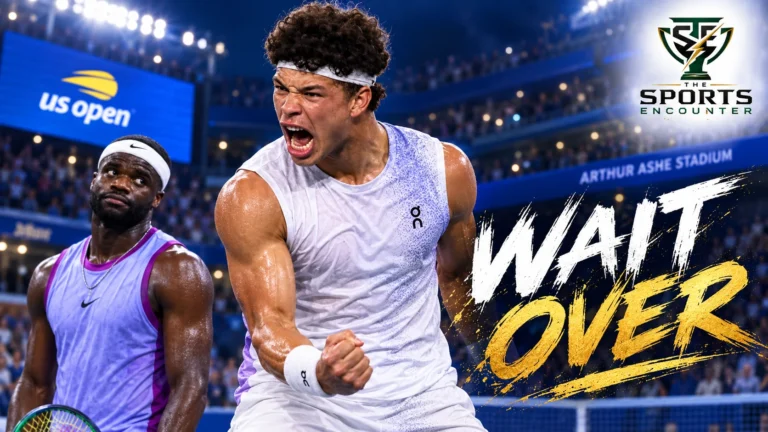
New York, United States: Frances Tiafoe spent the first two sets of his US Open quarterfinal looking like a man whose tournament was slipping away. More than four hours later, he was standing in an Arthur Ashe Stadium that had turned into a cauldron, celebrating one of the most remarkable victories of his career.
The No. 11 seed recovered from two sets down to defeat fellow American Alex Michelsen 5-7, 3-6, 7-5, 6-3, 7-6, winning the deciding match tiebreak 10-6 and reaching the US Open semifinals for the third time.
The numbers barely explain what happened. Michelsen struck 21 aces to Tiafoe’s 10. He won 173 total points to Tiafoe’s 170. Both men broke serve eight times. Michelsen even collected more receiving points.
Tiafoe won the points that decided the match.
Story at a glance

Michelsen Had the Match Moving Exactly Where He Wanted
For two sets, Michelsen looked closer to his first Grand Slam semifinal than Tiafoe did to extending the match.
The Third Set Became Tiafoe’s Line in the Sand
Tiafoe did not suddenly dominate the match. That is part of what makes the comeback more impressive.
The Fourth Set Turned a Comeback Into a Genuine Threat
Winning one set kept Tiafoe alive. Winning the fourth changed everything.
The Fifth Set Became a Battle for Survival
Michelsen repeatedly put himself in front during the deciding set, but Tiafoe would not disappear.
Tiafoe Won Despite Michelsen Winning More Total Points
This is the statistic that best captures the strange brutality of the match.
That is what separated an exhausting quarterfinal from an unforgettable one.
The comeback also extends an extraordinary New York run for Tiafoe, who had already removed former champion Daniil Medvedev in straight sets during the fourth round. The Sports Encounter followed the changing men’s draw in our US Open quarterfinal race analysis, where Michelsen’s breakthrough and Tiafoe’s growing momentum had already emerged as major American storylines.
Tiafoe vs Michelsen: Quarterfinal at a Glance
| Match Detail | Frances Tiafoe | Alex Michelsen |
|---|---|---|
| Final result | Winner | Eliminated |
| Set scores | 5-7, 3-6, 7-5, 6-3, 7-6 | |
| Deciding match tiebreak | 10 | 6 |
| Aces | 10 | 21 |
| Double faults | 4 | 9 |
| Break points converted | 8/17 | 8/23 |
| Tiebreaks won | 1 | 0 |
| Receiving points won | 62 | 73 |
| Total points won | 170 | 173 |
| Games won | 28 | 27 |
| Service points won | 108 | 100 |
| Service games won | 19 | 19 |
Michelsen Had the Match Moving Exactly Where He Wanted
For two sets, Michelsen looked closer to his first Grand Slam semifinal than Tiafoe did to extending the match.
The 22-year-old entered the quarterfinal without dropping a set through four rounds, having beaten Brandon Nakashima and Tomas Martin Etcheverry along the way. The official US Open quarterfinal preview noted that this was Michelsen’s first Grand Slam quarterfinal and that Tiafoe had won both of their previous meetings in straight sets.
None of that history seemed particularly relevant once the match began.
Michelsen took the opening set 7-5 and followed it with a 6-3 second set. His serve repeatedly pushed Tiafoe backward, and his 21 aces across the match reflected how difficult it became for Tiafoe to establish consistent return pressure.
At two sets to love, the younger American had taken control of the scoreboard and forced the more experienced player into a narrow survival route.
The Third Set Became Tiafoe’s Line in the Sand
Tiafoe did not suddenly dominate the match. That is part of what makes the comeback more impressive.
He had to fight his way into it.
The third set remained tight deep into its closing stages, with Michelsen still close enough to believe the semifinal could be finished without entering a fourth. Tiafoe found the break he needed and took the set 7-5.
That changed the emotional balance inside Arthur Ashe Stadium.
A match that had felt like Michelsen’s opportunity suddenly became a test of whether he could prevent the crowd, the occasion and Tiafoe’s experience from joining forces against him.
Tiafoe had already demonstrated his ability to survive long matches earlier in the tournament. He needed five sets against Martin Damm in the first round before progressively improving, eventually producing his best tennis to eliminate Medvedev. That progression was part of The Sports Encounter’s broader examination of a US Open men’s draw repeatedly disrupted by upsets and difficult conditions.
The Fourth Set Turned a Comeback Into a Genuine Threat
Winning one set kept Tiafoe alive. Winning the fourth changed everything.
He took it 6-3 and forced a deciding set after having been two sets from elimination.
By then, the match had moved beyond tactics alone. Fatigue, nerve, crowd reaction and the accumulated pressure of almost every service game had become part of the contest.
Tiafoe looked increasingly comfortable feeding off the Arthur Ashe atmosphere. Michelsen, to his credit, did not collapse. He continued serving aggressively, continued holding under pressure and carried the quarterfinal deep into the fifth.
The battle had become exactly what neither player could control completely.
The Fifth Set Became a Battle for Survival
Michelsen repeatedly put himself in front during the deciding set, but Tiafoe would not disappear.
At 3-3, the sense inside Arthur Ashe was no longer that one player had momentum. Every service game carried the possibility of deciding the match.
Michelsen edged ahead again. Tiafoe answered again.
Neither could create enough separation to finish the other before the deciding match tiebreak.
After more than four hours of tennis, the entire quarterfinal came down to a race to 10 points.
Tiafoe won it 10-6.
The official US Open had highlighted before the quarterfinal that Tiafoe had already reached the semifinals here in 2022 and 2024, while Michelsen was entering the last eight of a major for the first time. That difference in late-round Grand Slam experience finally became most visible when the match had nowhere left to hide. USOpen.org also noted that Tiafoe entered the match leading their head-to-head 2-0.
Tiafoe Won Despite Michelsen Winning More Total Points
This is the statistic that best captures the strange brutality of the match.
Michelsen won 173 points.
Tiafoe won 170.
Michelsen lost.
That three-point imbalance is a useful reminder that tennis does not reward accumulation evenly. A player can win more points across four hours and still lose because certain points carry far greater consequences than others.
Tiafoe’s advantage came from timing.
He converted eight of 17 break opportunities. Michelsen also broke eight times, but needed 23 chances to do it. When the match reached the final tiebreak, Tiafoe again found the cleaner execution.
The scoreboard therefore tells a more important story than the raw point total.
Michelsen won slightly more tennis. Tiafoe won the match.
Michelsen’s 21 Aces Could Not Finish the Job
Michelsen’s serving deserves considerable credit.
Twenty-one aces in a Grand Slam quarterfinal against a returner of Tiafoe’s athletic quality is an enormous number. His first strike repeatedly protected him during difficult service games and helped keep the fifth set balanced.
Yet the serve also came with volatility.
Michelsen committed nine double faults, more than twice Tiafoe’s four.
That contrast became increasingly relevant as pressure intensified. Aces can shorten service games, but double faults can surrender momentum without forcing an opponent to earn it.
Tiafoe’s serve was less spectacular statistically, but it became more dependable as the match developed.
Sixteen Breaks Show How Unstable This Match Became
Both players converted eight break points.
Sixteen breaks of serve across five sets underline how often control changed hands.
This was not one of those five-set matches where both players protected serve comfortably until one loose game decided everything. Service games repeatedly became pressure events.
Michelsen faced 17 break points.
Tiafoe faced 23.
The younger American created more opportunities, but could not turn that statistical advantage into the one additional break that might have ended the contest.
Tiafoe survived 15 of the 23 break points he faced. That resistance became one of the hidden foundations of the comeback.
Tiafoe’s US Open Relationship Keeps Producing Something Different
Some players have tournaments where their tennis consistently looks more natural.
For Tiafoe, New York has become that place.
Before this quarterfinal, the official tournament record showed that he had reached the US Open semifinals in both 2022 and 2024. He had also made the second week in six of the previous seven editions.
His 2026 run has developed in a very different way.
The first round required five sets. The middle rounds became progressively cleaner. Medvedev was beaten in straight sets. Michelsen then pushed him into a four-hour fight from two sets down.
There has been no single version of Tiafoe throughout this tournament.
That adaptability may now be his greatest strength.
The Medvedev Win Looks Even More Important Now
Tiafoe’s fourth-round victory over Daniil Medvedev was impressive because of how controlled it looked.
He beat the 2021 US Open champion 7-6(1), 6-4, 7-6(6), reversing a head-to-head matchup in which Medvedev had historically held the advantage.
The Sports Encounter examined that victory within our US Open quarterfinal race report.
The Michelsen match required almost the opposite skill set.
Against Medvedev, Tiafoe played from a position of control.
Against Michelsen, he spent much of the afternoon searching for a way back.
Winning both matches reveals more about his current form than either result would on its own.
Michelsen Leaves New York With His Status Changed
The defeat is painful because Michelsen was so close.
He was two sets ahead.
He won more total points.
He hit 21 aces.
He created 23 break opportunities.
He came within a deciding tiebreak of his first Grand Slam semifinal.
That should not obscure what this tournament has done for his career.
Michelsen arrived ranked No. 46 and reached his first major quarterfinal without dropping a set. His run included victories over seeded opponents and established him as considerably more than an interesting young American prospect.
The Sports Encounter had already identified his emergence as one of the key developments in the reshaping of the US Open men’s draw.
That assessment looks stronger now, even after defeat.
American Men Have Their Semifinalist
The quarterfinal guaranteed an American man would reach the last four.
Six Americans reached the singles quarterfinals across the men’s and women’s draws, the most at the US Open since 2002. Tiafoe, Michelsen and Ben Shelton represented the men, while Coco Gauff, Jessica Pegula and Emma Navarro carried the women’s challenge. :contentReference[oaicite:0]{index=0}
The Sports Encounter has tracked that American surge throughout the fortnight. Coco Gauff’s quarterfinal qualification added another major domestic storyline, while Emma Navarro’s victory over Anna Kalinskaya created another all-American quarterfinal against Jessica Pegula.
Tiafoe has now ensured the American men will also have representation in the semifinals.
The Wider Men’s Draw Has Become Increasingly Unpredictable
Tiafoe’s comeback fits a tournament already defined by unstable matches and unexpected survivors.
Botic van de Zandschulp also recovered from two sets down to defeat Arthur Gea in a five-set Round-of-16 epic, a match The Sports Encounter covered in our report on another remarkable New York comeback.
The opening week had already removed Novak Djokovic, Andrey Rublev and several other established names. Our US Open rain, upsets and major exits analysis documented how quickly the men’s hierarchy began to change.
Tiafoe has now survived one of the matches most likely to define the second week.
This Run Started Before New York
Tiafoe did not arrive at the US Open searching for form.
He reached the Cincinnati Open final shortly before New York, beating Lorenzo Musetti and Brandon Nakashima before losing to Arthur Fils. The Sports Encounter covered that run in our Cincinnati final and US Open race analysis.
Those matches gave him repeated exposure to pressure situations on North American hard courts.
Nothing in Cincinnati could fully replicate a fifth-set match tiebreak inside Arthur Ashe Stadium, but the competitive foundation was already there.
Tiafoe’s Path Was Never Supposed to Look Like This
When the US Open draw was released, the men’s bracket looked considerably different.
Novak Djokovic, Daniil Medvedev, Carlos Alcaraz, Alexander Zverev and several other established contenders were positioned across a field that appeared more predictable on paper.
The Sports Encounter’s original US Open draw analysis explored those projected quarterfinals before the tournament began.
Almost immediately, the draw started breaking apart.
Djokovic disappeared in the first round.
Medvedev eventually ran into Tiafoe.
Michelsen emerged from outside the seeded group.
Tiafoe is now in the semifinal after surviving the player who had disrupted that section most convincingly.
From Curtain-Raiser to Final Four
The tournament began with questions around defending champion Carlos Alcaraz, the absence of Jannik Sinner, the American challenge and whether the men’s field could produce another unexpected deep run.
The Sports Encounter’s complete US Open 2026 curtain-raiser laid out those storylines before the first ball was struck.
Tiafoe has now turned the American question into something much more immediate.
He is two wins from the title.
The Next Challenge Will Be Even Bigger
Tiafoe’s semifinal opponent will come from the quarterfinal between defending champion Carlos Alcaraz and Ben Shelton.
Either matchup would create a huge New York story.
A meeting with Shelton would guarantee an American finalist and turn Arthur Ashe into a celebration of the deepest U.S. men’s run in years.
A meeting with Alcaraz would place Tiafoe opposite the defending champion and one of the strongest Grand Slam players of his generation.
The destination changes depending on the opponent.
The pressure does not.
What Tiafoe’s Comeback Really Says
There is a temptation after a comeback like this to describe it only through heart or fighting spirit.
The numbers show something more precise.
Tiafoe survived 23 break points and converted eight of his own 17 opportunities. He won eight fewer receiving points than Michelsen and three fewer total points, yet finished one game ahead across the match.
That is concentration under uneven pressure.
It also shows why the third set mattered so much.
Tiafoe did not need to suddenly become the statistically superior player. He needed to stop losing the decisive passages.
Once he did that, the quarterfinal began to tilt.
The Sports Encounter Verdict
Frances Tiafoe’s 2026 US Open quarterfinal will be remembered for the comeback, but the deeper story is how little separated the two Americans after more than four hours.
Michelsen hit more aces. He won more points. He generated more break opportunities and led by two sets.
Tiafoe still found a way through.
The third set kept him alive. The fourth set changed the emotional balance. The fifth turned into a fight in which neither player could create lasting separation, and the final match tiebreak demanded exactly the kind of experience Tiafoe has accumulated during repeated deep runs in New York.
Michelsen leaves with the disappointment of knowing how close he came, but also with evidence that his first Grand Slam quarterfinal was no accident.
Tiafoe leaves Arthur Ashe with something far more tangible.
A place in the US Open semifinals.
Again.
And after recovering from two sets down in a match where his opponent actually won more total points, the American dream of ending the country’s long wait for another men’s US Open champion remains very much alive.
For continuing tournament coverage, match analysis and Grand Slam reporting, visit The Sports Encounter Tennis Hub.
Continue the US Open 2026 Story


Frequently Asked Questions
Who won Frances Tiafoe vs Alex Michelsen at the 2026 US Open?
Frances Tiafoe defeated Alex Michelsen in five sets, 5-7, 3-6, 7-5, 6-3, 7-6, after winning the deciding match tiebreak 10-6.
Did Tiafoe come back from two sets down?
Yes. Michelsen won the opening two sets 7-5 and 6-3 before Tiafoe won the next three to complete the comeback.
Who won the fifth-set match tiebreak?
Tiafoe won the deciding match tiebreak 10-6.
How many aces did Michelsen hit?
Michelsen hit 21 aces compared with Tiafoe’s 10.
Who won more total points?
Michelsen won 173 total points compared with Tiafoe’s 170, despite losing the match.
How many break points did each player convert?
Both players converted eight break points. Tiafoe went 8-for-17, while Michelsen converted eight of 23 opportunities.
How many US Open semifinals has Tiafoe reached?
The 2026 run gives Tiafoe his third US Open semifinal appearance after also reaching the last four in 2022 and 2024.
Who will Tiafoe play in the semifinal?
Tiafoe will face the winner of the quarterfinal between Carlos Alcaraz and Ben Shelton.
Was this Michelsen’s first Grand Slam quarterfinal?
Yes. Michelsen reached the quarterfinals of a Grand Slam for the first time after advancing through his first four US Open matches without dropping a set.
Where was the match played?
The quarterfinal was played at Arthur Ashe Stadium at the USTA Billie Jean King National Tennis Center in New York.