


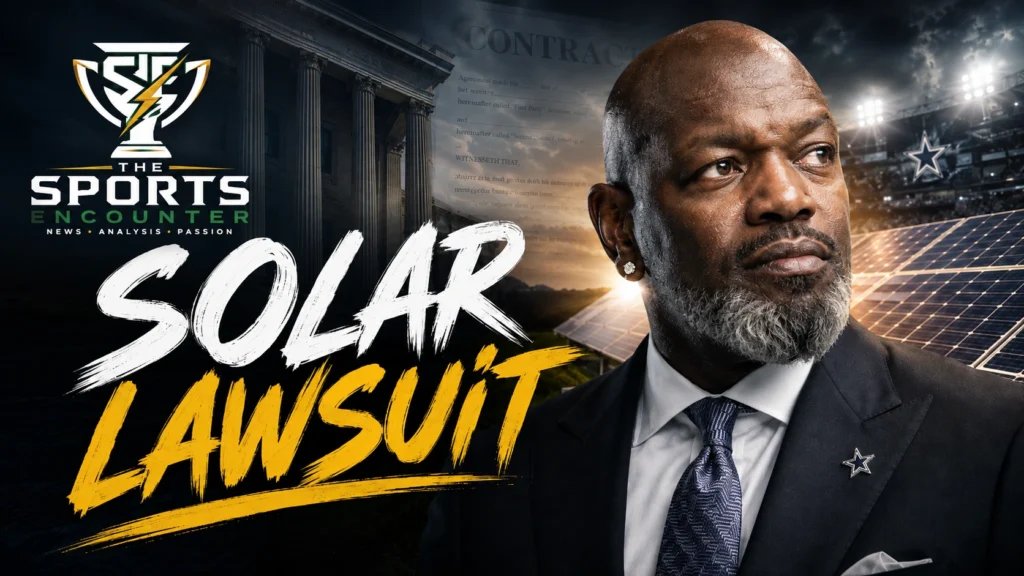
Emmitt Smith spent his football career building one of the most durable reputations in American sports. A new $2.5 million civil lawsuit now places that reputation beside a very different kind of record: allegations involving a failed Texas solar investment, disputed use of investor funds and an unpaid loan.
The important word is allegations.
Smith, the Dallas Cowboys legend and NFL’s all-time leading rusher, has been named in a lawsuit filed in Delaware’s Court of Chancery involving Kituwah LLC, a tribally owned investment company of the Eastern Band of Cherokee Indians.
The complaint alleges that Kituwah provided $2.5 million for a Texas solar-energy project known as Project Exodus after representations were made about the project’s development prospects, financing and commercial future.
Kituwah claims the money was not ultimately used for the purpose it understood it was funding.
According to the lawsuit, Smith, business partner David Mosley and their company, 4 13 Solutions Inc., allegedly caused or permitted the funds to be redirected toward repayment of an earlier obligation involving another party rather than advancing the solar project.
The plaintiff has characterized the alleged movement of money as resembling a Ponzi-style arrangement.
That description comes from the civil complaint. It is not a criminal finding, judicial ruling or established fact.
The lawsuit accuses the defendants of conduct including fraudulent inducement, breach of fiduciary duty and breach of contract. Kituwah is seeking recovery of at least the original $2.5 million investment, along with additional interest, costs and other relief.
Smith and the other defendants had not publicly responded to the allegations at the time the lawsuit became public.
For The Sports Encounter, the story matters for a reason beyond the famous name attached to the complaint.
Smith’s case sits at the intersection of athlete reputation, post-career business ventures, investment credibility and the enormous commercial value attached to retired sports legends. It also provides an important reminder that the credibility an athlete earns on the field does not automatically validate every business venture carrying that athlete’s name.
By The Sports Encounter Editorial Desk
Published: September 3, 2026
Updated: September 3, 2026
Emmitt Smith Solar Lawsuit: Key Facts
| Issue | Current Information |
|---|---|
| Plaintiff | Kituwah LLC |
| Defendants identified in reports | Emmitt Smith, David Mosley and 4 13 Solutions Inc. |
| Amount originally advanced | $2.5 million |
| Project | Project Exodus |
| Industry | Solar energy |
| Project location | Texas |
| Court | Delaware Court of Chancery |
| Central allegation | Investor funds were allegedly diverted from the solar project to satisfy another financial obligation |
| Loan maturity | February 1, 2024 |
| Current legal status | Civil allegations have been filed; no finding of liability has been established |
The case is being pursued in the Delaware Court of Chancery, a court that specializes heavily in corporate, fiduciary and business disputes involving Delaware entities.
Who Is Kituwah LLC?
Kituwah LLC is not presented in the lawsuit as an individual retail investor making a speculative personal bet.
The company describes itself as the tribally owned economic-development entity of the Eastern Band of Cherokee Indians.
According to Kituwah’s official website, it invests in and develops businesses intended to generate sustainable economic opportunities and long-term returns for the tribe.
That background gives the dispute an additional layer of significance.
The money at issue was tied to an institutional investment organization whose stated purpose is to build economic value for a tribal community.
Kituwah alleges that it entered the transaction after receiving information about Project Exodus, a proposed Texas solar project, and believed its $2.5 million would be used in connection with that development.
The complaint now claims the investment did not unfold as represented.
What Was Project Exodus?
Project Exodus was described as a solar-energy development in Texas.
The lawsuit alleges that Kituwah was presented with forecasts and representations suggesting the project had substantial commercial potential.
Those representations reportedly included expectations surrounding development progress, financing and the project’s path toward becoming operational.
Kituwah alleges that those expectations were important to its decision to advance the $2.5 million.
The dispute centers on what happened after the money was transferred.
According to the complaint, the funds were not used in the manner Kituwah believed had been agreed.
Instead, the plaintiff alleges that money was directed toward another financial obligation connected with an earlier investor or creditor.
That is the allegation at the center of the case.
Why the “Ponzi” Language Requires Careful Reporting
The phrase surrounding the case that will naturally attract the most attention is the plaintiff’s comparison to a Ponzi arrangement.
It needs to be handled carefully.
Kituwah alleges that its money was used to repay an earlier financial obligation rather than being deployed toward Project Exodus as expected.
That alleged sequence prompted the plaintiff to characterize the arrangement in Ponzi-like terms.
That does not mean Smith has been convicted of operating a Ponzi scheme.
There is no criminal conviction reflected in the reports surrounding this lawsuit, and the civil allegations have not yet been established through a final court judgment.
A complaint represents one side’s claims at the beginning of litigation.
The defendants are entitled to answer those allegations, challenge the evidence, dispute the plaintiff’s interpretation and present their own account of the transaction.
That legal distinction is especially important when the defendant is a highly recognizable public figure.
The Lawsuit Is About More Than an Unpaid Loan
If the dispute were simply about a loan reaching maturity without repayment, the case would still be commercially significant.
Kituwah’s allegations go further.
The plaintiff claims it was induced into the investment through misleading information and representations concerning the project.
It also alleges breaches involving contractual and fiduciary obligations.
Those claims shift the dispute from a straightforward debt collection issue into questions about how the investment was obtained and how the money was subsequently handled.
The court will ultimately determine which claims survive, what evidence supports them and whether any defendant bears civil liability.
Until then, the allegations remain allegations.
Why Emmitt Smith’s Name Changes the Public Impact of the Case
If an unknown developer were named in the same complaint, the dispute would probably remain largely inside business and legal circles.
Smith changes that immediately.
He is one of the most recognizable players in NFL history.
The Pro Football Hall of Fame credits Smith with 18,355 career rushing yards, 164 rushing touchdowns and 11 consecutive 1,000-yard seasons.
He won three Super Bowls with Dallas and entered Canton in 2010.
Smith’s football identity is deeply connected with the Cowboys, a franchise whose enormous commercial reach The Sports Encounter recently examined when Dallas reached an estimated $15.5 billion valuation.
That kind of legacy creates commercial credibility long after retirement.
A retired superstar can enter rooms, attract investment conversations and build business partnerships partly because decades of sporting success created trust around the name.
That does not prove anything about the allegations in this lawsuit.
It explains why the case attracts attention far beyond the solar-energy industry.
Sports Reputation Has Become a Business Asset
Modern elite athletes rarely stop being commercial entities when their playing careers end.
They invest in companies.
They build real-estate portfolios.
They launch media businesses.
They buy stakes in teams and leagues.
They enter venture capital, consumer products, restaurants, technology and entertainment.
The Sports Encounter has tracked the rapidly increasing value of that ecosystem through stories such as the $9.612 billion Seattle Seahawks ownership transaction and the broader rise in NFL franchise valuations.
Retired athletes often enter this world with advantages ordinary entrepreneurs cannot replicate.
They have recognition.
They have networks.
They have access.
They have personal brands built over decades.
Those strengths can create opportunities, but they can also increase reputational exposure when a business relationship breaks down.
Smith’s Football Legacy Remains Historically Secure
Whatever happens in the lawsuit, Smith’s place in NFL statistical history is not in dispute.
Dallas selected him in the first round of the 1990 NFL Draft.
He became the central running back in a Cowboys dynasty that won three Super Bowls during the 1990s.
Smith eventually surpassed Walter Payton’s career rushing record and retired with 18,355 yards.
That number remains the NFL record.
The historical significance of records like Smith’s is why Hall of Fame discussions continue to carry such weight. The Sports Encounter’s recent 2026 Pro Football Hall of Fame analysis examined how careers are ultimately preserved through performance, longevity and influence.
Smith already belongs permanently inside that history.
The current lawsuit concerns what happened years after the football achievements that put him there.
Athletes Eventually Have to Build a Second Identity
One of the most difficult transitions in professional sports comes after retirement.
An athlete can spend 15 years being evaluated almost entirely through competition and then suddenly enter industries where touchdowns, championships and popularity no longer determine outcomes.
Business operates differently.
Contracts matter.
Disclosure matters.
Capital structure matters.
Governance matters.
Investor communication matters.
Cash flow matters.
Due diligence matters.
The Sports Encounter recently examined a very different version of that transition when Aaron Donald returned to the NFL after retirement.
Some stars remain connected to competition.
Others move toward business, broadcasting, ownership or advocacy.
Each route creates a different second chapter.
Legacy Is Broader Than the Hall of Fame
The NFL has become increasingly sophisticated about how it preserves and markets former players.
The league recently changed its own approach to player recognition by ending the traditional Pro Bowl game while protecting the value of Pro Bowl selection.
That decision reflects how much legacy matters within professional football.
Retired stars remain ambassadors, business partners, television personalities, investors and public figures long after their final snap.
Smith represents that reality at the highest level.
His playing career has been over for more than two decades, yet his name still carries immediate national recognition.
The lawsuit therefore creates reputational stakes that extend beyond a normal commercial disagreement.
The Case Also Highlights the Importance of Investment Due Diligence
Celebrity involvement can influence how an opportunity feels.
It should never replace independent investment analysis.
Any commercial project should ultimately be evaluated through documentation, ownership structure, contractual rights, financial projections, use-of-funds controls, collateral, governance and enforceability.
That principle applies whether the public face of a venture is a Hall of Fame athlete, celebrity entrepreneur or unknown developer.
The complaint involving Smith illustrates why those structures matter.
The plaintiff alleges that what happened to its money differed materially from the purpose for which it believed the money had been advanced.
Whether that allegation can be proved is now a legal question.
The broader investment lesson exists independently of the eventual verdict.
Reputation can open a conversation.
Documentation has to protect the capital.
The NFL’s Commercial Scale Makes Former Players Increasingly Valuable
Smith’s post-career visibility also needs to be understood against the extraordinary economics surrounding professional football.
The Cowboys now sit at the top of a league where franchise values have climbed rapidly, and the NFL’s business reach extends into television, sponsorship, merchandise, international expansion, gaming, real estate and entertainment.
Our 2026 NFL valuation analysis found Dallas leading the league at an estimated $15.5 billion while the average franchise had risen to approximately $9.34 billion.
Former stars become commercially valuable extensions of that ecosystem.
Their names carry decades of accumulated audience trust.
That makes responsible business governance around athlete-led ventures especially important.
Public Reputation Can Move Faster Than a Court Case
Civil litigation often takes months or years.
Online judgment can happen in minutes.
That mismatch is one of the most difficult aspects of legal stories involving famous athletes.
A headline containing “$2.5 million,” “lawsuit” and “Emmitt Smith” can travel before most readers understand what has actually been alleged.
The same dynamic has affected athletes whose influence continues long after they leave the field.
The Sports Encounter recently explored another type of post-career public identity when Colin Kaepernick received the Muhammad Ali Center’s Humanitarian of the Year honor.
Former players rarely control the context in which their names return to public attention.
Smith now faces one of the least comfortable versions of that reality.
What Happens Next in the Emmitt Smith Lawsuit?
The next important stage will be the defendants’ formal response.
Smith, Mosley and the other parties named in the litigation can challenge the factual allegations, legal theories, claimed damages and interpretation of the transaction.
The court may eventually address motions to dismiss, discovery disputes, evidentiary questions or settlement discussions before any trial becomes necessary.
Many commercial lawsuits never reach a final courtroom judgment.
Some are dismissed.
Some claims survive while others do not.
Some cases settle privately.
Others proceed through discovery and trial.
At this stage, none of those outcomes should be assumed.
The Sports Encounter Analysis: Separate the Football Legend From the Legal Evidence
Emmitt Smith’s football career makes this lawsuit newsworthy.
It should not decide how the lawsuit is understood.
His three Super Bowl titles cannot prove that the allegations are false.
His fame cannot prove that they are true.
The evidence has to do that work.
That is the proper way to approach a case involving one of the most recognizable players the NFL has produced.
Smith remains the league’s all-time rushing leader and a member of the Pro Football Hall of Fame.
He is also now a defendant in a civil commercial dispute involving serious allegations about investor money.
Both statements can exist simultaneously without one determining the other.
The case also arrives at a time when former NFL stars possess greater commercial influence than ever. The league’s economic growth has turned historic players into valuable media personalities, ambassadors, investors and business partners long after retirement.
That wider NFL evolution can be seen throughout The Sports Encounter’s coverage, from the record Seahawks ownership transition to the new generation attempting to establish itself during the 2026 preseason.
Smith belongs to the generation that helped make the modern NFL commercially enormous.
His business life after football deserves to be judged by a different standard.
The $2.5 million Project Exodus dispute will now move through the legal system, where contracts, records, communications and the actual movement of money will matter far more than rushing yards or Super Bowl rings.
Until that process produces clearer answers, the responsible conclusion is straightforward: serious allegations have been made, Smith has not been found liable, and the evidence still has to be tested.
Frequently Asked Questions About the Emmitt Smith Lawsuit
Why is Emmitt Smith being sued?
Kituwah LLC alleges that Smith and business associates were involved in a transaction in which $2.5 million intended for a Texas solar-energy project was diverted from its stated purpose.
How much money is involved in the Emmitt Smith lawsuit?
The original investment at the center of the lawsuit was $2.5 million. Kituwah is seeking recovery of that amount along with additional interest, costs and other relief.
What was Project Exodus?
Project Exodus was presented as a proposed solar-energy development in Texas. The lawsuit concerns representations made about the project and the alleged use of investor funds.
Who is suing Emmitt Smith?
Kituwah LLC, a company wholly owned by the Eastern Band of Cherokee Indians, brought the lawsuit.
Where was the lawsuit filed?
The case was filed in Delaware’s Court of Chancery, which handles many corporate, fiduciary and business disputes involving Delaware entities.
Has Emmitt Smith been found guilty of fraud?
No. This is a civil lawsuit containing allegations. No court finding establishing fraud or civil liability has been reported at this stage.
Is Emmitt Smith accused of running a Ponzi scheme?
The plaintiff has used Ponzi-style language to describe the alleged movement of funds. That characterization is part of the plaintiff’s allegations and is not a criminal conviction or judicial finding.
Has Emmitt Smith responded to the lawsuit?
No public response from Smith was reported when the allegations became public. His position may become clearer through a formal court response or subsequent statement.
How many rushing yards did Emmitt Smith record in the NFL?
Smith finished his career with 18,355 rushing yards, the most in NFL history.
How many Super Bowls did Emmitt Smith win?
Smith won three Super Bowl championships with the Dallas Cowboys during the 1990s.