Connect with us

Published

on

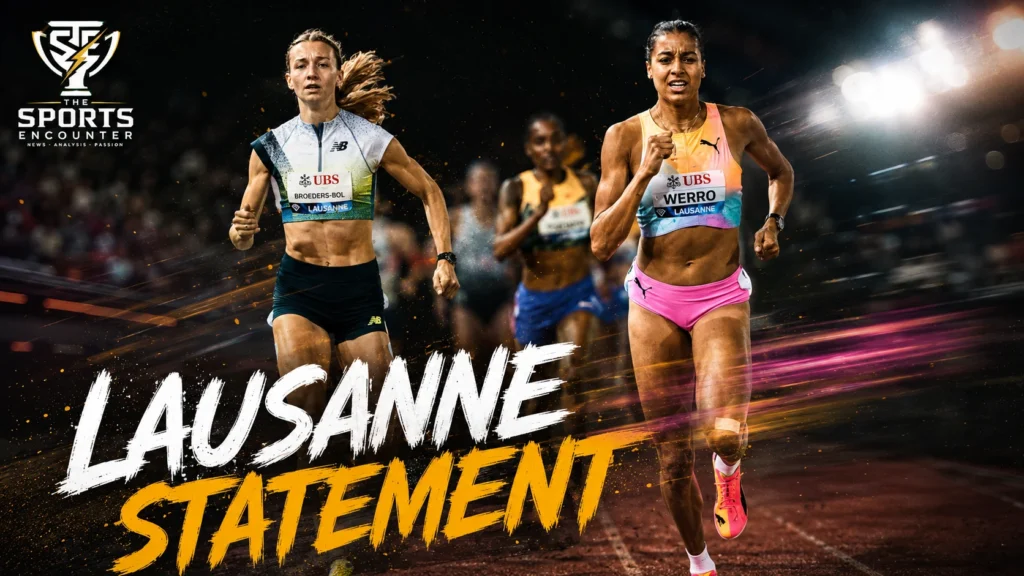
LAUSANNE, Switzerland, August 22, 2026: Audrey Werro returned home as European champion and left Lausanne with another reminder that the women’s 800 meters has changed around her.

The 22-year-old Swiss star won the Athletissima women’s 800m in a meeting-record 1:55.33, surviving a furious late charge from Femke Broeders-Bol to continue a season that has already pushed her into the all-time elite of the event.

Werro’s victory was only one part of a Lausanne Diamond League meeting that doubled as an important form check before next month’s World Athletics Ultimate Championships in Budapest.

Letsile Tebogo won the men’s 200m in 19.87. Emmanuel Wanyonyi finally claimed his first 800m victory of the season in 1:42.19. Masai Russell extended her unbeaten run in the women’s 100m hurdles. Winfred Yavi beat world champion Faith Cherotich in the steeplechase. Kayla White won the women’s 200m, where Shericka Jackson pulled up with an apparent hamstring problem.

One night earlier, Mondo Duplantis had already turned Lausanne into one of the standout Diamond League meetings of the year by clearing 6.21m, with Emmanouil Karalis pushing him through a historic pole vault battle. World Athletics confirmed that Karalis cleared 6.16m, the highest ever non-winning mark in the event.

Friday’s main stadium program then shifted the conversation from records to championship momentum.

For Werro, Tebogo and Wanyonyi especially, Lausanne felt less like another stop on the circuit and more like a message to Budapest.

Lausanne Diamond League 2026: Key Results

EventWinnerWinning MarkMain Story
Women’s 800mAudrey Werro1:55.33Meeting record and home victory
Men’s 200mLetsile Tebogo19.87Strong Budapest statement
Men’s 800mEmmanuel Wanyonyi1:42.19First 800m win of the season
Women’s 200mKayla White22.18Shericka Jackson pulls up injured
Women’s 100m hurdlesMasai Russell12.27Ninth consecutive victory
Women’s 3000m steeplechaseWinfred Yavi9:00.04Beat Faith Cherotich

The official World Athletics Diamond League hub provides the updated schedule, results and standings for the closing stages of the season.

Audrey Werro Finds Another Way to Win

Werro’s season has already been defined by speed.

Lausanne was more revealing because she won without producing anything close to her fastest performance.

She had run 1:53.98 in Stockholm earlier this season before improving to 1:53.80 in Paris, performances that established her among the fastest women in 800m history.

World Athletics identified her as one of Lausanne’s major attractions after she followed those performances by winning the European title in Birmingham.

The Sports Encounter has tracked that rise closely. Only days before Lausanne, Werro’s European Championship appeared to have disappeared when she fell during the 800m semifinal in Birmingham. A successful Swiss appeal restored her to the final, a remarkable sequence detailed in our report on Werro’s fall and reinstatement.

She then turned the reprieve into gold.

Lausanne asked a different question.

Could she recover quickly enough from the physical and emotional demands of Birmingham and still beat another world-class field?

She did.

Werro Went Out Hard and Almost Paid for It

Werro attacked the race aggressively and began to fade over the final 200 meters after a very fast opening lap.

That created an opportunity for Broeders-Bol.

The Dutch athlete, already a double world champion in the 400m hurdles before moving into the 800m this season, closed rapidly through the final straight.

Werro reached the line in 1:55.33.

Broeders-Bol finished in 1:55.41.

Eight hundredths separated them.

The Swiss victory also produced a Lausanne meeting record.

It was not Werro’s fastest race.

It may have been one of her most useful.

Why the 1:55.33 Matters More Than It Looks

A runner who has already gone 1:53 can make 1:55 look ordinary on paper.

Championship athletics works differently.

Budapest will not necessarily be paced perfectly. There may be contact, tactical hesitation or an opening lap that develops far differently from what the favorites want.

Werro has already shown this season that she can run historically fast times.

Lausanne showed she can still win after misjudging parts of a race and carrying fatigue from a major championship.

That ability may matter more in Budapest than another personal best.

Broeders-Bol Is Becoming a Serious 800m Threat

Broeders-Bol’s second place should not disappear beneath the Werro celebration.

Her transition from 400m hurdles to 800m has rapidly moved from experiment to legitimate global story.

She ran 1:55.41 in Lausanne, nearly stealing the race after Werro appeared to have established enough separation.

Her own assessment after the race was revealing. Broeders-Bol said the performance strengthened her belief that she belongs among the best and that she still needs to trust herself more after 500 meters.

That sounds like an athlete who believes there is significantly more available.

The Women’s 800m Is Becoming One of Budapest’s Best Events

Werro and Broeders-Bol are only part of the picture.

Keely Hodgkinson remains the Olympic champion. World champion Lilian Odira remains dangerous. Georgia Hunter Bell has produced major performances this summer.

Werro has now beaten elite opposition repeatedly, including Hodgkinson on her way to the European title.

The Sports Encounter’s Birmingham coverage of Werro showed how quickly the event has become less predictable than it appeared at the beginning of the season.

Lausanne reinforced that shift.

Letsile Tebogo Executes the Race He Wanted

There was far less drama in the men’s 200m.

Tebogo won in 19.87, only 0.03 outside his season best.

South Africa’s Sinesipho Dambile finished second in 19.98.

The most impressive element was the way Tebogo described the performance afterward.

His focus was on the bend and the first 150 meters rather than chasing a spectacular time.

That is exactly the kind of language expected from an Olympic champion entering the final phase before another major championship.

The work is becoming more specific.

The times are becoming secondary to execution.

Tebogo’s 19.87 Is a Warning Without Being a Peak

Running 19.87 in August is obviously fast.

The more significant point is that Tebogo does not appear to believe he has reached the end of his preparation.

He said the previous five weeks had focused heavily on gym work and acknowledged the difficulty of maintaining elite form throughout an entire season.

That matters ahead of Budapest.

Many championship favorites arrive at late-season meetings trying to protect their bodies while holding enough sharpness to remain competitive.

Tebogo appears to be doing both.

His 19.87 suggests the speed is there.

The rest becomes timing.

Mental Management Has Become Part of Tebogo’s Championship Plan

Tebogo also spoke openly about protecting his mental health through the final phase of the season.

That should not be dismissed as a casual post-race remark.

Elite sprinting demands repeated peaks across championships, Diamond League meetings, travel and promotional obligations.

Tebogo said he now wants to enjoy racing rather than allow the final weeks of the season to become mentally draining.

The comment provides important context around his approach to Budapest.

He is trying to arrive fast without arriving exhausted.

Emmanuel Wanyonyi Finally Gets His 800m Win

The men’s 800m produced one of the strongest finishes of the meeting.

Wanyonyi powered through the final 20 meters to win in 1:42.19, securing his first 800m victory of the season.

Djamel Sedjati finished second in 1:42.31.

Brandon Miller took third in 1:42.55.

Marco Arop, who had controlled much of the race, faded to fourth.

The margin between Wanyonyi and Sedjati was only 0.12 seconds.

Why Wanyonyi Needed This Win

Wanyonyi is already an Olympic champion.

He does not need a Lausanne victory to establish his credentials.

He did need evidence that his closing power remained available before Budapest.

The final 20 meters provided it.

Wanyonyi admitted afterward that his legs were tightening over the final 100 meters, but he continued driving toward the line.

That is an important championship signal.

The 800m often becomes a strength contest in the closing straight, particularly when several athletes enter the final bend within striking distance.

Wanyonyi showed that he could still find another gear while under physical stress.

Lausanne Had Special Meaning for Wanyonyi

Wanyonyi was returning to the venue where he ran 1:41.11 in 2024, a performance that placed him among the fastest 800m runners in history.

He did not approach that mark on Friday.

He did not need to.

The victory was about re-establishing competitive rhythm rather than rewriting history.

Wanyonyi, Sedjati and Arop Are Heading Toward Another Battle

The men’s 800m continues to look like one of the deepest events in world athletics.

Wanyonyi owns Olympic authority.

Arop owns championship pedigree.

Sedjati remains one of the fastest athletes in the event and was only 0.12 behind in Lausanne.

Miller’s 1:42.55 further illustrated how little separation exists near the front.

One tactical error in Budapest could move an athlete from gold-medal contention to outside the podium.

Kayla White Wins as Shericka Jackson Pulls Up

The women’s 200m produced the most concerning moment of the night.

American Kayla White won in 22.18.

Amy Hunt finished second in 22.32, continuing an outstanding month after her historic European Championships.

Favour Ofili took third following a photo finish.

The result itself, however, was overshadowed by Shericka Jackson pulling up with an apparent hamstring injury coming off the bend.

The seriousness of the problem was not immediately clear.

With Budapest approaching, any muscular issue involving a two-time world 200m champion becomes significant.

Amy Hunt Keeps Producing After Birmingham

Hunt’s second place deserves attention because of what she had done only days earlier.

The British sprinter became the first athlete to win four gold medals at a single European Championships in Birmingham.

The Sports Encounter followed that rise from the beginning, including her opening-night European 100m title and the wider championship momentum that followed.

She arrived in Lausanne with very little recovery time and still ran 22.32 against a strong Diamond League field.

That is another encouraging indicator before Budapest.

Hunt’s Summer Has Changed Her Global Status

Earlier in the season, Hunt was still being evaluated primarily as one of Britain’s rising sprint talents.

Birmingham changed that.

She entered the European Championships having already produced major performances and left carrying four gold medals.

The Sports Encounter’s Birmingham Day 2 coverage showed how Britain’s sprint success kept accelerating, while Day 3 documented Hunt’s continued presence among the championship’s standout performers.

Lausanne now shows she has carried that level beyond the emotional lift of a home championship.

Masai Russell Extends Her Perfect Run

Olympic champion Masai Russell continued one of the most consistent seasons in athletics by winning the women’s 100m hurdles in 12.27.

It was her ninth consecutive victory of the season.

The American had not raced for a month, which made the result particularly useful as a Budapest indicator.

There was no obvious rust.

Russell controlled the race from the opening barrier and maintained her unbeaten sequence.

World Athletics had identified her as one of Lausanne’s headline performers after she ran 12.14 earlier this year, only 0.02 outside the world record.

Russell’s Consistency May Be Her Biggest Weapon

Hurdles races can collapse through one mistake.

A poor first barrier can destroy rhythm.

One clipped hurdle can change an entire final.

Russell has repeatedly avoided those problems this season.

Nine straight victories indicate more than speed.

They indicate reliability.

That quality becomes especially valuable at a championship requiring rounds before the final.

Winfred Yavi Beats Faith Cherotich

The women’s 3000m steeplechase produced another elite head-to-head.

Olympic champion Winfred Yavi won in 9:00.04.

Kenya’s world champion Faith Cherotich followed in 9:01.90.

Both athletes had already run 8:51 during the season, making Lausanne another important test before Budapest.

Yavi’s victory gives her another psychological edge before they potentially meet again in the championship final.

Duplantis Had Already Set the Tone One Night Earlier

Lausanne’s biggest performance may technically have happened before the main Friday program.

Duplantis cleared 6.21m during Thursday’s city pole vault competition.

Karalis responded with 6.16m.

Only Duplantis himself has ever cleared higher than 6.21m, according to World Athletics.

The contest provided an ideal opening to a meeting that repeatedly produced elite performances without requiring a world record on the second night.

Duplantis and Karalis showed what late-season championship preparation can look like when both athletes are already operating close to historic levels.

Lausanne Was About Budapest More Than Lausanne

The timing of Athletissima changes how every result should be interpreted.

The World Athletics Ultimate Championships are approaching.

Many athletes are carrying European Championship fatigue.

Others are returning from training blocks.

Some are trying to secure Diamond League Final positions.

The biggest names are also monitoring their own bodies, technical execution and recovery.

Winning still matters.

Qualification matters.

But late-season races increasingly become rehearsals for championship pressure.

Who Sent the Strongest Budapest Message?

AthleteLausanne ResultBudapest Signal
Audrey Werro1st, 800m, 1:55.33Can win despite fatigue and late pressure
Letsile Tebogo1st, 200m, 19.87Speed and technical execution are already sharp
Emmanuel Wanyonyi1st, 800m, 1:42.19Closing strength returns at the right time
Masai Russell1st, 100m hurdles, 12.27Unbeaten consistency survives month-long break
Winfred Yavi1st, 3000m steeplechase, 9:00.04Another win over major rival Faith Cherotich
Amy Hunt2nd, 200m, 22.32European Championship form carries into Diamond League

TSE Analysis: Werro’s Victory May Have Been the Most Valuable Performance

Tebogo ran faster relative to his event.

Wanyonyi produced one of the year’s strongest 800m times.

Russell remained unbeaten.

Yet Werro may have learned the most about herself.

She arrived tired.

She went out aggressively.

Broeders-Bol closed the gap.

The race became uncomfortable.

Werro still won.

That is championship information.

Her season had already established that she can run fast when conditions allow it.

Lausanne established that she can protect a race when those conditions begin moving against her.

After the chaos of Birmingham, where her semifinal fall nearly ended her European title bid, the progression is striking.

She has experienced the full range of middle-distance pressure in barely more than a week.

And she keeps winning.

The Women’s 800m Has a New Center of Gravity

For years, the event’s hierarchy was easy to frame around established Olympic and world champions.

Werro has complicated it.

Her 1:53 performances moved her into historic territory.

Her European title gave the speed championship credibility.

Her Lausanne win showed she can absorb fatigue and tactical imperfection.

Broeders-Bol’s continued improvement adds another problem for the rest of the field.

Hodgkinson remains dangerous.

Odira remains dangerous.

Budapest now looks less like a contest with one obvious favorite and more like an event that could be decided by positioning over the final 200 meters.

Tebogo and Wanyonyi Are Approaching Budapest Differently

Tebogo appears focused on precision.

Wanyonyi appears focused on competitive strength.

Those approaches fit their events.

The 200m rewards technical execution through the bend and maintenance of speed into the straight.

The 800m often requires an athlete to survive contact, positioning changes and fatigue while still producing a final acceleration.

Lausanne gave both champions evidence that the necessary pieces are arriving at the right time.

Shericka Jackson’s Injury Is the Major Concern

Every major meeting produces winners.

Sometimes the most important development comes from somebody who does not finish.

Jackson’s apparent hamstring problem could significantly affect the women’s sprint picture if it proves serious.

There was no confirmed diagnosis immediately after the race.

Until one is provided, any projection about Budapest would be premature.

What is clear is that a hamstring issue only weeks before a major championship creates uncertainty for an athlete whose career has been built around explosive sprint mechanics.

What Comes Next on the Diamond League Circuit?

The Diamond League moves from Lausanne to Silesia on August 23, followed by Zurich on August 27 and the Brussels final on September 4-5.

Readers can follow the updated calendar, standings and qualification picture through the official World Athletics Diamond League schedule.

For athletes already carrying heavy championship workloads, the next two weeks become a balancing act.

Race enough to stay sharp.

Avoid accumulating unnecessary fatigue.

Protect injuries.

Secure qualification where necessary.

Final Verdict

Lausanne did not need a world record on Friday to tell us something important about the next month of athletics.

Audrey Werro remains one of the central names in the 800m conversation after surviving a race that became far more difficult than expected.

Letsile Tebogo looks fast without appearing fully peaked.

Emmanuel Wanyonyi rediscovered the closing power that makes him so dangerous over two laps.

Masai Russell remains perfect.

Winfred Yavi beat the world champion.

Amy Hunt continues to carry her European Championship form into the global circuit.

Shericka Jackson, meanwhile, leaves Lausanne with an injury question that could matter far more than one Diamond League result.

The meeting began with Duplantis flying over 6.21m and ended with several Olympic champions reminding the rest of the world that their own seasons are moving toward another peak.

Budapest is still weeks away.

Lausanne made it feel considerably closer.

Frequently Asked Questions

Who won the women’s 800m at the Lausanne Diamond League?

Audrey Werro won in 1:55.33, holding off Femke Broeders-Bol by 0.08 seconds.

Was Audrey Werro’s 1:55.33 a meeting record?

Yes. Werro’s winning performance established a Lausanne meeting record.

Who won the men’s 200m in Lausanne?

Olympic champion Letsile Tebogo won in 19.87 seconds, with South Africa’s Sinesipho Dambile second in 19.98.

Who won the men’s 800m?

Emmanuel Wanyonyi won in 1:42.19, ahead of Djamel Sedjati in 1:42.31 and Brandon Miller in 1:42.55.

What happened to Shericka Jackson?

Jackson pulled up with an apparent hamstring injury during the women’s 200m. No confirmed diagnosis was immediately available.

Who won the women’s 200m?

Kayla White won in 22.18 seconds, with Amy Hunt second in 22.32.

How many races has Masai Russell won in a row?

Russell’s 12.27 victory in Lausanne extended her winning streak to nine consecutive races this season.

Who won the women’s 3000m steeplechase?

Winfred Yavi won in 9:00.04 ahead of world champion Faith Cherotich, who finished in 9:01.90.

What did Mondo Duplantis clear in Lausanne?

Duplantis cleared 6.21m during the city pole vault competition, while Emmanouil Karalis cleared 6.16m.

When is the next Diamond League meeting?

The next Diamond League stop is Silesia on August 23, followed by Zurich on August 27 and the Brussels final on September 4-5.


Elma Victors is a London-based accounting professional and sports writer covering cricket, soccer, tennis, major international competitions, and the business and commercial side of sport. Her analytical background shapes a detail-oriented approach to sports journalism, with particular attention to statistics, performance trends, financial developments, sponsorships, contracts, and the wider context behind major sporting stories. At The Sports Encounter, Elma contributes match reports, breaking news, player-focused features, tournament analysis, and stories examining the commercial forces influencing modern sport. Her work combines clear reporting with statistical context and a practical understanding of how decisions made away from the field can affect teams, athletes, competitions, and supporters. Based in London, she brings both a global sports perspective and an analytical mindset to coverage across major leagues, tournaments, and international events.

Athletics

Athletics Gets a Makeover as Ultimate Championship Introduces Radical New Rules

World Athletics is using its inaugural Ultimate Championship in Budapest as a test lab for the future of track and field, introducing live 200m lane drafts, mandatory jump-offs, streamlined field events, augmented broadcasts and a $10 million prize pool.

Ruben Santos | The Sports Encounter

Published

on

Elite track and field athletes in a cinematic Budapest stadium setting highlighting the World Athletics Ultimate Championship’s new lane draft, jump-off and broadcast innovations.

Track and field has spent decades protecting its traditions.

In Budapest this September, World Athletics is going to start testing how many of them can change.

The inaugural World Athletics Ultimate Championship, scheduled for September 11-13, will introduce a series of competition and presentation innovations designed to make athletics faster, clearer and more attractive to modern audiences.

Sprinters in the men’s and women’s 200 metres will select their own semifinal heat and lane through a live draft. High jump and pole vault will no longer allow first-place ties. Field events will progressively eliminate athletes after early attempts. Television broadcasts will feature projected finishing positions and live win probabilities. The stadium itself will look different, with a black infield designed to focus attention on whichever event is taking place.

World Athletics is effectively using Budapest as a laboratory.

The results could influence how the sport is presented well beyond one three-night championship.

That makes the Ultimate Championship more significant than another addition to an already crowded athletics calendar.

It is a test of how far track and field can modernize without losing the qualities that made people care about it in the first place.

For more championship coverage, records, athlete stories and analysis, follow The Sports Encounter’s athletics coverage.

World Athletics Ultimate Championship 2026 at a Glance

DetailInformation
CompetitionWorld Athletics Ultimate Championship
DatesSeptember 11-13, 2026
Host cityBudapest, Hungary
FormatThree-night elite championship
Events28
Expected athletesApproximately 400
Total prize pool$10 million
Individual winner prize$150,000
Major innovations200m lane draft, jump-offs, field-event cuts, augmented graphics, live fan feedback
Visual presentationBlack infield and event-focused stadium production

The 200m Lane Draft May Be the Most Radical Change

The most eye-catching innovation comes before the starting gun.

In the men’s and women’s 200m, athletes will select their preferred semifinal heat and lane in a live draft held in front of media and fans the day before competition.

The order of selection will be determined by world ranking.

That turns something usually decided through competition procedures into a strategic decision made publicly by the athletes themselves.

Lane choice matters enormously over 200 metres.

A tight inside lane can make the bend more difficult.

An outside lane can leave an athlete running without visual reference points for much of the race.

Many sprinters prefer the middle lanes because they offer a balance between curve geometry and the ability to judge rivals.

Under the new system, the highest-ranked athletes gain the opportunity to decide which compromise they prefer.

The Lane Draft Adds Strategy Before the Race Even Begins

This is what makes the idea interesting beyond spectacle.

An athlete is no longer simply handed a lane.

He or she has to choose one.

That creates questions.

Does the favorite take the preferred middle lane immediately?

Does a sprinter choose a weaker semifinal instead?

Does an athlete deliberately place a major rival in the same heat?

Does someone choose an unconventional lane because personal data suggests it suits their running style?

The draft creates tactical information before the race.

It also creates television content.

World Athletics gets an additional moment to introduce athletes, discuss rivalries and build anticipation before anyone enters the blocks.

World Rankings Will Suddenly Have Another Practical Reward

Seeding already matters in athletics.

The Ultimate Championship gives ranking position another visible benefit.

The highest-ranked athletes choose first.

That creates an incentive beyond qualification itself.

A better ranking could mean a more favorable lane.

That is a small structural change with potentially significant competitive consequences.

It also makes rankings easier for casual viewers to understand because they influence something tangible on screen.

High Jump and Pole Vault Will Always Produce One Winner

World Athletics is also changing one of the most unusual traditions in the sport.

There will be no shared first place in the high jump or pole vault.

If athletes remain tied after the normal countback procedures, the title will be decided through a jump-off.

That guarantees one champion.

The logic is easy to understand.

Television likes definitive endings.

A championship event ending with two athletes sharing first place can be perfectly legitimate within the rules of athletics while feeling unresolved to viewers unfamiliar with the sport.

The Ultimate Championship removes that possibility.

The Tokyo Olympic High Jump Showed Why This Debate Is Complicated

Track and field fans will immediately think of Gianmarco Tamberi and Mutaz Barshim sharing Olympic high jump gold in Tokyo.

That became one of the most memorable emotional moments of the Games.

Both men had cleared the same height with identical records and chose to share gold rather than continue through a jump-off.

The moment became famous precisely because athletics allowed that choice.

The Ultimate Championship would not.

That creates an important philosophical question.

Does forcing a single winner improve sporting clarity?

Or does it remove the possibility of unusual human moments that make athletics special?

Budapest may provide the first real evidence.

Jump-Offs Could Produce Some of the Championship’s Best Drama

From a pure entertainment perspective, the potential is obvious.

Two pole vaulters tied after the normal competition.

One bar.

One attempt.

One champion.

The tension becomes immediately understandable even to somebody watching athletics for the first time.

That is exactly the type of clarity World Athletics appears to want.

Field Events Are Being Compressed Too

The horizontal jumps and throws will also operate differently.

All eight athletes initially receive two attempts.

The field is then reduced to six.

Later, it falls to four.

The objective is to concentrate the broadcast around athletes still genuinely competing for the title.

Traditional field-event formats can become difficult for casual viewers because eight competitors may each receive six attempts over a long period while other stadium events are happening simultaneously.

The Ultimate Championship is trying to reduce that complexity.

Two Attempts Create Immediate Pressure

The downside is obvious.

Field events often require adjustment.

A long jumper may foul the first attempt.

A discus thrower may misjudge the opening release.

A triple jumper may need several rounds to find the runway.

Under a more aggressive elimination system, there is less room for recovery.

That could make early rounds more exciting.

It could also remove major stars after one technical mistake.

Again, Budapest becomes the test.

The Format Rewards Athletes Who Start Fast

Championship athletics traditionally rewards survival.

An athlete can struggle early and improve as the competition progresses.

The Ultimate format places more value on immediate execution.

That changes preparation.

Warm-ups become more important.

The first competitive attempt becomes more important.

Psychological readiness becomes more important.

The format should create urgency from the opening round.

Television Will Show Live Win Probabilities

World Athletics is also borrowing ideas familiar from other sports broadcasts.

Viewers will see augmented graphics including projected finishing positions and live win probabilities.

That means a 1500m race could show how an athlete’s probability of winning changes as pace, position and remaining distance evolve.

A sprint broadcast could potentially display projected finishing order before athletes cross the line.

The technology is designed to make races easier to interpret for viewers who may not immediately understand tactical positioning or split times.

Win Probability Could Help New Fans Understand Tactics

Consider a championship 5000m.

An experienced athletics fan may recognize that an athlete sitting fifth with 600 metres remaining is in an excellent position because of superior finishing speed.

A casual viewer may simply see fifth place.

A probability graphic can translate hidden context.

Likewise, projected finishing positions during a sprint can help viewers understand how rapidly a race is changing.

The challenge is keeping those graphics informative rather than distracting.

There Is a Risk of Turning Athletics Into a Data Overlay

More information does not automatically improve a broadcast.

Athletics is visually simple at its best.

A runner chasing another runner.

A vaulter trying to clear a bar.

A javelin traveling through the air.

Too many graphics can compete with the action instead of explaining it.

The best implementation will use probabilities sparingly and allow the competition itself to remain visually dominant.

Live Fan Feedback Brings Another Layer of Interaction

World Athletics also plans to incorporate live audience feedback into broadcasts.

That reflects a broader shift in sports media.

Younger audiences increasingly consume events while interacting with polls, social media, fantasy platforms and live commentary.

The Ultimate Championship wants that participation inside the official product rather than outside it.

That could make broadcasts feel more immediate.

It could also create unnecessary noise if fan reactions begin competing with athletic performance.

Noah Lyles Helped Shape Athlete Presentation

The competition is not being redesigned entirely from a boardroom.

Olympic champion Noah Lyles has been involved in developing athlete introductions and presentation elements.

That makes sense.

Lyles has spent years arguing that track and field needs stronger personalities and better athlete promotion.

He understands that spectators often remember people before they remember times.

The Sports Encounter has repeatedly explored how modern athletics is becoming increasingly personality-driven through our broader track and field coverage.

World Athletics appears to be embracing that direction deliberately.

Athlete Introductions Could Finally Give Track Stars More Identity

One of athletics’ persistent marketing problems is that athletes sometimes appear on television only seconds before competing.

A graphic appears.

A name is announced.

The gun fires.

That is enough for established stars.

It does little for athletes casual viewers do not already know.

More developed introductions create room for personality, rivalry and context.

That is standard in boxing, combat sports, basketball and professional wrestling.

Track has historically been more restrained.

The Ultimate Championship wants to loosen that restraint.

Mondo Duplantis Has Even Created the Event Anthem

The experimentation extends into music.

Pole vault world-record holder Mondo Duplantis has created the championship anthem.

That may sound like a minor detail.

It reflects the same philosophy.

Athletes are being treated as cultural personalities rather than anonymous competitors appearing only during their event.

Duplantis is one of the biggest stars in global athletics.

Allowing him to contribute creatively strengthens his connection to the event.

The Black Infield Could Change How Athletics Looks on Television

The visual redesign may prove one of the smartest ideas.

The Budapest infield will be black.

Traditional athletics stadiums contain large areas of green grass surrounded by red or blue track surfaces.

World Athletics wants the darker infield to pull attention toward athletes and whichever competition is active.

That should increase contrast.

Bright uniforms.

White throwing circles.

Colored equipment.

Lighting.

All should stand out more clearly against black.

The Stadium Is Being Designed for Television First

This may be the most important underlying shift.

Track and field venues have traditionally been designed primarily around competition requirements.

The Ultimate Championship is also thinking about the screen.

How does the event look on a phone?

Where does the viewer’s eye go?

Can someone joining the broadcast immediately understand what matters?

Those questions are central to modern sports presentation.

One Field Event at a Time Could Solve an Old Athletics Problem

Major athletics championships can become chaotic.

A 400m semifinal is happening on the track.

A pole vault is approaching a decisive height.

A javelin favorite is taking a final throw.

A long jump leader is preparing for another attempt.

The stadium crowd enjoys the variety.

Television directors struggle with it.

The Ultimate Championship is being designed to reduce simultaneous competition and give individual events clearer windows.

That could significantly improve storytelling.

Traditionalists Will Ask Whether Athletics Needs Fixing

The answer depends on what problem you believe the sport has.

Athletics remains one of the central Olympic sports.

The 100m final remains one of the most watched events of every Games.

World Championships continue producing iconic performances.

Participation remains global.

The problem is maintaining that attention outside the Olympics and major championship moments.

World Athletics wants fans to follow the sport throughout the year rather than rediscovering it every four years.

Sebastian Coe Has Been Pushing Athletics Toward Entertainment

World Athletics President Sebastian Coe has repeatedly argued that the sport needs to modernize its presentation and become easier to consume.

The Ultimate Championship is probably the clearest expression of that strategy.

Shorter competition.

Elite fields.

More prize money.

Television graphics.

Clear winners.

Athlete personalities.

Stronger visual identity.

Each change targets the same problem: attention.

The $10 Million Prize Pool Gives the Experiment Credibility

World Athletics is backing the format financially.

The championship is expected to distribute $10 million in prize money.

Individual winners will receive $150,000.

That makes the event one of the richest competitions in track and field history.

The money matters because elite athletes are unlikely to treat an experimental championship seriously if the financial incentive feels secondary.

$150,000 changes that calculation.

Prize Money Also Helps the Championship Compete for Athlete Attention

The September date arrives late in a long season.

Many athletes will already have competed indoors, through Diamond League meetings and major championships.

Fatigue becomes real.

A substantial prize purse gives athletes another reason to maintain form through September.

That is necessary if World Athletics wants the Ultimate Championship to live up to its name.

Only Elite Fields Will Make the Experiment Work

New rules cannot compensate for weak competition.

The Ultimate Championship needs the best athletes.

If leading Olympic and world champions attend, viewers will care about lane drafts and jump-offs because the names matter.

If many stars skip Budapest, the innovations risk looking cosmetic.

World Athletics appears to understand this, which is why the championship is being built around elite qualification and substantial prize money.

Approximately 400 Athletes Will Compete Across 28 Events

The event is deliberately smaller than a traditional World Championships.

A normal global championship includes more events, larger fields and qualification rounds spread across many days.

Budapest will compress the product into three nights.

Approximately 400 athletes will contest 28 events.

That creates a denser concentration of elite competition.

There should be fewer preliminary rounds and fewer periods where casual viewers feel they are waiting for the main attraction.

The Mixed 4x100m Relay Adds Another Experiment

The Ultimate Championship will also feature the mixed 4x100m relay.

Mixed relays have become increasingly popular across athletics and swimming because they combine men’s and women’s performances within the same event.

The format creates tactical decisions around running order as well as national-team chemistry.

A mixed sprint relay also provides an easily understandable spectacle.

Four athletes.

Four exchanges.

One finish.

It fits the championship’s entertainment philosophy naturally.

Relay Order Could Become Fascinating

Countries will have to decide where to place their fastest male and female athletes.

Do you attack the opening leg?

Protect the bend?

Save the fastest athlete for the anchor?

Those decisions can produce enormous visual swings if men and women are matched differently on individual legs.

That makes the event tactically interesting even before baton exchanges enter the equation.

World Athletics Calls the Championship an Incubator

This is perhaps the most important context.

The governing body does not appear to be presenting every Budapest innovation as a permanent rewrite of athletics law.

The Ultimate Championship is being treated as an environment where ideas can be tested.

Some may work.

Some may not.

Successful elements could later influence other competitions.

Unsuccessful ideas can disappear without requiring the World Championships or Olympic Games to absorb the risk first.

That Experimental Approach Makes Sense

Sports often resist innovation because changes are introduced directly into prestigious competitions.

If the experiment fails, the damage becomes highly visible.

A dedicated championship creates insulation.

World Athletics can test:

  • broadcast technology;
  • competition formats;
  • athlete introductions;
  • venue design;
  • fan interaction;
  • and event scheduling

without immediately rewriting the World Championships.

The Phrase “Circus Athletics” Reveals the Fear Behind the Experiment

Competition director Jon Ridgeon has acknowledged that the challenge is creating something new without turning athletics into what critics might dismiss as a circus.

That fear is legitimate.

Sports can modernize so aggressively that presentation begins overwhelming competition.

Track and field does not need artificial drama.

A world-class 100m final already contains enough.

The challenge is helping more people understand why it matters.

The Best Innovations Will Make Athletics Easier to Follow, Not Harder to Recognize

This should be the standard used to judge Budapest.

Does a lane draft help viewers understand the 200m?

Probably.

Does a jump-off create a clearer ending?

Yes.

Do graphics explain tactics?

Potentially.

Does a black infield improve visual focus?

Likely.

If an innovation requires a five-minute explanation before anyone understands what is happening, it probably moves in the wrong direction.

World Athletics Is Competing With More Than Other Sports

The real competition is attention.

A teenager watching a championship has dozens of alternatives available immediately.

Football.

Basketball.

Combat sports.

Gaming.

YouTube.

TikTok.

Streaming platforms.

Track cannot assume Olympic prestige alone will keep younger audiences engaged.

That is why shorter formats and clearer storytelling matter.

Athletics Already Produces Perfect Short-Form Moments

Ironically, few sports are better suited to modern media.

A 100m race lasts under ten seconds.

A pole vault world record attempt can be understood instantly.

A javelin throw creates a spectacular visual.

A relay exchange produces immediate tension.

The raw material is excellent.

The challenge has been packaging those moments into a coherent event rather than allowing them to disappear inside multi-hour sessions.

The Recent European Championships Showed the Sport Still Has Huge Traditional Appeal

World Athletics is experimenting from a position of strength rather than desperation.

The recent European Championships in Birmingham produced packed sessions, national-team drama and record performances.

The Sports Encounter’s athletics coverage followed those championship storylines closely, including the medal races and standout performances that showed how compelling conventional track and field can still be.

The Ultimate Championship is therefore not replacing traditional championships.

It is trying to create another product beside them.

The Black Track Aesthetic Could Become Instantly Recognizable

Sports properties benefit from visual identity.

Wimbledon has grass and white clothing.

Roland Garros has red clay.

The Masters has Augusta’s green.

The Ultimate Championship wants viewers to recognize its black infield immediately.

If successful, that visual signature could help the competition establish its own brand quickly.

The Three-Night Format Is Built for Appointment Viewing

Traditional athletics championships can run for nine or ten days.

That rewards committed fans.

It creates a larger barrier for casual viewers.

Three nights are easier to understand.

Friday.

Saturday.

Sunday.

Each session can be marketed as a premium block of finals and elite races.

The format resembles how combat sports, major finals and playoff games create appointment viewing.

The Ultimate Championship Could Also Change Athlete Branding

Athletes currently build brands largely through social media, Olympic exposure and shoe-company marketing.

A championship that gives them longer introductions, distinct presentation and more personal storytelling could create additional opportunities.

That matters financially.

More recognizable athletes attract more sponsors.

More recognizable athletes create stronger rivalries.

Stronger rivalries produce audiences.

Noah Lyles Has Been Arguing This for Years

Lyles has repeatedly pushed athletics to market personalities rather than treating competitors as interchangeable names on a start list.

His involvement in the presentation process indicates that World Athletics has listened.

The governing body does not need every athlete to behave like Lyles.

It does need to give athletes enough space to show who they are.

Could These Rules Reach the World Championships?

That is the question Budapest will inevitably create.

World Athletics has not announced that the lane draft, jump-offs or field-event elimination system will automatically move elsewhere.

The championship is explicitly experimental.

Still, successful formats tend to travel.

If audiences respond positively, broadcasters like the presentation and athletes support the changes, some ideas could eventually influence Diamond League meetings or future championships.

The Olympics Would Be a Much Bigger Step

Olympic athletics operates within a different governance environment involving World Athletics and the International Olympic Committee.

Any major format change would require more consideration.

Tradition also carries additional weight at the Games.

That makes Budapest useful.

World Athletics can collect evidence before asking anybody to change Olympic competition.

What Should Be Measured After Budapest?

The success of the Ultimate Championship should not be judged only by television ratings.

World Athletics should examine:

  • broadcast audience size;
  • viewer retention;
  • social-media engagement;
  • athlete feedback;
  • fan understanding of new formats;
  • stadium attendance;
  • commercial performance;
  • international reach;
  • and whether casual viewers return after the event.

The most important measure may be repeat interest.

A viral lane draft is useful.

A new fan who watches athletics again is more valuable.

TSE Analysis: Track and Field Does Need Experimentation

The dangerous response to any innovation is to assume tradition automatically equals quality.

Track and field contains brilliant traditions.

It also contains presentation habits developed for a media environment that no longer exists.

Viewers have changed.

Technology has changed.

Sports marketing has changed.

Broadcast expectations have changed.

Athletics should be capable of changing too.

But the Sport Should Protect What Makes It Special

The stopwatch still matters.

The tape measure still matters.

The bar still matters.

The athlete still has to execute.

No graphic can make someone run 9.70 seconds.

No musical introduction can clear six metres.

No fan poll can throw a javelin 90 metres.

That competitive purity is athletics’ greatest asset.

The Ultimate Championship succeeds if presentation makes that excellence easier to appreciate.

It fails if presentation begins replacing it.

The Lane Draft May Become the Breakout Idea

Among all the experiments, the 200m draft feels particularly promising.

It has competitive consequences.

It creates strategy.

It promotes athletes.

It builds anticipation.

And it is easy to understand.

Those are the characteristics sports innovations need if they are going to survive beyond one event.

Jump-Offs Will Be More Divisive

Track traditionalists may be less comfortable with mandatory jump-offs.

Shared victories are rare but meaningful.

Forcing resolution changes that culture.

The entertainment argument is strong.

The sporting argument will depend on how athletes themselves respond.

Field-Event Cuts Carry the Most Competitive Risk

The streamlined attempt system deserves careful evaluation.

Reducing downtime helps broadcasters.

Giving athletes only two early attempts increases the chance that elite contenders disappear because of one foul or technical error.

That may create drama.

It may also lower the quality of finals.

This is exactly the kind of idea that needs an experimental championship before wider adoption.

Final Verdict: Budapest Is Testing the Future of Athletics

The first World Athletics Ultimate Championship will produce champions.

Its more important result may come after the medals, trophies and prize checks have been distributed.

Which ideas worked?

Which ones felt forced?

Which improved television?

Which did athletes enjoy?

Which helped new viewers understand the sport?

Those answers will determine whether Budapest becomes a fascinating one-off experiment or the beginning of something larger.

World Athletics is making a calculated bet.

Track and field does not need to abandon its traditions.

It needs to identify which traditions protect the sport and which merely protect the way the sport has always been presented.

The Ultimate Championship gives Sebastian Coe and his team three nights to begin separating the two.

If they get it right, the championship may do more than crown a new group of winners.

It could show athletics what its next generation looks like.

FAQs

When is the World Athletics Ultimate Championship 2026?

The inaugural competition will be held in Budapest from September 11 to September 13, 2026.

What is the 200m lane draft?

Men’s and women’s 200m athletes will choose their preferred semifinal heat and lane in a live draft, with selection order determined by world ranking.

Can athletes share first place in high jump or pole vault?

No. The Ultimate Championship will require a jump-off when competitors remain tied for first place after the normal competition procedures.

How will field-event qualification work?

Outside the vertical jumps, eight athletes begin with two attempts before the field is progressively reduced to six competitors and then four.

Will broadcasts show win probabilities?

Yes. World Athletics plans augmented broadcast graphics featuring projected finishing positions and live win probabilities.

Why will the infield be black?

The black surface is intended to create greater visual contrast and direct spectator and television attention toward whichever event is active.

How much prize money is available?

The competition is expected to distribute a total prize pool of $10 million, with individual champions receiving $150,000.

How many events will be held?

The inaugural Ultimate Championship will feature 28 events and approximately 400 athletes.

Is there a mixed 4x100m relay?

Yes. The mixed 4x100m relay is part of the competition program.

Did Noah Lyles help design the championship?

Noah Lyles contributed to athlete introductions and event-presentation concepts, while Mondo Duplantis created the championship anthem.

Will these rules be used at future World Championships?

World Athletics has presented the Ultimate Championship as an experimental environment. Successful ideas could influence other competitions in the future, but no automatic transfer of these rules has been announced.

Continue Reading

FIFA World Cup 2026 Hub

Leandro Paredes and Argentina players during the fallout from the 2026 FIFA World Cup final as FIFA announces suspensions and disciplinary sanctions. Leandro Paredes and Argentina players during the fallout from the 2026 FIFA World Cup final as FIFA announces suspensions and disciplinary sanctions.
Breaking News3 hours ago

FIFA Hits Argentina with Heavy World Cup Sanctions as Paredes Gets 10-Game Ban

FIFA has handed Argentina major disciplinary sanctions after the 2026 World Cup final brawl, including a 10-game suspension for Leandro...

Gianni Infantino at the center of a cinematic FIFA power struggle as UEFA, AFC and CONCACAF weigh a possible no-confidence move against the FIFA president. Gianni Infantino at the center of a cinematic FIFA power struggle as UEFA, AFC and CONCACAF weigh a possible no-confidence move against the FIFA president.
Breaking News1 day ago

Can FIFA Oust Gianni Infantino? Regional Powerhouses Now Weigh Historic No-Confidence Vote

Gianni Infantino is facing the most serious political challenge of his FIFA presidency as UEFA, the AFC and CONCACAF discuss...

AFC President Sheikh Salman and Qatar football officials depicted in a dramatic split-screen graphic as the Gianni Infantino crisis deepens divisions inside Asian football. AFC President Sheikh Salman and Qatar football officials depicted in a dramatic split-screen graphic as the Gianni Infantino crisis deepens divisions inside Asian football.
Editor's Choice4 days ago

AFC-Qatar Rift Deepens as Infantino Crisis Divides Asian Football

AFC President Sheikh Salman bin Ebrahim Al-Khalifa has hit back at Qatar after its football federation challenged the confederation’s stance...

Kevin Lamour and Gianni Infantino feature in a FIFA governance graphic highlighting Lamour’s departure after criticism of the abandoned World Cup investment plan. Kevin Lamour and Gianni Infantino feature in a FIFA governance graphic highlighting Lamour’s departure after criticism of the abandoned World Cup investment plan.
Breaking News4 days ago

Why FIFA COO Kevin Lamour Was Shown the Exit Way

FIFA COO Kevin Lamour has left the organization weeks after accusing staff of being deceived over the abandoned FIFA Forward...

Gianni Infantino pictured against an Ireland football backdrop as the FAI withdraws support for his FIFA re-election campaign. Gianni Infantino pictured against an Ireland football backdrop as the FAI withdraws support for his FIFA re-election campaign.
Breaking News1 week ago

Ireland Turns on Infantino as FIFA Election Revolt Spreads Beyond Europe’s Heavyweights

Ireland has withdrawn its support for Gianni Infantino’s re-election as FIFA president, adding another national association to a widening governance...

Donald Trump backs Gianni Infantino as UEFA, AFC and CONCACAF intensify pressure on the FIFA president ahead of the 2027 election. Donald Trump backs Gianni Infantino as UEFA, AFC and CONCACAF intensify pressure on the FIFA president ahead of the 2027 election.
Breaking News2 weeks ago

Donald Trump Comes to Gianni Infantino’s Rescue as FIFA Crisis Turns Political

Donald Trump has thrown his support behind Gianni Infantino as UEFA, AFC and CONCACAF deepen their challenge to the FIFA...

Gianni Infantino appears under intense scrutiny as UEFA, AFC and CONCACAF challenge his FIFA leadership over the abandoned World Cup commercial rights stake-sale plan. Gianni Infantino appears under intense scrutiny as UEFA, AFC and CONCACAF challenge his FIFA leadership over the abandoned World Cup commercial rights stake-sale plan.
Editor's Choice2 weeks ago

UEFA, AFC and CONCACAF Turn on Infantino as FIFA Crisis Becomes a Fight for His Presidency

UEFA, the AFC and CONCACAF have jointly accused FIFA President Gianni Infantino of breaking trust over the abandoned World Cup...

Gianni Infantino stands under intense scrutiny in a cinematic FIFA leadership crisis scene, surrounded by press cameras, officials, global football imagery, and the headline “Infantino Under Pressure.” Gianni Infantino stands under intense scrutiny in a cinematic FIFA leadership crisis scene, surrounded by press cameras, officials, global football imagery, and the headline “Infantino Under Pressure.”
Editor's Choice2 weeks ago

FIFA Says Infantino Is Being Undermined as Leadership Crisis Turns Into a Battle Over Legitimacy

FIFA has escalated its defense of Gianni Infantino, warning of a concerted effort to undermine its president as the fallout...

Lionel Messi raises both index fingers toward the sky in Argentina’s No. 10 jersey during a match, illustrating the uncertainty around when the 39-year-old legend will retire from international football. Lionel Messi raises both index fingers toward the sky in Argentina’s No. 10 jersey during a match, illustrating the uncertainty around when the 39-year-old legend will retire from international football.
Editor's Choice2 weeks ago

When Will Lionel Messi Retire? Argentina President Says Only Messi Has the Answer

Lionel Messi’s retirement remains an open question after his eight-goal 2026 World Cup. Argentina president Claudio Tapia says only Messi...

Cinematic FIFA governance graphic showing a somber football executive at a FIFA Congress podium, a glowing FA letter stamped “Support Withdrawn,” the headline “FA Turns Against Infantino,” international flags, a connected globe, and The Sports Encounter logo. Cinematic FIFA governance graphic showing a somber football executive at a FIFA Congress podium, a glowing FA letter stamped “Support Withdrawn,” the headline “FA Turns Against Infantino,” international flags, a connected globe, and The Sports Encounter logo.
Breaking News2 weeks ago

English FA Turns Its Back on Gianni Infantino, Withdraws Support for Re-Election

The English FA has formally withdrawn its support for Gianni Infantino’s bid for another term as FIFA president, adding major...

A suited FIFA official bows at a crisis meeting beneath a fractured world football graphic, surrounded by delegates, torn $4.2 billion deal papers and the headline “World Cup Not for Sale.” A suited FIFA official bows at a crisis meeting beneath a fractured world football graphic, surrounded by delegates, torn $4.2 billion deal papers and the headline “World Cup Not for Sale.”
Editor's Choice2 weeks ago

FIFA President Apologizes to Member Nations After FIFA World Cup Selloff Plan Fails to Inspire

FIFA has apologized to its member associations after abandoning a controversial plan to sell a 20% stake in a new...

Gianni Infantino stands under pressure as FIFA officials hold crisis talks in Morocco following the rejected World Cup commercial stake sale proposal. Gianni Infantino stands under pressure as FIFA officials hold crisis talks in Morocco following the rejected World Cup commercial stake sale proposal.
Breaking News2 weeks ago

Infantino in Survival Mode After World Cup Stake Sale Idea Results in Global Revolt

Gianni Infantino’s abandoned World Cup commercial rights proposal has triggered an internal FIFA revolt, lost European support, and drawn a...

Gianni Infantino stands isolated at a FIFA podium as Arsène Wenger, Mattias Grafstrom, Prince Ali and divided football officials surround him, with fractured blue-and-red VFX imagery, The Sports Encounter logo, and the headline “Allies Break Ranks.” Gianni Infantino stands isolated at a FIFA podium as Arsène Wenger, Mattias Grafstrom, Prince Ali and divided football officials surround him, with fractured blue-and-red VFX imagery, The Sports Encounter logo, and the headline “Allies Break Ranks.”
Editor's Choice2 weeks ago

Crisis Plagues FIFA as Wenger, Grafstrom and Federations Break Ranks

Gianni Infantino’s grip on FIFA is under growing pressure after senior officials, European federations and former allies distanced themselves from...

Gianni Infantino stands between representatives of smaller football nations and the rejected UEFA and CONCACAF blocs, with a glowing world map, voting imagery, and the headline “Small Nations, Big Power” beneath The Sports Encounter logo. Gianni Infantino stands between representatives of smaller football nations and the rejected UEFA and CONCACAF blocs, with a glowing world map, voting imagery, and the headline “Small Nations, Big Power” beneath The Sports Encounter logo.
Editor's Choice3 weeks ago

Infantino Looks to Smaller Nations After UEFA, CONCACAF Snub

Gianni Infantino’s FIFA future may depend on smaller and emerging nations after UEFA and CONCACAF lost confidence in his leadership....

Gianni Infantino appears under a fractured World Cup trophy as UEFA, AFC, and other football stakeholders reject FIFA’s failed private investment stake plan. Gianni Infantino appears under a fractured World Cup trophy as UEFA, AFC, and other football stakeholders reject FIFA’s failed private investment stake plan.
Editor's Choice3 weeks ago

FIFA’s World Cup Stake Plan Failed in Three Days. The Damage to Gianni Infantino May Last Much Longer

FIFA’s attempt to sell a 20% stake in a new World Cup commercial entity collapsed within days after a global...

Cinematic tribute to Cristiano Ronaldo’s World Cup career, showing his rise, record-breaking goals and six-tournament journey on one side, and his emotional final farewell with Portugal on the other, under the headline “Goals. Records. Farewell.” with The Sports Encounter logo. Cinematic tribute to Cristiano Ronaldo’s World Cup career, showing his rise, record-breaking goals and six-tournament journey on one side, and his emotional final farewell with Portugal on the other, under the headline “Goals. Records. Farewell.” with The Sports Encounter logo.
Editor's Choice3 weeks ago

Cristiano Ronaldo’s World Cup Career: Goals, Records and Final Farewell

Cristiano Ronaldo became the first man to score in six FIFA World Cups, but football’s greatest tournament never gave him...

Cinematic VFX featured image showing fictionalized World Cup legend silhouettes walking toward a glowing stadium tunnel, with farewell confetti, The Sports Encounter logo, and the headline “The Last Dance: World Cup Legends Say Goodbye.” Cinematic VFX featured image showing fictionalized World Cup legend silhouettes walking toward a glowing stadium tunnel, with farewell confetti, The Sports Encounter logo, and the headline “The Last Dance: World Cup Legends Say Goodbye.”
Editor's Choice3 weeks ago

The Golden Generation Saying Goodbye After the FIFA World Cup 2026

The 2026 World Cup did more than crown a champion. It marked the emotional farewell of a generation that shaped...

Cinematic tribute to Neymar Jr.’s World Cup journey, showing his Brazilian flair and rainbow-flick skill on one side and his pain, injuries and emotional heartbreak on the other, with the headline “Skill. Pain. Legacy.” and The Sports Encounter logo. Cinematic tribute to Neymar Jr.’s World Cup journey, showing his Brazilian flair and rainbow-flick skill on one side and his pain, injuries and emotional heartbreak on the other, with the headline “Skill. Pain. Legacy.” and The Sports Encounter logo.
Editor's Choice3 weeks ago

Neymar’s World Cup Career: Skill, Pain, and the Rainbow Flick Legacy

Neymar carried Brazil’s World Cup hopes across four tournaments, producing unforgettable goals while enduring injuries, criticism and elimination heartbreak. His...

Cinematic FIFA World Cup 2030 graphic showing the golden trophy at the center of a global football revolt, with protesting delegates, distressed executives, collapsing financial charts, torn investment documents, and the headline “World Cup 2030: Not for Sale?” alongside The Sports Encounter logo. Cinematic FIFA World Cup 2030 graphic showing the golden trophy at the center of a global football revolt, with protesting delegates, distressed executives, collapsing financial charts, torn investment documents, and the headline “World Cup 2030: Not for Sale?” alongside The Sports Encounter logo.
Editor's Choice3 weeks ago

Is the FIFA World Cup 2030 Not for Sale Anymore?

FIFA’s proposal to sell a minority stake in a $20 billion World Cup commercial company appears to have collapsed after...

A cinematic World Cup 2030 graphic compares a 48-team format with a proposed 64-team expansion, surrounded by national teams, global flags, the trophy, and contrasting calls to grow or protect the tournament. A cinematic World Cup 2030 graphic compares a 48-team format with a proposed 64-team expansion, surrounded by national teams, global flags, the trophy, and contrasting calls to grow or protect the tournament.
Editor's Choice3 weeks ago

FIFA Explores 64-Nation World Cup for 2030: Is Another Expansion Worth It?

FIFA is examining whether the 2030 World Cup should expand from 48 to 64 teams. The proposal could increase global...

ASEAN Championship 2026

English Premier League 2026

NHL 2026

The Hundred 2026

Wimbledon 2026

French Open 2026

Lanka Premier League 2026

Global Super League 2026

The World of LeBron James

NFL 2026-27

Boxing Gloves On

US Open 2026

Breaking News