


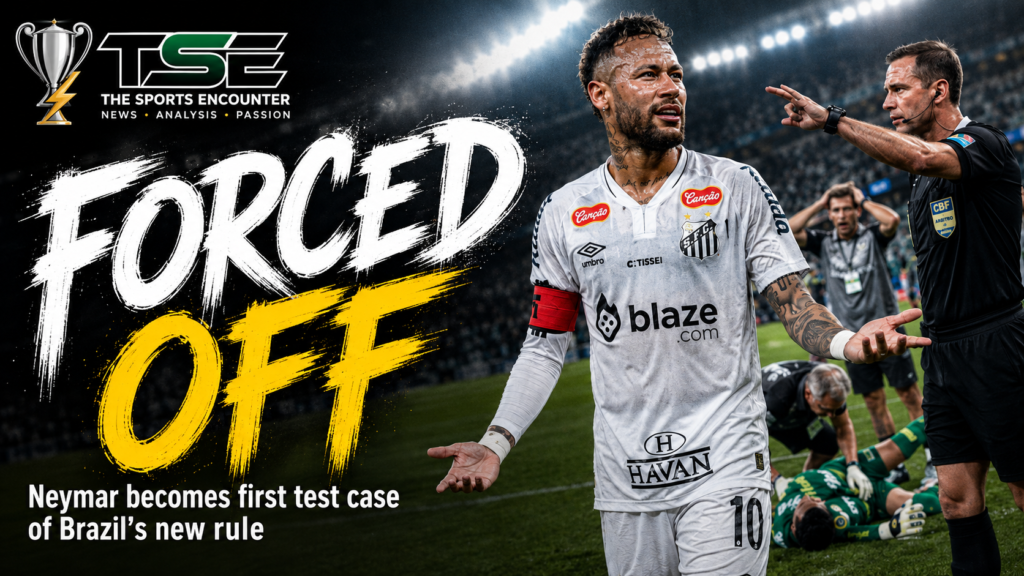
Neymar has spent most of his career making football history with the ball at his feet.
On Sunday, he entered the record books for something nobody at Santos would have planned.
The 34-year-old became the first player in Brazil’s Serie A to be temporarily forced off the pitch under a new anti-time-wasting rule designed to stop teams from using goalkeeper injuries as unofficial tactical timeouts.
The incident happened during Santos’ 3-0 victory over Vasco da Gama after goalkeeper Gabriel Brazão requested medical attention.
Once play was stopped for the goalkeeper’s treatment, Santos had 10 seconds to nominate an outfield player who would leave the field for one minute after the restart.
No nomination came quickly enough.
Under the trial protocol, that automatically transferred the responsibility to the captain.
The captain was Neymar.
So one of world football’s most recognizable players walked to the touchline and Santos temporarily continued with 10 men.
The incident lasted only a minute.
Its significance could last considerably longer.
Brazil is among the competitions testing an idea that attacks one of modern football’s most frustrating gray areas: the goalkeeper who suddenly requires treatment just as the opposition builds momentum, allowing teammates to gather near the technical area, receive instructions, drink water, reorganize and slow the game without using a substitution or formal timeout.
Football authorities have spent years trying to increase effective playing time. This experiment takes a different approach.
Instead of asking a referee to decide whether a goalkeeper is genuinely injured, it removes the potential tactical reward attached to the stoppage.
The Sports Encounter examined the concept before its implementation in our detailed analysis of how the goalkeeper timeout rule could change English soccer. Neymar has now provided the first major real-world example of what the rule looks like when the theory becomes an actual match situation.
Neymar’s One-Minute Exit: What Happened?
| Match | Vasco da Gama vs Santos |
| Competition | Brazil Serie A |
| Result | Santos won 3-0 |
| Goalkeeper involved | Gabriel Brazão |
| What triggered the rule? | Play was stopped for Brazão to receive medical treatment |
| What Santos had to do | Nominate an outfield player to leave temporarily |
| Time allowed for nomination | 10 seconds |
| What went wrong? | Santos did not nominate a player within the required period |
| Who had to leave? | Captain Neymar |
| How long? | One minute after play restarted |
| Why does the rule exist? | To discourage tactical goalkeeper injury stoppages and protect match flow |
The incident was confirmed by Reuters’ report on Neymar becoming the first player affected by the Brazilian trial.
Why Neymar Had to Leave Instead of Another Santos Player
This is the part of the incident most likely to confuse supporters.
Neymar was not injured.
He had not committed a foul.
He had not received a yellow card.
He was not being substituted.
His temporary removal was triggered entirely by the goalkeeper-treatment procedure.
Once Brazão required treatment and the conditions for the trial were met, Santos coach and staff needed to nominate one outfield player to temporarily leave the pitch.
The team had 10 seconds.
When that deadline passed without a nomination, the protocol designated the captain.
Neymar therefore became the automatic choice.
That detail may prove more important than it first appears.
Coaches now have an immediate decision to make whenever the rule is triggered. Hesitation carries a consequence, and the consequence could remove one of the team’s most important players.
Santos learned that lesson with perhaps the most high-profile captain possible.
The Rule Is Trying to Solve a Problem Referees Cannot Reliably Diagnose
Football has a fundamental problem when dealing with suspected tactical injuries.
Referees are not doctors.
A goalkeeper may genuinely feel pain after landing awkwardly, stretching for a cross or colliding with another player.
Another goalkeeper may go down because his team is under pressure and the bench wants an interruption.
From 30 yards away, those situations can look almost identical.
Asking a referee to decide whether somebody is pretending to be hurt would create obvious player-welfare problems.
This trial avoids that medical judgment.
The referee does not need to accuse the goalkeeper of simulation.
The goalkeeper can still receive treatment.
The team simply loses the ability to gain a completely free tactical pause from that stoppage.
English football’s version of the experiment has already received IFAB approval for the 2026-27 season. According to the Premier League’s official explanation of the goalkeeper injury trial, if play stops for goalkeeper treatment, an outfield teammate must leave for at least one minute after play resumes.
The stated purpose is to maintain appropriate medical care while removing the sporting advantage that can come from disrupting momentum or gathering players for tactical instructions.
Why Goalkeeper Injuries Became Football’s Unofficial Timeout
Modern football contains far more in-game coaching than the sport of previous generations.
Teams prepare pressing triggers.
Defensive lines change according to game state.
Managers adjust build-up structures.
Set-piece assignments are constantly refined.
Players receive information from analysts and coaches throughout matches.
That makes stoppages valuable.
Imagine a team defending a 1-0 lead in the 75th minute.
The opposition has created three consecutive chances. The crowd is growing louder. The defensive line is dropping too deep. Midfielders are losing second balls.
Then the goalkeeper sits down.
Medical staff enter.
The other 10 players walk toward the bench.
The coach reorganizes the shape, changes pressing instructions and tells the fullbacks to stay deeper.
Sixty or 90 seconds later, the goalkeeper stands up and continues.
The team under pressure has gained something remarkably similar to a tactical timeout.
No substitution was used.
No formal coaching break was called.
The momentum has disappeared.
That is the behavior this rule is designed to make less attractive.
The Genius of the Rule Is That It Attacks the Incentive
Football rules work best when they change the calculation behind behavior.
A yellow card discourages certain tactical fouls because the player now risks dismissal.
Added time reduces the value of wasting 30 seconds over a restart.
The eight-second goalkeeper rule increases the cost of holding the ball too long because the opposition can receive a corner.
This goalkeeper-treatment trial follows the same principle.
The question for the coach becomes simple:
Is this stoppage worth playing temporarily with 10 outfield players?
If the goalkeeper is genuinely hurt, the answer does not matter. Treatment comes first.
If the goalkeeper is perfectly fine and the real objective is breaking opposition momentum, the cost suddenly matters a great deal.
That is more practical than asking officials to determine intent.
Football Has Already Tightened the Rules Around Goalkeepers
The new trial fits a wider effort to reduce avoidable delays.
From the 2025-26 Laws of the Game, goalkeepers can be penalized if they control the ball with their hands or arms for more than eight seconds.
The referee gives a visible countdown and, if the goalkeeper continues holding the ball beyond the limit, the opposition receives a corner kick.
The International Football Association Board’s official explanation of the eight-second goalkeeper rule says the measure was introduced because prolonged goalkeeper possession wastes time while leaving opponents unable to challenge for the ball.
| Type of Delay | What the Rule Targets | Possible Consequence |
|---|---|---|
| Goalkeeper holds ball too long | Delaying release while opponents cannot challenge | Corner kick after the eight-second limit |
| Goalkeeper treatment stoppage | Potential tactical injury timeout | Outfield teammate leaves for at least one minute |
| Delayed throw-in or goal kick | Intentional delay before restart | Restart can be reversed under 2026-27 trial measures |
| Slow substitution | Player deliberately delaying exit | Replacement may face delayed entry |
For readers trying to understand how these measures fit into the wider Laws of the Game, The Sports Encounter’s guide to soccer fouls, cards and referee decisions explains how football distinguishes physical offenses, technical violations and unsporting behavior.
There Are Important Exceptions
Any rule involving injuries has to protect player welfare first.
The English version of the trial therefore includes clear exceptions.
The temporary-player-removal mechanism does not apply when a goalkeeper needs treatment immediately after being fouled and a free kick has been awarded.
It also does not apply in certain collisions involving a goalkeeper and an outfield player, or when the goalkeeper is bleeding.
Those protections matter because the rule cannot create an environment in which goalkeepers feel pressured to stay on their feet while genuinely injured.
The purpose is deterrence against tactical exploitation.
It is not punishment for requiring medical treatment.
What If a Goalkeeper Is Genuinely Injured?
This will remain the strongest criticism of the experiment.
A team can lose an outfield player temporarily even when the goalkeeper has done absolutely nothing wrong.
That can feel harsh.
Imagine a goalkeeper develops a genuine muscle problem while defending a corner. No foul occurs. Medical staff correctly determine that treatment is necessary.
His team could still face a minute with one fewer outfield player.
That minute might include another corner, a free kick or sustained pressure.
A goal could be scored.
The injured team would reasonably feel punished for something beyond its control.
This is exactly why trials exist.
Football authorities need evidence about whether the deterrent creates more benefit than unfairness.
The Tactical Choice of Who Leaves Could Become Fascinating
Neymar’s case exposed only the first layer.
Once coaches become accustomed to the rule, the choice of player could become a tactical exercise of its own.
A team protecting a lead may remove its striker and keep the defensive block intact.
A team chasing a goal could temporarily sacrifice a center-back and retain additional attackers.
If the opposition is preparing a corner, removing the shortest forward may make more sense than losing a dominant center-back.
A manager could also nominate a player who is about to be substituted anyway, although competition protocols may eventually need to address whether that becomes a loophole.
Every game state creates a different answer.
Neymar leaving because Santos failed to answer within 10 seconds shows why coaching staffs will soon need a predetermined hierarchy.
Captains Suddenly Have Another Reason to Demand Quick Decisions
The captain-default mechanism is clever because it places responsibility inside the team.
Coaches cannot simply delay while deciding.
Players cannot spend 30 seconds arguing about who should go.
If the team fails to respond, the captain pays the price.
That should create urgency.
Neymar is also an unusually appropriate player to expose this feature because his entire career has been lived under extraordinary visibility.
His return to Santos and eventual fourth World Cup campaign were chronicled in The Sports Encounter’s Neymar’s Last Dance, while our complete review of Neymar’s World Cup career examined the creativity, injuries and controversies that followed him across four tournaments.
Even after leaving the international stage, Neymar has found another way to become part of a football debate much larger than one Santos match.
The Premier League Will Now Be Watching Brazil Closely
This is where the story expands beyond Neymar.
The Premier League has confirmed that the goalkeeper injury trial will operate during the 2026-27 season as part of a coordinated English experiment involving the Premier League, FA, EFL, WSL Football and National League.
England therefore has the opportunity to test the rule across different competitive environments.
That matters.
A rule that works during an elite Premier League fixture with extensive officiating support may behave differently in the lower divisions.
Women’s football may produce different tactical patterns.
High-pressure relegation matches could expose unintended consequences that ordinary fixtures do not.
Brazil’s experience now gives England something valuable before its own implementation matures: real examples.
Could One Minute With 10 Men Decide a Match?
Absolutely.
One minute sounds insignificant until the ball remains in play.
A strong attacking team can create several meaningful actions in 60 seconds.
A corner can produce a second ball.
A high press can force a turnover.
An overload can appear because one midfielder is missing.
A fullback may suddenly have two players attacking his side.
The numerical disadvantage also becomes more dangerous because the opposition knows exactly how long it lasts.
Teams will eventually prepare specific patterns for these moments.
Imagine Manchester City, Arsenal, Liverpool or another possession-heavy side being told the opponent will have only 10 outfield players for the next minute.
That could become an immediate pressing trigger.
The rule designed to discourage time-wasting may therefore create a completely new tactical phase of football.
Could Teams Exploit the Rule in the Opposite Direction?
Almost every football law produces adaptation.
Teams will look for solutions.
If goalkeeper treatment becomes costly, coaches may shift tactical communication elsewhere.
An outfield player could require treatment instead.
Managers may use substitutions as information breaks.
Players could gather during VAR reviews.
Captains may carry more detailed instructions onto the pitch.
Some teams could develop coded signals to make sideline communication faster.
This does not automatically make the goalkeeper rule unsuccessful.
The objective is not eliminating every tactical pause from football.
The objective is removing an obvious incentive to manufacture one through goalkeeper treatment.
Neymar Has Become the Perfect Public Test Case
Had the first player removed under Brazil’s trial been an unknown fullback, the incident might have attracted limited attention outside South America.
Neymar changed that instantly.
Millions of supporters now know the rule exists because one of the most famous footballers of his generation was told to leave.
That visibility may actually help the experiment.
Fans understand rules more quickly when they see consequences.
The same process occurred around debates over penalty technique during the World Cup. The Sports Encounter’s analysis of stutter-step penalties and what the Laws actually allow showed how one high-profile incident can turn a technical rule into a global conversation.
Neymar has now done something similar with goalkeeper treatment stoppages.
Does Football Really Have a Time-Wasting Problem?
Yes, although the problem is wider than players simply taking too long.
Modern time management involves manipulating rhythm.
A team may want the clock to continue while the emotional intensity of the match disappears.
Slow restarts help.
Substitutions help.
Medical stoppages help.
Goalkeepers traditionally occupy a unique position because the game cannot resume without them.
Football authorities have increasingly recognized that protecting the goalkeeper’s special role should not create a tactical loophole.
The eight-second rule addresses possession delays.
This experiment addresses medical delays.
Together they reveal a broader direction for the sport.
Authorities want more football and fewer avoidable pauses.
Would This Rule Improve the Fan Experience?
Probably, if it works as intended.
Supporters understand genuine injuries.
What frustrates them is the suspicion that they are watching theater rather than medical necessity.
Few experiences are more irritating than watching a team build sustained pressure only for the opposing goalkeeper to sit down, invite the medical staff onto the pitch and suddenly provide everyone with an unofficial drinks break.
If the possibility of losing an outfield player reduces those incidents, matches should retain more natural momentum.
The challenge is ensuring spectators do not begin booing every goalkeeper who genuinely needs treatment.
Player welfare cannot become collateral damage in football’s attempt to improve entertainment.
Could This Eventually Become a Permanent Law of the Game?
Possibly.
That is why experiments are being conducted across multiple competitions.
IFAB traditionally uses trials to gather evidence before changing the global Laws of the Game.
The eight-second goalkeeper possession rule followed that pathway before becoming part of Law 12.
If the goalkeeper injury experiment reduces tactical stoppages without harming legitimate treatment, the case for wider adoption will strengthen.
If it produces controversial goals, discourages injured goalkeepers from seeking care or creates new forms of gamesmanship, authorities can modify or abandon it.
Neymar’s one-minute absence is therefore a tiny piece of a much larger evidence-gathering process.
TSE Verdict: Football May Have Found a Smarter Way to Fight Tactical Injuries
The most interesting feature of this rule is what it does not ask referees to do.
They do not have to accuse a goalkeeper of faking an injury.
They do not have to determine how much pain a player is experiencing.
They do not have to guess what a coach intended.
The goalkeeper receives treatment.
The game protects player welfare.
The potential tactical advantage disappears because the team temporarily sacrifices an outfield player.
That is a smarter starting point than trying to police human intent.
There are still legitimate concerns.
Genuinely injured teams can face a sporting disadvantage.
One minute with 10 men may become disproportionately important during corners or late pressure.
Coaches will search for loopholes.
Referees will have to apply exceptions consistently.
Those are precisely the questions Brazil, England and other trial competitions now need to answer.
Neymar’s involvement made the experiment famous much faster than the rule-makers probably expected.
Santos goalkeeper Gabriel Brazão needed treatment.
The coach did not nominate an outfield player within 10 seconds.
The responsibility fell to the captain.
Neymar walked off.
Sixty seconds later, he returned.
Nothing about the result changed. Santos still won 3-0.
Football’s approach to time-wasting may have changed a little more.
For more rule changes, tactical analysis and major stories shaping the modern game, follow The Sports Encounter’s soccer coverage.
Frequently Asked Questions
Why was Neymar forced off the pitch against Vasco?
Neymar had to leave temporarily because Santos goalkeeper Gabriel Brazão received treatment and the team failed to nominate another outfield player within 10 seconds. Under Brazil’s trial protocol, the captain automatically becomes the player who must leave if no nomination is made.
How long did Neymar have to stay off the pitch?
Neymar had to remain off for one minute after play restarted.
Was Neymar sent off or substituted?
No. He was neither sent off nor substituted. His temporary absence was part of the goalkeeper injury time-wasting trial, and he was allowed to return after the required period.
What is the new goalkeeper injury rule?
If play is stopped so a goalkeeper can receive medical treatment, the team may be required to nominate one outfield player who must leave the pitch temporarily after play resumes. The measure is intended to prevent goalkeeper injury breaks from being used as tactical timeouts.
Why does the captain have to leave?
The captain only becomes the automatic choice when the team fails to nominate another eligible outfield player within the required 10-second window.
Is the Premier League using the same rule?
Yes. English football has received IFAB approval to test a goalkeeper injury protocol during the 2026-27 season. The Premier League, EFL, National League and women’s professional game are involved in the broader trial.
Are genuine goalkeeper injuries punished?
The trial includes exemptions for certain situations, including treatment following a foul on the goalkeeper, some collisions and bleeding injuries. Player welfare remains the priority, although genuine non-exempt injuries can still create difficult situations for teams.
What happens if a goalkeeper holds the ball too long?
That is covered by a separate law. Since the 2025-26 changes, a goalkeeper controlling the ball with the hands or arms for longer than eight seconds can concede a corner kick after the referee’s visible countdown.
Could the goalkeeper injury rule become permanent?
Yes, potentially. IFAB and participating competitions will evaluate whether the trial reduces tactical delays while protecting player welfare before considering any wider permanent change.
Was Neymar the first player affected by the rule?
Neymar became the first player in Brazil’s Serie A to be forced temporarily off under the new trial when it was applied during Santos’ 3-0 victory over Vasco da Gama.
The Sports Encounter’s soccer coverage explains the rules, tactics and decisions changing football alongside the matches and players making the headlines.