Elena Rybakina Beats Coco Gauff to Reach Toronto Final
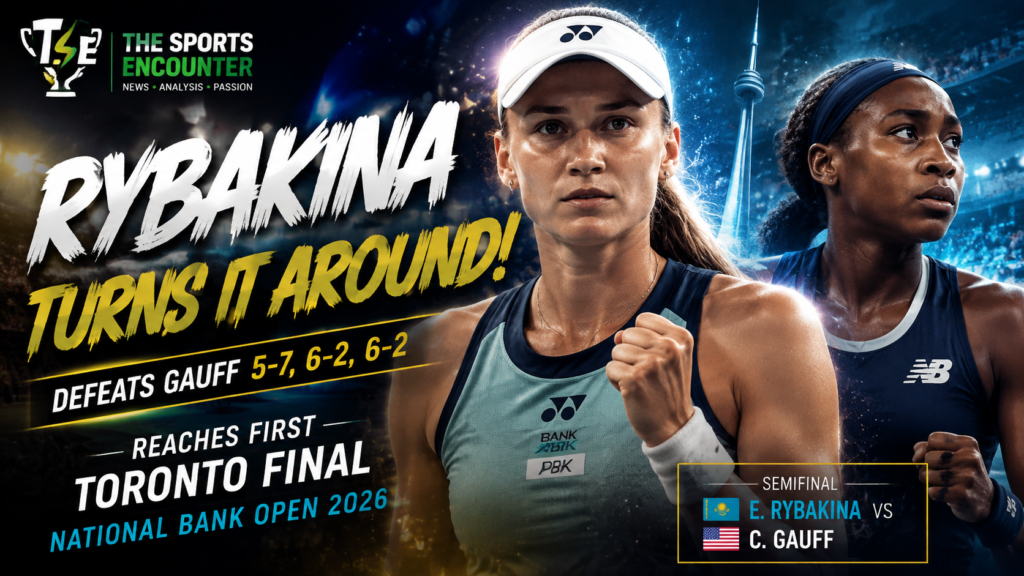
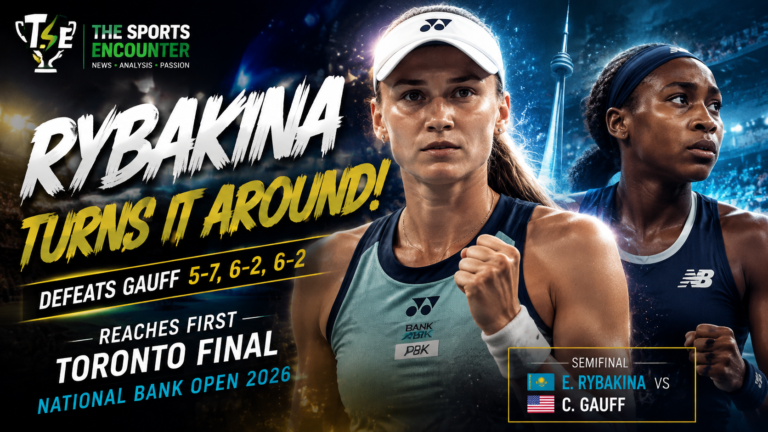
Elena Rybakina came from a set down to defeat Coco Gauff 5-7, 6-2, 6-2 in Toronto, reaching her first National Bank Open final with a commanding second-half performance.
Elena Rybakina spent the opening set of her National Bank Open semifinal trying to solve Coco Gauff. By the end of the night, she had taken the match away from her.
The No. 2 seed recovered from a difficult start to defeat Gauff 5-7, 6-2, 6-2 on Wednesday night in Toronto, reaching the National Bank Open final for the first time in her career.
What began as a controlled performance from Gauff turned sharply after the first set. Rybakina found greater depth on return, began attacking the American’s second serve and increasingly dictated the first meaningful strike in the rallies. Once she broke midway through the second set, the semifinal changed completely.
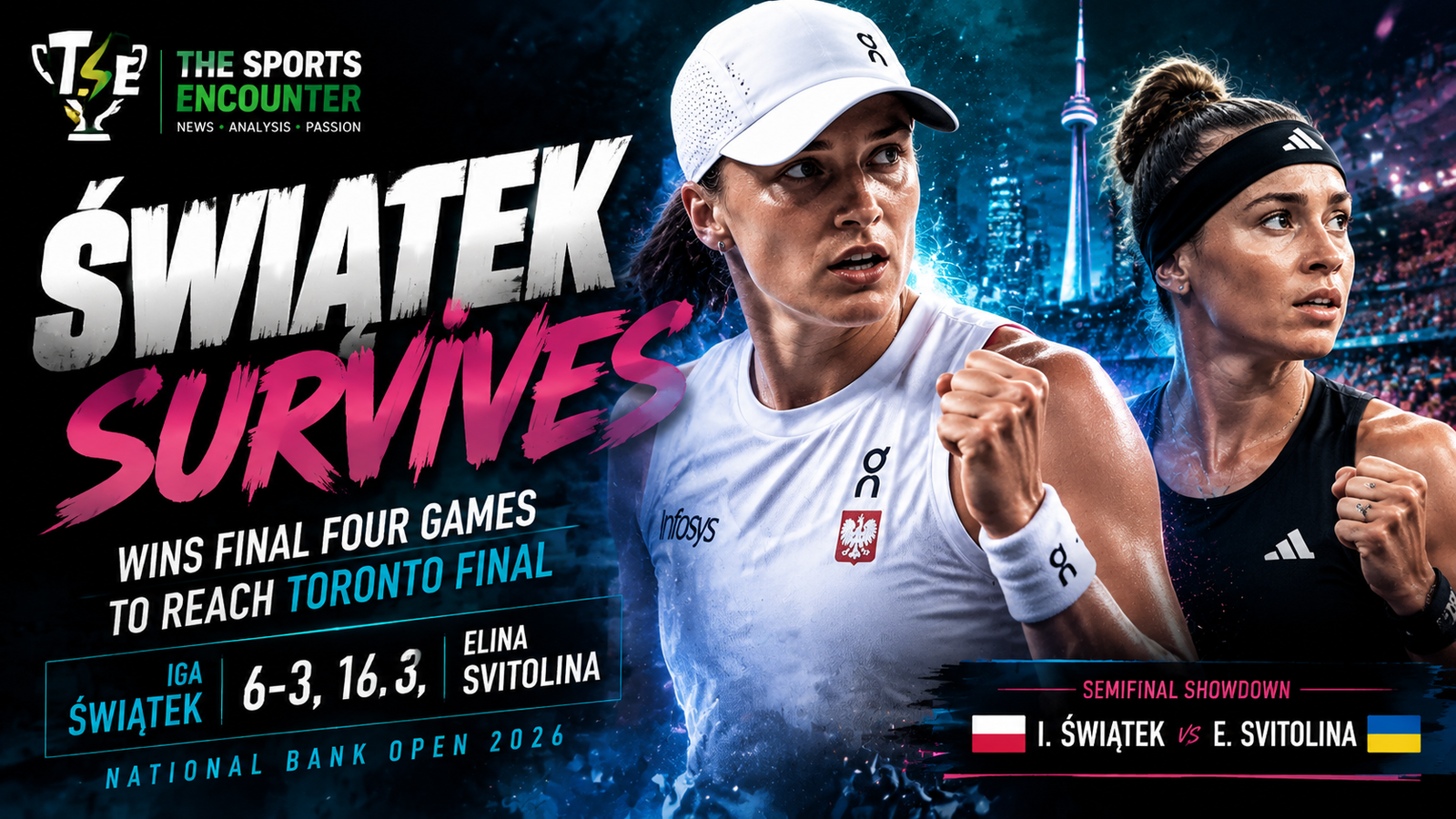
Rybakina will now face Iga Swiatek in the championship match after the Polish star defeated Elina Svitolina 6-3, 1-6, 6-3 in the other semifinal.
Gauff vs Rybakina: National Bank Open 2026 Semifinal
| Category | Coco Gauff | Elena Rybakina |
|---|---|---|
| Seed | No. 4 | No. 2 |
| Final score | 7, 2, 2 | 5, 6, 6 |
| Aces | 3 | 5 |
| Double faults | 6 | 1 |
| First-serve points won | 63% | 74% |
| Second-serve points won | 45% | 62% |
| Break points converted | 1 of 4 | 4 of 11 |
| Total points won | 80 | 98 |
| Match duration | 2 hours | |
Gauff Survives Early Trouble and Takes the First Set
Gauff entered the semifinal with considerably less court time in her legs than Rybakina. Her quarterfinal against Belinda Bencic never took place after the Swiss player withdrew with a hip injury, giving Gauff additional recovery time following an impressive run through the earlier rounds.
That advantage did not immediately translate into a comfortable start.
Rybakina opened the match by pushing Gauff to love-40 in the very first service game. Gauff escaped, and that hold became important. Rather than allowing Rybakina to establish early control, the American settled into the contest and protected her serve throughout most of the opening set.
That composure reflected the form Gauff had shown earlier in Toronto. She had already produced one of her cleanest performances of the tournament against Alina Korneeva, part of a women’s draw that The Sports Encounter followed throughout the National Bank Open quarterfinal race.
At 5-4, Gauff earned her first set point on Rybakina’s serve but could not convert it. Two games later, another opportunity arrived.
This time she took it.
Gauff broke for 7-5 and appeared to have created the tactical pattern she wanted. She was extending rallies, making Rybakina hit additional balls and preventing the Kazakhstani from consistently controlling exchanges with her serve and first groundstroke.
The Match Turns in the Middle of the Second Set
The semifinal changed during Gauff’s third service game of the second set.
After surviving a difficult hold earlier in the set, Gauff was broken to fall behind 3-2. From that point, her control disappeared quickly.
Rybakina began getting more returns into uncomfortable positions and forcing Gauff to play from defensive locations. The American’s error count rose, while her serve became far less reliable. Six double faults across the match compounded the pressure.
Rybakina, by comparison, committed only one double fault.
The difference on second serve became particularly damaging. According to the official National Bank Open match statistics, Rybakina won 62% of her second-serve points. Gauff managed only 45%.
That gave Rybakina freedom to attack rather than constantly protect her own service games.
She broke Gauff again late in the set and closed it 6-2, forcing a decider.
The comeback carried echoes of Rybakina’s quarterfinal against Naomi Osaka. In that match, she had also lost the opening set before fighting back to win 4-6, 7-6(5), 6-4. The Sports Encounter covered that escape as part of the National Bank Open semifinal lineup, where Rybakina’s ability to survive difficult match situations had already become one of Toronto’s defining stories.
Rybakina Breaks Again and Gauff Cannot Stop the Slide
Gauff needed an early reset in the deciding set, and for two service games she managed to steady herself.
The pressure never disappeared.
Rybakina continued pushing deep returns through the middle of the court and forcing Gauff to begin points without control. When another break came in Gauff’s third service game, the pattern from the second set returned almost immediately.
Rybakina accelerated.
She won the final five games of the match, breaking again for 5-2 before serving for a place in the final.
Gauff still created one last opening. She reached 15-40 in Rybakina’s final service game, giving herself two break points and a chance to extend the semifinal.
Rybakina erased both.
She completed the 5-7, 6-2, 6-2 victory after exactly two hours.
The Statistics Explain Why Rybakina Took Control
The final numbers show how dramatically the match tilted after the opening set.
Rybakina won 98 of the 178 points played, giving her 55% of the total. She won 69% of all service points compared with Gauff’s 56% and collected 44% of return points compared with Gauff’s 31%.
Her first serve was especially productive. Rybakina won 34 of 46 first-serve points, a 74% success rate. She also won 21 of 34 points behind her second serve.
Gauff could not generate comparable protection. She won 38 of 60 points behind her first serve and only 17 of 38 behind the second.
The break-point difference was equally important. Rybakina converted four of 11 opportunities. Gauff converted only one of four.
Those numbers fit the broader pattern that has developed throughout the tournament. Rybakina has repeatedly absorbed pressure before finding solutions, something already visible when she survived Liudmila Samsonova during the Sunday action in Toronto and then produced another comeback against Osaka.
Toronto Rivalry Comes Full Circle Four Years Later
There was also history behind this semifinal.
Gauff and Rybakina had met only once previously, also in Toronto, in 2022. Gauff won that contest in three sets after Rybakina saved four match points in the second set before eventually losing the decider.
Four years later, the result went the other way.
The win levels their career head-to-head at 1-1 and gives Rybakina another significant victory during a tournament where several established stars have faced difficult tests. Earlier in the week, Toronto’s changing title picture began taking shape as leading contenders advanced while others disappeared from the draw.
Gauff had remained among the strongest survivors. Rybakina ultimately became the player who stopped her.
Rybakina’s Hard-Court Form Is Becoming a US Open Story
The victory was also Rybakina’s tour-leading 26th hard-court win of the 2026 season, according to the WTA.
That matters beyond Toronto.
The North American hard-court swing is already feeding directly into the US Open conversation, and Rybakina’s ability to recover from difficult positions may be as significant as her raw power. The Sports Encounter’s US Open 2026 preview identified Rybakina, Gauff, Swiatek and the other leading women as central contenders in a deep championship field.
Toronto is sharpening that picture.
Rybakina arrived as the No. 2 seed and has now survived Samsonova, Osaka and Gauff on the way to the final. Her road has required adjustment rather than effortless dominance, which may make the run more valuable heading toward New York.
Swiatek Now Waits in the National Bank Open Final
The final presents an entirely different tactical problem.
Swiatek reached the championship match by defeating Svitolina 6-3, 1-6, 6-3, recovering after the Ukrainian dominated the second set. Her progress builds on a strong Toronto campaign that The Sports Encounter tracked when Swiatek and Svitolina secured their semifinal places.
Rybakina brings one of the biggest serves and cleanest first-strike games in women’s tennis. Swiatek brings elite movement, return pressure and the ability to turn neutral exchanges into attacking positions.
That contrast gives Toronto the final its women’s draw has been building toward.
Before the tournament, Rybakina was already among the leading contenders in The Sports Encounter’s National Bank Open 2026 tournament preview. Ten days later, she is one victory from the title.
She reached that position the hard way.
Against Gauff, losing the first set did not break the match open for the American. Instead, it forced Rybakina to change it.
Frequently Asked Questions
Who won the Coco Gauff vs Elena Rybakina semifinal?
Elena Rybakina defeated Coco Gauff 5-7, 6-2, 6-2 in the National Bank Open 2026 women’s semifinal in Toronto.
How long did the Gauff vs Rybakina semifinal last?
The match lasted exactly two hours on Centre Court.
How many break points did Rybakina convert?
Rybakina converted four of 11 break-point opportunities. Gauff converted one of four.
Who will Rybakina play in the National Bank Open final?
Rybakina will face Iga Swiatek, who defeated Elina Svitolina 6-3, 1-6, 6-3 in the other women’s semifinal.
Has Elena Rybakina reached a National Bank Open final before?
No. The 2026 championship match will be Rybakina’s first National Bank Open final.
What is the Gauff vs Rybakina head-to-head record?
Their career head-to-head is now 1-1. Gauff won their first meeting in Toronto in 2022, while Rybakina won their 2026 Toronto semifinal.
Breaking News
Tottenham Teammates Give Pedro Porro Guard of Honour After Spain’s World Cup Triumph
Pedro Porro returned to Tottenham as a world champion and was welcomed with a guard of honour after helping Spain beat Argentina 1-0 in the 2026 World Cup final.
Pedro Porro returned to Tottenham Hotspur this week with something no teammate could ignore: a World Cup winner’s medal, a place in FIFA’s fan-voted Dream XI, and one of the strongest international tournaments of his career behind him.
His Spurs teammates made sure the moment did not pass quietly.
Porro was welcomed back to Hotspur Way with a guard of honour as players, coaches and club staff lined up to celebrate the right-back after Spain’s FIFA World Cup 2026 triumph.
The gesture offered a simple but powerful image. Club football was beginning again, preseason work was waiting, and Tottenham had business to handle. For a few minutes, however, the training ground belonged to a world champion.
Tottenham confirmed that Porro reported back on Thursday to begin preseason for the first time since Spain defeated Argentina 1-0 after extra time in the World Cup final on July 19.
Readers can revisit Spain’s title run through The Sports Encounter’s FIFA World Cup 2026 coverage and follow wider developments through our soccer section.
Pedro Porro’s World Cup Return to Tottenham: Key Facts
| Detail | Information |
|---|---|
| Player | Pedro Porro |
| Club | Tottenham Hotspur |
| National team | Spain |
| World Cup result | Spain beat Argentina 1-0 after extra time in the final |
| Final date | July 19, 2026 |
| Tottenham return | August 13, 2026 |
| Welcome | Guard of honour from teammates, coaches and staff |
| World Cup recognition | Selected in FIFA’s fan-voted Dream XI |
| Historical significance | Fourth Spurs player to win the World Cup while registered with the club |
Hotspur Way Stops to Welcome a World Champion
The guard of honour was not staged after a final, under stadium lights or in front of television cameras around the world.
It happened at Tottenham’s training ground.
That made the moment feel different.
According to Tottenham Hotspur’s official account of Porro’s return, teammates, coaches and members of both playing and non-playing staff formed the guard of honour as the 26-year-old arrived back at Hotspur Way.
Porro walked through the line as the group applauded him, marking the first time he had returned to club duty since lifting the World Cup with Spain.
The gesture quickly attracted positive reaction from supporters, many of whom viewed it as evidence of strong team spirit before the 2026/27 season.
For Tottenham, it was also a chance to recognize what one of their own had just achieved on the biggest stage in football.
Porro Did Far More Than Simply Travel With Spain
Porro’s World Cup medal was not the result of a peripheral role.
He became one of Spain’s most important players during the tournament.
Tottenham confirmed that he started five of Spain’s seven matches, including every knockout game, and scored his first two senior international goals during the competition.
The first came against Austria.
Spain entered that knockout match looking for greater authority after a difficult group stage, and Porro helped provide it. He scored during a convincing 3-0 victory, a result The Sports Encounter examined in Spain’s commanding win over Austria.
That performance was the beginning of a knockout run that would change his international status.
The France Semifinal Became Porro’s Defining World Cup Night
If Austria announced Porro’s growing influence, the semifinal against France confirmed it.
Spain faced a French side packed with attacking talent, including Kylian Mbappé and Ousmane Dembélé. The match was supposed to test whether Spain’s defensive control could survive one of the tournament’s most dangerous attacks.
Porro responded at both ends of the field.
He helped Spain contain France’s width and then scored the second goal in a 2-0 victory, finishing a sharp combination with Dani Olmo after Spain recycled possession around the penalty area.
The Sports Encounter broke down that performance in our Spain vs France semifinal report, where Porro’s goal became one of the central moments in La Roja’s passage to the final.
FIFA also highlighted his contribution to Spain’s attacking structure, while Reuters later described the tournament as the moment Porro effectively made Spain’s right-back position his own.
Spain’s Final Needed Patience, and Porro Helped Deliver the Winner
The final against Argentina produced another very different test.
Spain controlled possession and created the clearer chances, but Argentina resisted throughout regulation time and forced the match into extra time.
Porro remained heavily involved.
The winning move arrived in the 106th minute.
Porro delivered a cross toward the far post, Nico Williams headed the ball back into danger, and Ferran Torres finished first time into the roof of the net.
That goal gave Spain a 1-0 victory and its second men’s World Cup title, 16 years after Andrés Iniesta scored another extra-time winner in the 2010 final.
The Sports Encounter covered the decisive match in full in Spain’s World Cup final victory over Argentina.
Porro therefore returned to Tottenham not only as a champion, but as a player directly involved in the move that decided the final.
From Injury Concern to World Cup Winner
His path to the final was not entirely smooth.
Porro had been managing a hamstring issue after the semifinal against France and trained separately during part of the build-up to the Argentina match.
The concern was serious enough to become one of Spain’s major pre-final talking points, alongside Lamine Yamal’s workload and general soreness.
The Sports Encounter tracked those issues in our complete Argentina vs Spain final preview.
Porro recovered in time to start.
That matters when assessing the tournament as a whole. His World Cup was not simply a run of attacking highlights. It required consistency, recovery and the ability to handle increasingly difficult knockout assignments.
A champion’s return for our Pedro 🤍🏆 pic.twitter.com/CDLBpCWZuM
— Tottenham Hotspur (@SpursOfficial) August 13, 2026
FIFA Dream XI Recognition Followed the Trophy
The medal was not the only recognition Porro brought back to North London.
He was later selected at right back in FIFA’s fan-voted Dream XI for the tournament.
Tottenham confirmed the selection on July 23, noting that Porro had combined defensive resilience with two international goals and a major contribution to Spain’s championship-winning attack.
The Sports Encounter also included him in its coverage of the full FIFA World Cup 2026 fan-voted Dream Team.
Porro joined Marc Cucurella and Golden Ball winner Rodri among the Spanish players selected.
That recognition reinforced the wider story of his tournament.
He had entered the World Cup fighting for status within Spain’s defensive hierarchy. He left it as the first-choice right back for the world champions.
Porro Joins a Very Short Tottenham List
The historical significance extends beyond Spain.
Porro became only the fourth Tottenham player to lift the men’s World Cup while registered with the club.
He follows Jimmy Greaves, who won with England in 1966, Hugo Lloris with France in 2018 and Cristian Romero with Argentina in 2022.
The achievement also means a Spurs player has now won the trophy at each of the last three World Cups.
Tottenham officially celebrated that historical milestone immediately after Spain’s victory, describing Porro as one of the standout performers of the tournament.
The timing gives the training-ground guard of honour more meaning.
It was not simply congratulations for winning a medal.
Tottenham were welcoming back someone who had entered a rare part of the club’s history.
The Guard of Honour Says Something About the Dressing Room Too
Football celebrations often become highly choreographed.
This one worked because it was simple.
Players and staff lined up. Porro walked through. The group applauded.
Supporters quickly responded to the scene because it looked less like a promotional exercise and more like teammates recognizing something extraordinary.
That matters during preseason.
Tottenham are moving from the emotional distance of the World Cup back into the practical demands of club football. Fitness work, tactical preparation, competition for places and another Premier League season now replace the celebrations.
Moments like this can help reconnect a squad after players have spent weeks representing different countries.
Porro spent part of July competing against footballers who will now become Premier League opponents again.
At Hotspur Way, however, the World Cup rivalry disappeared.
A Tournament That Changed How Porro Is Viewed
Porro’s standing has shifted significantly over the last two years.
His attacking ability was never in serious doubt, but questions around his defensive positioning followed him during his early period in England.
His performances in North America answered many of those concerns.
Spain trusted him in knockout matches against Austria, Portugal, Belgium, France and Argentina. He provided attacking width without weakening the structure behind him and repeatedly handled high-level opposition.
The quarterfinal against Belgium offered another example. Porro combined effectively with Lamine Yamal and helped create Spain’s opening goal during a difficult 2-1 victory, covered in The Sports Encounter’s Spain vs Belgium quarterfinal analysis.
By the end of the tournament, his value could no longer be reduced to crossing numbers or attacking output.
He had become part of the structure that made Spain champions.
Spain’s Success Was Built Around More Than One Star
Porro’s breakthrough also fits the larger story of Spain’s World Cup.
La Roja did not depend on one superstar carrying the tournament.
Rodri controlled midfield and eventually won the Golden Ball. Lamine Yamal provided imagination from wide areas. Unai Simón protected the defense, while Spain’s back line gave opponents very little space.
The Sports Encounter examined Rodri’s wider influence in our analysis of why he won the World Cup Golden Ball.
Porro fitted naturally into that collective structure.
His runs stretched defensive blocks, his recovery speed allowed Spain to maintain an aggressive shape, and his understanding with Yamal gave the champions another attacking route down the right.
That balance ultimately helped Spain survive increasingly difficult knockout rounds.
Now the World Champion Has to Become a Tottenham Player Again
The guard of honour closes one chapter.
Preseason opens another.
Porro returns to Spurs with greater international authority, a World Cup medal and fresh expectations around his club role.
There will be little time to live on the summer.
Tottenham’s season will bring different tactical demands, different opponents and an entirely different pressure cycle.
But the player walking back into Hotspur Way is not quite the same one who left.
He now knows what it feels like to start a World Cup final, contribute to the winning goal and leave the tournament recognized among its best players.
His teammates understood what that meant.
For a few minutes at the training ground, they made sure he did too.
Frequently Asked Questions
Why did Tottenham give Pedro Porro a guard of honour?
Tottenham players, coaches and staff gave Porro a guard of honour when he returned to Hotspur Way after helping Spain win the FIFA World Cup 2026.
Did Pedro Porro play in the World Cup final?
Yes. Porro started Spain’s 1-0 extra-time victory over Argentina and was involved in the move that led to Ferran Torres’ winning goal.
How many goals did Pedro Porro score at the 2026 World Cup?
Porro scored two goals during the tournament, against Austria and France.
Was Pedro Porro selected in the World Cup Dream XI?
Yes. Porro was selected at right back in FIFA’s fan-voted Dream XI following Spain’s title-winning campaign.
How many Tottenham players have won the World Cup?
Porro became the fourth Spurs player to win the World Cup while registered with the club, following Jimmy Greaves, Hugo Lloris and Cristian Romero.
Who scored the winning goal in the 2026 World Cup final?
Ferran Torres scored in the 106th minute as Spain defeated Argentina 1-0 after extra time.
When did Pedro Porro return to Tottenham training?
Porro returned to Hotspur Way on Thursday, August 13, 2026, to begin his preseason preparations with Tottenham.
Birmingham 2026
Audrey Werro Falls, Gets Reinstated and Keeps European 800m Gold Dream Alive
Audrey Werro’s European 800m title hopes looked over after a dramatic semifinal fall, but a successful Swiss appeal restored the world leader to Friday’s final in Birmingham.
Audrey Werro arrived in Birmingham as the fastest 800-meter runner in the world this year and one of the women expected to challenge Keely Hodgkinson for European gold.
For several frightening seconds on Thursday, that championship dream appeared to have ended on the track.
The 22-year-old Swiss star crashed to the ground with roughly 120 meters remaining in the first women’s 800m semifinal at the European Athletics Championships, turning what had been a controlled qualification race into one of Birmingham 2026’s most dramatic moments.
Werro eventually got back to her feet and completed the race, receiving warm applause from the Alexander Stadium crowd. She crossed the line last, well behind Great Britain’s Jemma Reekie, who won the semifinal in a season-best 1:58.61.
But Werro’s championships were not over.
Following a Swiss appeal and review of the incident, officials reinstated the world leader into Friday’s final. Lithuania’s Gabija Galvydyte, who was also affected by the collision, was advanced as well.
The decision preserves the showdown many athletics fans had been waiting for: Werro against Olympic champion Hodgkinson, with Reekie, Anaïs Bourgoin, Femke Broeders-Bol and the rest of a loaded European field also chasing the title.
Audrey Werro 800m Semifinal Fall: Key Facts
| Detail | Information |
|---|---|
| Competition | European Athletics Championships 2026 |
| Event | Women’s 800m semifinal |
| Venue | Alexander Stadium, Birmingham |
| Race winner | Jemma Reekie, Great Britain |
| Winning time | 1:58.61, season best |
| Werro’s status | Reinstated into the final after appeal |
| Werro’s 2026 world-leading time | 1:53.80 |
| Final | Friday, August 14 |
The Fall That Silenced Alexander Stadium
The first semifinal had already developed into a highly tactical race when the field approached the final bend.
Werro was positioned among the leading runners and appeared capable of qualifying comfortably. Then the race changed in an instant.
Contact in the tightly packed field sent the Swiss runner tumbling heavily onto the track with approximately 120 meters left.
Video review later indicated that contact involving France’s Anaïs Bourgoin contributed to Werro losing her footing. Early reactions around the incident produced uncertainty over exactly who had caused the collision, which is hardly unusual when athletes are moving at close to maximum speed in a tightly compressed middle-distance race.
The official process mattered more than the initial speculation.
Switzerland appealed, officials reviewed the available footage, and Werro was eventually advanced to the final.
Galvydyte also suffered disruption during the incident and received a place in the championship race.
The drama added another extraordinary chapter to a European Championships already full of unexpected moments. The Sports Encounter’s Birmingham 2026 Day 3 report tracked a program in which championship records, major comebacks and sudden reversals have repeatedly reshaped medal expectations.
Werro Finished the Race Because the Race Still Mattered
After falling, Werro could easily have remained on the track.
Instead, she got back up.
Her hopes of qualifying on position had disappeared, but finishing ensured that the result could still enter the official review process.
She eventually crossed the line in 2:35.35, far removed from the kind of time associated with the fastest woman in the world this year.
The performance itself no longer mattered. Completing the race did.
As Werro made her way to the finish, the Birmingham crowd responded with a standing ovation.
It was one of those championship moments when competition temporarily becomes secondary. The athlete who had arrived carrying expectations of gold was simply trying to finish after being knocked to the ground at racing speed.
Jemma Reekie Keeps Her Focus and Wins the Semifinal
While attention understandably turned toward Werro, Jemma Reekie still had a semifinal to win.
The British runner handled the disruption superbly.
Reekie crossed first in 1:58.61, producing a season-best performance and securing her place in Friday’s final. Bourgoin and Switzerland’s Veronica Vancardo also qualified from the heat.
Reekie’s victory gives Britain another serious presence in an 800m event already dominated by discussion around Hodgkinson.
The Scottish middle-distance star had reached the semifinals after running 1:58.45 in the opening round. Her ability to improve under championship pressure strengthens a British medal challenge that has already produced several major results at Alexander Stadium.
Amy Hunt delivered one of the home nation’s biggest breakthroughs by winning the European women’s 100m title, a performance The Sports Encounter examined in Hunt’s landmark Birmingham victory.
The championship momentum continued with Rhasidat Adeleke’s return to elite form. The Irish star won her 200m semifinal after an injury-disrupted season, as detailed in our Adeleke semifinal report.
Why Audrey Werro Entered Birmingham as a Gold-Medal Threat
Werro’s fall generated such a strong reaction because she is not simply another finalist.
She owns the fastest women’s 800m time in the world this year.
Werro ran 1:53.80 at the Paris Diamond League on June 28, a performance confirmed by World Athletics as her 2026 season best and world-leading mark.
The time also placed her among the fastest women ever over two laps.
She had already demonstrated that Birmingham form during the opening round, winning her heat in 1:57.83.
That performance reinforced the expectation surrounding a possible Werro-Hodgkinson confrontation, a rivalry that has become one of the central stories of the championships.
The Sports Encounter identified the women’s 800m as one of Birmingham’s defining events when examining the opening stages of the European Championships.
Werro Has Already Beaten Hodgkinson This Season
The anticipation around the final is rooted in something more substantial than rankings.
Werro has already shown she can beat Hodgkinson.
The Swiss runner defeated the Olympic champion earlier this summer during a breakthrough campaign that transformed her from emerging contender into one of the most dangerous middle-distance athletes in the world.
Hodgkinson remains one of the sport’s established champions, but Werro’s rise has changed the competitive balance around the women’s 800m.
That contrast was visible before Birmingham even began.
Hodgkinson carried championship pedigree, home support and Olympic authority. Werro brought the fastest time of the season and evidence that she could defeat the British star directly.
The fall therefore threatened to remove one of the championship’s most anticipated head-to-head battles before the final even began.
The successful appeal restored it.
The 800m Is Becoming One of Birmingham 2026’s Defining Events
Middle-distance racing has already played an important role in The Sports Encounter’s athletics coverage this summer.
At the Glasgow Commonwealth Games, Georgia Hunter Bell controlled the women’s 800m final to win gold, one of several major performances featured in our Glasgow 2026 Day 8 wrap-up.
Birmingham has raised the standard further.
The European women’s field contains Olympic champions, global medalists, established 800m specialists and athletes capable of producing times that would have seemed extraordinary only a few seasons ago.
The men’s event has been equally explosive. Ireland’s Mark English ran 1:43.49 during the semifinals, breaking a European Championships record that had stood since 1978. That achievement formed part of The Sports Encounter’s Day 3 analysis from Alexander Stadium.
The combination of fast times and tactical instability makes the 800m uniquely unpredictable.
Unlike a sprint run almost entirely in lanes, athletes converge after the opening bend. Positioning matters. Contact becomes possible. One move by one runner can affect several others within a fraction of a second.
Werro experienced the harshest version of that reality.
Was Werro Clipped or Was It Simply a Racing Accident?
That question dominated the immediate reaction.
Initial television images made the sequence difficult to interpret because several runners were clustered together when Werro lost balance.
Some observers initially questioned whether contact with fellow Swiss athlete Vancardo may have played a role.
Subsequent review provided a clearer picture.
European Athletics reported that the incident involved contact with Bourgoin as the athletes fought for position. After examining the race, officials accepted the Swiss appeal and restored Werro to the final.
That ruling does not necessarily imply deliberate wrongdoing by another runner.
Middle-distance contact frequently occurs as athletes converge, change lines and attempt to protect position. Intent and interference are separate questions.
What officials ultimately determined was that Werro had been sufficiently disadvantaged through the incident to justify advancement.
The Injury Question Now Becomes Critical
Qualification solves one problem.
It does not automatically solve the physical consequences of the fall.
Werro landed heavily and appeared uncomfortable after getting back to her feet. Her condition will therefore become one of the biggest questions before Friday’s final.
There was no immediate confirmed diagnosis suggesting a serious injury at the time of publication.
That distinction matters. A dramatic fall can look alarming without necessarily producing significant structural damage, but only the athlete and medical staff can determine whether she is physically capable of racing at championship level less than 24 hours later.
At 800m pace, even relatively minor soreness can matter.
The event demands aggressive acceleration, rapid changes of rhythm and enough strength to maintain form during the final 200 meters. Werro will need more than clearance to start. She will need enough confidence in her body to race freely.
Hodgkinson Advances and the Dream Final Survives
Keely Hodgkinson avoided the chaos that consumed the opening semifinal.
The Olympic champion won her semifinal in 1:57.38 and advanced comfortably, keeping alive her pursuit of another major championship title in front of a British crowd.
Her progression ensures that Friday’s final retains the rivalry around which much of the event had been built.
Werro owns the world-leading time.
Hodgkinson owns the Olympic gold medal and an outstanding championship record.
Reekie has now delivered a season-best semifinal win.
Broeders-Bol adds another compelling tactical dimension to the field.
What briefly looked like a final missing one of its biggest stars has instead become even more intriguing.
A Championship Already Defined by Fine Margins
Birmingham 2026 has repeatedly demonstrated how quickly reputations and medal projections can change.
The opening day produced major British success as Hunt struck gold and Jakob Ingebrigtsen returned to championship competition. The Sports Encounter followed those developments in our Day 1 championship wrap-up.
Day 2 brought another wave of tight finishes and major performances, including Nadine Visser’s extraordinary 100m hurdles victory by one-thousandth of a second. Our European Championships Day 2 report captured just how small the margins have become.
The same theme carried into Thursday’s 800m semifinals.
One stride, one moment of contact and one fall almost removed the world leader from a championship final.
The appeal process gave her another chance.
Werro’s Final Is Now About More Than Her 1:53.80
Before the semifinal, every discussion about Audrey Werro centered on speed.
Her 1:53.80 placed her at the top of the world list. Her victory over Hodgkinson gave the rivalry credibility. Her smooth opening-round run suggested she had carried that form into Birmingham.
Friday now asks a different question.
How does an athlete respond less than a day after seeing a championship nearly disappear through an incident she could not control?
Werro will enter the final knowing that she has already experienced the emotional swing of believing her championships were over and then receiving another opportunity.
That can drain an athlete.
It can also sharpen one.
The wider summer has already delivered remarkable examples of athletes responding to pressure and disruption. Glasgow produced breakthrough champions and long-awaited medals throughout its athletics program, including performances chronicled in The Sports Encounter’s Glasgow 2026 Day 5 report and Day 6 coverage.
Werro now gets her own opportunity to turn adversity into something memorable.
Friday’s 800m Final Just Became Must-Watch Athletics
Had the appeal failed, Birmingham would have lost the fastest woman in the world this year before the medal race.
Instead, the final survives with its central rivalry intact.
Reekie arrives after winning the most chaotic semifinal of the championships. Hodgkinson advanced without similar trouble. Werro reaches the start line through an appeal after one of the most dramatic falls of Birmingham 2026.
The official championship schedule, results and competition information can be followed through European Athletics, while athlete rankings and verified performance data are available from World Athletics.
For Werro, however, Friday will not be about statistics alone.
Her European title challenge appeared finished on the track.
Now she gets to race for it again.
Frequently Asked Questions
What happened to Audrey Werro in the European 800m semifinal?
Audrey Werro fell with roughly 120 meters remaining in the first women’s 800m semifinal at the 2026 European Athletics Championships in Birmingham after contact occurred in the field.
Did Audrey Werro qualify for the 800m final?
Yes. Werro was reinstated into Friday’s final after Switzerland appealed the semifinal incident and officials reviewed the race.
Who won Werro’s semifinal?
Great Britain’s Jemma Reekie won the first semifinal in a season-best 1:58.61.
Who was involved in the incident with Audrey Werro?
Official reporting following the review identified contact involving France’s Anaïs Bourgoin. Lithuania’s Gabija Galvydyte was also affected by the incident and was advanced to the final.
What is Audrey Werro’s fastest 800m time in 2026?
Werro has run 1:53.80, the fastest women’s 800m performance in the world during the 2026 season.
Has Audrey Werro beaten Keely Hodgkinson?
Yes. Werro defeated the Olympic champion earlier in the 2026 season, helping turn their rivalry into one of the biggest storylines ahead of the European Championships.
Did Keely Hodgkinson reach the European 800m final?
Yes. Hodgkinson won her semifinal in 1:57.38 and qualified for Friday’s final.
When is the women’s 800m final at Birmingham 2026?
The women’s 800m final is scheduled for Friday, August 14, at the European Athletics Championships in Birmingham.
Was Audrey Werro seriously injured in the fall?
No serious injury had been officially confirmed at the time of publication. Werro completed the race, but her physical condition will remain an important factor ahead of the final after the heavy fall.
Breaking News
Erling Haaland’s Image Found on 469kg Cocaine Shipment Seized in Ecuador
Ecuadorian police seized 469 kilograms of cocaine hidden inside a truck near the Colombian border. The bizarre discovery drew global attention because hundreds of packages carried images of Erling Haaland, who has no reported connection to the shipment.
Erling Haaland has spent much of 2026 appearing on scoreboards, television screens, social feeds and World Cup highlights.
His image has now turned up somewhere far stranger.
Police in Ecuador seized 469 kilograms of cocaine hidden inside a truck near the Colombian border, with hundreds of green packages carrying stickers featuring the Norwegian and Manchester City striker.
Authorities said the haul was discovered inside a false compartment of the vehicle after anti-narcotics officers acted on an anonymous tip along the Pan-American Highway. A woman carrying Colombian identification was arrested during the operation.
There is no indication that Haaland had any connection to the shipment. His image appears to have been used without his involvement as a marker on the packages, a practice authorities and law-enforcement reporting say is sometimes used by trafficking networks to distinguish shipments, producers or intended recipients.
Erling Haaland Cocaine Seizure in Ecuador: Key Facts
| Detail | Information |
|---|---|
| Location | Near Tulcán, Carchi Province, Ecuador, close to the Colombian border |
| Drug seized | Cocaine |
| Total weight | 469 kilograms, approximately 1,034 pounds |
| Number of packages | 370 |
| Where drugs were found | False compartment inside a truck |
| Distinctive feature | Green packages carrying stickers featuring Erling Haaland |
| Estimated US value | More than $11 million |
| Estimated European value | More than $19.6 million, approximately €17 million |
| Arrest | A woman identified by authorities as María R., carrying Colombian documents |
Police Find 370 Packages Hidden Inside a Truck
The seizure took place near the northern Ecuadorian border with Colombia, one of the most important corridors in the international cocaine trade.
According to Associated Press reporting based on Ecuadorian police information, anti-narcotics officers were conducting an operation after receiving an anonymous tip when they identified a suspicious truck traveling along the Pan-American Highway.
A search revealed 370 packages concealed in a false bottom.
Police footage showed officers removing the green rectangular packages from the vehicle. Many carried stickers displaying Haaland’s face alongside soccer-related imagery.
The unusual packaging immediately pushed what would otherwise have been another major drug seizure into the international sports conversation.
Haaland has been one of football’s most visible players this year. His prominence grew substantially during Norway’s historic World Cup campaign, when he scored seven goals and became a central figure in The Sports Encounter’s coverage of Haaland’s career, records and first World Cup.
Why Would Traffickers Put Haaland’s Face on Cocaine?
The obvious question is also the strangest part of the story.
Why Haaland?
Police did not publicly establish a specific reason for his image appearing on this particular shipment.
However, drug-trafficking organizations have long used logos, symbols, names and celebrity images as identifying marks on narcotics packages. Such markings can help distinguish one shipment from another, identify the organization associated with the product or signal its intended recipient.
That context matters because the sticker should not be interpreted as evidence of any relationship between Haaland and the people involved.
There is none established in the reporting.
The footballer’s image appears to have functioned as unauthorized branding.
That choice may also reflect Haaland’s extraordinary global visibility. During the FIFA World Cup 2026, his popularity expanded far beyond goals. The Sports Encounter tracked how he became one of the tournament’s most recognizable internet figures in our analysis of the World Cup’s most viral players.
Haaland’s 2026 Fame Makes the Choice Less Random Than It Looks
Haaland entered the summer as one of the best-known strikers in world football. The World Cup pushed his profile into another category.
Norway reached the quarterfinals for the first time, and Haaland scored seven times during the tournament. His late double against Brazil helped deliver one of the biggest knockout shocks of the competition.
The Sports Encounter’s Brazil vs Norway preview framed that Round of 16 meeting around the clash between Haaland and Vinícius Júnior. Norway eventually won 2-1, with Haaland providing both goals.
His World Cup became about more than finishing.
Memes, old music videos, unusual social posts, running clips and fan edits kept circulating around him. We later explored that strange expansion of his public identity in the Haaland Multiverse, where his football and internet personalities had effectively become separate stories.
None of that explains who physically chose his image for the Ecuador shipment.
It does explain why traffickers looking for a globally recognizable face would have had no trouble recognizing Haaland’s commercial and cultural visibility.
The Shipment Could Be Worth More Than $19 Million in Europe
The scale of the seizure extends well beyond the bizarre stickers.
Ecuadorian authorities estimated that the 469 kilograms of cocaine would be worth about $842,000 domestically.
The same shipment could command more than $11 million if sold in the United States and more than $19.6 million, or approximately €17 million, in Europe, according to the estimates reported by the Associated Press.
Those differences illustrate how dramatically cocaine values increase as shipments move farther from production areas and deeper into major consumer markets.
The woman arrested in connection with the operation was identified only as María R. Authorities said she was carrying Colombian identity documents when detained in the Guagua Negro area near Tulcán, roughly 246 kilometers north of Quito.
Ecuador Sits at the Center of a Major Cocaine Transit Network
Ecuador does not produce cocaine on anything close to the scale of neighboring Colombia or Peru, but its geography has made the country an important logistics point in the international trade.
Large quantities of cocaine produced elsewhere in the region move through Ecuador before continuing toward Central America, the United States and European ports.
According to the AP report, local criminal groups working with Colombian and Mexican cartels control significant trafficking routes. Police say around 80% of narcotics moving through Ecuador originate in Colombia, with most of the remainder coming from Peru.
Ecuadorian police reported seizing about 80 tons of drugs during the first half of 2026. Authorities confiscated nearly 215 tons during 2025 and almost 295 tons in 2024.
The Haaland-marked shipment is therefore unusual because of its packaging, but the trafficking route itself fits a much larger pattern.
This Is Not the First Time a Soccer Star Has Appeared on Drug Packages
Haaland is also not the first elite footballer whose image has reportedly appeared on narcotics packaging.
Authorities have previously encountered packages carrying the image of Lionel Messi, according to reporting surrounding the Ecuador seizure.
The practice shows how globally recognized athletes can become symbols entirely outside their control.
Football stars occupy a strange place in modern visual culture. Their faces appear on legitimate products, advertising campaigns, video games, trading cards, merchandise and social platforms. The same recognizability can also make those images attractive for unauthorized or criminal use.
Haaland’s fame is particularly well suited to that kind of instant recognition.
The Norwegian has become part of a new generation carrying global football beyond the Messi and Cristiano Ronaldo era. The Sports Encounter’s look at football’s changing World Cup generation placed Haaland alongside Kylian Mbappé, Jude Bellingham, Lamine Yamal and other stars shaping the sport’s next phase.
A Very Different Haaland Story After His World Cup Summer
For most of the summer, Haaland’s name was attached to goals.
He helped Norway eliminate Brazil and then faced England in the quarterfinals. Jude Bellingham scored twice as England won 2-1 after extra time, ending Norway’s run in a match covered in our England vs Norway quarterfinal report.
The tournament strengthened Haaland’s international reputation after years in which much of his fame had been attached to Manchester City and club football.
It also introduced more fans to his personality.
His friendship with Bellingham became another major storyline, especially after the former Borussia Dortmund teammates ended up facing one another in a World Cup knockout match. The Sports Encounter explored that relationship in Haaland and Bellingham’s friendship story.
That combination of athletic success, global exposure and internet popularity made Haaland one of the most recognizable faces of the tournament.
Weeks later, that face appeared on hundreds of packages inside a truck in Ecuador.
The Important Distinction: Haaland Is Part of the Image, Not the Crime
The nature of the story makes careful wording essential.
Police seized cocaine packages carrying Haaland’s image.
That does not mean police seized “Haaland cocaine” in any meaningful ownership or endorsement sense, and there is no reported evidence connecting the Manchester City striker with the shipment, the arrested woman or the trafficking network.
The stickers appear to be unauthorized imagery used by people involved in the drug trade.
That distinction should remain central whenever the story is discussed or shared.
Haaland remains a professional footballer whose image was placed on an illegal product without any publicly established involvement on his part.
From Football Meme to Criminal Packaging
The story is likely to travel because the visual contrast is difficult to ignore.
One of football’s most recognizable stars appears on hundreds of green cocaine bricks removed from a hidden compartment by police officers thousands of miles from Manchester or Norway.
Social media users quickly responded with jokes about sponsorships, transfer fees and Haaland’s scoring record.
The humor is understandable, but the underlying story remains serious. Nearly half a metric ton of cocaine was intercepted on a route connected to one of the world’s largest narcotics trafficking systems.
The celebrity sticker made the seizure unusual.
The drugs made it consequential.
For more stories involving the personalities, culture and wider world surrounding football, readers can follow The Sports Encounter’s soccer coverage.
Frequently Asked Questions
How much cocaine did Ecuadorian police seize?
Police seized 469 kilograms of cocaine, equivalent to approximately 1,034 pounds.
Why was Erling Haaland’s image on the cocaine packages?
Police did not establish a specific reason for Haaland’s image appearing on the shipment. Criminal networks sometimes use celebrity images, symbols or logos to identify shipments, producers or intended recipients.
Was Erling Haaland involved in the cocaine shipment?
There is no reported evidence connecting Haaland to the cocaine, the trafficking network or the people arrested. His image appears to have been used without his involvement.
How many packages were found?
Authorities discovered 370 packages hidden inside a false compartment in a truck.
Where was the cocaine seized?
The seizure occurred in Ecuador’s Carchi Province near Tulcán and the border with Colombia.
How much was the cocaine worth?
Authorities estimated the shipment at nearly $842,000 in Ecuador, more than $11 million in the United States and more than $19.6 million, or approximately €17 million, in Europe.
Was anyone arrested?
Yes. Authorities said a woman identified as María R., who carried Colombian identification documents, was arrested during the operation.
Have other footballers appeared on drug packages?
Yes. Lionel Messi’s image has reportedly appeared on previously seized narcotics packages, reflecting a broader practice of using recognizable celebrities as unauthorized shipment markings.