


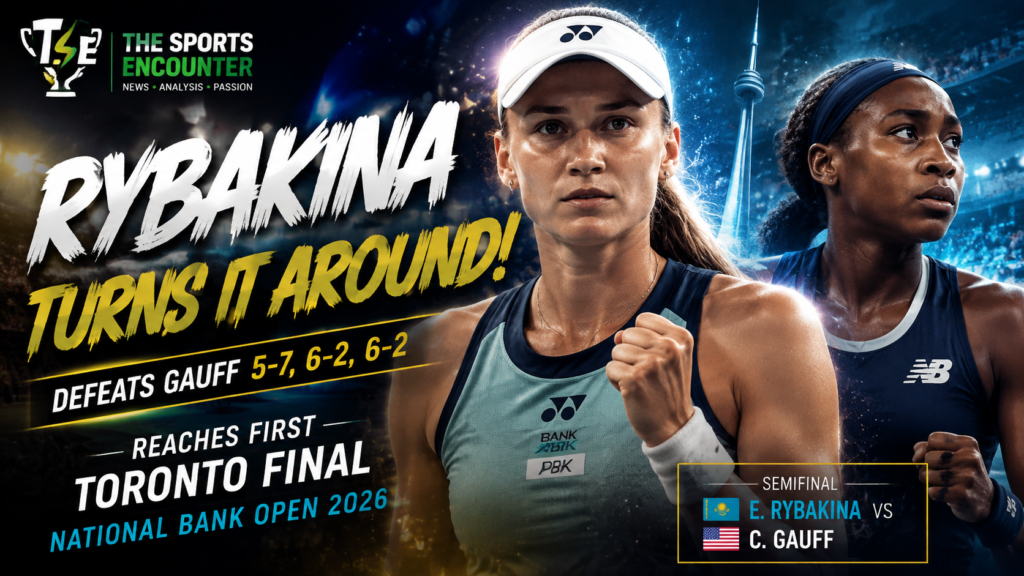
Elena Rybakina spent the opening set of her National Bank Open semifinal trying to solve Coco Gauff. By the end of the night, she had taken the match away from her.
The No. 2 seed recovered from a difficult start to defeat Gauff 5-7, 6-2, 6-2 on Wednesday night in Toronto, reaching the National Bank Open final for the first time in her career.
What began as a controlled performance from Gauff turned sharply after the first set. Rybakina found greater depth on return, began attacking the American’s second serve and increasingly dictated the first meaningful strike in the rallies. Once she broke midway through the second set, the semifinal changed completely.
Rybakina will now face Iga Swiatek in the championship match after the Polish star defeated Elina Svitolina 6-3, 1-6, 6-3 in the other semifinal.
Gauff vs Rybakina: National Bank Open 2026 Semifinal
| Category | Coco Gauff | Elena Rybakina |
|---|---|---|
| Seed | No. 4 | No. 2 |
| Final score | 7, 2, 2 | 5, 6, 6 |
| Aces | 3 | 5 |
| Double faults | 6 | 1 |
| First-serve points won | 63% | 74% |
| Second-serve points won | 45% | 62% |
| Break points converted | 1 of 4 | 4 of 11 |
| Total points won | 80 | 98 |
| Match duration | 2 hours | |
Gauff Survives Early Trouble and Takes the First Set
Gauff entered the semifinal with considerably less court time in her legs than Rybakina. Her quarterfinal against Belinda Bencic never took place after the Swiss player withdrew with a hip injury, giving Gauff additional recovery time following an impressive run through the earlier rounds.
That advantage did not immediately translate into a comfortable start.
Rybakina opened the match by pushing Gauff to love-40 in the very first service game. Gauff escaped, and that hold became important. Rather than allowing Rybakina to establish early control, the American settled into the contest and protected her serve throughout most of the opening set.
That composure reflected the form Gauff had shown earlier in Toronto. She had already produced one of her cleanest performances of the tournament against Alina Korneeva, part of a women’s draw that The Sports Encounter followed throughout the National Bank Open quarterfinal race.
At 5-4, Gauff earned her first set point on Rybakina’s serve but could not convert it. Two games later, another opportunity arrived.
This time she took it.
Gauff broke for 7-5 and appeared to have created the tactical pattern she wanted. She was extending rallies, making Rybakina hit additional balls and preventing the Kazakhstani from consistently controlling exchanges with her serve and first groundstroke.
The Match Turns in the Middle of the Second Set
The semifinal changed during Gauff’s third service game of the second set.
After surviving a difficult hold earlier in the set, Gauff was broken to fall behind 3-2. From that point, her control disappeared quickly.
Rybakina began getting more returns into uncomfortable positions and forcing Gauff to play from defensive locations. The American’s error count rose, while her serve became far less reliable. Six double faults across the match compounded the pressure.
Rybakina, by comparison, committed only one double fault.
The difference on second serve became particularly damaging. According to the official National Bank Open match statistics, Rybakina won 62% of her second-serve points. Gauff managed only 45%.
That gave Rybakina freedom to attack rather than constantly protect her own service games.
She broke Gauff again late in the set and closed it 6-2, forcing a decider.
The comeback carried echoes of Rybakina’s quarterfinal against Naomi Osaka. In that match, she had also lost the opening set before fighting back to win 4-6, 7-6(5), 6-4. The Sports Encounter covered that escape as part of the National Bank Open semifinal lineup, where Rybakina’s ability to survive difficult match situations had already become one of Toronto’s defining stories.
Rybakina Breaks Again and Gauff Cannot Stop the Slide
Gauff needed an early reset in the deciding set, and for two service games she managed to steady herself.
The pressure never disappeared.
Rybakina continued pushing deep returns through the middle of the court and forcing Gauff to begin points without control. When another break came in Gauff’s third service game, the pattern from the second set returned almost immediately.
Rybakina accelerated.
She won the final five games of the match, breaking again for 5-2 before serving for a place in the final.
Gauff still created one last opening. She reached 15-40 in Rybakina’s final service game, giving herself two break points and a chance to extend the semifinal.
Rybakina erased both.
She completed the 5-7, 6-2, 6-2 victory after exactly two hours.
The Statistics Explain Why Rybakina Took Control
The final numbers show how dramatically the match tilted after the opening set.
Rybakina won 98 of the 178 points played, giving her 55% of the total. She won 69% of all service points compared with Gauff’s 56% and collected 44% of return points compared with Gauff’s 31%.
Her first serve was especially productive. Rybakina won 34 of 46 first-serve points, a 74% success rate. She also won 21 of 34 points behind her second serve.
Gauff could not generate comparable protection. She won 38 of 60 points behind her first serve and only 17 of 38 behind the second.
The break-point difference was equally important. Rybakina converted four of 11 opportunities. Gauff converted only one of four.
Those numbers fit the broader pattern that has developed throughout the tournament. Rybakina has repeatedly absorbed pressure before finding solutions, something already visible when she survived Liudmila Samsonova during the Sunday action in Toronto and then produced another comeback against Osaka.
Toronto Rivalry Comes Full Circle Four Years Later
There was also history behind this semifinal.
Gauff and Rybakina had met only once previously, also in Toronto, in 2022. Gauff won that contest in three sets after Rybakina saved four match points in the second set before eventually losing the decider.
Four years later, the result went the other way.
The win levels their career head-to-head at 1-1 and gives Rybakina another significant victory during a tournament where several established stars have faced difficult tests. Earlier in the week, Toronto’s changing title picture began taking shape as leading contenders advanced while others disappeared from the draw.
Gauff had remained among the strongest survivors. Rybakina ultimately became the player who stopped her.
Rybakina’s Hard-Court Form Is Becoming a US Open Story
The victory was also Rybakina’s tour-leading 26th hard-court win of the 2026 season, according to the WTA.
That matters beyond Toronto.
The North American hard-court swing is already feeding directly into the US Open conversation, and Rybakina’s ability to recover from difficult positions may be as significant as her raw power. The Sports Encounter’s US Open 2026 preview identified Rybakina, Gauff, Swiatek and the other leading women as central contenders in a deep championship field.
Toronto is sharpening that picture.
Rybakina arrived as the No. 2 seed and has now survived Samsonova, Osaka and Gauff on the way to the final. Her road has required adjustment rather than effortless dominance, which may make the run more valuable heading toward New York.
Swiatek Now Waits in the National Bank Open Final
The final presents an entirely different tactical problem.
Swiatek reached the championship match by defeating Svitolina 6-3, 1-6, 6-3, recovering after the Ukrainian dominated the second set. Her progress builds on a strong Toronto campaign that The Sports Encounter tracked when Swiatek and Svitolina secured their semifinal places.
Rybakina brings one of the biggest serves and cleanest first-strike games in women’s tennis. Swiatek brings elite movement, return pressure and the ability to turn neutral exchanges into attacking positions.
That contrast gives Toronto the final its women’s draw has been building toward.
Before the tournament, Rybakina was already among the leading contenders in The Sports Encounter’s National Bank Open 2026 tournament preview. Ten days later, she is one victory from the title.
She reached that position the hard way.
Against Gauff, losing the first set did not break the match open for the American. Instead, it forced Rybakina to change it.
Frequently Asked Questions
Who won the Coco Gauff vs Elena Rybakina semifinal?
Elena Rybakina defeated Coco Gauff 5-7, 6-2, 6-2 in the National Bank Open 2026 women’s semifinal in Toronto.
How long did the Gauff vs Rybakina semifinal last?
The match lasted exactly two hours on Centre Court.
How many break points did Rybakina convert?
Rybakina converted four of 11 break-point opportunities. Gauff converted one of four.
Who will Rybakina play in the National Bank Open final?
Rybakina will face Iga Swiatek, who defeated Elina Svitolina 6-3, 1-6, 6-3 in the other women’s semifinal.
Has Elena Rybakina reached a National Bank Open final before?
No. The 2026 championship match will be Rybakina’s first National Bank Open final.
What is the Gauff vs Rybakina head-to-head record?
Their career head-to-head is now 1-1. Gauff won their first meeting in Toronto in 2022, while Rybakina won their 2026 Toronto semifinal.