


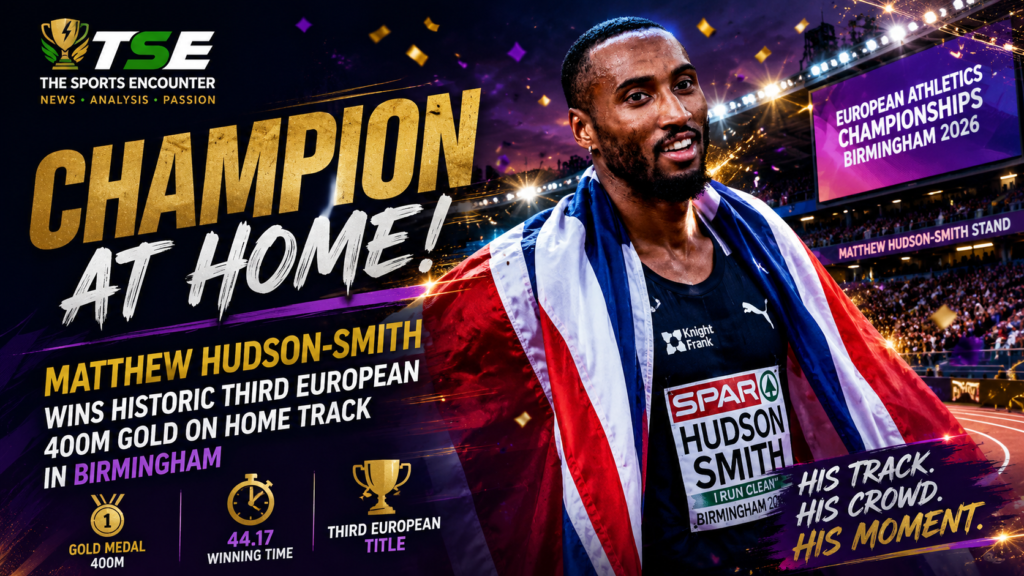
Matthew Hudson-Smith delivered the homecoming Birmingham wanted, winning the men’s 400m European title in 44.17 seconds at Alexander Stadium to become the first man in history to claim three individual European crowns over one lap.
Running from lane nine, the 31-year-old Wolverhampton sprinter held his nerve around the outside and powered through the home straight to beat France’s Muhammad Abdallah Kounta, who took silver in 44.40.
Jonas Phijffers completed the podium for the Netherlands in a national-record 44.41, finishing only 0.01 seconds behind Kounta.
For Hudson-Smith, however, the significance went far beyond another fast time.
He won at the stadium where he developed as a young athlete, in front of a stand carrying his name, and added another chapter to a European Championship career that now contains eight medals.
The victory also completed a remarkable return to the top of the continental 400m podium after his previous individual European titles in 2018 and 2022.
Fans can follow the rest of the competition through The Sports Encounter’s Birmingham 2026 coverage hub.
Matthew Hudson-Smith Wins European 400m Gold: Key Results
| Position | Athlete | Nation | Time | Notable Detail |
|---|---|---|---|---|
| 1 | Matthew Hudson-Smith | Great Britain | 44.17 | Third European 400m title |
| 2 | Muhammad Abdallah Kounta | France | 44.40 | European silver |
| 3 | Jonas Phijffers | Netherlands | 44.41 | National record |
Official event results, schedules and championship information are available through European Athletics.
Lane Nine Could Not Hide Birmingham’s Favorite
Hudson-Smith started the final from lane nine, a position that creates a very different race from competing in the middle of the track.
From the outside lane, he had almost nobody immediately in front of him to judge.
That removes one of the usual visual references available to 400m runners. Athletes in the outside lanes often have to trust rhythm, race plan and internal pacing rather than react directly to rivals.
Hudson-Smith handled that problem with the confidence of a man who has spent years racing at the highest level.
He attacked the opening bend without forcing the pace, remained composed down the back straight and entered the final bend still running smoothly.
By the time the field began to straighten for home, the race had become increasingly clear.
Kounta was the biggest threat.
Hudson-Smith still had enough.
His 44.17 was not his European record, but championship racing asks a different question from record chasing.
The clock only matters after position has been secured.
Hudson-Smith secured first.
Kounta Pushes Hudson-Smith All the Way
Muhammad Abdallah Kounta gave France an excellent silver medal performance.
His 44.40 kept him close enough to punish any mistake from Hudson-Smith during the final 100 meters.
There was no mistake.
The French athlete finished 0.23 seconds behind the champion, while Phijffers crossed only another 0.01 seconds back.
That made the fight for silver even tighter than the race for gold.
Phijffers’ 44.41 also established a Dutch national record, giving the Netherlands another major performance during a championship that has already produced several national and world-leading marks.
Those margins matter because the 400m often exposes athletes in the final 40 meters.
The body has accumulated enormous lactate, stride length starts to deteriorate and runners can lose several tenths almost instantly.
Hudson-Smith remained technically strong enough to protect his advantage.
Three European 400m Titles Put Hudson-Smith in History
The Birmingham gold gives Hudson-Smith a record nobody else in the men’s European 400m had achieved.
He is now the first man to win the individual title three times.
His previous victories came in Berlin in 2018 and Munich in 2022.
That level of championship longevity is difficult to sustain in the 400m.
The event is brutally demanding physically, while the competitive landscape can change rapidly between championship cycles.
Four years can produce a completely new generation of sprinters.
Hudson-Smith has remained relevant through several of them.
He has developed from a promising British quarter-miler into an Olympic medalist, European record holder and one of the fastest 400m runners ever.
Birmingham now adds another layer.
He is also the most successful individual men’s 400m athlete in European Championship history.
Eight European Medals Match a Major Men’s Championship Record
Hudson-Smith’s latest gold also takes his overall European Championship medal collection to eight.
That puts him level with France’s Christophe Lemaitre for the men’s record for medals won at the championships.
The total reflects more than individual 400m success.
Hudson-Smith has also played an important role in British relay teams across multiple championships.
Relay medals sometimes receive less attention than individual titles, but they help reveal one of the defining qualities of his career.
He has remained useful to Great Britain across multiple championship cycles.
That durability has become increasingly rare in elite sprinting.
Athletes can lose entire seasons through injury, miss championship windows because of form, or gradually disappear as younger runners emerge.
Hudson-Smith has kept returning.
The Matthew Hudson-Smith Stand Made This Different
There was another layer to the final that no other athlete in the race could share.
Alexander Stadium includes a temporary stand named in Hudson-Smith’s honor for Birmingham 2026.
British Athletics announced the tribute earlier this summer, recognizing his connection with the West Midlands and his development at the venue.
Hudson-Smith grew up in Wolverhampton and trained at Alexander Stadium during the formative stages of his career.
Winning in front of supporters seated in the Matthew Hudson-Smith Stand therefore turned the final into something much more personal than another international appearance.
The crowd was watching a local athlete return to the same track as one of Europe’s greatest quarter-milers.
That is difficult to manufacture.
Major championships regularly promote home athletes as emotional centerpieces.
Hudson-Smith did not need the marketing.
The geography already told the story.
Birmingham Has Become Britain’s Sprint Championship
Hudson-Smith’s victory also extends an extraordinary few days for British sprinting.
Amy Hunt won the women’s 100m title on the opening night in 11.00 seconds, producing her first major senior individual gold medal.
One day later, Romell Glave won the men’s 100m, with Jeremiah Azu taking silver.
The Sports Encounter’s Birmingham 2026 Day 2 report examined how that result gave Britain both European 100m titles.
Now Hudson-Smith has added the men’s 400m crown.
That gives the host nation another championship-defining sprint moment at Alexander Stadium.
The pattern is becoming hard to ignore.
British athletes are not simply benefiting emotionally from competing at home.
They are converting the atmosphere into medals.
Hudson-Smith Had Already Survived Questions About His Fitness
The road to the final was not completely straightforward.
Hudson-Smith progressed through the earlier rounds while questions were raised publicly about whether he was operating at full fitness.
He ran 44.78 in the semifinal and finished second in his race.
That performance was enough to qualify, but it did not look like the kind of overwhelming semifinal that removes all doubt before a final.
The Sports Encounter noted those questions in its Day 2 championship analysis.
Hudson-Smith answered them the only way that truly matters at a championship.
He won the final.
His 44.17 represented a significant step forward from the semifinal and demonstrated that he had managed his effort across the rounds.
That is one of the key skills championship sprinters acquire with experience.
Qualification rounds exist to be survived.
Finals exist to be won.
3x EUROPEAN CHAMPION!!!🥇
— Track & Field Gazette (@TrackGazette) August 12, 2026
Matthew Hudson-Smith 🇬🇧 stormed to GOLD in the men's 400m at the European Championships in Birmingham out of lane 8 in a time of 44.17s!
Muhammad Abdallah Kounta 🇫🇷 won the Silver in 44.40s, just edging Jonas Phijffers 🇳🇱 who set a Dutch Record of… pic.twitter.com/XxmJTzr29e
Why 44.17 Matters Even Without a Record
Hudson-Smith owns the European 400m record at 43.44 seconds, set during the Paris 2024 Olympic final.
That makes 44.17 look modest when viewed only against his personal ceiling.
It should not.
A championship final is a different environment.
Athletes have already raced through earlier rounds, preparation is shaped by recovery rather than pure speed, and the objective is position rather than maximum time.
Hudson-Smith needed to beat seven finalists.
He did.
The gap between 43.44 and 44.17 is therefore far less important than the gap between first and second.
That was 0.23 seconds.
Gold medals are awarded on position.
Birmingham confirmed Hudson-Smith still understands that better than almost anyone in Europe.
From Paris Olympic Silver to Another European Gold
Hudson-Smith’s career reached another level at the Paris 2024 Olympics.
He ran 43.44 in the final, breaking his own European record and taking silver.
That performance placed him among the fastest 400m runners in history.
It also reinforced one of the unusual tensions in his career.
Hudson-Smith has repeatedly produced extraordinary times, yet major championship gold at global level has remained elusive.
Europe has been different.
He has consistently converted continental opportunities.
Berlin.
Munich.
Now Birmingham.
That sequence covers eight years of championship competition.
Few sprinters remain at the top of their discipline across such a long period.
The Home Crowd Has Already Shaped Birmingham 2026
Alexander Stadium has produced several emotionally charged home performances since the championships began.
The opening night delivered Hunt’s 100m victory, while The Sports Encounter’s Day 1 wrap-up also covered Jakob Ingebrigtsen’s 5000m return and Great Britain’s mixed 4x400m relay silver.
The crowd response to British athletes has been one of the clearest features of the championship.
Hudson-Smith amplified that because his connection with the venue predates Birmingham 2026 by years.
He was not discovering Alexander Stadium as a championship arena.
He was returning to it.
That difference explains why his victory felt particularly personal.
European Athletics Is Producing Different Forms of Dominance
Hudson-Smith’s third 400m title also fits a wider theme developing across Birmingham 2026.
Some champions are establishing new eras.
Others are extending old ones.
Miltiadis Tentoglou won a fourth consecutive men’s long jump title on Day 2.
Nadia Battocletti retained her women’s 5000m crown.
Jessica Schilder captured a third straight European outdoor shot put title.
Hudson-Smith now belongs firmly in that group of athletes whose championship record has moved beyond isolated success.
The difference is longevity.
Winning once proves an athlete can reach the top.
Winning across multiple editions proves they can remain there while the field changes around them.
The Sports Encounter’s Day 2 analysis explored the same theme through Tentoglou and Battocletti.
Hudson-Smith has now supplied another example.
His Journey Gives the Gold More Weight
Hudson-Smith’s career has contained far more than medals and records.
He has spoken publicly in the past about periods when injuries, financial difficulties and mental-health struggles pushed him into a very difficult place personally.
Those experiences became part of his wider story after he returned to elite competition and rebuilt his career.
That context makes Birmingham more meaningful.
The local athlete celebrated by the crowd did not travel through a straight line from talented teenager to established champion.
His career nearly disappeared before reaching its most successful phase.
Since then, Hudson-Smith has broken the European record multiple times, won Olympic silver, collected World Championship medals and continued adding European titles.
Birmingham represents continuity after disruption.
That may be the most impressive part.
Home Championships Can Change Athletes’ Careers
Competing at home can create pressure as easily as motivation.
Every family member wants tickets.
Media attention increases.
Expectations rise.
The athlete becomes part of the event’s marketing before the first round begins.
Hudson-Smith had another layer on top of that.
His name was literally attached to part of the stadium.
That could have become a distraction.
Instead, he used the setting.
This summer has already produced several examples of home athletes converting pressure into major performances.
At Glasgow 2026, local and British athletes repeatedly benefited from intense home support during medal events. The Sports Encounter followed those championship patterns through its Glasgow Day 5 report and Day 6 analysis.
Birmingham has extended the pattern.
A Different Kind of Legacy Is Taking Shape
Hudson-Smith’s legacy is increasingly difficult to describe through one achievement.
The European record matters.
The Olympic silver matters.
His World Championship performances matter.
Three European 400m titles matter.
Eight European Championship medals matter.
Put together, they describe something more substantial.
Hudson-Smith has become one of the defining European quarter-milers of his generation.
The Birmingham victory strengthens that claim because championship history often outlasts isolated fast times.
Records can eventually disappear.
Titles remain attached to names.
What Comes Next for Hudson-Smith?
The European title does not end Hudson-Smith’s 2026 ambitions.
Britain still has relay opportunities later in the championships, while the wider season continues beyond Birmingham.
His immediate challenge will be recovery.
The 400m is one of athletics’ most physically expensive sprint events.
Championship athletes who also compete in relays must recover quickly after multiple individual rounds.
Hudson-Smith’s experience will help, but the workload remains significant.
For Britain, his availability in relay competition could add another medal opportunity before Birmingham 2026 concludes on August 16.
The host nation has already built strong momentum through Hunt, Glave, Azu and Hudson-Smith.
There are more medals still available.
TSE Verdict: The Perfect Place for Hudson-Smith’s Third Title
Matthew Hudson-Smith could have won his third European 400m title anywhere and the achievement would still have been historic.
Birmingham made it something else.
He won at the track where part of his career began.
He raced beside a stand carrying his name.
He started from lane nine without the usual visual reference of chasing athletes ahead.
He carried questions about his condition into the final.
Then he ran 44.17 and beat everyone.
The result makes him the first man to win three European individual 400m titles and takes his championship medal total to eight.
Those numbers establish the historical significance.
The setting provides the emotion.
Hudson-Smith has spent years traveling around the world chasing medals, records and validation.
One of the defining victories of his career required a much shorter journey.
He came home.
And won.
Frequently Asked Questions
Who won the men’s 400m at the 2026 European Athletics Championships?
Great Britain’s Matthew Hudson-Smith won the men’s 400m European title in Birmingham with a time of 44.17 seconds.
Who finished second behind Matthew Hudson-Smith?
France’s Muhammad Abdallah Kounta won silver in 44.40 seconds.
Who won bronze in the men’s 400m?
Jonas Phijffers of the Netherlands took bronze in a national-record 44.41 seconds.
Which lane did Matthew Hudson-Smith run from?
Hudson-Smith ran the final from lane nine.
How many European 400m titles has Matthew Hudson-Smith won?
He has now won three individual European 400m titles, taking gold in 2018, 2022 and 2026.
Is Matthew Hudson-Smith the first man to win three European 400m titles?
Yes. His Birmingham victory made him the first man to win the European men’s 400m title three times.
How many European Championship medals does Hudson-Smith have?
Hudson-Smith now has eight European Championship medals, matching Christophe Lemaitre’s men’s championship record.
Where was the 400m final held?
The race took place at Alexander Stadium in Birmingham during the 2026 European Athletics Championships.
Why is Alexander Stadium important to Hudson-Smith?
Hudson-Smith grew up in Wolverhampton and trained at Alexander Stadium during his development as an athlete. A temporary stand at Birmingham 2026 has also been named in his honor.
What is Matthew Hudson-Smith’s European 400m record?
Hudson-Smith holds the European record of 43.44 seconds, set at the Paris 2024 Olympic Games.
Where can I follow more Birmingham 2026 stories?
Follow The Sports Encounter’s Birmingham 2026 hub for results, athlete stories, records and championship analysis.