


Published: August 13, 2026
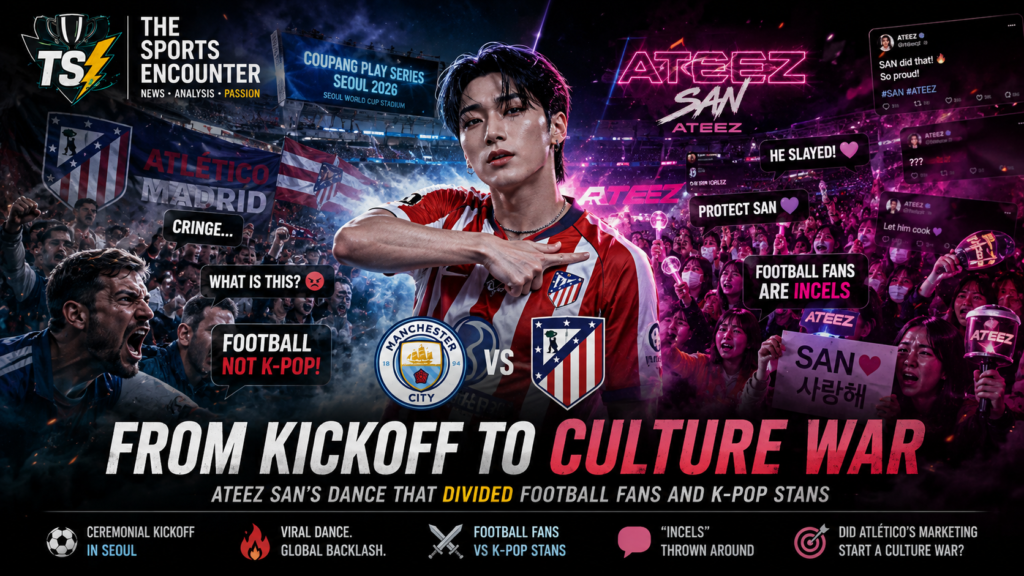
A K-pop star walked onto a football pitch in Seoul, kicked a ball, performed a few seconds of choreography and somehow ended up at the center of an international argument about masculinity, fandom, football culture and K-pop.
That was probably not in Atlético Madrid’s marketing plan.
ATEEZ member Choi San appeared before Manchester City’s preseason friendly against Atlético Madrid at Seoul World Cup Stadium on August 9 as part of the ceremonial kickoff.
The occasion already represented a carefully constructed collision of Korean pop culture and European football.
San was there.
South Korean star Lee Kang-in was preparing to make his unofficial Atlético debut after joining the Spanish club from Paris Saint-Germain.
K-pop group RESCENE had been booked as part of the matchday entertainment.
Signed ATEEZ merchandise formed part of the wider fan activation around the Coupang Play Series.
Atlético were also spending the week aggressively building their presence in South Korea around Lee, fan events and their expanding commercial strategy in Asia.
For a few minutes, it worked almost perfectly.
Then San danced.
After completing the ceremonial kickoff, he performed a short section of the choreography associated with ATEEZ’s viral song “BAD.”
Within hours, the clip escaped the K-pop ecosystem for which the choreography required little explanation.
Football accounts began reposting it.
Some viewers laughed.
Others called it embarrassing or cringe.
The mockery escalated.
ATEEZ fans pushed back.
Some accused football supporters of insecurity, homophobia or racism. Others began describing hostile critics as “incels.”
By August 12, San was trending inside conversations populated by people who had probably never listened to ATEEZ and K-pop fans who had little previous reason to care about an Atlético Madrid preseason friendly.
A marketing crossover had become an online culture clash.
The more interesting question is whether that means Atlético’s strategy failed.
There is another possibility.
Maybe the campaign worked almost too well.
For more stories exploring how football interacts with identity, fandom, media and internet culture, readers can follow The Sports Encounter’s soccer coverage.
What Actually Happened Before Manchester City vs Atlético Madrid?
| Detail | Information |
|---|---|
| Event | 2026 Coupang Play Series |
| Match | Manchester City vs Atlético Madrid |
| Date | August 9, 2026 |
| Venue | Seoul World Cup Stadium |
| Ceremonial guest | ATEEZ member San |
| San’s role | Ceremonial kickoff and support message for Lee Kang-in |
| Viral moment | Short performance of ATEEZ’s “BAD” choreography |
| Football result | Manchester City 3-1 Atlético Madrid |
| Attendance | More than 50,000 |
| Major Atlético storyline | Lee Kang-in’s unofficial club debut in South Korea |
Atlético had officially announced their participation in the Coupang Play Series against Manchester City months earlier.
The event itself was more than a normal European preseason friendly transported thousands of miles from home.
It was entertainment programming.
Football was the central product, but everything around it was designed to expand the audience.
San was selected for the ceremonial kickoff and was also expected to deliver a message supporting Lee Kang-in ahead of the Korean midfielder’s first appearance for Atlético.
RESCENE were scheduled to perform during the event, while fans were offered K-pop and football-related promotional items.
That crossover was intentional.
Internet war erupts between football fans and K-pop stans
— RT (@RT_com) August 12, 2026
Atletico Madrid invites K-pop star San to kick off friendly in South Korea
Football fans roast his dance
K-pop fans brand football crowd 'INCELS'
Did Atletico’s marketing campaign accidentally start a culture war? pic.twitter.com/d2eUotu8AQ
One Correction Matters: This Was Bigger Than Atlético Inviting San
Much of the viral framing has reduced the story to “Atlético Madrid invited a K-pop star onto the pitch.”
The reality is slightly different.
San’s appearance was part of the broader Coupang Play Series event surrounding Manchester City against Atlético Madrid.
That distinction matters because the activation belonged to a much larger Korean sports-entertainment strategy rather than functioning purely as an Atlético club promotion.
Atlético nevertheless embraced it enthusiastically.
After San’s appearance began circulating, the club amplified the crossover through its official social media presence with messaging declaring that Atlético had entered its “K-pop era.”
That was a revealing choice.
The club was not distancing itself from a celebrity activation that had little to do with Diego Simeone’s football preparation.
It was leaning into it.
Why San Was There in the First Place
The presence of San becomes much easier to understand when viewed through modern preseason economics.
European clubs do not travel to Seoul merely because they need somewhere warm to run fitness drills.
These tours are global audience-building operations.
Clubs meet sponsors.
They sell merchandise.
Players attend fan events.
Local celebrities appear around teams.
Supporters who normally experience the club through screens are given physical access.
Commercial departments collect the attention that football departments generate.
Atlético’s 2026 trip was especially important because of Lee Kang-in.
Lee Kang-in Changed Atlético’s Commercial Position in South Korea
Atlético completed Lee’s transfer from Paris Saint-Germain on July 25 and handed him the No. 7 shirt.
The club’s official announcement of Lee Kang-in’s signing immediately gave Atlético one of South Korea’s most recognizable footballers.
That transformed the meaning of the Seoul trip.
Atlético had visited South Korea before.
In 2023, the Spanish club played the K League All-Stars and Manchester City during another preseason tour.
Three years later, Atlético returned with an actual South Korean international on its roster.
Lee became the connection point between club and market.
Atlético organized fan-facing events around Seoul and opened its Casa Atleti concept to local supporters.
Lee hosted a Korean dinner for players, coaches and club staff during the trip.
The club itself reported receiving substantial affection from South Korean supporters throughout the week.
Its official gallery called the scenes “red and white passion in Seoul”.
San’s appearance fits naturally inside that strategy.
Atlético were trying to become culturally visible in Korea, rather than merely physically present.
Why K-pop Made Commercial Sense for a European Football Club
K-pop fandom is unusually useful to marketers because it is highly networked.
Fans do not simply listen to music.
They create clips.
They translate interviews.
They organize streaming campaigns.
They circulate fancams.
They coordinate hashtags.
They create edits, memes and reaction posts.
They follow idols across fashion, television, advertising and entertainment appearances.
That behavior creates distribution without a brand having to purchase every impression itself.
Put a popular idol inside a football stadium and two networks suddenly overlap.
Football accounts circulate the clip because something unusual happened on a pitch.
K-pop accounts circulate the same clip because their artist appeared at a major sporting event.
The crossover reaches people neither Atlético nor ATEEZ would ordinarily reach alone.
The Sports Encounter previously explored the same broader phenomenon in our analysis of how football stars become internet and pop-culture figures beyond their performances.
San’s moment reversed that formula.
This time, a pop star entered football’s algorithm.
Then Came the “BAD” Dance
San did more than kick the ball.
After the ceremonial moment, he performed a brief section of choreography connected to ATEEZ’s “BAD,” a dance that was already circulating widely in Korean entertainment spaces.
For ATEEZ followers, the gesture required no explanation.
It was recognizable.
It connected the football appearance back to San’s actual profession.
Outside that context, the same movement looked completely different.
A large section of the football audience encountered a man in an Atlético shirt suddenly performing stylized K-pop choreography on the pitch before a football match.
Context disappeared.
The algorithm supplied the clip without the cultural instruction manual.
That gap created the joke.
Football Twitter Found Its New Meme
Football’s online culture rewards ridicule almost instantly.
Players miss penalties and become memes.
Managers make strange expressions and become reaction images.
Unusual celebrations are clipped and reposted.
Supporters mock rival fans, hairstyles, interviews, transfer announcements and practically anything else that offers an opening.
San’s dance arrived with every ingredient required for football meme culture.
It was unexpected.
It was visually distinctive.
Most viewers outside K-pop had no idea what they were seeing.
The performer was famous enough to generate engagement but unfamiliar enough to become an object of curiosity.
Mocking posts multiplied.
Some merely called the dance awkward.
Others used it to make broader jokes about K-pop.
According to discussions collected from K-pop communities reacting to the incident, some comments escalated into homophobic and racist language.
That escalation changed the tone of the dispute.
Then K-pop Fans Entered the Fight
K-pop fandoms are hardly passive online audiences.
ATEEZ supporters saw the football posts quickly.
What football users viewed as ordinary meme culture was interpreted by many fans as targeted humiliation of San.
Defensive responses followed.
Some argued that football supporters were uncomfortable with a male performer displaying a type of movement and style that did not conform to their expectations of masculinity.
Others accused critics of homophobia.
Several fan accounts began using “incel” as an insult toward hostile football users.
That is where the original disagreement changed.
People were no longer arguing about whether a dance looked awkward.
They were arguing about each other.
Did K-pop Fans Really Brand Football Fans “Incels”?
Some did.
That requires careful wording.
There is no reasonable basis for describing football supporters generally as incels, just as there is no basis for describing K-pop followers generally as obsessive stans.
What happened online was more specific.
Individual ATEEZ and K-pop accounts used “incel” as a retaliatory insult against football users mocking San.
The term increasingly functions online as a general attack on men perceived as insecure, misogynistic or resentful, even when there is no evidence that the target belongs to an actual incel community.
That distinction matters because the word has a real meaning beyond social-media insult culture.
The internet flattened it anyway.
Football Fans and K-pop Stans May Have More in Common Than Either Side Wants to Admit
This is where the story becomes genuinely interesting.
The two cultures mocked each other for behavior they frequently share.
Football supporters organize their identities around clubs and players.
K-pop supporters organize theirs around artists and groups.
Football fans buy shirts.
K-pop fans buy albums and merchandise.
Supporters travel internationally to watch teams.
Fans travel internationally to watch concerts.
Football arguments revolve around Messi, Ronaldo, clubs, leagues and transfer loyalties.
K-pop arguments revolve around groups, idols, chart rankings and fandom rivalries.
Both cultures create edits.
Both produce fan accounts.
Both defend their favorites aggressively.
Both can become tribal.
Both sometimes struggle to recognize how strange their behavior can look to outsiders.
The Sports Encounter examined a softer version of that same emotional attachment in our feature on why fans become invested in footballers’ friendships and personal relationships.
Fans rarely consume sport or entertainment as detached observers anymore.
They participate.
Parasocial Fandom Is No Longer Unique to Pop Music
The term “parasocial relationship” is most commonly associated with celebrities and entertainment personalities.
Sports increasingly operates the same way.
Fans follow athletes’ families.
They monitor relationships.
They analyze social-media follows.
They watch training videos.
They buy clothing associated with players.
They debate personalities as intensely as tactics.
Footballers have become lifestyle figures.
That explains why our feature on the most viral player of the 2026 World Cup had to consider music, memes, fashion and internet personality alongside goals.
K-pop simply developed this model earlier and more deliberately.
The Masculinity Question Cannot Be Ignored
Part of the reaction to San also appears connected to different ideas of male performance.
Football culture remains heavily shaped by traditional presentations of masculinity.
Strength.
Aggression.
Competition.
Physical confrontation.
K-pop masculinity can operate through a different visual vocabulary.
Fashion.
Choreography.
Makeup.
Controlled sensuality.
Highly stylized appearance.
Those presentations are normal within K-pop but can look unfamiliar inside some football spaces.
San brought one version of male performance directly into a space dominated by another.
The internet reaction exposed the friction.
That Does Not Mean Every Joke Was Homophobic
This is equally important.
People are allowed to find a dance awkward.
A football supporter saying San’s choreography looked strange in the middle of a stadium is not automatically expressing prejudice.
Humor and abuse cannot be treated as the same thing.
Some K-pop responses blurred that distinction by treating virtually all ridicule as evidence of insecurity or hostility toward Asian men.
That escalation helped keep the conflict alive.
Once one side labels the other hateful and the other responds by mocking the fandom harder, the original event becomes irrelevant.
Racism and Homophobia Cross a Different Line
The opposite distinction matters too.
Racial stereotypes, anti-Asian abuse and homophobic slurs cannot be dismissed as normal football banter simply because they appear inside a meme thread.
Multiple K-pop discussion threads surrounding the incident reported encountering those types of comments while defending San.
That does not establish that the football audience generally behaved that way.
It does show how quickly mass online ridicule can create cover for more extreme abuse.
One person posts a joke.
Another makes a harsher joke.
A third pushes further because outrage generates engagement.
By the time the thread becomes viral, the most extreme comment often receives more attention than the original one.
The Algorithm Was the Real Promoter
Atlético and Coupang could create the crossover.
They could not control what happened once millions of users encountered it.
Modern social platforms reward emotional reactions.
Admiration works.
Mockery works.
Anger works particularly well.
A football supporter reposting the clip to laugh at San distributes Atlético branding.
An ATEEZ fan quote-posting the criticism to defend him distributes the same clip again.
People arguing about whether the dance is cringe create more impressions than people calmly enjoying it.
The marketing asset reproduces itself through conflict.
Did Atlético Accidentally Start a Culture War?
Literally, no.
Metaphorically, they helped create the conditions for a small one.
The club wanted cultural crossover.
It got cultural collision.
The activation placed two enormous but often separate digital tribes inside the same online conversation.
Once that happened, Atlético no longer controlled the meaning of the content.
This is a growing challenge for sports marketing.
Brands want new audiences.
New audiences bring new norms.
Existing fans may interpret those norms differently.
The Sports Encounter has already examined the growing commercialization of football through stories such as FIFA’s failed attempt to restructure part of the World Cup business around private investment.
The scale is very different, but the principle is related.
Modern football constantly searches for new commercial territory.
Culture comes with it.
Why Atlético’s Korea Strategy Still Makes Sense
The backlash should not obscure the larger commercial logic.
Atlético compete against Real Madrid, Barcelona, Manchester United, Liverpool, Manchester City, Bayern Munich and other globally established clubs for attention.
They cannot simply rely on La Liga results to close that gap.
International markets matter.
Lee Kang-in gives Atlético a powerful entry point into South Korea.
Local entertainment personalities deepen that connection.
Fan experiences make it physical.
Social media multiplies the reach.
Atlético’s official coverage of its Seoul trip showed a club consciously trying to embed itself in local culture rather than behaving like a visiting European exhibition team.
The same international attention economy is visible in transfer strategy across elite football. The Sports Encounter recently examined how global clubs weigh sporting value, commercial prestige and long-term positioning in elite transfer battles.
Lee Kang-in Is the Real Center of Atlético’s Korean Strategy
San generated the viral clip.
Lee is the strategic asset.
The 25-year-old South Korean international joined Atlético after three seasons with PSG and returned to La Liga as one of his country’s biggest football stars.
His first days with Atlético created intense local interest.
Diego Simeone publicly praised Lee’s personality and work ethic.
The club gave him the No. 7 shirt.
South Korean fans appeared in Atlético colors throughout the Seoul trip.
Commercially, Lee offers something Atlético cannot manufacture through advertising alone.
Authenticity.
He gives South Korean supporters a personal reason to follow the club every week.
The Friendly Proved the Audience Already Exists
More than 50,000 spectators attended the match at Seoul World Cup Stadium.
Manchester City won 3-1 after Omar Marmoush scored twice and Rayan Aït-Nouri added a late third goal.
Sixteen-year-old Jorge Domínguez scored Atlético’s goal.
The official Manchester City match report described an entertaining contest played in front of more than 50,000 supporters.
On the field, the result was another preseason data point.
Off it, the event demonstrated why European clubs keep returning to Seoul.
South Korea Has Become a Major European Football Market
European football occupies an increasingly large space inside South Korean sports culture.
Premier League clubs have benefited enormously from Son Heung-min’s career.
Paris Saint-Germain gained attention through Lee Kang-in.
Tottenham’s previous Korean tours showed how strongly a European club can connect with a local audience through one player.
Atlético now want their own version of that relationship.
San was a logical amplifier.
The San Controversy Shows the Risk of Cross-Fandom Marketing
Crossovers work because they introduce audiences to something unfamiliar.
That same unfamiliarity creates risk.
A K-pop fan may interpret football banter as unusually aggressive.
A football fan may interpret idol fandom as unusually intense.
Neither side necessarily understands the unwritten rules of the other.
Brands entering that territory should expect friction.
The lesson is not to avoid crossover marketing.
The lesson is to understand that cultural translation matters as much as audience size.
TSE Analysis: Atlético Did Not Lose This Internet Fight
From a conventional public-relations perspective, brands fear controversy.
From an attention perspective, Atlético received extraordinary exposure.
The club’s shirt appeared across feeds that do not normally cover La Liga.
ATEEZ fans learned who Atlético were.
Football supporters who had never heard of San learned his name.
K-pop media covered the football event.
Football accounts circulated the K-pop moment.
The crossover succeeded in its most basic objective.
It crossed over.
Whether Atlético would have preferred thousands of posts arguing about masculinity and “cringe” is another question.
Attention Is Valuable, but Sentiment Still Matters
There is a temptation in modern marketing to believe all engagement is good engagement.
That is too simplistic.
Negative attention can damage an individual.
It can reinforce stereotypes.
It can create harassment.
It can make a partner question whether future crossovers are worth the trouble.
San became the human target of a campaign designed by institutions around him.
That deserves consideration.
The athlete or celebrity in the middle of an activation absorbs reactions that the brand itself rarely experiences personally.
Football’s Viral Economy Is Expanding Beyond Football
This story also reflects how dramatically the definition of football content has changed.
A generation ago, a preseason match produced a scoreline, photographs and perhaps a television report.
Today, the most widely circulated moment from a match can happen before kickoff.
It may involve someone who does not play football.
It may have nothing to do with tactics.
That does not make the attention irrelevant.
The Sports Encounter’s analysis of the viral economy surrounding World Cup stars showed how modern football attention already moves through memes, music, fashion, friendships and personality.
San simply demonstrated that the traffic can move in the opposite direction too.
Football Fandom Is Becoming Part of Global Pop Culture
This is the larger shift.
Football used to export players into celebrity culture.
Now celebrity culture enters football directly.
Musicians launch shirts.
Actors appear at matches.
Fashion houses collaborate with clubs.
Influencers receive access.
Artists perform around fixtures.
K-pop idols take ceremonial kickoffs.
The boundary between sports fan and entertainment fan becomes less useful every year.
Our feature on Brazil fandom in Karachi’s Lyari explored another version of the same phenomenon: football identity can flourish thousands of miles away from the team or country at its center.
Atlético are trying to build precisely that kind of emotional geography in South Korea.
Why Clubs Will Keep Doing This Anyway
No major European club is likely to watch the San episode and conclude that celebrity crossovers should stop.
The incentives point in the opposite direction.
Clubs need younger audiences.
They need international audiences.
They need women fans.
They need viewers outside traditional football families.
They need commercial relevance between matches.
K-pop offers access to all of those spaces.
The next crossover will simply be planned with greater awareness of how quickly content can escape its intended cultural context.
The Real Winner Was the Algorithm
Manchester City won the match.
Atlético gained Korean exposure.
San reached millions of people outside K-pop.
Football meme accounts gained engagement.
ATEEZ fan accounts gained engagement defending him.
Platforms gained everything.
Every argument extended the life of the clip.
That may be the most modern part of the entire story.
Neither fandom needed to agree.
They only needed to keep replying.
Final Verdict: Atlético Wanted a Crossover and Got a Collision
San’s ceremonial kickoff should have lasted a few seconds.
That was the event.
The internet created everything afterward.
His “BAD” choreography moved from Korean entertainment culture into football meme culture without context.
Some football fans mocked it.
Some went much further.
K-pop fans defended him.
Some retaliated by attacking football supporters as insecure or calling them incels.
Within days, a tiny entertainment segment before a preseason friendly had become a debate about fandom, masculinity, racism, homophobia and the commercialization of football.
That does not mean Atlético made a disastrous marketing mistake.
The opposite case may be stronger.
Atlético wanted South Korean attention.
They received it.
They wanted their brand to travel beyond conventional La Liga audiences.
It did.
They wanted football and Korean pop culture to meet.
They met.
The club simply discovered something every modern sports marketer eventually learns.
When two huge internet cultures collide, nobody controls the conversation for long.
The next club planning a celebrity crossover will probably remember San’s dance.
Not because it failed.
Because it demonstrated exactly how powerful, unpredictable and combustible modern fandom has become.
Frequently Asked Questions
Who is San?
Choi San is a South Korean singer and performer and a member of the K-pop group ATEEZ.
Why was ATEEZ’s San at an Atlético Madrid match?
San was invited to perform the ceremonial kickoff before Manchester City played Atlético Madrid in the 2026 Coupang Play Series at Seoul World Cup Stadium.
Did Atlético Madrid directly invite San?
The appearance was part of the wider Coupang Play Series event rather than simply an Atlético-only activation. Atlético nevertheless embraced and promoted the K-pop crossover through its own official social channels.
What dance did San perform?
After the ceremonial kickoff, San performed a short section of choreography associated with ATEEZ’s “BAD,” which had already become a viral dance challenge.
Why did football fans mock San?
Some football users encountered the choreography without its K-pop context and described it as awkward or cringe. The reaction then escalated as the clip spread across football meme accounts.
Did football fans make racist or homophobic comments?
K-pop discussion threads reacting to the controversy reported seeing racist and homophobic comments among the broader wave of mockery. Those comments should not be generalized to football supporters as a whole.
Why were some football fans called “incels”?
Some ATEEZ and K-pop fan accounts used “incel” as an insult toward hostile critics, particularly users they perceived as insecure or aggressively mocking San’s masculinity. There is no evidence that football fans generally belong to actual incel communities.
Who won Manchester City vs Atlético Madrid?
Manchester City won the preseason friendly 3-1 at Seoul World Cup Stadium.
How many people attended the match?
More than 50,000 spectators attended according to Manchester City’s official match report.
Why was the Seoul match important for Atlético Madrid?
The match formed part of Atlético’s broader effort to expand its profile in South Korea, particularly following the signing of South Korean international Lee Kang-in from Paris Saint-Germain.
Did Lee Kang-in play?
Yes. The match marked Lee Kang-in’s unofficial Atlético Madrid debut in his home country.
Is Atlético Madrid targeting the South Korean market?
Yes. The club organized fan events in Seoul, promoted its new Korean signing extensively and used the tour to deepen its relationship with supporters in South Korea.
Was the San controversy bad marketing for Atlético?
That depends on the measurement. The backlash created negative commentary around San but dramatically increased the reach of the crossover. From an attention perspective, Atlético’s brand reached audiences that normally do not follow the club.