


A final whistle usually tells supporters how a football match ended. It does not always tell them what the players felt.
That emotional gap is often filled by a handshake, an embrace, a shirt exchange, or a few quiet words between opponents who once shared a dressing room.
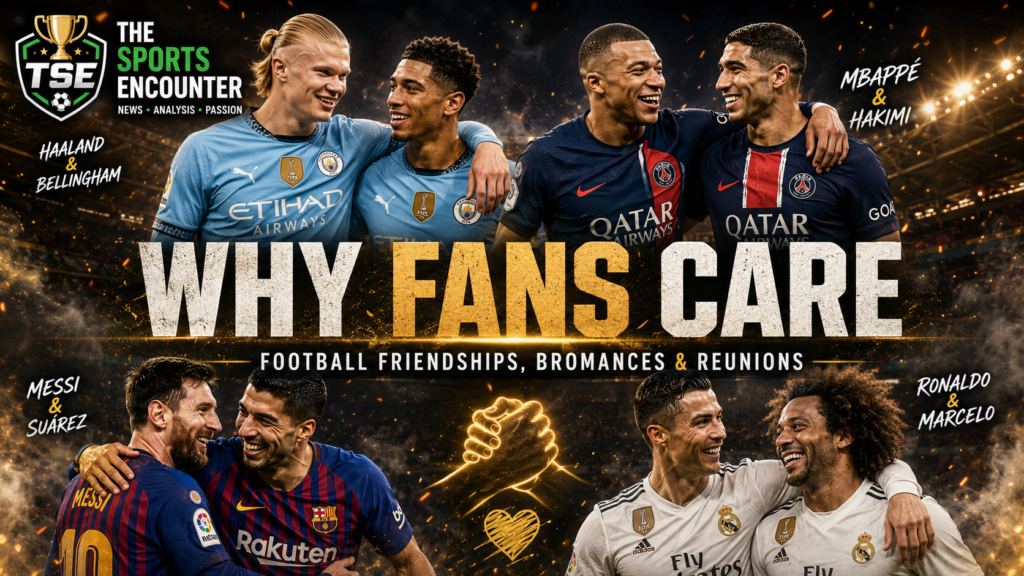
Erling Haaland and Jude Bellingham hugged after England ended Norway’s FIFA World Cup 2026 campaign. Kylian Mbappé consoled Achraf Hakimi after France defeated Morocco. Lionel Messi and Luis Suárez remained close while their careers moved through different countries and clubs.
Millions of fans care about these moments even when they have little effect on the score.
Player friendships offer something that tactics, statistics, and transfer fees cannot provide. They reveal affection inside an industry built around competition. Supporters see elite athletes behaving like former colleagues, childhood friends, or people trying to preserve an important relationship despite distance and rivalry.
That is why football bromances keep becoming searchable stories.
TL;DR
- Player friendships allow fans to see footballers as people rather than distant performers.
- Social media gives supporters regular access to training clips, vacations, jokes, celebrations, and private-looking moments.
- Fans can develop one-sided feelings of familiarity with athletes, commonly described as parasocial relationships.
- Friendships create emotional continuity when players leave clubs or represent opposing countries.
- Haaland and Bellingham attract interest because fans watched their relationship develop before they became global superstars.
- Mbappé and Hakimi combine genuine personal affection with proven chemistry at Paris Saint-Germain.
- Reunion debates allow supporters to mix nostalgia, transfer imagination, and tactical discussion.
- The healthiest fan interest recognizes that public moments reveal only part of a private relationship.
Why Famous Football Friendships Matter to Fans
| Fan Motivation | What the Friendship Provides | Football Example |
|---|---|---|
| Human connection | A view of players beyond performance and celebrity | Haaland and Bellingham joking together at Dortmund |
| Nostalgia | Memories of a successful team or era | Ronaldo and Marcelo at Real Madrid |
| Emotional tension | Friends becoming opponents in an important match | Mbappé facing Hakimi at the World Cup |
| Transfer imagination | A reason to picture former teammates reuniting | Haaland potentially playing with Bellingham again |
| Generational connection | Respect between established stars and younger players | Ronaldo interacting with Lamine Yamal |
| Community discussion | A safe, accessible debate that does not require tactical expertise | Fans ranking football’s best bromances |
Footballers Once Felt More Distant
Supporters have always cared about players’ personalities, but access used to be limited.
Newspapers carried occasional interviews. Television showed match footage and carefully arranged studio appearances. Fans learned about friendships through autobiographies, retirement interviews, or stories that emerged years after the relationships began.
Social media changed the distance between athlete and audience.
Players now post from training grounds, team buses, restaurants, vacations, dressing rooms, award ceremonies, and family celebrations. Clubs also publish behind-the-scenes content designed to show personalities that match broadcasts rarely capture.
A supporter may watch a striker for 90 minutes on Saturday and then see him teasing a teammate on TikTok, playing video games on a livestream, or leaving a joke under a friend’s Instagram post.
That steady access creates familiarity.
Research into athlete-fan relationships describes some of these connections as parasocial. Fans feel that they know a public figure through repeated media exposure even though the relationship is one-sided. Tilburg University explains that these bonds can grow through admiration, perceived closeness, and regular access to an athlete’s life. Read the university’s explanation of why fans form strong bonds with athletes.
Friendships Make Elite Players Feel Recognizable
Haaland’s physical presence can make him look like a footballer constructed in a laboratory.
He is tall, exceptionally fast for his size, and capable of finishing chances with brutal efficiency. That image changes when supporters see him laughing with Bellingham, recording an awkward rap song, or carrying an unusual raccoon souvenir through an airport.
The contrast creates warmth.
Bellingham also appears more approachable when he stops being the Real Madrid and England midfielder expected to control major matches. Around Haaland, he becomes a young man teasing an old teammate, sharing memories, or acknowledging a friend after a painful result.
The Sports Encounter followed that relationship in our feature on how Haaland and Bellingham’s friendship survived Dortmund and the World Cup.
The attraction does not come from believing supporters truly know either player. It comes from recognizing familiar behavior inside an unfamiliar world.
Fans Watched Haaland and Bellingham Grow Up Together
The Haaland-Bellingham friendship carries unusual emotional value because it began before either player reached his current level of fame.
They played together at Borussia Dortmund from 2020 to 2022, sharing the field 63 times and winning the 2021 German Cup. Training videos, interviews, celebrations, and club-produced features captured their relationship while both were still developing.
Bellingham later called Haaland “like a brother” and described him as “an even better guy than a striker.” FIFA revisited their bond before England and Norway met in the 2026 World Cup quarterfinal. FIFA documented how their friendship became a World Cup rivalry.
By then, the pair represented different superclubs and national teams.
Bellingham scored twice as England eliminated Norway 2-1 after extra time. Their post-match embrace worked emotionally because fans understood the history behind it. Viewers were not watching two famous players manufacture a respectful photograph. They were watching friends process opposite outcomes.
Our England vs Norway quarterfinal report explains how Bellingham’s goals ended Haaland’s historic tournament.
Mbappé and Hakimi Show How Friendship Survives National Rivalry
Kylian Mbappé and Achraf Hakimi offer another version of the same emotional conflict.
The pair became close at Paris Saint-Germain after Hakimi joined the club in 2021. Their friendship appeared through celebrations, travel, social posts, and time spent together away from football.
International competition repeatedly placed them on opposing sides.
France faced Morocco in the 2022 World Cup semifinal and again during the 2026 tournament. Mbappé wanted France to advance. Hakimi carried the expectations of Morocco and millions of supporters across Africa, the Arab world, and the Moroccan diaspora.
Once the competition ended, personal concern returned. Fans focused on the consolation because it showed that victory did not erase affection.
The Sports Encounter explored the tension before their latest meeting in our France vs Morocco World Cup preview.
Friendships Create Stories That Continue After Transfers
A transfer usually closes one sporting chapter.
Friendship stories keep it alive.
Haaland leaving Dortmund did not end fan interest in his connection with Bellingham. Mbappé moving away from PSG made supporters more curious about whether he and Hakimi remained close. Messi’s departure from Barcelona increased nostalgia around his relationship with Neymar and Suárez.
These bonds create continuity across football’s constant movement.
Players change clubs, shirt colors, coaches, leagues, and commercial partnerships. A long-running friendship gives supporters a thread they can follow through those changes.
The relationship may become more interesting after separation because every reunion now carries history. A Champions League draw, international fixture, award ceremony, or summer vacation can bring the players together again.
Why Reunion Debates Become So Popular
Supporters enjoy imagining former teammates playing together again because the discussion combines memory with possibility.

Part of the appeal is emotional. Fans want to recover a period they enjoyed.
The rest is tactical. Would Haaland score more goals with Bellingham creating behind him? Could Hakimi restore his right-side relationship with Mbappé? Would Neymar still fit beside Messi and Suárez?
Unlike ordinary transfer rumors, friendship reunions already carry evidence of personal compatibility. Fans have seen the players celebrate together, speak warmly about each other, and share a dressing room.
That makes the fantasy easier to believe.
Our analysis of which football friendship deserves a club reunion gave Haaland and Bellingham a narrow advantage over Mbappé and Hakimi because of their long-term tactical potential.
Player Friendships Offer Relief From Football Tribalism
Club football teaches supporters to divide the sport into sides.
Manchester City and Real Madrid compete for European control. England and Norway entered their quarterfinal knowing only one could advance. France and Morocco carried national ambition into a match with political, cultural, and sporting meaning.
Friendships complicate those divisions.
A fan may dislike a rival club while still enjoying the bond between two players. Supporters can celebrate aggressive competition and appreciate the respect that follows it.
Those moments remind audiences that footballers do not always experience rivalry as permanently as fans do.
Players share national-team camps, youth academies, agents, sponsors, neighborhoods, languages, and years of dressing-room life. Two opponents may have attended each other’s weddings or supported one another through injuries and family difficulties.
Public affection does not weaken competition. It shows that competition can remain intense without requiring personal hatred.
Football Bromances Give Casual Fans an Entry Point
Not every supporter enters football through formations, expected-goal models, or club history.
Some begin with a player.
A short video of Haaland and Bellingham laughing may encourage someone to learn that they played together at Dortmund. Interest in Mbappé and Hakimi can lead toward PSG, Morocco, France, or a World Cup knockout match.
Friendships provide an accessible narrative because the emotions require little explanation.
People understand loyalty, separation, rivalry, and reunion. Those themes work across languages and cultures.
This accessibility also explains why friendship content performs strongly on visual platforms. A hug communicates immediately. A tactical breakdown needs time, context, and attention.
Social Media Turns Fans Into Story Builders
Players and clubs provide fragments. Fans assemble the larger story.
A photograph, comment, interview clip, or celebration can inspire edits, compilations, memes, fictional scenarios, and debates about the relationship.
Some supporters describe this as “shipping,” a term commonly used when audiences imagine or emotionally support a particular relationship between public figures or fictional characters.
Football fandom brings its own version. Fans exaggerate friendships for humor, create reunion scenarios, interpret body language, and build narratives around brief interactions.
The result can be entertaining, but it also requires perspective.
Supporters see selected public moments. They do not know every private conversation, disagreement, or boundary. A friendship can be genuine without matching the story fans create around it.
When Fan Interest Goes Too Far
Most engagement with football friendships is harmless.
Problems begin when supporters treat private relationships as public property.
Constantly analyzing who followed whom, demanding explanations for missing birthday messages, or attacking a player for developing new friendships can turn affection into entitlement.
Fan fiction and humorous edits should also respect the fact that the people involved are real. A playful bromance narrative can become invasive when it ignores personal boundaries or presents invented claims as fact.
Healthy fandom leaves room for uncertainty.
Players may be close friends, former friends, friendly colleagues, or people who simply respect each other. The audience rarely knows the complete answer.
Why Haaland Became the Perfect Friendship-Era Football Star
Haaland’s World Cup popularity showed how strongly modern fans respond to personality.
His seven goals and Norway’s quarterfinal run provided sporting credibility. Memes, music, social posts, friendship content, and strange off-field moments turned him into a wider cultural figure.
Associated Press described how his playful online persona attracted attention beyond traditional football audiences and helped fans form a sense of personal connection with him.
The Sports Encounter examined those different identities in The Haaland Multiverse and compared his reach with other stars in our feature on the most viral player of FIFA World Cup 2026.
His friendship with Bellingham gave fans a human story within that larger phenomenon.
Fan Poll: Which Football Friendship Connects With You Most?
Which player friendship do you enjoy following most?
- Erling Haaland and Jude Bellingham
- Kylian Mbappé and Achraf Hakimi
- Lionel Messi and Luis Suárez
- Cristiano Ronaldo and Marcelo
- Lionel Messi and Neymar
- Declan Rice and Mason Mount
- Another friendship not listed here
Share your choice in the comments and explain the moment that made the friendship memorable for you.
Final Verdict
Football fans care about player friendships because the sport gives them plenty of conflict and relatively few moments of visible tenderness.
A friendship adds emotional depth to careers usually measured through goals, trophies, wages, and transfer values. It reminds supporters that players carry shared memories into every reunion, even when competition places them on opposing sides.
Haaland and Bellingham represent friendship shaped during youth and tested by a World Cup. Mbappé and Hakimi show how affection can survive repeated international rivalry. Messi, Suárez, Neymar, Ronaldo, and Marcelo connect supporters with eras they are reluctant to leave behind.
The fascination will continue as long as football keeps separating teammates and bringing them together again.
Fans may arrive for the rivalry. Friendship gives them another reason to care after the match ends.
Follow more fan stories, player features, and tournament analysis through The Sports Encounter’s FIFA World Cup 2026 hub and complete soccer news and analysis.
The Sports Encounter covers football through match reporting, analysis, history, fan culture, player stories, and the human relationships that shape the game.