National Bank Open: Iga Swiatek, Elina Svitolina Reach Semifinals as Montreal Enters QF Stage
Iga Swiatek and Elina Svitolina became the first confirmed National Bank Open 2026 semifinalists in Toronto, while Montreal’s men’s draw moved into an open quarterfinal stage led by Ben Shelton, Jakub Mensik, Rafael Jodar and Arthur Fils.
Iga Swiatek reached the National Bank Open semifinals by removing almost every trace of uncertainty from her quarterfinal. Elina Svitolina got there by surviving it.
That contrast has given Toronto its first confirmed semifinal of the 2026 National Bank Open, with Swiatek and Svitolina preparing to meet after taking very different routes through Monday’s quarterfinal action.
Swiatek dismantled Diana Shnaider 6-2, 6-1 in one of her most controlled performances of the tournament. Svitolina had to recover from losing the opening set against Ekaterina Alexandrova before turning the contest completely around, winning 3-6, 6-0, 6-3.
The other side of the women’s draw remains unresolved, with Coco Gauff facing Belinda Bencic and Naomi Osaka meeting Elena Rybakina for the remaining two semifinal places.
Montreal presents a different picture.
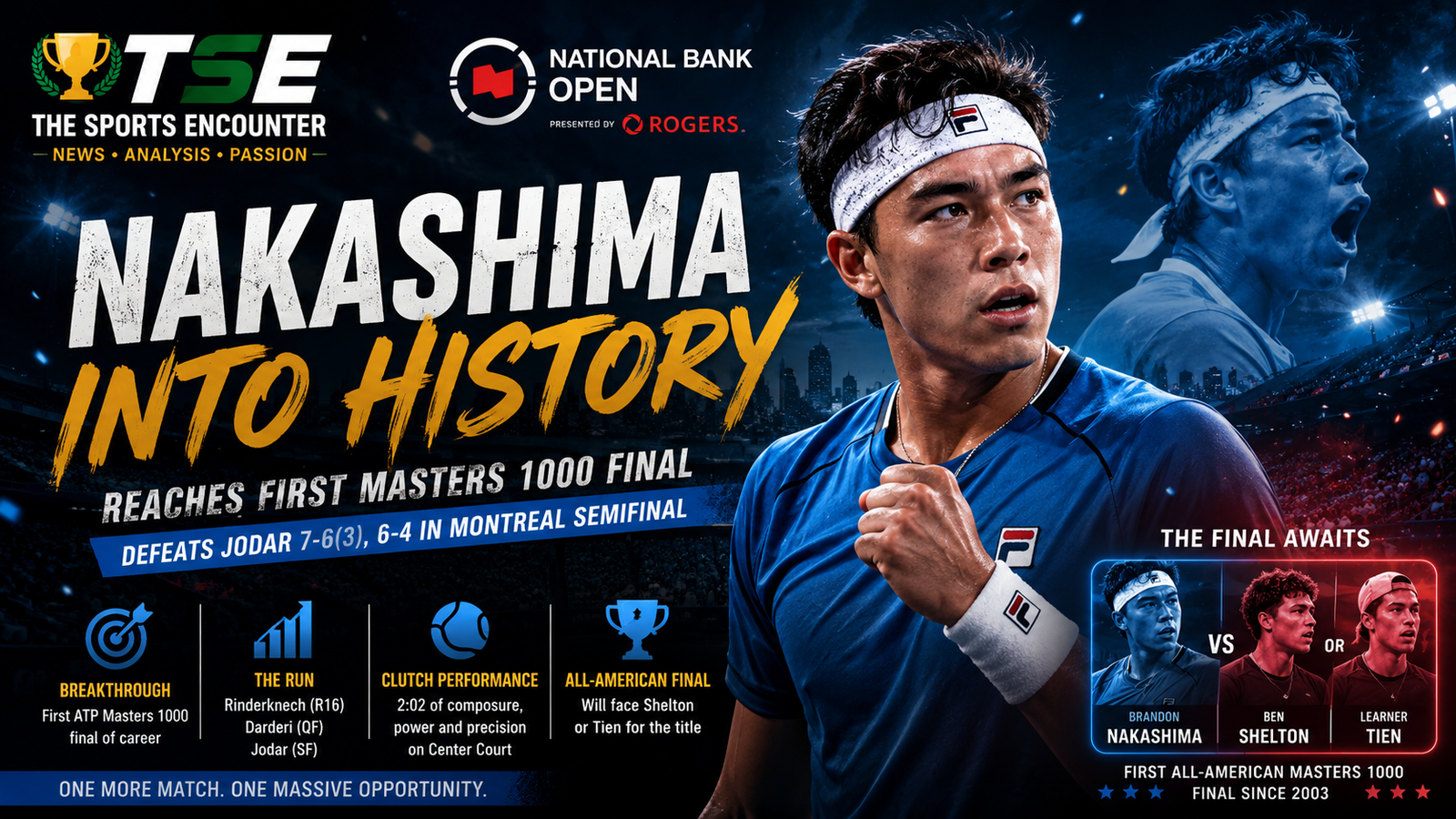
All eight men’s quarterfinalists are known, but weather disruption has compressed the closing schedule. Defending champion Ben Shelton faces Jakub Mensik, Rafael Jodar meets Arthur Fils, Luciano Darderi plays Brandon Nakashima, and Learner Tien takes on Daniel Merida.
The tournament has therefore reached its most revealing stage. Toronto is asking whether established champions can regain control of a draw repeatedly disrupted by upsets. Montreal is offering several members of the younger generation an unusually clear route toward an ATP Masters 1000 title.
For the complete tournament trail, readers can revisit The Sports Encounter’s original National Bank Open 2026 preview, which examined the expanded draws, leading contenders and the US Open questions surrounding both events before play began.
National Bank Open 2026: Latest Tournament Picture
| Event | Player/Match | Status |
|---|---|---|
| Toronto Women’s Singles | Iga Swiatek | Semifinalist |
| Toronto Women’s Singles | Elina Svitolina | Semifinalist |
| Toronto Semifinal | Iga Swiatek vs Elina Svitolina | Confirmed |
| Toronto Quarterfinal | Coco Gauff vs Belinda Bencic | To be completed |
| Toronto Quarterfinal | Naomi Osaka vs Elena Rybakina | To be completed |
| Montreal Quarterfinal | Rafael Jodar vs Arthur Fils | Scheduled |
| Montreal Quarterfinal | Luciano Darderi vs Brandon Nakashima | Scheduled |
| Montreal Quarterfinal | Jakub Mensik vs Ben Shelton | Scheduled |
| Montreal Quarterfinal | Learner Tien vs Daniel Merida | Scheduled |
Swiatek’s Quarterfinal Was a Statement in Control
Iga Swiatek did not give Diana Shnaider much room to turn their quarterfinal into a contest.
The seventh seed won 6-2, 6-1 and advanced after dropping only three games.
That matters because Swiatek’s tournament has gradually become less chaotic.
Earlier in Toronto, she had to reconstruct her match against Marta Kostyuk after a difficult opening set. Swiatek lost the first 6-3 before recovering to win the next two 6-1, 6-2.
That comeback formed one of the central stories in The Sports Encounter’s report on the exits of Aryna Sabalenka and Jessica Pegula.
The difference against Shnaider was obvious.
Swiatek did not need to repair the match.
She controlled it.
Her return pressure prevented Shnaider from establishing comfortable service games, while the Pole’s baseline depth repeatedly forced her opponent to defend from positions where attacking tennis became difficult.
The official WTA record now places Swiatek into her 23rd WTA 1000 semifinal, an extraordinary level of consistency at the tour’s highest level below the Grand Slams.
More importantly for the next few weeks, the performance looked structurally sound.
The North American hard-court season is increasingly about preparation for the US Open. Swiatek does not simply need victories. She needs matches in which her movement, return game and court positioning work together without extended periods of uncertainty.
The Shnaider win provided exactly that.
Svitolina’s Route Was the Complete Opposite
Elina Svitolina had to solve a problem before she could think about the semifinals.
Alexandrova took the opening set 6-3 and appeared capable of extending the form that had already removed world No. 1 Aryna Sabalenka from the tournament.
Svitolina responded emphatically.
She won the second set 6-0.
Rather than allowing Alexandrova to dictate with the same aggression that had worked early, Svitolina improved her defensive depth, forced longer exchanges and made her opponent repeatedly play additional shots.
The match was no longer being played at Alexandrova’s preferred rhythm.
Svitolina then took the deciding set 6-3 to complete the turnaround.
The victory extended her unbeaten run in WTA 1000 matches to ten and put her into another high-level semifinal at a particularly useful stage of the season.
Swiatek vs Svitolina Is More Interesting Than the Rankings Suggest
The confirmed semifinal is not simply a higher-ranked player against an underdog.
The styles create a genuine tactical problem.
Swiatek will want to take the ball early, establish control through her forehand and force Svitolina to defend from increasingly uncomfortable positions.
Svitolina’s best chance comes from disrupting that rhythm.
She can absorb pace, extend rallies and make aggressive players feel they need one more attacking shot than they originally expected.
That extra shot can become important against Swiatek because her most difficult matches often occur when opponents prevent her from consistently controlling the first neutral exchange.
Svitolina’s quarterfinal demonstrated why she remains dangerous in that type of contest.
She did not overpower Alexandrova.
She gradually changed the terms of the match.
Swiatek, meanwhile, enters the semifinal having just played the cleaner tennis.
That makes Wednesday’s meeting one of the tournament’s most compelling tactical battles.
Sabalenka and Pegula’s Exits Created the Opening
The current Toronto picture would look very different if the highest seeds had protected their sections of the draw.
They did not.
Alexandrova eliminated top seed Aryna Sabalenka 7-6(3), 4-6, 6-4, while Shnaider defeated Jessica Pegula 6-3, 6-3.
Those results transformed the upper half and gave Swiatek and Svitolina a clearer opportunity to push toward the title.
The pattern had been developing throughout the tournament. Our earlier National Bank Open analysis examined how leading names were falling while younger and less-established contenders kept advancing.
The quarterfinal stage has not reversed that trend.
It has clarified who managed the chaos best.
Gauff vs Bencic Could Be Decided by Court Position
Coco Gauff still has the opportunity to join Swiatek and Svitolina in the semifinals, but Belinda Bencic provides a difficult stylistic test.
Bencic likes to take the ball early and redirect pace before opponents have time to recover their court position.
Gauff brings very different strengths.
Her movement gives her exceptional defensive coverage, and her ability to turn defensive points into neutral rallies can frustrate opponents who expect early control.
Gauff reached the quarterfinals after defeating Alina Korneeva in the round of 16, while Bencic ended Alexandra Eala’s latest run.
Eala entered Toronto with considerable momentum after winning the Mubadala DC Open. Her Washington breakthrough, including the final victory over Jessica Pegula, is covered in The Sports Encounter’s report on Eala’s historic first WTA title.
The Bencic-Gauff quarterfinal should reveal which player can impose court position first.
If Bencic controls the baseline and takes time away, Gauff may be forced into too much defensive tennis.
If Gauff extends rallies and prevents Bencic from finishing points quickly, the physical balance of the match could change.
Osaka vs Rybakina Brings First-Strike Tennis to the Quarterfinals
Naomi Osaka against Elena Rybakina offers almost the opposite tactical picture.
Both women are capable of deciding points quickly.
The serve matters.
The return matters.
The first clean groundstroke after both matters even more.
Osaka reached the quarterfinals by ending Leylah Fernandez’s home run, while Rybakina survived her own tests to reach the last eight.
Their progress, along with Gauff’s and Shelton’s, was central to The Sports Encounter’s Sunday National Bank Open wrap-up.
Rybakina’s serve can make return games disappear quickly when her placement is working.
Osaka possesses the return aggression required to prevent that comfort.
The player who consistently gets the first meaningful attacking strike should have the advantage.
Montreal Has Become the Tournament of Opportunity
If Toronto still contains several proven Grand Slam champions, Montreal looks increasingly like an audition for the ATP’s next layer of Masters contenders.
The quarterfinal lineup contains Ben Shelton, Jakub Mensik, Arthur Fils, Rafael Jodar, Brandon Nakashima, Luciano Darderi, Learner Tien and Daniel Merida.
Only Shelton entered the event inside the top 10.
The broader men’s draw had already been weakened by the absence of several leading names and then reshaped further when major seeds fell during the opening week.
Alexander Zverev, Daniil Medvedev and Taylor Fritz were among the prominent casualties documented in The Sports Encounter’s Day 5 National Bank Open report.
The result is a Masters 1000 quarterfinal stage where opportunity may matter as much as ranking.
Shelton vs Mensik Is the Montreal Quarterfinal With the Most Established Firepower
Ben Shelton remains the defending champion.
That status carries more weight now because so many established contenders have disappeared.
Shelton defeated Joao Fonseca 6-3, 7-6(3) in the round of 16, while Mensik beat Botic van de Zandschulp 6-4, 7-5.
The American’s serve gives him an obvious advantage in short service games, but Mensik has enough power and first-strike ability to prevent the match from becoming entirely dependent on Shelton’s terms.
Both men also understand what winning at Masters 1000 level requires.
Among the four Montreal quarterfinals, this is the one that feels closest to an established heavyweight contest.
The previous round and the full last-eight lineup are broken down in our National Bank Open quarterfinal preview.
Rafael Jodar’s Breakthrough Has Survived Another Tournament
Rafael Jodar’s presence in the Montreal quarterfinals is becoming harder to describe as a temporary surge.
The 19-year-old Spaniard arrived in Canada shortly after reaching the Mubadala DC Open final.
He lost that championship match to Taylor Fritz 7-6(2), 6-4, but the run established him as one of the most intriguing young players of the North American summer.
Instead of fading after Washington, Jodar continued winning in Montreal.
His rise was already evident when he defeated Lorenzo Musetti, another result examined in our analysis of the younger players changing the tournament.
He now faces Arthur Fils.
That pairing should test Jodar in a different way.
Fils can bring explosive acceleration from both wings and is comfortable turning neutral exchanges into attacking points quickly.
Jodar’s challenge will be maintaining depth without allowing the Frenchman to dictate from inside the baseline.
For more context on the Spaniard’s rapid rise, readers can revisit Taylor Fritz’s victory over Jodar in the Washington final.
Tien vs Merida Guarantees Another Young Semifinalist
Learner Tien against Daniel Merida ensures that another young player will reach the final four in Montreal.
Tien has been one of the tournament’s most efficient performers and has continued a season in which his ability to redirect pace and absorb pressure has steadily improved.
Merida has produced his own breakthrough run.
The significance of this quarterfinal lies partly in what it represents.
Masters 1000 tournaments traditionally become difficult for inexperienced players once the draw narrows and expectations increase.
One of these two will leave Montreal with a semifinal appearance and a completely different level of visibility.
Darderi vs Nakashima Offers Another Open Door
Luciano Darderi and Brandon Nakashima occupy another section of the draw where opportunity has replaced expectation.
Nakashima reached his first Masters 1000 quarterfinal after surviving Arthur Rinderknech, while Darderi fought through Nuno Borges.
Neither entered Montreal as an obvious title favorite.
That is no longer particularly relevant.
Three wins now separate every quarterfinalist from the championship.
Rain Has Changed the Physical Equation in Montreal
The weather disruption adds another variable.
Montreal’s quarterfinal program has been compressed, with all four matches placed onto Tuesday’s schedule.
That means the players who survive must recover quickly for the semifinal stage.
Tournament tennis already tests recovery across multiple rounds. Compressing the final stages makes efficient victories more valuable.
A player who completes a quarterfinal in straight sets could carry a meaningful physical advantage over someone dragged through three long sets.
Shelton’s serve becomes particularly useful under those conditions because quick service games can reduce cumulative physical workload.
The same logic applies to Fils and Mensik when their first-strike tennis is functioning cleanly.
Fans can follow the updated men’s draw, results and schedule through the official ATP National Bank Open results and official ATP daily schedule.
The US Open Shadow Is Getting Larger
The National Bank Open title matters on its own.
What happens here will also influence how several players arrive in New York.
Swiatek is building hard-court confidence.
Svitolina is extending a high-level winning run.
Osaka is testing whether another resurgence can hold across consecutive rounds.
Gauff and Rybakina still have the opportunity to leave Toronto with major momentum.
Montreal is giving Shelton, Mensik, Jodar, Fils and Tien the chance to establish themselves as genuine threats heading deeper into the North American swing.
The broader US Open picture has also become more complicated because Jannik Sinner has withdrawn from Cincinnati with a right knee injury after already missing Montreal. The Sports Encounter examined what Sinner’s latest withdrawal means for his US Open preparation.
That uncertainty makes every healthy contender’s form more relevant.
What the National Bank Open Has Told Us So Far
| Storyline | What We Have Learned |
|---|---|
| Iga Swiatek | Her tennis is becoming cleaner and more controlled as the tournament progresses. |
| Elina Svitolina | Her ability to change matches tactically remains one of her greatest strengths. |
| Toronto favorites | Sabalenka and Pegula’s exits prove ranking protection has meant little in this draw. |
| Naomi Osaka | Her hard-court power remains capable of carrying her deep into major events. |
| Ben Shelton | The defending champion has survived while many of Montreal’s bigger seeds disappeared. |
| Rafael Jodar | His Washington breakthrough is becoming part of a sustained North American run. |
| Montreal youth movement | Several emerging players now have a realistic route to a Masters 1000 final. |
| Weather | The compressed men’s schedule could make recovery an important competitive factor. |
TSE Analysis: Toronto Is Becoming About Control, Montreal About Possibility
The two tournaments now feel very different.
Toronto still contains players whose careers are already defined by major championships, No. 1 rankings and deep runs at the biggest tournaments.
Swiatek is trying to restore the level of control that has defined her best seasons.
Svitolina is demonstrating that experience and tactical discipline can still overturn difficult matches.
Osaka, Gauff, Rybakina and Bencic provide four very different routes into the other semifinal.
Montreal has moved in another direction.
The early exits of established seeds did not weaken the competition so much as change its purpose.
Shelton now carries the pressure of a defending champion.
Mensik has an opportunity to beat him.
Jodar can continue turning a breakout summer into something more substantial.
Fils can convert potential into one of the biggest titles of his career.
Tien, Merida, Nakashima and Darderi have similar opportunities.
That is what makes the final days compelling.
The women’s tournament is asking which established contender can seize control.
The men’s tournament is asking who is ready to claim an opening that may not appear this wide again soon.
What Happens Next?
Toronto still has two quarterfinals to determine the other half of its semifinal lineup:
- Coco Gauff vs Belinda Bencic
- Naomi Osaka vs Elena Rybakina
Swiatek and Svitolina are already through and will meet for a place in the final.
Montreal’s four quarterfinals are:
- Luciano Darderi vs Brandon Nakashima
- Rafael Jodar vs Arthur Fils
- Jakub Mensik vs Ben Shelton
- Learner Tien vs Daniel Merida
Official women’s scores, draws and tournament updates are available through the WTA National Bank Open results page. The WTA has also published detailed reports on Swiatek’s quarterfinal victory over Shnaider and Svitolina’s comeback against Alexandrova.
For continuing reports, analysis and player features from the North American hard-court season, visit The Sports Encounter’s tennis coverage.
Final Verdict: The Draws Have Stopped Following the Rankings
By this stage of a Masters 1000 tournament, rankings normally begin to impose order.
The National Bank Open has resisted that pattern.
Sabalenka is gone.
Pegula is gone.
Many of the leading men’s seeds disappeared before the quarterfinals.
Swiatek has responded by becoming increasingly authoritative.
Svitolina has responded by becoming increasingly difficult to remove.
Gauff, Bencic, Osaka and Rybakina still have their say to make in Toronto.
Montreal may soon produce a champion from a generation that began the tournament chasing opportunity rather than carrying expectation.
That combination has given the National Bank Open something more valuable than a predictable march toward the finals.
It has given the closing stages genuine uncertainty.
Swiatek and Svitolina are the first players to turn that uncertainty into semifinal places.
Everyone else now has to follow them.
Frequently Asked Questions
Who has reached the National Bank Open 2026 women’s semifinals?
Iga Swiatek and Elina Svitolina are the first two confirmed women’s semifinalists in Toronto.
What was the Iga Swiatek vs Diana Shnaider score?
Swiatek defeated Shnaider 6-2, 6-1 to reach the semifinals.
What was the Elina Svitolina vs Ekaterina Alexandrova score?
Svitolina recovered from losing the first set to win 3-6, 6-0, 6-3.
Who will Swiatek play in the semifinal?
Swiatek will face Svitolina for a place in the Toronto final.
Which women’s quarterfinals are still to be played?
Coco Gauff faces Belinda Bencic, while Naomi Osaka plays Elena Rybakina.
Who will Ben Shelton play in the Montreal quarterfinals?
Defending champion Ben Shelton will face Jakub Mensik.
Who will Rafael Jodar play next?
Jodar will face Arthur Fils in the Montreal quarterfinals.
What are the other Montreal quarterfinals?
Luciano Darderi faces Brandon Nakashima, while Learner Tien plays Daniel Merida.
Who did Shelton beat in the round of 16?
Shelton defeated Joao Fonseca 6-3, 7-6(3).
Who did Jakub Mensik beat in the round of 16?
Mensik defeated Botic van de Zandschulp 6-4, 7-5.
Where can readers follow more National Bank Open coverage?
The Sports Encounter’s tennis section contains continuing National Bank Open reports, analysis, player stories and US Open build-up coverage.
CPL 2026
Andre Fletcher Hands Patriots Their First Win in the Caribbean Premier League 2026
Andre Fletcher stayed unbeaten on 48 as St Kitts and Nevis Patriots chased 156 in 17.4 overs to beat St Lucia Kings by five wickets and claim their first CPL 2026 win.
St Kitts and Nevis Patriots finally have their first win of the Caribbean Premier League 2026 season, and they earned it by understanding exactly what the chase required.
Andre Fletcher stayed unbeaten on 48 from 41 balls, Kyle Mayers launched 32 from just 16, and the Patriots chased down St Lucia Kings’ 155 for eight with 14 balls to spare at the Daren Sammy National Cricket Stadium in Gros Islet.
The five-wicket victory was built on two very different phases. First, Saurabh Netravalkar and Jason Holder combined for six wickets to prevent St Lucia from turning a promising middle-overs position into the 180-plus total captain Roston Chase believed was available. Then Johnson Charles and Mayers attacked from the start of the chase, giving Fletcher the freedom to control the rest.
The result moved the Patriots to one win and one defeat after their rain-affected opening loss to Trinbago Knight Riders, while St Lucia slipped to 1-1 after beginning their campaign with a four-run victory over Antigua and Barbuda Falcons.
Fans can follow every match through The Sports Encounter’s dedicated CPL 2026 hub and our broader cricket coverage.
St Lucia Kings vs St Kitts and Nevis Patriots: CPL 2026 Match 5
| Match Detail | Information |
|---|---|
| Competition | Caribbean Premier League 2026 |
| Match | St Lucia Kings vs St Kitts and Nevis Patriots, Match 5 |
| Date | August 12, 2026 |
| Venue | Daren Sammy National Cricket Stadium, Gros Islet, St Lucia |
| Toss | St Lucia Kings elected to bat |
| St Lucia Kings | 155/8 in 20 overs |
| St Kitts and Nevis Patriots | 156/5 in 17.4 overs |
| Result | Patriots won by five wickets with 14 balls remaining |
| Player of the Match | Andre Fletcher, 48* from 41 balls and two catches |
| Best bowling | Saurabh Netravalkar 3/32, Jason Holder 3/20 |
| Top scorer | Jewel Andrew, 58 from 42 balls |
| Points | St Kitts and Nevis Patriots 2, St Lucia Kings 0 |
TL;DR
- St Kitts and Nevis Patriots defeated St Lucia Kings by five wickets in CPL 2026 Match 5.
- St Lucia made 155 for eight after recovering from 12 for two through Jewel Andrew’s 58 and Kamil Pooran’s 54.
- Netravalkar and Holder took three wickets each, with Holder conceding only 20 runs from four overs.
- Johnson Charles smashed 16 from five balls and Kyle Mayers hit 32 from 16 as the Patriots raced to 59 for two in the powerplay.
- Andre Fletcher anchored the chase with an unbeaten 48 from 41 deliveries.
- Wanindu Hasaranga finished the match with a six as the Patriots reached 156 for five in 17.4 overs.
- The victory gave the Patriots their first win of CPL 2026 after losing their opener to Trinbago Knight Riders.
Netravalkar Strikes Twice Before St Lucia’s Young Batters Take Over
St Lucia chose to bat first and immediately ran into trouble.
Saurabh Netravalkar removed Andries Gous for four in the opening over and then dismissed Ackeem Auguste for a duck in his second spell with the new ball. The Kings were 12 for two after 2.3 overs, and the Patriots had exactly the start Holder wanted.
That early position made the response from Kamil Pooran and Jewel Andrew particularly impressive.
The pair rebuilt aggressively rather than retreating. Their third-wicket stand pushed St Lucia from 12 for two to 94 before Pooran was run out at the end of the 11th over.
Pooran’s 54 came from only 30 deliveries and contained seven fours and three sixes. He reached his half-century from 28 balls and repeatedly punished anything short or overpitched.
Andrew played a slightly different role. He absorbed more deliveries but still found the boundary often enough to keep St Lucia moving, eventually making 58 from 42 balls with two fours and four sixes.
At 82 for two after 10 overs, St Lucia appeared well placed to build toward a total closer to the 180 or 190 Chase later said the team had targeted.
That possibility disappeared quickly.
Holder and Netravalkar Turn 133 for Three Into 141 for Eight
The decisive period of the first innings arrived after Charith Asalanka helped St Lucia move to 133 for three.
Holder removed Asalanka for 14, then bowled Andrew four balls later. Netravalkar followed by dismissing Matthew Forde for two, and Holder struck again to remove Shadley van Schalkwyk.
Obed McCoy then had McKenny Clarke caught behind.
St Lucia had collapsed from 133 for three to 141 for eight in just over three overs.
Holder finished with outstanding figures of three for 20 from four overs, delivering 16 dot balls and conceding only five runs per over. Netravalkar took three for 32, continuing an impressive short-term spell with the Patriots that Holder specifically highlighted after the match.
The captain said Netravalkar had been “outstanding” and explained that he had personally pushed for the left-arm seamer to join the squad for the three matches he was available.
The late squeeze mattered because the Kings had already shown how dangerous they could be with the bat in their four-run victory over Antigua and Barbuda Falcons in Match 3. In that game, Gous scored 82 and St Lucia reached 187 for eight.
This time, they managed only 22 runs from the final 4.5 overs after Asalanka’s dismissal.
Chase later admitted his side had left roughly 30 to 35 runs on the field.
Charles and Mayers Refuse to Let the Chase Become Complicated
The Patriots had been bowled into submission by Sunil Narine and Trinbago Knight Riders in their opening match, scoring only 109 for nine before losing by 19 runs under the DLS method. That defeat is covered in our CPL 2026 Match 2 report.
Against St Lucia, there was no sign of the same caution.
Johnson Charles attacked immediately.
He scored 16 from five balls at a strike rate of 320, including two sixes, before Matthew Forde bowled him in the second over.
Kyle Mayers then took over.
Forde suffered badly in his second over as Mayers launched three sixes and two fours during a brutal counterattack. The left-hander reached 32 from only 16 deliveries before Maheesh Theekshana had him caught at deep midwicket.
By then, the damage had already been done.
The Patriots reached 50 after only four overs and finished the powerplay at 59 for two. Chasing 156, they had reduced the required rate to a level where the middle order no longer needed to manufacture boundaries every over.
Holder later described that early acceleration as crucial because it kept his team ahead of the required rate throughout the chase.
Fletcher Changes Roles and Controls the Middle Overs
Andre Fletcher’s innings was not spectacular in the conventional T20 sense.
It was more useful than that.
Once Charles and Mayers had done the damage, Fletcher recognized that the Patriots no longer needed reckless batting. He rotated the strike, chose his attacking moments carefully and allowed others to play around him.
Kevin Wickham added 19 from 20 balls during a 45-run partnership before Theekshana struck again.
Holder made 10, while Dasun Shanaka contributed 12 from nine. Their dismissals briefly gave St Lucia a route back into the contest as the Patriots moved from 97 for three to 137 for five.
Fletcher never lost control.
He finished unbeaten on 48 from 41 balls, with three fours and a six, after also taking two catches earlier in the match.
That composed approach earned him Player of the Match.
Fletcher explained afterward that the original plan had been to attack hard in the powerplay. Once Charles departed and later Mayers fell, his role changed.
He decided to bat deep, rotate strike and make sure the chase did not drift away from the Patriots.
Hasaranga Finishes It With Authority
Wanindu Hasaranga joined Fletcher with 19 runs still required and kept the chase moving.
The finishing blow came from the fourth ball of the 18th over.
Forde went short and down the leg side. Hasaranga used the pace, helped the ball over the wicketkeeper and watched it clear the boundary for six.
The Patriots reached 156 for five in 17.4 overs.
Fletcher celebrated with a rare burst of emotion after spending most of the chase remarkably calm.
St Lucia’s spinners had done their best to make the middle overs competitive. Theekshana took two for 22 from four overs, Joshua Bishop conceded only 25 while claiming Shanaka, and Chase finished with one for 32.
Forde, however, endured a difficult night. His 2.4 overs cost 47 runs, including much of the early assault from Charles and Mayers.
The Real Turning Point Came Before the Chase
Fletcher’s unbeaten innings will understandably dominate the result, but the Patriots probably won the match during St Lucia’s final five overs.
The Kings had reached 133 for three with almost five overs remaining.
A total around 180 was still realistic.
Instead, Holder, Netravalkar and McCoy took five wickets while allowing only 22 more runs.
That changed the chase entirely.
St Lucia’s captain recognized the same issue afterward, saying 180 or 190 had been the original target and that his team finished approximately 30 to 35 runs short.
Once the Patriots scored 59 during the powerplay, the required rate never became a serious problem.
The match offered a sharp contrast with the previous CPL fixture, when Barbados Tridents survived Andre Russell’s astonishing assault to beat Jamaica Kingsmen by five runs. That contest became a frantic finish because Jamaica remained within striking distance.
Here, the Patriots made sure the chase rarely reached that stage.
Holder Gets the Response He Needed
For Jason Holder, the result was less about perfection and more about preventing an 0-2 start.
He praised the bowling attack, Fletcher’s composure and the aggressive opening approach, while also admitting the Patriots had been sloppy in the field and could improve their energy.
His own contribution was significant.
Holder’s three for 20 was the most economical spell of the match, and ESPNcricinfo rated him as its match MVP despite Fletcher taking the official Player of the Match award.
The Patriots now have two points and some breathing room before moving on to Antigua.
That matters after the way their campaign began against TKR.
Across the competition, CPL 2026 has already produced wildly different match types. The opener went to the final delivery as Antigua and Barbuda Falcons edged Jamaica Kingsmen, Match 2 was shaped by rain and Narine, Match 3 went down to a four-run margin, and Match 4 produced Russell’s extraordinary late assault.
Match 5 was different.
The Patriots won by taking control early enough that the final overs never became desperate.
What the Result Means for St Lucia Kings
St Lucia can take encouragement from Andrew and Pooran.
Chase emphasized afterward that his squad is extremely young and praised both batters for responding after the early wickets.
The concern is what happened around them.
After Pooran’s run-out, only Andrew reached double figures among the remaining batters. The Kings’ last six wickets added just 61 runs, and the final five overs produced far less than the platform demanded.
That was a major change from their season-opening win, when their top order and spin attack combined effectively against Antigua.
The loss leaves St Lucia 1-1, but there is little reason for alarm this early in the tournament. The more important question is whether Andrew and Pooran can turn this performance into something sustainable as the competition develops.
Patriots Leave Gros Islet With Something to Build On
Holder summed up the significance simply: one-and-one is considerably better than zero-and-two.
The Patriots still have areas to clean up. Their fielding lacked sharpness, several half-chances went begging, and the middle order gave St Lucia enough wickets to briefly reopen the chase.
But they also showed the balance a good T20 side needs.
Netravalkar attacked with the new ball. Holder controlled the death overs. Charles and Mayers destroyed the required rate early. Fletcher then understood when acceleration was no longer necessary.
That combination delivered the Patriots’ first victory of CPL 2026.
The broader franchise game continues to reward precisely that ability to change roles during an innings. The Sports Encounter recently explored the evolution of modern T20 batting when Jos Buttler became the format’s leading career run-scorer, while the remarkable defensive effort in the Global Super League final showed how quickly T20 assumptions can collapse.
The Patriots did not need anything extraordinary in St Lucia.
They simply read the game better once the important moments arrived.
Official fixtures, results and tournament information are available through the Caribbean Premier League’s official website.
Frequently Asked Questions
Who won St Lucia Kings vs St Kitts and Nevis Patriots in CPL 2026 Match 5?
St Kitts and Nevis Patriots defeated St Lucia Kings by five wickets at the Daren Sammy National Cricket Stadium in Gros Islet.
What was the final score?
St Lucia Kings scored 155 for eight from 20 overs. St Kitts and Nevis Patriots reached 156 for five in 17.4 overs.
Who was Player of the Match?
Andre Fletcher was named Player of the Match after scoring an unbeaten 48 from 41 balls and taking two catches.
Who were the leading scorers for St Lucia Kings?
Jewel Andrew top-scored with 58 from 42 balls, while Kamil Pooran made 54 from 30 deliveries.
Who took the most wickets for the Patriots?
Saurabh Netravalkar and Jason Holder both took three wickets. Netravalkar finished with 3/32, while Holder returned 3/20 from four overs.
How quickly did the Patriots chase 156?
The Patriots completed the chase in 17.4 overs, winning with 14 balls remaining.
How many points did the Patriots earn?
St Kitts and Nevis Patriots collected two points from the victory, while St Lucia Kings received none.
What is the Patriots’ record after two CPL 2026 matches?
The Patriots have one win and one defeat. They lost their opening match to Trinbago Knight Riders before beating St Lucia Kings in Match 5.
Editor's Choice
Iga Świątek Survives Svitolina Fightback, Wins Final Four Games to Reach Toronto Final
Iga Swiatek recovered from a second-set collapse and a 3-2 deficit in the decider to beat Elina Svitolina 6-3, 1-6, 6-3 and reach the National Bank Open 2026 final.
Iga Swiatek looked in complete control, lost that control almost entirely, then found it again when the National Bank Open semifinal was slipping away.
The Polish star defeated Elina Svitolina 6-3, 1-6, 6-3 on Wednesday night in Toronto, surviving a dramatic momentum swing to reach her first final of the 2026 season and her 14th career WTA 1000 championship match.
The scoreline only tells part of the story. Swiatek raced through the opening set, Svitolina answered with a ruthless second-set takeover, and the Ukrainian then broke in the deciding set to lead 3-2.
That was the moment the semifinal changed again.
Swiatek won the final four games, stopping Svitolina’s surge and turning a dangerous third set into a 6-3 finish. She now advances to face Elena Rybakina in the National Bank Open final after Rybakina defeated Coco Gauff in the other semifinal.
Swiatek vs Svitolina: National Bank Open 2026 Semifinal
| Category | Elina Svitolina | Iga Swiatek |
|---|---|---|
| Seed | No. 9 | No. 7 |
| Final score | 3, 6, 3 | 6, 1, 6 |
| Aces | 1 | 0 |
| Double faults | 4 | 4 |
| First-serve points won | 59% | 56% |
| Second-serve points won | 43% | 47% |
| Break points converted | 5 of 19 | 5 of 13 |
| Total points won | 88 | 86 |
| Match duration | 2 hours, 17 minutes | |
The official National Bank Open match statistics underline how close the contest became. Svitolina actually won two more total points, 88 to 86, despite losing the match.
Swiatek Starts Fast and Pushes Svitolina Back
For much of the opening set, the semifinal looked like it might become another controlled Swiatek performance.
She quickly established a 5-1 lead, using depth through the middle and early ball striking to stop Svitolina from creating comfortable attacking positions. Svitolina began to find better timing late in the set and pulled back to 5-3, but Swiatek closed it 6-3 before the recovery could become anything more dangerous.
That start continued a pattern already visible in Toronto.
Swiatek had entered the semifinal after dismantling Diana Shnaider 6-2, 6-1 in the quarterfinal, a result The Sports Encounter covered when Swiatek and Svitolina secured their semifinal places.
Earlier in the tournament, Swiatek had also survived a more difficult test against Marta Kostyuk, recovering from a set down to win 3-6, 6-1, 6-2 as the Toronto draw lost Aryna Sabalenka and Jessica Pegula.
Those two performances had already shown both sides of her week: the ability to dominate and the ability to repair a match after losing momentum.
She needed the second quality against Svitolina.
Svitolina Flips the Match With a 6-1 Second Set
The opening set gave almost no warning of what came next.
Svitolina began taking the ball earlier, attacking Swiatek’s second serve and pushing deeper into return games. The rallies changed shape. Swiatek, who had dictated so many of the important exchanges in the first set, increasingly found herself reacting rather than controlling.
The Ukrainian broke repeatedly and ran through the second set 6-1.
It was a sharp reminder of why Svitolina had become such an uncomfortable opponent for Swiatek in 2026.
This was their third meeting of the season, and Svitolina had won the previous two. According to the WTA, Swiatek entered Toronto still searching for her first victory over Svitolina in three attempts this year.
The second set suggested that problem might be repeating itself.
Svitolina had also arrived with considerable confidence. She recovered from a set down against Ekaterina Alexandrova in the quarterfinal, winning 3-6, 6-0, 6-3. That comeback formed part of a week in which the experienced Ukrainian had repeatedly resisted pressure.
The broader tournament had already become increasingly volatile, from early upsets to late-round recoveries. The Sports Encounter tracked that shift as the National Bank Open moved into an unpredictable second week.
Svitolina Breaks for 3-2 and Puts Swiatek Under Real Pressure
The deciding set became the real test.
Both players held through the opening games before Svitolina broke Swiatek and moved ahead 3-2.
The scoreboard now favored the Ukrainian. So did the momentum.
Swiatek had lost the second set heavily, had just surrendered serve again and was facing an opponent who had already beaten her twice this season.
Her response was immediate.
Instead of allowing Svitolina to consolidate the break, Swiatek attacked the next return game and broke straight back.
That hold-break sequence mattered more than any individual winner.
The match had reached the point where confidence could have tilted decisively toward Svitolina. Swiatek denied her that chance.
Four Straight Games Decide the Semifinal
Once Swiatek recovered the break, the final phase became increasingly one-sided.
She held for 4-3, broke again for 5-3 and then served out the match.
Four consecutive games turned a 2-3 deficit into a 6-3 victory.
The finish was particularly significant because the overall numbers remained so close. Svitolina won 51% of the total points, while Swiatek won 49%. The Ukrainian also created 19 break-point opportunities compared with Swiatek’s 13.
Yet tennis matches are decided by the distribution of points rather than the raw total.
Swiatek won the most important cluster of them.
That ability to reset under pressure has defined several key moments during her Toronto run. She showed it against Kostyuk, then again here after Svitolina threatened to take over the semifinal.
Swiatek Finally Solves the Svitolina Problem
The victory carried more weight because of their recent history.
Svitolina had beaten Swiatek twice earlier in 2026, both times forcing the Polish player into uncomfortable patterns and exposing moments when Swiatek struggled to reset during longer matches.
Toronto produced a different ending.
Swiatek still lost control for a long stretch. The difference was what happened after she lost it.
Instead of allowing one poor set to dictate the third, she changed the pace of the rallies, competed harder in Svitolina’s service games and recovered immediately after falling behind.
The WTA described it as a significant improvement in Swiatek’s ability to find the right rhythm against an opponent who had repeatedly troubled her this season.
That adjustment sends her into her first final of 2026.
A First Final of 2026 and Another WTA 1000 Milestone
The result also extends Swiatek’s elite record at WTA 1000 level.
Toronto will be the 14th WTA 1000 final of her career, and she has now reached the championship match at nine of the 10 events currently on the WTA 1000 calendar. Wuhan remains the only exception.
That milestone comes during a season in which Swiatek has had to work harder for momentum than in several of her dominant previous campaigns.
The National Bank Open has therefore become more than another deep run.
It has given her a chance to establish hard-court rhythm before the US Open.
The tournament began with exactly those questions. The Sports Encounter’s National Bank Open 2026 preview framed Toronto and Montreal as the first major examination of the North American hard-court season.
Ten days later, Swiatek is one match from the title.
Rybakina Awaits in the Toronto Final
The championship match now brings together two players who reached it through very different semifinals.
Rybakina recovered from a set down to defeat Gauff 5-7, 6-2, 6-2, continuing a run in which she has repeatedly solved difficult matches after falling behind.
Her route to the semifinals included another comeback against Naomi Osaka, which formed the centerpiece of The Sports Encounter’s report on Toronto’s completed final four.
The final therefore brings together Rybakina’s first-strike power and Swiatek’s return pressure, movement and ability to redirect pace.
Fans can follow continuing tournament coverage through The Sports Encounter’s Tennis section.
For Swiatek, the semifinal provided the exact kind of test she may value most before a major championship.
She was comfortable, then uncomfortable, then under real pressure.
She still found a way through.
Frequently Asked Questions
Who won the Iga Swiatek vs Elina Svitolina semifinal?
Iga Swiatek defeated Elina Svitolina 6-3, 1-6, 6-3 in the National Bank Open 2026 women’s semifinal in Toronto.
How long did the Swiatek vs Svitolina semifinal last?
The semifinal lasted 2 hours and 17 minutes.
Did Svitolina lead in the third set?
Yes. Svitolina broke Swiatek to lead 3-2 in the deciding set before Swiatek won the final four games.
How many total points did each player win?
Svitolina won 88 total points and Swiatek won 86, despite Swiatek winning the match.
Who will Iga Swiatek play in the National Bank Open final?
Swiatek will face Elena Rybakina, who defeated Coco Gauff 5-7, 6-2, 6-2 in the other semifinal.
Is this Iga Swiatek’s first final of 2026?
Yes. Toronto is Swiatek’s first tournament final of the 2026 season.
How many WTA 1000 finals has Swiatek reached?
The 2026 National Bank Open final will be the 14th WTA 1000 final of Swiatek’s career.
Editor's Choice
Elena Rybakina Beats Coco Gauff to Reach Toronto Final
Elena Rybakina came from a set down to defeat Coco Gauff 5-7, 6-2, 6-2 in Toronto, reaching her first National Bank Open final with a commanding second-half performance.
Elena Rybakina spent the opening set of her National Bank Open semifinal trying to solve Coco Gauff. By the end of the night, she had taken the match away from her.
The No. 2 seed recovered from a difficult start to defeat Gauff 5-7, 6-2, 6-2 on Wednesday night in Toronto, reaching the National Bank Open final for the first time in her career.
What began as a controlled performance from Gauff turned sharply after the first set. Rybakina found greater depth on return, began attacking the American’s second serve and increasingly dictated the first meaningful strike in the rallies. Once she broke midway through the second set, the semifinal changed completely.
Rybakina will now face Iga Swiatek in the championship match after the Polish star defeated Elina Svitolina 6-3, 1-6, 6-3 in the other semifinal.
Gauff vs Rybakina: National Bank Open 2026 Semifinal
| Category | Coco Gauff | Elena Rybakina |
|---|---|---|
| Seed | No. 4 | No. 2 |
| Final score | 7, 2, 2 | 5, 6, 6 |
| Aces | 3 | 5 |
| Double faults | 6 | 1 |
| First-serve points won | 63% | 74% |
| Second-serve points won | 45% | 62% |
| Break points converted | 1 of 4 | 4 of 11 |
| Total points won | 80 | 98 |
| Match duration | 2 hours | |
Gauff Survives Early Trouble and Takes the First Set
Gauff entered the semifinal with considerably less court time in her legs than Rybakina. Her quarterfinal against Belinda Bencic never took place after the Swiss player withdrew with a hip injury, giving Gauff additional recovery time following an impressive run through the earlier rounds.
That advantage did not immediately translate into a comfortable start.
Rybakina opened the match by pushing Gauff to love-40 in the very first service game. Gauff escaped, and that hold became important. Rather than allowing Rybakina to establish early control, the American settled into the contest and protected her serve throughout most of the opening set.
That composure reflected the form Gauff had shown earlier in Toronto. She had already produced one of her cleanest performances of the tournament against Alina Korneeva, part of a women’s draw that The Sports Encounter followed throughout the National Bank Open quarterfinal race.
At 5-4, Gauff earned her first set point on Rybakina’s serve but could not convert it. Two games later, another opportunity arrived.
This time she took it.
Gauff broke for 7-5 and appeared to have created the tactical pattern she wanted. She was extending rallies, making Rybakina hit additional balls and preventing the Kazakhstani from consistently controlling exchanges with her serve and first groundstroke.
The Match Turns in the Middle of the Second Set
The semifinal changed during Gauff’s third service game of the second set.
After surviving a difficult hold earlier in the set, Gauff was broken to fall behind 3-2. From that point, her control disappeared quickly.
Rybakina began getting more returns into uncomfortable positions and forcing Gauff to play from defensive locations. The American’s error count rose, while her serve became far less reliable. Six double faults across the match compounded the pressure.
Rybakina, by comparison, committed only one double fault.
The difference on second serve became particularly damaging. According to the official National Bank Open match statistics, Rybakina won 62% of her second-serve points. Gauff managed only 45%.
That gave Rybakina freedom to attack rather than constantly protect her own service games.
She broke Gauff again late in the set and closed it 6-2, forcing a decider.
The comeback carried echoes of Rybakina’s quarterfinal against Naomi Osaka. In that match, she had also lost the opening set before fighting back to win 4-6, 7-6(5), 6-4. The Sports Encounter covered that escape as part of the National Bank Open semifinal lineup, where Rybakina’s ability to survive difficult match situations had already become one of Toronto’s defining stories.
Rybakina Breaks Again and Gauff Cannot Stop the Slide
Gauff needed an early reset in the deciding set, and for two service games she managed to steady herself.
The pressure never disappeared.
Rybakina continued pushing deep returns through the middle of the court and forcing Gauff to begin points without control. When another break came in Gauff’s third service game, the pattern from the second set returned almost immediately.
Rybakina accelerated.
She won the final five games of the match, breaking again for 5-2 before serving for a place in the final.
Gauff still created one last opening. She reached 15-40 in Rybakina’s final service game, giving herself two break points and a chance to extend the semifinal.
Rybakina erased both.
She completed the 5-7, 6-2, 6-2 victory after exactly two hours.
The Statistics Explain Why Rybakina Took Control
The final numbers show how dramatically the match tilted after the opening set.
Rybakina won 98 of the 178 points played, giving her 55% of the total. She won 69% of all service points compared with Gauff’s 56% and collected 44% of return points compared with Gauff’s 31%.
Her first serve was especially productive. Rybakina won 34 of 46 first-serve points, a 74% success rate. She also won 21 of 34 points behind her second serve.
Gauff could not generate comparable protection. She won 38 of 60 points behind her first serve and only 17 of 38 behind the second.
The break-point difference was equally important. Rybakina converted four of 11 opportunities. Gauff converted only one of four.
Those numbers fit the broader pattern that has developed throughout the tournament. Rybakina has repeatedly absorbed pressure before finding solutions, something already visible when she survived Liudmila Samsonova during the Sunday action in Toronto and then produced another comeback against Osaka.
Toronto Rivalry Comes Full Circle Four Years Later
There was also history behind this semifinal.
Gauff and Rybakina had met only once previously, also in Toronto, in 2022. Gauff won that contest in three sets after Rybakina saved four match points in the second set before eventually losing the decider.
Four years later, the result went the other way.
The win levels their career head-to-head at 1-1 and gives Rybakina another significant victory during a tournament where several established stars have faced difficult tests. Earlier in the week, Toronto’s changing title picture began taking shape as leading contenders advanced while others disappeared from the draw.
Gauff had remained among the strongest survivors. Rybakina ultimately became the player who stopped her.
Rybakina’s Hard-Court Form Is Becoming a US Open Story
The victory was also Rybakina’s tour-leading 26th hard-court win of the 2026 season, according to the WTA.
That matters beyond Toronto.
The North American hard-court swing is already feeding directly into the US Open conversation, and Rybakina’s ability to recover from difficult positions may be as significant as her raw power. The Sports Encounter’s US Open 2026 preview identified Rybakina, Gauff, Swiatek and the other leading women as central contenders in a deep championship field.
Toronto is sharpening that picture.
Rybakina arrived as the No. 2 seed and has now survived Samsonova, Osaka and Gauff on the way to the final. Her road has required adjustment rather than effortless dominance, which may make the run more valuable heading toward New York.
Swiatek Now Waits in the National Bank Open Final
The final presents an entirely different tactical problem.
Swiatek reached the championship match by defeating Svitolina 6-3, 1-6, 6-3, recovering after the Ukrainian dominated the second set. Her progress builds on a strong Toronto campaign that The Sports Encounter tracked when Swiatek and Svitolina secured their semifinal places.
Rybakina brings one of the biggest serves and cleanest first-strike games in women’s tennis. Swiatek brings elite movement, return pressure and the ability to turn neutral exchanges into attacking positions.
That contrast gives Toronto the final its women’s draw has been building toward.
Before the tournament, Rybakina was already among the leading contenders in The Sports Encounter’s National Bank Open 2026 tournament preview. Ten days later, she is one victory from the title.
She reached that position the hard way.
Against Gauff, losing the first set did not break the match open for the American. Instead, it forced Rybakina to change it.
Frequently Asked Questions
Who won the Coco Gauff vs Elena Rybakina semifinal?
Elena Rybakina defeated Coco Gauff 5-7, 6-2, 6-2 in the National Bank Open 2026 women’s semifinal in Toronto.
How long did the Gauff vs Rybakina semifinal last?
The match lasted exactly two hours on Centre Court.
How many break points did Rybakina convert?
Rybakina converted four of 11 break-point opportunities. Gauff converted one of four.
Who will Rybakina play in the National Bank Open final?
Rybakina will face Iga Swiatek, who defeated Elina Svitolina 6-3, 1-6, 6-3 in the other women’s semifinal.
Has Elena Rybakina reached a National Bank Open final before?
No. The 2026 championship match will be Rybakina’s first National Bank Open final.
What is the Gauff vs Rybakina head-to-head record?
Their career head-to-head is now 1-1. Gauff won their first meeting in Toronto in 2022, while Rybakina won their 2026 Toronto semifinal.