


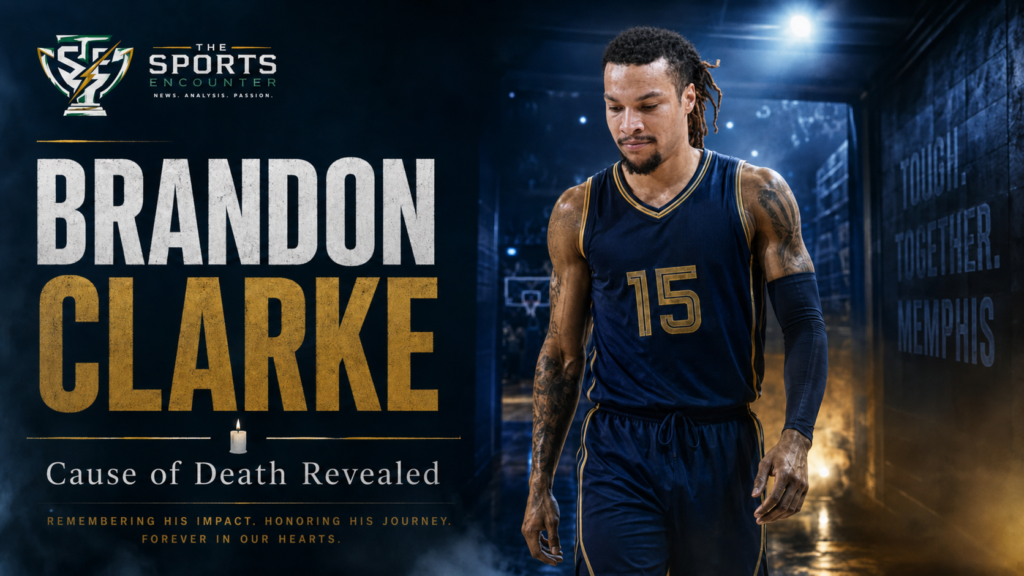
Memphis Grizzlies forward Brandon Clarke died from the combined effects of heroin and cocaine, the Los Angeles County Department of Medical Examiner has determined, nearly three months after the 29-year-old NBA player was found unresponsive at a residence in California.
The examiner ruled Clarke’s death an accident.
Multiple prescription medications were also identified as a significant contributing condition, according to information released by the medical examiner on Friday, August 7. The specific medications have not yet been publicly disclosed, and the full medical examiner’s report remains pending.
The finding provides the first official explanation for Clarke’s death after weeks in which the circumstances surrounding it remained unresolved publicly.
Clarke was found unresponsive in a bedroom at a residence in California’s San Fernando Valley on May 11. Emergency personnel pronounced him dead at the scene. He was 29 years old.
The medical examiner performed an examination the following day before formally certifying both the cause and manner of death in August.
The ruling closes one part of the uncertainty surrounding Clarke’s death, but it does not answer every question. The full toxicology findings have not been released publicly, the prescription medications cited as contributing factors have not been identified, and authorities have not detailed the sequence of events immediately preceding his death. :contentReference[oaicite:1]{index=1}
For continuing basketball coverage, player stories and league developments, visit The Sports Encounter’s NBA hub.
Brandon Clarke Cause of Death: What Has Been Confirmed?
| Detail | Confirmed Information |
|---|---|
| Player | Brandon Clarke |
| Age | 29 |
| Date of death | May 11, 2026 |
| Location | Residence in California’s San Fernando Valley |
| Official cause | Combined effects of heroin and cocaine |
| Contributing condition | Combined effects of multiple prescription medications |
| Manner of death | Accident |
| Authority | Los Angeles County Department of Medical Examiner |
| Full medical examiner report | Not yet publicly released |
| NBA team | Memphis Grizzlies |
| NBA career | Seven seasons |
| Career games | 309 |
| Career averages | 10.2 points, 5.5 rebounds |
TL;DR
- The Los Angeles County medical examiner ruled Brandon Clarke’s death accidental.
- The official cause was the combined effects of heroin and cocaine.
- Multiple prescription medications were also listed as a significant contributing condition.
- The medications have not been publicly identified.
- The full medical examiner report has not yet been released.
- Clarke was found unresponsive at a San Fernando Valley residence on May 11, 2026.
- He was pronounced dead at the scene.
- Clarke spent all seven of his NBA seasons with the Memphis Grizzlies.
- He averaged 10.2 points and 5.5 rebounds across 309 regular-season games.
- He finished fourth in NBA Rookie of the Year voting in 2019-20 and made the NBA All-Rookie First Team.
Medical Examiner Rules Clarke’s Death an Accident
The ruling from the Los Angeles County Department of Medical Examiner is important because it establishes both an official cause of death and a legal classification of the manner of death.
The cause was listed as the combined effects of heroin and cocaine.
The manner was ruled accidental.
Those are separate determinations.
A cause of death identifies the medical process or substances that led to death. The manner of death places the case into a broader classification such as natural, accidental, suicide, homicide or undetermined.
In Clarke’s case, the examiner concluded that the fatal drug effects were accidental rather than intentional.
Associated Press reporting also said drug paraphernalia had been found at the residence, although the full official report providing the detailed scene and toxicology findings has not yet been released publicly. :contentReference[oaicite:2]{index=2}
That distinction matters because several reports after Clarke’s death had discussed a possible overdose without an official ruling.
Those reports were provisional at the time.
The August finding is the first formal determination from the medical examiner.
What the Medical Examiner Has Not Yet Explained
The headline finding is clear, but several details remain unknown.
The examiner identified multiple prescription medications as a significant contributing condition but did not name them in the initial public information.
That means it would be irresponsible to speculate about what medications Clarke may have taken, why they had been prescribed or how they interacted with the other substances found in his system.
The complete medical examiner report may eventually provide concentrations, toxicology results, medical history and other details, but those findings should not be assumed before the report becomes public.
There is also no publicly established evidence at this stage showing how or when Clarke obtained the substances involved in his death.
His earlier arrest in Arkansas is part of the documented timeline, but the information currently available does not establish a direct connection between that arrest and the heroin and cocaine identified in the medical examiner’s ruling.
That distinction is essential.
Clarke Was Found Unresponsive on May 11
Clarke’s death shocked the NBA when it was announced in May.
The 29-year-old was discovered unresponsive inside a bedroom at a residence in the San Fernando Valley.
Emergency responders were called to the home, but Clarke could not be revived and was pronounced dead at the scene.
The medical examiner conducted an examination on May 12.
At the time, no official cause was released.
The Memphis Grizzlies, the NBA and Clarke’s representatives instead focused their public statements on his death, his family and the impact he had made during seven years in Memphis. :contentReference[oaicite:3]{index=3}
The Grizzlies Remembered Clarke as More Than a Basketball Player
When Clarke died, Memphis described him as an outstanding teammate and an even better person.
The organization’s response reflected how deeply he had become associated with a Grizzlies generation built around young players including Ja Morant, Jaren Jackson Jr. and, earlier in Clarke’s career, Dillon Brooks.
Clarke entered Memphis as a first-round pick in 2019 and never played an NBA game for another franchise.
Seven seasons in one organization is increasingly unusual in a league defined by trades, free agency and rapid roster turnover.
That continuity meant Clarke’s connection with the franchise extended beyond his statistics.
He became part of the identity of a young Memphis team that developed from a rebuilding roster into a Western Conference contender.
The Sports Encounter continues to follow former Grizzlies players and their careers, including our recent report on Dillon Brooks’ three-year, $73 million Phoenix Suns extension.
Brandon Clarke’s NBA Career Began With Immediate Impact
Clarke entered the NBA with questions about his age, shooting range and conventional position.
His production quickly answered many of them.
Oklahoma City selected him with the 21st overall pick in the 2019 NBA Draft before his rights were traded to Memphis.
The move became one of the Grizzlies’ more productive draft-night decisions of that rebuilding period.
Clarke immediately became an efficient interior scorer, energetic rebounder and athletic frontcourt defender.
As a rookie, he averaged 12.1 points and 5.9 rebounds and shot 61.8 percent from the field.
Gonzaga noted that his field-goal percentage set an NBA rookie record among qualifying players at the time. He also led qualified rookies in rebounds, ranked second in blocks and finished fourth in Rookie of the Year voting. :contentReference[oaicite:4]{index=4}
He earned NBA All-Rookie First Team honors.
Those accomplishments established Clarke as more than a developmental prospect.
He had immediately become a useful NBA rotation player.
Why Clarke’s Rookie Season Stood Out
Clarke was unconventional even before he entered the NBA.
He did not fit neatly into the traditional mold of a power forward or center.
He was undersized for some interior matchups, did not enter the league as a high-volume three-point shooter and was older than many first-round selections.
What he did possess was exceptional timing.
Clarke understood where to move without the ball.
He finished efficiently around the rim, attacked offensive rebounds, ran the floor, blocked shots and converted opportunities created by Memphis’ guards.
He rarely needed an offense designed around him.
That quality made him particularly useful beside ball-dominant creators.
Advanced metrics also reflected the efficiency of his rookie season. Gonzaga reported that Clarke led NBA rookies in win shares and established rookie marks for effective field-goal percentage and true shooting percentage. :contentReference[oaicite:5]{index=5}
Gonzaga Turned Clarke Into a National Star
Clarke’s rise did not begin in Memphis.
His final college season at Gonzaga transformed his professional outlook.
After beginning his college career at San Jose State, Clarke transferred to Gonzaga and developed into one of the most efficient two-way players in college basketball.
During the 2018-19 season, he averaged 16.9 points and 8.6 rebounds while shooting 68.7 percent from the field.
His 117 blocked shots led the nation, and his 3.16 blocks per game ranked among the best marks in Division I basketball.
He was named West Coast Conference Defender of the Year and Newcomer of the Year while earning First Team All-WCC recognition. :contentReference[oaicite:6]{index=6}
That season changed his career trajectory.
Clarke had gone from an under-the-radar transfer to a first-round NBA prospect.
Memphis Found a Role That Fit Him
The Grizzlies rarely asked Clarke to become something he was not.
Instead, they used his athleticism and instincts.
He became effective as a screener and roller, a lob threat, a cutter and an offensive rebounder.
Defensively, he could provide weak-side rim protection without carrying the full responsibility of a traditional center.
His partnership with Memphis’ guards was particularly productive because Clarke understood spacing and timing.
He could dive toward the rim once a defender committed to the ball handler, creating easy finishes without needing extended possessions.
That made him valuable alongside Ja Morant, whose ability to penetrate created exactly those opportunities.
Clarke’s Career Numbers Show Consistency
Across 309 NBA regular-season games, Clarke averaged 10.2 points and 5.5 rebounds.
He started only 50 of those games.
That context matters.
Clarke’s statistical value came largely from a reserve role in which he was asked to provide energy and efficiency rather than carry high usage.
His career therefore cannot be assessed simply by comparing his scoring average with starting forwards around the league.
His role was different.
At his best, Clarke could enter a game and immediately change its physical rhythm through rebounding, transition running and interior finishing.
For wider NBA player analysis and roster context, readers can also explore The Sports Encounter’s examination of how lineup construction shapes NBA contenders.
The Achilles Tear Changed the Final Phase of His Career
The defining sporting setback of Clarke’s career arrived in March 2023.
He tore his left Achilles tendon during a game against the Denver Nuggets.
The injury ended his season and began a rehabilitation process that kept him away from NBA competition for more than a year.
An Achilles rupture remains one of the most demanding injuries for an explosive basketball player because so much of the game depends on acceleration, jumping and repeated changes of direction.
Clarke’s game was particularly dependent on those physical qualities.
His vertical pop, second jump, mobility and ability to finish above defenders were central to his effectiveness.
Returning from such an injury was therefore about more than being medically cleared.
He also had to rebuild the physical tools that had made him distinctive.
The NBA documented the season-ending Achilles injury when it occurred. :contentReference[oaicite:7]{index=7}
He Returned, but Injuries Continued
Clarke eventually returned to the Grizzlies, but his later seasons became increasingly disrupted by health problems.
A knee issue affected his preparation for the 2025-26 season.
He then appeared in only two games before a calf injury interrupted his comeback again.
Memphis ultimately ruled him out for the remainder of the season in March 2026.
The recurring interruptions meant Clarke entered the final months of his life far removed from the regular role he had once occupied.
There is no evidence establishing that those injuries caused or contributed to the circumstances of his death.
They remain important only as part of the basketball timeline of his final seasons.
The Sports Encounter regularly examines how injuries alter NBA careers and roster planning, including our report on Jamir Watkins’ ACL surgery and its impact on Washington’s roster.
The Arkansas Arrest Came Six Weeks Before Clarke’s Death
Another major development occurred on April 1.
Clarke was arrested in Cross County, Arkansas.
Authorities listed charges that included possession of a controlled substance, trafficking a controlled substance, fleeing in a vehicle, speeding and improper passing.
The Cross County Sheriff’s Department booking information documented the arrest.
Contemporary reports said authorities had allegedly found more than 200 grams of kratom in Clarke’s vehicle. ESPN and other outlets reported the charges while emphasizing that they were allegations at that stage. :contentReference[oaicite:8]{index=8}
The legal principle remains important here.
An arrest is not a conviction.
Clarke died before the case could run its normal legal course.
The medical examiner’s August finding should therefore not be used to retroactively treat every allegation connected to the Arkansas arrest as established fact.
The Arrest and the Death Should Not Be Automatically Combined
Because the arrest occurred approximately six weeks before Clarke died, it is understandable that the two events will be discussed together.
They are both part of the public timeline.
They are not automatically the same case.
The Arkansas arrest reportedly involved kratom.
The Los Angeles County medical examiner identified heroin and cocaine as the substances responsible for Clarke’s death, along with unspecified prescription medications as a contributing condition.
No official source cited in the current reporting has established that the substances involved in the Arkansas arrest were connected to Clarke’s death in California.
Any claim beyond that would move from reporting into speculation.
Why the Full Medical Examiner Report Still Matters
The initial ruling answers the central question of cause and manner of death.
The full report may provide additional clarity.
Medical examiner reports can include toxicology findings, substance concentrations, known medical conditions, investigative details and other information used to support the final determination.
Until those details are available, several questions should remain unanswered rather than filled through assumption.
That includes the prescription medications involved.
The fact that prescription drugs were listed as a significant contributing condition does not by itself tell readers whether Clarke had been taking them as directed, whether they had been recently prescribed or how each medication interacted medically with the other substances.
Those details require evidence.
Clarke’s Death Became a Shock to a Grizzlies Generation
Memphis had undergone substantial change by the time Clarke died.
Players who had entered the league around him were moving into different stages of their careers.
Brooks had left Memphis years earlier and rebuilt his career elsewhere before eventually receiving a major extension in Phoenix.
Morant had become one of the league’s most recognizable guards.
The Grizzlies themselves had experienced the normal cycles of contention, injuries, coaching changes and roster turnover.
Clarke remained connected to the franchise through all of it.
That continuity helps explain why the organization’s reaction to his death focused so strongly on his personality and relationships.
NBA Commissioner Adam Silver Also Paid Tribute
The NBA published Commissioner Adam Silver’s statement after Clarke’s death alongside the Grizzlies’ tribute.
The league’s response reflected the unusual shock of losing an active NBA player at 29.
Clarke remained under contract with Memphis and had been attempting to recover from injury.
This was not the death of a player decades removed from the game.
He was still part of an NBA roster and still expected, before his health setbacks, to continue his career.
The league’s official remembrance remains available through the NBA’s Brandon Clarke tribute and announcement. :contentReference[oaicite:9]{index=9}
Clarke’s Career Was More Than His Final Months
The new cause-of-death ruling inevitably changes the public conversation around Clarke.
That should not erase the preceding seven years.
His basketball career included:
- A first-round NBA Draft selection.
- An NBA All-Rookie First Team appearance.
- A fourth-place Rookie of the Year finish.
- More than 300 regular-season NBA games.
- Multiple playoff appearances with Memphis.
- One of the most efficient rookie scoring seasons of his generation.
- A comeback attempt following a major Achilles rupture.
Those accomplishments remain part of the record.
His Rookie Efficiency Was Historically Unusual
Clarke’s early production deserves particular attention because his game was so different from the high-volume scoring archetype that usually dominates rookie conversations.
He did not lead his class in points.
He did not dominate possession.
He produced value by converting possessions efficiently.
Gonzaga reported that Clarke’s .618 field-goal percentage was the best among qualifying NBA rookies and that his .642 effective field-goal percentage and .663 true-shooting percentage established rookie records. :contentReference[oaicite:10]{index=10}
Those numbers illustrated the same qualities scouts had seen at Gonzaga.
He understood where his best shots were.
He rarely needed difficult attempts to influence a game.
Injuries Leave an Unanswered Basketball Question
Clarke’s death also leaves one sporting question that can never be resolved.
What might his career have looked like without the Achilles tear and the injuries that followed?
At 29, he was still young enough to have several productive NBA seasons remaining.
His game might have required adaptation as his athleticism changed, but players with his basketball intelligence often find ways to remain useful.
He could rebound.
He understood defensive positioning.
He could screen, cut and finish.
Those skills can survive even when explosiveness declines.
The Achilles injury interrupted that progression before anyone could see how Clarke’s game would evolve into his 30s.
Memphis’ Loss Extends Beyond the Box Score
The Grizzlies’ initial statement emphasized Clarke’s influence on teammates and the wider Memphis community.
That language is worth remembering because professional athletes often become publicly reduced to numbers at the moment something happens to them.
Clarke’s 10.2 points per game describe his NBA production.
They do not describe seven years of daily interaction with teammates, coaches, trainers, staff members and fans.
The organization’s reaction made clear that those relationships were central to how Memphis remembered him.
How Sports Journalism Should Handle Clarke’s Cause of Death
The medical examiner’s ruling is news and should be reported directly.
The substances involved should not be hidden.
At the same time, the facts do not require sensational language.
There is no editorial value in turning Clarke’s death into spectacle.
The accurate framing is straightforward:
- The medical examiner identified heroin and cocaine as the cause.
- Prescription medications contributed.
- The death was ruled accidental.
- The full report is still pending.
- An earlier drug-related arrest is part of the timeline but should not be treated as proof of how the substances involved in his death were obtained.
That is what the available evidence supports.
What Happens Next?
The next major development will likely be the release of the complete Los Angeles County medical examiner report.
That document could provide further toxicology details and identify the prescription medications referenced in Friday’s finding.
If additional information is released, it may clarify the medical sequence leading to Clarke’s death.
Until then, the official determination should be treated as the authoritative conclusion while the unanswered details remain precisely that: unanswered.
Brandon Clarke’s NBA Career at a Glance
| Category | Career Detail |
|---|---|
| NBA Draft | 2019 |
| Draft position | 21st overall |
| Drafted by | Oklahoma City Thunder, rights traded to Memphis |
| NBA franchise | Memphis Grizzlies |
| NBA seasons | Seven |
| Regular-season games | 309 |
| Starts | 50 |
| Career scoring average | 10.2 points per game |
| Career rebounding average | 5.5 rebounds per game |
| Rookie honor | NBA All-Rookie First Team |
| Rookie of the Year voting | Fourth |
| College | San Jose State, Gonzaga |
| Major injury | Left Achilles rupture in 2023 |
From Gonzaga to Memphis: A Career Built on Efficiency
If Clarke’s career has one basketball theme, it is efficiency.
At Gonzaga, he shot 68.7 percent from the field.
As an NBA rookie, he shot 61.8 percent.
Those numbers came from understanding his role rather than forcing himself into one that did not suit him.
He attacked the rim.
He cut behind defenders.
He followed missed shots.
He ran in transition.
He played above the rim.
He made himself useful without requiring the ball for long stretches.
That skill set helped him survive the transition from an unusual college prospect to a reliable NBA rotation player.
Clarke Was Part of a Distinct Memphis Era
The Grizzlies team Clarke joined in 2019 was beginning a new cycle.
Morant arrived in the same draft class.
Jaren Jackson Jr. was developing into a cornerstone.
Brooks provided the edge that would become associated with the team.
Clarke provided something quieter but equally valuable: reliable production.
Memphis became younger, faster and more aggressive.
Clarke fit naturally into that identity.
His later injury problems meant he was less visible during the closing stages of that era, but his role in its development should not be overlooked.
Readers interested in the changing careers of players from that Memphis generation can also read our analysis of how Dillon Brooks rebuilt his value after leaving the Grizzlies.
A Broader Reminder About Athlete Lives Beyond Competition
Clarke’s death is also a reminder of something sports coverage sometimes struggles to acknowledge.
Professional athletes can be simultaneously wealthy, famous, physically gifted and vulnerable.
None of those realities cancels the others.
An NBA contract does not provide immunity from physical injury, legal problems, personal difficulties or substance-related harm.
That does not mean journalists should diagnose struggles that have not been documented.
It means athletes should be covered as human beings rather than characters created entirely from highlights, contracts and standings.
The Sports Encounter has applied the same principle when covering difficult athlete-health stories outside basketball, including our report on Ahman Green’s Parkinson’s diagnosis and the questions it raised about life after professional sport.
Why Speculation Would Be Particularly Harmful Here
The time between Clarke’s death in May and the examiner’s August ruling created a vacuum.
Those gaps often attract rumors.
Now that an official cause has been established, there may be a temptation to retrospectively assign motives, patterns or explanations to every event in Clarke’s final months.
The evidence does not support that.
The medical examiner has identified the substances involved.
It has not publicly explained Clarke’s intent beyond ruling the death accidental.
It has not publicly identified the prescription medications.
It has not connected the Arkansas case to the substances involved in his death.
Those boundaries matter.
Final Perspective
The Los Angeles County Department of Medical Examiner has now answered the central medical question surrounding Brandon Clarke’s death.
The 29-year-old Memphis Grizzlies forward died from the combined effects of heroin and cocaine.
Multiple prescription medications contributed.
The death was accidental.
Those findings are difficult but clear.
They should also remain one part of Clarke’s story rather than becoming the entire story.
He was a first-round draft pick who turned an unconventional playing style into an effective NBA career.
He became one of the league’s most efficient rookies.
He played 309 games for one franchise.
He fought through a torn Achilles and attempted to rebuild his career after more than a year away.
His teammates and organization remembered him in deeply personal terms after his death.
There are still unanswered questions, and responsible coverage should allow them to remain unanswered until evidence becomes available.
The full medical examiner report may eventually provide more detail.
For now, the official finding gives the NBA community an explanation it had waited nearly three months to receive, while leaving Memphis to remember a player whose career and relationships extended far beyond the circumstances of his final day.
Frequently Asked Questions
What was Brandon Clarke’s official cause of death?
The Los Angeles County Department of Medical Examiner determined that Clarke died from the combined effects of heroin and cocaine.
Was Brandon Clarke’s death ruled an overdose?
The medical examiner attributed his death to the combined effects of heroin and cocaine and classified the manner of death as an accident. Reports have described the death as an accidental overdose. :contentReference[oaicite:11]{index=11}
Did prescription medications contribute to Brandon Clarke’s death?
Yes. The medical examiner listed the combined effects of multiple prescription medications as a significant contributing condition. The specific medications have not yet been publicly disclosed.
When did Brandon Clarke die?
Clarke died on May 11, 2026.
How old was Brandon Clarke?
He was 29 years old.
Where was Brandon Clarke found?
He was found unresponsive in a bedroom at a residence in California’s San Fernando Valley.
Was Brandon Clarke’s death ruled accidental?
Yes. The Los Angeles County medical examiner classified the manner of death as an accident.
Has the full Brandon Clarke medical examiner report been released?
No. The full report had not been publicly released when the cause and manner of death were announced.
Was Brandon Clarke arrested before his death?
Yes. Clarke was arrested in Arkansas on April 1, 2026 on allegations including possession and trafficking of a controlled substance, fleeing, speeding and improper passing. The arrest occurred approximately six weeks before his death. An arrest does not constitute a conviction. :contentReference[oaicite:12]{index=12}
Did the Arkansas arrest involve the same drugs found in Clarke’s system?
No official source currently establishes that connection. Reports surrounding the Arkansas arrest referred to kratom, while the Los Angeles medical examiner identified heroin and cocaine in Clarke’s death. The two events should not be directly linked without evidence.
How long did Brandon Clarke play in the NBA?
Clarke played seven NBA seasons, all with the Memphis Grizzlies.
What were Brandon Clarke’s career statistics?
He averaged 10.2 points and 5.5 rebounds across 309 regular-season games, including 50 starts.
Was Brandon Clarke an NBA All-Rookie player?
Yes. Clarke made the NBA All-Rookie First Team after the 2019-20 season and finished fourth in Rookie of the Year voting. :contentReference[oaicite:13]{index=13}
Where did Brandon Clarke play college basketball?
Clarke played at San Jose State before transferring to Gonzaga, where he became a First Team All-WCC selection and the conference’s Defender and Newcomer of the Year. :contentReference[oaicite:14]{index=14}
What major injury did Brandon Clarke suffer?
Clarke tore his left Achilles tendon in March 2023, an injury that kept him out for more than a year. :contentReference[oaicite:15]{index=15}
Editorial note: This article reports findings released by the Los Angeles County Department of Medical Examiner and information from established public records and official basketball sources. The full medical examiner report has not yet been released. The Sports Encounter will update this report if additional verified information becomes available.
This article is for informational and editorial purposes and should not be interpreted as medical advice.