


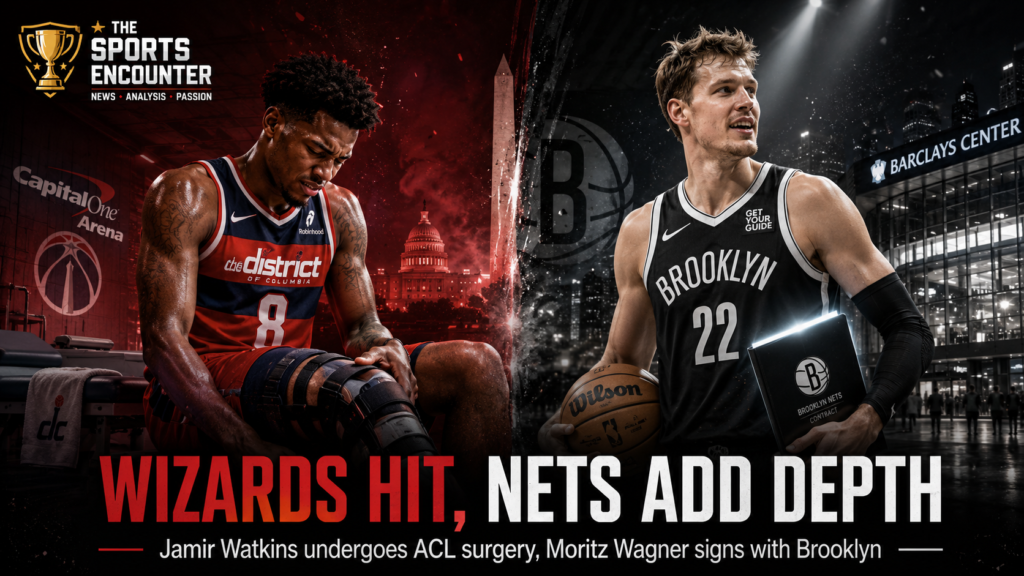
The Washington Wizards face another difficult injury setback after second-year forward Jamir Watkins underwent surgery to reconstruct a torn left ACL, while the Brooklyn Nets have strengthened their frontcourt by signing veteran center Moritz Wagner to a reported two-year, $19 million contract.
Two Eastern Conference rebuilding projects moved in opposite directions on Friday.
Washington received confirmation that Jamir Watkins could miss most or all of the 2026-27 NBA season after undergoing successful surgery on his left knee. The 25-year-old forward suffered the injury during the Wizards’ opening NBA Summer League game against the Utah Jazz on July 9.
Brooklyn, meanwhile, added proven frontcourt depth by signing Moritz Wagner to a multi-year agreement. The Nets did not release the financial terms, but reports placed the deal at two years and $19 million.
The moves involve players at different stages of their careers. Watkins had begun establishing himself as a useful two-way wing during his rookie season. Wagner enters his ninth NBA campaign as an experienced reserve who brings scoring, physicality, energy and positional flexibility.
For the Wizards, the injury removes a developing defender from a roster already depending heavily on the health of Anthony Davis and Trae Young. Brooklyn’s move gives head coach Jordi Fernández another dependable rotation player as the Nets continue assembling a younger roster around selected veterans.
Readers can follow trades, injuries, contracts, draft developments and roster analysis through The Sports Encounter’s NBA Hub.
Wizards and Nets News at a Glance
| Category | Jamir Watkins | Moritz Wagner |
|---|---|---|
| Team | Washington Wizards | Brooklyn Nets |
| Position | Forward | Center/forward |
| Age | 25 | 29 |
| Latest development | Underwent surgery to reconstruct torn left ACL | Signed multi-year contract with Brooklyn |
| Reported contract | Roster status affected by long-term injury | Two years, $19 million |
| 2025-26 production | 7.4 points and 3.9 rebounds in 50 games | 6.9 points and 3.2 rebounds in 36 games |
| Immediate outlook | Could miss most or all of 2026-27 | Expected to provide experienced bench depth |
Jamir Watkins Undergoes ACL Reconstruction
The Wizards announced that Watkins underwent surgery at the Hospital for Special Surgery in New York. Dr. Riley J. Williams III, the chief of the hospital’s Sports Medicine Institute, performed the procedure.
Washington did not provide a definite return date. ACL reconstruction normally requires a long rehabilitation process, and Watkins could miss the entire coming season depending on his response to surgery, strength development and basketball-specific recovery work.
The injury occurred in Las Vegas during Washington’s first Summer League game. Watkins slipped while defending Utah Jazz guard Darryn Peterson, the second overall pick in the 2026 NBA Draft, and immediately grabbed his left knee.
He later returned and played nearly 20 total minutes, but the Wizards held him out of their remaining Summer League schedule. Further testing revealed the torn ligament.
The fact that Watkins briefly resumed playing does not make the diagnosis unusual. Some athletes can continue moving after an ACL tear because swelling, instability and pain do not always reach their full intensity immediately.
His rehabilitation will now focus on restoring range of motion, rebuilding the muscles around the knee and gradually progressing from straight-line movement to cutting, landing, defensive slides and contact work.
Official statistics, player profiles and league updates are available through the official NBA website.
Why Watkins’ Injury Hurts Washington’s Rebuild
Watkins entered the league without the profile attached to a lottery pick. Utah selected him 43rd overall in the 2025 NBA Draft before sending him to Washington in a draft-night transaction.
The former Florida State forward then earned a legitimate NBA role.
Watkins appeared in 50 games as a rookie and started seven. He averaged 7.4 points, 3.9 rebounds and 20.6 minutes while showing the physical tools to defend multiple positions.
His scoring remained inconsistent, particularly from three-point range, but Washington valued his size, rebounding effort, activity and defensive potential.
Those qualities matter on a developing team. Young stars need role players who can defend without demanding constant touches. Watkins had begun showing that he could become part of that supporting structure.
The injury delays that evaluation by at least one season and leaves the Wizards with one fewer wing capable of handling difficult defensive assignments.
Washington entered the summer with greater optimism after selecting AJ Dybantsa first overall. The Sports Encounter covered the franchise-changing choice in its analysis of the 2026 NBA Draft and Dybantsa’s arrival in Washington.
Dybantsa Now Carries More Immediate Responsibility
Dybantsa was already expected to become the central figure in Washington’s next era. Watkins’ injury increases the pressure on the rookie to handle significant minutes on the wing.
The first overall pick brings far greater offensive upside. He can create shots, attack in transition, finish above the rim and defend several positions when fully engaged.
Washington must still avoid treating him as the answer to every roster problem.
A young player benefits from sharing defensive responsibilities with reliable wings. Watkins could have absorbed difficult assignments, generated transition opportunities and allowed Dybantsa to conserve energy for offensive creation.
The Wizards may now ask another young player to fill that role or add a veteran before the season begins.
Washington’s direction has changed substantially since its pre-draft uncertainty. The Sports Encounter previously examined why the Wizards faced their biggest draft decision since selecting John Wall.
Anthony Davis and Trae Young Add More Injury Uncertainty
Watkins is not Washington’s only medical concern.
The Wizards acquired Anthony Davis and Trae Young through major trades, but both stars endured injury-hit 2025-26 seasons.
Davis played only 20 games for Dallas because of hand and groin problems before being traded to Washington. He did not appear for the Wizards after the move.
Young managed 10 games with Atlanta and five with Washington while dealing with lower-back and right quadriceps injuries.
Their availability will shape the franchise’s short-term ceiling. A healthy Davis can anchor the defense, protect the rim and give Washington an elite interior scorer. Young can organize the offense and create easier opportunities for Dybantsa, Deandre Ayton and the team’s supporting players.
The risk is obvious. Washington cannot build a stable rotation if its veteran leaders move in and out of the lineup.
The possibility of Davis changing teams had already become part of the wider offseason conversation, as discussed in The Sports Encounter’s analysis of the Warriors’ reported interest in Anthony Davis and LeBron James.
Moritz Wagner Gives Brooklyn a Reliable Frontcourt Option
Brooklyn’s signing carries less drama but could offer immediate value.
Wagner spent more than five seasons with the Orlando Magic and became a dependable reserve through his physical offense, movement without the ball and ability to draw contact.
He averaged 6.9 points and 3.2 rebounds in 36 appearances during the 2025-26 season. His role came mainly from the bench, where he provided energy and scoring during shorter stretches.
Across 399 NBA games, including 57 starts, Wagner has averaged 9.0 points, 3.9 rebounds and 16.2 minutes. He has shot 51.8% from the field and 80.8% at the free-throw line.
The Los Angeles Lakers selected him 25th overall in 2018 after his college career at Michigan. He later played for Washington, Boston and Orlando before joining Brooklyn, his fifth NBA organization.
Wagner also brings personal knowledge of ACL rehabilitation. He tore the ligament in his left knee during the 2024-25 campaign and worked his way back into Orlando’s rotation.
That experience does not directly affect Watkins’ recovery, but it highlights how modern rehabilitation can return frontcourt players to productive NBA roles when medical progression remains controlled.
What Wagner Adds to the Nets
Wagner is unlikely to become Brooklyn’s primary center. His value comes from making the second unit more functional.
He runs the floor, screens with force and attacks defenders who struggle with his physicality. Wagner can finish around the basket, operate as a short-roll passer and stretch defenses enough to prevent them from ignoring him outside the paint.
His emotional style also brings an edge to young teams. Opponents may find him irritating, but teammates often respond to his activity and willingness to compete for loose balls.
The Nets have spent much of their rebuild balancing future assets with players capable of keeping games organized. Wagner fits that approach because his contract does not appear large enough to damage long-term flexibility.
Brooklyn’s wider offseason has included major roster movement, including the arrival of Julius Randle. That transaction formed part of the market context behind The Sports Encounter’s report on Minnesota’s offseason restructuring and Ayo Dosunmu’s new contract.
Brooklyn Is Building Around Development and Stability
The Nets are still unlikely to measure success only through their 2026-27 win total.
The organization has invested in younger players, future draft capital and salary flexibility. Head coach Jordi Fernández needs veterans who can support that development without blocking every pathway to playing time.
Wagner can help young guards by setting reliable screens and making the correct offensive reads. He also gives Brooklyn another body capable of handling the physical demands of an 82-game season.
Good rebuilding teams need more than prospects. They require professionals who understand spacing, preparation, defensive positioning and the rhythm of NBA competition.
The importance of retaining or acquiring trusted role players has appeared throughout the summer. Boston recently committed to one of its developing defenders, a move explored in The Sports Encounter’s feature on Jordan Walsh’s long-term Celtics extension.
Other teams have followed similar principles with less prominent roster moves, including those covered in the analysis of Leonard Miller and Ron Harper Jr. earning new opportunities.
What the Two Moves Mean for the Eastern Conference
Neither announcement will immediately change the championship race, but both reveal how Eastern Conference teams are preparing for the coming season.
Washington is trying to accelerate a rebuild by combining Dybantsa with established stars. Watkins’ injury weakens the depth surrounding that ambitious core and increases the importance of health across the roster.
Brooklyn is taking a more patient route. Wagner adds competence without forcing the organization into an expensive long-term commitment.
| Team | Immediate Priority | Main Question |
|---|---|---|
| Washington Wizards | Replace Watkins’ defensive minutes and protect Dybantsa’s development | Can Davis and Young remain healthy enough to stabilize the team? |
| Brooklyn Nets | Integrate Wagner into a young rotation | Can the Nets develop prospects while remaining competitive? |
The league’s balance has shifted after the New York Knicks won the 2026 championship. The Eastern Conference now contains contenders, veteran experiments and rebuilding teams attempting to shorten their timelines.
Roster depth may decide which projects move forward. The Sports Encounter’s analysis of why Oklahoma City traded Aaron Wiggins to Atlanta showed how financial flexibility and rotation value often intersect during the offseason.
Final Verdict
Jamir Watkins’ ACL injury is a painful interruption for a player who had begun earning Washington’s trust.
His rookie statistics did not make national headlines, but his size, defensive activity and willingness to handle supporting work gave the Wizards a useful piece. Losing him places greater pressure on Dybantsa and a roster already carrying serious health questions around Davis and Young.
Brooklyn’s signing of Moritz Wagner represents the opposite kind of development. The Nets have added a veteran who knows his role, competes physically and can support younger players without requiring the offense to revolve around him.
Wagner will not solve every frontcourt problem, but a reported two-year, $19 million commitment offers reasonable value for a dependable NBA reserve.
Washington must now think about patience. Watkins’ long-term recovery matters more than forcing him back during a season in which the franchise is still defining its direction.
Brooklyn can focus on integration. Wagner’s job will involve stabilizing bench lineups, bringing energy and helping the Nets’ young players function within a professional structure.
One team lost a developing piece. The other gained a proven one. Those small shifts often shape rebuilding seasons more than the biggest headlines suggest.
Frequently Asked Questions
What injury did Jamir Watkins suffer?
Watkins tore the anterior cruciate ligament in his left knee during the Wizards’ opening Summer League game against Utah.
Has Jamir Watkins undergone surgery?
Yes. He underwent ACL reconstruction at the Hospital for Special Surgery in New York.
Will Watkins miss the entire 2026-27 NBA season?
Washington has not announced a definitive timetable, but he could miss most or all of the season because ACL rehabilitation commonly requires many months.
How did Watkins perform as a rookie?
He averaged 7.4 points, 3.9 rebounds and 20.6 minutes across 50 appearances, including seven starts.
Who did Washington select first overall in 2026?
The Wizards selected AJ Dybantsa from BYU with the first pick.
Did the Brooklyn Nets sign Moritz Wagner?
Yes. Brooklyn announced a multi-year contract with the veteran center.
How much is Wagner’s Nets contract worth?
The Nets did not disclose the terms, but reports described it as a two-year agreement worth $19 million.
What did Wagner average last season?
He averaged 6.9 points and 3.2 rebounds in 36 games for Orlando during the 2025-26 season.
Which teams has Moritz Wagner played for?
Wagner has represented the Lakers, Wizards, Celtics, Magic and Nets.
Is Moritz Wagner related to Franz Wagner?
Yes. Moritz is Franz Wagner’s older brother. Franz remains with the Orlando Magic.