


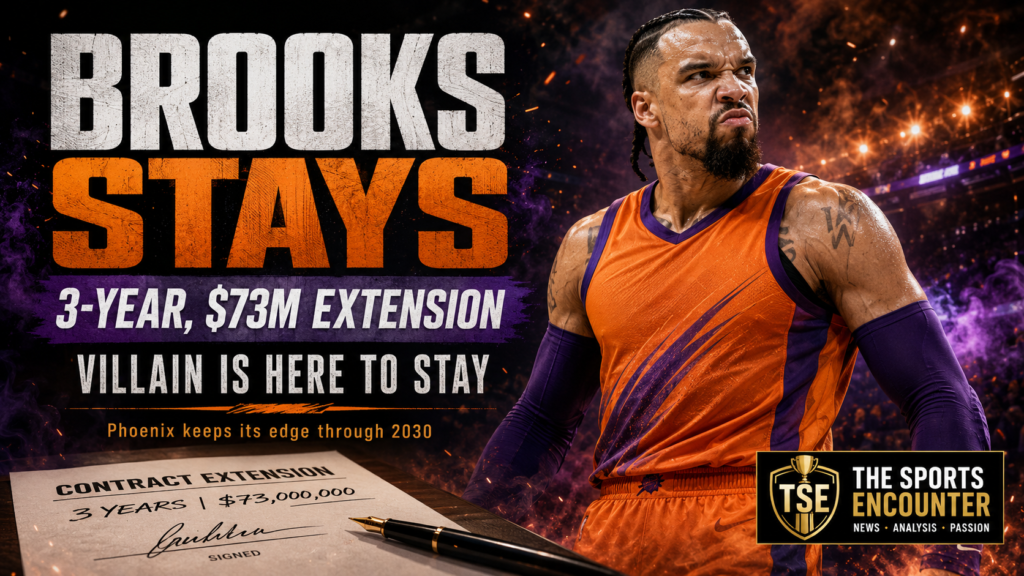
Dillon Brooks has signed a three-year, $73 million contract extension with the Phoenix Suns, rewarding the veteran forward after the most productive scoring season of his NBA career.
The new agreement keeps Brooks under contract through the 2029-30 season and reinforces his place beside Devin Booker in Phoenix’s attempt to build a tougher, more sustainable championship contender.
Brooks embraced the identity that has followed him throughout his career when discussing the deal.
“Villain is here to stay. Championship is all on my mind.”
The 30-year-old averaged a career-high 20.2 points during his first season with the Suns after arriving from the Houston Rockets in the trade that sent Kevin Durant in the opposite direction.
Brooks also contributed 3.6 rebounds, 1.8 assists, and 1.0 steal across 56 regular-season appearances, starting every game he played.
His season ended with disappointment as the Oklahoma City Thunder swept Phoenix in the opening round of the playoffs. Brooks still produced 26 points and six rebounds per game during the four-game series, strengthening his case for a long-term commitment.
For wider basketball coverage, contract analysis, playoff reports, and offseason developments, visit The Sports Encounter’s NBA Hub.
Dillon Brooks Contract Extension at a Glance
| Detail | Information |
|---|---|
| Player | Dillon Brooks |
| Team | Phoenix Suns |
| Contract length | Three years |
| Reported value | $73 million |
| Average annual value | Approximately $24.3 million |
| Contract runs through | 2029-30 season |
| 2025-26 scoring average | 20.2 points per game |
| Playoff scoring average | 26.0 points per game |
| NBA experience | Nine seasons |
Why Phoenix Extended Dillon Brooks
Phoenix acquired Brooks as part of a larger roster reset rather than as a short-term salary component.
The Suns sent Durant to Houston and received a package that included Brooks, Jalen Green, draft assets, and young players. The transaction moved Phoenix away from an aging superstar model and toward a roster built around Booker, greater depth, and more manageable long-term roles.
Brooks immediately became one of the clearest successes of that strategy.
His 20.2 points per game represented the highest scoring average of his career. He provided physical defense, emotional intensity, availability when healthy, and enough offensive production to become more than a specialist.
The extension also removes a major contract question before the 2026-27 season begins.
Phoenix could have allowed Brooks to approach free agency while evaluating whether his scoring improvement was sustainable. That approach would have carried the risk of losing him or facing a more expensive negotiation after another strong year.
The Suns instead chose cost certainty and continuity.
Brooks Became More Than Phoenix’s Defensive Agitator
Brooks entered the league with a reputation built around defense, physicality, confrontation, and an unusual willingness to challenge the NBA’s biggest stars.
Those qualities remained visible in Phoenix.
He defended primary scorers, fought through screens, pressured wings, and helped establish a harder edge around a Suns team that had often been criticized for lacking resistance during difficult playoff moments.
His offensive development changed the financial conversation.
A player averaging around 14 or 15 points while defending at a high level can earn an important rotational contract. A player producing more than 20 points while starting every available game becomes much more expensive to replace.
Brooks attacked mismatches, increased his scoring responsibility, and gave Phoenix a secondary source of offense when Booker was unavailable or heavily defended.
He recorded a career-high 40 points against the Detroit Pistons in January, showing that he could carry a larger scoring burden rather than simply punish defensive attention created by teammates.
The extension reflects that broader role.
The $73 Million Question: Is the Contract Good Value?
Brooks will earn approximately $24.3 million per season under the extension.
That figure places him well below the NBA’s superstar salary tier but firmly inside the range normally reserved for reliable starters, high-level two-way wings, and important playoff contributors.
The deal looks reasonable if Brooks remains close to his 2025-26 production.
Phoenix is paying for three things:
- A starting-caliber defensive wing
- A player capable of scoring between 17 and 21 points per game
- A durable emotional leader willing to accept difficult defensive assignments
The contract becomes less attractive if his scoring returns sharply toward his career average.
Brooks has averaged 14.8 points across 548 regular-season games. His 20.2-point season may represent genuine development, a larger offensive role, or a temporary peak produced by Phoenix’s roster circumstances.
The Suns are betting that enough of the improvement will remain.
That wager resembles the questions examined in our analysis of Ayo Dosunmu’s $112 million Timberwolves agreement, where role, age, production, and future salary-cap growth shaped the value of a major extension.
Phoenix Is Building Around Booker, Brooks, and a New Identity
The Suns’ recent history was defined by the attempt to surround Booker with established stars.
Durant and Bradley Beal gave Phoenix enormous individual talent, but the roster became expensive, shallow, and difficult to adjust.
The new structure appears to prioritize a wider rotation, younger assets, financial flexibility, and players whose roles fit more naturally around Booker.
Brooks supports that direction.
He does not require the offense to run through him on every possession. He can defend the opposing team’s strongest wing, play through physical contact, make open shots, attack closeouts, and bring energy when the offense loses rhythm.
Booker remains the offensive centerpiece. Brooks can absorb many of the defensive and emotional responsibilities that accompany a long regular season and a demanding Western Conference playoff race.
Phoenix’s broader place in that race remains uncertain. The Thunder, San Antonio Spurs, Denver Nuggets, Minnesota Timberwolves, and other contenders have built strong young cores or retained established championship talent.
Our examination of the NBA 2026-27 championship odds showed how competitive the West remains and why Phoenix must improve beyond simply retaining familiar players.
The Playoff Sweep Still Defines Phoenix’s Immediate Challenge
Brooks performed well individually against Oklahoma City, averaging 26 points and six rebounds.
Phoenix still lost all four games.
That result prevents the extension from being treated as proof that the Suns have solved their larger basketball problems.
The Thunder exposed weaknesses in Phoenix’s depth, shot creation, defensive execution, and ability to survive extended stretches against a younger, faster, and more connected opponent.
Brooks competed throughout the series, but one aggressive wing could not reverse the matchup.
The Suns now need to determine whether the current core has enough support to move from playoff qualification toward genuine contention.
Oklahoma City’s own roster decisions show how carefully strong teams manage cost and depth. The Sports Encounter recently examined why the Thunder traded Aaron Wiggins despite his value, illustrating how championship-level organizations balance contribution against future payroll pressure.
What Brooks Must Prove After Signing the Extension
Brooks has secured financial stability through his early 30s. The next task is proving that Phoenix committed to a sustainable version of his game.
1. Maintain Efficient Scoring
Scoring 20 points per game matters less if it requires a damaging number of possessions.
Brooks must continue improving his shot selection, reduce forced attempts, and convert the open opportunities created by Booker and Phoenix’s other playmakers.
His greatest offensive value comes when he attacks within the team’s structure rather than trying to win every individual matchup.
2. Preserve His Defensive Impact
Physical defense remains the foundation of Brooks’ reputation and contract value.
Phoenix will expect him to guard elite perimeter scorers, handle difficult assignments, and maintain enough discipline to stay on the floor.
That final point matters because his aggression has occasionally produced suspensions, technical fouls, and avoidable distractions.
3. Give Phoenix Playoff Stability
The Suns need Brooks’ regular-season production to translate into series where opponents repeatedly attack weaknesses.
His performance against Oklahoma City was encouraging, but Phoenix must see that production across a longer postseason run before the contract can be judged as a complete success.
4. Help Establish the Team’s Emotional Standard
Brooks brings a competitive personality that can strengthen a team when directed properly.
He must help Phoenix become harder to play against without allowing confrontations to distract from defensive assignments, rotations, and late-game execution.
The “Villain” Identity Is Now Part of Phoenix’s Brand
Brooks has never avoided the hostility he receives from opposing crowds and players.
He has repeatedly embraced the idea that he is one of the league’s antagonists.
That identity gives Phoenix a recognizable emotional edge.
Fans may disagree over whether Brooks’ behavior crosses the line, but opponents rarely ignore him. He creates tension, demands attention, and attempts to make every matchup personal.
The Suns appear comfortable with that persona.
His “Villain is here to stay” comment turns the extension into more than a financial announcement. It signals that Phoenix values the edge he brought during his first season.
The challenge involves ensuring that the character serves the basketball.
Agitation can disrupt an opponent. It can also produce unnecessary fouls, technical penalties, suspensions, or energy spent on disputes rather than execution.
Phoenix is committing to the full Dillon Brooks experience. The organization must help keep its most productive elements under control.
How the Deal Fits the NBA’s Current Contract Market
NBA contracts must be evaluated against the salary cap rather than by comparing raw numbers across generations.
As league revenue grows, starter-level contracts continue moving upward.
A three-year, $73 million agreement may sound enormous in isolation. Within the current market, it represents a significant but manageable commitment to a proven starting wing.
Phoenix also avoided the longer-term risk of a four- or five-year agreement.
Brooks will be 33 when the extension ends. That structure reduces the possibility of the Suns paying deep into the decline phase of his career.
The contract’s length resembles the approach discussed in our report on Jordan Walsh’s Celtics extension, although the players occupy very different salary and responsibility levels.
Teams increasingly use contract length to balance immediate roster certainty against future flexibility.
Phoenix’s Championship Claim Needs More Evidence
Brooks says a championship is on his mind.
The Suns must now build a roster capable of matching that ambition.
Extending Brooks preserves a valuable contributor. It does not automatically place Phoenix alongside the strongest teams in the West.
The front office still needs:
- Reliable secondary creation behind Booker
- Greater frontcourt consistency
- More two-way depth
- Improved health across the rotation
- A playoff offense that survives defensive adjustments
- Enough shooting to create space for attacking players
The NBA’s competitive landscape has made these decisions harder.
Some teams are chasing established stars for one final championship run, as discussed in our analysis of Golden State’s veteran superteam ambitions.
Others are building around younger, less expensive cores capable of remaining together for several years.
Phoenix is trying to occupy the middle ground by keeping Booker in his prime while reshaping the pieces around him.
Brooks’ Career Has Reached a New Stage
Memphis selected Brooks in the second round of the 2017 NBA Draft.
He spent six seasons with the Grizzlies and became a central figure in their aggressive, confrontational identity.
His departure from Memphis raised questions about whether his personality and shot selection had begun to outweigh his defensive contribution.
Houston gave him a new opportunity in 2023.
Two seasons with the Rockets helped Brooks rebuild his value as an experienced defender and culture-setter before the Durant trade took him to Phoenix.
His first Suns season changed his market again.
The player once viewed mainly as a disruptive defensive specialist became a 20-point scorer and playoff leader. Phoenix has now rewarded that evolution with the largest financial commitment of his career.
What the Extension Means for the Western Conference
Brooks remaining in Phoenix preserves one of the conference’s more difficult perimeter matchups.
Teams facing the Suns will continue preparing for his physical defense, emotional pressure, and willingness to challenge high-profile scorers.
The move also signals that Phoenix intends to remain competitive rather than begin another major teardown following its first-round exit.
The Suns have committed to Booker and Brooks through 2029-30. That timeline suggests the organization expects the current retooling process to produce results quickly.
Other Western Conference teams will judge Phoenix by whether the supporting cast improves enough to turn that commitment into a meaningful playoff threat.
The Thunder’s recent postseason success and San Antonio’s rise have already changed the conference hierarchy. The path to the Finals is increasingly controlled by teams with younger stars and deeper rotations.
The Sports Encounter tracked that changing balance during the playoffs, including the buildup to the Thunder-Spurs Western Conference Finals battle.
Final Verdict
Dillon Brooks earned this extension by producing the best scoring season of his NBA career while continuing to handle difficult defensive assignments.
The three-year structure protects Phoenix from committing too deeply into his mid-30s. The $73 million value reflects the price of retaining a productive two-way starter in the modern NBA.
The remaining uncertainty concerns sustainability.
Brooks must prove that his 20.2-point average represents a lasting expansion of his game rather than one exceptional season. Phoenix must also demonstrate that keeping him is part of a complete championship plan rather than a response to individual production during a disappointing year.
His playoff performance against Oklahoma City showed that he can remain aggressive when the pressure rises.
The sweep showed how much work the Suns still have to do.
Brooks has embraced his role, his reputation, and the expectations attached to the contract.
The villain will remain in Phoenix through 2030. The next question is whether the Suns can give him a team capable of playing deep into May and June.
Follow The Sports Encounter’s NBA coverage for the latest contract extensions, trades, player news, roster analysis, and championship developments.