Dillon Brooks Signs $73M Suns Extension: Phoenix Keeps Its Villain Through 2030
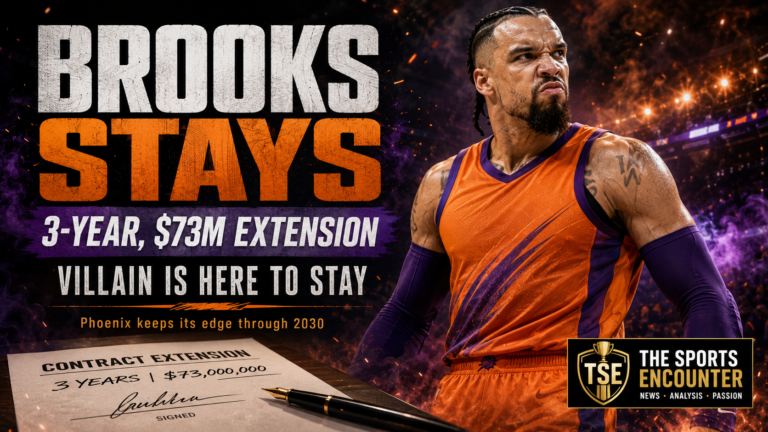
The Phoenix Suns have signed Dillon Brooks to a three-year, $73 million contract extension through the 2029-30 season after the veteran forward delivered a career-best scoring campaign.
Dillon Brooks has signed a three-year, $73 million contract extension with the Phoenix Suns, rewarding the veteran forward after the most productive scoring season of his NBA career.
The new agreement keeps Brooks under contract through the 2029-30 season and reinforces his place beside Devin Booker in Phoenix’s attempt to build a tougher, more sustainable championship contender.
Brooks embraced the identity that has followed him throughout his career when discussing the deal.
“Villain is here to stay. Championship is all on my mind.”
The 30-year-old averaged a career-high 20.2 points during his first season with the Suns after arriving from the Houston Rockets in the trade that sent Kevin Durant in the opposite direction.
Brooks also contributed 3.6 rebounds, 1.8 assists, and 1.0 steal across 56 regular-season appearances, starting every game he played.
His season ended with disappointment as the Oklahoma City Thunder swept Phoenix in the opening round of the playoffs. Brooks still produced 26 points and six rebounds per game during the four-game series, strengthening his case for a long-term commitment.
For wider basketball coverage, contract analysis, playoff reports, and offseason developments, visit The Sports Encounter’s NBA Hub.
Dillon Brooks Contract Extension at a Glance
| Detail | Information |
|---|---|
| Player | Dillon Brooks |
| Team | Phoenix Suns |
| Contract length | Three years |
| Reported value | $73 million |
| Average annual value | Approximately $24.3 million |
| Contract runs through | 2029-30 season |
| 2025-26 scoring average | 20.2 points per game |
| Playoff scoring average | 26.0 points per game |
| NBA experience | Nine seasons |
Why Phoenix Extended Dillon Brooks
Phoenix acquired Brooks as part of a larger roster reset rather than as a short-term salary component.
The Suns sent Durant to Houston and received a package that included Brooks, Jalen Green, draft assets, and young players. The transaction moved Phoenix away from an aging superstar model and toward a roster built around Booker, greater depth, and more manageable long-term roles.
Brooks immediately became one of the clearest successes of that strategy.
His 20.2 points per game represented the highest scoring average of his career. He provided physical defense, emotional intensity, availability when healthy, and enough offensive production to become more than a specialist.
The extension also removes a major contract question before the 2026-27 season begins.
Phoenix could have allowed Brooks to approach free agency while evaluating whether his scoring improvement was sustainable. That approach would have carried the risk of losing him or facing a more expensive negotiation after another strong year.
The Suns instead chose cost certainty and continuity.
Brooks Became More Than Phoenix’s Defensive Agitator
Brooks entered the league with a reputation built around defense, physicality, confrontation, and an unusual willingness to challenge the NBA’s biggest stars.
Those qualities remained visible in Phoenix.
He defended primary scorers, fought through screens, pressured wings, and helped establish a harder edge around a Suns team that had often been criticized for lacking resistance during difficult playoff moments.
His offensive development changed the financial conversation.
A player averaging around 14 or 15 points while defending at a high level can earn an important rotational contract. A player producing more than 20 points while starting every available game becomes much more expensive to replace.
Brooks attacked mismatches, increased his scoring responsibility, and gave Phoenix a secondary source of offense when Booker was unavailable or heavily defended.
He recorded a career-high 40 points against the Detroit Pistons in January, showing that he could carry a larger scoring burden rather than simply punish defensive attention created by teammates.
The extension reflects that broader role.
The $73 Million Question: Is the Contract Good Value?
Brooks will earn approximately $24.3 million per season under the extension.
That figure places him well below the NBA’s superstar salary tier but firmly inside the range normally reserved for reliable starters, high-level two-way wings, and important playoff contributors.
The deal looks reasonable if Brooks remains close to his 2025-26 production.
Phoenix is paying for three things:
- A starting-caliber defensive wing
- A player capable of scoring between 17 and 21 points per game
- A durable emotional leader willing to accept difficult defensive assignments
The contract becomes less attractive if his scoring returns sharply toward his career average.
Brooks has averaged 14.8 points across 548 regular-season games. His 20.2-point season may represent genuine development, a larger offensive role, or a temporary peak produced by Phoenix’s roster circumstances.
The Suns are betting that enough of the improvement will remain.
That wager resembles the questions examined in our analysis of Ayo Dosunmu’s $112 million Timberwolves agreement, where role, age, production, and future salary-cap growth shaped the value of a major extension.
Phoenix Is Building Around Booker, Brooks, and a New Identity
The Suns’ recent history was defined by the attempt to surround Booker with established stars.
Durant and Bradley Beal gave Phoenix enormous individual talent, but the roster became expensive, shallow, and difficult to adjust.
The new structure appears to prioritize a wider rotation, younger assets, financial flexibility, and players whose roles fit more naturally around Booker.
Brooks supports that direction.
He does not require the offense to run through him on every possession. He can defend the opposing team’s strongest wing, play through physical contact, make open shots, attack closeouts, and bring energy when the offense loses rhythm.
Booker remains the offensive centerpiece. Brooks can absorb many of the defensive and emotional responsibilities that accompany a long regular season and a demanding Western Conference playoff race.
Phoenix’s broader place in that race remains uncertain. The Thunder, San Antonio Spurs, Denver Nuggets, Minnesota Timberwolves, and other contenders have built strong young cores or retained established championship talent.
Our examination of the NBA 2026-27 championship odds showed how competitive the West remains and why Phoenix must improve beyond simply retaining familiar players.
The Playoff Sweep Still Defines Phoenix’s Immediate Challenge
Brooks performed well individually against Oklahoma City, averaging 26 points and six rebounds.
Phoenix still lost all four games.
That result prevents the extension from being treated as proof that the Suns have solved their larger basketball problems.
The Thunder exposed weaknesses in Phoenix’s depth, shot creation, defensive execution, and ability to survive extended stretches against a younger, faster, and more connected opponent.
Brooks competed throughout the series, but one aggressive wing could not reverse the matchup.
The Suns now need to determine whether the current core has enough support to move from playoff qualification toward genuine contention.
Oklahoma City’s own roster decisions show how carefully strong teams manage cost and depth. The Sports Encounter recently examined why the Thunder traded Aaron Wiggins despite his value, illustrating how championship-level organizations balance contribution against future payroll pressure.
What Brooks Must Prove After Signing the Extension
Brooks has secured financial stability through his early 30s. The next task is proving that Phoenix committed to a sustainable version of his game.
1. Maintain Efficient Scoring
Scoring 20 points per game matters less if it requires a damaging number of possessions.
Brooks must continue improving his shot selection, reduce forced attempts, and convert the open opportunities created by Booker and Phoenix’s other playmakers.
His greatest offensive value comes when he attacks within the team’s structure rather than trying to win every individual matchup.
2. Preserve His Defensive Impact
Physical defense remains the foundation of Brooks’ reputation and contract value.
Phoenix will expect him to guard elite perimeter scorers, handle difficult assignments, and maintain enough discipline to stay on the floor.
That final point matters because his aggression has occasionally produced suspensions, technical fouls, and avoidable distractions.
3. Give Phoenix Playoff Stability
The Suns need Brooks’ regular-season production to translate into series where opponents repeatedly attack weaknesses.
His performance against Oklahoma City was encouraging, but Phoenix must see that production across a longer postseason run before the contract can be judged as a complete success.
4. Help Establish the Team’s Emotional Standard
Brooks brings a competitive personality that can strengthen a team when directed properly.
He must help Phoenix become harder to play against without allowing confrontations to distract from defensive assignments, rotations, and late-game execution.
The “Villain” Identity Is Now Part of Phoenix’s Brand
Brooks has never avoided the hostility he receives from opposing crowds and players.
He has repeatedly embraced the idea that he is one of the league’s antagonists.
That identity gives Phoenix a recognizable emotional edge.
Fans may disagree over whether Brooks’ behavior crosses the line, but opponents rarely ignore him. He creates tension, demands attention, and attempts to make every matchup personal.
The Suns appear comfortable with that persona.
His “Villain is here to stay” comment turns the extension into more than a financial announcement. It signals that Phoenix values the edge he brought during his first season.
The challenge involves ensuring that the character serves the basketball.
Agitation can disrupt an opponent. It can also produce unnecessary fouls, technical penalties, suspensions, or energy spent on disputes rather than execution.
Phoenix is committing to the full Dillon Brooks experience. The organization must help keep its most productive elements under control.
How the Deal Fits the NBA’s Current Contract Market
NBA contracts must be evaluated against the salary cap rather than by comparing raw numbers across generations.
As league revenue grows, starter-level contracts continue moving upward.
A three-year, $73 million agreement may sound enormous in isolation. Within the current market, it represents a significant but manageable commitment to a proven starting wing.
Phoenix also avoided the longer-term risk of a four- or five-year agreement.
Brooks will be 33 when the extension ends. That structure reduces the possibility of the Suns paying deep into the decline phase of his career.
The contract’s length resembles the approach discussed in our report on Jordan Walsh’s Celtics extension, although the players occupy very different salary and responsibility levels.
Teams increasingly use contract length to balance immediate roster certainty against future flexibility.
Phoenix’s Championship Claim Needs More Evidence
Brooks says a championship is on his mind.
The Suns must now build a roster capable of matching that ambition.
Extending Brooks preserves a valuable contributor. It does not automatically place Phoenix alongside the strongest teams in the West.
The front office still needs:
- Reliable secondary creation behind Booker
- Greater frontcourt consistency
- More two-way depth
- Improved health across the rotation
- A playoff offense that survives defensive adjustments
- Enough shooting to create space for attacking players
The NBA’s competitive landscape has made these decisions harder.
Some teams are chasing established stars for one final championship run, as discussed in our analysis of Golden State’s veteran superteam ambitions.
Others are building around younger, less expensive cores capable of remaining together for several years.
Phoenix is trying to occupy the middle ground by keeping Booker in his prime while reshaping the pieces around him.
Brooks’ Career Has Reached a New Stage
Memphis selected Brooks in the second round of the 2017 NBA Draft.
He spent six seasons with the Grizzlies and became a central figure in their aggressive, confrontational identity.
His departure from Memphis raised questions about whether his personality and shot selection had begun to outweigh his defensive contribution.
Houston gave him a new opportunity in 2023.
Two seasons with the Rockets helped Brooks rebuild his value as an experienced defender and culture-setter before the Durant trade took him to Phoenix.
His first Suns season changed his market again.
The player once viewed mainly as a disruptive defensive specialist became a 20-point scorer and playoff leader. Phoenix has now rewarded that evolution with the largest financial commitment of his career.
What the Extension Means for the Western Conference
Brooks remaining in Phoenix preserves one of the conference’s more difficult perimeter matchups.
Teams facing the Suns will continue preparing for his physical defense, emotional pressure, and willingness to challenge high-profile scorers.
The move also signals that Phoenix intends to remain competitive rather than begin another major teardown following its first-round exit.
The Suns have committed to Booker and Brooks through 2029-30. That timeline suggests the organization expects the current retooling process to produce results quickly.
Other Western Conference teams will judge Phoenix by whether the supporting cast improves enough to turn that commitment into a meaningful playoff threat.
The Thunder’s recent postseason success and San Antonio’s rise have already changed the conference hierarchy. The path to the Finals is increasingly controlled by teams with younger stars and deeper rotations.
The Sports Encounter tracked that changing balance during the playoffs, including the buildup to the Thunder-Spurs Western Conference Finals battle.
Final Verdict
Dillon Brooks earned this extension by producing the best scoring season of his NBA career while continuing to handle difficult defensive assignments.
The three-year structure protects Phoenix from committing too deeply into his mid-30s. The $73 million value reflects the price of retaining a productive two-way starter in the modern NBA.
The remaining uncertainty concerns sustainability.
Brooks must prove that his 20.2-point average represents a lasting expansion of his game rather than one exceptional season. Phoenix must also demonstrate that keeping him is part of a complete championship plan rather than a response to individual production during a disappointing year.
His playoff performance against Oklahoma City showed that he can remain aggressive when the pressure rises.
The sweep showed how much work the Suns still have to do.
Brooks has embraced his role, his reputation, and the expectations attached to the contract.
The villain will remain in Phoenix through 2030. The next question is whether the Suns can give him a team capable of playing deep into May and June.
Follow The Sports Encounter’s NBA coverage for the latest contract extensions, trades, player news, roster analysis, and championship developments.
Breaking News
Harper and Asalanka Punish Colombo’s Chaos as Galle Reach LPL Final
Sam Harper’s commanding 77 and Charith Asalanka’s composed 59 carried Galle Gallants past Colombo Kaps and into the LPL 2026 final against Jaffna Kings.
Colombo Kaps scored quickly enough to threaten Galle Gallants, but they never batted long enough to control the match.
That difference decided Qualifier 2.
Colombo lost five wickets inside seven overs, recovered through Rubin Hermann and Ravindu Fernando, and then surrendered its remaining batting resources before completing 20 overs. Galle responded with a far calmer chase, riding Sam Harper’s masterful 77 and Charith Asalanka’s 59 to reach 177 for four in 18.4 overs.
The six-wicket victory at the R. Premadasa Stadium sends Galle into Saturday’s Lanka Premier League 2026 final against Jaffna Kings. Colombo’s promising playoff run ends one victory short of the title match.
TL;DR
- Galle Gallants chased 177 in 18.4 overs to win Qualifier 2 by six wickets.
- Sam Harper led the chase with 77 from 51 balls, including four fours and four sixes.
- Charith Asalanka scored 59 from 42 and shared a match-defining 126-run partnership with Harper.
- Colombo recovered from 52 for five to reach 176, but was bowled out in 18.5 overs.
- Dasun Shanaka’s constant bowling changes prevented Colombo from controlling the innings.
- Galle will face Jaffna Kings in the LPL 2026 final on August 8.
Galle Gallants vs Colombo Kaps Scorecard
| Detail | Information |
|---|---|
| Competition | Lanka Premier League 2026, Qualifier 2 |
| Venue | R. Premadasa Stadium, Colombo |
| Date | August 7, 2026 |
| Toss | Colombo Kaps elected to bat |
| Colombo Kaps | 176 all out in 18.5 overs |
| Galle Gallants | 177/4 in 18.4 overs |
| Result | Galle Gallants won by six wickets |
| Top Galle batter | Sam Harper, 77 from 51 balls |
| Galle support | Charith Asalanka, 59 from 42 balls |
| Top Colombo batters | Ravindu Fernando 48; Rubin Hermann 45 |
| Best Galle bowling | Sachindu Colombage 2/34; Charith Asalanka 2/34 |
| Turning point | Harper and Asalanka added 126 after Galle slipped to 21/1 |
| What comes next | Galle face Jaffna Kings in the August 8 final |
Colombo’s Run Rate Hid a Deeper Batting Failure
A total of 176 from 18.5 overs suggests aggression. The scorecard tells a harsher story.
Colombo fell to 20 for three before the third over had ended. Sadeera Samarawickrama made five, Thanuka Dabare scored 11, and captain Kamindu Mendis managed one. Janith Liyanage briefly counterattacked with 23 from nine balls, but his dismissal left the Kaps at 47 for four.
James Neesham then fell for one, reducing Colombo to 52 for five in 6.1 overs.
The Kaps kept swinging when the situation called for one decisive partnership. That approach produced boundaries, but it repeatedly exposed new batters before they had understood the surface or match situation.
Hermann supplied some resistance with 45 from 33 balls. Ravindu Fernando changed the innings’ pace with five sixes in a 27-ball 48, while Malsha Tharupathi contributed a valuable 28 from 17. Their hitting dragged Colombo toward a defendable total, yet the team lost its seventh wicket at 158 in the 17th over and was dismissed with seven balls unused.
Those missing deliveries mattered. Even at a modest late-innings rate, Colombo could have added another 10 to 15 runs. Against a Galle batting lineup that eventually needed eight runs from the final eight balls, that extra cushion could have changed the pressure entirely.
Colombo had shown much better knockout control while eliminating Kandy, as detailed in The Sports Encounter’s report on McDermott, Neesham and Wanuja Sahan ending the Royals’ campaign. Qualifier 2 exposed the opposite version of their batting.
Shanaka Kept Searching Until Galle Found Control
Dasun Shanaka’s captaincy deserves as much credit as the wickets.
Colombo’s batters attacked nearly every bowling matchup, which could easily have forced a captain into defensive thinking. Shanaka continued rotating his options instead. Six bowlers entered the attack, preventing any Colombo batter from settling against one repeated pace or angle.
Charith Asalanka conceded 34 from three overs but removed Dabare and Kamindu. Mohammad Nawaz delivered the evening’s most economical spell, taking one for 12 from two overs. Akif Javed and Tharindu Ratnayake collected one wicket each, while Sachindu Colombage returned two for 34.
The changes did not stop every boundary. They kept producing questions, and Colombo’s reckless shot selection eventually supplied the answers.
Galle had already beaten the Kaps twice during the league stage, including a 13-run victory that secured a top-two finish. Shanaka again showed why his team has handled changing match situations better across the tournament.
Harper and Asalanka Remove the Panic From the Chase
Galle lost Thomas Rogers for 13 at 21 for one, giving Colombo the early opening it needed. Harper and Asalanka closed it with patience, strike rotation and controlled aggression.
Their 126-run partnership lasted 84 balls. Harper struck four fours and four sixes during his 77 from 51, while Asalanka contributed three fours and four sixes in a 42-ball 59.
Both batters understood that the required rate demanded intent without desperation. They targeted weaker deliveries, kept the scoreboard moving between boundaries and denied Colombo the clusters of wickets that had damaged the first innings.
Harper has repeatedly shaped Galle’s successful chases. His earlier 65 against the same opponent helped produce another victory, covered in The Sports Encounter’s report on Galle’s five-wicket win over Colombo.
Asalanka again provided the calm middle-overs influence that defined his 65 in Galle’s opening victory over Jaffna.
Colombo dismissed Asalanka, Harper and Chamika Karunaratne late, but the damage had already been done. Shanaka completed the chase with a six, finishing unbeaten on eight from three balls.
The Final Brings Galle Back to Jaffna
Galle’s reward is an immediate rematch with Jaffna Kings, who defeated them by 14 runs in Qualifier 1 after Kamil Mishara’s unbeaten century.
Jaffna will enter the final rested and confident after posting 242 for two in that meeting. Galle arrives with momentum, a proven chasing structure and fresh evidence that Harper and Asalanka can manage knockout pressure.
The official Lanka Premier League schedule confirms that the final will take place at the R. Premadasa Stadium on August 8. Readers can follow the buildup through The Sports Encounter’s Lanka Premier League coverage hub and wider cricket reporting and analysis.
Colombo leaves with clear evidence of its attacking ability, but also with the question that ended its season: why keep swinging when the match was asking someone to stay?
Galle found the balance Colombo could not. One more victory will make them champions.
Breaking News
Ilhan Fandi Delivers the Point That Sends Singapore Through
Ilhan Fandi rescued Singapore with a decisive second-half equalizer against Indonesia, earning the Lions the point they needed to reach the ASEAN Championship semifinals.
Singapore spent 19 tense second-half minutes watching its place in the ASEAN Championship semifinals slip toward Indonesia. Then Ilhan Fandi reacted first to one moment of defensive confusion and changed the direction of two campaigns.
His 66th-minute equalizer earned Singapore a 1-1 draw at Jalan Besar Stadium on Friday, August 7, giving the Lions the point they needed to finish second in Group A. Indonesia, which had to win, finished one point behind Singapore and exited the tournament despite leading through Ragnar Oratmangoen.
For Singapore, the final whistle brought relief, celebration and another place in the last four. For Indonesia, it confirmed a painful elimination after a group campaign that began with two convincing victories.
TL;DR
- Singapore drew 1-1 with Indonesia and qualified for the semifinals.
- Ragnar Oratmangoen put Indonesia ahead in the 47th minute.
- Ilhan Fandi equalized in the 66th minute after confusion inside Indonesia’s penalty area.
- Jacob Mahler earned the official Hyundai Player of the Match award.
- Song Ui-young briefly received a second yellow card, but the referee overturned it after an on-field review.
- Vietnam won Group A with 10 points, followed by Singapore with eight and Indonesia with seven.
Singapore vs Indonesia Match Information
| Detail | Information |
|---|---|
| Match | Singapore vs Indonesia |
| Competition | ASEAN Hyundai Cup 2026, Group A |
| Final score | Singapore 1-1 Indonesia |
| Goalscorers | Ragnar Oratmangoen 47’; Ilhan Fandi 66’ |
| Venue | Jalan Besar Stadium, Singapore |
| Date | Friday, August 7, 2026 |
| Top performer | Jacob Mahler, Hyundai Player of the Match |
| Turning point | Ilhan punished confusion between Rizky Ridho and Cahya Supriadi |
| Cards | Seven confirmed yellow cards; Song Ui-young’s second yellow was overturned |
| Group impact | Singapore qualified in second place; Indonesia was eliminated |
| Next match | Singapore hosts the Group B winner on August 15 |
Indonesia Struck First but Could Not Find Control
Indonesia approached the match with no room for calculation. John Herdman’s side needed all three points, while Singapore could advance with a draw.
That urgency nearly produced a goal after only two minutes. Mitch Baker found space with goalkeeper Izwan Mahbud exposed, but Shah Shahiran recovered with a perfectly timed sliding block. The intervention set the tone for a Singapore performance built on defensive concentration and collective recovery.
Indonesia carried the greater attacking obligation, yet Singapore gradually slowed the contest in midfield. Jacob Mahler helped protect the central areas, while Shah and Hariss Syahin limited the clean passing lanes Indonesia needed to dictate the tempo.
The hosts also created chances. Song Ui-young forced Cahya Supriadi into a save after meeting Lionel Tan’s low cross, while Ilhan tested the goalkeeper with an improvised effort. At the opposite end, Izwan stretched to keep out Baker’s header.
The score remained level until two minutes after halftime. Thom Haye delayed his pass just long enough to release Dony Pamungkas on the left. Dony cut the ball back, and Oratmangoen scored at the second attempt.
Indonesia had earned the lead it needed. The challenge was keeping it.
A Reversed Decision Kept Singapore Alive
The match appeared to turn decisively against Singapore in the 58th minute when Song received what initially looked like his second yellow card for a challenge on Ivar Jenner.
Referee Mohammed Khalfan Salim Al Mani reviewed the incident at the pitch-side monitor and rescinded the booking. The decision meant Singapore remained at full strength rather than facing the closing half-hour with 10 men.
Eight minutes later, the Lions equalized.
A lofted delivery created hesitation between defender Rizky Ridho and goalkeeper Cahya. Neither completed the clearance, allowing Ilhan to reach the loose ball and guide a first-time finish into an empty net.
It was a poacher’s goal shaped by anticipation rather than elaborate buildup. Ilhan understood the danger before Indonesia’s defenders resolved it. His third important goal of the tournament completed a group stage in which he repeatedly supplied Singapore’s decisive attacking moments.
Readers who followed his earlier contributions will recognize the pattern. Ilhan also delivered the dramatic winner in the tournament opener before scoring against Timor-Leste, a performance covered in The Sports Encounter’s report on Singapore’s controlled victory over Timor-Leste.
Mahler Gave Singapore Its Defensive Foundation
Ilhan scored the qualification goal, but Mahler earned the official Player of the Match award for holding Singapore together under pressure.
His positioning helped close central spaces, and his willingness to contest second balls prevented Indonesia from building sustained attacks after taking the lead. Indonesia pushed forward late, with Rizky Pratama hitting the side netting, but Singapore protected the penalty area and avoided the decisive mistake.
The defensive resilience echoed the disciplined performance that earned the Lions a goalless draw against Vietnam in Hanoi. Across those two defining matches, Singapore conceded only once and collected the two points that separated it from Indonesia.
More regional tournament reporting is available through The Sports Encounter’s soccer coverage and its ASEAN Championship 2026 coverage.
Indonesia’s Strong Start Ended in Frustration
Indonesia leaves the tournament with seven points and a positive goal difference, but its inability to recover from the 3-0 defeat against Vietnam proved costly.
Herdman’s team had looked dangerous earlier in the campaign. Baker scored a hat trick in the 5-1 victory over Cambodia, and Indonesia later defeated Timor-Leste 3-0. Those results created momentum but could not guarantee qualification.
Against Singapore, Indonesia produced several threatening moments and deserved its lead. The team’s problems arrived after Oratmangoen scored. Rather than controlling possession and forcing Singapore to chase recklessly, Indonesia allowed the hosts to remain within one incident of qualification.
That incident came in the 66th minute.
Yellow and Red Cards
| Minute | Player | Team | Card |
|---|---|---|---|
| 43’ | Song Ui-young | Singapore | Yellow |
| 58’ | Ivar Jenner | Indonesia | Yellow |
| 76’ | Mitch Baker | Indonesia | Yellow |
| 77’ | Lionel Tan | Singapore | Yellow |
| 82’ | Marc Klok | Indonesia | Yellow |
| 86’ | Timo Geypens | Indonesia | Yellow |
| 90+7’ | Jacob Mahler | Singapore | Yellow |
No player finished the match with a red card. Song’s second caution was canceled following the referee’s monitor review.
Final Group A Points Table
| Pos. | Team | P | W | D | L | GF | GA | GD | Pts |
|---|---|---|---|---|---|---|---|---|---|
| 1 | Vietnam | 4 | 3 | 1 | 0 | 13 | 1 | +12 | 10 |
| 2 | Singapore | 4 | 2 | 2 | 0 | 5 | 2 | +3 | 8 |
| 3 | Indonesia | 4 | 2 | 1 | 1 | 9 | 5 | +4 | 7 |
| 4 | Cambodia | 4 | 1 | 0 | 3 | 6 | 10 | -4 | 3 |
| 5 | Timor-Leste | 4 | 0 | 0 | 4 | 0 | 15 | -15 | 0 |
Vietnam’s 3-1 win over Cambodia secured first place. Singapore qualified as the runner-up, while Indonesia, Cambodia and Timor-Leste were eliminated.
What Comes Next for Singapore?
Singapore will host the Group B winner in the first leg of its semifinal on August 15. The Lions remain two stages away from a fifth regional title, but their group campaign has shown why they can trouble stronger opponents.
They can defend compactly, absorb pressure and find decisive contributions from Ilhan. Mahler’s influence gives the midfield stability, while Izwan’s experience provides security behind the defensive line.
Singapore did not require a victory on Friday. It needed composure when the match turned against it. The Lions found enough, and Ilhan found the goal that carried them into the semifinals.
Breaking News
Nguyễn Đình Bắc Answers Cambodia’s Challenge as Vietnam Win Group A
Nguyễn Đình Bắc scored twice as Vietnam survived Cambodia’s second-half fightback, won 3-1 in Hanoi and secured first place in ASEAN Championship Group A.
Cambodia’s equalizer forced Mỹ Đình National Stadium to confront an uncomfortable possibility. Vietnam had controlled the ball, created the better chances and led for most of the evening, yet one sharp Cambodian attack had suddenly placed top spot in Group A back in jeopardy.
The defending champions responded with the composure expected from a team planning another deep tournament run.
Vakhim Im’s 84th-minute own goal restored Vietnam’s advantage before Nguyễn Đình Bắc completed his two-goal performance five minutes later, sealing a 3-1 victory in Hanoi on Friday, August 7.
Vietnam finished the group stage unbeaten with 10 points and advanced to the ASEAN Hyundai Cup 2026 semifinals as Group A winners. Cambodia ended its campaign in fourth place with three points, but Iago Bento Fernandes’ equalizer and the resistance surrounding it made Vietnam work far harder than the final score suggests.
Fans can follow The Sports Encounter’s continuing regional coverage through our soccer news and analysis hub.
TL;DR
- Vietnam defeated Cambodia 3-1 at Mỹ Đình National Stadium.
- Nguyễn Đình Bắc scored in the 18th and 89th minutes.
- Substitute Iago Bento Fernandes equalized for Cambodia in the 71st minute.
- Vakhim Im’s 84th-minute own goal became the decisive turning point.
- Vietnam won Group A with 10 points and qualified for the semifinals.
- Cambodia received one yellow card. Vietnam received none, and no red cards were shown.
Vietnam vs Cambodia Match Information
| Detail | Information |
|---|---|
| Match | Vietnam vs Cambodia |
| Competition | ASEAN Hyundai Cup 2026, Group A |
| Result | Vietnam 3-1 Cambodia |
| Venue | Mỹ Đình National Stadium, Hanoi |
| Date | Friday, August 7, 2026 |
| Vietnam goals | Nguyễn Đình Bắc 18’, 89’; Vakhim Im own goal 84’ |
| Cambodia goal | Iago Bento Fernandes 71’ |
| Top performer | Nguyễn Đình Bắc, two goals and four shots on target |
| Turning point | Vakhim Im’s own goal restored Vietnam’s lead in the 84th minute |
| Yellow cards | Vietnam 0; Cambodia 1 |
| Red cards | None |
| Group impact | Vietnam won Group A; Cambodia were eliminated |
Dình Bắc Gives Vietnam Early Control
Vietnam entered the match knowing a draw would secure qualification, but coach Kim Sang-sik had made his intention clear beforehand. He wanted victory and first place after the frustration of the team’s earlier goalless draw with Singapore.
Dình Bắc delivered the opening goal after 18 minutes. The forward received possession inside the penalty area and produced a forceful finish past Koy Salim, giving Vietnam the reward their territorial control deserved.
The hosts held 75.2 percent possession and attempted 16 shots compared with Cambodia’s six. Their passing repeatedly moved Cambodia’s compact 4-4-2 shape from side to side, while Nguyễn Quang Hải and Nguyễn Hoàng Đức helped control the central spaces.
Dình Bắc remained the most direct threat. All four of his attempts tested the goalkeeper, extending a tournament that began with his hat trick in Vietnam’s 7-0 opening victory over Timor-Leste.
Yet Vietnam failed to turn its control into a second goal before halftime. Salim made timely saves, while Cambodia protected the central route toward goal better than it had during the 5-1 defeat against Indonesia.
Cambodia’s Halftime Change Creates a Real Contest
Cambodia coach Koji Gyotoku introduced Iago Bento Fernandes for Hav Soknet at halftime, sacrificing the scorer of two goals in the 3-0 win over Timor-Leste for a quicker, more mobile attacking option.
The change paid off in the 71st minute.
Iago found the space Cambodia had spent most of the match trying to create and beat Patrik Lê Giang to make it 1-1. Vietnam had conceded for the first time in the tournament, and Cambodia suddenly had a result capable of disrupting the top of Group A.
The equalizer exposed the only serious concern in Vietnam’s performance. Heavy possession can create comfort, and comfort can reduce defensive alertness. Cambodia completed far fewer passes and produced only three shots on target, but one well-timed attack was enough to change the emotional temperature inside Mỹ Đình.
For 13 minutes, Cambodia had belief.
Two Late Goals Separate the Group Winner From the Eliminated Side
Vietnam’s winning goal arrived cruelly for the visitors. With six minutes remaining, pressure around Cambodia’s penalty area ended with Vakhim Im turning the ball into his own net.
The own goal reflected the strain Vietnam had built across the match. Cambodia spent long periods defending close to its goal, making 12 fouls and repeatedly clearing attacks before the hosts could find a clean final shot.
Dình Bắc then removed any remaining uncertainty in the 89th minute. His second goal completed Vietnam’s recovery and moved him further into the tournament’s individual scoring conversation.
The forward’s development has given Kim another reliable match-winner alongside Nguyễn Xuân Son, Đỗ Hoàng Hên and Quang Hải. Vietnam’s depth had already driven its 3-0 victory over Indonesia. Against Cambodia, Dình Bắc supplied both the early finish and the late assurance.
Updated ASEAN Championship Group A Table
Singapore’s draw with Indonesia completed the final Group A standings.
| Pos. | Team | P | W | D | L | GF | GA | GD | Pts |
|---|---|---|---|---|---|---|---|---|---|
| 1 | Vietnam | 4 | 3 | 1 | 0 | 13 | 1 | +12 | 10 |
| 2 | Singapore | 4 | 2 | 2 | 0 | 5 | 2 | +3 | 8 |
| 3 | Indonesia | 4 | 2 | 1 | 1 | 9 | 5 | +4 | 7 |
| 4 | Cambodia | 4 | 1 | 0 | 3 | 6 | 10 | -4 | 3 |
| 5 | Timor-Leste | 4 | 0 | 0 | 4 | 0 | 15 | -15 | 0 |
Vietnam and Singapore advance to the two-legged semifinals. Indonesia miss out despite collecting seven points, while Cambodia and Timor-Leste leave the competition.
The final standings confirm the possibilities outlined in The Sports Encounter’s final group-stage qualification preview. Vietnam will face the Group B runner-up, whose identity will be decided after the remaining matches.
Official tournament schedules and semifinal updates are available through the ASEAN United FC competition portal.
What Vietnam and Cambodia Take From the Group Stage
Vietnam reached the semifinals through three different types of performance. It overwhelmed Timor-Leste, endured Singapore’s defensive resistance and clinically punished Indonesia before surviving Cambodia’s late challenge.
That range matters in knockout football. Kim’s team has scored 13 goals, conceded only once and shown it can win through sustained possession, pressing and rapid transitions.
Cambodia leave with fewer rewards, but their campaign contained useful signs. Soknet’s two goals against Timor-Leste, Iago’s impact in Hanoi and the team’s willingness to keep attacking stronger opponents offer a base for future development.
Vietnam move forward as Group A’s strongest team. Cambodia head home after proving, for a tense second-half spell in Hanoi, that they could still make the defending champions feel the pressure.https://chatgpt.com/backend-api/sentinel/frame.html?sv=20260423af3c
-
Editor's Choice4 weeks agoWhat Counts as a Foul in Soccer? A Simple Guide for World Cup Fans
-
Editor's Choice4 weeks agoWhy Ticket Prices Crashed Ahead of the Biggest Matches of FIFA World Cup 2026
-
Editor's Choice3 weeks agoWhat Went Wrong for England in the World Cup 2026 Semi-Final Defeat to Argentina