


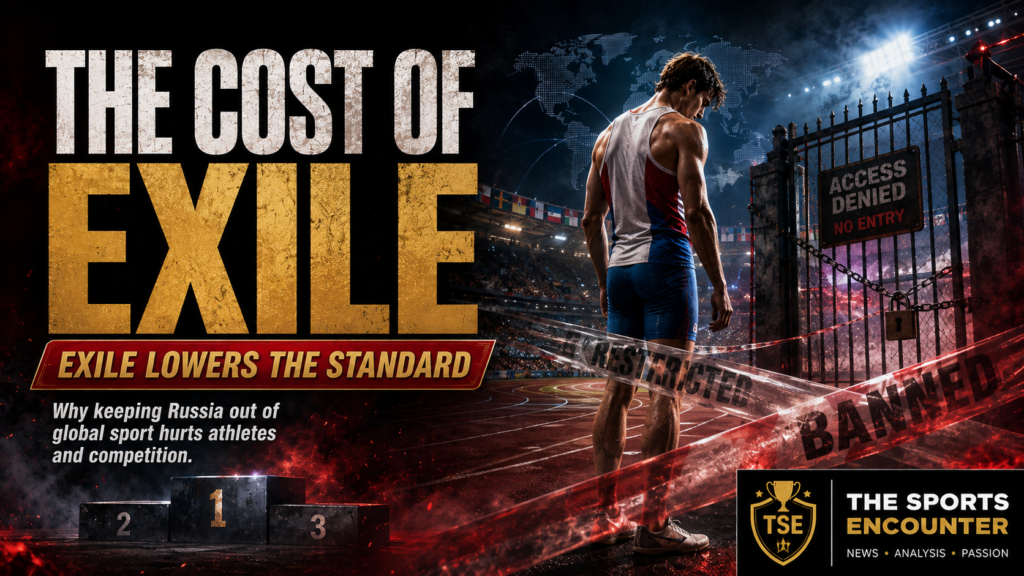
Russia’s continued exclusion from major international sports events may satisfy the demand for political consequences, but indefinite collective punishment is weakening competition, damaging athletes who had no role in government decisions, and turning global sport into an inconsistent foreign-policy instrument.
This argument does not excuse Russia’s invasion of Ukraine, erase the suffering of Ukrainian athletes, or dismiss the country’s long record of state-backed doping violations.
Russia’s conduct required consequences. Sports institutions also had legitimate reasons to suspend national symbols, remove events from Russian territory, strengthen anti-doping controls, and protect Ukrainian competitors.
The harder question is whether athletes should continue losing entire careers because of their nationality, even when they meet strict anti-doping requirements, compete without national symbols, and have no documented connection to military institutions or war propaganda.
More than a decade after Russian athletics first entered isolation, the evidence is becoming harder to ignore. Athletes are losing motivation, domestic standards are stagnating, global rankings no longer reflect the strongest available field, and international federations are struggling to explain why an individual competitor should carry responsibility for decisions made by a government.
The international sports system needs a smarter response. It should punish institutions and individuals connected to wrongdoing while allowing independently vetted athletes to compete under neutral conditions.
TL;DR: The Case Against Russia’s Indefinite Sports Exile
- Blanket national exclusions punish athletes without proving individual responsibility.
- Major competitions lose sporting depth when world-class Russian athletes are absent.
- Isolation weakens motivation, development standards, coaching systems, and domestic competition.
- Long bans can strengthen state propaganda by portraying international sport as hostile to ordinary Russians.
- Sport loses credibility when sanctions vary widely by country, conflict, federation, and commercial interest.
- Neutral participation can separate athletes from government representation while preserving competitive integrity.
- Doping concerns should be addressed through testing, monitoring, and individual sanctions rather than nationality alone.
- Ukraine’s athletes and sporting infrastructure still require significant financial and institutional support.
- The strongest model combines targeted accountability with independently verified neutral participation.
Russia’s Exclusion Began With a Legitimate Integrity Crisis
Any serious discussion must begin with the reason Russian athletics entered isolation before the invasion of Ukraine.
World Athletics suspended the Russian Athletics Federation in 2015 following evidence of institutionalized doping, manipulation of testing procedures, and failures within the country’s anti-doping system.
Those were sporting violations within the direct jurisdiction of sporting bodies.
International federations had a responsibility to protect clean athletes, investigate officials, restrict compromised institutions, and prevent medals from being decided through a corrupted system.
Russia’s later invasion of Ukraine in February 2022 created a second and very different basis for exclusion.
The International Olympic Committee recommended that federations remove Russian and Belarusian athletes and officials from international competitions. National teams disappeared, events were moved, symbols were prohibited, and many individual athletes lost access to qualification pathways.
The original athletics suspension concerned doping and governance. The later exclusion concerned war, state responsibility, security, and international solidarity.
Combining those two issues into one permanent national punishment creates a problem. Doping can be investigated through evidence, testing records, hearings, and appeals. Political responsibility is far more difficult to assign to an individual sprinter, swimmer, gymnast, wrestler, or tennis player.
The Athlete Is Not the Government
The central weakness in blanket exclusion is the assumption that nationality creates responsibility.
An athlete does not decide whether a country invades another state. Most competitors have no influence over military policy, diplomatic negotiations, territorial disputes, or sanctions.
Some Russian athletes may support the government openly. Others may work for military-linked clubs, participate in propaganda events, or display symbols connected to the war.
Those cases should be investigated individually.
Other athletes may have avoided political activity, trained independently, lived outside Russia, opposed the war privately, or faced personal danger if they made public statements.
Treating every Russian competitor as an extension of the Kremlin removes the distinction between evidence and assumption.
IOC President Kirsty Coventry summarized this concern when she said that sporting bodies should avoid holding athletes accountable for the actions of their governments.
That position recognizes a basic principle of justice. Responsibility should follow conduct.
If an athlete has promoted war, violated anti-doping rules, received prohibited military support, or breached neutrality conditions, sanctions can be imposed.
If none of those facts applies, excluding that athlete solely because of a passport starts to resemble discrimination rather than regulation.
Global Competition Becomes Weaker Without the Best Athletes
International sport claims to identify the fastest, strongest, most skillful, and most tactically accomplished athletes in the world.
That claim becomes harder to defend when entire sporting populations are excluded for reasons unrelated to qualification performance.
Russian Athletics Federation chief Boris Yaryshevsky said six Russian senior athletes were ranked first in the world in their disciplines despite their lack of access to major international competition.
That claim comes from an interested national official and should be independently verified. The wider point remains valid.
Russia has historically produced elite competitors across athletics, gymnastics, wrestling, fencing, swimming, figure skating, ice hockey, artistic sports, combat sports, and several winter disciplines.
A world championship without leading contenders may still award medals. It does not necessarily produce the strongest possible competitive test.
The absence of major competitors affects more than Russia.
- Champions face a shallower field.
- World records are pursued under less demanding pressure.
- Qualification routes become distorted.
- Seeding systems lose accuracy.
- Fans are denied matchups between leading athletes.
- Commercial partners receive a less complete global product.
- Historical comparisons become harder to interpret.
The same principle applies when any major sporting nation is removed.
A global competition should avoid exclusion whenever security, integrity, and individual accountability can be protected through narrower measures.
Isolation Is Damaging Russian Performance Standards
Yaryshevsky’s most important observation concerns the long-term consequences of isolation.
He said Russian athletes are losing motivation, performances are stagnating, and the general competitive level is declining.
This outcome is predictable.
Elite development depends on repeated exposure to elite opposition.
Domestic championships can provide coaching, selection, and national prestige. They cannot fully reproduce the psychological and tactical demands of competing against the best athletes from different systems, climates, training cultures, and competitive environments.
An athlete who never enters major international events loses access to:
- High-pressure championship experience
- Global ranking opportunities
- International coaching knowledge
- Different competitive styles
- Elite commercial sponsorship
- Travel and preparation experience
- Olympic and world-title motivation
The damage extends through the development chain.
Young athletes may leave sport because the Olympic pathway appears closed. Coaches may move abroad or leave the profession. Domestic sponsors may reduce investment. Training facilities may lose relevance. National championships may become repetitive and less demanding.
By the time a ban ends, the sporting system may have lost an entire generation.
That does not weaken the Russian government in a targeted or measurable way. It mainly weakens athletes, coaches, families, clubs, and local sporting communities.
An Indefinite Ban Has No Clear Success Metric
Sanctions work best when they have a defined objective, transparent conditions, and a measurable route toward compliance.
Anti-doping sanctions can require institutional reforms, independent testing, access to laboratories, disclosure of data, removal of officials, and regular audits.
Political sports bans are much less precise.
What exactly must an individual athlete do to regain eligibility?
Must the war end?
Must a peace treaty be signed?
Must occupied territory be restored?
Must the athlete publicly condemn the government?
Would such a statement be safe for the athlete or their family?
What happens when different federations define neutrality differently?
World Athletics has maintained its sanctions, citing the absence of tangible movement toward peace negotiations. The IOC has moved toward provisional reintegration of Russia’s Olympic body.
Those conflicting approaches expose the structural problem.
The same passport can produce complete exclusion in one sport, neutral entry in another, and normal professional participation elsewhere.
Rules that depend heavily on the federation involved create confusion and weaken trust in global sports governance.
Sport Is Applying Political Principles Inconsistently
Russia’s invasion created a powerful international response because of its scale, its breach of international law, and the suffering inflicted on Ukraine.
Sporting institutions still face a difficult credibility question.
Why are some wars, occupations, human rights abuses, and government actions treated as grounds for national exclusion while others produce statements, fines, relocation decisions, or no sporting sanction at all?
International sport has continued working with countries accused of serious human rights violations, military actions, political repression, discrimination, and restrictions on civil liberties.
This does not mean Russia should escape accountability.
It means governing bodies need rules that can be applied consistently rather than responses shaped by geography, political alliances, media pressure, or commercial dependence.
The governance concerns exposed by FIFA’s recent crisis show why consistency matters. The Sports Encounter has examined the danger of concentrated decision-making through its reports on FIFA’s apology over its failed World Cup commercial plan and the federations and senior officials breaking ranks with Gianni Infantino.
When sports bodies invoke values selectively, critics begin to see principles as political tools rather than universal standards.
Exclusion Can Strengthen the Propaganda It Is Supposed to Defeat
One argument for banning Russian athletes is that their victories may be used by the state as propaganda.
That risk is real.
Governments have always used international sporting success to promote national prestige, political legitimacy, and institutional strength.
Blanket exclusion can also be used as propaganda.
Russian authorities can present bans as evidence that Western institutions oppose Russian citizens regardless of their personal conduct.
This narrative can turn athletes into symbols of national victimhood and reduce public space for criticism of the government.
A carefully regulated neutral pathway creates a different message.
It tells Russian citizens that international sport remains open to individuals who follow common rules, submit to independent testing, avoid political promotion, and separate themselves from state representation.
That approach isolates government symbols rather than isolating an entire population.
Neutral Participation Is Imperfect, but Better Than Collective Exclusion
Neutral status cannot remove every political difficulty.
A Russian athlete’s performance may still be celebrated inside Russia. Governments may still claim indirect credit. Neutrality checks may produce difficult borderline cases.
Those weaknesses do not make the model useless.
A strong neutral system can include:
- No Russian flag, anthem, or official team identity
- No participation in national team events where neutrality is impossible
- Independent background screening
- Exclusion of athletes linked directly to military institutions
- Exclusion of competitors who publicly promote the invasion
- Enhanced out-of-competition anti-doping testing
- Transparent eligibility decisions
- An independent appeal process
- Clear conduct rules during events
- Immediate sanctions for political or symbolic breaches
This framework separates the right to compete from the right to represent the Russian state.
It also gives clean athletes a defined route back rather than leaving them trapped inside an indefinite political condition they cannot personally change.
Doping Must Remain a Separate and Serious Test
Arguments for reintegration cannot ignore Russia’s anti-doping history.
The Russian Athletics Federation’s 2015 suspension followed evidence serious enough to damage trust across global sport.
A return should therefore require stricter testing, not lower standards.
Every Russian athlete seeking neutral status should be required to demonstrate a reliable testing history through recognized and independently supervised systems.
Sample collection, biological-passport monitoring, whereabouts data, laboratory analysis, and disciplinary decisions must remain outside political control.
Officials connected to manipulation should remain excluded even when individual athletes return.
This distinction matters.
Athletes should not be banned forever because institutions failed. Institutions should not be restored automatically because some athletes are clean.
Targeted accountability can handle both issues more fairly.
Ukrainian Athletes Cannot Be Treated as an Afterthought
The case for allowing neutral Russian participation must acknowledge the reality facing Ukraine’s sporting community.
Ukrainian athletes have lost training facilities, homes, coaches, teammates, preparation time, and in some cases their lives.
Many have trained abroad, served in the armed forces, or competed while families remained under attack.
For them, facing Russian athletes may carry emotional and political consequences that do not exist for neutral observers.
International federations should therefore pair any reintegration policy with stronger support for Ukraine.
- Direct funding for damaged sports infrastructure
- Training grants and international camps
- Travel and accommodation support
- Mental-health services
- Protected qualification opportunities
- Security arrangements at shared competitions
- Consultation with Ukrainian athlete representatives
Reintegration should never mean pretending the war did not happen.
It should mean refusing to abandon individual justice while continuing to support those harmed by the conflict.
Security and Boycott Risks Need Practical Management
Some Ukrainian athletes and federations may refuse to compete against Russians, even under neutral status.
Other governments may threaten funding cuts or political action against sports bodies that readmit Russian and Belarusian competitors.
These risks require planning rather than automatic exclusion.
Federations can establish draw procedures, security protocols, protest rules, media guidelines, and disciplinary standards before competition begins.
Athletes should not be forced into political ceremonies or staged displays of reconciliation.
They should be expected to compete under published rules.
International sport has managed politically sensitive contests before. The difficulty of managing them does not prove that a nationality-based ban is the only workable answer.
Major Events Need Russia More Than Officials Admit
Russia remains one of the world’s largest sporting nations.
Its long absence affects event quality, media audiences, historical rivalries, qualification systems, and commercial reach.
This should not determine ethical policy by itself. It should form part of an honest assessment of consequences.
International events work because audiences believe they bring together the strongest athletes from the widest possible range of nations.
The FIFA World Cup 2026 demonstrated the commercial and emotional power of global participation. It also showed how quickly governance disputes can threaten trust, as explored in The Sports Encounter’s analysis of the failed FIFA World Cup stake-sale plan.
The Olympic movement depends even more heavily on universality.
A Games that excludes leading athletes indefinitely for nationality-based political reasons risks moving away from competition and toward permanent geopolitical alignment.
Young Athletes Are Paying for Decisions Made Before Their Careers Began
The longer the exclusion continues, the more it affects competitors who were children when the major political and doping decisions occurred.
A 17-year-old athlete preparing for Los Angeles 2028 may have been 11 when the invasion began and an infant when Russia’s athletics suspension started.
That athlete did not design a doping system, direct military operations, or control government policy.
Yet the current structure can remove their only realistic Olympic opportunity.
Elite careers are short.
A four-year wait is not an administrative inconvenience. It can erase a career.
International law and sports governance both recognize the importance of proportionality. Sanctions should be connected to responsibility, evidence, and legitimate objectives.
A system that punishes younger and younger athletes for an inherited national status moves further away from those principles with every passing season.
The Best Competitors Also Improve Everyone Around Them
Elite athletes do more than chase medals.
They force rivals to improve.
A world-leading jumper raises the standard required to reach a final. A dominant wrestler forces tactical development. An exceptional swimmer changes pacing strategies. A technically advanced gymnast expands the difficulty level of the field.
Removing strong competitors can reduce the pressure that drives innovation.
This is part of Yaryshevsky’s warning about declining standards inside Russia, but the effect also travels outward.
International rivals lose exposure to those competitors. Coaches lose comparative data. Events lose tactical variety. Younger athletes lose important reference points.
The Sports Encounter’s coverage consistently examines why competition quality matters beyond final results, including the role of tactical pressure and tournament structure across its global soccer coverage.
Sport Should Build Bridges Without Becoming Politically Blind
The traditional claim that sport and politics are completely separate has never been convincing.
Governments fund teams, host tournaments, use athletes as symbols, influence federations, and pursue prestige through medals.
Sport cannot ignore war, corruption, discrimination, doping, or human rights.
It also should not abandon its role as one of the few global spaces where individuals from hostile states can meet under shared rules.
That role becomes more important during conflict.
Dialogue through sport will not end a war. Competition can still preserve human contact, shared standards, and recognition of individual identity beyond nationality.
Permanent exclusion closes that space.
The Counterargument: Why Many Still Support the Ban
Supporters of continued exclusion make several serious arguments.
- Russia breached the Olympic Truce and international law.
- Ukrainian athletes cannot compete normally while their country remains under attack.
- Russian victories may be used for state propaganda.
- Some elite Russian athletes have military or state affiliations.
- Neutral status may be difficult to verify.
- Russia’s doping history has weakened trust.
- Readmission may normalize an unresolved war.
These concerns should shape eligibility rules.
They do not necessarily justify excluding every athlete without individual review.
The Council of Europe has argued that Russian and Belarusian participation could be exploited by propaganda and that neutral criteria may not offer sufficient guarantees. At the same time, material included in its own examination recorded the UN Special Rapporteur’s concern that nationality-based exclusion raises issues of non-discrimination and the right to participate in sporting life.
The disagreement reveals the real policy choice.
One side prioritizes the symbolic and political power of collective exclusion. The other prioritizes individual assessment and proportionality.
A credible international framework should try to protect both values rather than treating them as mutually exclusive.
A Better Model for Russian Participation
International sports bodies should replace indefinite blanket exclusion with a five-part model.
1. Maintain Institutional Sanctions
Russian national teams, flags, anthems, government officials, and sanctioned federation leaders should remain restricted until defined conditions are met.
2. Create Independent Neutral Eligibility Panels
Panels should include anti-doping experts, athlete representatives, human-rights specialists, security professionals, and independent legal officials.
3. Assess Every Athlete Individually
Eligibility should examine doping history, military affiliation, political conduct, funding relationships, and compliance with neutrality rules.
4. Publish Decisions and Appeals
Federations should explain approvals and rejections while protecting sensitive personal information. Athletes must have access to independent appeal.
5. Link Reintegration With Support for Ukraine
Revenue from major events and federation development funds should continue supporting Ukrainian athletes, facilities, and sporting institutions.
What This Means for Los Angeles 2028
The IOC’s provisional lifting of the Russian Olympic Committee’s suspension suggests the wider Olympic movement is preparing for some form of reintegration before the Los Angeles Games.
World Athletics remains on a different path and has reaffirmed its sanctions.
This disagreement cannot remain unresolved until qualification deadlines approach.
Athletes, federations, hosts, broadcasters, and national Olympic committees need clarity well before 2028.
The debate surrounding participation and selection will also influence other major Olympic stories, including the shape of the United States’ teams and the possibility of major stars returning for one final appearance at the Los Angeles Olympics.
Los Angeles should not inherit a fragmented system in which eligibility depends on the sport rather than a common set of transparent principles.
Final Verdict
Keeping Russia out of global sports indefinitely is becoming harder to justify as a fair, effective, or strategically useful policy.
The exclusion has not produced a clear route toward peace. It has reduced motivation, weakened sporting development, distorted competition, created inconsistent rules, and punished athletes whose personal responsibility has never been established.
Russia’s government should remain accountable for its actions.
Officials involved in doping, war promotion, institutional manipulation, or military structures should not receive automatic access to international sport.
Clean athletes who pass independent screening should receive a defined neutral pathway.
This approach would preserve sanctions against the state, protect competition integrity, support Ukraine, and restore the principle that sporting punishment should be based on individual conduct.
Global sport loses something important when it excludes an entire generation without offering a fair test or a realistic route back.
The strongest response to political wrongdoing is targeted accountability. Collective exile may feel decisive, but over time it weakens the standards, universality, and credibility that international sport claims to defend.
This article is an editorial analysis. It does not minimize Russia’s invasion of Ukraine or the impact of the war on Ukrainian athletes and sporting institutions.