Aaron Donald’s Rams Comeback is Suddenly Real: Should NFL Be Terrified?
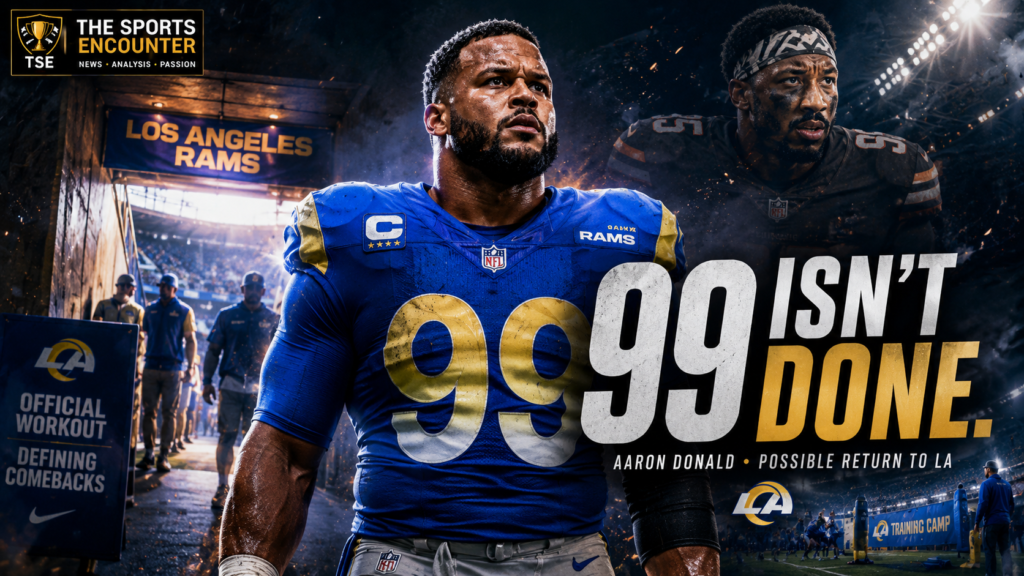
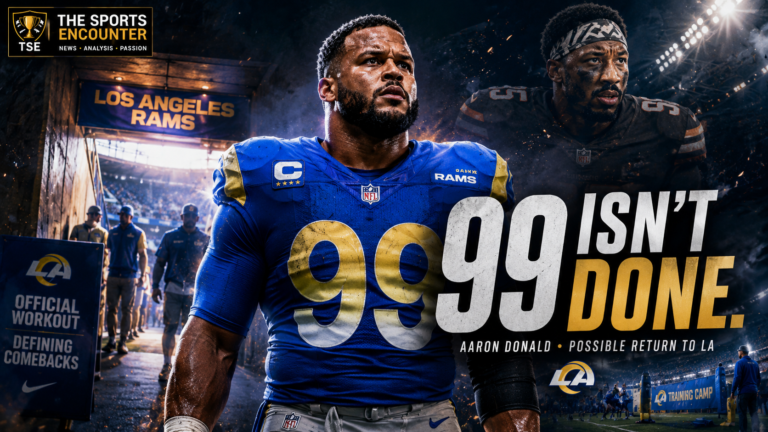
Aaron Donald’s return to the Los Angeles Rams suddenly feels realistic after the retired defensive legend completed an official workout at the team facility. A reunion with Sean McVay and a potential partnership with Myles Garrett could reshape the 2026 NFL title race.
Aaron Donald walked back onto a Los Angeles Rams practice field on Wednesday, used official team equipment and completed a workout that had to be reported to the NFL.
That procedural detail changed the entire conversation.
Donald’s possible comeback had spent weeks living in the familiar territory of hints, private conversations and carefully chosen comments from Sean McVay. The three-time NFL Defensive Player of the Year had trained at the Rams’ facility before. Myles Garrett had spoken openly about trying to bring him back. McVay had repeatedly suggested that discussions were moving in a positive direction.
Wednesday brought the first official entry on the league’s transaction wire.
Donald has not signed a contract. He remains retired, and no return date has been announced. Yet an official workout represents far more than a former player stopping by camp to greet old teammates.
It means the Rams and Donald have moved close enough to a football return that league procedures now apply.
McVay did little to calm the growing excitement.
“Best tryout we’ve ever had. I think he could make the team.”
The coach delivered the line with humor, but the possibility behind it has become serious.
Donald is 35 and has not played since the 2023 season. He also retired as one of the most destructive defensive players the NFL has ever seen.
If he returns beside reigning Defensive Player of the Year Myles Garrett, Los Angeles could field a pass-rushing partnership powerful enough to reshape the entire 2026 championship race.
Aaron Donald Rams Comeback: Key Facts
| Question | Current Situation |
|---|---|
| Did Aaron Donald work out for the Rams? | Yes. His official workout appeared on the NFL transaction wire. |
| Has Donald signed a contract? | No contract or roster activation has been announced. |
| Is he still officially retired? | Yes. Donald remains on the NFL’s retired list. |
| What must happen before he can play? | Donald must apply to the league for reinstatement. |
| How old is Aaron Donald? | He turned 35 in May 2026. |
| When did he last play? | Donald last appeared during the 2023 NFL season. |
| Career sacks | 111 in 154 regular-season games. |
| Career forced fumbles | 24. |
| Major individual honor | Three-time NFL Defensive Player of the Year. |
| Potential defensive partner | Myles Garrett, the reigning Defensive Player of the Year. |
Why This Workout Was Different
Donald has never stopped training like an elite athlete.
Videos of his strength work, agility drills and conditioning sessions have appeared regularly since his retirement. The Rams also allowed him to use their facility earlier in the summer as he tested whether his body still wanted the demands of professional football.
Those sessions could still be described as private preparation.
Wednesday crossed into official league territory.
Donald worked at the Rams’ team facility and used official equipment during training camp. Under NFL rules, the club had to report the session as a workout or risk disciplinary consequences.
The listing does not guarantee a contract. Teams host workouts for unsigned players throughout the season without completing deals.
Donald is hardly a conventional free agent trying to prove he belongs in the league.
The Rams already know his technique, mentality, physical standards and influence inside their building. The real evaluation concerns whether he can still prepare for a complete NFL season after two years away.
McVay’s joke about Donald making the team revealed the obvious truth.
Los Angeles is not evaluating his résumé.
Donald is evaluating whether his body can satisfy his own standards.
What Most Coverage Misses About Donald’s Decision
The comeback question is often framed around whether Donald remains better than the defensive linemen currently on the Rams’ roster.
That bar is too low.
Donald never built his career around merely earning a place. He became a ten-time Pro Bowler, eight-time first-team All-Pro, Super Bowl champion and three-time Defensive Player of the Year because ordinary excellence never satisfied him.
A return only makes sense if he believes he can still affect games at a level worthy of his name.
That explains why the process has moved slowly.
The Rams would welcome a reduced version of Donald because even a reduced version could strengthen their front. Donald must decide whether he can accept becoming a rotational veteran rather than the central force around which every protection plan is built.
He may discover that his body remains capable of much more.
Two seasons away eliminated the weekly punishment of double-teams, cut blocks, heavy contact and constant recovery. Donald has continued training without carrying the accumulated damage of another 34 regular-season games.
Rest does not reverse age. It can preserve explosiveness, motivation and physical freshness.
That distinction may determine whether this comeback becomes a nostalgic cameo or a championship-changing return.
Myles Garrett Changed the Equation
Donald’s interest reportedly intensified after the Rams acquired Myles Garrett from Cleveland during the offseason.
Los Angeles paid a major price in a deal involving young pass rusher Jared Verse, but the move gave McVay’s team the reigning NFL Defensive Player of the Year and the most prolific sack artist of the 2025 season.
Garrett recorded a league-record 23 sacks last year and raised his career total to 125.5 across nine seasons.
Donald reportedly told Garrett that he was seriously considering a return.
The appeal is easy to understand.
Donald spent most of his career as the first problem every offensive coordinator tried to solve. Guards received immediate help. Centers slid toward him. Running backs stayed in protection. Quarterbacks changed launch points before the snap.
Garrett creates the same type of panic from the edge.
Putting both players on the same defensive front would force offenses into choices without comfortable answers.
- Double Donald inside and leave Garrett with a one-on-one matchup.
- Slide protection toward Garrett and expose the interior.
- Keep extra blockers in and reduce the number of receivers in the route.
- Release the ball quickly and accept shorter, more predictable concepts.
- Move the quarterback and risk simplifying the offense.
That is the real attraction for Donald.
He would no longer have to carry the entire pass rush. Garrett’s presence could preserve his body while creating cleaner opportunities than he saw during much of his first Rams career.
Donald and Garrett Could Break Protection Plans Before the Snap
The most frightening part of a Donald-Garrett partnership would not be the combined career sack total.
It would be the flexibility Los Angeles could build around them.
Donald can attack from the three-technique position, move across the interior or align wider when the matchup demands it. Garrett can rush from either edge, reduce inside on passing downs and overpower tackles without needing elaborate pressure design.
Defensive coordinators normally use movement and simulated pressure to manufacture favorable matchups.
The Rams could create them through personnel alone.
Kobie Turner and Byron Young would also benefit. Opponents could not devote the same protection resources to emerging players when Donald and Garrett command immediate attention.
Los Angeles could rush four and still create the effect of a blitz.
That allows more defenders to remain in coverage, shrinks throwing windows and gives the secondary additional protection against explosive plays.
Donald’s return would therefore change more than the defensive line.
It could simplify the entire defense.
Aaron Donald’s Career Numbers Still Look Unreal
Donald retired after 10 seasons with 111 sacks, 24 forced fumbles and 543 tackles across 154 regular-season games.
Those numbers become even more impressive when viewed through his position.
Interior defensive linemen face traffic on almost every snap. They operate in smaller spaces, absorb contact from multiple blockers and rarely receive the open rushing angles available to edge defenders.
Donald still produced six seasons with double-digit sacks.
His 20.5-sack campaign in 2018 remains one of the greatest seasons ever produced by an interior defender. He won Defensive Player of the Year honors in 2017, 2018 and 2020, joining the smallest circle of defensive players to dominate an era.
Donald also recorded the decisive fourth-quarter pressure against Joe Burrow that secured the Rams’ Super Bowl LVI victory over Cincinnati.
His official career statistics can be reviewed through the Aaron Donald career record at Pro Football Reference.
Any comeback would delay his Hall of Fame eligibility, which begins five years after a player’s final season.
That consequence will hardly influence a player considering another legitimate championship opportunity.
Two Years Away Create Real Risks
Donald’s reputation should not remove the physical uncertainty.
No private workout can fully recreate an NFL game.
Conditioning drills do not replicate a 320-pound lineman leaning on the body for four quarters. Medicine-ball work cannot reproduce the impact of striking, shedding and chasing during an extended drive. Individual sessions also do not test how quickly a player recovers from Sunday to Sunday.
Donald last played a competitive snap in January 2024.
He would need to rebuild football-specific endurance, hand timing, pad level and trust in his body. Training camp offers time, but the Rams must resist accelerating the process because the name creates excitement.
The primary risks include:
- Soft-tissue injuries after two years away from game speed
- Reduced snap-to-snap endurance
- Slower recovery between games
- Difficulty handling a full regular-season workload
- Pressure to perform at his former historic standard
A carefully managed role would make sense.
Donald would not need to play every early down. Los Angeles could preserve him for high-leverage situations, third downs, red-zone possessions and late-game pressure packages.
The objective should be having him healthy when the season reaches its most important weeks.
What Must Happen Before Donald Can Play
Donald remains listed as retired by the NFL.
He must formally apply for reinstatement through the league office before the Rams can place him on the active roster.
The process is generally administrative when a retired player voluntarily seeks to return and no disciplinary issue is involved.
Los Angeles could also receive a temporary roster exemption while Donald completes the reinstatement and conditioning process. That would allow the club to keep him around training camp without immediately removing another player from the current roster.
A contract must then be resolved.
The Rams retained Donald’s contractual rights when he retired, meaning he cannot simply sign with another franchise. Los Angeles and Donald would need to determine the financial structure, guarantees, incentives and expected role.
None of those steps appears impossible.
The decisive issue remains Donald’s commitment.
Why the Rams Are Willing to Wait
Most teams would demand clarity before reaching this point in training camp.
Donald has earned more patience.
He spent his entire career with the Rams after the franchise selected him with the 13th pick of the 2014 NFL Draft. He helped lead the organization through its return to Los Angeles, two Super Bowl appearances and the championship season that defined McVay’s first era.
The relationship involves trust that few player-team partnerships ever reach.
McVay understands Donald’s preparation habits. General manager Les Snead knows the competitive personality behind the retirement decision. The organization also knows Donald will not return casually.
If he says yes, the Rams expect complete commitment.
That allows them to tolerate uncertainty longer than they would with another veteran.
Los Angeles has already positioned itself aggressively for another championship run. The Garrett trade showed that the front office values elite impact over conservative roster building.
The Sports Encounter recently examined how overlooked additions can shape the coming season in its analysis of the most underrated NFL offseason signings for 2026.
Donald would belong to a different category entirely.
His return would be the offseason’s defining move, even if it arrived after training camp began.
Could Aaron Donald Still Be an Elite Player?
Expecting the 2020 version of Donald would be unfair.
Assuming he can only offer ceremonial value would be equally careless.
Donald recorded eight sacks during his final season and earned first-team All-Pro recognition. He did not retire because opponents had solved him or because his play had collapsed.
He left while he could still control the terms of his departure.
That matters when projecting a return.
His game was always built on more than raw speed. Donald combined exceptional leverage, violent hand placement, balance, anticipation and the ability to read blocking angles almost instantly.
Those technical strengths age better than pure athleticism.
His first step may lose a fraction of its former explosion. The hand speed, understanding of leverage and ability to identify protection schemes could remain devastating.
The presence of Garrett would also reduce the number of snaps in which Donald faces immediate double-teams.
A player no longer capable of dominating 70 snaps may still decide a game across 35 carefully selected ones.
What Donald’s Return Would Mean for the NFC
The Rams already entered the season with championship expectations.
Adding Donald would create one of the NFL’s most recognizable and intimidating defenses while strengthening a roster built around veteran quarterback Matthew Stafford and a high-level offense.
The NFC’s leading contenders would have to adjust immediately.
Teams with interior offensive-line concerns would face a particularly difficult matchup. Quarterbacks who rely on stepping forward in the pocket could lose their preferred escape route. Offenses built around slow-developing play-action concepts would face pressure before routes fully opened.
Donald’s effect would extend into preparation.
Every opponent would spend additional practice time designing protections, quick throws and movement concepts for a defensive front featuring two former Defensive Players of the Year.
That mental burden can become almost as valuable as the sacks themselves.
Readers can follow the latest roster moves, injuries and league developments through The Sports Encounter’s recent NFL news and training-camp updates.
The Hall of Fame Can Wait
Donald is already considered a near-certain first-ballot Hall of Fame selection whenever he becomes eligible.
A return would reset the five-year waiting period after his final game.
That is a small price for a player who may still feel the pull of competition.
Retirement gave Donald time with his family and freedom from the physical routine that had structured his adult life. The decision appeared settled until the Rams assembled a roster capable of offering something rare.
Another realistic Super Bowl run.
Another season with McVay.
A chance to line up beside Garrett.
The possibility of finishing his career at the top rather than returning to rescue a struggling team.
Players of Donald’s stature rarely come back because they miss ordinary Sundays. They return because one final competitive picture becomes too compelling to ignore.
The Sports Encounter Verdict
Aaron Donald has not officially returned to the Los Angeles Rams.
The difference between speculation and reality has narrowed considerably.
An official workout means Donald has moved beyond casual interest. McVay’s comments show that the Rams are ready to welcome him. Garrett’s involvement gives the comeback a football reason stronger than nostalgia.
The final decision belongs to Donald.
He must determine whether his body can still meet the standard established across 10 historic seasons. The Rams must build a role that protects him without reducing his influence. Both sides also need to complete the reinstatement and contractual process.
Wednesday supplied the clearest evidence yet that they may reach that point.
Donald does not need another season to validate his career.
Los Angeles may need him to transform a strong defense into one opponents fear before they leave the locker room.
If No. 99 walks back onto an NFL field beside Myles Garrett, the story will move beyond a famous comeback.
It could become the move that changes who wins the Super Bowl.
Frequently Asked Questions
Is Aaron Donald returning to the Rams?
Donald has completed an official workout with Los Angeles, but he has not signed a contract or formally ended his retirement.
Why was the workout listed on the NFL transaction wire?
The session took place using official Rams facilities and equipment during training camp, requiring the team to report it to the league.
What did Sean McVay say about the workout?
McVay jokingly called it the best tryout the Rams had ever held and said he believed Donald could make the team.
How old is Aaron Donald?
Donald turned 35 in May 2026.
When did Aaron Donald retire?
He announced his retirement in March 2024 after completing the 2023 season.
How many career sacks does Aaron Donald have?
Donald recorded 111 sacks across 154 regular-season games.
Can Donald immediately join the active roster?
No. He must first apply for NFL reinstatement because he remains on the retired list.
Would Aaron Donald play beside Myles Garrett?
Yes. Garrett joined the Rams during the 2026 offseason and could form a historic pass-rushing partnership with Donald.
Has Donald played during the past two NFL seasons?
No. He sat out the 2024 and 2025 seasons after retiring.
Where can fans follow more NFL coverage?
Visit The Sports Encounter for NFL news, roster developments, injuries, analysis and major stories from across American sports.
Breaking News
Harper and Asalanka Punish Colombo’s Chaos as Galle Reach LPL Final
Sam Harper’s commanding 77 and Charith Asalanka’s composed 59 carried Galle Gallants past Colombo Kaps and into the LPL 2026 final against Jaffna Kings.
Colombo Kaps scored quickly enough to threaten Galle Gallants, but they never batted long enough to control the match.
That difference decided Qualifier 2.
Colombo lost five wickets inside seven overs, recovered through Rubin Hermann and Ravindu Fernando, and then surrendered its remaining batting resources before completing 20 overs. Galle responded with a far calmer chase, riding Sam Harper’s masterful 77 and Charith Asalanka’s 59 to reach 177 for four in 18.4 overs.
The six-wicket victory at the R. Premadasa Stadium sends Galle into Saturday’s Lanka Premier League 2026 final against Jaffna Kings. Colombo’s promising playoff run ends one victory short of the title match.
TL;DR
- Galle Gallants chased 177 in 18.4 overs to win Qualifier 2 by six wickets.
- Sam Harper led the chase with 77 from 51 balls, including four fours and four sixes.
- Charith Asalanka scored 59 from 42 and shared a match-defining 126-run partnership with Harper.
- Colombo recovered from 52 for five to reach 176, but was bowled out in 18.5 overs.
- Dasun Shanaka’s constant bowling changes prevented Colombo from controlling the innings.
- Galle will face Jaffna Kings in the LPL 2026 final on August 8.
Galle Gallants vs Colombo Kaps Scorecard
| Detail | Information |
|---|---|
| Competition | Lanka Premier League 2026, Qualifier 2 |
| Venue | R. Premadasa Stadium, Colombo |
| Date | August 7, 2026 |
| Toss | Colombo Kaps elected to bat |
| Colombo Kaps | 176 all out in 18.5 overs |
| Galle Gallants | 177/4 in 18.4 overs |
| Result | Galle Gallants won by six wickets |
| Top Galle batter | Sam Harper, 77 from 51 balls |
| Galle support | Charith Asalanka, 59 from 42 balls |
| Top Colombo batters | Ravindu Fernando 48; Rubin Hermann 45 |
| Best Galle bowling | Sachindu Colombage 2/34; Charith Asalanka 2/34 |
| Turning point | Harper and Asalanka added 126 after Galle slipped to 21/1 |
| What comes next | Galle face Jaffna Kings in the August 8 final |
Colombo’s Run Rate Hid a Deeper Batting Failure
A total of 176 from 18.5 overs suggests aggression. The scorecard tells a harsher story.
Colombo fell to 20 for three before the third over had ended. Sadeera Samarawickrama made five, Thanuka Dabare scored 11, and captain Kamindu Mendis managed one. Janith Liyanage briefly counterattacked with 23 from nine balls, but his dismissal left the Kaps at 47 for four.
James Neesham then fell for one, reducing Colombo to 52 for five in 6.1 overs.
The Kaps kept swinging when the situation called for one decisive partnership. That approach produced boundaries, but it repeatedly exposed new batters before they had understood the surface or match situation.
Hermann supplied some resistance with 45 from 33 balls. Ravindu Fernando changed the innings’ pace with five sixes in a 27-ball 48, while Malsha Tharupathi contributed a valuable 28 from 17. Their hitting dragged Colombo toward a defendable total, yet the team lost its seventh wicket at 158 in the 17th over and was dismissed with seven balls unused.
Those missing deliveries mattered. Even at a modest late-innings rate, Colombo could have added another 10 to 15 runs. Against a Galle batting lineup that eventually needed eight runs from the final eight balls, that extra cushion could have changed the pressure entirely.
Colombo had shown much better knockout control while eliminating Kandy, as detailed in The Sports Encounter’s report on McDermott, Neesham and Wanuja Sahan ending the Royals’ campaign. Qualifier 2 exposed the opposite version of their batting.
Shanaka Kept Searching Until Galle Found Control
Dasun Shanaka’s captaincy deserves as much credit as the wickets.
Colombo’s batters attacked nearly every bowling matchup, which could easily have forced a captain into defensive thinking. Shanaka continued rotating his options instead. Six bowlers entered the attack, preventing any Colombo batter from settling against one repeated pace or angle.
Charith Asalanka conceded 34 from three overs but removed Dabare and Kamindu. Mohammad Nawaz delivered the evening’s most economical spell, taking one for 12 from two overs. Akif Javed and Tharindu Ratnayake collected one wicket each, while Sachindu Colombage returned two for 34.
The changes did not stop every boundary. They kept producing questions, and Colombo’s reckless shot selection eventually supplied the answers.
Galle had already beaten the Kaps twice during the league stage, including a 13-run victory that secured a top-two finish. Shanaka again showed why his team has handled changing match situations better across the tournament.
Harper and Asalanka Remove the Panic From the Chase
Galle lost Thomas Rogers for 13 at 21 for one, giving Colombo the early opening it needed. Harper and Asalanka closed it with patience, strike rotation and controlled aggression.
Their 126-run partnership lasted 84 balls. Harper struck four fours and four sixes during his 77 from 51, while Asalanka contributed three fours and four sixes in a 42-ball 59.
Both batters understood that the required rate demanded intent without desperation. They targeted weaker deliveries, kept the scoreboard moving between boundaries and denied Colombo the clusters of wickets that had damaged the first innings.
Harper has repeatedly shaped Galle’s successful chases. His earlier 65 against the same opponent helped produce another victory, covered in The Sports Encounter’s report on Galle’s five-wicket win over Colombo.
Asalanka again provided the calm middle-overs influence that defined his 65 in Galle’s opening victory over Jaffna.
Colombo dismissed Asalanka, Harper and Chamika Karunaratne late, but the damage had already been done. Shanaka completed the chase with a six, finishing unbeaten on eight from three balls.
The Final Brings Galle Back to Jaffna
Galle’s reward is an immediate rematch with Jaffna Kings, who defeated them by 14 runs in Qualifier 1 after Kamil Mishara’s unbeaten century.
Jaffna will enter the final rested and confident after posting 242 for two in that meeting. Galle arrives with momentum, a proven chasing structure and fresh evidence that Harper and Asalanka can manage knockout pressure.
The official Lanka Premier League schedule confirms that the final will take place at the R. Premadasa Stadium on August 8. Readers can follow the buildup through The Sports Encounter’s Lanka Premier League coverage hub and wider cricket reporting and analysis.
Colombo leaves with clear evidence of its attacking ability, but also with the question that ended its season: why keep swinging when the match was asking someone to stay?
Galle found the balance Colombo could not. One more victory will make them champions.
Breaking News
Ilhan Fandi Delivers the Point That Sends Singapore Through
Ilhan Fandi rescued Singapore with a decisive second-half equalizer against Indonesia, earning the Lions the point they needed to reach the ASEAN Championship semifinals.
Singapore spent 19 tense second-half minutes watching its place in the ASEAN Championship semifinals slip toward Indonesia. Then Ilhan Fandi reacted first to one moment of defensive confusion and changed the direction of two campaigns.
His 66th-minute equalizer earned Singapore a 1-1 draw at Jalan Besar Stadium on Friday, August 7, giving the Lions the point they needed to finish second in Group A. Indonesia, which had to win, finished one point behind Singapore and exited the tournament despite leading through Ragnar Oratmangoen.
For Singapore, the final whistle brought relief, celebration and another place in the last four. For Indonesia, it confirmed a painful elimination after a group campaign that began with two convincing victories.
TL;DR
- Singapore drew 1-1 with Indonesia and qualified for the semifinals.
- Ragnar Oratmangoen put Indonesia ahead in the 47th minute.
- Ilhan Fandi equalized in the 66th minute after confusion inside Indonesia’s penalty area.
- Jacob Mahler earned the official Hyundai Player of the Match award.
- Song Ui-young briefly received a second yellow card, but the referee overturned it after an on-field review.
- Vietnam won Group A with 10 points, followed by Singapore with eight and Indonesia with seven.
Singapore vs Indonesia Match Information
| Detail | Information |
|---|---|
| Match | Singapore vs Indonesia |
| Competition | ASEAN Hyundai Cup 2026, Group A |
| Final score | Singapore 1-1 Indonesia |
| Goalscorers | Ragnar Oratmangoen 47’; Ilhan Fandi 66’ |
| Venue | Jalan Besar Stadium, Singapore |
| Date | Friday, August 7, 2026 |
| Top performer | Jacob Mahler, Hyundai Player of the Match |
| Turning point | Ilhan punished confusion between Rizky Ridho and Cahya Supriadi |
| Cards | Seven confirmed yellow cards; Song Ui-young’s second yellow was overturned |
| Group impact | Singapore qualified in second place; Indonesia was eliminated |
| Next match | Singapore hosts the Group B winner on August 15 |
Indonesia Struck First but Could Not Find Control
Indonesia approached the match with no room for calculation. John Herdman’s side needed all three points, while Singapore could advance with a draw.
That urgency nearly produced a goal after only two minutes. Mitch Baker found space with goalkeeper Izwan Mahbud exposed, but Shah Shahiran recovered with a perfectly timed sliding block. The intervention set the tone for a Singapore performance built on defensive concentration and collective recovery.
Indonesia carried the greater attacking obligation, yet Singapore gradually slowed the contest in midfield. Jacob Mahler helped protect the central areas, while Shah and Hariss Syahin limited the clean passing lanes Indonesia needed to dictate the tempo.
The hosts also created chances. Song Ui-young forced Cahya Supriadi into a save after meeting Lionel Tan’s low cross, while Ilhan tested the goalkeeper with an improvised effort. At the opposite end, Izwan stretched to keep out Baker’s header.
The score remained level until two minutes after halftime. Thom Haye delayed his pass just long enough to release Dony Pamungkas on the left. Dony cut the ball back, and Oratmangoen scored at the second attempt.
Indonesia had earned the lead it needed. The challenge was keeping it.
A Reversed Decision Kept Singapore Alive
The match appeared to turn decisively against Singapore in the 58th minute when Song received what initially looked like his second yellow card for a challenge on Ivar Jenner.
Referee Mohammed Khalfan Salim Al Mani reviewed the incident at the pitch-side monitor and rescinded the booking. The decision meant Singapore remained at full strength rather than facing the closing half-hour with 10 men.
Eight minutes later, the Lions equalized.
A lofted delivery created hesitation between defender Rizky Ridho and goalkeeper Cahya. Neither completed the clearance, allowing Ilhan to reach the loose ball and guide a first-time finish into an empty net.
It was a poacher’s goal shaped by anticipation rather than elaborate buildup. Ilhan understood the danger before Indonesia’s defenders resolved it. His third important goal of the tournament completed a group stage in which he repeatedly supplied Singapore’s decisive attacking moments.
Readers who followed his earlier contributions will recognize the pattern. Ilhan also delivered the dramatic winner in the tournament opener before scoring against Timor-Leste, a performance covered in The Sports Encounter’s report on Singapore’s controlled victory over Timor-Leste.
Mahler Gave Singapore Its Defensive Foundation
Ilhan scored the qualification goal, but Mahler earned the official Player of the Match award for holding Singapore together under pressure.
His positioning helped close central spaces, and his willingness to contest second balls prevented Indonesia from building sustained attacks after taking the lead. Indonesia pushed forward late, with Rizky Pratama hitting the side netting, but Singapore protected the penalty area and avoided the decisive mistake.
The defensive resilience echoed the disciplined performance that earned the Lions a goalless draw against Vietnam in Hanoi. Across those two defining matches, Singapore conceded only once and collected the two points that separated it from Indonesia.
More regional tournament reporting is available through The Sports Encounter’s soccer coverage and its ASEAN Championship 2026 coverage.
Indonesia’s Strong Start Ended in Frustration
Indonesia leaves the tournament with seven points and a positive goal difference, but its inability to recover from the 3-0 defeat against Vietnam proved costly.
Herdman’s team had looked dangerous earlier in the campaign. Baker scored a hat trick in the 5-1 victory over Cambodia, and Indonesia later defeated Timor-Leste 3-0. Those results created momentum but could not guarantee qualification.
Against Singapore, Indonesia produced several threatening moments and deserved its lead. The team’s problems arrived after Oratmangoen scored. Rather than controlling possession and forcing Singapore to chase recklessly, Indonesia allowed the hosts to remain within one incident of qualification.
That incident came in the 66th minute.
Yellow and Red Cards
| Minute | Player | Team | Card |
|---|---|---|---|
| 43’ | Song Ui-young | Singapore | Yellow |
| 58’ | Ivar Jenner | Indonesia | Yellow |
| 76’ | Mitch Baker | Indonesia | Yellow |
| 77’ | Lionel Tan | Singapore | Yellow |
| 82’ | Marc Klok | Indonesia | Yellow |
| 86’ | Timo Geypens | Indonesia | Yellow |
| 90+7’ | Jacob Mahler | Singapore | Yellow |
No player finished the match with a red card. Song’s second caution was canceled following the referee’s monitor review.
Final Group A Points Table
| Pos. | Team | P | W | D | L | GF | GA | GD | Pts |
|---|---|---|---|---|---|---|---|---|---|
| 1 | Vietnam | 4 | 3 | 1 | 0 | 13 | 1 | +12 | 10 |
| 2 | Singapore | 4 | 2 | 2 | 0 | 5 | 2 | +3 | 8 |
| 3 | Indonesia | 4 | 2 | 1 | 1 | 9 | 5 | +4 | 7 |
| 4 | Cambodia | 4 | 1 | 0 | 3 | 6 | 10 | -4 | 3 |
| 5 | Timor-Leste | 4 | 0 | 0 | 4 | 0 | 15 | -15 | 0 |
Vietnam’s 3-1 win over Cambodia secured first place. Singapore qualified as the runner-up, while Indonesia, Cambodia and Timor-Leste were eliminated.
What Comes Next for Singapore?
Singapore will host the Group B winner in the first leg of its semifinal on August 15. The Lions remain two stages away from a fifth regional title, but their group campaign has shown why they can trouble stronger opponents.
They can defend compactly, absorb pressure and find decisive contributions from Ilhan. Mahler’s influence gives the midfield stability, while Izwan’s experience provides security behind the defensive line.
Singapore did not require a victory on Friday. It needed composure when the match turned against it. The Lions found enough, and Ilhan found the goal that carried them into the semifinals.
Breaking News
Nguyễn Đình Bắc Answers Cambodia’s Challenge as Vietnam Win Group A
Nguyễn Đình Bắc scored twice as Vietnam survived Cambodia’s second-half fightback, won 3-1 in Hanoi and secured first place in ASEAN Championship Group A.
Cambodia’s equalizer forced Mỹ Đình National Stadium to confront an uncomfortable possibility. Vietnam had controlled the ball, created the better chances and led for most of the evening, yet one sharp Cambodian attack had suddenly placed top spot in Group A back in jeopardy.
The defending champions responded with the composure expected from a team planning another deep tournament run.
Vakhim Im’s 84th-minute own goal restored Vietnam’s advantage before Nguyễn Đình Bắc completed his two-goal performance five minutes later, sealing a 3-1 victory in Hanoi on Friday, August 7.
Vietnam finished the group stage unbeaten with 10 points and advanced to the ASEAN Hyundai Cup 2026 semifinals as Group A winners. Cambodia ended its campaign in fourth place with three points, but Iago Bento Fernandes’ equalizer and the resistance surrounding it made Vietnam work far harder than the final score suggests.
Fans can follow The Sports Encounter’s continuing regional coverage through our soccer news and analysis hub.
TL;DR
- Vietnam defeated Cambodia 3-1 at Mỹ Đình National Stadium.
- Nguyễn Đình Bắc scored in the 18th and 89th minutes.
- Substitute Iago Bento Fernandes equalized for Cambodia in the 71st minute.
- Vakhim Im’s 84th-minute own goal became the decisive turning point.
- Vietnam won Group A with 10 points and qualified for the semifinals.
- Cambodia received one yellow card. Vietnam received none, and no red cards were shown.
Vietnam vs Cambodia Match Information
| Detail | Information |
|---|---|
| Match | Vietnam vs Cambodia |
| Competition | ASEAN Hyundai Cup 2026, Group A |
| Result | Vietnam 3-1 Cambodia |
| Venue | Mỹ Đình National Stadium, Hanoi |
| Date | Friday, August 7, 2026 |
| Vietnam goals | Nguyễn Đình Bắc 18’, 89’; Vakhim Im own goal 84’ |
| Cambodia goal | Iago Bento Fernandes 71’ |
| Top performer | Nguyễn Đình Bắc, two goals and four shots on target |
| Turning point | Vakhim Im’s own goal restored Vietnam’s lead in the 84th minute |
| Yellow cards | Vietnam 0; Cambodia 1 |
| Red cards | None |
| Group impact | Vietnam won Group A; Cambodia were eliminated |
Dình Bắc Gives Vietnam Early Control
Vietnam entered the match knowing a draw would secure qualification, but coach Kim Sang-sik had made his intention clear beforehand. He wanted victory and first place after the frustration of the team’s earlier goalless draw with Singapore.
Dình Bắc delivered the opening goal after 18 minutes. The forward received possession inside the penalty area and produced a forceful finish past Koy Salim, giving Vietnam the reward their territorial control deserved.
The hosts held 75.2 percent possession and attempted 16 shots compared with Cambodia’s six. Their passing repeatedly moved Cambodia’s compact 4-4-2 shape from side to side, while Nguyễn Quang Hải and Nguyễn Hoàng Đức helped control the central spaces.
Dình Bắc remained the most direct threat. All four of his attempts tested the goalkeeper, extending a tournament that began with his hat trick in Vietnam’s 7-0 opening victory over Timor-Leste.
Yet Vietnam failed to turn its control into a second goal before halftime. Salim made timely saves, while Cambodia protected the central route toward goal better than it had during the 5-1 defeat against Indonesia.
Cambodia’s Halftime Change Creates a Real Contest
Cambodia coach Koji Gyotoku introduced Iago Bento Fernandes for Hav Soknet at halftime, sacrificing the scorer of two goals in the 3-0 win over Timor-Leste for a quicker, more mobile attacking option.
The change paid off in the 71st minute.
Iago found the space Cambodia had spent most of the match trying to create and beat Patrik Lê Giang to make it 1-1. Vietnam had conceded for the first time in the tournament, and Cambodia suddenly had a result capable of disrupting the top of Group A.
The equalizer exposed the only serious concern in Vietnam’s performance. Heavy possession can create comfort, and comfort can reduce defensive alertness. Cambodia completed far fewer passes and produced only three shots on target, but one well-timed attack was enough to change the emotional temperature inside Mỹ Đình.
For 13 minutes, Cambodia had belief.
Two Late Goals Separate the Group Winner From the Eliminated Side
Vietnam’s winning goal arrived cruelly for the visitors. With six minutes remaining, pressure around Cambodia’s penalty area ended with Vakhim Im turning the ball into his own net.
The own goal reflected the strain Vietnam had built across the match. Cambodia spent long periods defending close to its goal, making 12 fouls and repeatedly clearing attacks before the hosts could find a clean final shot.
Dình Bắc then removed any remaining uncertainty in the 89th minute. His second goal completed Vietnam’s recovery and moved him further into the tournament’s individual scoring conversation.
The forward’s development has given Kim another reliable match-winner alongside Nguyễn Xuân Son, Đỗ Hoàng Hên and Quang Hải. Vietnam’s depth had already driven its 3-0 victory over Indonesia. Against Cambodia, Dình Bắc supplied both the early finish and the late assurance.
Updated ASEAN Championship Group A Table
Singapore’s draw with Indonesia completed the final Group A standings.
| Pos. | Team | P | W | D | L | GF | GA | GD | Pts |
|---|---|---|---|---|---|---|---|---|---|
| 1 | Vietnam | 4 | 3 | 1 | 0 | 13 | 1 | +12 | 10 |
| 2 | Singapore | 4 | 2 | 2 | 0 | 5 | 2 | +3 | 8 |
| 3 | Indonesia | 4 | 2 | 1 | 1 | 9 | 5 | +4 | 7 |
| 4 | Cambodia | 4 | 1 | 0 | 3 | 6 | 10 | -4 | 3 |
| 5 | Timor-Leste | 4 | 0 | 0 | 4 | 0 | 15 | -15 | 0 |
Vietnam and Singapore advance to the two-legged semifinals. Indonesia miss out despite collecting seven points, while Cambodia and Timor-Leste leave the competition.
The final standings confirm the possibilities outlined in The Sports Encounter’s final group-stage qualification preview. Vietnam will face the Group B runner-up, whose identity will be decided after the remaining matches.
Official tournament schedules and semifinal updates are available through the ASEAN United FC competition portal.
What Vietnam and Cambodia Take From the Group Stage
Vietnam reached the semifinals through three different types of performance. It overwhelmed Timor-Leste, endured Singapore’s defensive resistance and clinically punished Indonesia before surviving Cambodia’s late challenge.
That range matters in knockout football. Kim’s team has scored 13 goals, conceded only once and shown it can win through sustained possession, pressing and rapid transitions.
Cambodia leave with fewer rewards, but their campaign contained useful signs. Soknet’s two goals against Timor-Leste, Iago’s impact in Hanoi and the team’s willingness to keep attacking stronger opponents offer a base for future development.
Vietnam move forward as Group A’s strongest team. Cambodia head home after proving, for a tense second-half spell in Hanoi, that they could still make the defending champions feel the pressure.https://chatgpt.com/backend-api/sentinel/frame.html?sv=20260423af3c
-
Editor's Choice4 weeks agoWhat Counts as a Foul in Soccer? A Simple Guide for World Cup Fans
-
Editor's Choice4 weeks agoWhy Ticket Prices Crashed Ahead of the Biggest Matches of FIFA World Cup 2026
-
Editor's Choice3 weeks agoWhat Went Wrong for England in the World Cup 2026 Semi-Final Defeat to Argentina