Taylor Fritz Beats Rafael Jodar to Win Mubadala DC Open 2026 Title
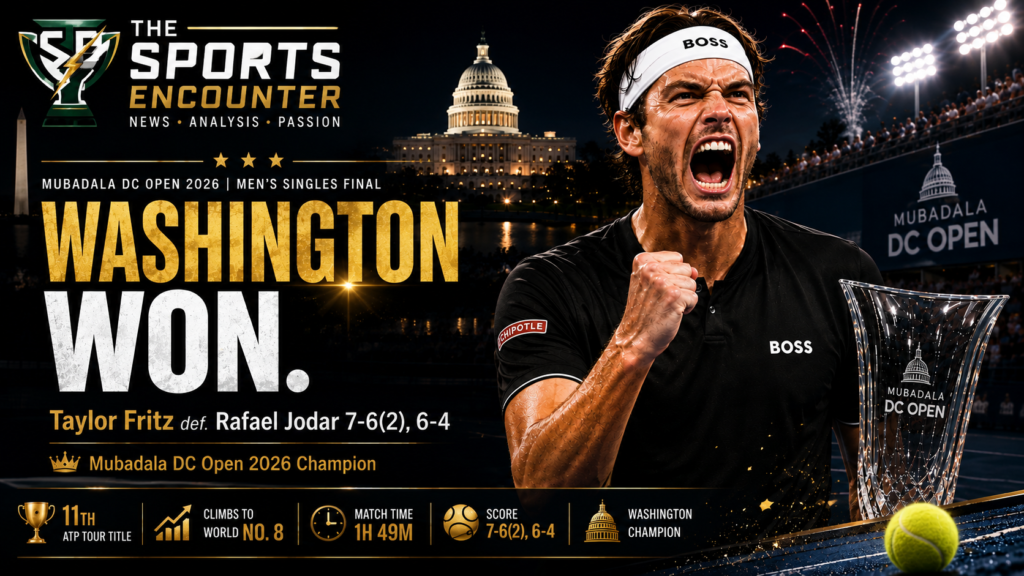
Taylor Fritz defeated Rafael Jodar 7-6(2), 6-4 in the rain-delayed Mubadala DC Open men’s final, securing his 11th ATP Tour title and valuable momentum before the National Bank Open and US Open.
Taylor Fritz defeated Rafael Jodar 7-6(2), 6-4 in the rain-delayed Mubadala DC Open men’s final, securing his 11th ATP Tour title and his first trophy above ATP 250 level since 2022.
Taylor Fritz ended his long wait for another major ATP title by defeating Spanish teenager Rafael Jodar in straight sets in the 2026 Mubadala DC Open men’s singles final.
The third-seeded American won 7-6(2), 6-4 in Washington, completing a championship run that had required resilience long before he stepped onto the court for the final.
Fritz controlled the first-set tiebreak, broke early in the second set and survived a tense final service game before converting his fifth championship point. The match lasted one hour and 49 minutes.
The victory gave Fritz his 11th ATP Tour singles title and his first trophy above ATP 250 level since he won the Tokyo ATP 500 event in 2022. It also made him only the second American man to win the Washington title since 2008, following Sebastian Korda’s success in 2024.
Jodar fell short of his first ATP 500 championship, but his run carried the 19-year-old into the ATP Top 20 for the first time and strengthened his position in the race for the season-ending ATP Finals.
Fans can review official results, draws and tournament information through the official Mubadala DC Open website.
For more tournament reports, player features and Grand Slam analysis, follow The Sports Encounter’s latest tennis coverage.
Taylor Fritz vs Rafael Jodar Final Score
| Player | First Set | Second Set | Result |
|---|---|---|---|
| Taylor Fritz | 7 | 6 | Champion |
| Rafael Jodar | 6 | 4 | Runner-up |
Mubadala DC Open 2026 Men’s Final at a Glance
| Category | Detail |
|---|---|
| Champion | Taylor Fritz |
| Runner-up | Rafael Jodar |
| Final score | 7-6(2), 6-4 |
| Match duration | 1 hour, 49 minutes |
| Tournament level | ATP 500 |
| Surface | Outdoor hard court |
| Venue | William H.G. FitzGerald Tennis Center, Washington, D.C. |
| Fritz’s career titles | 11 |
| Jodar’s ranking milestone | First appearance inside ATP Top 20 |
Why Was the Fritz vs Jodar Final Played on Monday?
The men’s final was originally scheduled for Sunday, August 2, but persistent rain disrupted the championship program in Washington.
Organizers postponed both singles finals until Monday. Alexandra Eala completed her historic comeback against Jessica Pegula before Fritz and Jodar entered Stadium Court for the men’s championship match.
Eala defeated Pegula 4-6, 6-4, 6-0 to become the first Filipino player to win a WTA Tour singles title. The Sports Encounter covered her breakthrough in our report on Alexandra Eala’s historic Mubadala DC Open victory.
The delay gave both men an additional night to recover from demanding three-set semifinals. It also created a longer championship weekend than planned, with the tournament finally concluding on Monday afternoon.
Fritz and Jodar Trade Confident Service Holds
The opening set offered few opportunities for either returner.
Fritz relied on his first serve and short forehand combinations, while Jodar showed no visible fear in the first ATP 500 final of his career. The teenager protected his service games and matched the experienced American through 12 games.
Jodar’s composure was especially impressive because Fritz entered the match as the higher-ranked player, the home favorite and an established ATP champion.
Neither man secured the break required to avoid a tiebreak, but the balance shifted as soon as the first-set shootout began.
First-Set Tiebreak Changes the Final
Fritz increased the depth of his returns during the tiebreak and forced Jodar to play several balls from uncomfortable positions.
The American stopped allowing Jodar to control rallies through his first strike. His returns landed closer to the baseline, and the added pressure produced errors from the Spaniard.
Fritz took the tiebreak 7-2, turning a highly competitive opening set into a clear scoreboard advantage.
The moment mattered because Jodar had spent much of the set proving he could compete evenly with the third seed. Once Fritz secured the tiebreak, the teenager had to recover mentally while also finding a way to create more pressure on the American’s serve.
Early Break Gives Fritz Control of the Second Set
Fritz carried his momentum into the second set and immediately began striking his groundstrokes with greater authority.
He broke Jodar early and moved 3-0 ahead, giving the teenager little time to process the first-set disappointment.
The American’s forehand became increasingly influential. When Jodar left a ball short, Fritz stepped forward and redirected it with enough pace to end the exchange or force a defensive reply.
Jodar refused to collapse. He continued holding serve and stayed close enough to make Fritz earn the championship, but the early break left him chasing the match throughout the set.
Fritz Survives a Dramatic Final Game
Serving for the title at 5-4, Fritz encountered his most uncomfortable period of the final.
Jodar saved several championship points and earned a break opportunity that could have returned the set to level terms. Fritz appeared physically drained between points, bending over as the tension and summer conditions began to take their toll.
The American saved the break point, continued attacking and eventually converted his fifth championship opportunity.
Fritz fell to the court after sealing the victory. He then returned to his feet, acknowledged the Washington crowd and embraced Jodar at the net.
That final game captured the larger story of his week. Fritz rarely had a completely comfortable path, but he repeatedly found a way through the moments when defeat was close enough to feel real.
Taylor Fritz’s Road to the Washington Title
| Round | Opponent | Result or Key Detail |
|---|---|---|
| Second round | Zizou Bergs | Comfortable opening victory |
| Third round | Kamil Majchrzak | Straightforward win to reach the quarterfinals |
| Quarterfinal | Alex Michelsen | Saved a match point before advancing |
| Semifinal | Brandon Nakashima | Won 6-3, 3-6, 6-3 |
| Final | Rafael Jodar | Won 7-6(2), 6-4 |
Fritz’s quarterfinal escape against Michelsen became one of the defining moments of the tournament. He saved a match point and remained alive long enough to reach his first Washington final.
His semifinal against Nakashima also demanded three sets. Fritz won the opener, lost the second and regained control in the decider to secure his place in Monday’s championship match.
The title therefore came through repeated recovery rather than a week of routine straight-set victories.
Why This Title Matters for Taylor Fritz
Fritz had reached several finals during the 2026 season without converting those opportunities into a title.
He finished runner-up in Dallas and Halle and also lost the Stuttgart ATP 250 final. Washington represented his third ATP 500 final of the season and another chance to end that pattern.
The victory lifted him two places to No. 8 in the ATP live rankings and provided valuable momentum ahead of the Masters 1000 events in Canada and Cincinnati.
It was also his first trophy above ATP 250 level since Tokyo in 2022. That same season, he won his only Masters 1000 championship at Indian Wells.
Fritz’s place among the leading American contenders for New York is examined in The Sports Encounter’s complete US Open 2026 preview.
The latest title also improves his position within a strong American group that includes Ben Shelton, Tommy Paul, Frances Tiafoe, Brandon Nakashima and Alex Michelsen.
Fritz Responds After Wimbledon Disappointment
Fritz arrived in Washington having played no competitive match since losing to Alexander Zverev in the Wimbledon quarterfinals.
Zverev won that match in straight sets, ending a tournament in which Fritz had reached the last eight after defeating Alexander Bublik.
The Sports Encounter tracked that stage of the tournament in our Wimbledon quarterfinal roundup.
Washington gave Fritz an immediate chance to move from grass to outdoor hard courts. His serve remained central to his success, but his return depth and forehand aggression decided the most important points in the final.
His ranking and title credentials were already clear before Wimbledon, where he entered among the leading men’s seeds. That pre-tournament landscape was covered in our analysis of the Wimbledon 2026 top seeds.
Rafael Jodar’s Breakthrough Week
The defeat should not overshadow Jodar’s remarkable performance in Washington.
The 19-year-old reached his first ATP 500 final and only the second tour-level final of his career. He had already won his maiden ATP title in Marrakech in April, but Washington demanded victories against a significantly deeper field.
Jodar defeated Arthur Fils earlier in the tournament before producing one of his biggest career wins against Lorenzo Musetti in the quarterfinals.
Musetti won the opening set 6-1, but Jodar responded by taking the next two sets 6-1 and 6-4. That comeback secured his first ATP 500 semifinal and guaranteed his arrival inside the Top 20.
Jodar then defeated Alejandro Tabilo 6-7(6), 6-4, 6-4 in the semifinal, recovering from a set down for the second consecutive round.
His ability to survive physical three-set matches, remain aggressive under pressure and recover after difficult opening sets made him one of the stories of the tournament.
Rafael Jodar’s Road to the Final
| Stage | Opponent | Significance |
|---|---|---|
| Early round | Arthur Fils | Defeated an established young ATP contender |
| Quarterfinal | Lorenzo Musetti | Recovered to win 1-6, 6-1, 6-4 |
| Semifinal | Alejandro Tabilo | Won 6-7(6), 6-4, 6-4 |
| Final | Taylor Fritz | Lost 7-6(2), 6-4 in first ATP 500 final |
Jodar’s promise had already appeared during the grass season. He made an assured Wimbledon debut and defeated Felix Gill in straight sets, a result included in our Wimbledon 2026 opening-day report.
Jodar Enters the ATP Top 20
Jodar’s Washington run lifted him into the ATP Top 20 for the first time.
He also moved to 11th in the ATP Live Race to Turin, placing him within reach of a possible qualification challenge for the Nitto ATP Finals.
Reaching Turin would make him only the third player after Stefanos Tsitsipas and Carlos Alcaraz to qualify for the ATP Finals one year after appearing at the Next Gen ATP Finals.
The final showed that his development remains incomplete. Fritz exposed the difference between competing evenly through service games and controlling the points that decide a championship.
Still, Jodar leaves Washington with a much stronger ranking, wins over elite opposition and evidence that he can compete deep into a demanding ATP 500 event.
How Did Fritz Beat Jodar?
Three tactical factors shaped the final.
1. Greater Return Depth in the Tiebreak
Fritz struggled to create consistent pressure during the first 12 games. In the tiebreak, his returns landed deeper and prevented Jodar from immediately controlling the rally.
2. Early Second-Set Pressure
The American attacked at the beginning of the second set while Jodar was still processing the loss of the opener. The early break allowed Fritz to play with scoreboard control.
3. Forehand Authority on Short Balls
Whenever Jodar left the ball short, Fritz moved inside the baseline and used his forehand to take time away. That pattern became more influential as the match progressed.
Fritz Extends His Head-to-Head Lead Over Jodar
The final was the second ATP meeting between Fritz and Jodar.
Fritz’s victory improved his head-to-head record against the Spaniard to 2-0. The gap between them was narrow through much of the match, but the American’s experience became visible during the tiebreak and the final service game.
Future meetings could look different as Jodar develops physically and gains more experience against top-10 opponents. Washington nevertheless gave Fritz the early advantage in what may become an important rivalry during the next phase of men’s tennis.
What Comes Next for Taylor Fritz?
Fritz will now travel to Montreal for the National Bank Open, the sixth ATP Masters 1000 tournament of the season.
The tight turnaround creates an immediate recovery challenge. He played through Monday in Washington after the rain delay and must now adjust quickly to a new city, venue and draw.
Montreal also carries greater ranking points and stronger depth across the field. The absence of Jannik Sinner and Novak Djokovic has opened the men’s tournament, a development analyzed in our report on why Sinner and Djokovic withdrew from Montreal.
The Cincinnati Open will follow, with Fritz listed among the leading men expected to compete. The strength of that field and its notable wild cards are detailed in our Cincinnati Open 2026 wild-card report.
For Fritz, the next few weeks involve balancing momentum with physical management. Washington gave him confidence, but Montreal, Cincinnati and the US Open will create a much heavier workload.
What Comes Next for Rafael Jodar?
Jodar leaves Washington with his reputation transformed.
He entered the tournament as a talented teenager with one ATP title. He leaves as a Top 20 player, an ATP 500 finalist and a credible contender in the race to Turin.
His next challenge involves managing expectation. Opponents will prepare for him more carefully, while his ranking will place him in seeded positions at major tournaments.
The North American hard-court swing should suit his willingness to attack and redirect pace. His Washington performance also suggests that he can recover during long matches and handle consecutive contests against established opponents.
Jodar’s rise follows a wider wave of young men making breakthroughs during the summer. Arthur Gea also earned his first ATP title in Mexico, a story covered in our report on Gea’s Los Cabos victory over Denis Shapovalov.
What the Washington Final Means for the US Open
Fritz’s title strengthens his position among the leading American hopes for New York.
His serve and forehand already make him dangerous on hard courts. Washington showed that he can also survive difficult moments, save match points during a tournament and close a final when physical pressure begins to build.
Jodar’s run adds another possible disruptor to the US Open draw. A Top 20 ranking should improve his seeding position, while his recent form will make him a difficult opponent for established contenders.
Neither player can treat Washington as a guarantee of success in New York. The Masters tournaments in Montreal and Cincinnati will place additional physical demands on both men.
However, the final clarified two important points. Fritz remains one of the strongest American hard-court players, while Jodar’s rise has advanced far enough to affect major draws immediately.
Final Verdict
Taylor Fritz won the Mubadala DC Open because he controlled the moments that carried the greatest weight.
Jodar matched him through the opening set and remained competitive throughout the final. Fritz found another level in the tiebreak, broke early in the second set and survived a demanding final game to complete the victory.
The 7-6(2), 6-4 scoreline reflected a match decided by small but important differences in return depth, first-strike authority and championship experience.
Fritz leaves Washington with his 11th career title, a return to the ATP Top 10 and renewed momentum before the most important hard-court stretch of the season.
Jodar leaves without the trophy, yet his week still represents a major breakthrough. He has entered the Top 20, strengthened his ATP Finals ambitions and established himself as one of the most important young players to watch during the US Open build-up.
The Sports Encounter’s tennis coverage follows tournament results, tactical developments, player form, rankings and the biggest stories across the ATP Tour, WTA Tour and Grand Slam tennis.
Frequently Asked Questions
Who won the Mubadala DC Open 2026 men’s final?
Taylor Fritz won the title by defeating Rafael Jodar 7-6(2), 6-4.
What was the Fritz vs Jodar final score?
Fritz won 7-6(2), 6-4 in one hour and 49 minutes.
How many ATP titles has Taylor Fritz won?
The Washington championship was the 11th ATP Tour singles title of Fritz’s career.
Was this Taylor Fritz’s first Mubadala DC Open title?
Yes. Fritz won the Washington title for the first time after reaching his first final at the tournament.
Why was the Mubadala DC Open men’s final played on Monday?
The final was postponed from Sunday because of rain and completed on Monday, August 3.
How many championship points did Fritz need?
Fritz converted his fifth championship point after saving a break point in the final game.
What ranking will Taylor Fritz have after winning Washington?
The title lifted Fritz two places to No. 8 in the ATP live rankings.
Did Rafael Jodar enter the ATP Top 20?
Yes. Jodar’s run to the final secured his first appearance inside the ATP Top 20.
Has Rafael Jodar won an ATP title?
Yes. Jodar won his first ATP Tour title in Marrakech in April 2026 before reaching his first ATP 500 final in Washington.
What is the Fritz vs Jodar head-to-head record?
Fritz leads the ATP head-to-head series 2-0 following his victory in Washington.
Who did Fritz beat on his way to the title?
His Washington run included victories over Zizou Bergs, Kamil Majchrzak, Alex Michelsen, Brandon Nakashima and Rafael Jodar.
Who did Jodar beat before reaching the final?
His notable victories included wins over Arthur Fils, Lorenzo Musetti and Alejandro Tabilo.
Where will Taylor Fritz play next?
Fritz is scheduled to compete at the National Bank Open in Montreal before continuing his US Open preparation.
What surface is the Mubadala DC Open played on?
The tournament is played on outdoor hard courts in Washington, D.C.
Is the Mubadala DC Open an ATP 500 tournament?
Yes. It is an ATP 500 event and part of the North American hard-court season.
Breaking News
Harper and Asalanka Punish Colombo’s Chaos as Galle Reach LPL Final
Sam Harper’s commanding 77 and Charith Asalanka’s composed 59 carried Galle Gallants past Colombo Kaps and into the LPL 2026 final against Jaffna Kings.
Colombo Kaps scored quickly enough to threaten Galle Gallants, but they never batted long enough to control the match.
That difference decided Qualifier 2.
Colombo lost five wickets inside seven overs, recovered through Rubin Hermann and Ravindu Fernando, and then surrendered its remaining batting resources before completing 20 overs. Galle responded with a far calmer chase, riding Sam Harper’s masterful 77 and Charith Asalanka’s 59 to reach 177 for four in 18.4 overs.
The six-wicket victory at the R. Premadasa Stadium sends Galle into Saturday’s Lanka Premier League 2026 final against Jaffna Kings. Colombo’s promising playoff run ends one victory short of the title match.
TL;DR
- Galle Gallants chased 177 in 18.4 overs to win Qualifier 2 by six wickets.
- Sam Harper led the chase with 77 from 51 balls, including four fours and four sixes.
- Charith Asalanka scored 59 from 42 and shared a match-defining 126-run partnership with Harper.
- Colombo recovered from 52 for five to reach 176, but was bowled out in 18.5 overs.
- Dasun Shanaka’s constant bowling changes prevented Colombo from controlling the innings.
- Galle will face Jaffna Kings in the LPL 2026 final on August 8.
Galle Gallants vs Colombo Kaps Scorecard
| Detail | Information |
|---|---|
| Competition | Lanka Premier League 2026, Qualifier 2 |
| Venue | R. Premadasa Stadium, Colombo |
| Date | August 7, 2026 |
| Toss | Colombo Kaps elected to bat |
| Colombo Kaps | 176 all out in 18.5 overs |
| Galle Gallants | 177/4 in 18.4 overs |
| Result | Galle Gallants won by six wickets |
| Top Galle batter | Sam Harper, 77 from 51 balls |
| Galle support | Charith Asalanka, 59 from 42 balls |
| Top Colombo batters | Ravindu Fernando 48; Rubin Hermann 45 |
| Best Galle bowling | Sachindu Colombage 2/34; Charith Asalanka 2/34 |
| Turning point | Harper and Asalanka added 126 after Galle slipped to 21/1 |
| What comes next | Galle face Jaffna Kings in the August 8 final |
Colombo’s Run Rate Hid a Deeper Batting Failure
A total of 176 from 18.5 overs suggests aggression. The scorecard tells a harsher story.
Colombo fell to 20 for three before the third over had ended. Sadeera Samarawickrama made five, Thanuka Dabare scored 11, and captain Kamindu Mendis managed one. Janith Liyanage briefly counterattacked with 23 from nine balls, but his dismissal left the Kaps at 47 for four.
James Neesham then fell for one, reducing Colombo to 52 for five in 6.1 overs.
The Kaps kept swinging when the situation called for one decisive partnership. That approach produced boundaries, but it repeatedly exposed new batters before they had understood the surface or match situation.
Hermann supplied some resistance with 45 from 33 balls. Ravindu Fernando changed the innings’ pace with five sixes in a 27-ball 48, while Malsha Tharupathi contributed a valuable 28 from 17. Their hitting dragged Colombo toward a defendable total, yet the team lost its seventh wicket at 158 in the 17th over and was dismissed with seven balls unused.
Those missing deliveries mattered. Even at a modest late-innings rate, Colombo could have added another 10 to 15 runs. Against a Galle batting lineup that eventually needed eight runs from the final eight balls, that extra cushion could have changed the pressure entirely.
Colombo had shown much better knockout control while eliminating Kandy, as detailed in The Sports Encounter’s report on McDermott, Neesham and Wanuja Sahan ending the Royals’ campaign. Qualifier 2 exposed the opposite version of their batting.
Shanaka Kept Searching Until Galle Found Control
Dasun Shanaka’s captaincy deserves as much credit as the wickets.
Colombo’s batters attacked nearly every bowling matchup, which could easily have forced a captain into defensive thinking. Shanaka continued rotating his options instead. Six bowlers entered the attack, preventing any Colombo batter from settling against one repeated pace or angle.
Charith Asalanka conceded 34 from three overs but removed Dabare and Kamindu. Mohammad Nawaz delivered the evening’s most economical spell, taking one for 12 from two overs. Akif Javed and Tharindu Ratnayake collected one wicket each, while Sachindu Colombage returned two for 34.
The changes did not stop every boundary. They kept producing questions, and Colombo’s reckless shot selection eventually supplied the answers.
Galle had already beaten the Kaps twice during the league stage, including a 13-run victory that secured a top-two finish. Shanaka again showed why his team has handled changing match situations better across the tournament.
Harper and Asalanka Remove the Panic From the Chase
Galle lost Thomas Rogers for 13 at 21 for one, giving Colombo the early opening it needed. Harper and Asalanka closed it with patience, strike rotation and controlled aggression.
Their 126-run partnership lasted 84 balls. Harper struck four fours and four sixes during his 77 from 51, while Asalanka contributed three fours and four sixes in a 42-ball 59.
Both batters understood that the required rate demanded intent without desperation. They targeted weaker deliveries, kept the scoreboard moving between boundaries and denied Colombo the clusters of wickets that had damaged the first innings.
Harper has repeatedly shaped Galle’s successful chases. His earlier 65 against the same opponent helped produce another victory, covered in The Sports Encounter’s report on Galle’s five-wicket win over Colombo.
Asalanka again provided the calm middle-overs influence that defined his 65 in Galle’s opening victory over Jaffna.
Colombo dismissed Asalanka, Harper and Chamika Karunaratne late, but the damage had already been done. Shanaka completed the chase with a six, finishing unbeaten on eight from three balls.
The Final Brings Galle Back to Jaffna
Galle’s reward is an immediate rematch with Jaffna Kings, who defeated them by 14 runs in Qualifier 1 after Kamil Mishara’s unbeaten century.
Jaffna will enter the final rested and confident after posting 242 for two in that meeting. Galle arrives with momentum, a proven chasing structure and fresh evidence that Harper and Asalanka can manage knockout pressure.
The official Lanka Premier League schedule confirms that the final will take place at the R. Premadasa Stadium on August 8. Readers can follow the buildup through The Sports Encounter’s Lanka Premier League coverage hub and wider cricket reporting and analysis.
Colombo leaves with clear evidence of its attacking ability, but also with the question that ended its season: why keep swinging when the match was asking someone to stay?
Galle found the balance Colombo could not. One more victory will make them champions.
Breaking News
Ilhan Fandi Delivers the Point That Sends Singapore Through
Ilhan Fandi rescued Singapore with a decisive second-half equalizer against Indonesia, earning the Lions the point they needed to reach the ASEAN Championship semifinals.
Singapore spent 19 tense second-half minutes watching its place in the ASEAN Championship semifinals slip toward Indonesia. Then Ilhan Fandi reacted first to one moment of defensive confusion and changed the direction of two campaigns.
His 66th-minute equalizer earned Singapore a 1-1 draw at Jalan Besar Stadium on Friday, August 7, giving the Lions the point they needed to finish second in Group A. Indonesia, which had to win, finished one point behind Singapore and exited the tournament despite leading through Ragnar Oratmangoen.
For Singapore, the final whistle brought relief, celebration and another place in the last four. For Indonesia, it confirmed a painful elimination after a group campaign that began with two convincing victories.
TL;DR
- Singapore drew 1-1 with Indonesia and qualified for the semifinals.
- Ragnar Oratmangoen put Indonesia ahead in the 47th minute.
- Ilhan Fandi equalized in the 66th minute after confusion inside Indonesia’s penalty area.
- Jacob Mahler earned the official Hyundai Player of the Match award.
- Song Ui-young briefly received a second yellow card, but the referee overturned it after an on-field review.
- Vietnam won Group A with 10 points, followed by Singapore with eight and Indonesia with seven.
Singapore vs Indonesia Match Information
| Detail | Information |
|---|---|
| Match | Singapore vs Indonesia |
| Competition | ASEAN Hyundai Cup 2026, Group A |
| Final score | Singapore 1-1 Indonesia |
| Goalscorers | Ragnar Oratmangoen 47’; Ilhan Fandi 66’ |
| Venue | Jalan Besar Stadium, Singapore |
| Date | Friday, August 7, 2026 |
| Top performer | Jacob Mahler, Hyundai Player of the Match |
| Turning point | Ilhan punished confusion between Rizky Ridho and Cahya Supriadi |
| Cards | Seven confirmed yellow cards; Song Ui-young’s second yellow was overturned |
| Group impact | Singapore qualified in second place; Indonesia was eliminated |
| Next match | Singapore hosts the Group B winner on August 15 |
Indonesia Struck First but Could Not Find Control
Indonesia approached the match with no room for calculation. John Herdman’s side needed all three points, while Singapore could advance with a draw.
That urgency nearly produced a goal after only two minutes. Mitch Baker found space with goalkeeper Izwan Mahbud exposed, but Shah Shahiran recovered with a perfectly timed sliding block. The intervention set the tone for a Singapore performance built on defensive concentration and collective recovery.
Indonesia carried the greater attacking obligation, yet Singapore gradually slowed the contest in midfield. Jacob Mahler helped protect the central areas, while Shah and Hariss Syahin limited the clean passing lanes Indonesia needed to dictate the tempo.
The hosts also created chances. Song Ui-young forced Cahya Supriadi into a save after meeting Lionel Tan’s low cross, while Ilhan tested the goalkeeper with an improvised effort. At the opposite end, Izwan stretched to keep out Baker’s header.
The score remained level until two minutes after halftime. Thom Haye delayed his pass just long enough to release Dony Pamungkas on the left. Dony cut the ball back, and Oratmangoen scored at the second attempt.
Indonesia had earned the lead it needed. The challenge was keeping it.
A Reversed Decision Kept Singapore Alive
The match appeared to turn decisively against Singapore in the 58th minute when Song received what initially looked like his second yellow card for a challenge on Ivar Jenner.
Referee Mohammed Khalfan Salim Al Mani reviewed the incident at the pitch-side monitor and rescinded the booking. The decision meant Singapore remained at full strength rather than facing the closing half-hour with 10 men.
Eight minutes later, the Lions equalized.
A lofted delivery created hesitation between defender Rizky Ridho and goalkeeper Cahya. Neither completed the clearance, allowing Ilhan to reach the loose ball and guide a first-time finish into an empty net.
It was a poacher’s goal shaped by anticipation rather than elaborate buildup. Ilhan understood the danger before Indonesia’s defenders resolved it. His third important goal of the tournament completed a group stage in which he repeatedly supplied Singapore’s decisive attacking moments.
Readers who followed his earlier contributions will recognize the pattern. Ilhan also delivered the dramatic winner in the tournament opener before scoring against Timor-Leste, a performance covered in The Sports Encounter’s report on Singapore’s controlled victory over Timor-Leste.
Mahler Gave Singapore Its Defensive Foundation
Ilhan scored the qualification goal, but Mahler earned the official Player of the Match award for holding Singapore together under pressure.
His positioning helped close central spaces, and his willingness to contest second balls prevented Indonesia from building sustained attacks after taking the lead. Indonesia pushed forward late, with Rizky Pratama hitting the side netting, but Singapore protected the penalty area and avoided the decisive mistake.
The defensive resilience echoed the disciplined performance that earned the Lions a goalless draw against Vietnam in Hanoi. Across those two defining matches, Singapore conceded only once and collected the two points that separated it from Indonesia.
More regional tournament reporting is available through The Sports Encounter’s soccer coverage and its ASEAN Championship 2026 coverage.
Indonesia’s Strong Start Ended in Frustration
Indonesia leaves the tournament with seven points and a positive goal difference, but its inability to recover from the 3-0 defeat against Vietnam proved costly.
Herdman’s team had looked dangerous earlier in the campaign. Baker scored a hat trick in the 5-1 victory over Cambodia, and Indonesia later defeated Timor-Leste 3-0. Those results created momentum but could not guarantee qualification.
Against Singapore, Indonesia produced several threatening moments and deserved its lead. The team’s problems arrived after Oratmangoen scored. Rather than controlling possession and forcing Singapore to chase recklessly, Indonesia allowed the hosts to remain within one incident of qualification.
That incident came in the 66th minute.
Yellow and Red Cards
| Minute | Player | Team | Card |
|---|---|---|---|
| 43’ | Song Ui-young | Singapore | Yellow |
| 58’ | Ivar Jenner | Indonesia | Yellow |
| 76’ | Mitch Baker | Indonesia | Yellow |
| 77’ | Lionel Tan | Singapore | Yellow |
| 82’ | Marc Klok | Indonesia | Yellow |
| 86’ | Timo Geypens | Indonesia | Yellow |
| 90+7’ | Jacob Mahler | Singapore | Yellow |
No player finished the match with a red card. Song’s second caution was canceled following the referee’s monitor review.
Final Group A Points Table
| Pos. | Team | P | W | D | L | GF | GA | GD | Pts |
|---|---|---|---|---|---|---|---|---|---|
| 1 | Vietnam | 4 | 3 | 1 | 0 | 13 | 1 | +12 | 10 |
| 2 | Singapore | 4 | 2 | 2 | 0 | 5 | 2 | +3 | 8 |
| 3 | Indonesia | 4 | 2 | 1 | 1 | 9 | 5 | +4 | 7 |
| 4 | Cambodia | 4 | 1 | 0 | 3 | 6 | 10 | -4 | 3 |
| 5 | Timor-Leste | 4 | 0 | 0 | 4 | 0 | 15 | -15 | 0 |
Vietnam’s 3-1 win over Cambodia secured first place. Singapore qualified as the runner-up, while Indonesia, Cambodia and Timor-Leste were eliminated.
What Comes Next for Singapore?
Singapore will host the Group B winner in the first leg of its semifinal on August 15. The Lions remain two stages away from a fifth regional title, but their group campaign has shown why they can trouble stronger opponents.
They can defend compactly, absorb pressure and find decisive contributions from Ilhan. Mahler’s influence gives the midfield stability, while Izwan’s experience provides security behind the defensive line.
Singapore did not require a victory on Friday. It needed composure when the match turned against it. The Lions found enough, and Ilhan found the goal that carried them into the semifinals.
Breaking News
Nguyễn Đình Bắc Answers Cambodia’s Challenge as Vietnam Win Group A
Nguyễn Đình Bắc scored twice as Vietnam survived Cambodia’s second-half fightback, won 3-1 in Hanoi and secured first place in ASEAN Championship Group A.
Cambodia’s equalizer forced Mỹ Đình National Stadium to confront an uncomfortable possibility. Vietnam had controlled the ball, created the better chances and led for most of the evening, yet one sharp Cambodian attack had suddenly placed top spot in Group A back in jeopardy.
The defending champions responded with the composure expected from a team planning another deep tournament run.
Vakhim Im’s 84th-minute own goal restored Vietnam’s advantage before Nguyễn Đình Bắc completed his two-goal performance five minutes later, sealing a 3-1 victory in Hanoi on Friday, August 7.
Vietnam finished the group stage unbeaten with 10 points and advanced to the ASEAN Hyundai Cup 2026 semifinals as Group A winners. Cambodia ended its campaign in fourth place with three points, but Iago Bento Fernandes’ equalizer and the resistance surrounding it made Vietnam work far harder than the final score suggests.
Fans can follow The Sports Encounter’s continuing regional coverage through our soccer news and analysis hub.
TL;DR
- Vietnam defeated Cambodia 3-1 at Mỹ Đình National Stadium.
- Nguyễn Đình Bắc scored in the 18th and 89th minutes.
- Substitute Iago Bento Fernandes equalized for Cambodia in the 71st minute.
- Vakhim Im’s 84th-minute own goal became the decisive turning point.
- Vietnam won Group A with 10 points and qualified for the semifinals.
- Cambodia received one yellow card. Vietnam received none, and no red cards were shown.
Vietnam vs Cambodia Match Information
| Detail | Information |
|---|---|
| Match | Vietnam vs Cambodia |
| Competition | ASEAN Hyundai Cup 2026, Group A |
| Result | Vietnam 3-1 Cambodia |
| Venue | Mỹ Đình National Stadium, Hanoi |
| Date | Friday, August 7, 2026 |
| Vietnam goals | Nguyễn Đình Bắc 18’, 89’; Vakhim Im own goal 84’ |
| Cambodia goal | Iago Bento Fernandes 71’ |
| Top performer | Nguyễn Đình Bắc, two goals and four shots on target |
| Turning point | Vakhim Im’s own goal restored Vietnam’s lead in the 84th minute |
| Yellow cards | Vietnam 0; Cambodia 1 |
| Red cards | None |
| Group impact | Vietnam won Group A; Cambodia were eliminated |
Dình Bắc Gives Vietnam Early Control
Vietnam entered the match knowing a draw would secure qualification, but coach Kim Sang-sik had made his intention clear beforehand. He wanted victory and first place after the frustration of the team’s earlier goalless draw with Singapore.
Dình Bắc delivered the opening goal after 18 minutes. The forward received possession inside the penalty area and produced a forceful finish past Koy Salim, giving Vietnam the reward their territorial control deserved.
The hosts held 75.2 percent possession and attempted 16 shots compared with Cambodia’s six. Their passing repeatedly moved Cambodia’s compact 4-4-2 shape from side to side, while Nguyễn Quang Hải and Nguyễn Hoàng Đức helped control the central spaces.
Dình Bắc remained the most direct threat. All four of his attempts tested the goalkeeper, extending a tournament that began with his hat trick in Vietnam’s 7-0 opening victory over Timor-Leste.
Yet Vietnam failed to turn its control into a second goal before halftime. Salim made timely saves, while Cambodia protected the central route toward goal better than it had during the 5-1 defeat against Indonesia.
Cambodia’s Halftime Change Creates a Real Contest
Cambodia coach Koji Gyotoku introduced Iago Bento Fernandes for Hav Soknet at halftime, sacrificing the scorer of two goals in the 3-0 win over Timor-Leste for a quicker, more mobile attacking option.
The change paid off in the 71st minute.
Iago found the space Cambodia had spent most of the match trying to create and beat Patrik Lê Giang to make it 1-1. Vietnam had conceded for the first time in the tournament, and Cambodia suddenly had a result capable of disrupting the top of Group A.
The equalizer exposed the only serious concern in Vietnam’s performance. Heavy possession can create comfort, and comfort can reduce defensive alertness. Cambodia completed far fewer passes and produced only three shots on target, but one well-timed attack was enough to change the emotional temperature inside Mỹ Đình.
For 13 minutes, Cambodia had belief.
Two Late Goals Separate the Group Winner From the Eliminated Side
Vietnam’s winning goal arrived cruelly for the visitors. With six minutes remaining, pressure around Cambodia’s penalty area ended with Vakhim Im turning the ball into his own net.
The own goal reflected the strain Vietnam had built across the match. Cambodia spent long periods defending close to its goal, making 12 fouls and repeatedly clearing attacks before the hosts could find a clean final shot.
Dình Bắc then removed any remaining uncertainty in the 89th minute. His second goal completed Vietnam’s recovery and moved him further into the tournament’s individual scoring conversation.
The forward’s development has given Kim another reliable match-winner alongside Nguyễn Xuân Son, Đỗ Hoàng Hên and Quang Hải. Vietnam’s depth had already driven its 3-0 victory over Indonesia. Against Cambodia, Dình Bắc supplied both the early finish and the late assurance.
Updated ASEAN Championship Group A Table
Singapore’s draw with Indonesia completed the final Group A standings.
| Pos. | Team | P | W | D | L | GF | GA | GD | Pts |
|---|---|---|---|---|---|---|---|---|---|
| 1 | Vietnam | 4 | 3 | 1 | 0 | 13 | 1 | +12 | 10 |
| 2 | Singapore | 4 | 2 | 2 | 0 | 5 | 2 | +3 | 8 |
| 3 | Indonesia | 4 | 2 | 1 | 1 | 9 | 5 | +4 | 7 |
| 4 | Cambodia | 4 | 1 | 0 | 3 | 6 | 10 | -4 | 3 |
| 5 | Timor-Leste | 4 | 0 | 0 | 4 | 0 | 15 | -15 | 0 |
Vietnam and Singapore advance to the two-legged semifinals. Indonesia miss out despite collecting seven points, while Cambodia and Timor-Leste leave the competition.
The final standings confirm the possibilities outlined in The Sports Encounter’s final group-stage qualification preview. Vietnam will face the Group B runner-up, whose identity will be decided after the remaining matches.
Official tournament schedules and semifinal updates are available through the ASEAN United FC competition portal.
What Vietnam and Cambodia Take From the Group Stage
Vietnam reached the semifinals through three different types of performance. It overwhelmed Timor-Leste, endured Singapore’s defensive resistance and clinically punished Indonesia before surviving Cambodia’s late challenge.
That range matters in knockout football. Kim’s team has scored 13 goals, conceded only once and shown it can win through sustained possession, pressing and rapid transitions.
Cambodia leave with fewer rewards, but their campaign contained useful signs. Soknet’s two goals against Timor-Leste, Iago’s impact in Hanoi and the team’s willingness to keep attacking stronger opponents offer a base for future development.
Vietnam move forward as Group A’s strongest team. Cambodia head home after proving, for a tense second-half spell in Hanoi, that they could still make the defending champions feel the pressure.https://chatgpt.com/backend-api/sentinel/frame.html?sv=20260423af3c
-
Editor's Choice4 weeks agoWhat Counts as a Foul in Soccer? A Simple Guide for World Cup Fans
-
Editor's Choice4 weeks agoWhy Ticket Prices Crashed Ahead of the Biggest Matches of FIFA World Cup 2026
-
Editor's Choice3 weeks ago2026 WNBA All-Star Game: Full Rosters, Schedule, Stats, Injury News and More