


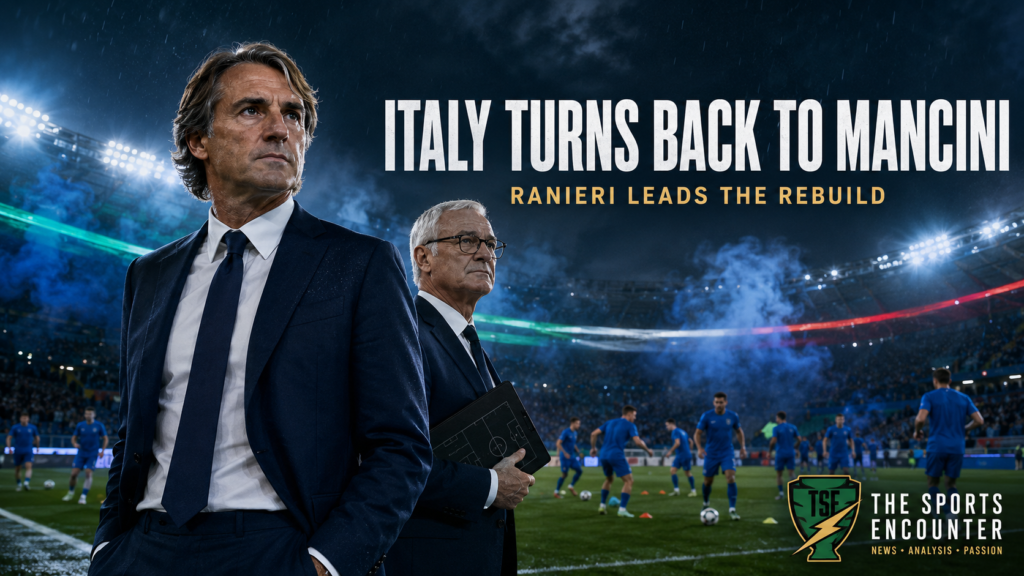
Italy have reunited with the coach who restored their pride at Euro 2020, while Claudio Ranieri takes control of the wider technical structure after a chaotic search exposed divisions inside the federation.
Roberto Mancini has returned as Italy head coach nearly three years after his unexpected departure, accepting one of the most difficult rebuilding assignments in international soccer.
Italian Football Federation President Giovanni Malagò confirmed Mancini’s appointment following Tuesday’s Federal Council meeting. Claudio Ranieri has joined the project as FIGC technical director and president of Club Italia, giving the former Leicester City manager oversight of technical operations and elite development across Italy’s national-team structure.
Mancini replaces Gennaro Gattuso, who left in April after Italy failed to qualify for the 2026 FIFA World Cup. The four-time world champions have now missed three consecutive editions of the tournament, extending an absence that began after their final group match at the 2014 World Cup.
The appointments provide Italy with two respected and highly experienced coaches. They also carry a clear tension. Mancini previously rebuilt the national team, won the European Championship and established a world-record unbeaten run. His first tenure still ended with Italy missing the 2022 World Cup and with his sudden resignation in August 2023.
Italy are therefore returning to a coach who represents both their greatest modern success and one of their most painful failures.
Mancini and Ranieri Appointments at a Glance
| Key detail | Information |
|---|---|
| Italy head coach | Roberto Mancini |
| Technical director | Claudio Ranieri |
| Additional Ranieri role | President of Club Italia |
| Outgoing coach | Gennaro Gattuso |
| Outgoing technical director | Paolo Maldini |
| Mancini’s first Italy tenure | 2018 to 2023 |
| Matches during first tenure | 58 |
| Major achievement | European Championship winner in 2021 |
| Record unbeaten run | 37 matches |
| Immediate challenge | Restore Italy after missing three consecutive World Cups |
Why Italy Returned to Roberto Mancini
Malagò described Mancini as the best person for the position, but the decision followed a coaching search that moved through several prominent candidates and generated another institutional crisis.
Pep Guardiola was reportedly Italy’s preferred option. The former Manchester City manager declined the opportunity, leaving the federation to explore alternatives.
Andrea Pirlo then became the leading candidate with the support of technical director Paolo Maldini and adviser Leonardo. His proposed appointment was blocked amid concerns surrounding his commercial relationship with a Russian betting company.
Maldini and Leonardo resigned shortly afterward, only 16 days after entering their federation roles. The full sequence intensified questions about authority, background checks and strategic control within the FIGC. The Sports Encounter previously examined how Maldini’s rapid departure exposed Italy’s deeper governance problems.
Mancini offered Malagò an experienced alternative who required little introduction to the national setup. He understands the federation, knows many of the available players and has already shown that he can restore confidence after a World Cup qualification failure.
His appointment also carries less coaching risk than the proposed move for Pirlo. The former Italy midfielder brought enormous symbolic value, but his managerial record remained relatively modest for a national team facing this level of pressure. Our earlier analysis of why Italy considered Pirlo after Guardiola’s refusal explored the attraction and uncertainty surrounding that plan.
Mancini Already Knows How to Revive a Wounded Italy
Mancini first became Italy coach in May 2018 after the country failed to reach the World Cup in Russia. The national team had lost confidence, supporters had become disconnected, and the squad appeared caught between generations.
He responded by changing both the mood and the style.
Italy moved away from the excessively cautious football that had shaped perceptions of the national team. Mancini encouraged pressing, short passing, positional movement and greater involvement from technical midfielders. The Azzurri began playing with freedom while retaining enough defensive intelligence to control difficult matches.
That transformation produced a 37-game unbeaten sequence consisting of 30 wins and seven draws. Italy scored 93 goals and conceded only 12 during the run, which became a men’s international record before Spain ended it in the 2021 UEFA Nations League semifinal.
The defining achievement came at the delayed Euro 2020 tournament. Italy defeated Turkey, Switzerland and Wales in the group stage before overcoming Austria, Belgium and Spain. Mancini’s side then beat England on penalties at Wembley to win the country’s first European Championship since 1968.
The victory temporarily restored Italy’s international authority. It also reconnected the current team with an older tradition of players who carried enormous national expectations, including the unforgettable figure explored in The Sports Encounter’s feature on Roberto Baggio and Italy’s emotional 1994 World Cup journey.
The Failure Mancini Cannot Escape
Italy’s European triumph makes Mancini’s return understandable. What happened afterward explains why the reunion cannot rely on nostalgia.
The Azzurri failed to qualify for the 2022 World Cup after losing to North Macedonia in a playoff semifinal. Italy dominated possession and produced a high volume of shots, yet lacked the efficiency and penalty-area authority needed to turn control into goals.
That failure exposed weaknesses concealed by the European Championship victory. Italy struggled to replace important players, several attackers failed to develop consistently, and the team lost the freshness that had defined its unbeaten run.
Mancini remained in charge and began another rebuilding process. His relationship with the federation later deteriorated, however, and he resigned in August 2023. He subsequently managed Saudi Arabia and returned to club football in Qatar.
Italy must now establish what has changed. If Mancini returns with the same ideas, the same personnel preferences and the same institutional frustrations, the federation may reproduce the conditions that ended his first tenure.
His second spell requires a sharper selection policy, a clearer attacking plan and closer coordination with Italy’s youth teams. The modern international game rewards countries that continually regenerate. Spain’s success with a new generation, illustrated by Lamine Yamal’s rise during the 2026 World Cup, shows the value of giving exceptional young players meaningful responsibility.
Ranieri Gives the Project More Than a Famous Name
Ranieri’s appointment may eventually prove as important as Mancini’s return.
The 74-year-old will serve as technical director and president of Club Italia, placing him above the day-to-day work of the senior national team. His responsibilities are expected to include technical coordination, elite development and greater alignment across Italy’s national sides.
Ranieri brings experience across several football cultures and competitive environments. His greatest achievement came in 2016, when he led Leicester City to one of the most unlikely Premier League titles in English soccer history.
That triumph was built on clear roles, tactical discipline, emotional intelligence and an ability to create trust within a squad that richer clubs had underestimated. Those qualities should help him evaluate Italy’s problems without becoming trapped by reputation or nostalgia.
His relationship with Mancini will still require clearly defined authority. Maldini’s departure showed how quickly a technical structure can collapse when the federation and its football leadership disagree over the head coach.
Ranieri must have genuine influence over development strategy and national-team coordination. Mancini, meanwhile, needs enough control to select and coach the senior side without feeling that changes are being imposed around him.
Malagò said he needed a technical director with whom he could share the decision on the coach. That statement suggests Ranieri entered the role with greater agreement over Mancini than Maldini had over Pirlo. The next test involves turning that personal alignment into a functioning governance model.
What Mancini Must Fix First
Find a dependable source of goals
Italy’s recurring attacking problems have outlived several coaches. The team can move the ball intelligently and control territory, but possession has too often ended without enough penalty-area presence.
Mancini must identify forwards who can complement one another rather than continually rotating players in search of an ideal solution. Wide attackers need clear responsibilities, while midfielders must contribute more runs and goals.
Build around the next generation
The squad needs renewal without discarding experienced players who can still contribute. Mancini gave young footballers opportunities during his first spell, and he must show the same courage again.
Selection should reward form, tactical suitability and development potential. Club reputation alone cannot determine who carries Italy into the next cycle.
Create a modern tactical identity
Italy cannot simply recreate the football of 2021. Opponents have evolved, player availability has changed, and international tournaments increasingly demand athletic range, pressing resistance and tactical flexibility.
Mancini needs a structure that can control weaker opponents without becoming vulnerable to transitions. He must also prepare Italy to manage momentum inside major matches. The dangers of losing control after taking the lead were evident in The Sports Encounter’s analysis of England’s tactical retreat against Argentina.
Italy’s Crisis Extends Beyond the Senior Team
No coach can repair Italian soccer alone.
Italy still produces intelligent players, accomplished coaches and tactically sophisticated clubs. Serie A remains internationally relevant. The national team, however, has struggled to turn those strengths into a stable supply of experienced Italian talent.
Young domestic players often face limited opportunities at leading clubs. Some spend crucial developmental years moving through loans or playing outside the highest level. Others arrive in the national squad without enough experience in Champions League matches, title races or high-pressure knockout football.
Ranieri’s technical role matters because those problems require coordination beyond international windows. Italy need stronger connections among youth national teams, club academies, coaching education and the senior side.
The 2026 World Cup provided another reminder that historic status offers no protection. Germany’s elimination, covered in our report on Paraguay’s World Cup upset over Germany, showed how quickly a traditional power can fall when execution and emotional control disappear.
Italy did not even reach that tournament. Supporters can revisit the competition’s major results, tactical stories and international trends through The Sports Encounter’s FIFA World Cup 2026 coverage.
Can Mancini and Ranieri Take Italy Forward?
The appointments solve the immediate vacancies, but they do not erase the disorder that preceded them.
Mancini knows how to restore belief, build relationships and give Italy a more ambitious playing identity. Ranieri brings calm judgment, immense experience and a reputation for improving teams through clarity rather than noise.
Their credentials give the new structure credibility. Their age and experience also mean Italy have chosen established authority instead of presenting the project as a radical generational reset.
That approach can work if Mancini remains open to tactical evolution and Ranieri creates a sustainable pathway beneath the senior team. It will fail if the federation expects two respected coaches to compensate for weak planning, limited development opportunities and unclear decision-making.
Mancini’s return is emotionally powerful because Italian supporters remember Wembley, the unbeaten run and a team that briefly made the country believe again. The harder memory involves North Macedonia, another missed World Cup and a resignation that arrived without a stable succession plan.
Italy are placing both versions of Mancini’s legacy back on the touchline.
Final Verdict
Roberto Mancini is a logical choice to lead Italy’s immediate recovery. He has already succeeded in this exact environment, understands the emotional demands of the position and owns a stronger international record than most available alternatives.
Claudio Ranieri gives the federation a respected technical leader capable of examining the wider structure. His appointment should provide Mancini with an experienced partner while creating greater continuity between the senior team and Italy’s development system.
The arrangement will be judged by more than early results. Italy need a recognizable style, productive young players, a more reliable attack and a development pathway that survives future coaching changes.
Mancini once helped Italy rise from the shock of missing a World Cup. His second attempt begins after the problem has grown much worse.
Official announcements, national-team information and technical updates are available through the official Italian Football Federation website.
For more international football news, coaching developments and tactical analysis, visit The Sports Encounter’s soccer coverage hub.