


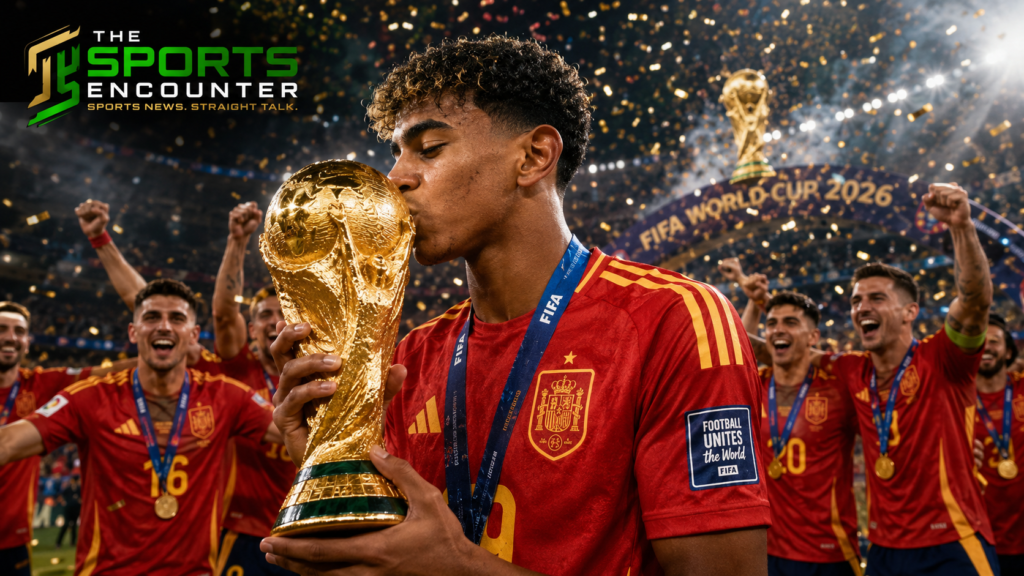
Lamine Yamal arrived at the FIFA World Cup 2026 as the most famous teenager in soccer. He left North America as a world champion, a symbol of modern Spain, and the young player who connected the tournament with a new generation of fans.
His campaign did not unfold through a simple collection of goals or a procession of spectacular individual performances. Spain asked Yamal to occupy defenders, create space, carry the ball through pressure, and provide the unpredictability that a possession-heavy team still needed.
At 19 years and six days, he became one of the youngest players ever to win the men’s World Cup. He also became the first teenager to appear in both a European Championship final and a FIFA World Cup final, having already helped Spain win Euro 2024 as a 17-year-old.
By the time Spain defeated Argentina 1-0 after extra time in the final, Yamal had completed a journey that stretched far beyond one tournament. The fearless boy who broke records at Barcelona had learned how to influence games when opponents designed entire defensive plans around stopping him.
Lamine Yamal at the FIFA World Cup 2026
- Age during the final: 19 years and six days
- Country: Spain
- Position: Right winger
- Tournament finish: FIFA World Cup champion
- World Cup appearance: Tournament debut
- Major role: Wide creator, dribbler, chance-maker, and attacking outlet
- Historic achievement: First teenager to play in both a European Championship final and a World Cup final
How Did Lamine Yamal Perform at the FIFA World Cup 2026?
Yamal scored once during Spain’s title run, but his value could not be reduced to his goal total.
He remained one of Spain’s primary sources of width and creativity from the right. Opposing left backs rarely defended him alone. Midfielders moved across to close the inside channel, while center backs prepared for the moment he cut toward goal on his stronger left foot.
That attention changed Spain’s attacking geometry.
When two defenders moved toward Yamal, teammates gained room elsewhere. Pedri and Dani Olmo could receive between the lines. Fullbacks found wider passing lanes. Mikel Oyarzabal, Ferran Torres, and Nico Williams benefited from defensive units leaning toward Spain’s right side.
Yamal’s influence appeared in passes that opened attacks, dribbles that forced fouls, and moments when a defender had to abandon his position to confront him. His tournament became a study in how an elite young player can affect matches even when the scoring numbers remain modest.
FIFA consistently included him among the leading candidates for the tournament’s Young Player Award, although the honor eventually went to his Spain teammate Pau Cubarsí. Yamal’s fellow teenager earned the award through outstanding defensive performances, while Yamal supplied much of Spain’s attacking imagination.
The World Cup Tested Yamal Differently
Yamal had already won major trophies before arriving in North America. He had become Spain’s youngest international and goalscorer, played a central role in the Euro 2024 triumph, and established himself as one of Barcelona’s most important players.
The World Cup brought a different level of attention.
Every match carried global scrutiny. Every quiet spell became a debate. Defenders understood his preferred movements, while coaches built compact structures to prevent him from receiving the ball near the penalty area.
Spain’s opening draw against Cape Verde provided an early warning. Yamal found limited room against a disciplined defensive block, and Spain struggled to turn possession into clear chances. The result became one of the tournament’s early surprises and forced Luis de la Fuente’s team to become more varied in attack.
Rather than chasing the game on his own, Yamal adapted. He released the ball earlier, combined more frequently with midfield runners, and learned when to hold his width instead of constantly moving inside.
That tactical growth mattered as Spain progressed through the competition. Their route included victories over Austria, Portugal, Belgium, France, and Argentina, opponents with very different defensive approaches.
Lamine Yamal’s Best World Cup 2026 Performances
Yamal’s attacking importance became clearer during the knockout rounds.
Against Austria in the Round of 32, his movement stretched a defense that struggled to contain Spain’s wide threats. Portugal then presented a more physical and experienced challenge, forcing the teenager to work through tighter spaces during Spain’s 1-0 victory.
The quarterfinal against Belgium offered another stage for his creativity. Belgium attempted to crowd central areas and break quickly through its own attacking talent, but Yamal continued to carry Spain forward from the right as the champions won 2-1.
His composure before the semifinal also revealed how comfortable he had become under the brightest lights. Yamal turned 19 on July 13, one day before facing France. Asked about pressure, he treated the occasion with the relaxed confidence of someone playing a familiar neighborhood game rather than a World Cup semifinal. He had already scored against France at ages 16 and 17, and he entered the match focused on another Spanish victory rather than personal recognition.
Spain won 2-0, controlling a French side led by Kylian Mbappé and Ousmane Dembélé. Rodri and Spain’s midfield dictated the match, but Yamal’s presence continued to influence where France placed its defensive protection.
That victory sent Spain into the FIFA World Cup 2026 final against Argentina, where Yamal faced the player who had shaped so much of his own football imagination.
Lamine Yamal vs Lionel Messi Became the Story of Generations
The final carried an irresistible narrative.
In 2007, a young Lionel Messi held six-month-old Yamal during a charity calendar photo shoot organized by Barcelona, UNICEF, and the Spanish newspaper Sport. Nearly two decades later, they met on opposite sides of a World Cup final.
The image returned throughout the tournament because it captured the passage of football time with remarkable clarity. Messi represented the most influential playing career of the modern era. Yamal stood as one of the clearest candidates to lead the sport’s next generation.
That storyline could easily have overwhelmed a teenager. Yamal handled it with maturity.
He spoke respectfully about Messi without treating the final as a ceremonial handover. Spain’s goal was to win, and Yamal played with the aggression of a competitor rather than the hesitation of an admirer.
During the final, he repeatedly attempted to isolate Argentina’s defenders and thought he had scored the opening goal before the effort was ruled out. Argentina contained him for long stretches, yet his movement kept their defensive line occupied while Spain maintained territorial control.
Ferran Torres eventually scored in the 106th minute, ending Argentina’s resistance and securing Spain’s second World Cup title.
After the match, Yamal approached Messi and embraced him. The moment carried respect rather than theatrical symbolism. One Barcelona generation had met another on the largest stage, and the younger player left with the trophy.
Why Lamine Yamal Inspired Young Soccer Fans
Yamal’s influence extended well beyond Spain’s tactical structure.
Young fans saw a 19-year-old playing decisive World Cup matches with visible joy. His game included the qualities that attract children to soccer in the first place: dribbling, invention, quick changes of direction, daring passes, and the willingness to challenge defenders.
His background added another layer to that appeal.
Yamal grew up in Rocafonda, a working-class and culturally diverse neighborhood near Barcelona. He represents that community with his “304” celebration, a reference to the final digits of the local postal code. Born to a Moroccan father and an Equatorial Guinean mother, he has spoken through his career and public image to a Spain shaped by migration, mixed identities, and neighborhood pride.
During the World Cup, residents of Rocafonda gathered around the story of a local child reaching the final against Messi. His success carried social meaning because he remained connected to the place that formed him.
For young players in Barcelona, Madrid, Casablanca, Malabo, Karachi, Lagos, New York, and countless other cities, Yamal made elite soccer appear closer. His journey showed that global fame does not require abandoning local identity.
His popularity across social media also helped the tournament reach audiences who experience soccer through clips, short videos, player-led content, and mobile-first storytelling. By the end of the World Cup, his Instagram audience had grown beyond 50 million followers, reflecting a global appeal that already stretched beyond traditional club loyalties.
Yamal Led a Remarkable Generation of Young Players
The FIFA World Cup 2026 featured several young players who looked ready to shape the next decade.
Pau Cubarsí won the Young Player Award after anchoring Spain’s defense. Désiré Doué impressed for France. Nico O’Reilly strengthened England’s midfield options, while Ayyoub Bouaddi emerged as another high-level prospect.
Yamal remained the most visible figure among them.
His fame, playing style, championship pedigree, and ability to connect with younger audiences gave him a different kind of influence. Cubarsí earned the official youth award, but Yamal became the tournament’s clearest generational symbol.
He was also central to a Spain side that blended teenage talent with experienced leaders such as Rodri. The balance allowed young players to express themselves within a disciplined structure rather than carrying the team alone.
That framework helps explain why Spain won. Yamal offered freedom and improvisation. Rodri supplied control. Cubarsí brought defensive composure, while the wider squad contributed goals from several positions.
How Old Was Lamine Yamal When Spain Won the World Cup?
Yamal was 19 years and six days old when Spain defeated Argentina in the final on July 19, 2026.
FIFA’s tournament statistics placed him among the youngest World Cup winners in history. Only a small group, including Pelé and Giuseppe Bergomi, lifted the trophy at a younger age.
The achievement became even more remarkable because Yamal was already a European champion. He had won Euro 2024 shortly after turning 17, then added the World Cup two years later.
Few players in soccer history have accumulated that level of international experience before their 20th birthday.
Did Lamine Yamal Win the World Cup Young Player Award?
No. Spain center back Pau Cubarsí received the FIFA World Cup 2026 Young Player Award.
That result did not diminish Yamal’s tournament. The two young Spaniards influenced different parts of the game, and Cubarsí’s defensive consistency helped Spain concede only one goal across eight matches.
Yamal’s contribution appeared through creativity, width, defensive attention, and attacking progression. He entered the tournament as a global star and left as a world champion who had learned to contribute even when opponents prevented him from dominating individually.
What the 2026 World Cup Changed for Lamine Yamal
Before the tournament, Yamal was already viewed as football’s leading young talent.
After it, he had become part of World Cup history.
The distinction matters. Club brilliance creates fame, while World Cups create memories shared across countries and generations. Yamal’s tournament now belongs to children who watched him challenge defenders, lift the trophy, embrace his younger brother on the field, and share a respectful moment with Messi after the final.
That family celebration softened the scale of the occasion. His three-year-old brother, Keyne, ran onto the field wearing Yamal’s shirt and became one of the tournament’s most widely shared post-final images. The scene reminded millions of viewers that the new world champion was still a young man surrounded by family.
Yamal did not need to win the Golden Ball, Golden Boot, or Young Player Award to define the youth story of the World Cup.
His broader achievement was making elite football feel adventurous again. Every touch carried possibility. Every one-on-one duel invited anticipation. Young fans watched him play and saw someone close enough to their own age to make ambition feel immediate.
Frequently Asked Questions
How many goals did Lamine Yamal score at the FIFA World Cup 2026?
Yamal scored once during Spain’s championship campaign, while contributing through chance creation, dribbling, width, and attacking combinations.
Did Lamine Yamal play in the 2026 World Cup final?
Yes. Yamal started for Spain against Argentina and became the first teenager to appear in both a European Championship final and a World Cup final.
How old was Lamine Yamal in the World Cup final?
He was 19 years and six days old when Spain won the final on July 19, 2026.
Did Lamine Yamal win the Best Young Player award?
No. His Spain teammate Pau Cubarsí won the FIFA Young Player Award.
Is Lamine Yamal the youngest World Cup winner?
No. Pelé remains the youngest men’s World Cup winner. Yamal nevertheless became one of the youngest players ever to lift the trophy.
Why is Lamine Yamal so popular with young soccer fans?
His expressive playing style, age, multicultural background, neighborhood identity, social media presence, and success at Barcelona and with Spain make him highly relatable to younger audiences worldwide.
A World Champion Before His 20th Birthday
The FIFA World Cup 2026 did not represent Yamal’s arrival. That had already happened at Barcelona and Euro 2024.
It marked his maturation.
He learned to influence matches when space disappeared, remained composed under global pressure, helped Spain navigate the knockout rounds, and started a World Cup final against his childhood idol.
By the end, Yamal stood with a winner’s medal, a trophy, and a place inside the next chapter of soccer history.
The generation inspired by Messi now has a champion of its own age to follow.
The Sports Encounter’s World Cup 2026 coverage focuses on fixtures, team news, match analysis, fan stories, tournament trends, and the biggest talking points from football’s global stage.