


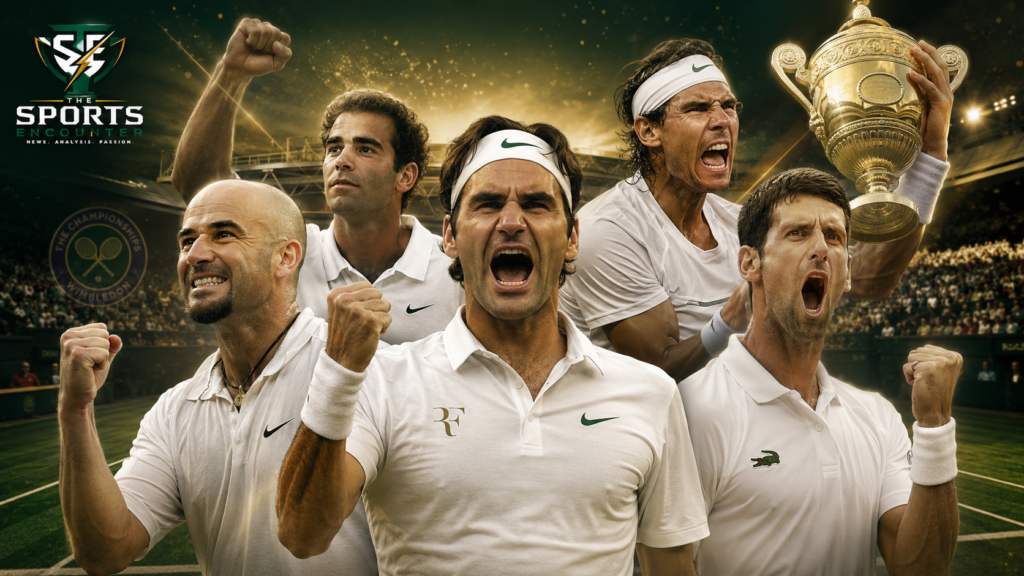
Wimbledon has crowned champions since Spencer Gore won the inaugural gentlemen’s singles tournament in 1877. Across nearly 150 years, the championship has moved from wooden rackets, challenge rounds, and amateur-only competition to today’s global professional game.
This guide covers every unique Wimbledon men’s singles champion through Jannik Sinner’s successful 2026 title defense. Rather than repeating players for every year they won, it gives each champion two concise sections: how he captured Wimbledon and what the victory meant for his wider career.
ALSO READ: Guo Hanyu and Kristina Mladenovic Turn Trust Into Wimbledon 2026 Glory
Wimbledon used the challenge-round system until 1921, allowing the reigning champion to advance directly to the following year’s final. The modern all-comers format began in 1922, while professionals gained admission when the Open Era started in 1968. The Gentlemen’s Singles Trophy currently presented on Centre Court dates to 1887.
Wimbledon Men’s Singles Champions at a Glance
| Record | Player |
|---|---|
| Most Wimbledon men’s singles titles | Roger Federer, 8 |
| Most consecutive titles | William Renshaw, 6 |
| Most Open Era titles after Federer | Pete Sampras and Novak Djokovic, 7 |
| First champion | Spencer Gore, 1877 |
| First Open Era champion | Rod Laver, 1968 |
| First unseeded Open Era champion | Boris Becker, 1985 |
| First wild-card champion | Goran Ivanisevic, 2001 |
| First Italian men’s champion | Jannik Sinner, 2025 |
| Latest champion | Jannik Sinner, 2026 |
The Modern Champions: 2000 to 2026
Jannik Sinner
Sinner won his first Wimbledon title in 2025 by recovering from a set down to defeat Carlos Alcaraz 4-6, 6-4, 6-4, 6-4. He returned in 2026 and survived an opening-round five-set scare before beating Novak Djokovic in straight sets in the semifinal and Alexander Zverev 6-7(7), 7-6(2), 6-3, 6-4 in the final. The second victory made him the 10th man to defend the Wimbledon title in the Open Era.
The two titles established Sinner as far more than a hard-court specialist. His 2026 triumph gave him a fifth major championship and his 100th Grand Slam match win. Becoming Italy’s first Wimbledon men’s singles champion, then repeating the achievement one year later, strengthened his standing as the leading player of his generation and the central figure in modern men’s tennis.
Carlos Alcaraz
Alcaraz won his first Wimbledon title in 2023 by recovering from a disastrous opening set against Djokovic and prevailing 1-6, 7-6(6), 6-1, 3-6, 6-4. He defended the championship in 2024 with a far more authoritative performance, beating Djokovic 6-2, 6-2, 7-6(4).
Those victories proved that Alcaraz’s explosive movement and improvisational tennis could succeed on grass as effectively as on clay and hard courts. The 2023 final carried particular historical weight because he defeated a seven-time champion who had not lost a completed Wimbledon match since 2016. Alcaraz’s back-to-back titles confirmed him as a generational champion rather than a young player enjoying an early surge.
Novak Djokovic
Djokovic won Wimbledon seven times, beginning in 2011 when he defeated Rafael Nadal in four sets. His later titles included victories over Roger Federer in 2014, 2015, and the unforgettable 2019 final, when he saved two championship points and won the first deciding-set tiebreak used in a Wimbledon singles final.
Wimbledon became one of the foundations of Djokovic’s claim as the most accomplished men’s player in Grand Slam history. His movement, return of serve, balance, and ability to defend on grass changed assumptions about how the surface had to be played. The seven titles also placed him alongside Pete Sampras and one behind Federer’s men’s record.
Roger Federer
Federer won his first Wimbledon title in 2003 by defeating Mark Philippoussis in straight sets. He then captured five consecutive championships through 2007, added emotionally significant victories in 2009 and 2012, and won a record eighth title in 2017 without dropping a set.
Wimbledon became inseparable from Federer’s identity. His fluid movement, attacking instincts, disguised serve, and ability to take the ball early appeared perfectly designed for Centre Court. The 2003 victory began his transformation into a global sporting icon, while the 2017 title, won at age 35, extended his career narrative from early genius to enduring greatness.
ALSO READ: Jannik Sinner’s Wimbledon Defense Against Novak Djokovic and Alexander Zverev
Andy Murray
Murray defeated Djokovic 6-4, 7-5, 6-4 in 2013 to become the first British man to win the Wimbledon singles title since Fred Perry in 1936. He won again in 2016, overcoming Milos Raonic in straight sets after surviving several demanding matches earlier in the tournament.
The first triumph lifted one of the heaviest burdens carried by any British athlete. Murray had already won the 2012 US Open and Olympic gold, but Wimbledon changed his public standing at home and completed his rise into the elite group challenging Federer, Nadal, and Djokovic. His second title reinforced that the first was a career-defining achievement built on sustained excellence.
Rafael Nadal
Nadal produced one of Wimbledon’s greatest victories in 2008, defeating Federer 9-7 in the fifth set after four hours and 48 minutes of changing momentum, rain delays, and fading light. He claimed the championship again in 2010 with a straight-sets win over Tomas Berdych.
The 2008 title expanded Nadal’s career beyond his early image as a clay-court phenomenon. Beating Federer on the surface where the Swiss had won five consecutive championships demonstrated the reach of Nadal’s athleticism, competitive force, and tactical adaptability. His second title confirmed that the first had come from a genuine command of grass rather than one extraordinary afternoon.
Lleyton Hewitt
Hewitt defeated David Nalbandian 6-1, 6-3, 6-2 in the 2002 final. His return game, speed, passing shots, and constant pressure overwhelmed an opponent playing his first major championship match.
The title gave Hewitt his second Grand Slam crown after the 2001 US Open and strengthened his position as the world’s leading player before Federer’s ascent. He also became the last men’s champion before the long period of dominance associated with Federer, Nadal, Djokovic, and Murray.
Goran Ivanisevic
Ivanisevic entered Wimbledon in 2001 as a wild card after injuries and declining form had pushed his ranking outside the normal entry range. After three previous final defeats, he beat Pat Rafter 9-7 in the fifth set on an emotional Monday final staged before a loud, unconventional Centre Court crowd.
The championship transformed Ivanisevic’s career story. Without it, he might have been remembered as one of the greatest servers never to win a major. The victory completed his sporting redemption and made him the first men’s wild-card champion in Wimbledon history, a distinction officially recognized by the tournament.
Pete Sampras
Sampras won seven Wimbledon titles between 1993 and 2000. His first came against Jim Courier, while his final championship required a comeback against Pat Rafter in a match that finished in fading evening light.
The grass amplified every defining feature of Sampras’s game: his serve, athletic overhead, first volley, and calm under pressure. Wimbledon became the center of his legacy, and his seventh title gave him what was then the men’s record of 13 Grand Slam championships. Federer later surpassed his Wimbledon record, but Sampras remains one of the tournament’s most dominant champions.
The Champions of the 1980s and 1990s
Richard Krajicek
Krajicek won the 1996 title by defeating Mal Washington 6-3, 6-4, 6-3. His defining performance came earlier, when he ended Sampras’s 25-match Wimbledon winning streak in the quarterfinals.
The championship remained Krajicek’s only major title and the greatest achievement of his career. It showed how destructive his serve-and-volley game could become on fast grass and made him the first Dutchman to win a Grand Slam singles championship.
Andre Agassi
Agassi defeated Ivanisevic in a five-set 1992 final, winning 6-4 in the deciding set. His return of serve and baseline precision allowed him to succeed against one of the most dangerous servers of the era despite widespread doubts about whether his game suited grass.
Wimbledon was Agassi’s first Grand Slam title. It changed the trajectory of a career already shaped by celebrity, expectation, and near misses. The victory gave substance to his fame and began a major-winning journey that eventually produced the career Grand Slam.
Michael Stich
Stich defeated Boris Becker 6-4, 7-6(4), 6-4 in the 1991 final after eliminating defending champion Stefan Edberg in a semifinal decided without Edberg losing serve. Stich then played composed, varied tennis to defeat his more celebrated German compatriot.
The title became the defining achievement of Stich’s career and established him as more than a gifted player living in Becker’s shadow. He later reached major finals in Paris and New York, but Wimbledon remained the clearest expression of his elegant, all-court talent.
Boris Becker
Becker won Wimbledon in 1985 at age 17, defeating Kevin Curren in four sets. He became the youngest men’s champion of the Open Era and the first unseeded player to win the title. He defended it in 1986 and reclaimed the trophy in 1989 with a straight-sets victory over Edberg.
The championships turned Becker into a global star almost overnight. His diving volleys, explosive serve, and emotional presence made him one of Centre Court’s defining figures. Three titles and seven final appearances ensured Wimbledon remained the tournament most closely connected to his career.
Stefan Edberg
Edberg defeated Becker in the 1988 final and again in a five-set 1990 championship match. The latter required him to recover after Becker erased a two-set deficit and threatened to complete the comeback.
Wimbledon rewarded the purity of Edberg’s serve-and-volley game. His movement into the net, backhand volley, and calm demeanor made him one of the finest grass-court players of his era. The two titles became central to a six-major career and his rise to world No. 1.
Pat Cash
Cash defeated Ivan Lendl 7-6(5), 6-2, 7-5 in the 1987 final. After championship point, he climbed into the stands to celebrate with his family and team, creating one of Wimbledon’s most memorable traditions.
The title was Cash’s only Grand Slam singles championship and the high point of a career repeatedly disrupted by injuries. His aggressive net play and fearless athleticism found their ideal stage on grass, while the climb into the players’ box became part of modern Wimbledon culture.
John McEnroe
McEnroe lost the historic 1980 final to Bjorn Borg despite winning an 18-16 fourth-set tiebreak. He returned in 1981 and ended Borg’s reign, then added titles in 1983 and 1984. His 1984 demolition of Jimmy Connors, 6-1, 6-1, 6-2, remains one of the finest men’s final performances.
The three titles captured McEnroe at the height of his creative and competitive powers. His left-handed serve, reflex volleys, touch, and court awareness made him almost impossible to pass when fully engaged. Wimbledon also became the setting for both his greatest tennis and many of the emotional confrontations that defined his public image.
Jimmy Connors
Connors won Wimbledon in 1974 by crushing Ken Rosewall 6-1, 6-1, 6-4. Eight years later, he defeated McEnroe in five sets to win a second title in one of the finest late-career victories of the period.
The gap between his championships told the story of Connors’s longevity. His first title formed part of a dominant three-major season, while the 1982 victory re-established him after younger rivals had appeared to move beyond him. Wimbledon showcased his flat groundstrokes, fierce return game, and refusal to surrender relevance.
Bjorn Borg
Borg won five consecutive Wimbledon titles from 1976 through 1980. He defeated Ilie Nastase without losing a set for the first, survived five sets against Connors in 1977, and beat McEnroe 8-6 in the fifth set of the 1980 final after losing the famous fourth-set tiebreak.
Those victories transformed conventional ideas about grass-court tennis. Borg stayed back more often than traditional champions, using heavy topspin, speed, and extraordinary concentration. His ability to dominate both Roland Garros and Wimbledon made him the first modern symbol of complete surface versatility.
ALSO READ: Ostapenko and Arevalo Win Wimbledon 2026 Mixed Doubles Title
The First Open Era Champions
Arthur Ashe
Ashe defeated heavily favored defending champion Connors 6-1, 6-1, 5-7, 6-4 in 1975. He used changes of pace, sliced approaches, and intelligent placement to prevent Connors from settling into the hard, repetitive exchanges he preferred.
The victory gave Ashe his third major singles title and made him the first Black man to win Wimbledon. It remains one of the most tactically admired final performances in tournament history. The title also expanded the cultural reach of a player whose influence later extended far beyond competition.
Jan Kodes
Kodes defeated Alex Metreveli in the 1973 final during a championship affected by a major player boycott. He handled the unusual circumstances and won in straight sets, adding Wimbledon to his two French Open titles.
The depleted field has often complicated perceptions of the victory, but Kodes still had to navigate the draw and perform under pressure. Wimbledon completed a three-major career and gave the Czech player a grass-court achievement that broadened his legacy beyond clay.
Stan Smith
Smith defeated Nastase 7-5 in the fifth set of the 1972 final. The match featured two contrasting personalities, with Smith relying on his serve, composure, and direct attacking game to survive a shifting contest.
The title followed his 1971 US Open victory and confirmed him as one of the leading players of the early 1970s. Wimbledon also gave lasting competitive meaning to a name that later became globally familiar through footwear and fashion.
John Newcombe
Newcombe won in 1967 before the Open Era and added championships in 1970 and 1971. Both Open Era victories came through five-set finals, first against Rosewall and then against Smith.
His three titles established Newcombe as one of Australia’s great grass-court champions. A powerful serve, strong forehand, athletic net game, and competitive confidence carried him to seven major singles titles overall. Wimbledon remained the venue where his classic attacking style looked most natural.
Rod Laver
Laver won Wimbledon in 1961 and 1962 as an amateur, then returned after professionals were readmitted and captured the 1968 and 1969 titles. His 1969 victory over Newcombe formed part of his second calendar-year Grand Slam.
The Wimbledon championships connect every major phase of Laver’s career. He won before professional exclusion, endured years when he could not enter, and returned to dominate the Open Era. That span strengthened his standing as one of the most complete players tennis has produced.
The Great Amateur-Era Champions
Manuel Santana
Santana defeated Dennis Ralston 6-4, 11-9, 6-4 in the 1966 final. The Spaniard adjusted a game developed largely on clay, using intelligent placement and a willingness to move forward.
The victory made Santana the first Spanish man to win Wimbledon. It also completed a career that included championships in Paris and New York, proving his success could travel across surfaces during an era when grass dominated much of the international calendar.
Roy Emerson
Emerson defeated Fred Stolle in consecutive Wimbledon finals in 1964 and 1965. His fitness, return game, efficient volleying, and relentless competitive intensity helped him control two all-Australian championship matches.
The titles formed part of Emerson’s 12-major singles record, which stood for decades. Although many leading professionals were excluded during the amateur era, his durability and consistent winning across all four majors remain major components of Australian tennis history.
Chuck McKinley
McKinley defeated Stolle 9-7, 6-1, 6-4 in the 1963 final. His fast, aggressive style and constant movement toward the net disrupted the taller Australian.
Wimbledon became McKinley’s only major singles title and the peak of his career. The victory also confirmed the United States as a continuing force during a period increasingly dominated by Australian men.
Neale Fraser
Fraser defeated Laver 6-4, 3-6, 9-7, 7-5 in the 1960 final. His left-handed serve and net coverage helped him win the critical points against a younger opponent who would soon dominate world tennis.
The title completed an exceptional major season and added Wimbledon to Fraser’s US Championships success. It also gave him a prominent place within the deep generation of Australian champions who controlled the sport around the turn of the 1960s.
Alex Olmedo
Peruvian-born Olmedo, representing the United States, defeated Laver in straight sets in the 1959 final. His attacking play and confidence prevented the young Australian from settling into the match.
Wimbledon followed Olmedo’s Australian Championships victory and formed the centerpiece of his brief but brilliant period at the top. His achievements also gave Latin American tennis an important early connection to major championship success.
Ashley Cooper
Cooper recovered from losing the opening set to defeat Fraser 3-6, 6-3, 6-4, 13-11 in 1958. The long final set tested the serve-and-volley precision and endurance of both Australians.
The title came during a season in which Cooper won three of the four major championships. Wimbledon therefore helped define one of the great amateur campaigns, although his professional move soon removed him from Grand Slam competition.
Lew Hoad
Hoad defeated Rosewall in 1956 and Cooper in 1957 to win consecutive Wimbledon titles. The first completed the third leg of what appeared to be a possible calendar Grand Slam before Hoad lost the US final.
The championships captured Hoad’s immense natural power and athletic freedom. Many contemporaries considered his peak level among the highest they had seen. Wimbledon gave permanent weight to that reputation before his professional career became increasingly affected by back problems.
Tony Trabert
Trabert defeated Kurt Nielsen 6-3, 7-5, 6-1 in the 1955 final. His controlled aggression and physical strength gave him command of the rallies and denied Nielsen a second-set route back into the contest.
The victory formed part of a remarkable season in which Trabert won three major singles titles. Wimbledon strengthened his standing as the world’s leading amateur before he turned professional and left the Grand Slam stage.
Jaroslav Drobny
Drobny defeated Rosewall 13-11, 4-6, 6-2, 9-7 in 1954 after losing two previous Wimbledon finals. The Egyptian representative, born in Czechoslovakia, finally broke through at age 32.
The championship became the emotional culmination of his long tennis journey. Drobny had already won two French titles, but Wimbledon gave his career a victory built on perseverance, political displacement, and repeated attempts at the same elusive prize.
Vic Seixas
Seixas defeated Nielsen 9-7, 6-3, 6-4 in 1953. He handled the pressure of a tight opening set and then used his athletic net play to take control.
Wimbledon became his first major singles championship, followed by the US title in 1954. The victory established Seixas as the leading American player of the period and helped sustain US prominence as Australian depth continued to grow.
Frank Sedgman
Sedgman recovered from losing the opening set to beat Drobny in the 1952 final. His speed, serve-and-volley timing, and ability to dominate the front of the court steadily changed the match.
The championship came during the final phase of an extraordinary amateur career before Sedgman turned professional. It formed part of a five-major singles résumé and strengthened his reputation as one of Australia’s first postwar global stars.
Dick Savitt
Savitt defeated Ken McGregor 6-4, 6-4, 6-4 in 1951. His heavy serve and forceful groundstrokes gave him control throughout a final between two players seeking a first Wimbledon crown.
The victory followed Savitt’s Australian Championships title earlier that year. His elite career was relatively short, making Wimbledon an especially important part of his legacy and one of the great early achievements by a Jewish American athlete.
Budge Patty
Patty beat Sedgman 6-1, 8-10, 6-2, 6-3 in 1950. After losing the long second set, he recovered his composure and used touch, movement, and tactical variety to regain control.
The title completed a rare Roland Garros-Wimbledon double in the same season. It became the defining achievement of a cosmopolitan career largely built in Europe and placed Patty among the most accomplished American players of the postwar period.
Ted Schroeder
Schroeder defeated Drobny in a five-set 1949 final, recovering from setbacks in the first and fourth sets. His serve and willingness to attack under pressure proved decisive late in the match.
The championship gave Schroeder a second major singles title after the US Championships. His selective international schedule meant he did not build the volume of results associated with some contemporaries, but Wimbledon secured his historical standing.
Bob Falkenburg
Falkenburg defeated John Bromwich 7-5 in the fifth set of the 1948 final after trailing badly and saving championship points. His aggressive serving and attacking instincts allowed him to escape a match that appeared lost.
The title remained his only major singles championship. Its dramatic nature ensured Falkenburg retained a distinct place in Wimbledon history, even as his later life became better known for successful business ventures in Brazil.
Jack Kramer
Kramer overwhelmed Tom Brown 6-1, 6-3, 6-2 in the 1947 final. His serve, forehand, and systematic approach to attacking tennis made the match one-sided.
The victory completed his dominance of the amateur game before he joined the professional circuit. Kramer later shaped tennis as a promoter, tour organizer, and influential thinker, but Wimbledon represented the clearest championship display of his playing philosophy.
Yvon Petra
Petra defeated Geoff Brown in five sets in 1946, the first Wimbledon held after World War II. He recovered after losing the third and fourth sets to win 6-4 in the fifth.
The Frenchman’s title carried historic resonance because Petra had survived wartime imprisonment and returned to competition. Wimbledon became his only major singles championship and a symbol of both personal endurance and the tournament’s postwar revival.
The Interwar Champions
Bobby Riggs
Riggs defeated Elwood Cooke in five sets in 1939 after trailing by two sets to one. His tactical intelligence, anticipation, and control proved more important than physical power.
The Wimbledon title formed part of a remarkable tournament in which Riggs won singles, men’s doubles, and mixed doubles. It established him as one of the era’s leading players decades before his role in the 1973 “Battle of the Sexes” shaped his wider public identity.
Don Budge
Budge defeated Gottfried von Cramm in 1937 and Bunny Austin in 1938. His second final was a 6-1, 6-0, 6-3 demonstration during the season when he became the first player to complete the calendar Grand Slam.
The titles showcased a revolutionary backhand and a game without an obvious weakness. Wimbledon became central to Budge’s claim as the dominant player of his era and one of the earliest men considered in all-time-great discussions.
Fred Perry
Perry won three consecutive Wimbledon titles from 1934 through 1936. His final victory, a 6-1, 6-1, 6-0 defeat of von Cramm, was one of the most emphatic championship performances.
The titles made Perry Britain’s defining men’s champion for generations. His 1936 win remained the country’s last in men’s singles until Murray succeeded in 2013. Perry’s career later gained broader cultural influence through the fashion brand carrying his name.
Jack Crawford
Crawford defeated Ellsworth Vines in five sets in 1933. The victory followed championships in Australia and France, leaving him one US title away from completing what journalists began calling a Grand Slam.
Although he narrowly missed that clean sweep, Wimbledon strengthened Crawford’s standing as the outstanding player of 1933. His smooth strokes and all-court control placed him among Australia’s earliest international tennis greats.
Ellsworth Vines
Vines defeated Bunny Austin 6-2, 6-2, 6-0 in the 1932 final. His explosive serve and powerful groundstrokes overwhelmed the British challenger.
The title confirmed Vines as one of the sport’s most naturally gifted attacking players. He later became a major professional star and an accomplished golfer, but Wimbledon preserved the clearest record of his amateur peak.
Sidney Wood
Wood became champion in 1931 when Frank Shields withdrew before the final because of injury. The walkover remains the only one in a Wimbledon men’s singles championship match.
The unusual ending sometimes overshadows Wood’s achievement in reaching the final without losing a set. At 19, he became one of the youngest champions in tournament history, and Wimbledon remained the defining result of his career.
Bill Tilden
Tilden won Wimbledon in 1920, 1921, and 1930. His final title came at age 37, when he defeated Wilmer Allison in straight sets and became the oldest men’s singles champion of the modern all-comers period.
The championships extended Tilden’s influence beyond his dominance in the United States. His tactical sophistication, serving variation, and commanding personality helped turn tennis into a larger international spectacle. His later life and criminal convictions severely complicated his legacy, but his competitive impact remains historically significant.
Henri Cochet
Cochet won in 1927 and 1929. His first title came through a two-set comeback against Jean Borotra, 4-6, 4-6, 6-3, 6-4, 7-5.
The victories formed part of the French “Four Musketeers” era that controlled Wimbledon from 1924 through 1929. Cochet’s ability to improvise, defend, and turn losing positions into victories made him one of the defining players of that celebrated generation.
Rene Lacoste
Lacoste defeated Borotra in 1925 and Cochet in 1928. His methodical baseline game, concentration, and ability to identify opponents’ patterns contrasted with the more flamboyant styles around him.
The titles helped build a seven-major career and reinforced the dominance of French tennis during the 1920s. Lacoste’s influence later expanded through racket innovation and the clothing company represented by the crocodile emblem.
Jean Borotra
Borotra won Wimbledon in 1924 and 1926. His first championship required a five-set victory over Lacoste, while his second came in straight sets against Howard Kinsey.
Known as the “Bounding Basque,” Borotra brought energy, athletic net play, and theatrical appeal to the court. His two titles formed part of the Musketeers’ golden period and helped popularize French tennis internationally.
Bill Johnston
Johnston defeated Frank Hunter 6-0, 6-3, 6-1 in 1923. His forehand, often considered one of the finest of the period, controlled the match from the beginning.
Wimbledon added an international championship to a career already distinguished by repeated US success. The title strengthened Johnston’s place alongside Tilden as one of America’s outstanding players of the early 1920s.
Gerald Patterson
Patterson won Wimbledon in 1919 and 1922. The first came through an all-Australian victory over Norman Brookes, while the second followed the abolition of the challenge round.
His huge serve earned him the nickname “The Human Catapult.” The championships established Patterson as one of the leading power players of his period and extended Australia’s early influence at Wimbledon.
The Challenge-Round Champions
Norman Brookes
Brookes became the first overseas man to win Wimbledon when he defeated Arthur Gore in 1907. He captured a second title in 1914 by beating Anthony Wilding, another champion from the Australasian tennis tradition.
The victories broke Britain’s early control of the tournament and announced the global expansion of elite tennis. Brookes later became a major administrator, and the Australian Open men’s trophy now carries his name.
Anthony Wilding
Wilding won four consecutive Wimbledon titles from 1910 through 1913. His athleticism, fitness, heavy forehand, and ability to compete successfully on different surfaces made him the dominant player of the period immediately before World War I.
The championships created the foundation of his sporting fame and made the New Zealander one of tennis’s first international celebrities. Wilding died during military service in 1915, giving his achievements a lasting association with a brilliant career and life cut short.
Arthur Gore
Gore won Wimbledon in 1901, 1908, and 1909. His 1909 victory required a five-set comeback after he lost the first two sets to Major Ritchie.
His final championship came at age 41, making him the oldest men’s singles winner in Wimbledon history. The three titles reflected extraordinary longevity during the challenge-round era and established him as one of Britain’s most enduring early champions.
Laurence Doherty
Laurence Doherty won five consecutive singles titles from 1902 through 1906. He defeated players including Gore, Frank Riseley, and Brookes while combining precise placement with exceptional movement.
The run made him one of the first great sustained champions after the Renshaw era. Together with his brother Reginald, he also dominated doubles, helping turn the Doherty name into a central part of early Wimbledon history.
Reginald Doherty
Reginald Doherty won four consecutive Wimbledon singles titles from 1897 through 1900. His victories included a five-set comeback against Gore in 1899.
The championships established him as the leading player of the late 1890s. His doubles partnership with Laurence further expanded his record and made the brothers one of tennis’s earliest sporting dynasties.
Harold Mahony
Mahony defeated Wilfred Baddeley in a five-set final in 1896. He recovered after falling behind by two sets to one and won the deciding set 6-3.
The victory was the greatest singles achievement of his career and made him the only Irish-born man to win Wimbledon singles. His title preserved an important Irish presence within the tournament’s predominantly British early history.
Wilfred Baddeley
Baddeley won Wimbledon in 1891, 1892, and 1895. His final triumph required one of the tournament’s early great comebacks, as he recovered from two sets down against Wilberforce Eaves.
The championships made Baddeley the leading player of the early 1890s. Together with twin brother Herbert, he also achieved major doubles success, continuing the tradition of family partnerships established by the Renshaws.
Joshua Pim
Pim won consecutive titles in 1893 and 1894, defeating Baddeley on both occasions. His aggressive style and precise volleying helped him reverse earlier losses against his chief rival.
The championships made the Irish player one of the dominant figures of the decade. His success in singles and doubles placed him among the most accomplished competitors of the challenge-round period.
Willoughby Hamilton
Hamilton defeated six-time defending champion William Renshaw in the 1890 all-comers event before beating him again in the challenge round. He recovered from two sets to one down to take the final 6-1 in the fifth.
The victory ended Renshaw’s extended hold over Wimbledon and became Hamilton’s defining result. Illness later limited his career, making the championship an especially important record of his ability at full strength.
William Renshaw
Renshaw won seven Wimbledon singles titles, including six consecutive championships from 1881 through 1886 and another in 1889. His dominance was aided by the challenge-round system, but his attacking play, powerful serving, and success over changing opponents separated him from his contemporaries.
Wimbledon credits Renshaw as a foundational figure in the growth of lawn tennis. His winning streak generated public interest, expanded attendance, and helped move the sport beyond a small social pastime. His seven-title record stood alone for more than a century before Sampras and later Federer matched or surpassed it.
Ernest Renshaw
Ernest defeated Herbert Lawford 6-3, 7-5, 6-0 to win the 1888 title. He had previously lost championship matches to twin brother William in 1882 and 1883.
The victory gave Ernest an individual place in history beyond the brothers’ celebrated doubles partnership. Although William collected more singles championships, Ernest’s title ensured both twins became Wimbledon champions.
Herbert Lawford
Lawford defeated Ernest Renshaw in five sets in 1887 after losing several earlier finals. His heavy forehand, played with significant topspin for the period, gave him a distinctive attacking weapon.
The championship rewarded years of persistence against the Renshaw brothers. Lawford’s forehand technique also made him an important figure in the tactical development of early lawn tennis.
John Hartley
Hartley won Wimbledon in 1879 and 1880. He defeated Vere St. Leger Goold in straight sets for his first title and then overcame Lawford in four sets to retain it.
The clergyman became the first player to win consecutive Wimbledon singles championships. His reign ended when William Renshaw defeated him decisively in 1881, but his two titles established the tournament’s first successful defense.
Frank Hadow
Hadow defeated inaugural champion Spencer Gore 7-5, 6-1, 9-7 in 1878. He used the lob effectively against Gore’s frequent net attacks, helping popularize a shot that became fundamental to tennis strategy.
Hadow never returned to defend his title, making him one of Wimbledon’s most unusual champions. His sole appearance still influenced the tactical evolution of the sport and gave him a permanent place in its earliest history.
Spencer Gore
Gore won the first Wimbledon tournament in 1877, defeating William Marshall 6-1, 6-2, 6-4. The competition featured 22 entrants and was staged at the All England Croquet and Lawn Tennis Club.
The victory made Gore the first champion of what became the world’s most famous tennis tournament. He reportedly doubted that lawn tennis would develop into a major sport, but his place at the beginning of Wimbledon history remains secure.
What Wimbledon Victory Has Meant Across Tennis History
The meaning of becoming Wimbledon champion has changed with the sport. Early winners competed within a largely British amateur culture. Later champions represented the growth of Australian, American, French, German, Spanish, Serbian, Italian, and other tennis traditions.
Yet the career impact has remained remarkably consistent. For some players, including Federer, Sampras, Djokovic, Borg, and Renshaw, Wimbledon became the centerpiece of sustained dominance. For Ivanisevic, Cash, Krajicek, Stich, and several early champions, one victory reshaped an entire career narrative.
The surface has changed too. Grass became firmer, equipment became more powerful, movement improved, and baseline play became increasingly important. Champions adapted. Serve-and-volley players once controlled Centre Court, but modern winners have shown that aggressive baseline tennis, elite returning, and complete defensive movement can also dominate Wimbledon.
The official tournament history reflects each stage of that evolution, from the challenge round and the emergence of overseas champions to the Open Era and the global spectacle Wimbledon has become.
Final Perspective
Every Wimbledon champion won the same tournament, but each title answered a different career question.
Could Nadal conquer grass? Could Murray carry British expectation? Could Ivanisevic recover from three final defeats? Could Federer return late in his career? Could Sinner defend the crown after arriving with doubts?
The answers arrived on Centre Court.
Some champions built dynasties. Others experienced one perfect fortnight. All joined a lineage stretching from Gore in 1877 to Sinner in 2026, connected by a trophy, a grass court, and one of the hardest achievements in sport.
FAQs
Who has won the most Wimbledon men’s singles titles?
Roger Federer holds the men’s record with eight titles, won between 2003 and 2017.
Who won Wimbledon six consecutive times?
William Renshaw won six straight championships from 1881 through 1886 under the challenge-round system.
Who has won seven Wimbledon men’s titles?
William Renshaw, Pete Sampras, and Novak Djokovic have each won seven. Renshaw competed during the amateur challenge-round era, while Sampras and Djokovic won in the Open Era.
Who was the first Wimbledon men’s champion?
Spencer Gore won the inaugural tournament in 1877.
Who was the first overseas Wimbledon champion?
Australian Norman Brookes became the first non-British men’s singles champion in 1907.
Who was the first Open Era Wimbledon men’s champion?
Rod Laver won the first Open Era edition in 1968.
Who was the youngest Wimbledon men’s champion?
Boris Becker won in 1985 at age 17.
Has a wild card ever won Wimbledon men’s singles?
Yes. Goran Ivanisevic won the 2001 championship after entering as a wild card.
Who was the first Italian man to win Wimbledon?
Jannik Sinner became the first Italian men’s singles champion in 2025 and successfully defended the title in 2026.
Was Wimbledon held every year?
No. The tournament was suspended during World War I from 1915 to 1918, during World War II from 1940 to 1945, and in 2020 because of the COVID-19 pandemic.