


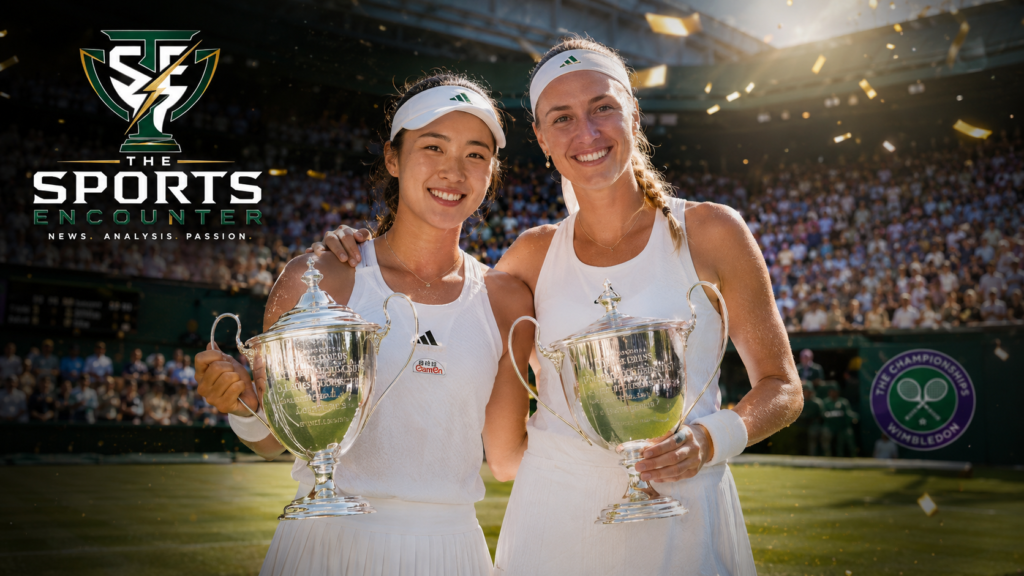
Guo Hanyu arrived on Centre Court carrying the nerves of her first Grand Slam final. Kristina Mladenovic walked beside her with six women’s doubles majors, years of elite experience, and a body that had forced her to rebuild her career from crutches.
Ninety-two minutes later, they stood together as Wimbledon champions.
The No. 10 seeds defeated second-seeded Gabriela Dabrowski and Luisa Stefani 6-3, 7-5 in the Wimbledon 2026 women’s doubles final, completing a title run shaped by aggressive returning, sharp net instincts, and a partnership built on trust long before either player knew where it might lead.
Mladenovic secured her seventh women’s doubles major and her first Wimbledon title in the discipline. Guo became a Grand Slam champion in her first major final and joined Peng Shuai as only the second Chinese player in the Open Era to win the Wimbledon women’s doubles crown.
The final carried a deeper emotional weight for both champions.
Mladenovic, 34, had spent much of the previous year recovering from a serious injury. Her doubles ranking had disappeared during the layoff. Guo, then still searching for a breakthrough at the sport’s highest level, accepted her invitation to form a partnership without hesitation.
That decision produced an Auckland title in their first tournament together. Six months later, it produced Wimbledon.
“It feels like a dream,” Mladenovic said after the final. “I definitely cannot believe what just happened now.”
TL;DR
Guo Hanyu and Kristina Mladenovic defeated Gabriela Dabrowski and Luisa Stefani 6-3, 7-5 to win the Wimbledon 2026 women’s doubles title.
The No. 10 seeds:
- Won the final in one hour and 32 minutes
- Claimed their first Grand Slam title as a partnership
- Won their second title together after Auckland
- Defeated the No. 1 and No. 2 seeds during their title run
- Dropped only one set across six matches
- Won all three tiebreaks they played
- Handed Dabrowski and Stefani their first defeat after an 18-set winning streak
- Gave Guo her first major title
- Gave Mladenovic her seventh women’s doubles Grand Slam crown and 10th major overall
Wimbledon 2026 Women’s Doubles Final: Key Facts
| Match detail | Information |
|---|---|
| Champions | Guo Hanyu and Kristina Mladenovic |
| Runners-up | Gabriela Dabrowski and Luisa Stefani |
| Final score | 6-3, 7-5 |
| Match duration | 1 hour, 32 minutes |
| Champions’ seeding | No. 10 |
| Runners-up seeding | No. 2 |
| Guo’s achievement | First Grand Slam title |
| Mladenovic’s achievement | Seventh women’s doubles major |
| Partnership titles in 2026 | Auckland and Wimbledon |
| Decisive moment | Guo and Mladenovic broke at 5-5 in the second set |
| Tournament record | Six wins, one set lost |
The complete tournament results and official draw remain available through the official Wimbledon website. The latest movement among the champions and finalists can also be followed through the official WTA doubles rankings.
Five Straight Games Changed the Final Immediately
Dabrowski and Stefani entered Centre Court as the higher seeds and the more established partnership.
Their route into the final had been emphatic. They arrived on an 18-set winning streak, which included the Eastbourne title and five straight-set victories at Wimbledon. During their semifinal against Shuko Aoyama and Liang En-shuo, the second seeds did not lose serve or face a break point.
Guo and Mladenovic removed that confidence almost immediately.
They read Dabrowski’s early lobs, closed the net quickly, and attacked the space between their opponents. Mladenovic’s forehand carried weight from the baseline, while Guo reacted sharply around the service line.
The champions raced into a 5-0 lead.
That start mattered because women’s doubles finals can turn quickly once one team takes control of the court’s geometry. Guo and Mladenovic were not simply hitting harder. They were deciding where the exchanges happened.
Mladenovic pushed Dabrowski and Stefani backward with deep returns. Guo then stepped into the court, taking balls early and reducing the runners-up’ reaction time.
The Canadian-Brazilian pair finally settled and won three consecutive games. Their recovery made the first set more competitive, but the damage had already been done.
Guo and Mladenovic closed it 6-3.
The scoreboard showed one break of separation. The tactical gap had felt wider.
Dabrowski and Stefani Finally Find Their Shape
The second set looked more like the final many expected.
Dabrowski and Stefani improved their first-ball execution and became more secure on serve. Stefani’s movement at the net brought greater pressure, while Dabrowski varied her placement rather than relying as heavily on the lob.
Their cleaner positioning prevented Guo and Mladenovic from taking early control.
Break opportunities finally appeared for the second seeds. They created two chances, but Mladenovic’s crosscourt forehand repeatedly helped the champions escape.
Those saves proved vital.
Doubles pressure often arrives in clusters. One poor service game can alter an entire set because there is less time to recover than in singles. Guo and Mladenovic recognized those moments and played with greater clarity when the scoreboard tightened.
The teams remained level at 5-5.
At that stage, the final had entered its most delicate phase. Dabrowski and Stefani had overcome the poor start, found a more effective rhythm, and stood two games from forcing a deciding set.
Guo changed the match at the net.
Guo’s Backhand Creates the Championship Break
The 11th game became the defining passage of the final.
Guo attacked Stefani’s serve with confidence, meeting the ball early and redirecting pace rather than simply blocking returns back into play.
Her backhand work around the net created a break-point opportunity. The Chinese player then finished the game with a tightly angled crosscourt backhand, giving her team a 6-5 lead.
The WTA’s official report described a sequence of three return winners against Stefani’s serve, with Guo producing the final shot that secured the break.
It was a fitting contribution from a player contesting her first major final.
Guo had spent much of the match showing restraint. Mladenovic supplied much of the visible power, especially from the forehand side. When the title moved within reach, Guo became the aggressor.
She attacked the return, trusted her hands, and created the championship game.
Mladenovic Serves Out the Biggest Comeback of Her Career
Mladenovic had served for major titles before.
She understood that experience did not remove nerves. It gave her a method for handling them.
Guo produced a volley winner to help create championship point. Mladenovic then struck a firm forehand that Dabrowski and Stefani could only return into the net.
The match was over.
Guo raised her arms before turning toward her partner. Mladenovic’s reaction carried the release of someone who knew how far she had traveled to reach Centre Court again.
This was her first women’s doubles major since the 2022 French Open.
Her previous six titles had confirmed her status as one of the finest doubles players of her generation. Wimbledon 2026 carried a different meaning because the road back had offered no guarantees.
“I had no ranking, I had a tough injury last year, and she did not hesitate at all,” Mladenovic said of Guo. “I am very proud to be standing here with her.”
The victory brought Mladenovic’s career total to 31 WTA doubles titles. It also gave her a 10th Grand Slam trophy across women’s and mixed doubles. Her wider major record now includes seven women’s doubles championships and three mixed doubles titles.
Guo’s Gratitude Reveals the Foundation of the Partnership
Guo’s trophy presentation speech explained why the pair looked so connected during the final.
“I just feel so lucky to have you on my side and with this trophy now,” she told Mladenovic. “Thank you for choosing me, trusting me.”
Mladenovic immediately returned the praise.
She explained that she had approached Guo at the beginning of the season while rebuilding her career. Her ranking offered little security, and the injury created understandable doubts about what level she could reach.
Guo accepted.
“Hanyu said that she’s lucky that I picked her, but I would like to thank her for believing in me and wanting to play with me because I was the one who asked her to play with me at the beginning of the season,” Mladenovic said during the presentation.
That exchange separated their partnership from the usual language of convenience.
Doubles teams often form around ranking access, tournament entry, schedules, surface preferences, or short-term opportunity. Guo and Mladenovic began with professional uncertainty on both sides.
Mladenovic needed someone willing to believe her body and game could recover.
Guo needed an experienced partner who could help her see a bigger version of her own career.
Wimbledon became the result of both decisions.
From Auckland to the All England Club
The partnership produced evidence almost immediately.
Guo and Mladenovic won the Auckland title in January during their first tournament together. They completed that event without losing a set and established the complementary style that later carried them through Wimbledon.
Mladenovic supplied experience, return quality, and the power to control crosscourt exchanges.
Guo brought fast reactions, movement, compact technique, and growing confidence around the net.
Their season still included setbacks. They lost in the fourth round of the Australian Open and fell narrowly in the Queen’s Club semifinals before Wimbledon, losing a deciding match tiebreak against Tereza Mihalikova and Olivia Nicholls.
Those results mattered because they exposed the pair to different kinds of pressure.
Australia tested their ability to manage a major draw together. Queen’s gave them grass-court preparation and showed how quickly a doubles match can turn in a deciding breaker.
At Wimbledon, they converted those lessons.
The One Match That Nearly Ended Their Run
Guo and Mladenovic dropped only one set across six matches.
Their greatest danger came in the third round against Anastasia Detiuc and Irina Khromacheva. The No. 10 seeds lost the opening set and fell a break behind in the second.
They were close to elimination.
Guo and Mladenovic recovered, survived a tiebreak, and won the deciding set. The official WTA account described it as the only significant disruption in an otherwise controlled title run. They finished the tournament having won all three tiebreaks they contested.
That escape strengthened the partnership before its biggest tests.
In the quarterfinals, they eliminated top seeds Katerina Siniakova and Taylor Townsend, one of the strongest and most decorated combinations in the draw.
Next came an all-Chinese semifinal battle against Jiang Xinyu and Xu Yifan. Guo and Mladenovic recovered from 3-0 down in the opening set and advanced in straight sets.
Their final opponent brought the No. 2 seeding and an 18-set winning streak.
Guo and Mladenovic completed the title run by beating both top-seeded teams.
Guo Becomes China’s New Grand Slam Doubles Champion
Guo entered Wimbledon ranked outside the established elite of women’s doubles.
She left as a Grand Slam champion and projected top-10 player.
The Wimbledon victory was Guo’s seventh career doubles title and her first above WTA 500 level. It also became her second trophy of 2026 and continued a run of multiple-title seasons stretching across three consecutive years.
Her ranking reward reflected the scale of the breakthrough.
The WTA projected Guo to rise to world No. 9, her first appearance inside the doubles top 10. Mladenovic was projected to jump to No. 13 as she continued rebuilding her position following injury. The partnership was also expected to rise to fourth in the season-long doubles race.
Guo also became the second Chinese player in the Open Era to win the Wimbledon women’s doubles title after Peng Shuai’s victory in 2013.
The achievement expands China’s modern doubles tradition.
Chinese women have produced major champions and Olympic medalists through intelligent positioning, disciplined return play, and technically strong net work. Guo’s victory carries that history forward while giving it a new personality.
Her game at Wimbledon looked modern and assertive. She defended well when necessary, but the decisive points came when she moved forward and trusted her attacking instincts.
“Another person I want to thank is Alan Ma,” Guo said. “He helped me to see lots of possibilities in my career and always helped me, giving me advice when I didn’t know what to do.”
“I will keep trying and keep building. Let’s see what’s going to happen next.”
Dabrowski and Stefani Leave With Progress Despite the Defeat
The final ended painfully for Dabrowski and Stefani, but their Wimbledon campaign represented a major step forward.
They entered the championship after winning Eastbourne and advanced to the final without dropping a set. Their semifinal performance was particularly dominant, with neither player losing serve or facing a break point.
Stefani also broke through a personal barrier by reaching her first Grand Slam final after losing her previous three major semifinals.
Dabrowski knew the disappointment more intimately. She had previously finished runner-up in the Wimbledon women’s doubles event in 2019 and 2024.
The 2026 loss became another near miss, but the Canadian remained focused on the partnership’s wider progress.
“The last few weeks have been absolutely amazing,” Dabrowski said during the trophy presentation.
“I couldn’t have imagined being in another position to fight for a Slam title, so I’m very grateful for all the weeks that we have together. I know it didn’t work out for us today, but we’ve put in a lot of good work and I’m still really proud of us.”
That assessment felt accurate.
Dabrowski and Stefani did not lose because their tournament had been poor. They lost because Guo and Mladenovic executed the biggest points more cleanly.
Why Guo and Mladenovic Won the Final
Three tactical factors separated the champions.
1. They controlled the return exchanges
Guo and Mladenovic placed sustained pressure on the second seeds’ service games. The first five games established that pattern, while the decisive break at 5-5 came through a sequence of aggressive returns.
“We were really clutch in important moments to get the break on their serve,” Mladenovic said.
“I think that’s what made the big difference in the second set, but also, throughout the match, we really put them under pressure on their service games.”
2. Mladenovic dictated with the forehand
Mladenovic’s crosscourt forehand prevented Dabrowski and Stefani from controlling the middle. It also saved her team during the second set when the runners-up created break chances.
Her ability to hit through the court gave Guo time to close forward.
3. Guo trusted her hands when the title tightened
Guo’s net play and backhand returns became most dangerous during the final two games.
A player in her first major final could easily have become conservative. Guo did the opposite. She took the ball early, attacked Stefani’s serve, and helped create championship point with a decisive volley.
A Different Kind of Wimbledon Partnership Story
Wimbledon 2026 produced several major tennis narratives across singles and doubles.
Jelena Ostapenko and Marcelo Arevalo came from behind to win the Wimbledon mixed doubles title. Karolina Muchova and Linda Noskova created a historic all-Czech women’s singles final. Novak Djokovic rewrote the men’s record book before his run ended, having earlier passed Roger Federer’s Wimbledon match-win record.
Guo and Mladenovic added a quieter but equally powerful story.
Their victory was built around belief exchanged in both directions.
Guo trusted a champion returning without a ranking.
Mladenovic trusted a partner who had never played a Grand Slam final.
The result looked polished on Centre Court, but its roots lay in uncertainty, rehabilitation, and the willingness to make a professional commitment before either player could promise an immediate reward.
Final Verdict
Guo Hanyu and Kristina Mladenovic won Wimbledon because their partnership performed best when the match became tight.
Their opening burst created control. Their resilience protected them during the second set. Guo’s return aggression secured the decisive break, and Mladenovic’s experience carried them through the final service game.
Yet the title will endure for more than its tactical quality.
For Guo, Wimbledon became the moment possibility turned into proof. She entered her first major final and played the closing games like someone who belonged there.
For Mladenovic, the trophy completed a return that had once looked uncertain. She moved from injury, crutches, and no meaningful ranking to a seventh women’s doubles major.
Their partnership started with one player asking and the other saying yes.
Centre Court supplied the answer.
Wimbledon 2026 Women’s Doubles Final Scorecard
| Category | Guo/Mladenovic | Dabrowski/Stefani |
|---|---|---|
| First-set start | 10/10 | 5/10 |
| Return pressure | 9.5/10 | 7.5/10 |
| Net execution | 9/10 | 8/10 |
| Break-point resilience | 9.5/10 | 7/10 |
| Tactical adjustment | 9/10 | 8/10 |
| Closing execution | 10/10 | 7/10 |
| Overall performance | 9.5/10 | 8/10 |
FAQs
Who won the Wimbledon 2026 women’s doubles title?
Guo Hanyu and Kristina Mladenovic won the title by defeating Gabriela Dabrowski and Luisa Stefani 6-3, 7-5.
How long did the final last?
The match lasted one hour and 32 minutes.
Was this Guo Hanyu’s first Grand Slam title?
Yes. Wimbledon 2026 was Guo’s first Grand Slam final and first major championship.
How many Grand Slam doubles titles has Kristina Mladenovic won?
Mladenovic now owns seven women’s doubles major titles. She has also won three mixed doubles majors, giving her 10 Grand Slam trophies overall.
Had Mladenovic won Wimbledon women’s doubles before?
No. She had previously finished runner-up in 2014. The 2026 victory gave her a first Wimbledon title in women’s doubles.
How did Guo and Mladenovic reach the final?
They dropped only one set during six matches. Their run included victories over top seeds Katerina Siniakova and Taylor Townsend in the quarterfinals and Jiang Xinyu and Xu Yifan in the semifinals.
How many titles have Guo and Mladenovic won together?
They won two titles during the first half of 2026, starting with Auckland and followed by Wimbledon.
What happened to Guo and Mladenovic in the third round?
They lost the opening set and fell behind by a break against Anastasia Detiuc and Irina Khromacheva before recovering to win. It was the only set they lost during the tournament.
What ranking did Guo reach after Wimbledon?
The WTA projected Guo to enter the doubles top 10 at a career-high world No. 9. Mladenovic was projected to rise to No. 13.
Where can readers find the official Wimbledon draw and WTA rankings?
Readers can check the official Wimbledon women’s doubles draw and the official WTA doubles rankings.