Connect with us
Miley Rumer | The Sports Encounter

Published

on

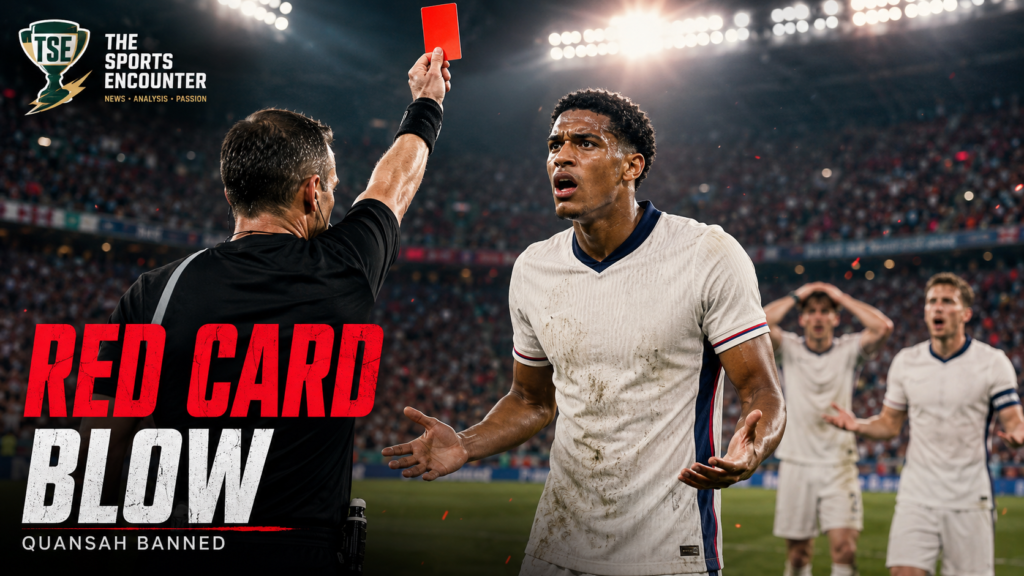
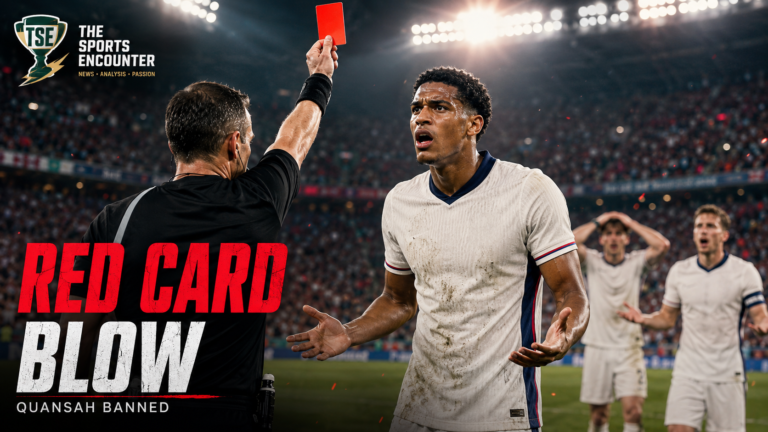
England’s formidable defense received a major blow on Thursday ahead of their last-eight clash of the FIFA World Cup 2026 against Norway, as FIFA handed a two-match suspension to Jarell Quansah, The Sports Encounter has learnt.

The decision means Quansah will miss England’s quarterfinal against Norway and would also be unavailable for the semifinal if Thomas Tuchel’s side extend their World Cup run. The defender would only be eligible to return if England reach either the final or the third-place playoff.

It is a costly punishment at a difficult moment for England. They survived a furious Round of 16 battle against Mexico, winning 3-2 despite playing the final stretch with 10 men after Quansah’s red card. That victory sent England into the quarterfinals, but it also left Tuchel with another defensive problem before facing one of the most dangerous attacking teams left in the tournament.

According to the official FIFA World Cup 2026 match schedule, England’s quarterfinal against Norway is part of the last-eight stage, with the winner moving one step closer to the semifinal. That is why Quansah’s suspension now carries far more weight than a normal one-match absence.

Why Was Jarell Quansah Suspended for Two Matches?

Quansah was sent off in the second half against Mexico after a VAR review upgraded his challenge to a red-card offense. The incident immediately changed the shape of the match. England had to protect their lead with one fewer player, adjust their defensive line, and sacrifice attacking balance to survive Mexico’s late pressure.

The challenge divided opinion because Quansah appeared to make contact with the ball, but the follow-through, body momentum, and contact with the opponent’s leg made the incident serious enough for the referee to change the original decision after the video review.

A normal red card usually brings an automatic one-match suspension. FIFA, however, can extend the punishment depending on the nature of the offense. The FIFA Disciplinary Code, available through FIFA’s official legal documents section, allows stronger sanctions for serious foul play.

That is the important detail behind this ruling. FIFA did not treat Quansah’s red card as a routine dismissal. The governing body appears to have classified the challenge as serious foul play, which raises the punishment and removes him from England’s plans for more than one knockout match.

What Matches Will Quansah Miss?

MatchQuansah Status
England vs Norway, QuarterfinalSuspended
Potential SemifinalSuspended
Final or Third-Place PlayoffEligible to return

The suspension changes the stakes for England. A one-match ban would have kept Quansah out of only the Norway quarterfinal. A two-match ban means England must now plan for two major knockout games without one of their defensive options.

That matters because knockout football rarely gives teams clean conditions. Injuries, suspensions, yellow-card management, extra time, and tactical matchups all shape selection. England already had a physically demanding battle against Mexico. Now they face Norway with less defensive flexibility and a clear need to protect the spaces where Quansah might have helped.

How This Affects England Against Norway

England’s quarterfinal against Norway was already a difficult tactical assignment. FIFA’s official Norway vs England preview frames the tie as one of the major last-eight battles of the tournament, with Norway chasing a historic semifinal and England trying to return to the final four.
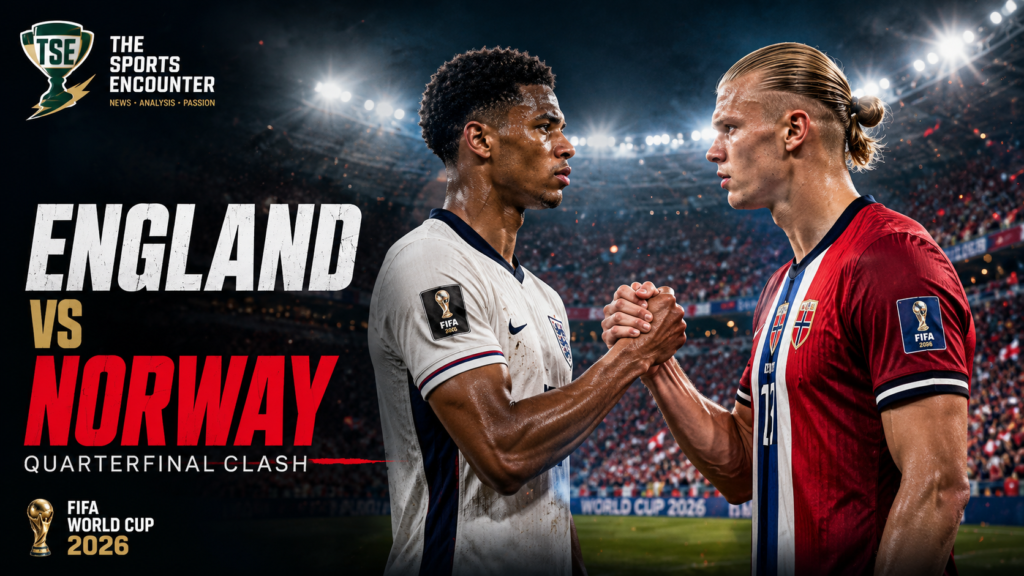
Norway’s attacking threat will force England into one of their toughest defensive tests of the tournament. Erling Haaland’s presence changes how England defend crosses, second balls, transitions, and direct passes behind the line. Martin Ødegaard gives Norway control between midfield and attack, while their wide players can stretch the pitch and create space for early service into dangerous areas.

For readers tracking Haaland’s wider tournament and career profile, The Sports Encounter has already explored his records, scoring impact, and World Cup importance in this detailed feature on Erling Haaland records and World Cup career.

Quansah’s absence does not simply remove one defender from the squad sheet. It reduces England’s ability to rotate, adjust, and respond during the match. Against Mexico, his red card forced Tuchel to make a quick tactical correction and protect the back line under pressure. That reshuffle worked on the night, but Norway will offer a different kind of test.

England will need strong positioning from their center backs, disciplined full-back defending, and midfield protection in front of the back four. If Reece James is not fully ready, the right side of England’s defense becomes even more important. That area was already under pressure after the Mexico game, and Norway will almost certainly test it.

England’s Defensive Depth Now Faces Its Biggest Test

England have been one of the tournament’s most resilient teams, but their route to the quarterfinal has not been smooth. They needed control against DR Congo, nerve against Mexico, and now require tactical maturity against Norway. The defense has often looked strong, but World Cup knockout football can expose even small weaknesses.

England and Norway players lock hands before their FIFA World Cup 2026 quarterfinal clash under stadium lights.

Quansah gave England useful coverage because he could help across defensive roles and allow Tuchel to manage different match situations. His suspension removes one layer from that structure. England may still have enough quality, but the margin for error has narrowed.

Tuchel’s biggest decision may now be whether to keep his defensive shape stable or make a specific adjustment for Haaland. England cannot afford to defend too deep for long periods because Norway have the aerial threat to punish passive defending. They also cannot push recklessly high, because one direct pass into space could turn the game.

That balance will define England’s quarterfinal. A clean defensive structure matters, but so does composure. England cannot let the frustration around Quansah’s ban distract them from the practical job: stopping Norway from turning direct attacks and set pieces into decisive moments.

Why the Red Card Debate Matters

The Quansah incident also feeds into a wider discussion around VAR, serious foul play, and how referees judge dangerous challenges in tournament football. Supporters often focus on whether a player touched the ball, but modern foul interpretation also looks at force, control, point of contact, and danger to an opponent.

That makes Quansah’s case relevant beyond England. It sits inside the broader debate around what counts as reckless or dangerous play, especially when VAR intervenes after the referee initially allows play to continue. The Sports Encounter has explained the basics of fouls, dangerous tackles, and referee decisions in this guide on what counts as a foul in soccer.

For England fans, the frustration is understandable. Quansah’s challenge happened in a fast knockout match, and the decision changed both the game and England’s squad situation. For FIFA, the disciplinary process appears to have followed the serious foul play route, which is why the punishment moved beyond a single match.

What England Must Fix Before Norway

England cannot allow the Quansah ruling to become a distraction. Norway will not care about disciplinary debates. They will look at England’s right side, England’s defensive communication, and England’s ability to handle Haaland under pressure.

Tuchel’s staff now have three urgent priorities.

First, England must settle the back line early. Constant reshuffling against a team with Haaland and Ødegaard could invite trouble.

Second, the midfield must protect central spaces. Norway are dangerous when they can play quickly into attacking runners or force defenders into isolated duels.

Third, England need discipline. After Quansah’s red card against Mexico, they cannot risk another careless challenge, especially against a team that can turn set pieces and transitions into decisive moments.

The quarterfinal will test England’s depth, but also their emotional control. Knockout games are often decided by players who stay calm when the match becomes messy.

Key Facts

DetailInformation
PlayerJarell Quansah
TeamEngland
OffenseRed card against Mexico
MatchEngland 3-2 Mexico, Round of 16
SuspensionTwo matches
Immediate match missedEngland vs Norway, Quarterfinal
Possible second match missedSemifinal, if England qualify
Possible returnFinal or third-place playoff

Final Word

England reached the quarterfinals by surviving Mexico’s pressure, but the cost of that victory is now clear. Quansah’s red card has become a two-match suspension, and Tuchel must solve a defensive puzzle before facing Norway.

The timing could hardly be worse. Norway are confident, Haaland is dangerous, and England’s defense has lost one of its options before the biggest test of their tournament so far.

England still have the talent to cope. What they need now is clarity, discipline, and a defensive plan that can survive Norway’s power without turning the quarterfinal into another emergency.
Miley Rumer is a St. Clairsville, Ohio-based sports journalist and The Sports Encounter’s U.S. correspondent, covering the NHL, NBA, NFL, MLB, MLS, and major sporting stories across North America. Her work focuses on player performance, team identity, rivalries, roster decisions, tournament developments, and the human stories that shape how fans experience sport. At The Sports Encounter, Miley contributes breaking news, match coverage, analysis, and feature stories across American and international sport, including major soccer and tennis events. Her reporting combines clear news judgment with performance context, historical perspective, and an understanding of the fan conversations surrounding teams and athletes. Based in the United States, she brings a grounded North American perspective to coverage of the leagues, competitions, and personalities driving global sports interest.

A Celebration of 5000 ODIs

A Celebration of 5000 ODIs Match 11: 22 From One Ball Ends South Africa’s World Cup Dream

South Africa were closing on their first World Cup final when 12 minutes of Sydney rain turned a demanding chase into cricket’s most infamous impossible equation.

Hamad Hussain | The Sports Encounter

Published

on

A Celebration of 5000 ODIs Match 11: 22 From One Ball Ends South Africa’s World Cup Dream

South Africa needed 22 runs from 13 balls. Brian McMillan and Dave Richardson were still there. A place in the World Cup final remained difficult, but entirely possible.

Then Sydney’s rain arrived.

Twelve minutes later, the equation that had taken almost seven hours of cricket to create had become impossible. The giant SCG scoreboard flashed the numbers that would follow South African cricket for decades: 22 runs required from one ball.

There is an important detail behind that famous image. Archived match records show the scoreboard was actually wrong. Under the calculation eventually applied, South Africa’s true requirement was 21 from the final delivery. It hardly mattered. No legal delivery could produce either number. The semifinal had effectively ended in a calculation rather than a cricketing contest.

That extraordinary finish is why England’s 19-run victory on March 22, 1992, is Match 11 in The Sports Encounter’s A Celebration of 5000 ODIs series. The match gave us Graeme Hick’s finest World Cup innings, Jonty Rhodes attacking under knockout pressure, a genuinely competitive chase and, finally, a rain rule so inadequate that cricket was forced to rethink how interrupted matches should be decided.

TL;DR

  • England scored 252/6 from 45 overs, led by Graeme Hick’s 83 from 90 balls.
  • South Africa reached 231/6 after 42.5 overs and required 22 from the final 13 balls when rain interrupted play.
  • The Most Productive Overs method reduced the chase to an impossible final-ball equation.
  • Jonty Rhodes made an attacking 43 from 38 balls, while Andrew Hudson top-scored with 46.
  • Richard Illingworth and Gladstone Small took two wickets each for England.
  • Graeme Hick was Player of the Match as England advanced to the final against Pakistan.

England vs South Africa 1992 World Cup Semifinal: Match Information

DetailInformation
MatchEngland vs South Africa, 2nd Semifinal
Tournament1992 Cricket World Cup
DateMarch 22, 1992
VenueSydney Cricket Ground, Sydney
TossSouth Africa won the toss and fielded
England252/6 in 45 overs
South Africa232/6 in 43 overs
ResultEngland won by 19 runs under the revised target
Player of the MatchGraeme Hick, 83 from 90 balls
Top South Africa BatterAndrew Hudson, 46 from 52 balls
Turning PointRain with South Africa needing 22 from 13 balls
Tournament ImpactEngland reached the World Cup final
Historical ImpactThe finish exposed serious flaws in cricket’s rain-adjustment system

Why Match 11 Belongs in A Celebration of 5000 ODIs

A famous controversy alone would not be enough.

This semifinal deserves its place because a very good cricket match was unfolding before the mathematics swallowed it.

South Africa were playing their first World Cup after returning to international cricket following more than two decades of isolation. They had already reached the semifinals at their first attempt. England, meanwhile, were trying to reach their third World Cup final.

The chase remained alive almost to its natural conclusion.

That combination of historical context, individual performance, knockout pressure and an unprecedented finish satisfies exactly what our 100-match ODI collection was built to preserve. The series has already revisited extraordinary World Cup moments such as Kapil Dev rescuing India from 17 for five against Zimbabwe and India defending 183 against West Indies in the 1983 final.

This one belongs for another reason: cricket eventually learned from it.

Graeme Hick Builds England’s Innings Under Pressure

England lost Graham Gooch for two and Ian Botham for 21, leaving the innings at 39 for two.

Graeme Hick supplied the stability they needed.

His 83 from 90 balls contained nine fours and came at a strike rate above 92, excellent tempo for an ODI semifinal in 1992. He added 71 with Alec Stewart, then helped push England toward a total capable of surviving South Africa’s deep batting order.

Hick’s dismissal at 187 for five could have stalled the innings.

Instead, England found another gear.

Dermot Reeve Turns 220 Into 252

Dermot Reeve’s contribution lasted only 14 balls.

It changed the value of England’s total.

Reeve struck an unbeaten 25 with four boundaries, while Chris Lewis added 18 not out from 16 deliveries. Their late acceleration carried England to 252 for six after the innings had been restricted to 45 overs because South Africa failed to complete their scheduled overs within the allotted time.

Those final runs became even more significant once the chase tightened.

Andrew Hudson Keeps South Africa Moving

South Africa lost captain Kepler Wessels for 17, but Andrew Hudson refused to allow England complete control.

Hudson made 46 from 52 deliveries with six fours and kept the required rate manageable despite regular wickets around him. Peter Kirsten fell for 11 before Hudson departed at 90 for three.

Adrian Kuiper then made 36, but England kept removing batters before partnerships could become decisive.

Richard Illingworth was particularly important, dismissing Hudson and Kuiper while conceding 46 from his 10 overs.

Jonty Rhodes Attacks the Semifinal

Jonty Rhodes produced South Africa’s most aggressive innings.

His 43 from 38 balls pushed the chase forward when the required rate was becoming uncomfortable. England knew one substantial partnership could take the match away from them, and Rhodes was beginning to build exactly that threat.

Gladstone Small eventually removed him with the score on 206.

Yet South Africa were not finished.

McMillan and Richardson took the total to 231 for six. Thirteen legitimate deliveries remained.

They needed 22.

Then the weather intervened.

The 12 Minutes That Changed Cricket’s Rain Rules

The 1992 World Cup used the Most Productive Overs method for rain-affected matches. When overs disappeared from the chasing team’s innings, the target was adjusted by removing the least productive overs from the first innings.

That logic became absurd when rain arrived near the end of this chase.

South Africa had only 13 balls left. Losing two overs therefore removed almost all their remaining opportunities, while England’s target reduction amounted to only one run.

The television and SCG scoreboard famously changed from 22 required from 13 balls, to 22 from seven, and finally 22 from one. Archived ESPN records note that the mathematically correct requirement was actually 21 from one.

McMillan pushed Chris Lewis’ final delivery for a single.

Nobody celebrated the cricket.

England had earned their position and had arguably been the better side over the match, but even they had reached the final through an ending nobody could reasonably defend as a competitive solution. The incident became one of the strongest arguments for developing a more sophisticated method for rain-adjusted targets, eventually leading ODI cricket toward the Duckworth-Lewis system.

Man of the Match: Graeme Hick

Hick’s 83 remains the central performance of the semifinal.

England’s innings repeatedly threatened to lose momentum, and none of their other top-six batters reached 35. Without Hick, there would probably have been no 252 to defend and perhaps no controversy for history to remember.

He therefore deserved the Player of the Match award.

His innings tends to disappear behind the famous scoreboard image, which is unfortunate. The rain rule explains why the match became infamous. Hick explains why England had something worth defending in the first place.

Complete Match Scorecard

England Innings: 252/6 in 45 Overs

BatterDismissalRunsBalls4s6s
Graham Goochc Richardson b Donald2800
Ian Bothamb Pringle212330
Alec Stewartc Richardson b McMillan335440
Graeme Hickc Rhodes b Snell839090
Neil Fairbrotherb Pringle285010
Allan Lambc Richardson b Donald192210
Chris Lewisnot out181620
Dermot Reevenot out251440
Extrasb 1, lb 7, w 9, nb 623
Total6 wickets, 45 overs252

Did not bat: Phil DeFreitas, Gladstone Small, Richard Illingworth.

Fall of wickets: 20-1, 39-2, 110-3, 183-4, 187-5, 221-6.

South Africa Bowling

BowlerOversMaidensRunsWickets
Allan Donald100692
Meyrick Pringle92362
Richard Snell80521
Brian McMillan90471
Adrian Kuiper50260
Hansie Cronje40140

South Africa Innings: 232/6 in 43 Overs

BatterDismissalRunsBalls4s6s
Kepler Wesselsc Lewis b Botham172110
Andrew Hudsonlbw b Illingworth465260
Peter Kirstenb DeFreitas112600
Adrian Kuiperb Illingworth364450
Hansie Cronjec Hick b Small244610
Jonty Rhodesc Lewis b Small433830
Brian McMillannot out212100
Dave Richardsonnot out131010
Extraslb 17, w 421
Total6 wickets, 43 overs232

Did not bat: Richard Snell, Meyrick Pringle, Allan Donald.

Fall of wickets: 26-1, 61-2, 90-3, 131-4, 176-5, 206-6.

England Bowling

BowlerOversMaidensRunsWickets
Ian Botham100521
Chris Lewis50380
Phil DeFreitas81281
Richard Illingworth101462
Gladstone Small101512

England Were Better, but South Africa Deserved a Cricketing Finish

It is tempting to retell this semifinal entirely as an injustice.

That loses some of its complexity.

England had made 252 despite being limited to 45 overs. Hick had played the game’s strongest innings. Their bowlers had taken six wickets and repeatedly prevented South Africa from putting together the partnership that could have settled the chase earlier.

South Africa also contributed to their own difficulty by taking too long to bowl England’s innings, which led to the reduction from 50 overs to 45.

Yet none of that makes the final equation sensible.

A World Cup semifinal with 22 required from 13 balls deserved to be decided by players attempting those 13 balls.

That is ultimately why Match 11 survives.

Readers can revisit other matches where a single moment changed a World Cup through our reports on Australia’s seven-run 1987 final victory over England and Gary Gilmour’s extraordinary 1975 semifinal against England, while ongoing match reports and analysis are available through The Sports Encounter Cricket Hub.

Final Takeaway: The Match Cricket Had to Learn From

England advanced to face Pakistan and South Africa went home from their first World Cup carrying an image that would become part of cricket folklore.

The semifinal’s real legacy, however, reaches further than heartbreak.

Hick played a superb innings. Rhodes attacked the chase. England’s bowlers kept the game under pressure. South Africa remained alive with 13 balls remaining.

Then the rules failed the match.

Thirty-four years later, people still remember 22 from one without needing the teams, venue or date explained to them. Few scoreboards in ODI history have said so little while revealing so much about why cricket sometimes has to change.https://chatgpt.com/backend-api/sentinel/frame.html?sv=20260810913b

Continue Reading

Breaking News

Bunny Shaw Wins PFA Players’ Player of the Year After Historic Manchester City Season

Khadija “Bunny” Shaw has been named the 2025/26 PFA Women’s Players’ Player of the Year after another dominant Manchester City season featuring 21 WSL goals, 27 in all competitions and a record third consecutive Golden Boot.

Published

on

Khadija “Bunny” Shaw celebrates after winning the 2025/26 PFA Women’s Players’ Player of the Year award following a record-breaking Manchester City season.

Khadija “Bunny” Shaw has been named the 2025/26 PFA Women’s Players’ Player of the Year after a season in which the Manchester City striker combined record-breaking scoring with the kind of consistency that made her the outstanding individual force in the Women’s Super League.

The Jamaican forward scored 21 goals in 22 WSL appearances, claimed the Golden Boot for a record third consecutive season and finished the campaign with 27 goals across all competitions.

Her fellow professionals have now given her the clearest endorsement available to an elite footballer.

Shaw has won the PFA Players’ Player of the Year award for the second time in her career, having previously taken the honor in 2023/24. The latest award arrives after a season in which she also helped Manchester City win the WSL title and FA Cup.

Manchester City confirmed the award on August 25, describing Shaw as a central figure in the club’s successful 2025/26 campaign.

Bunny Shaw 2025/26 Season at a Glance

Player Khadija “Bunny” Shaw
Club Manchester City
Nationality Jamaica
PFA Award 2025/26 Women’s Players’ Player of the Year
Previous PFA win 2023/24
WSL goals 21 in 22 matches
All-competition goals 27
WSL Golden Boot Third consecutive season
Manchester City contract Runs until 2030

Why Bunny Shaw Won the PFA Players’ Player of the Year

The number that immediately stands out is 21.

Shaw scored 21 goals in only 22 league appearances, matching the best WSL scoring return of her career and finishing as the competition’s leading scorer.

Yet reducing her season to one total misses what made it so difficult for opponents to contain her.

Manchester City’s official data showed that Shaw also contributed four WSL assists and reached 100 goal involvements in the competition during the campaign.

She scored against 10 of City’s 11 league opponents, including Arsenal, Chelsea and Manchester United, while continuing to produce goals late in matches when defensive concentration was already being stretched.

The award therefore reflects more than finishing ability.

Shaw became the focal point of a title-winning attack, handled the physical attention that follows an elite center forward and continued producing even when opponents knew exactly where City’s greatest scoring threat would come from.

A Record Third Straight WSL Golden Boot

The PFA award arrived after Shaw had already made WSL history.

Her 21 league goals secured a third successive Golden Boot, making her the first player to win the award in three consecutive WSL seasons.

She had scored 21 league goals in 2023/24 before sharing the 2024/25 Golden Boot with Alessia Russo after both finished on 12.

Another 21-goal campaign followed in 2025/26.

Manchester City also confirmed that Shaw became the first player in WSL history to reach 20 league goals in three separate seasons.

That distinction matters because goalscoring peaks are common in football. Sustained scoring at the same level is much harder.

Shaw has now produced elite output across multiple seasons while opponents have had years to study her movement, strength, finishing patterns and preferred areas.

The Peer Vote Gives This Award Extra Weight

The PFA Players’ Player of the Year carries a particular kind of credibility because the winner is chosen by professional footballers.

These are the defenders trying to stop Shaw, the midfielders tracking her movement and the players competing against Manchester City throughout the season.

The 2026 shortlist also reflected the depth of individual quality in the WSL.

Shaw was nominated alongside Manchester City teammate Yui Hasegawa, Arsenal forward Alessia Russo, Aston Villa’s Kirsty Hanson, Chelsea’s Lauren James and Manchester United’s Jess Park.

The Professional Footballers’ Association confirmed the six-player shortlist before the winners were announced at the annual PFA Awards ceremony in Manchester.

Being selected from that group by fellow professionals strengthens the case that Shaw’s season was not simply statistically impressive. It was respected across the league.

Shaw’s 27 Goals Were Part of a Complete Attacking Season

Across all competitions, Shaw finished with 27 goals in 32 appearances.

Manchester City also credited her with eight assists across the campaign.

That output challenges the idea that Shaw operates only as a penalty-box finisher.

Her physical presence allows City to play directly when necessary. She can hold defenders off, create space for runners, attack crosses and turn imperfect deliveries into dangerous situations.

Her movement inside the penalty area remains the foundation of her game, but the broader production shows a forward increasingly capable of influencing attacks before the final touch.

That distinction becomes more important as elite women’s football continues becoming tactically deeper and physically faster.

Manchester City’s Success Changed the Meaning of Shaw’s Season

Individual awards tend to carry more weight when they accompany team success.

Shaw’s goals helped Manchester City win the WSL and FA Cup during a season that strengthened the club’s position at the top of English women’s football.

She was central to that success rather than an isolated scorer producing numbers for a team falling short of trophies.

The relationship between individual excellence and collective progress has become one of the major themes across women’s football.

A similar pattern appeared at the international level during the 2026 Women’s Africa Cup of Nations, where Cameroon completed a remarkable run to their first WAFCON title after entering the tournament through an expanded field.

Malawi produced another example of how individual attacking quality can reshape an entire team’s ceiling. Temwa Chawinga won the WAFCON Golden Boot as the Scorchers reached the final and qualified for their first Women’s World Cup.

The Sports Encounter documented Malawi’s breakthrough qualification after their quarterfinal victory over Ghana.

Shaw’s Manchester City season belongs in that broader conversation about the growing influence of elite forwards on the direction of women’s football.

She Has Now Passed 100 Goals for Manchester City

Another major milestone arrived during the season.

Shaw became the first player in Manchester City’s professional era to reach 100 goals for the club when she scored against Aston Villa in December 2025.

By the end of the league campaign, Manchester City listed her with 117 goals in 137 appearances for the club.

Those numbers provide useful context for the PFA award.

The 2025/26 season was not a sudden breakout from a forward discovering elite-level production for the first time. It was another dominant chapter in a scoring record that has been building since she joined City in 2021.

She had already become Manchester City Women’s record goalscorer in March 2024.

The gap between a prolific striker and a defining club player is usually measured over years rather than months. Shaw has now entered the second category.

Khadija “Bunny” Shaw celebrates after winning the 2025/26 PFA Women’s Players’ Player of the Year award following a record-breaking Manchester City season.

Her New Manchester City Contract Matters

City have also secured Shaw’s future.

The forward signed a new four-year contract earlier this year, extending her stay at Manchester City until 2030.

That decision gives the club continuity around one of the most productive strikers in world football at a time when women’s football is becoming increasingly competitive in the transfer market.

Manchester City have made significant changes elsewhere across their football operation, including the transition surrounding the men’s team ahead of the new Premier League season.

The Sports Encounter’s 2026/27 Premier League preview examined how City are managing a very different transition on the men’s side following Pep Guardiola’s departure.

The women’s team have a clearer attacking reference point.

Shaw is signed through the end of the decade and remains firmly within the prime years of her career.

Bunny Shaw’s Success Carries Major Importance for Jamaica

The award also travels well beyond Manchester.

Shaw is already the most recognizable figure in Jamaican women’s football and one of the Caribbean’s most successful active players.

Her rise from Spanish Town to becoming the leading scorer for one of England’s biggest clubs has given Jamaica a global football figure whose influence extends beyond international tournament appearances.

That visibility matters as women’s football continues expanding into countries and regions that historically received less global coverage.

Africa has experienced a similar shift in recent months.

Algeria qualified for their first Women’s World Cup while Morocco secured another appearance, part of a changing international landscape ahead of Brazil 2027.

Malawi then pushed that story even further by reaching their first WAFCON final, a journey The Sports Encounter followed through their semifinal breakthrough.

Shaw operates in a different competition and on a different continent, but her career reflects the same broad trend. Elite women’s football is drawing defining players from a much wider global map.

The Numbers Explain Only Part of Her Dominance

There is a temptation with prolific forwards to treat every season as a mathematical exercise.

Goals per appearance. Conversion rates. Golden Boots. Records.

Those numbers matter, but Shaw’s value also lies in the tactical problems she creates.

Center backs cannot comfortably defend high against her because she can attack space. Dropping deeper creates another problem because she is strong enough to receive possession with a defender behind her.

Crosses become more dangerous because of her aerial presence. Loose balls inside the penalty area become emergencies because she reacts quickly enough to turn them into shots.

Opponents therefore need more than one solution.

That ability to alter how another team defends is one of the clearest signs of an elite forward.

Women’s Football Is Building More Global Superstars

Shaw’s award arrives during a period of rapid expansion for the women’s game.

Domestic leagues are growing commercially, international tournaments are attracting larger audiences and more players are becoming recognizable outside their home markets.

The next FIFA Women’s World Cup in Brazil will offer another significant stage for that development.

Africa’s qualification picture has already produced major changes, including first-time qualifiers Algeria and Malawi.

Malawi’s historic qualification showed how quickly a national team can alter its global standing when a generation of players begins producing at a higher level.

Elsewhere in women’s sport, questions about representation have become increasingly important too.

The Sports Encounter recently examined new broadcast guidelines designed to change how female athletes are filmed at the 2026 European Athletics Championships.

Those debates sit alongside the sporting achievements themselves. More visibility creates more scrutiny, more commercial opportunity and greater expectations around how female athletes are presented.

Shaw’s season gives that visibility a powerful sporting foundation.

What Comes Next for Bunny Shaw?

The difficult part now is repeating a season that already looks difficult to improve.

Twenty-one league goals produced another Golden Boot. Twenty-seven across all competitions helped Manchester City win major trophies. Her peers voted her the best player in the league.

She has also committed her future to City until 2030.

The next targets therefore become increasingly ambitious.

More league titles. European success. More scoring records. Further progress with Jamaica.

The strongest players eventually reach a point where they are competing as much with their own previous standards as with the players around them.

Shaw appears to have reached that stage.

TSE Verdict

Khadija Shaw’s second PFA Players’ Player of the Year award feels like a logical conclusion to a season in which almost every important indicator pointed in the same direction.

She scored 21 league goals in 22 matches, won a third consecutive WSL Golden Boot, reached 100 WSL goal involvements, passed 100 goals for Manchester City and finished the campaign with 27 goals across all competitions.

The trophies gave those numbers greater meaning.

The peer vote gave them authority.

Manchester City have now secured her through 2030, which means this story may still be closer to the middle of Shaw’s English career than the end.

For now, the 2025/26 season belongs firmly on the list of the strongest individual campaigns the WSL has produced.

And the players who had to face her clearly agree.

Frequently Asked Questions

Who won the 2025/26 PFA Women’s Players’ Player of the Year?

Manchester City striker Khadija “Bunny” Shaw won the 2025/26 PFA Women’s Players’ Player of the Year award.

How many times has Bunny Shaw won the PFA Players’ Player of the Year?

Shaw has now won the award twice. She previously received the honor for the 2023/24 season.

How many goals did Bunny Shaw score in the 2025/26 WSL season?

Shaw scored 21 goals in 22 Women’s Super League appearances.

Did Bunny Shaw win the WSL Golden Boot?

Yes. She won the 2025/26 WSL Golden Boot and became the first player to claim the award in three consecutive seasons.

How many goals did Bunny Shaw score in all competitions?

Shaw scored 27 goals in 32 appearances across all competitions during the 2025/26 campaign.

How many goals has Bunny Shaw scored for Manchester City?

Manchester City reported that Shaw had reached 117 goals in 137 appearances for the club by the end of the 2025/26 league campaign.

How long is Bunny Shaw’s Manchester City contract?

Shaw signed a new four-year contract that keeps her at Manchester City until 2030.

Who else was nominated for the PFA Women’s Players’ Player of the Year?

The shortlist included Yui Hasegawa, Alessia Russo, Kirsty Hanson, Lauren James and Jess Park alongside Shaw.

Where can I verify Bunny Shaw’s PFA award?

Manchester City officially confirmed Shaw’s award on its club website, while the PFA published the official 2026 awards shortlist ahead of the ceremony.

The Sports Encounter’s football coverage follows major domestic leagues, international tournaments, player milestones and the stories shaping the global game.

Continue Reading

Breaking News

Vietnam Hold the Lead, but Thailand Still Have 90 Minutes to Change the ASEAN Final

Vietnam carry a 2-0 lead into the ASEAN Championship final second leg, but Thailand still have attacking weapons capable of turning Hanoi into a far more nervous night.

Published

on

Vietnam Hold the Lead, but Thailand Still Have 90 Minutes to Change the ASEAN Final

Thailand arrive in Hanoi with a problem that can be expressed very simply: they need goals, and they need them without giving Vietnam the spaces that made the first leg so damaging.

Vietnam’s 2-0 victory at Rajamangala Stadium has placed the defending champions within touching distance of another ASEAN Championship title. Nguyễn Hai Long and Nguyễn Quang Hải scored seven minutes apart during the second half in Bangkok, turning a competitive final into a difficult rescue mission for Thailand.

Yet the first leg also offered Anthony Hudson’s team enough evidence to believe the final remains alive. Thailand created dangerous first-half situations, forced Patrik Lê Giang into important saves and carried enough attacking threat to make Vietnam uncomfortable before Kim Sang-sik’s substitutions changed the match.

The second leg at Mỹ Đình National Stadium on August 26 will therefore revolve around one question: can Thailand score early enough to change the psychology of the final before Vietnam’s counterattacking threat changes it again?

Fans following the wider regional game can find more coverage in The Sports Encounter’s soccer news and analysis section and its continuing coverage of the ASEAN Championship knockout stages.

TL;DR

  • Vietnam lead the ASEAN Championship 2026 final 2-0 after winning the first leg in Bangkok.
  • Nguyễn Hai Long and Nguyễn Quang Hải scored in the 62nd and 69th minutes.
  • Thailand must attack, but conceding first in Hanoi could effectively end their comeback hopes.
  • Nguyễn Đình Bắc and Nguyễn Xuân Son remain Vietnam’s major attacking threats, with five tournament goals each entering the final.
  • Teerasak Poeiphimai, Kakana Khamyok and Yotsakon Burapha give Thailand enough attacking quality to create problems.
  • Vietnam have the stronger tactical position because they can defend compactly and attack the spaces Thailand must eventually leave behind.

Vietnam vs Thailand Final Second-Leg Information

DetailInformation
MatchVietnam vs Thailand
CompetitionASEAN Hyundai Cup 2026 Final, Second Leg
DateAugust 26, 2026
VenueMỹ Đình National Stadium, Hanoi
First LegThailand 0-2 Vietnam
AggregateVietnam lead 2-0
First-Leg ScorersNguyễn Hai Long 62′, Nguyễn Quang Hải 69′
Vietnam CoachKim Sang-sik
Thailand CoachAnthony Hudson
Main QuestionCan Thailand score early enough to make the comeback believable?
What Is at StakeVietnam’s fourth ASEAN title and first successful title defense, or Thailand’s record-extending eighth championship

Thailand’s Comeback Starts With the First Goal

Thailand cannot afford to treat the second leg as a 90-minute attacking exercise from kickoff.

Hudson’s biggest challenge is timing.

If Thailand throw numbers forward too aggressively during the opening 15 minutes, they risk giving Nguyễn Đình Bắc, Nguyễn Xuân Son and Vietnam’s supporting runners exactly the transition spaces they want. If the visitors remain too cautious, the clock becomes Vietnam’s most useful defender.

Thailand therefore need sustained pressure rather than desperation.

Teerasak Poeiphimai is central to that plan. He entered the final as Thailand’s leading tournament scorer with four goals and produced two of them in the 3-1 semifinal first-leg victory over Singapore. Kakana Khamyok has added three goals, while Yotsakon Burapha troubled Vietnam during the opening half in Bangkok.

Thailand’s path probably requires one of those players to score before halftime.

A 1-0 lead in Hanoi would suddenly turn every tackle, set piece and Vietnamese clearance into a moment carrying much greater pressure.

Hudson has already made Thailand’s intention clear, saying before the return leg that his team’s only objective is victory and that his players will have to fight for it.

The War Elephants have already experienced the opposite side of this equation. They carried a 3-1 semifinal advantage home against Singapore, lost the second leg 2-1 and still advanced 4-3 on aggregate. The Sports Encounter’s analysis of Thailand’s tense semifinal escape showed how quickly a comfortable aggregate position can become uncomfortable.

Now Thailand must create that discomfort themselves.

Vietnam Have the Luxury Thailand Do Not

Vietnam can choose their moments.

That may be the biggest advantage of all.

Kim Sang-sik’s team have scored more goals than any other side in the tournament while also producing its strongest defensive record. Before the final, Vietnam had scored 17 times and conceded only once through six matches, recording five clean sheets.

Their semifinal against Malaysia offered an important rehearsal for this exact situation.

Vietnam won the first leg 2-0 in Kuala Lumpur, returned to Hanoi with no need to chase the match and still won the second leg 2-0 through two Nguyễn Xuân Son goals. They managed the aggregate advantage while continuing to create attacking opportunities rather than retreating permanently into their own penalty area.

The Sports Encounter examined that first-leg platform after Vietnam left Malaysia facing a two-goal semifinal deficit.

Thailand now face the same problem, against a team that has already shown it knows how to protect this exact margin.

Players to Watch for Vietnam

Nguyễn Đình Bắc

Five goals before the final made Đình Bắc one of the tournament’s joint leading scorers. His influence extends beyond finishing. His backheel created Hai Long’s opener in Bangkok, and his movement can punish Thailand whenever their defensive line becomes stretched.

He announced himself immediately during Vietnam’s 7-0 opening win over Timor-Leste, scoring a hat trick and establishing himself as one of the competition’s decisive attackers.

Nguyễn Xuân Son

Xuân Son also entered the final with five goals. His physical presence gives Vietnam another way to escape pressure because he can receive direct passes, contest aerial balls and occupy central defenders while teammates break forward.

Nguyễn Quang Hải

The captain may become even more influential if Thailand control possession. His technique, decision-making and ability to arrive around the penalty area produced Vietnam’s second goal in Bangkok. Another such moment could end the contest.

Patrik Lê Giang

Comeback attempts often depend on converting the first major chance. Vietnam’s goalkeeper prevented Thailand from doing that in Bangkok. Another strong opening half from Lê Giang could drain belief from the visitors very quickly.

Players to Watch for Thailand

Teerasak Poeiphimai

Thailand need a finisher and Teerasak has been their most productive one. His four goals and intelligent movement make him the obvious player Vietnam’s central defenders must track.

The Sports Encounter saw his knockout influence clearly when he scored twice against Singapore in the semifinal first leg.

Kakana Khamyok

Kakana can change matches through movement between midfield and attack. His ability to carry the ball forward may become especially valuable if Vietnam sit deeper than they did in Bangkok.

Yotsakon Burapha

Yotsakon’s first-leg involvement deserves attention despite the absence of a goal. He helped Thailand create some of their best moments before halftime and could become important if Hudson wants quicker combinations around Vietnam’s penalty area.

Sarach Yooyen

Thailand’s captain must manage the emotional side of the comeback. His passing tempo and decision-making will determine whether the visitors attack with structure or simply push bodies forward.

Who Really Has the Advantage?

Vietnam, clearly.

The two-goal lead matters, but the tactical conditions matter just as much.

Thailand have to alter the game. Vietnam can react to it.

Every additional Thai attacker creates another possible passing lane behind Thailand’s midfield. Every minute without a Thai goal makes the comeback harder. Every Vietnamese counterattack forces Hudson’s defenders to decide whether to protect themselves or keep supporting the attack.

A Thailand goal during the opening half would change the atmosphere dramatically. Two Thai goals would erase the aggregate deficit and could force extra time under the competition’s knockout format, while a three-goal victory would complete the comeback without requiring an additional period. The away-goals rule does not apply.

Vietnam’s best strategy therefore involves neither sitting completely inside their own box nor chasing another early goal.

They need control.

TSE Verdict: Thailand Can Make It Nervous, Vietnam Should Finish the Job

There is a credible route back for Thailand because they possess enough attacking talent to score at Mỹ Đình. Their first-leg performance was also better than a 2-0 defeat might suggest during stretches of the game.

The deeper problem is what happens after the first Thai goal.

They would still need another, and that requirement would continue pulling players forward against one of the tournament’s most efficient attacking teams.

Vietnam have already survived this tournament without losing, carried a two-goal semifinal advantage through another second leg in Hanoi and beaten Thailand on their own ground.

Thailand can make the final uncomfortable.

Vietnam remain much better positioned to decide how uncomfortable it becomes.

TSE Prediction: Vietnam 1-1 Thailand. Vietnam win 3-1 on aggregate and retain the ASEAN Championship.

Continue Reading

FIFA World Cup 2026 Hub

Leandro Paredes and Argentina players during the fallout from the 2026 FIFA World Cup final as FIFA announces suspensions and disciplinary sanctions. Leandro Paredes and Argentina players during the fallout from the 2026 FIFA World Cup final as FIFA announces suspensions and disciplinary sanctions.
Breaking News4 days ago

FIFA Hits Argentina with Heavy World Cup Sanctions as Paredes Gets 10-Game Ban

FIFA has handed Argentina major disciplinary sanctions after the 2026 World Cup final brawl, including a 10-game suspension for Leandro...

Gianni Infantino at the center of a cinematic FIFA power struggle as UEFA, AFC and CONCACAF weigh a possible no-confidence move against the FIFA president. Gianni Infantino at the center of a cinematic FIFA power struggle as UEFA, AFC and CONCACAF weigh a possible no-confidence move against the FIFA president.
Breaking News5 days ago

Can FIFA Oust Gianni Infantino? Regional Powerhouses Now Weigh Historic No-Confidence Vote

Gianni Infantino is facing the most serious political challenge of his FIFA presidency as UEFA, the AFC and CONCACAF discuss...

AFC President Sheikh Salman and Qatar football officials depicted in a dramatic split-screen graphic as the Gianni Infantino crisis deepens divisions inside Asian football. AFC President Sheikh Salman and Qatar football officials depicted in a dramatic split-screen graphic as the Gianni Infantino crisis deepens divisions inside Asian football.
Editor's Choice1 week ago

AFC-Qatar Rift Deepens as Infantino Crisis Divides Asian Football

AFC President Sheikh Salman bin Ebrahim Al-Khalifa has hit back at Qatar after its football federation challenged the confederation’s stance...

Kevin Lamour and Gianni Infantino feature in a FIFA governance graphic highlighting Lamour’s departure after criticism of the abandoned World Cup investment plan. Kevin Lamour and Gianni Infantino feature in a FIFA governance graphic highlighting Lamour’s departure after criticism of the abandoned World Cup investment plan.
Breaking News1 week ago

Why FIFA COO Kevin Lamour Was Shown the Exit Way

FIFA COO Kevin Lamour has left the organization weeks after accusing staff of being deceived over the abandoned FIFA Forward...

Gianni Infantino pictured against an Ireland football backdrop as the FAI withdraws support for his FIFA re-election campaign. Gianni Infantino pictured against an Ireland football backdrop as the FAI withdraws support for his FIFA re-election campaign.
Breaking News2 weeks ago

Ireland Turns on Infantino as FIFA Election Revolt Spreads Beyond Europe’s Heavyweights

Ireland has withdrawn its support for Gianni Infantino’s re-election as FIFA president, adding another national association to a widening governance...

Donald Trump backs Gianni Infantino as UEFA, AFC and CONCACAF intensify pressure on the FIFA president ahead of the 2027 election. Donald Trump backs Gianni Infantino as UEFA, AFC and CONCACAF intensify pressure on the FIFA president ahead of the 2027 election.
Breaking News2 weeks ago

Donald Trump Comes to Gianni Infantino’s Rescue as FIFA Crisis Turns Political

Donald Trump has thrown his support behind Gianni Infantino as UEFA, AFC and CONCACAF deepen their challenge to the FIFA...

Gianni Infantino appears under intense scrutiny as UEFA, AFC and CONCACAF challenge his FIFA leadership over the abandoned World Cup commercial rights stake-sale plan. Gianni Infantino appears under intense scrutiny as UEFA, AFC and CONCACAF challenge his FIFA leadership over the abandoned World Cup commercial rights stake-sale plan.
Editor's Choice2 weeks ago

UEFA, AFC and CONCACAF Turn on Infantino as FIFA Crisis Becomes a Fight for His Presidency

UEFA, the AFC and CONCACAF have jointly accused FIFA President Gianni Infantino of breaking trust over the abandoned World Cup...

Gianni Infantino stands under intense scrutiny in a cinematic FIFA leadership crisis scene, surrounded by press cameras, officials, global football imagery, and the headline “Infantino Under Pressure.” Gianni Infantino stands under intense scrutiny in a cinematic FIFA leadership crisis scene, surrounded by press cameras, officials, global football imagery, and the headline “Infantino Under Pressure.”
Editor's Choice2 weeks ago

FIFA Says Infantino Is Being Undermined as Leadership Crisis Turns Into a Battle Over Legitimacy

FIFA has escalated its defense of Gianni Infantino, warning of a concerted effort to undermine its president as the fallout...

Lionel Messi raises both index fingers toward the sky in Argentina’s No. 10 jersey during a match, illustrating the uncertainty around when the 39-year-old legend will retire from international football. Lionel Messi raises both index fingers toward the sky in Argentina’s No. 10 jersey during a match, illustrating the uncertainty around when the 39-year-old legend will retire from international football.
Editor's Choice2 weeks ago

When Will Lionel Messi Retire? Argentina President Says Only Messi Has the Answer

Lionel Messi’s retirement remains an open question after his eight-goal 2026 World Cup. Argentina president Claudio Tapia says only Messi...

Cinematic FIFA governance graphic showing a somber football executive at a FIFA Congress podium, a glowing FA letter stamped “Support Withdrawn,” the headline “FA Turns Against Infantino,” international flags, a connected globe, and The Sports Encounter logo. Cinematic FIFA governance graphic showing a somber football executive at a FIFA Congress podium, a glowing FA letter stamped “Support Withdrawn,” the headline “FA Turns Against Infantino,” international flags, a connected globe, and The Sports Encounter logo.
Breaking News3 weeks ago

English FA Turns Its Back on Gianni Infantino, Withdraws Support for Re-Election

The English FA has formally withdrawn its support for Gianni Infantino’s bid for another term as FIFA president, adding major...

A suited FIFA official bows at a crisis meeting beneath a fractured world football graphic, surrounded by delegates, torn $4.2 billion deal papers and the headline “World Cup Not for Sale.” A suited FIFA official bows at a crisis meeting beneath a fractured world football graphic, surrounded by delegates, torn $4.2 billion deal papers and the headline “World Cup Not for Sale.”
Editor's Choice3 weeks ago

FIFA President Apologizes to Member Nations After FIFA World Cup Selloff Plan Fails to Inspire

FIFA has apologized to its member associations after abandoning a controversial plan to sell a 20% stake in a new...

Gianni Infantino stands under pressure as FIFA officials hold crisis talks in Morocco following the rejected World Cup commercial stake sale proposal. Gianni Infantino stands under pressure as FIFA officials hold crisis talks in Morocco following the rejected World Cup commercial stake sale proposal.
Breaking News3 weeks ago

Infantino in Survival Mode After World Cup Stake Sale Idea Results in Global Revolt

Gianni Infantino’s abandoned World Cup commercial rights proposal has triggered an internal FIFA revolt, lost European support, and drawn a...

Gianni Infantino stands isolated at a FIFA podium as Arsène Wenger, Mattias Grafstrom, Prince Ali and divided football officials surround him, with fractured blue-and-red VFX imagery, The Sports Encounter logo, and the headline “Allies Break Ranks.” Gianni Infantino stands isolated at a FIFA podium as Arsène Wenger, Mattias Grafstrom, Prince Ali and divided football officials surround him, with fractured blue-and-red VFX imagery, The Sports Encounter logo, and the headline “Allies Break Ranks.”
Editor's Choice3 weeks ago

Crisis Plagues FIFA as Wenger, Grafstrom and Federations Break Ranks

Gianni Infantino’s grip on FIFA is under growing pressure after senior officials, European federations and former allies distanced themselves from...

Gianni Infantino stands between representatives of smaller football nations and the rejected UEFA and CONCACAF blocs, with a glowing world map, voting imagery, and the headline “Small Nations, Big Power” beneath The Sports Encounter logo. Gianni Infantino stands between representatives of smaller football nations and the rejected UEFA and CONCACAF blocs, with a glowing world map, voting imagery, and the headline “Small Nations, Big Power” beneath The Sports Encounter logo.
Editor's Choice3 weeks ago

Infantino Looks to Smaller Nations After UEFA, CONCACAF Snub

Gianni Infantino’s FIFA future may depend on smaller and emerging nations after UEFA and CONCACAF lost confidence in his leadership....

Gianni Infantino appears under a fractured World Cup trophy as UEFA, AFC, and other football stakeholders reject FIFA’s failed private investment stake plan. Gianni Infantino appears under a fractured World Cup trophy as UEFA, AFC, and other football stakeholders reject FIFA’s failed private investment stake plan.
Editor's Choice3 weeks ago

FIFA’s World Cup Stake Plan Failed in Three Days. The Damage to Gianni Infantino May Last Much Longer

FIFA’s attempt to sell a 20% stake in a new World Cup commercial entity collapsed within days after a global...

Cinematic tribute to Cristiano Ronaldo’s World Cup career, showing his rise, record-breaking goals and six-tournament journey on one side, and his emotional final farewell with Portugal on the other, under the headline “Goals. Records. Farewell.” with The Sports Encounter logo. Cinematic tribute to Cristiano Ronaldo’s World Cup career, showing his rise, record-breaking goals and six-tournament journey on one side, and his emotional final farewell with Portugal on the other, under the headline “Goals. Records. Farewell.” with The Sports Encounter logo.
Editor's Choice3 weeks ago

Cristiano Ronaldo’s World Cup Career: Goals, Records and Final Farewell

Cristiano Ronaldo became the first man to score in six FIFA World Cups, but football’s greatest tournament never gave him...

Cinematic VFX featured image showing fictionalized World Cup legend silhouettes walking toward a glowing stadium tunnel, with farewell confetti, The Sports Encounter logo, and the headline “The Last Dance: World Cup Legends Say Goodbye.” Cinematic VFX featured image showing fictionalized World Cup legend silhouettes walking toward a glowing stadium tunnel, with farewell confetti, The Sports Encounter logo, and the headline “The Last Dance: World Cup Legends Say Goodbye.”
Editor's Choice3 weeks ago

The Golden Generation Saying Goodbye After the FIFA World Cup 2026

The 2026 World Cup did more than crown a champion. It marked the emotional farewell of a generation that shaped...

Cinematic tribute to Neymar Jr.’s World Cup journey, showing his Brazilian flair and rainbow-flick skill on one side and his pain, injuries and emotional heartbreak on the other, with the headline “Skill. Pain. Legacy.” and The Sports Encounter logo. Cinematic tribute to Neymar Jr.’s World Cup journey, showing his Brazilian flair and rainbow-flick skill on one side and his pain, injuries and emotional heartbreak on the other, with the headline “Skill. Pain. Legacy.” and The Sports Encounter logo.
Editor's Choice4 weeks ago

Neymar’s World Cup Career: Skill, Pain, and the Rainbow Flick Legacy

Neymar carried Brazil’s World Cup hopes across four tournaments, producing unforgettable goals while enduring injuries, criticism and elimination heartbreak. His...

Cinematic FIFA World Cup 2030 graphic showing the golden trophy at the center of a global football revolt, with protesting delegates, distressed executives, collapsing financial charts, torn investment documents, and the headline “World Cup 2030: Not for Sale?” alongside The Sports Encounter logo. Cinematic FIFA World Cup 2030 graphic showing the golden trophy at the center of a global football revolt, with protesting delegates, distressed executives, collapsing financial charts, torn investment documents, and the headline “World Cup 2030: Not for Sale?” alongside The Sports Encounter logo.
Editor's Choice4 weeks ago

Is the FIFA World Cup 2030 Not for Sale Anymore?

FIFA’s proposal to sell a minority stake in a $20 billion World Cup commercial company appears to have collapsed after...

A cinematic World Cup 2030 graphic compares a 48-team format with a proposed 64-team expansion, surrounded by national teams, global flags, the trophy, and contrasting calls to grow or protect the tournament. A cinematic World Cup 2030 graphic compares a 48-team format with a proposed 64-team expansion, surrounded by national teams, global flags, the trophy, and contrasting calls to grow or protect the tournament.
Editor's Choice4 weeks ago

FIFA Explores 64-Nation World Cup for 2030: Is Another Expansion Worth It?

FIFA is examining whether the 2030 World Cup should expand from 48 to 64 teams. The proposal could increase global...

ASEAN Championship 2026

English Premier League 2026

NHL 2026

The Hundred 2026

Wimbledon 2026

French Open 2026

Lanka Premier League 2026

Global Super League 2026

The World of LeBron James

NFL 2026-27

Boxing Gloves On

US Open 2026

Breaking News