Connect with us
Hamad Hussain | The Sports Encounter

Published

on

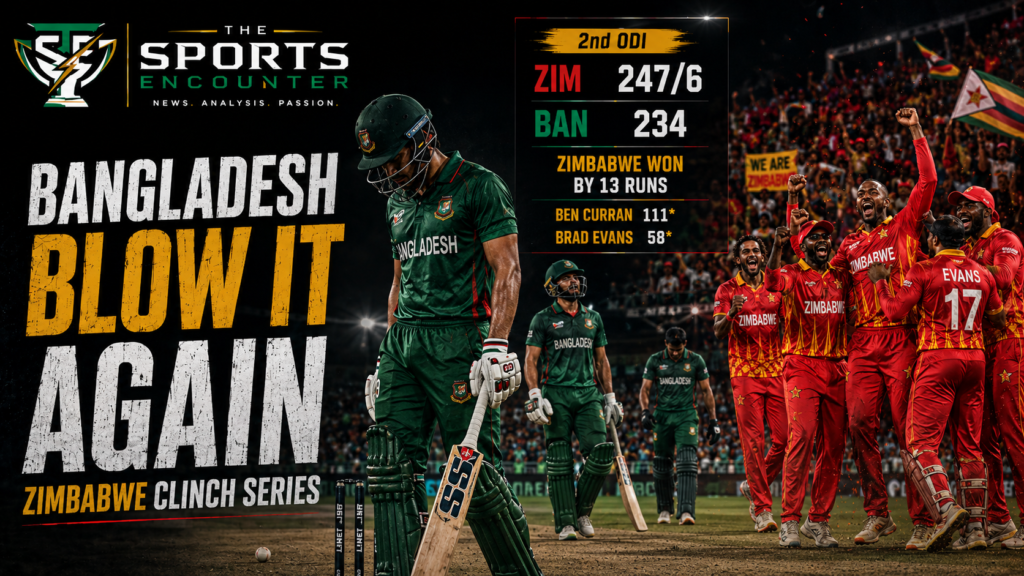
Bangladesh did not lose this match because the target was impossible. They lost it because the chase again became too heavy for their temperament.

At one stage in Harare, 248 looked manageable. Tanzid Hasan Tamim had given Bangladesh a base. Towhid Hridoy had settled in. Nurul Hasan had added urgency. The required rate was under control, and Zimbabwe were searching for one more opening.

Then Bangladesh opened the door themselves.

Wickets fell at the wrong time, poor choices returned, and another chase that should have been finished with calm turned into a familiar late-innings mess. Zimbabwe kept fighting, kept believing, and eventually turned a competitive total into a series-clinching 13-run victory.

For Zimbabwe, this was a statement. For Bangladesh, it was another warning sign.

You can follow more cricket coverage in our Cricket News section.

TL;DR

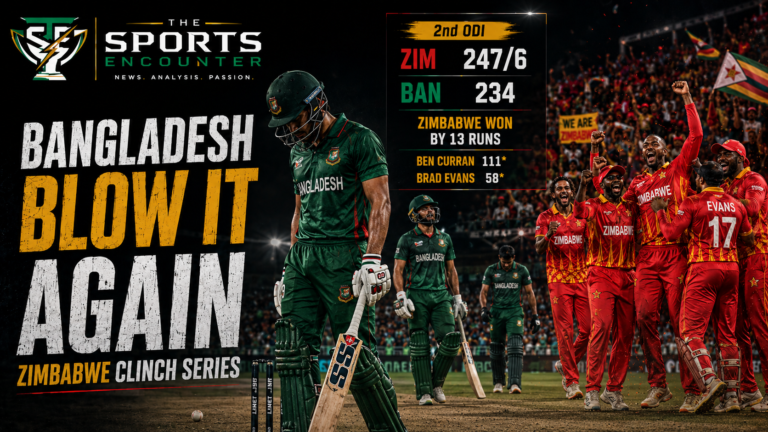
  • Zimbabwe beat Bangladesh by 13 runs in the 2nd ODI at Harare Sports Club.
  • Ben Curran carried Zimbabwe with an unbeaten 111 from 135 balls.
  • Brad Evans changed the innings with 58 not out from 38 balls, then took 2 wickets.
  • Bangladesh were well placed during the chase but collapsed from 207 for 5 to 234 all out.
  • Zimbabwe won the series 2-0 with one ODI still to play.
  • Bangladesh’s repeated failure under chase pressure has become the biggest story of the series.

Scorecard / Key Information Box

DetailInformation
MatchZimbabwe vs Bangladesh, 2nd ODI
ResultZimbabwe won by 13 runs
VenueHarare Sports Club, Harare
DateJuly 9, 2026
Zimbabwe247/6 in 50 overs
Bangladesh234 all out in 48.1 overs
Top PerformerBen Curran, 111 not out from 135 balls
Key SupportBrad Evans, 58 not out from 38 balls and 2 for 48
Turning PointBangladesh losing Nurul Hasan at 207 for 6, then collapsing under late pressure
What It MeansZimbabwe sealed the ODI series 2-0 with one match remaining

Ben Curran Carries Zimbabwe After Early Trouble

Bangladesh had good reason to feel satisfied after choosing to bowl first.

Taskin Ahmed struck twice inside the first three overs, removing Brian Bennett for a duck and Innocent Kaia for 4. Zimbabwe were 8 for 2, then 32 for 3 when Nahid Rana bowled Craig Ervine. At that stage, Bangladesh had the game moving in the direction they wanted.

The bowlers were disciplined enough to keep Zimbabwe under 250. Taskin finished with 2 for 57, Nahid Rana took 1 for 48, Mehidy Hasan Miraz returned a controlled 2 for 32, and Rishad Hossain picked up one wicket. Zimbabwe were never allowed to explode through the middle overs.

Yet Bangladesh could not remove Ben Curran.

Curran’s unbeaten 111 from 135 balls was not a reckless hundred. It was a patient, intelligent innings built around survival, tempo, and responsibility. Zimbabwe needed someone to bat deep after losing early wickets, and Curran accepted the role without chasing style points.

He added 68 with Sikandar Raza, who made 33 from 53 balls, and then found the perfect late-innings partner in Brad Evans. By the end, Curran had turned Zimbabwe’s innings from fragile to competitive.

For a team defending a series lead, that kind of innings carries more value than the strike rate alone suggests.

Brad Evans Changes the Shape of the Match

Zimbabwe were 148 for 6 in the 37th over when Brad Evans joined Curran.

Bangladesh should have closed the innings down from there. Instead, Evans shifted the pressure back.

His unbeaten 58 from 38 balls gave Zimbabwe the late acceleration they badly needed. He struck two fours and five sixes, taking advantage of anything loose and forcing Bangladesh to defend rather than attack. The unbroken 99-run stand between Curran and Evans turned 200 into 247 and gave Zimbabwe’s bowlers a total they could defend.

That partnership became the difference between a below-par score and a fighting score.

Zimbabwe still finished under 250, which means Bangladesh’s bowlers had done a lot right. But in ODI cricket, the last 10 overs often decide the emotional direction of the chase before it even starts. Bangladesh allowed Evans to give Zimbabwe belief.

That belief carried into the second innings.

For more context on how late lower-order runs can reshape a limited-overs match, read our recent report on Zimbabwe defending 141 after Nahid Rana’s six-wicket spell.

Bangladesh Had the Chase Under Control, Then Lost It

Bangladesh’s chase did not begin perfectly.

Soumya Sarkar fell for 5, and Najmul Hossain Shanto made only 9. At 38 for 2, Zimbabwe had early pressure. But Tanzid Hasan Tamim and Towhid Hridoy rebuilt the innings with an 84-run stand, giving Bangladesh a clear route toward the target.

Tanzid made 57 from 70 balls. Hridoy followed with 60 from 90. Both innings had value because they took Bangladesh close to the point where the chase should have become simple.

That is what makes the defeat harder to accept.

Bangladesh were 122 for 3 when Tanzid fell. They were 169 for 4 when Hridoy was dismissed. Even at 207 for 6 after Nurul Hasan’s wicket, the chase was still within reach. Bangladesh needed 41 from 48 balls with four wickets in hand.

A mature ODI side finishes that match.

Bangladesh did not.

Rishad Hossain fell for 8. Taskin Ahmed was out for 0. Shoriful Islam was bowled by Evans for 6. Mehidy Hasan Miraz, left with the responsibility of finishing the chase, was caught off Richard Ngarava for 27 as Bangladesh were bowled out for 234.

This was less about Zimbabwe finding magic and more about Bangladesh gifting the match away under pressure.

Zimbabwe’s Bowlers Were Disciplined, Patient, and Mature

Zimbabwe’s bowling effort deserves serious credit.

They did not panic when Bangladesh had partnerships. They did not scatter the field too early. They kept asking batters to make decisions, and Bangladesh kept making the wrong ones.

Richard Ngarava led the attack with 3 for 55 and took the final wicket. Blessing Muzarabani’s 2 for 33 from 10 overs was arguably just as important because he controlled the chase from the top. Evans backed up his batting with 2 for 48, while Sikandar Raza, Brian Bennett, and Wessly Madhevere each found key breakthroughs.

Bennett’s wicket of Tanzid was especially important because it broke the stand that had given Bangladesh control. Madhevere’s dismissal of Hridoy was another turning point. Ngarava’s removal of Nurul Hasan pushed the game toward Zimbabwe again.

This was mature defensive bowling. Zimbabwe did not bowl like a team hoping Bangladesh would collapse. They bowled like a team that believed pressure could be built one over at a time.

The result proves they were right.

Bangladesh’s Batting Problem Is Now a Pattern

One poor chase can be dismissed as a bad day. Two in a row begins to look like a pattern.

Bangladesh failed to chase 142 in the first ODI. They then failed to chase 248 in the second. The targets were different, but the problem looked familiar: batters getting starts, losing control, and leaving too much emotional weight for the lower order.

There is enough skill in this batting lineup. Tanzid made a half-century. Hridoy made a fighting 60. Nurul’s 38 from 41 kept the chase alive. Mehidy showed enough calm to keep Bangladesh interested late.

But the collective game sense was not strong enough.

Bangladesh batters continued to give wickets away when the situation called for restraint. Several dismissals came at points where the only real demand was to stay in the match. Zimbabwe were disciplined, but Bangladesh helped them too often.

This is where Bangladesh need a more honest review. The issue is not only shot selection. It is chase structure, match awareness, and responsibility under pressure.

A similar discussion has surrounded other recent batting collapses in international cricket, including India’s poor decision-making in their heavy T20I defeat against England.

Zimbabwe’s Series Win Feels Bigger Than the Margin

Zimbabwe have now won the series with one match to spare.

That matters because both wins came from pressure positions. In the first ODI, they defended 141 after being bowled out cheaply. In the second, they recovered from 148 for 6, posted 247, then defended it after Bangladesh seemed well placed.

This is how teams build belief.

Sikandar Raza summed up the change in Zimbabwe’s mindset after the match, saying the team now believes it can win from any position. That line fits what has happened in this series. Zimbabwe have been tested twice and have refused to go away twice.

For Bangladesh, the third ODI is no longer only about avoiding a clean sweep. It is about restoring some confidence in a batting unit that looks increasingly unsure when chasing.

For Zimbabwe, the final match is a chance to turn a series win into a stronger message about direction, character, and home advantage.

You can also read our cricket features on Kapil Dev’s lasting influence on Indian cricket, Babar Azam’s return as Pakistan Test captain, and how Bazball changed and exposed England.

For official international cricket rankings and fixtures context, visit the ICC’s official ODI rankings page.

Final Word

Zimbabwe won this ODI because they stayed in the contest longer than Bangladesh.

Ben Curran gave them the innings. Brad Evans gave them the surge. Ngarava, Muzarabani, Evans, Raza, Bennett, and Madhevere gave them the wickets. The crowd gave them energy. The result gave them the series.

Bangladesh, meanwhile, will leave Harare with a familiar frustration. Their bowlers kept Zimbabwe under 250. Their batters built enough of a platform. The match was there to be won.

Then pressure arrived, and Bangladesh folded again.

That is the real story of the 2nd ODI. Zimbabwe did not need Bangladesh to be terrible for 100 overs. They only needed them to lose discipline for one decisive stretch.

Bangladesh obliged.

Founder/Senior Editor | Dubai, UAE Hamad Hussain is the Founder and Senior Editor of The Sports Encounter, where he leads editorial direction, sports coverage standards, and reader-first storytelling. His work focuses on cricket, sports opinion, athlete performance, team selection debates, match analysis, and fan-first sports coverage. He brings more than 22 years of leadership experience across corporate governance, operations, finance, HR, administration, and business development, giving his sports analysis a structured and decision-focused edge. Before leading The Sports Encounter, Hamad worked with the platform as a Sports Analyst from 2010 to 2015. Coverage areas: Cricket, sports opinion, team analysis, athlete performance, selection debates, editorial direction.

Breaking News

Meet the New Most Expensive Player in NHL History

The Anaheim Ducks matched a five-year, $90 million offer sheet to keep Leo Carlsson, making the 21-year-old center the highest-paid player per season in NHL history and reshaping the contract market for young stars.

Marcos Wetherfield | The Sports Encounter

Published

on

Back view of an NHL player standing on the ice as dollar bills rain down around him in a dramatic record-deal themed graphic.

The NHL’s richest annual contract now belongs to a 21-year-old center who has played only three regular seasons.

That sentence alone explains why the Anaheim Ducks’ decision to match the Philadelphia Flyers’ offer sheet is more than a team transaction. It is a league-wide reset.

The player is Leo Carlsson, the Swedish center Anaheim selected No. 2 overall in the 2023 NHL Draft. The deal is a five-year, $90 million contract with an average annual value of $18 million, making Carlsson the highest-paid player in NHL history on a per-season basis. For readers following The Sports Encounter’s wider NHL coverage, this is one of the most aggressive contract moments the league has seen in years.

The Ducks had a choice. They could match the offer sheet and keep their franchise center at a massive price, or they could let him go to Philadelphia and receive four first-round draft picks as compensation. Anaheim chose certainty over draft capital. In doing so, the Ducks kept the player they believe can define their next era.

The Contract That Forced Anaheim’s Hand

Philadelphia’s offer sheet was designed to create pressure.

A five-year term kept the deal short enough to return Carlsson to unrestricted free agency in 2031, while the $18 million annual value placed him above every player in the league on a per-season basis. According to the official NHL report on Carlsson’s offer sheet, the contract was worth $90 million over five years and would have required four first-round picks as compensation if Anaheim did not match.

That structure made the decision uncomfortable. Four first-round picks are not small compensation. In a rebuild, they can shape half a decade of roster construction. But Carlsson is not a normal restricted free agent. He is a young top-line center, a premium position player, and already one of the most important pieces in Anaheim’s rebuild.

For the Ducks, the question was never only about money. It was about identity.

Do you let a franchise center leave because the price is uncomfortable, or do you pay the price because players like this rarely become available?

Anaheim gave its answer.

Why the Ducks Could Not Let Him Walk

Carlsson’s rise explains the match.

Last season, he posted career highs with 29 goals, 38 assists, and 67 points in 70 regular-season games. He also added 11 points in 12 playoff games as Anaheim pushed deeper into the postseason picture. Across his first 201 regular-season games, he has produced 141 points, including 61 goals and 80 assists.

Those numbers matter, but they do not tell the whole story.

At 6-foot-3 and over 200 pounds, Carlsson gives Anaheim size down the middle. He can handle matchups, create offense, and grow into the kind of two-way center who changes how a team is built. Elite centers are hockey’s structural pieces. Wingers can score. Defensemen can tilt the ice. Goalies can steal nights. But a true No. 1 center gives a franchise its spine.

That is why the Ducks’ front office viewed him as non-negotiable.

General manager Pat Verbeek said Anaheim had viewed Carlsson as a franchise player since meeting him before the 2023 draft. Ducks owners Henry and Susan Samueli also made clear that the team had planned its cap space with the ability to keep him. That language matters because it frames the deal as a long-term bet, not a panic reaction.

Philadelphia Lost the Player but Still Changed the Market

The Flyers did not get Carlsson, but they still shook the NHL.

Offer sheets remain rare because they are aggressive by nature. They test another team’s cap structure, force public decisions, and sometimes strain relationships between front offices. Philadelphia knew Anaheim had the right to match. That was the point. The Flyers made the Ducks pay a historic price to keep their own player.

That strategy may not deliver Carlsson to Philadelphia, but it sends a message to the rest of the league. Young restricted free agents now have a new reference point. Agents will look at this deal when negotiating for other emerging stars. General managers will look at their cap tables differently. Teams with unsigned young centers and franchise forwards will know that another club may not wait politely for negotiations to finish.

This is why the contract matters beyond Anaheim. It pushes the restricted free-agent market into a more dangerous place for teams that delay business with cornerstone players.

Highest Paid Does Not Mean Safest Bet

Carlsson is now the NHL’s highest-paid player per season, but that does not mean the deal is risk-free.

Anaheim is paying for what he is and what it believes he will become. At 21, he has already shown top-line production, playoff impact, and franchise-player traits. Still, $18 million per season creates pressure. Every cold stretch will be discussed. Every comparison with other elite centers will follow him. Every playoff failure will make the number louder.

The Ducks are betting that his prime years will justify the price.

That is not an unreasonable bet. Carlsson’s age gives Anaheim upside. This is not a late-career contract for past achievement. It is a front-loaded belief in future value. If he becomes one of the league’s truly elite centers, the deal could age better than it looks today, especially if the salary cap continues to rise.

The risk is that the contract immediately changes the standard by which Carlsson is judged. He is no longer only a promising young center. He is the NHL’s highest-paid player per season.

What This Means for Anaheim’s Rebuild

The Ducks have now made their clearest statement yet about the direction of the franchise.

This team is no longer only collecting prospects and waiting for the future. Anaheim has committed superstar-level money to the player it believes can carry that future. The next step is harder: building a serious contender around him.

That means drafting well, developing young talent, managing cap space, and avoiding the trap of paying too much around one centerpiece. Carlsson can be the foundation, but he cannot be the whole structure.

Anonymous hockey player stands on the ice under arena lights beside the headline “Meet the New Most Expensive Player in the NHL History” in a dramatic NHL-themed graphic.

For context, The Sports Encounter has already tracked several major NHL roster and ownership moves this offseason, including major NHL updates, Pittsburgh’s ownership change, and Florida’s Stanley Cup favorite push after the Brady Tkachuk blockbuster. Carlsson’s contract belongs in that same offseason conversation because it changes competitive planning, not just payroll.

Anaheim now has its center. The challenge is turning that center into a championship timeline.

Why the No-Trade Restriction Matters

Because Anaheim matched the offer sheet, Carlsson cannot be traded for at least one year.

That detail protects the spirit of the offer-sheet system. A team cannot simply match the contract and immediately flip the player elsewhere. The Ducks are now committed to keeping him and absorbing the cap impact, at least in the short term.

That also gives Carlsson stability. He wanted Anaheim to match, and now he gets the security of a massive contract while remaining with the team that drafted him. His comments made that clear. The offer was enormous, but he still wanted to stay a Duck.

For a young player, that matters. Money changes expectations, but comfort and role can shape performance. Carlsson knows Anaheim’s room, market, coaching environment, and organizational direction. Now he has to grow from franchise cornerstone into franchise driver.

Key Facts

DetailInformation
PlayerLeo Carlsson
TeamAnaheim Ducks
Offer Sheet TeamPhiladelphia Flyers
ContractFive years, $90 million
Average Annual Value$18 million
NHL SignificanceHighest-paid player per season in league history
Compensation If Not MatchedFour first-round draft picks
2025-26 Production29 goals, 38 assists, 67 points in 70 games
Career Production141 points in 201 regular-season games
Draft PositionNo. 2 overall in the 2023 NHL Draft

The Bigger Contract Lesson

This deal will not stay isolated.

Every major young player negotiation now has a new ceiling to discuss. Carlsson’s contract gives agents a stronger argument for elite restricted free agents. It also gives aggressive teams a blueprint. If a rival club has a franchise player unsigned and limited cap room, an offer sheet can become a weapon.

That does not mean the NHL will suddenly become an offer-sheet league. Front offices still move carefully. Draft-pick compensation is expensive, and relationships matter. But Philadelphia proved that the tactic can create pressure even when it fails to land the player.

The Flyers forced Anaheim into a historic contract. That alone makes the move successful in a disruptive sense.

FAQs

Who became the highest-paid NHL player per season?

Leo Carlsson became the NHL’s highest-paid player per season after the Anaheim Ducks matched the Philadelphia Flyers’ five-year, $90 million offer sheet.

How much is Leo Carlsson’s new contract worth?

The contract is worth $90 million over five years, with an average annual value of $18 million.

Why did the Ducks match the offer sheet?

Anaheim matched because Carlsson is viewed as a franchise center and one of the core players in the Ducks’ long-term rebuild.

What would the Flyers have paid in compensation?

If Anaheim had not matched, Philadelphia would have owed the Ducks four first-round draft picks.

Can Anaheim trade Leo Carlsson now?

No. Because Anaheim matched the offer sheet, Carlsson cannot be traded for at least one year.

Final Word

The NHL’s richest annual signing is not only about Leo Carlsson getting paid.

It is about a young star becoming the center of a franchise’s future, a rival team forcing a historic decision, and a contract market that now has a new number everyone will remember.

Anaheim kept its player. Philadelphia made its point. Carlsson got the deal of a lifetime and the responsibility that comes with it.

Now the hockey part begins.

For the Ducks, this contract will be judged by more than goals and assists. It will be judged by whether Carlsson becomes the elite center Anaheim believes it just paid for.

Continue Reading

Breaking News

France Punish Below-Par Morocco After Bounou’s First-Half Heroics

Mbappé missed a penalty, then scored a stunning second-half goal as France beat Morocco 2-0 to reach the World Cup 2026 semifinals.

Miley Rumer | The Sports Encounter

Published

on

France Punish Below-Par Morocco After Bounou’s First-Half Heroics

France did not turn their quarterfinal dominance into a first-half lead. That was the only thing keeping Morocco alive.

For 45 minutes, Les Bleus controlled the field, controlled the rhythm, and kept finding ways into dangerous spaces. Morocco’s goalkeeper Yassine Bounou stood between France and a heavy scoreline, saving Kylian Mbappé’s penalty just before the first hydration break and keeping his team in the match when the pressure should have broken them.

Then the second half arrived, and Mbappé corrected the story.

His 60th-minute goal broke Morocco’s resistance, Ousmane Dembélé added the second six minutes later, and France moved into the FIFA World Cup 2026 semifinals with a 2-0 win that felt more comfortable than the scoreline suggested.

For Morocco, this was a painful end to another proud World Cup run. For France, it was another reminder that their ceiling remains frighteningly high.

Follow more tournament coverage through our FIFA World Cup 2026 hub.

TL;DR

  • France beat Morocco 2-0 in the first FIFA World Cup 2026 quarterfinal.
  • Kylian Mbappé missed a first-half penalty before scoring a superb goal in the 60th minute.
  • Ousmane Dembélé doubled France’s lead in the 66th minute.
  • Yassine Bounou kept Morocco alive with an exceptional goalkeeping display.
  • France dominated the match, while Morocco struggled to create meaningful chances.
  • Les Bleus now look like one of the strongest contenders to lift the World Cup.

Scorecard / Key Information Box

DetailInformation
MatchFrance vs Morocco, FIFA World Cup 2026 Quarterfinal
ResultFrance beat Morocco 2-0
VenueFoxborough, Massachusetts, USA
DateJuly 9, 2026
GoalsKylian Mbappé 60’, Ousmane Dembélé 66’
Top PerformerKylian Mbappé, goal after missed penalty and constant attacking threat
Turning PointMbappé’s 60th-minute curling finish after Bounou had saved his first-half penalty
What It MeansFrance reached the World Cup semifinals and strengthened their title credentials

France Controlled the First Half, But Bounou Refused to Break

The first half told two stories at once.

France were the better team by a wide margin. Their movement was sharper, their passing had more intent, and their attacking players kept Morocco pinned deep for long spells. Morocco, by contrast, looked unusually passive for a knockout match of this size.

The numbers reflected that imbalance. France produced wave after wave of pressure, while Morocco barely threatened Mike Maignan’s goal. ESPN’s match feed showed France far ahead in attacking output, with Morocco unable to generate a shot on target in the available match data.

Yet the score remained 0-0 at halftime.

That was mostly because of Bounou.

Morocco’s goalkeeper had one of those first halves where a goalkeeper changes the emotional temperature of the match. He saved from dangerous positions, read the moment well, and then delivered the biggest intervention of the half when Mbappé stepped up from the penalty spot.

Mbappé’s penalty came after a long delay, and the wait seemed to affect him. His run-up lacked authority, the strike lacked conviction, and Bounou read it well enough to make the save. Guardian’s live report described the penalty as an easy one for Bounou after Mbappé aimed toward the bottom right without enough power or placement.

That miss added Mbappé to a growing list of superstar penalty drama at this World Cup, with Lionel Messi already part of that conversation earlier in the tournament. It also became the fifth saved penalty of FIFA World Cup 2026, a trend that has made penalty technique, run-ups, and goalkeeper preparation one of the major tactical subplots of the competition.

Read more on that debate in our explainer on whether stutter-step penalties should be allowed.

Morocco Survived the First Half, But Never Looked Comfortable

Morocco deserved credit for surviving the pressure, but survival was never going to be enough.

Their defensive line spent too much of the first half reacting rather than shaping the match. Achraf Hakimi had flashes, but Morocco’s attacking structure lacked rhythm. Brahim Díaz and the front line struggled to receive the ball in areas where they could turn and hurt France. The midfield could not build long enough sequences to pull France out of position.

This was not the Morocco that had troubled bigger sides through aggression, discipline, and fast breaks.

This was a Morocco side stuck between defending deep and trying to find a way forward without enough support. The result was a performance that felt below par for a team playing a World Cup quarterfinal.

That made Bounou’s work even more valuable. Without him, this match could easily have moved into 4-0, 5-0, or worse territory before France’s second-half goals. The final score was respectable. The balance of play was not.

For background on the rivalry and emotional stakes, read our preview: France vs Morocco Preview: Revenge, Pride, and a Brutal Road to the Semifinal.

Mbappé’s 60th-Minute Goal Changed the Match

The best players do not always avoid mistakes. They recover from them quickly enough to still define the match.

Mbappé did exactly that.

In the 60th minute, he received the ball near the left edge of the Morocco box, shifted inside, and bent a beautiful finish beyond Bounou. Guardian’s live report described the strike as a curler into the right side of the net, with Bounou fully extended but unable to reach it.

It was a classic Mbappé moment because it came from a position where defenders know the danger and still cannot stop it.

The goal also took his World Cup 2026 tally to eight, pushing him deeper into Golden Boot territory and strengthening the feeling that France’s tournament is increasingly being shaped around his attacking presence.

There was a psychological release in that goal. France had been frustrated for nearly an hour. Morocco had been hanging on. Bounou had won the penalty duel. Then Mbappé found the shot that no goalkeeper could stop.

From that moment, the match changed.

France no longer had to force the game. Morocco had to open up. That suited Les Bleus perfectly.

For more on the tournament’s biggest attacking stars, read our profile on Erling Haaland’s records, career, and World Cup hope.

Dembélé Ends the Contest Before the Second Hydration Break

Morocco barely had time to reset.

Six minutes after Mbappé’s opener, Ousmane Dembélé doubled France’s lead with a low drive from the edge of the area. The goal came in the 66th minute, just before the second hydration break, and it felt like the moment Morocco’s resistance finally cracked.

The strike itself came from a defensive lapse. Dembélé was allowed to advance too far without enough pressure. Once he had the space, he drove the ball low toward the corner. Bounou got a hand to it, but this time he could not keep it out.

That was the difference between surviving and competing.

Morocco had survived France for an hour. After Dembélé’s goal, they needed to chase a game they had never truly controlled. The energy went out of their defensive block, and France were able to manage the rest of the contest with authority.

The 2-0 scoreline was familiar from their 2022 World Cup semifinal meeting. The feeling was similar too: Morocco competed with heart, but France had the greater attacking quality when the decisive moments arrived.

Mbappé Magic Makes France Look Like a Serious Title Threat

France now look like a team moving from contender to favorite conversation.

They have depth, pace, balance, and enough individual quality to win matches even when they waste chances. That is the mark of a dangerous tournament side. They can dominate through structure, then finish through talent.

Mbappé remains the obvious headline. Eight goals at this stage of a World Cup is a serious statement. He has not only scored in volume, he has scored at moments that bend matches toward France. Even his penalty miss did not define his night. His response did.

Dembélé’s goal matters too. France need their attack to be more than one player, and this quarterfinal showed again that opponents cannot collapse only toward Mbappé. Dembélé, Michael Olise, Désiré Doué, Bradley Barcola, and France’s midfield runners give Didier Deschamps different ways to stretch a game.

That variety is what makes France so difficult to contain.

The only concern is efficiency. France had enough chances to make this a much heavier defeat for Morocco. Bounou’s brilliance was part of that, but France will know that semifinal football may not offer the same volume of openings.

Still, this was a strong performance. France controlled the match, absorbed their own missed penalty drama, then killed the contest in six second-half minutes.

Morocco’s Dream Ends With Pride, But Also Questions

Morocco can leave this World Cup with dignity. Their run again carried emotional weight for African and Arab football, and their earlier performances gave fans real belief.

But this quarterfinal will hurt because Morocco did not produce their best football on the biggest night.

They were too passive in the first half, too limited in possession, and too dependent on Bounou. Their goalkeeper gave them a chance to reach halftime level. Their outfield structure did not turn that chance into a serious second-half platform.

Diop’s yellow card in the 63rd minute, after bringing down Mbappé, summed up the pressure Morocco were under after France’s opener. Guardian’s live report confirmed the booking, which came during France’s strongest spell of the match.

There were no confirmed red cards in the available match feeds reviewed.

Morocco’s defensive resilience kept the score respectable, but France’s superiority was clear. The Atlas Lions needed a near-perfect tactical performance. They received a brilliant goalkeeper performance instead.

That was not enough.

For readers following tournament discipline and officiating themes, our guide on what counts as a foul in soccer explains how referees judge contact, fouls, and punishment in match situations.

What This Means for France

France are into the semifinals, and the warning to the rest of the World Cup is clear.

They do not need a perfect match to win. They can miss a penalty, waste chances, deal with a locked defensive block, and still find enough quality to decide a quarterfinal in six minutes.

That is why this win matters.

It was not only about beating Morocco. It was about showing that France can stay calm when dominance does not immediately become a lead. Tournament football often punishes impatient teams. France were frustrated, but they did not lose their shape.

Mbappé’s missed penalty could have made the night awkward. His goal turned it into another chapter of his growing World Cup authority.

France now move one step closer to another final. The squad has the firepower to go all the way, and after this performance, it is fair to say they look like one of the most serious contenders left in the tournament.

For official tournament schedules, fixtures, and results, visit FIFA’s World Cup 2026 match schedule page.

Morocco’s Run Ends as the Last Arab Nation Heads Home

Morocco also carried a wider emotional weight into this quarterfinal. They were the last Arab nation left in the FIFA World Cup 2026 knockout race, and their exit means the Arab challenge is now over.

That makes the performance more disappointing.

Morocco did not go out with the same fire Egypt showed against Argentina in the Round of 16. Egypt fought with real hunger, pushed the world champions hard, and left the tournament with pride despite defeat. Morocco, by contrast, looked strangely complacent for long spells against France. They defended, they survived, and they relied heavily on Bounou, but they never truly made France uncomfortable enough.

The final attacking numbers told the same story. France produced 22 total attempts compared to Morocco’s 5, underlining how one-sided the contest became. Morocco’s goalkeeper kept the scoreline respectable, but the outfield performance did not match the size of the occasion. ESPN’s match feed had already shown France far ahead in attacking output during the second half, with Morocco struggling to generate any real threat on goal.

That is why this defeat will sting. Morocco had the talent, the emotional backing, and the recent World Cup pedigree to make this a ruthless contest. Instead, France controlled the game, waited for their breakthrough, and then finished the job in six second-half minutes.

For Arab football, Egypt left with bruises but also respect. Morocco leave with a stronger question: why did a team this capable look so flat in a quarterfinal?

Final Word

France beat Morocco 2-0 because they played like a semifinal team. Morocco did not.

Bounou gave the Atlas Lions a fighting chance with his first-half penalty save and several important stops, but Morocco never turned that lifeline into pressure. The last Arab nation standing is now heading home, and the hardest part for Morocco fans will be the manner of the exit.

Egypt had gone down swinging against Argentina. Morocco went down waiting for something to happen.

Mbappé made sure it did not.

He missed from the spot, then answered with the kind of goal that separates great players from ordinary ones. Dembélé followed six minutes later, and France walked into the semifinals with authority.

The missed penalty will be part of the story.

The response is the headline.

Continue Reading

Breaking News

Spain vs Belgium: La Roja’s Control Meets Belgium’s Knockout Fire

Spain bring control, form, and defensive authority into their World Cup quarterfinal against Belgium, but De Ketelaere, Courtois, and Belgian belief make this a dangerous test.

Ruben Santos | The Sports Encounter

Published

on

Spain vs Belgium: La Roja’s Control Meets Belgium’s Knockout Fire.

The question around Spain has changed.

Earlier in the FIFA World Cup 2026, it was about whether La Roja had enough edge to survive the knockout pressure. Now, after eliminating Portugal with a stoppage-time winner, the question is sharper: can Spain turn control into a semifinal place against a Belgium side that suddenly looks dangerous again?

This second quarterfinal at Los Angeles Stadium brings two very different forms of momentum. Spain arrive with structure, patience, pressing discipline, and the confidence of a team that has learned how to win tight games. Belgium arrive with release, attacking belief, and the emotional lift of a 4-1 Round of 16 statement against the United States.

For full tournament coverage, follow The Sports Encounter’s FIFA World Cup 2026 hub.

TL;DR

  • Spain face Belgium in the FIFA World Cup 2026 quarterfinal at Los Angeles Stadium on July 10.
  • Spain reached this stage after beating Portugal 1-0 through a late Mikel Merino goal.
  • Belgium stormed past the United States 4-1 in the Round of 16, with Charles De Ketelaere producing a breakout knockout display.
  • Spain appear in better overall shape because of their balance, unbeaten rhythm, and defensive control.
  • Belgium have momentum too, but their defense must solve the biggest question of the match: how to contain Lamine Yamal.
  • The winner moves into the semifinal and stays alive in a tournament where Europe’s heavyweights have begun to separate themselves.

Key Information Box

DetailInformation
MatchSpain vs Belgium
CompetitionFIFA World Cup 2026 Quarterfinal
VenueLos Angeles Stadium, Inglewood
DateJuly 10, 2026
Kickoff19:00 GMT
RefereeMichael Oliver
Spain Round of 16 ResultSpain 1-0 Portugal
Belgium Round of 16 ResultBelgium 4-1 United States
Main DuelLamine Yamal vs Belgium defense
Head-to-Head22 meetings: Spain 12 wins, Belgium 5 wins, 5 draws
What It MeansWinner advances to the FIFA World Cup 2026 semifinal

Spain Arrive With Control, But Also a New Kind of Edge

Spain have carried one of the cleanest tournament profiles into the quarterfinals.

They have not always overwhelmed opponents with chaos or constant goal rushes. Their strength has been more measured: ball control, positional discipline, technical security, and a midfield that can suffocate rhythm before the opposition finds comfort.

The 3-0 win over Austria in the Round of 32 showed Spain’s sharper side. Mikel Oyarzabal scored twice, Pedro Porro added another, and Lamine Yamal stretched Austria’s defensive shape with his movement and timing. That performance, covered in The Sports Encounter’s report on Spain’s commanding Austria win, gave La Roja the attacking authority they needed after earlier questions about whether they could turn possession into punishment.

Then came Portugal.

Spain’s 1-0 Round of 16 win was a different type of proof. They did not need a perfect attacking display. They needed patience, control, nerve, and a late killer moment. Mikel Merino’s stoppage-time winner ended Portugal’s World Cup and likely closed Cristiano Ronaldo’s World Cup story. More importantly for Spain, it confirmed that this team can win a knockout match when the rhythm becomes uncomfortable.

That is why Spain come into this quarterfinal in better overall shape. They have control when the game is open, discipline when the game is tight, and enough bench depth to change the mood late. Their tournament has built layer by layer.

Read more on that emotional knockout night in The Sports Encounter’s report: Spain End Ronaldo’s World Cup Dream With Brutal Late Winner.

Belgium’s Tournament Has Been Messier, But the Belief Is Back

Belgium’s path has been less smooth.

Their group-stage campaign had warning signs. Draws against Egypt and Iran raised questions about tempo, creativity, and whether this version of Belgium still had enough sharpness to go deep. The 5-1 win over New Zealand helped reset the mood, but it did not fully erase the feeling that Belgium were still searching for their best version.

The Round of 16 changed that conversation.

Belgium’s 4-1 win over the United States was their most convincing performance of the tournament. Charles De Ketelaere delivered the kind of display that can change how opponents prepare. His brace gave Belgium a younger attacking reference point beyond the familiar names, while Thibaut Courtois, Kevin De Bruyne, and Romelu Lukaku still give the squad high-level experience around pressure moments.

The win also carried political and emotional noise after the buildup around Folarin Balogun’s availability, which The Sports Encounter covered in its analysis of USA vs Belgium becoming a major World Cup rules debate. Belgium handled that distraction well. Once the match started, they looked sharper, stronger, and far more ruthless than they had earlier in the tournament.

Their 4-1 win also ended the host nation’s run and gave Belgium genuine momentum before facing Spain. The Sports Encounter’s match report on USA’s World Cup dream ending against Belgium remains the key internal reference for that performance.

Which Team Is in Better Shape?

Spain are in better shape overall.

That does not make this match simple. Belgium have the individual quality to hurt any team left in the competition. Courtois can keep them alive. De Bruyne can still find passes that bypass structure. Lukaku can create physical problems late. De Ketelaere now gives Belgium a forward runner with confidence and form.

Still, Spain look more complete.

Their midfield has more control. Their defensive structure has been more reliable. Their wide threat is more consistent. Their unbeaten rhythm under Luis de la Fuente gives them the feel of a team that trusts its own mechanisms rather than waiting for individual rescue acts.

Belgium’s momentum is real, but Spain’s momentum feels more stable.

There is also one selection concern for Belgium. Amadou Onana’s injury removes a major midfield presence, which matters against a Spain side that wants to dominate central zones and force opponents to defend for long spells. Without him, Belgium may need extra defensive discipline from their midfield line and cleaner decision-making when they recover the ball.

Lamine Yamal vs Belgium’s Defense Could Decide the Match

Belgium’s defensive plan begins with Lamine Yamal.

Yamal has already become one of the defining young faces of this World Cup. His threat is not only about dribbling. He changes the geometry of Spain’s attack. When he receives wide, defenders hesitate. When he comes inside, midfielders are forced to decide whether to step out or protect the half-space. That hesitation creates Spain’s rhythm.

Belgium cannot defend him with one player alone.

If the fullback jumps too early, Yamal can slip passes inside or attack the outside shoulder. If Belgium double him too aggressively, Spain can switch play and find space on the far side. If they sit too deep, Spain can keep recycling possession until Rodri and the midfield begin to dictate every angle.

Belgium’s best answer may be controlled aggression. They need to reduce Yamal’s first touch comfort, block his inside passing lanes, and make him defend as much as possible by attacking Spain’s right side when possession turns over.

That is easier to say than to execute.

Yamal’s biggest weapon is calm. He rarely looks rushed. Belgium must avoid the mistake of turning this into a personal duel driven by emotion. The smarter plan is collective: pressure the passer, cover the inside lane, delay the dribble, and avoid cheap fouls near the box.

Spain’s Midfield Control vs Belgium’s Vertical Threat

Spain will likely try to make the match feel slow before making it suddenly fast.

That pattern suits them. Rodri’s presence gives Spain control over second balls and tempo. Pedri, Gavi, Merino, or whichever midfield combination de la Fuente chooses can keep Belgium moving side to side. The aim will be to tire Belgium’s midfield line, pull defenders out of shape, and let Yamal or Nico Williams attack when the space appears.

Belgium will want the opposite.

They need the game to open in moments. Their best chance may come from transitions, quick vertical passes, and early service before Spain’s rest defense settles. De Ketelaere’s confidence after the USA match makes him important here. He can run into gaps, receive between lines, and force Spain’s center backs to make decisions facing their own goal.

De Bruyne’s role could be decisive, even if he is managed carefully. If he gets time to lift his head, Belgium can turn one recovery into a scoring chance. Spain will know that. Cutting off his first forward option may be as important as pressing him directly.

Head-to-Head: Spain Hold the Historical Edge

Spain and Belgium have met 22 times in senior men’s international football.

Spain lead the head-to-head record with 12 wins, while Belgium have won five. Five matches have ended in draws. That history gives Spain the statistical edge, but knockout football rarely follows old records cleanly.

The more relevant pattern is recent competitive identity.

Spain have rebuilt themselves into a cohesive tournament team. Belgium, after years of carrying the “golden generation” label, now look like a side trying to blend old leadership with newer attacking energy. This quarterfinal will test whether Belgium’s reboot has enough substance to survive against one of the most structured teams in the tournament.

Tactical Keys to the Match

Tactical AreaSpain NeedBelgium Need
Wide PlayIsolate Yamal and Williams in advanced zonesStop first-touch comfort and protect half-spaces
Midfield BattleControl tempo through Rodri and quick passing trianglesSurvive without Onana and break pressure cleanly
TransitionsStop De Ketelaere and De Bruyne earlyAttack before Spain settle defensively
Set PiecesAvoid needless fouls around the boxUse size and delivery to disrupt Spain’s control
Bench ImpactRepeat the late-match influence shown against PortugalUse Lukaku, De Bruyne, or fresh runners at the right moment

What Spain Must Avoid

Spain must avoid turning control into comfort.

That has been a familiar danger for possession-heavy teams at World Cups. They can dominate the ball, push the opponent back, and still leave themselves exposed to one transition. Belgium have enough quality to punish that.

La Roja also need patience with purpose. Passing for control is useful only if it moves Belgium’s defensive block. If Spain become too slow, Belgium will settle into a compact shape and wait for counters.

The best version of Spain moves the ball quickly enough to shift the opponent, then accelerates through Yamal, Williams, Oyarzabal, or late midfield runners. That version can make Belgium defend too many zones at once.

What Belgium Must Do to Upset Spain

Belgium need courage, but reckless pressing would be dangerous.

They should pick pressing moments carefully, especially after backward passes or heavy touches. Spain are too comfortable technically to be chased blindly. Belgium must also protect the central spaces in front of their back line because that is where Spain can turn possession into control and control into chances.

Courtois will matter. His experience in Spanish football gives him insight into many of Spain’s players, but this match will still demand concentration for long stretches. Against Spain, goalkeepers can go quiet for 20 minutes and then suddenly face a decisive chance.

Belgium’s attacking players must also be efficient. They may not get many clear openings. When De Ketelaere, Lukaku, or De Bruyne see one, they have to make Spain feel the risk of pushing high.

Prediction: Spain Have the Edge, But Belgium Have the Punch

Spain should enter the FIFA World Cup 2026 quarterfinal as favorites.

They have the stronger tournament body of work, the cleaner tactical identity, and the better balance between control and threat. Their late win over Portugal showed they can carry pressure without panic. Their earlier win over Austria showed they can open up a knockout opponent when the attack clicks.

Belgium, though, are dangerous because they arrive with their best performance behind them. A 4-1 win over the United States gave them belief, goals, and a new attacking headline through De Ketelaere. If they score first, this match could become uncomfortable for Spain very quickly.

Still, the safer read is Spain by a narrow margin.

They look more stable. They have more ways to control the game. And if Lamine Yamal finds enough space against Belgium’s defense, La Roja may have the one player who can tilt a tight quarterfinal before Belgium’s veterans get their chance to rescue it.

For more knockout-stage context, read The Sports Encounter’s Round of 16 preview and the latest Soccer coverage.

Continue Reading

Breaking News