Connect with us

Breaking News

A Storm Before the Storm? Mexico vs England Gets an Unwanted Visitor at the Azteca

Mexico vs England was already one of the biggest Round of 16 matches of FIFA World Cup 2026. Then thunderstorms arrived near the Azteca and turned the buildup into a weather drama.

Miley Rumer | The Sports Encounter

Published

on

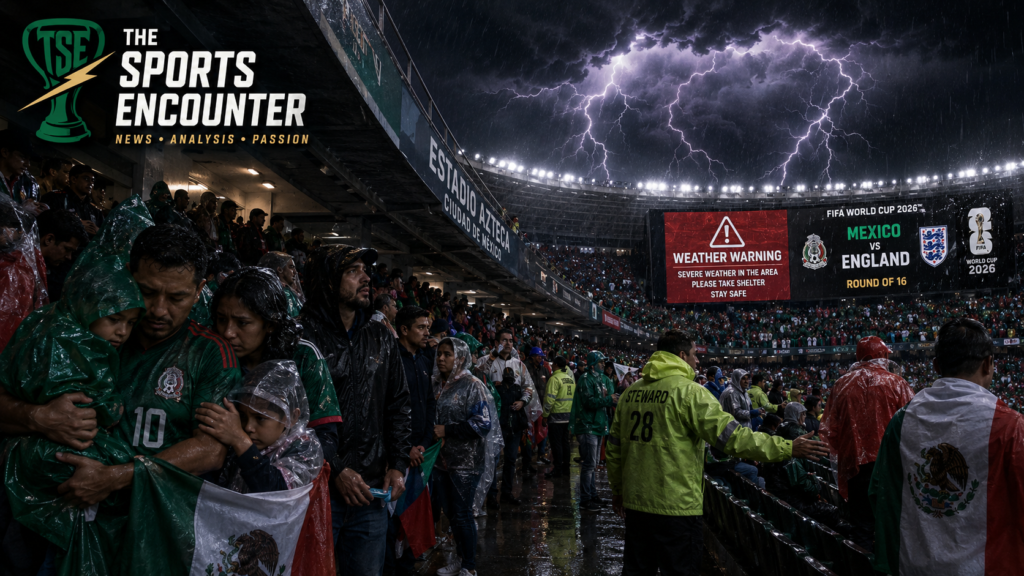
Soccer fans in rain ponchos take shelter at Estadio Azteca as a severe storm approaches before Mexico vs England at World Cup 2026.

The first warning at the Azteca did not come from Mexico’s press, England’s counterattack, or the noise of a crowd ready to shake one of football’s most historic stadiums.

It came from the sky.

Mexico vs England was supposed to begin as a football storm. A host nation chasing a deeper World Cup run. A European heavyweight stepping into altitude, noise, pressure, and memory. A Round of 16 match carrying national hope on one side and tournament expectation on the other.

Then severe weather moved into the story.

Key Facts Box

DetailInformation
MatchMexico vs England
CompetitionFIFA World Cup 2026
StageRound of 16
VenueEstadio Azteca, Mexico City
Main issueThunderstorms near the stadium
FIFA actionShelter-in-place order before kickoff
Stadium warning“Thunderstorm activated, please take your seats”
Fans affectedSupporters traveling to the venue sought cover under bridges and awnings
Wider concernWeather disruption, fan safety, kickoff planning, and tournament operations
Previous related issueMexico’s Round of 32 match against Ecuador was delayed due to rain

A shelter-in-place order was issued before the Mexico vs England FIFA World Cup 2026 last-16 clash after thunderstorms developed around Estadio Azteca. FIFA said people working on the pitch were asked to move into the tunnel, while the big screen inside the stadium warned that severe weather was approaching. Outside the venue, displays told fans: “Thunderstorm activated, please take your seats.”

For supporters walking toward the stadium, the night suddenly became less about chants and more about cover. Some fans were seen sheltering under bridges and awnings as the weather threatened to disrupt one of the tournament’s biggest knockout matches.

This was not just rain before kickoff.

It was a storm before the storm.

For readers following the wider knockout picture, the weather scare now adds another layer to a tournament phase already shaped by pressure, VAR debate, late drama, and shifting momentum in the FIFA World Cup 2026 Round of 16.

The Azteca Was Ready for Noise. It Got Thunder First

Estadio Azteca does not need help creating drama.

The stadium carries football memory in its concrete, shadows, tunnels, and upper tiers. It has hosted World Cup history that still feels alive decades later. Every major match there arrives with echoes.

Mexico vs England gave the place another emotional charge.

Mexico entered the night with the kind of pressure only a host nation knows. Fans did not come only to watch a match. They came carrying years of expectation, the dream of a deeper run, and the old desire to turn home advantage into history.

England arrived with a different burden. Every tournament match involving England travels with noise, scrutiny, hope, and fear. Recent performances had already tested the team’s control, especially after Harry Kane’s late brilliance in England’s comeback against DR Congo.

However, weather changed the buildup before either team could impose itself.

Thunderstorms do not care about tactical plans. They do not respect kickoff windows, television schedules, player routines, or national emotion. A storm can turn a knockout match into an operational emergency within minutes.

That is why the Azteca warning mattered.

The stadium was ready for a football explosion. Instead, it had to manage a safety alert.

Why This Was More Than a Weather Delay

Football has always had a strange romance with rain.
Supporters remember soaked shirts, sliding tackles, muddy socks, goalkeepers punching crosses through mist, and fans singing through storms. Rain can make football feel raw and beautiful.

Thunderstorms are different.

Rain affects the game. Lightning threatens lives.

That distinction matters. Once severe weather approaches a stadium, the issue moves beyond sporting inconvenience. Pitch staff, volunteers, security teams, camera crews, players warming up, and fans moving through open areas all become part of the safety equation.

FIFA reportedly considered moving the match forward but kept the original kickoff time. Local reports also suggested the fixture could move to 12:00 p.m. local time because of the forecast. In the end, the original plan remained.

That decision can be understood.

A World Cup knockout match cannot be moved casually. Broadcasters, transport systems, police planning, ticket holders, hospitality teams, volunteers, stadium workers, international viewers, and team routines all depend on timing. A change of several hours can create a different set of problems.

Still, keeping the kickoff time carried its own risk.

When a shelter order appears before a match, tournament organizers must explain the thinking behind the decision. Fans need clarity. Teams need confidence. Workers need instructions. Broadcasters need certainty, but safety must sit above schedule protection.

This is where FIFA faces the bigger test.

The governing body does not only run matches. It runs trust.

Supporters can follow official tournament information through the FIFA World Cup 2026 official website, which FIFA describes as the 23rd edition of the tournament and the first to feature 48 teams across three host countries.

Weather Has Become a World Cup 2026 Story

The Mexico vs England warning did not happen in isolation.

Mexico’s Round of 32 match against Ecuador had already been delayed because of rain. That earlier disruption should have made one thing clear: weather is not background scenery in this tournament. It is part of the competition environment.

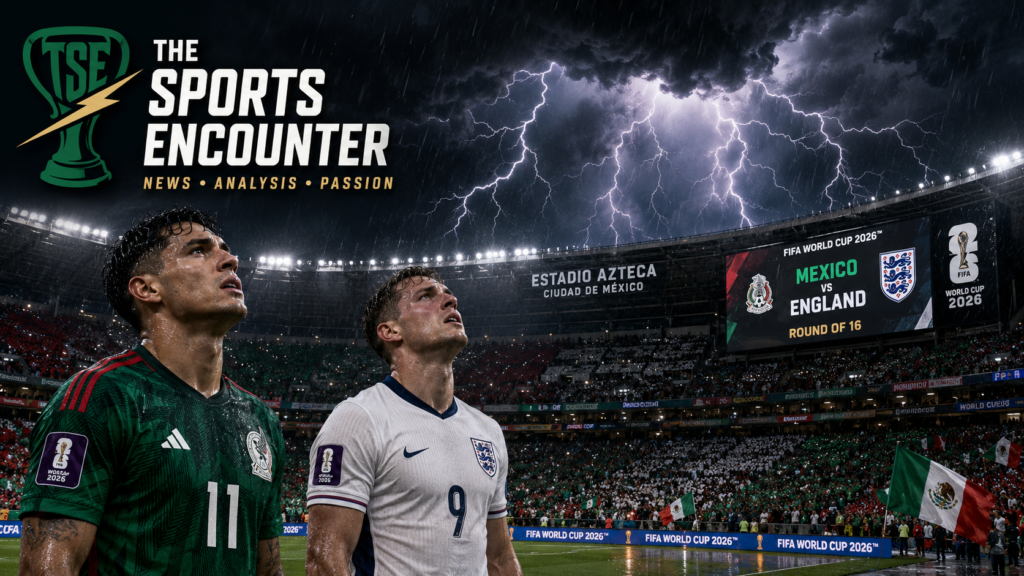
Mexico and England players look up at lightning above Estadio Azteca before their FIFA World Cup 2026 Round of 16 match.

World Cup 2026 has already stretched football across different climates, cities, altitudes, kickoff windows, and travel patterns. The tournament’s scale has created a bigger event, but it has also created more exposure to disruption.

Heat has been one part of the story. The debate over player welfare and match rhythm grew after hydration breaks became one of World Cup 2026’s most divisive issues. Now storms have added another layer.

Weather affects more than comfort.

A delayed warmup changes player routines. A slick pitch alters passing speed. Heavy rain can make defenders hesitate and goalkeepers spill shots. Lightning warnings can empty active areas, pause preparation, and create anxiety before the first whistle.

Meanwhile, fans experience the situation in a more personal way.

A supporter may spend months saving for tickets, travel, lodging, shirts, food, transport, and one unforgettable night. If severe weather hits near the stadium, that fan does not think in terms of “operational protocols.” They think about safety, family, shelter, timing, and whether they will still get to see the match they traveled for.

That human side must sit at the center of World Cup planning.

Mexico’s Home Advantage Meets a Different Kind of Pressure

For Mexico, the Azteca crowd is part of the team’s emotional engine.

Home fans do not simply fill seats. They lift duels, amplify pressure, energize transitions, and turn defensive clearances into moments of belief. At the Azteca, noise can become a tactical force.

Weather can interrupt that force.

If fans are delayed outside the stadium, the emotional buildup changes. If supporters arrive wet, anxious, or scattered, the first wave of atmosphere may feel different. A shelter warning can also turn a crowd from aggressive to cautious before kickoff.

Mexico had already shown the power of home momentum earlier in the tournament. Their group-stage charge included a confident performance in Mexico’s win over Czechia, while their tense battle with Korea Republic showed how narrow World Cup margins can become when one mistake changes everything in Mexico’s group-stage fight against South Korea.

Against England, every small shift matters.

A slower start can calm the visiting team. A broken rhythm can reduce the early emotional punch. A slick surface can favor quick transitions or punish loose defending. For Mexico, the mission becomes mental as much as tactical: stay ready, keep the crowd close, and make the storm feel like part of the night rather than a disruption to it.

England Must Handle More Than the Ball

England’s challenge is also bigger than the weather.

The team must manage altitude, crowd hostility, knockout pressure, and a host nation with everything to gain. Add storm disruption, and the night becomes a test of emotional control.

A weather delay can hurt a team that likes structure. Players warm up, stop, wait, stretch again, and restart. Coaches adjust messaging. Medical staff manage body temperature. Goalkeepers need touch and rhythm. Strikers need sharpness. Midfielders need their first few passes to settle.

For England, this creates a familiar tournament question: can they stay calm when the match refuses to unfold cleanly?

The answer may define the night.

Kane’s leadership becomes important. So does the experience of senior players who understand that knockout football rarely gives perfect conditions. England cannot allow the weather warning to become an excuse if Mexico starts fast.

Instead, they need to treat the first 15 minutes like a separate match.

Win second balls. Avoid panic clearances. Slow the crowd when needed. Use possession to breathe. Then build into the contest.

A storm can unsettle both teams, but the more composed side usually gains first.

Could Weather Change the Match Itself?

Yes, and not only through a delay.

A wet surface can increase ball speed and make first touches harder. Defenders may mistime tackles. Goalkeepers may struggle with shots that skid low. Set pieces become more dangerous because attackers need only one mistimed clearance or one loose punch.

In addition, heavy rain changes risk calculations.

Fullbacks may think twice before overlapping. Center backs may clear earlier. Midfielders may avoid turning under pressure. Coaches may ask for more direct balls into channels. Teams with strong second-ball reactions can benefit because matches become less polished and more instinctive.

For Mexico, that could help if they feed off emotion and quick forward pressure.

For England, it could help if they use Kane as a control point and attack loose defensive moments.

However, lightning protocols are the real line. Rain can become part of football. Lightning cannot. If conditions become unsafe, the match must wait.

That principle should never be negotiable.

Did FIFA Make the Right Call?

FIFA made the right move by issuing the shelter order.

Once thunderstorms threatened the area, safety had to come first. Moving pitch workers into the tunnel and warning fans through stadium displays showed that protocols were active. No World Cup match, regardless of size, should put people at avoidable risk.

The more complex issue is scheduling.

FIFA may have had strong weather data supporting the decision to keep the original kickoff time. Moving a match forward can create transportation confusion, crowd-control problems, broadcast disruption, and sporting imbalance. It can also punish fans who planned around the published schedule.

Even so, tournament organizers should communicate these decisions with more detail.

A short public explanation would help fans understand why kickoff stayed unchanged despite forecasts. It would also show that safety, not television convenience, guided the call.

In a tournament of this size, FIFA should consider regular weather protocol briefings for high-risk matches. Those updates could explain lightning thresholds, shelter guidance, delay rules, pitch inspections, fan movement advice, and decision timelines.

That would not remove disruption.

It would reduce confusion.

The Bigger Lesson for World Cup 2026

The 2026 World Cup is the biggest edition football has ever staged.

More teams. More matches. More host cities. More travel. More local climates. More operational complexity. That scale creates opportunity, but it also makes disruption more likely.

Weather will continue to matter.

Heat can affect hydration and tempo. Rain can delay matches. Storms can trigger safety orders. Altitude can change physical load. Travel can reduce recovery. A tournament this large must plan for reality, not the ideal version of summer football.

The same World Cup week has already produced wildly different forms of drama. Norway’s stunning Round of 16 win over Brazil showed how one missed penalty and one elite striker can destroy a favorite in Brazil’s World Cup nightmare against Haaland and Norway. Elsewhere, Portugal’s match with Croatia reminded fans how VAR and fine margins can turn a knockout tie into chaos in Portugal’s Round of 32 survival act.

Now Mexico vs England has added another type of drama.

Nature.

The sport can control referees, schedules, stadium operations, video systems, and disciplinary procedures. It cannot control the sky. That makes communication, safety planning, and flexibility essential parts of modern tournament leadership.

Why This Night Will Stay With Fans

Fans will remember the football, of course.

They will remember the tackles, saves, chances, goals, and emotional swings. Yet for many people at the Azteca, the memory may begin earlier: the warning on the screen, the sky darkening, the rush for shelter, the strange feeling that one of the world’s great stadiums had paused before it could roar.

That is what makes this story powerful.

A World Cup match is never only a match. It is a journey, a gathering, a family memory, a national ritual, and a personal investment. When the weather interrupts that, the emotion changes. Supporters become part of the uncertainty before players do.

For Mexico fans, the night already carried history.

For England fans, it carried pressure.

For FIFA, it carried a warning.

The biggest tournament in football cannot treat weather as an inconvenience. It must treat weather as part of the event.

Final Whistle Before the First Whistle

Mexico vs England was built for noise.

The Azteca was ready to shake. Mexico was ready to believe. England was ready to prove its control. Fans were ready for a knockout match that could tilt the tournament’s emotional map.

Then the storm arrived first.

That does not make the match smaller. In some ways, it makes it bigger. Football now has to share the stage with safety, weather, planning, and human patience.

If the match goes ahead cleanly, the storm warning may become part of the night’s mythology. If delays return, it will become part of a larger debate about how FIFA manages weather risk in the largest World Cup ever staged.

Either way, the message is clear.

At the Azteca, the first contest was not Mexico against England.

It was football against the weather.

FAQs

Why was there a shelter order before Mexico vs England?

A shelter-in-place order was issued because thunderstorms were reported around Estadio Azteca before the Mexico vs England Round of 16 match. People working on the pitch were moved into the tunnel, while fans inside and outside the venue received storm warnings.

Did FIFA delay Mexico vs England because of the weather?

FIFA kept the original kickoff time despite weather concerns. The governing body had reportedly considered moving the match earlier, but the schedule remained unchanged.

Why are thunderstorms more serious than normal rain in football?

Rain can affect passing, footing, visibility, and goalkeeper handling. Thunderstorms create a safety risk because of lightning, especially for players, staff, broadcasters, volunteers, security teams, and fans in exposed areas.

How can weather affect Mexico vs England tactically?

A wet pitch can make the ball move faster, increase defensive errors, and make set pieces more dangerous. A delayed or disrupted warmup can also affect rhythm, especially during the opening minutes of a knockout match.

Why does weather matter more at World Cup 2026?

World Cup 2026 is staged across three countries, many cities, and different climates. That larger footprint increases exposure to heat, rain, altitude, travel demands, and severe weather disruptions.

Did Mexico already face weather disruption earlier in the tournament?

Yes. Mexico’s Round of 32 match against Ecuador was delayed because of rain, making the Azteca shelter order another sign that weather has become a real tournament-management issue.

Was FIFA right to issue the shelter order?

Yes. Once thunderstorms approached the stadium area, safety had to come first. The bigger question is whether FIFA should provide clearer public explanations when weather forecasts threaten kickoff timing.


Miley Rumer is The Sports Encounter’s U.S. correspondent for American sports coverage, focusing on the NHL, NBA, NFL, MLB, MLS, and major sporting stories across North America. Her coverage tracks the moments that shape games, seasons, rivalries, and fan conversations, with a sharp eye on performance, pressure, team identity, and the human stories behind the scoreboard. Based in St. Clairsville, Ohio, Miley brings a grounded American sports voice to The Sports Encounter’s coverage, helping readers follow the biggest developments from arenas, stadiums, locker rooms, and fan communities across the country.

Breaking News

Kobel Breaks Colombia Hearts as Switzerland Reach World Cup Quarterfinals

Switzerland beat Colombia 4-3 on penalties after 120 goalless minutes at BC Place Vancouver, with Gregor Kobel’s shootout save sending the Swiss into an Argentina quarterfinal.

Miley Rumer | The Sports Encounter

Published

on

Kobel Breaks Colombia Hearts as Switzerland Reach World Cup Quarterfinals

The last Round of 16 match had no goal to separate Colombia from Switzerland, but it still found a way to leave one team frozen on the pitch and the other running toward history.

After 120 minutes of pressure, missed chances, brave goalkeeping, tired legs, and rising tension at BC Place Vancouver, Switzerland beat Colombia 4-3 on penalties following a 0-0 draw. Gregor Kobel became the central figure of the night, saving Cucho Hernández’s penalty after Davinson Sánchez had already hit the bar, before Ruben Vargas sent the decisive kick past Camilo Vargas.

It was Switzerland’s first FIFA World Cup quarterfinal appearance since 1954, and it came through the kind of match that tests far more than attacking rhythm. Colombia had possession, energy, and the larger attacking volume. Switzerland had shape, patience, Kobel, and enough composure from the spot to survive one of the tensest nights of the tournament.

For readers following the wider knockout story, this match completed the path first mapped in The Sports Encounter’s FIFA World Cup 2026 Round of 16 preview, where Colombia’s clash with Switzerland already looked like one of the round’s most physically demanding matchups.

TL;DR

  • Switzerland beat Colombia 4-3 on penalties after a 0-0 draw through extra time.
  • Gregor Kobel made the decisive shootout save from Cucho Hernández and delivered a huge all-round goalkeeping performance.
  • Camilo Vargas also kept Colombia alive with important saves across regular and extra time.
  • Colombia created more shots and pushed hard, but could not turn pressure into a goal.
  • Switzerland will face Argentina in the quarterfinal at Kansas City Stadium on Saturday, July 11 local time.
  • Switzerland received three yellow cards, Colombia received two, and no red cards were reported.

Key Match Information

DetailInformation
MatchSwitzerland vs Colombia
CompetitionFIFA World Cup 2026, Round of 16
ResultSwitzerland 0-0 Colombia, Switzerland won 4-3 on penalties
VenueBC Place Vancouver, Vancouver
DateJuly 7, 2026 local time, July 8 IST
Top PerformerGregor Kobel, decisive penalty save and key saves across the match
Turning PointKobel saved Cucho Hernández’s penalty after Davinson Sánchez hit the bar
What It MeansSwitzerland reached their first World Cup quarterfinal since 1954 and will face Argentina

Colombia Had the Ball, Switzerland Had the Nerve

Colombia looked more comfortable with the ball for long stretches. Their midfield tried to move Switzerland sideways, Luis Díaz kept asking questions from wide areas, and the second-half changes brought fresh running into the final third.

The numbers reflected that pressure. Colombia had more possession, more shots, and more corners. Their problem was the final touch. The attacks kept reaching dangerous zones without producing the one clean finish that could break Switzerland’s defensive block.

That has been one of Colombia’s strengths in this tournament: they rarely panic when matches become difficult. Their 1-0 win over Ghana in the previous round showed a mature knockout temperament, and that same discipline appeared again in Vancouver. The difference this time was that Switzerland refused to open up. You can revisit that build-up in our report on Colombia’s Round of 32 win over Ghana.

Switzerland did not dominate the ball, but Murat Yakin’s side managed the match with patience. They defended the box well, slowed Colombia’s rhythm when needed, and kept the game close enough to make penalties feel like a realistic route rather than a desperate escape.

Gregor Kobel Gives Switzerland the Match They Needed

Kobel’s night will be remembered for the penalty save, but his influence started much earlier.

Colombia forced Switzerland into uncomfortable defensive phases, especially when they moved the ball quickly into wide channels and attacked second balls near the box. Kobel gave the Swiss back line confidence by staying sharp on crosses, reading danger early, and making the saves that kept the match scoreless.

His biggest moment arrived in the shootout. After Sánchez struck the bar, Switzerland had an opening. Akanji then missed, and the pressure returned. That was when Kobel stepped forward.

Hernández went low. Kobel read it, got across, and made the save that changed the shootout. Moments later, Ruben Vargas finished the job.

Switzerland have played enough major-tournament knockout matches where small margins went against them. This time, their goalkeeper owned the margin.

Camilo Vargas Deserved Better Than Defeat

Colombia’s pain will be sharper because Camilo Vargas also played an exceptional match.

Switzerland did not create as many chances as Colombia, but Vargas still had to stay alert through long periods where the match rhythm kept shifting. He handled deliveries, protected his area, and kept Colombia alive when Swiss attacks threatened to open space around the box.

His penalty-shootout night ended cruelly. He went the wrong way for the decisive Ruben Vargas kick, then sat on the goal line as Switzerland celebrated. That image told the story of Colombian heartbreak, but it should not erase his work across the match.

Goalkeepers often become visible only when they make the final save or miss the final moment. This match had two goalkeepers who shaped the entire contest. Kobel got the winning image. Vargas still gave Colombia every chance to take the game deeper.

Switzerland’s Bench Helped Drag the Match Toward Penalties

Yakin’s substitutions mattered because Switzerland needed fresh legs more than attacking poetry.

Zeki Amdouni, Cedric Itten, Ruben Vargas, Miro Muheim, Silvan Widmer, and Djibril Sow all entered at different stages, giving Switzerland energy in a match that became more stretched after 90 minutes. Amdouni, Itten, Xhaka, and Ruben Vargas converted their penalties, which also showed how much trust Switzerland placed in players who had to enter a match already loaded with pressure.

That is often where knockout football becomes a squad test. Starting elevens build the platform. Substitutes decide whether a tired team still has enough calm left for the final act.

Colombia’s Exit Hurts Because the Performance Had Belief

Colombia will leave this World Cup with frustration, but not embarrassment.

They finished the match with 15 shots to Switzerland’s seven, forced Kobel into work, and carried the stronger attacking intent through several phases. James Rodríguez started and helped Colombia control some early rhythm before Juan Fernando Quintero replaced him and later scored the first penalty of the shootout.

Luis Díaz also converted his penalty under huge pressure, but Colombia’s two misses proved decisive. Sánchez hit the bar. Hernández was stopped by Kobel. In a match without goals, those two moments became the difference between a quarterfinal place and a painful flight home.

This result also connects with the wider pattern of a knockout round shaped by tension, late drama, and emotional exits. Switzerland’s survival now sits beside Argentina’s rescue act against Egypt, covered in our report on Messi saving Argentina after Egypt pushed the champions to the brink.

Penalties Decide the Final Round of 16 Match

Penalty OrderTeamPlayerOutcome
1ColombiaJuan Fernando QuinteroScored
2SwitzerlandGranit XhakaScored
3ColombiaDavinson SánchezMissed, hit bar
4SwitzerlandZeki AmdouniScored
5ColombiaJaminton CampazScored
6SwitzerlandManuel AkanjiMissed
7ColombiaCucho HernándezSaved by Gregor Kobel
8SwitzerlandCedric IttenScored
9ColombiaLuis DíazScored
10SwitzerlandRuben VargasScored

The shootout had everything: an early Colombian lead, a Swiss response, a defender’s miss from each side, a goalkeeper’s defining save, and Ruben Vargas turning a difficult night into one of Switzerland’s biggest World Cup moments.

This was also a reminder of why penalty technique has become one of the tournament’s most discussed themes. For more context on modern spot-kick debates, read our explainer on why stutter-step penalties are dividing World Cup 2026 fans.

Cards and Discipline

TeamYellow CardsPlayers BookedRed Cards
Switzerland3Granit Xhaka 51’, Denis Zakaria 59’, Miro Muheim 105’0
Colombia2Luis Suárez 60’, Davinson Sánchez 95’0

The match carried plenty of physical pressure, but it never fully lost control. The five yellow cards reflected the edge of the contest, especially after halftime and during extra time, but no player was sent off.

That disciplinary control mattered in a Round of 16 already shaped by refereeing conversations. The wider tournament debate around officials has grown louder, especially after fan scrutiny in other knockout matches. The Sports Encounter covered that trend in our feature on why FIFA World Cup 2026 fans are suddenly obsessed with referees.

Switzerland vs Argentina Quarterfinal: Where and When?

Switzerland will now face Argentina in the FIFA World Cup 2026 quarterfinal.

DetailInformation
MatchArgentina vs Switzerland
RoundQuarterfinal
VenueKansas City Stadium, Kansas City
Local DateSaturday, July 11, 2026
Local Time8:00 PM CDT
Pakistan TimeSunday, July 12, 2026, 6:00 AM PKT
India TimeSunday, July 12, 2026, 6:30 AM IST

Argentina arrive after surviving Egypt in one of the most emotional matches of the tournament. Switzerland arrive with belief, a clean sheet, and a goalkeeper who has already won one knockout match with his hands and his nerve.

The winner of Argentina vs Switzerland will face Norway or England in the semifinal, which gives the Swiss a clear but brutal path. Beat Colombia on penalties. Face Messi’s Argentina. Then possibly deal with England’s tournament muscle or Erling Haaland’s Norway.

For readers tracking the full quarterfinal picture, Switzerland’s next match now belongs beside Belgium’s 4-1 win over the USA and Spain’s late win over Portugal as part of a final eight loaded with storylines.

What This Win Says About Switzerland

Switzerland did not produce a dazzling attacking performance. They produced something more useful in a knockout match: survival with structure.

They absorbed pressure without collapsing. They managed fatigue without losing shape. They trusted their goalkeeper. They recovered after Akanji’s missed penalty. They found a final taker in Ruben Vargas who could walk into the most important kick of the night and finish it cleanly.

That is why this win matters. It was not built on one brilliant attacking spell. It was built on a team understanding exactly what the match had become and staying alive long enough for Kobel to decide it.

The official FIFA World Cup 2026 stage now moves toward the quarterfinals with Switzerland still standing. Colombia leave with regret, but Switzerland leave Vancouver with history, a clean sheet, and the belief that Argentina will have to break them the hard way.

Continue Reading

Breaking News

India Hit New T20I Low as England Storm to 125-Run Win

England posted 201-7 at Trent Bridge before Jofra Archer and Josh Tongue ripped through India’s chase in a record 125-run T20I defeat.

Luke Edelman The Sports Encounter

Published

on

India Hit New T20I Low as England Storm to 125-Run Win

Trent Bridge had seen enough before India’s chase even reached the halfway mark.

England had already done their job with the bat, posting 201-7 after Phil Salt gave the innings authority, Jos Buttler supplied early force, and Sam Curran finished with calm aggression. The chase demanded clarity, courage, and control from India. Instead, it produced panic.

India were bowled out for 76 in 11.4 overs, losing by 125 runs. According to the full scorecard available on ESPNcricinfo and live score updates on Google Cricket feeds, this is now India’s worst ever defeat in T20I cricket by margin of runs.

For a team with India’s depth, talent pool, and financial muscle, this was not an ordinary bad night. It was a public breakdown.

For more coverage of international cricket, visit The Sports Encounter’s Cricket Hub.

TL;DR

  • England beat India by 125 runs in the 3rd T20I at Trent Bridge, Nottingham.
  • England posted 201-7 after Phil Salt’s 70, Jos Buttler’s 36, and Sam Curran’s unbeaten 41.
  • India were bowled out for 76 in 11.4 overs, their worst T20I defeat by runs.
  • Jofra Archer and Josh Tongue destroyed India’s power play, taking five wickets between them before the chase had any shape.
  • India’s top order collapsed again after another confused batting display.
  • England now lead the five-match series 2-0 after the opening match was washed out.

Scorecard and Key Information

DetailInformation
MatchEngland vs India, 3rd T20I
ResultEngland won by 125 runs
VenueTrent Bridge, Nottingham
DateJuly 7, 2026
England Score201-7 in 20 overs
India Score76 all out in 11.4 overs
Top PerformerPhil Salt, 70 off 44 balls
Bowling ImpactJofra Archer and Josh Tongue broke India inside the power play
Turning PointIndia collapsed to 52-5 after five overs
What It MeansEngland lead the series 2-0 and India’s T20I reset looks increasingly unstable

England’s 201 Was More Than Enough After Salt Sets the Base

England’s innings had balance even when it was not perfect.

India won the toss and chose to bowl first, a decision that looked reasonable for a short period. Arshdeep Singh began with rare control, and England did not immediately run away with the game. The innings changed once Buttler and Salt found rhythm.

Buttler’s 36 from 21 balls gave England an aggressive launch. He attacked early, forced India to adjust their fields, and helped England move through the first phase without being trapped by the new ball.

Phil Salt then turned England’s innings into a proper match-winning platform. His 70 from 44 balls included seven fours and three sixes, and it came at exactly the right tempo. He did not throw away the start. He stretched the innings deep enough to make India chase the game.

Salt’s dismissal at 158-5 in the 17th over briefly gave India a chance to keep England below 190, but Sam Curran closed that door.

Curran’s unbeaten 41 from 24 balls was the finishing hand England needed. He found gaps, punished anything loose, and helped England cross 200 despite a few late wickets and run-outs. Will Jacks added a useful 14 from seven balls, while England’s lower order kept the board moving.

India’s bowling had moments. Prince Yadav, brought into the side in place of Ravi Bishnoi, finished with 2-30 on debut. Harshit Rana picked up two wickets as well. Still, England’s 201-7 told the real story. India had taken wickets, but they had not controlled the innings.

For readers following the wider series, England’s win came after Jacob Bethell’s match-winning effort in Manchester. Read more in The Sports Encounter’s report on Jacob Bethell inspiring England’s victory over India in the 2nd T20I.

Archer and Tongue Turned the Chase Into a Wreck

India needed a sharp start. They got a collapse.

The target was 202, but the chase was effectively dead after five overs. Jofra Archer and Josh Tongue bowled with pace, bounce, and purpose. India’s top order answered with rushed shots, loose judgment, and the kind of batting that looked aggressive only on the surface.

Abhishek Sharma began with intent, hitting Tongue for six, but he soon fell for 10. Vaibhav Sooryavanshi briefly flashed his talent with two sixes in a 13-run cameo, yet Archer hurried him with pace and bounce. Ishan Kishan made 13 but picked out the fielder. Shreyas Iyer’s dismissal for 5 was one of the ugliest moments of the chase because the captain needed to calm the innings, not add to the chaos.

Axar Patel came out swinging and made 10 from four balls. His wicket left India 52-5 after exactly five overs.

That was the match.

Archer and Tongue’s first five power-play overs produced five wickets for 52 runs between them. Archer had 3-29 from his first three overs. Tongue struck three times in his opening spell and kept hitting the hard length that India’s batters kept misreading.

The bowling was outstanding, but India helped England far too much.

India’s Top Order Played Brainless Cricket When Calm Was Needed

This was not fearless cricket. It was careless cricket.

India’s top order never looked interested in building a chase. Abhishek, Sooryavanshi, Kishan, Iyer, and Axar all fell before India had completed six overs. Some shots came from pressure. Others came from poor awareness. A few were simply awful choices for the match situation.

A 202-run chase does require risk. It also requires thought.

India’s batters looked as if they wanted to win the match inside the power play. That mindset might create highlight clips on a good day, but against Archer and Tongue on a lively Trent Bridge surface, it became self-destruction.

Shreyas Iyer’s wicket will invite the most scrutiny. Captains are judged harshly in collapses, and rightly so. When the top order is falling around him, the captain has to bring a little sense to the crease. Instead, Iyer played a poor leg-side shot and gave England another easy moment.

Tilak Varma, Harshit Rana, Shivam Dube, Arshdeep Singh, Prince Yadav, and Varun Chakaravarthy were left with a chase that no longer existed. India eventually folded for 76 in 11.4 overs.

For wider context on India’s recent struggles, read The Sports Encounter’s analysis of India’s defeat against England in the 2nd T20I.

Selection Chaos Continues for India

India’s defeat at Trent Bridge cannot be separated from the larger pattern.

They have now lost four of their last five completed T20Is. That run includes a whitewash against Ireland and two straight defeats in England after the opening match of this series was washed out.

The numbers are bad. The cricket looks worse.

India’s selection thinking continues to look unsettled. The batting order has changed, the balance of the side keeps inviting debate, and the role clarity is poor. Vaibhav Sooryavanshi is an exciting young talent, but India cannot simply depend on teenage fearlessness to solve senior-level batting problems. Ishan Kishan has not given India enough stability. Abhishek Sharma remains dangerous, yet his shot selection under pressure remains a concern. Iyer’s leadership is now under serious examination.

Axar Patel’s promotion, Harshit Rana’s batting position ahead of Shivam Dube, and the overall shape of the order all raised the same uncomfortable question: did India know exactly how they wanted to chase 202?

At Trent Bridge, the answer looked painfully clear.

They did not.

India’s Worst T20I Defeats by Runs

India’s 125-run loss to England is now their heaviest T20I defeat by runs. The previous worst was an 80-run defeat against New Zealand in Wellington in 2019.

RankMarginOpponentVenueYear
1125 runsEnglandTrent Bridge, Nottingham2026
280 runsNew ZealandWellington2019
376 runsSouth AfricaAhmedabad2026
451 runsSouth AfricaNew Chandigarh2025
550 runsNew ZealandVisakhapatnam2016
649 runsAustraliaBridgetown2010

This table matters because it puts the Trent Bridge collapse into proper historical perspective.

India have had bad T20I nights before. They have been outplayed, out-hit, and out-thought. This defeat sits above all of them by margin. A 125-run defeat in a 20-over match is not a routine loss. It is a structural warning.

England Looked Clear, India Looked Confused

England’s performance was not flawless, but it was coherent.

Their batters understood the surface. Salt anchored and accelerated. Buttler set the tempo. Curran gave the innings a final push. With the ball, Archer and Tongue attacked the stumps, ribs, and judgment of India’s batters. Their fields were sharp, their catching was clean, and their intensity never dropped once the collapse began.

India looked like a side stuck between slogans and systems.

They talk about intent, but intent without shot selection becomes recklessness. They talk about depth, but depth does not matter if the top order burns the game inside five overs. They talk about transition, but transition needs structure.

England had a plan. India had movement without direction.

For more England coverage, visit The Sports Encounter’s England cricket section.

What This Means for the Series

England now lead the five-match series 2-0 after three scheduled games. The opener was washed out after India made 189-7 in Durham. England then won the second T20I in Manchester before producing this ruthless performance at Trent Bridge.

India can no longer win the series. At best, they can draw it 2-2 by winning the final two matches.

That is the immediate damage.

The deeper concern is what this result says about India’s T20I direction. Their batting order looks fragile. Their selection choices lack clarity. Their captain is under pressure. Their young players are being asked to carry too much emotional weight in an unstable structure.

England, meanwhile, will feel they have found a sharper white-ball rhythm. Salt’s return to form, Curran’s finishing, Archer’s power-play hostility, and Tongue’s new-ball threat give them a strong base for the rest of the series.

For India, Trent Bridge will not fade quickly.

A defeat like this stays in selection meetings. It follows captains into press conferences. It becomes part of the public argument about who belongs, who leads, and what kind of T20 cricket the team actually wants to play.

India did not simply lose the 3rd T20I.

They suffered their worst T20I defeat by runs, and the scoreboard exposed a team still searching for order in the middle of its reset.

Continue Reading

Breaking News

Messi Saves Argentina After Egypt Push Champions to the Brink

Argentina survived Egypt’s brave upset bid with three late goals in Atlanta, as Messi recovered from a penalty miss to lead an emotional World Cup escape.

Ruben Santos | The Sports Encounter

Published

on

Messi Saves Argentina After Egypt Push Champions to the Brink

Atlanta had already seen Egypt believe. By the 78th minute, that belief looked strong enough to shake a world champion.

Egypt were two goals up, compact without being passive, brave without becoming reckless, and close to writing the biggest result of their football history. Argentina looked frustrated. Lionel Messi had missed a first-half penalty. Mostafa Shobeir had turned into a wall. The Pharaohs had survived wave after wave and still found the nerve to threaten on the break.

Then the match cracked.

Cristian Romero scored in the 79th minute. Messi equalized five minutes later. Enzo Fernández completed the comeback in stoppage time. In just over 13 minutes of football, Argentina dragged themselves from the edge of elimination into the FIFA World Cup 2026 quarterfinals.

After the final whistle, Messi was crying and emotional after one of the hardest knockout wins of Argentina’s title defense. His reaction told its own story. This was not a routine champion’s victory. Egypt had pushed Argentina to the limit and deserved full credit for a performance built on courage, discipline and belief.

For readers following the full tournament path, this result now sits beside Argentina’s tense extra-time escape against Cabo Verde as another warning sign wrapped inside another survival story.

TL;DR

  • Argentina beat Egypt 3-2 in a dramatic FIFA World Cup 2026 Round of 16 match at Atlanta Stadium.
  • Egypt led 2-0 deep into the second half before Argentina scored three late goals.
  • Mostafa Shobeir produced a heroic first-half display, including a penalty save from Lionel Messi.
  • Egypt had a second-half goal disallowed, a decision that shifted the emotional temperature of the match.
  • Emam Ashour’s injury before halftime hurt Egypt’s midfield control after the break.
  • Egypt received four yellow cards in a volatile knockout match, but there was no red card.

Match Information

DetailInformation
MatchArgentina vs Egypt
ResultArgentina 3-2 Egypt
CompetitionFIFA World Cup 2026
StageRound of 16
VenueAtlanta Stadium, Atlanta
DateJuly 7, 2026
Top PerformerLionel Messi, one goal and key creative influence after missing a penalty
Egypt StandoutMostafa Shobeir, penalty save and several major first-half stops
Turning PointCristian Romero’s 79th-minute header cut Egypt’s lead and shifted the pressure
DisciplineEgypt received four yellow cards; no red cards were shown
What It MeansArgentina move into the quarterfinals, while Egypt exit after their bravest World Cup knockout performance

Egypt Were Brave, Organized and Almost Ruthless

Egypt did not treat Argentina like a team to admire. They treated them like a team to trouble.

Yasser Ibrahim’s opening goal in the 15th minute gave Egypt more than a lead. It gave them emotional control. The header came from a set-piece, and it punished Argentina’s early lack of sharpness in the box. From there, Egypt leaned into their best qualities: numbers behind the ball, quick outlets toward Mohamed Salah and Mostafa Zico, and disciplined pressure around Argentina’s central midfield.

Their second goal, scored by Zico after a swift counter-attacking move, pushed the match into shock territory. Egypt were not merely hanging on by then. They had found a route through Argentina’s structure and made the defending champions look exposed in transition.

Credit must go to Egypt here. They were not lucky passengers in a dramatic match. They were organized, fearless and tactically sharp for long periods. Their players ran themselves into exhaustion, their goalkeeper gave them a platform, and their attack kept Argentina worried until the very end.

This was the same Egypt team that had already shown its nerve in the penalty shootout win over Australia. Against Argentina, the Pharaohs added another layer: they showed they could hurt elite opposition before fatigue, pressure and controversy pulled the match away from them.

Shobeir Gave Egypt a First-Half Platform

Mostafa Shobeir’s first half deserved a different ending.

The Egypt goalkeeper saved Messi’s penalty in the 20th minute, reading the low effort and stretching across his line to protect the lead. That moment could have broken a weaker team’s concentration. For Egypt, it deepened belief.

Shobeir then denied Alexis Mac Allister with a sharp reaction save, handled pressure from wide deliveries, and produced a superb low stop from Julián Álvarez before halftime. Argentina created enough openings to equalize early, but Shobeir kept closing the door.

His performance mattered because it turned Egypt’s lead into a tactical weapon. Argentina had the ball, but Egypt had the scoreboard. Every save made Argentina more anxious. Every missed chance made Egypt’s counters feel more dangerous.

The goalkeeper could not hold out forever, but he gave Egypt a real chance to eliminate the defending champions.

Did the Disallowed Egypt Goal Change the Match?

Yes, it changed the match’s emotional and tactical rhythm.

Egypt thought they had scored a stunning counter-attacking goal around the hour mark, only for VAR to intervene and rule it out. The move had everything Egypt wanted: a fast release, Salah’s intelligence, Zico’s timing, and a composed finish before the celebrations were cut short.

The decision did not directly decide the final score on its own, because Egypt later restored a two-goal cushion. Still, the disallowed goal mattered. It denied Egypt the chance to stretch the match into a far more dangerous psychological space for Argentina. At 2-0 earlier, or potentially 3-0 depending on the sequence and timing, the champions would have faced a completely different game state.

Zico’s yellow card after the disallowed goal added another layer of frustration. Egypt had gone from euphoria to punishment in the same passage of play, and that emotional swing fed into the volatility that later consumed the match.

For tournament context, this controversy belongs in the same wider discussion as the VAR-heavy knockout drama covered in The Sports Encounter’s Round of 16 preview.

Ashour’s Injury Hurt Egypt’s Second-Half Control

Emam Ashour’s injury just before halftime hurt Egypt in a very specific way.

Hamdi Fathy brought strength and defensive bite after replacing him, but Egypt lost some of the midfield timing that had helped them survive the first half. Ashour had given Egypt a bridge between pressure resistance and forward movement. Without him, Egypt became more reactive after the break.

That mattered once Argentina increased the tempo.

The Pharaohs still defended with courage, but their second-half possessions became shorter. Salah and Zico had fewer clean support angles. Marwan Attia had more ground to cover. Argentina sensed that Egypt’s midfield legs were beginning to stretch, and Lionel Scaloni’s side pushed more players forward.

Ashour’s absence did not cause Egypt’s collapse by itself. It reduced their ability to slow the match when Argentina needed chaos.

Messi Missed, Then Took Over

Messi’s night looked wounded before it became historic.

The missed penalty could have shaped the whole post-match conversation. Shobeir had denied him, Egypt had the lead, and Argentina’s captain looked visibly frustrated during a first half when his free kick struck the woodwork and his finishing lacked its usual calm.

Then came the late surge.

Messi’s cross helped Argentina find momentum through Romero’s header. Soon after, he scored the equalizer, turning a night of frustration into another defining World Cup scene. The goal also made Messi the only player to score in nine consecutive World Cup finals matches, underlining how long he has remained decisive at the highest level.

This was not the smooth Messi of highlight reels. It was the stubborn Messi of survival football, the version who absorbs a miss, waits for one more opening, and changes a knockout match when the air feels tight.

His emotion after the final whistle made sense. Argentina had been pushed to the edge by a team that refused to shrink. Messi’s tears felt less like celebration and more like release. The captain knew how close Argentina had come to losing control of their World Cup defense.

Argentina have leaned heavily on that quality throughout this tournament. Their group-stage rhythm, covered in the Day 12 World Cup highlights, already showed Messi’s scoring influence. The knockouts have now shown something more uncomfortable: Argentina still need him to rescue games they should control earlier.

Argentina’s Comeback Was Brilliant, but the Warning Signs Remain

Romero’s 79th-minute goal did more than cut the score. It changed Egypt’s body language.

Argentina suddenly attacked with belief instead of desperation. Egypt’s defensive line dropped deeper. The midfield gaps widened. Messi started receiving the ball closer to the box, and Argentina’s runners attacked crosses with greater conviction.

The equalizer arrived with the kind of inevitability that only pressure can create. By the time Enzo Fernández scored in stoppage time, Egypt were no longer playing the same match they had controlled for nearly 80 minutes. They were surviving inside Argentina’s final wave.

Still, this was not a clean Argentine performance. The defending champions again looked vulnerable to direct transitions. Their defensive concentration from set-pieces remains a concern. Their dependence on late moments has become a pattern, not an isolated scare.

For fans tracking the tournament’s broader heavyweight drama, this match now belongs beside the World Cup’s growing list of emotional swings, from Egypt’s historic first win earlier in the tournament to the expanded-format pressure explained in The Sports Encounter’s World Cup curtain raiser.

Cards, Discipline and Late Chaos

This match carried the emotional temperature of a final, and the discipline record reflected Egypt’s rising frustration as Argentina’s comeback gathered pace.

The correct disciplinary summary was four yellow cards to Egypt and no red card in the match. Egypt’s bookings came during a second half that became increasingly tense after the disallowed goal, Argentina’s late pressure, and the stoppage-time winner.

That detail matters because the story should focus on Egypt’s brave fight and emotional frustration without overstating the disciplinary chaos. The Pharaohs were intense, angry at key moments, and heartbroken by the finish, but they were not reduced to ten men, and no red-card dismissal shaped the result.

What This Means for Argentina and Egypt

Argentina move on, but they move on with questions.

Their comeback showed championship nerve. Their first 78 minutes showed why their title defense remains fragile. A team with Messi, Enzo Fernández, Julián Álvarez and Lautaro Martínez can always find a goal. A team that keeps giving opponents belief can also run out of escapes.

Egypt leave with pain, but also with proof.

They led the defending champions by two goals in a World Cup knockout match. They forced Messi into a missed penalty. Their goalkeeper produced one of the tournament’s great individual performances. Their structure, courage and counter-attacking threat gave Argentina more problems than many expected.

Salah’s World Cup run ends in heartbreak, yet Egypt’s tournament should not be reduced to the final 13 minutes. This was a team that turned belief into results, then nearly turned a Round of 16 tie into a national football landmark.

Messi’s emotional reaction after the final whistle captured the real weight of the night. Argentina survived, but Egypt made them suffer for every inch.

Argentina advanced because Messi found one more answer.

Egypt exited because knockout football can punish even the bravest team when control slips for a few minutes.

The Sports Encounter’s World Cup 2026 coverage focuses on fixtures, team news, match analysis, fan stories, tournament trends, and the biggest talking points from football’s global stage.

Continue Reading

Breaking News