


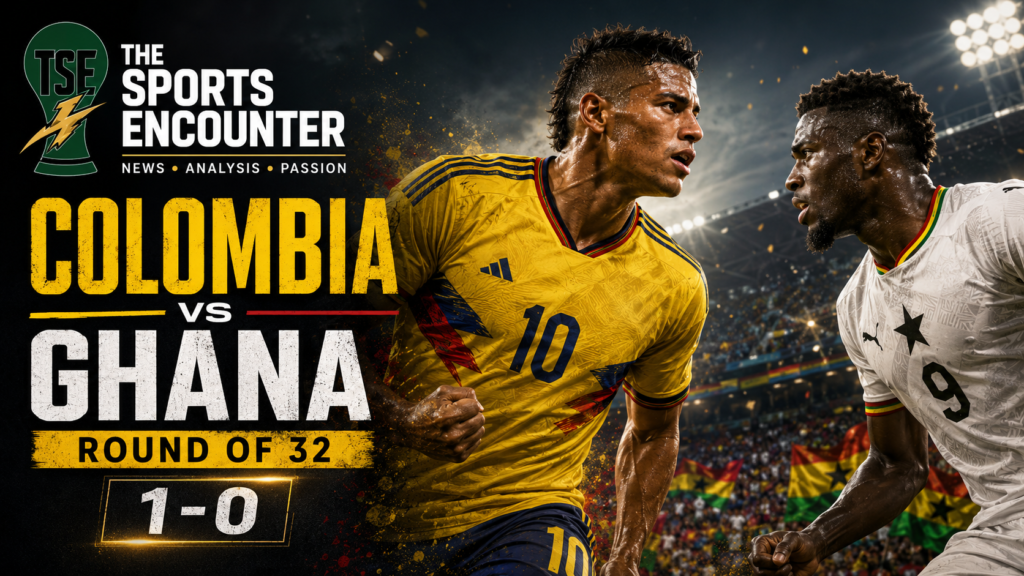
Colombia ended the first-ever FIFA World Cup Round of 32 the way knockout teams often survive deep tournaments: with an early goal, a stubborn defensive shape, and enough competitive edge to make the result matter more than the spectacle.
A 14th-minute goal from Jhon Arias gave Colombia a 1-0 win over Ghana in Kansas City and sent Los Cafeteros into the Round of 16, where they will face Switzerland. It was not Colombia’s most fluid performance of the tournament, but it was disciplined, intense, and mature enough to close the door on a Ghana side that never stopped pushing but struggled to turn possession and effort into clear chances.
For readers following the full knockout picture, this result completes The Sports Encounter’s FIFA World Cup 2026 coverage and connects directly with our earlier analysis of which Lucky 8 teams could survive the Round of 32.
Key Match Information
| Match | Colombia vs Ghana |
|---|---|
| Competition | FIFA World Cup 2026, Round of 32 |
| Venue | Kansas City Stadium |
| Result | Colombia 1-0 Ghana |
| Goal | Jhon Arias 14’ |
| Colombia’s next match | Switzerland, Round of 16 |
| Yellow cards | Daniel Yirenkyi, Ghana; Alidu Seidu, Ghana; Richard Ríos, Colombia |
| Red cards | None verified |
| Match pattern | Colombia scored early, defended aggressively, and controlled key spaces |
Arias’ Early Goal Gives Colombia the Match They Wanted
Colombia needed only 14 minutes to create the decisive moment. Jhon Arias found the finish that shaped everything after it, giving his team the lead before Ghana could fully settle into the pace and physical rhythm of a knockout match.
That early goal mattered because it allowed Colombia to play from their preferred emotional position. They could press when needed, drop into compact defensive lines when Ghana carried the ball, and use Luis Díaz, James Rodríguez, and their midfield runners to keep Ghana worried about transitions.
Arias’ goal also gave Colombia a psychological cushion. Ghana had entered this match as a third-placed qualifier with defensive discipline as their strongest weapon. Once they fell behind, they had to chase a game against a Colombian team that had already shown during the group stage that it can protect narrow margins.
Colombia did not always attack with clean timing. Some of their forward moves felt rushed, and there were moments when they could have killed the match earlier. Still, their control without the ball stood out. Davinson Sánchez and the defensive unit stayed alert, Camilo Vargas had a relatively protected night, and Colombia’s midfield kept reacting quickly whenever Ghana tried to build through the center.
This was not a glamorous win. It was a tournament win.
Colombia’s Defense Looks Like Its Real World Cup Weapon
Colombia’s identity in this match looked less like the old romantic idea of a flair-heavy South American side and more like a team built on pressure, recovery, and collective defending.
Every Ghana possession had to move through contact. Every loose touch invited pressure. Colombia hunted second balls with aggression, and even when they lost shape for short spells, they recovered quickly enough to deny Ghana the kind of central openings that could have changed the match.
Richard Ríos’ yellow card in the 78th minute reflected the edge Colombia played with. It was a physical performance, sometimes messy, but rarely passive. That matters before the Switzerland match because knockout football often turns on small details: one blocked lane, one forced turnover, one early tactical foul, one keeper who barely needs to face a clean shot because the structure in front of him holds.
Colombia finished the Round of 32 with a result that strengthens their credibility. They topped Group K, avoided defeat through the group stage, and then found a way through Ghana without needing extra time or penalties.
For more context on Colombia’s earlier tournament momentum, read The Sports Encounter’s Day 13 World Cup key moments, where Colombia’s late breakthrough against DR Congo had already hinted at this team’s patience and persistence.
Ghana Show Fight, but the Final Ball Never Arrives
Ghana’s World Cup ended with frustration because the Black Stars were competitive for long stretches without ever truly forcing Colombia into panic.
They worked hard through midfield. Antoine Semenyo kept pressing and trying to stretch Colombia’s defensive line. Jordan Ayew and Iñaki Williams carried experience and movement, while Thomas Partey gave Ghana moments of control when they tried to slow the match and build with more patience.
The problem came near the box. Ghana reached promising areas, especially in the second half, but the final pass often arrived late, wide, or without enough runners attacking the space. Colombia’s defenders read those moments well. Crosses became recoverable. Shots came from difficult areas. Attacks faded before Vargas had to make a defining save.
Daniel Yirenkyi’s yellow card early in the second half and Alidu Seidu’s booking in the 76th minute also showed how the match became more difficult for Ghana as Colombia kept forcing them into stretched defensive actions.
Ghana did not lose this match because they lacked courage. They lost because Colombia gave them very little clean football inside the areas that decide knockout matches.
Ati-Zigi Keeps Ghana Alive Until the End
Lawrence Ati-Zigi gave Ghana a chance to stay in the contest. Recalled to the starting lineup, the goalkeeper produced important saves and kept the score at 1-0 when Colombia threatened to separate the match.
That mattered because Ghana’s belief depended on staying close. At 2-0, the final phase would have felt very different. At 1-0, every set piece, every second ball, and every Ghana attack carried possibility.
Ati-Zigi’s performance also fits one of the stronger African goalkeeping themes of this tournament. Cabo Verde’s Vozinha had already delivered a heroic display against Argentina, and Ati-Zigi added another strong performance from an African goalkeeper under knockout pressure.
For Ghana, that will matter when they review this campaign. They did not leave because they collapsed. They left because one early mistake and one sharp Colombian finish forced them to chase a match that never fully opened.
Ghana’s World Cup Journey Ends With Respect
Ghana’s 2026 World Cup journey had real value, even if it ended before the Round of 16.
The Black Stars arrived in a difficult Group L with England, Croatia, and Panama. They beat Panama, held England to a goalless draw, and lost narrowly to Croatia, finishing third before advancing as one of the best third-placed teams. That path was not easy, and Ghana still found a way into the knockouts.
Their tournament also carried a familiar Ghanaian mix of promise and pain. The team had enough defensive structure to trouble stronger opponents. They had enough athleticism to compete physically. They had enough experience to avoid looking overwhelmed. Yet the same issue kept returning: goals.
In knockout football, defensive courage can carry a team far, but it rarely carries a team forever. Ghana needed one more moment of attacking quality in Kansas City. It never came.
Still, the Black Stars leave with pride. They were difficult to beat, tactically serious, and strong enough to push a Colombia side that now has every reason to believe it can trouble Switzerland.
Switzerland Will Test Colombia Differently
Colombia’s Round of 16 meeting with Switzerland should be one of the more tactical games of the next phase.
Switzerland will not offer the same match rhythm Ghana offered. They can defend compactly, manage tempo, and punish careless possession. Colombia will need more attacking clarity than they showed in Kansas City, especially if Switzerland deny the early goal that gave Los Cafeteros control against Ghana.
Luis Díaz remains central to Colombia’s attacking threat. James Rodríguez still gives the team calm and creativity between lines. Arias has now given Colombia a knockout goal. But the bigger lesson from this win is that Colombia’s defensive work may be the platform that keeps their World Cup alive.
They do not need to entertain every minute. They need to keep finding answers.
Against Ghana, one answer was enough.
The Sports Encounter’s World Cup 2026 coverage focuses on fixtures, team news, match analysis, fan stories, tournament trends, and the biggest talking points from football’s global stage.