


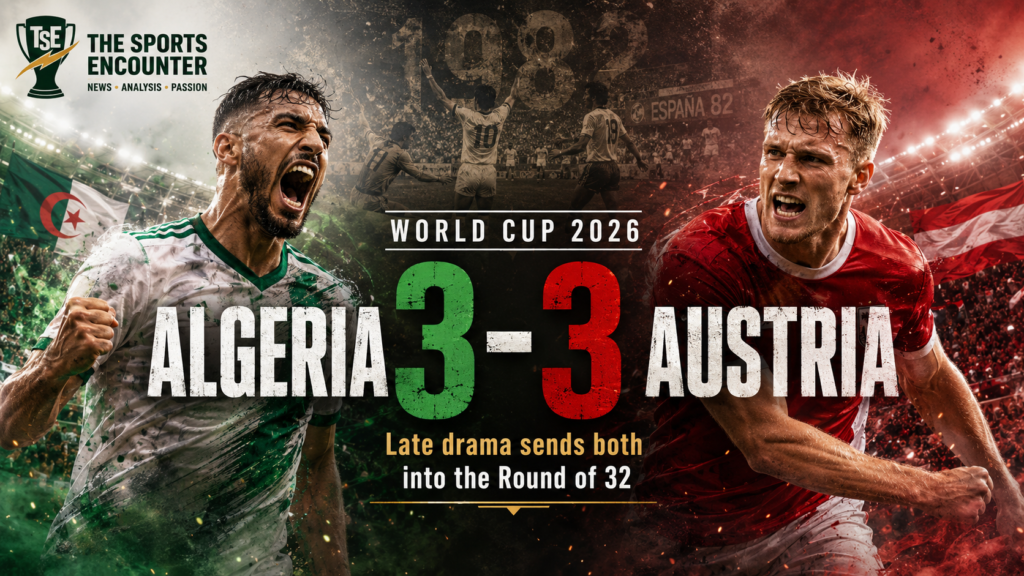
Algeria had the win in their hands, the old ghosts on the run, and a place in World Cup folklore waiting at the final whistle.
Then Sasa Kalajdzic rose in the 95th minute.
One header changed the feeling of the night. Algeria still reached the FIFA World Cup 2026 Round of 32 after a breathless 3-3 draw with Austria in Kansas City, but the final act left them with the strange ache of survival mixed with regret. They had scored three times. Riyad Mahrez had dragged the match toward a dramatic Algerian victory. For a few seconds, it looked as if 44 years of football hurt had found a clean answer.
Austria refused to leave.
Kalajdzic’s late equalizer rescued second place in Group J for Austria, sent both teams into the knockouts, and eliminated Iran from the tournament equation. Austria will now face Spain in the Round of 32 at Los Angeles Stadium on July 2, while Algeria move on as one of the best third-placed teams and will meet Switzerland at BC Place in Vancouver on the same day.
The result also adds another dramatic layer to The Sports Encounter’s FIFA World Cup 2026 hub, where the expanded tournament format has already produced late twists, best third-placed drama, and knockout scenarios that kept shifting until the final minutes.
Match Facts: Algeria vs Austria
Match: Algeria vs Austria
Competition: FIFA World Cup 2026, Group J
Venue: Kansas City Stadium, Kansas City
Final score: Algeria 3-3 Austria
Algeria scorers: Rafik Belghali 45’, Riyad Mahrez 60’, 90+2’
Austria scorers: Marko Arnautovic 28’, Marcel Sabitzer 55’, Sasa Kalajdzic 90+5’
Yellow cards: Marko Arnautovic 11’
Red cards: None listed in the available match log
Algeria next match: Round of 32 vs Switzerland, July 2, Vancouver
Austria next match: Round of 32 vs Spain, July 2, Los Angeles
Austria Strike First, Algeria Refuse to Fold
Austria started with more authority and found the first breakthrough in the 28th minute. David Alaba supplied the opening, and Marko Arnautovic forced Austria ahead from close range. It was a goal that suited Austria’s early approach: direct enough to unsettle Algeria, calm enough to control the scoreboard.
Arnautovic had already been booked in the 11th minute for serious foul play, which added a little edge to his performance. His goal gave Austria the position they wanted. At that stage, they were second in the group, Algeria were chasing, and the match was beginning to tilt toward Austrian control.
Algeria, though, did not retreat into frustration.
They pushed through the right moments instead of swinging blindly at the game. Rafik Belghali had been lively before the equalizer, and in the 45th minute he found the finish Algeria needed. His goal brought the match level before halftime and changed the tone inside Kansas City Stadium. Algeria had been behind, but they had not looked beaten.
That mattered.
For a team carrying both knockout pressure and historic weight, Algeria’s response showed nerve. It also fitted the wider pattern of this World Cup, where late group-stage matches have kept changing the knockout picture until the final minutes. The Sports Encounter’s World Cup 2026 knockout picture explains why the expanded format has made the Round of 32 race so unpredictable.
Sabitzer Restores Austria’s Lead, Mahrez Takes Over
Austria came out after halftime with the cleaner punch. Marcel Sabitzer restored their lead in the 55th minute, assisted by Konrad Laimer, and the finish gave Austria a 2-1 advantage that felt dangerous for Algeria.
At that point, Algeria had a choice. They could let the match become another painful chapter against Austria, or they could keep attacking the space Austria left behind.
Mahrez chose the second path.
The veteran winger equalized in the 60th minute, with Houssem Aouar providing the assist. It was a sharp, timely finish from a player who still understands how to slow a big game down inside his own head. Mahrez did not play like a fading name chasing one more moment. He played like Algeria’s emotional center.
His second goal arrived in stoppage time, and for a moment it looked like the winning goal.
Aouar again made the key contribution, giving Mahrez the chance to score in the 90+2’ minute. Algeria led 3-2. Mahrez had two goals. Aouar had two assists. Austria were suddenly staring at a collapse, and Algeria were seconds away from taking the kind of victory that would have carried huge symbolic weight.
Algeria had already shown against Jordan that their second-half pressure could change a World Cup match. This time, they found even more attacking fire, but the final defensive detail escaped them. Their earlier World Cup lifeline against Jordan now looks even more important in the wider story of their campaign.
Kalajdzic’s Header Turns Victory Into Survival
The final twist came almost immediately.
Austria threw bodies forward, and Michael Gregoritsch delivered the decisive assist. Kalajdzic, sent on in stoppage time, made the kind of impact managers dream about and opponents dread. His 90+5’ header made it 3-3 and flipped the group picture again.
Austria were back into second place. Algeria dropped into third, but the point still carried them into the Round of 32 as one of the best third-placed teams.
That is the brutal beauty of this expanded World Cup format. A draw can feel like heartbreak and rescue at the same time. Algeria did enough to survive, yet not enough to own the night. Austria did enough to avoid disaster, yet not enough to suggest Spain should be overly worried.
Algeria Showed Fire, but Game Management Must Improve
Algeria’s attacking performance deserves respect. Scoring three against Austria in a pressure match shows personality, belief, and real forward threat. Belghali gave them width and direct running. Aouar influenced the game with two assists. Mahrez delivered the kind of leadership that still makes him central to Algeria’s biggest nights.
The issue was control after scoring.
Algeria came back twice and then took the lead in stoppage time, but they could not protect the final phase. Once Mahrez made it 3-2, the final job was not creative. It was structural. Slow the restart. Win the first ball. Defend the box. Kill the rhythm. Force Austria wide without giving them a clean delivery.
They failed at the last step.
That weakness will matter against Switzerland. The Swiss are organized, patient, and experienced enough to punish emotional swings. Algeria have shown they can score, but knockout football rarely forgives late disorder.
For more match analysis, tournament updates, and global football coverage, visit The Sports Encounter’s soccer section.
Austria Survive, but Spain Will Ask Harder Questions
Austria’s night had a different meaning.
They led twice, lost control, then saved themselves at the end. That shows resilience, but it also exposes a concern. Austria allowed Algeria to keep finding answers. They could not turn a 1-0 lead or a 2-1 lead into calm possession. Their midfield had good moments through Sabitzer and Laimer, while Alaba’s quality on the ball helped create the opener, but Austria looked vulnerable when Algeria attacked with speed and conviction.
Against Spain, those gaps become far more dangerous.
Spain will test Austria’s defensive distances, drag midfielders out of shape, and punish loose transitions. Austria’s best hope is that the late equalizer gives them momentum rather than relief. They cannot arrive in Los Angeles playing like a team grateful to still be alive. Spain will sense that immediately.
Austria are alive, but the Spain match will demand cleaner defensive management, sharper midfield control, and far better concentration in transition.
The 1982 Shadow Never Fully Left
No Algeria vs Austria World Cup match can escape 1982.
Algeria’s debut World Cup campaign in Spain remains one of football’s most painful group-stage stories. They stunned West Germany 2-1, won twice in the group, and still went home after West Germany beat Austria 1-0 in a match that became infamous because the result suited both European teams and eliminated Algeria. The fallout helped push FIFA toward scheduling final group games at the same time to reduce the risk of convenient results.
The Sports Encounter’s preview on Algeria, Austria and the 44-year World Cup wound from Gijón explains why this fixture still carries emotional weight for Algerian fans.
That history gave this 2026 meeting a sharper edge.
For Algeria fans, Austria were never just another opponent. They represented an old wound, even if the players on this pitch had nothing to do with the events of Gijón. That is how football memory works. It travels through families, old broadcasts, newspaper clippings, and stories passed down by supporters who never forgot.
This time, there was no quiet arrangement and no slow-motion group-stage bargain. There were six goals, wild momentum swings, and two teams fighting until the final touch.
Algeria did not get the revenge win. Austria did not get a comfortable escape. Both walked into the knockouts with reasons to believe and reasons to worry.
The 1982 Algeria story also remains one of the great reminders of how World Cup shocks can reshape football history. The Sports Encounter’s feature on famous World Cup upsets gives broader context to the kind of results that keep football dangerous, emotional, and impossible to script.
For Algeria, Switzerland now waits.
For Austria, Spain waits.
For everyone who watched, Kansas City delivered one of the loudest reminders of this World Cup so far: history can shape a match, but the final minute can still rewrite the feeling of it.