


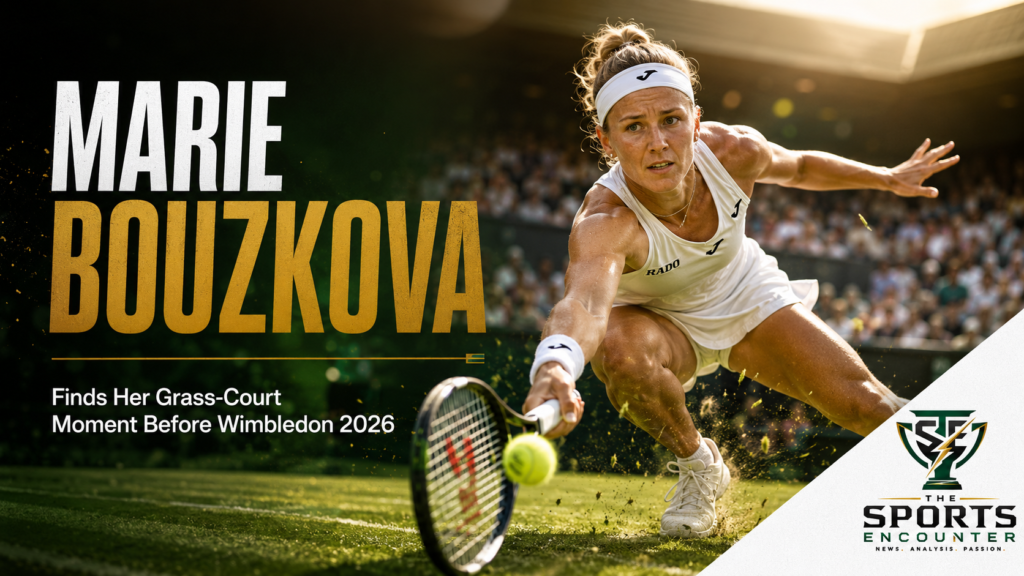
Marie Bouzkova arrived in Nottingham needing grass-court confidence. She left with a title, a ranking lift, and the kind of late-June momentum every player wants before Wimbledon.
The Czech fourth seed defeated third-seeded Emma Navarro 7-6(5), 4-6, 6-2 in the Nottingham Open final, winning her first career singles title on grass after a nearly three-hour fight that tested patience, movement, nerve, and pain tolerance. For a player known more for discipline than noise, this was a statement with perfect timing.
Bouzkova has never been the loudest name in a women’s draw. She does not overwhelm opponents with one destructive shot. She builds pressure through shape, recovery, court sense, and stubborn rally management. On grass, where bad bounces and short reaction windows punish hesitation, that style can either look exposed or beautifully efficient.
In Nottingham, it worked.
For more tennis coverage, Grand Slam previews, and grass-court storylines, follow The Sports Encounter’s Tennis Hub.
Marie Bouzkova Turns Nottingham Into a Career Marker
This was not only another WTA title for Bouzkova.
It was her fourth career singles title, her second of the 2026 season, and her first on grass. That surface detail matters because grass often exposes players who need too much time to settle into rallies. Bouzkova adapted well enough through the week to make Nottingham feel less like a warm-up stop and more like a genuine breakthrough.
She had already won on clay in Bogota earlier this season. Adding a grass title gives her 2026 campaign a different shape. It shows that her game can travel across surfaces when her body holds up and her timing stays clean.
The final against Navarro brought all of that into focus.
Bouzkova had to fight through a tight opening set, absorb Navarro’s serving pressure, manage physical discomfort, and keep enough control late in the match to win the decider. She also reportedly dealt with an ankle issue during the final, which made the victory feel even more earned.
Also Read: Our Full Wimbledon 2026 Title Preview
The scoreline tells one story. The match rhythm tells another.
The First Set Set the Emotional Tone for Marie Bouzkova
The opening set was always going to matter.
Navarro came into the final with the profile of a player who can make matches feel uncomfortable. She competes hard, serves with purpose, and rarely gives away long stretches for free. Bouzkova needed to avoid chasing the match early, especially on grass, where scoreboard pressure can move quickly.
The first set went to a tiebreak, and Bouzkova edged it 7-5.
That was the match’s first major swing. Winning a tight opener against Navarro gave Bouzkova space to breathe. It also forced Navarro to spend more emotional energy trying to reset rather than build from the front.
Still, Navarro refused to fade.
The American took the second set 6-4, using her serve and aggression to drag the final into a third set. She finished with 10 aces and saved 10 of 14 break points, which shows how often Bouzkova pushed her into pressure moments and how well Navarro fought to stay alive.
That made the final set less about momentum and more about clarity.
Marie Bouzkova Wins the Decider With Discipline
The third set belonged to Bouzkova because she simplified the match better.
Grass can tempt players into panic. Points end fast. Returns skid. Net approaches arrive earlier than expected. A player who loses shape for three or four games can watch a final disappear.
Bouzkova avoided that trap.
She kept making Navarro play one more ball. She stayed compact on return games. She refused to let the match become only about Navarro’s serve. Once Bouzkova found the break opportunities, she applied enough pressure to turn them into control.
That has always been one of her best qualities. Bouzkova may not always bully opponents, but she makes them solve problems repeatedly. At Nottingham, Navarro solved many of them. She just could not solve enough.
The final lasted 2 hours and 57 minutes, making it one of the toughest WTA finals of the season and exactly the kind of battle that can harden a player before a Grand Slam.
Why This Victory Matters for Bouzkova Before Wimbledon
Timing makes this title bigger.
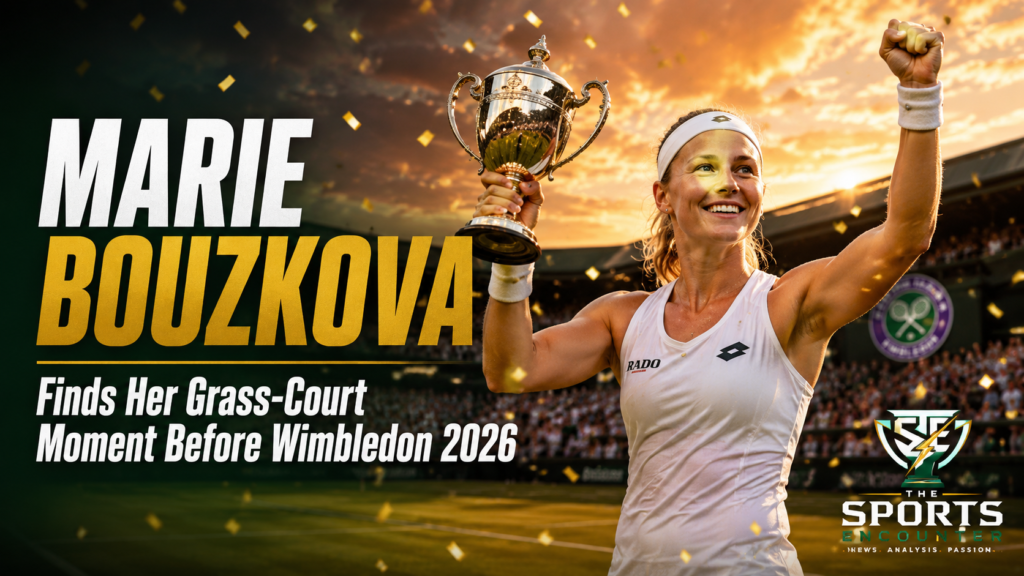
Wimbledon begins on June 29, and the women’s draw already looks full of movement. Injuries, wildcard stories, grass-court form swings, and returning icons have made the build-up unusually busy. Bouzkova’s Nottingham title now adds another layer to that picture.
She is not suddenly the Wimbledon favorite. That would be a stretch. But she is now a dangerous grass-court name with form, belief, and match toughness behind her.
That matters because Wimbledon often rewards players who arrive with rhythm rather than reputation alone. A strong serve helps. Power helps. But movement, balance, patience, and comfort on low balls matter just as much.
Marie Bouzkova has now shown those qualities in a title run.
For a wider look at the tournament build-up, read Wimbledon 2026: What’s In Store This Year?.
Navarro Leaves With Frustration, but Also Proof
Emma Navarro lost the final, but her week should not be dismissed.
The American reached another grass-court final, pushed Bouzkova for nearly three hours, and served well enough to stay in danger even when break points piled up against her. Ten aces in a final show real serving authority. Saving 10 of 14 break points also shows competitive nerve.
The issue was conversion at the right moments.
Navarro kept the match alive, but Bouzkova controlled more of the decisive exchanges. That is the small difference between leaving Nottingham with a trophy and leaving with a useful but painful lesson.
Navarro will still take positives into Wimbledon. Her game has enough structure for grass. She competes cleanly, does not panic easily, and has the athletic base to handle awkward rallies. But this final also showed the next step: turning resistance into command when matches get tight.
That will matter in London.
Bouzkova’s Game Fits the Wimbledon Upset Zone
Bouzkova is exactly the kind of player seeded contenders dislike seeing early at Wimbledon.
She keeps points honest. She moves well. She can defend without looking desperate. She reads patterns early and often makes opponents hit the extra shot from an uncomfortable position.
On grass, that can become a quiet weapon.
Players who rely heavily on rhythm sometimes struggle against someone who redirects pace, absorbs pressure, and refuses to donate errors. Bouzkova can do all of that. If her ankle holds and her serve gives her enough cheap points, she can become one of those awkward names nobody wants in their section of the draw.
The women’s field already feels open enough for that kind of run. The build-up has included Serena and Venus Williams’ return storyline, new-generation pressure, and questions around who can actually handle the grass. The Sports Encounter explored that wider power shift in Wimbledon 2026 Curtain Raiser: Tennis Returns to Oldest Stage With a New Power Shift.
A Title Built on Timing, Not Hype
Bouzkova’s Nottingham victory does not need exaggeration.
It is strong enough as it is.
She beat a quality opponent, survived a three-set final, won her first grass-court title, and enters Wimbledon with a clearer sense of what her game can do on the surface. That is real progress.
Nottingham also gives her something less visible but just as important: evidence. When a player wins on a surface that has not always delivered trophies, belief becomes practical. It is no longer only about hoping the game fits. It has already worked under pressure.
That could change how Bouzkova steps onto the grass in London.
For full tournament dates and schedule details, check When Is Wimbledon 2026? Full Dates, Schedule, Venue and Key Details.
Final Word: Bouzkova Has Earned Wimbledon Attention
Marie Bouzkova will not walk into Wimbledon as the loudest story.
That space may belong to bigger names, former champions, and the players carrying heavier expectations.
But Nottingham changed her conversation.
She is now a grass-court champion. She has a hard final behind her. She has beaten a strong opponent in Navarro. She has also shown that her calm, precise tennis can survive a surface that gives players very little time to think.
Wimbledon often produces surprises, but they rarely come from nowhere. They usually come from players who arrive with form, confidence, and enough proof that the surface suits them.