



Jonathan Toews never needed noise to own a room. He did it with his eyes, his posture, his faceoff stance, his defensive reads, his short answers, and the kind of silence that made teammates lean in rather than look away.
Now, at 38, one of the great captains of the modern NHL has stepped away from the game. Toews announced his retirement after 16 NHL seasons, closing a career that stretched from Chicago’s rebirth to Winnipeg’s emotional full-circle goodbye.
He leaves with three Stanley Cups, two Olympic gold medals, a World Championship, a Conn Smythe Trophy, a Selke Trophy, a Mark Messier Leadership Award, 912 regular-season points, 119 playoff points, and a legacy that feels larger than any spreadsheet can hold.
For full hockey coverage, Stanley Cup features, and NHL analysis, follow The Sports Encounter’s NHL Hub.
The Goodbye Came in Winnipeg, But the Echo Reached Chicago
Toews made his retirement official in Winnipeg, inside a sportsplex that already carries his name. That detail mattered.
This was not only the end of an NHL career. It was a homecoming story reaching its final page.
After two years away from the league because of health issues, Toews returned for the 2025-26 season with the Winnipeg Jets, his hometown team. He played all 82 games, contributed 11 goals and 18 assists, and proved something that had little to do with scoring pace.
He proved he could come back.
That final season did not rewrite his prime. It did something softer and perhaps more meaningful. It allowed him to leave the game on skates, in front of people who had watched his journey begin long before Chicago made him a franchise cornerstone.
At his farewell, Toews said it was a privilege to say goodbye to hockey and the NHL. He also admitted the game had taken a heavy toll and that he was ready to let the stress level down.
There was honesty in that. Toews did not frame retirement like a marketing slogan. He sounded like a man who had given hockey almost everything and finally decided he had earned peace.
The Chicago Years Changed Everything
Before Toews became “Captain Serious,” the Chicago Blackhawks were still trying to find their way back into the center of the NHL conversation.
He arrived as the No. 3 overall pick in the 2006 NHL Draft. He scored on his first NHL shot in his first NHL game in October 2007. Less than a year later, Chicago made him captain at 20 years and 79 days old, making him the youngest captain in franchise history and one of the youngest captains the league had seen at that time.
It was a massive responsibility. Toews made it look natural.
With Patrick Kane, Duncan Keith, Brent Seabrook, Marian Hossa, Corey Crawford and others around him, Toews became the emotional and tactical center of a Blackhawks team that restored championship hockey to Chicago.
The first Stanley Cup came in 2010, ending a 49-year drought for the franchise. Then came another in 2013. Then another in 2015.
Three Cups in six seasons.
That kind of run does not happen because a team has talent alone. It happens because talent learns how to suffer together, defend together, win ugly together, and return to the same standard after the celebration ends. Toews was the player who kept pointing Chicago back to that standard.
For a broader look at why hockey’s biggest moments still connect with fans, read The Sports Encounter’s feature on how the NHL’s ratings rise showed hockey has rediscovered its lost mojo.
2010 Was the Year Toews Became Immortal in Chicago
Every legendary career has a season that turns reputation into permanence.
For Toews, that season was 2009-10.
He was still only 22, yet he captained the Blackhawks through a postseason that changed the franchise forever. Toews finished that playoff run with 29 points in 22 games and won the Conn Smythe Trophy as playoff MVP.
Chicago did not simply win the Stanley Cup. It changed its identity.
A city that had waited nearly half a century for another NHL championship suddenly had a new generation of heroes. Kane brought genius and flair. Keith brought endurance and elite defense. Hossa brought experience and class. Toews brought the spine.
That is why the “Captain Serious” nickname stuck. It was partly playful, partly accurate, and partly a sign of respect. Toews treated winning like work. Not joyless work. Sacred work.
He took draws in hard zones. He tracked back with purpose. He handled media pressure. He wore the “C” like a job description rather than decoration.
Chicago’s official tribute captured that well, describing him as the heartbeat of the Blackhawks and a player who restored the franchise to the top of the hockey world.
The Greatness Was in the Details Casual Fans Missed
Toews was never only a point producer.
That is important because a surface-level reading of his career can miss the real thing. He finished with 383 goals and 529 assists, excellent numbers across 1,149 games. But Toews’ value lived in the hard areas that never fit cleanly into a highlight reel.
He was a faceoff weapon. He was a defensive conscience. He killed penalties. He supported the puck low in the zone. He protected leads. He made the next shift calmer for everyone else.
That is why his 2013 Selke Trophy matters. It recognized him as the NHL’s best defensive forward, but it also confirmed what coaches, opponents and teammates already knew. Toews could control a game without needing to look flashy.
His playoff numbers also tell the bigger truth. Toews produced 45 goals and 74 assists in 137 postseason games. He played his best hockey when the game tightened, when ice disappeared, when every mistake had a cost.
Some stars get louder when the stage grows. Toews got cleaner.
Team Canada Saw the Same Captain Chicago Saw
Toews’ international career reinforced his NHL legacy.
He won Olympic gold with Canada in 2010 in Vancouver and again in 2014 in Sochi. He scored the opening goal in the 2010 gold-medal game against the United States and was named the tournament’s best forward. Four years later, he scored the first goal in Canada’s gold-medal win over Sweden.
Those moments matter because Team Canada is not short of stars.
Toews still found a way to become essential.
He also won a World Championship with Canada in 2007 and later added gold at the 2016 World Cup of Hockey. His 2010 Stanley Cup triumph made him a member of the Triple Gold Club, reserved for players who have won Olympic gold, a World Championship and the Stanley Cup.
He was the youngest player to achieve that feat.
That is not a side note. It is a measure of how quickly Toews became one of hockey’s most complete winners.
Jonathan Toews: Leadership Was His Greatest Skill
The word “leadership” gets overused in sports. With Toews, it fits.
His leadership was never built on theater. He did not need to perform emotion for cameras. He led through preparation, responsibility, and a stubborn refusal to let standards slip.
The Mark Messier Leadership Award in 2015 recognized that side of him. It arrived in the same year Chicago won its third Stanley Cup of the era, and it felt right because Toews had become the model of what a modern NHL captain could be.
He was serious, yes. But the Blackhawks’ tribute made an important point: the nickname only told half the story.
Toews also gave time to the community. He invested in young hockey players. He respected fans. He carried Chicago’s expectations without making them look like a burden.
That kind of leadership lasts because it shapes habits around a team. Players do not only remember what a captain says before Game 7. They remember how he skates in practice in November, how he handles losing streaks, how he treats the staff, how he responds after mistakes.
Toews built his authority there.
The Health Battle Made the Final Chapter Human
The final years of Toews’ career were not simple.
He missed the entire 2020-21 season while dealing with Chronic Inflammatory Response Syndrome. He later missed time because of the effects of long COVID-19. For a player whose game depended on discipline, conditioning, and repeatable effort, those health battles changed the rhythm of his career.
That makes his Winnipeg season more powerful.
Playing all 82 games after two years away from the NHL was not a sentimental cameo. It was a physical and mental achievement. His numbers with the Jets were modest by peak Toews standards, but the point was never only production.
The point was that he returned.
The Jets honored that, posting a tribute that recognized his love for the game and his connection to Winnipeg. That final chapter gave him something many great athletes never receive: a chance to close the circle near home.
Where Jonathan Toews Stands in Blackhawks History
Inside Blackhawks history, Toews belongs in the most sacred tier.
He ranks sixth in franchise goals and sixth in franchise points. He captained the team for 14 seasons. He led Chicago to three championships. He gave the franchise its first Stanley Cup since 1961. He turned a sleeping hockey city into a dynasty market again.
That last point matters most.
Statistics can tell us what Toews did. Chicago can tell us what he meant.
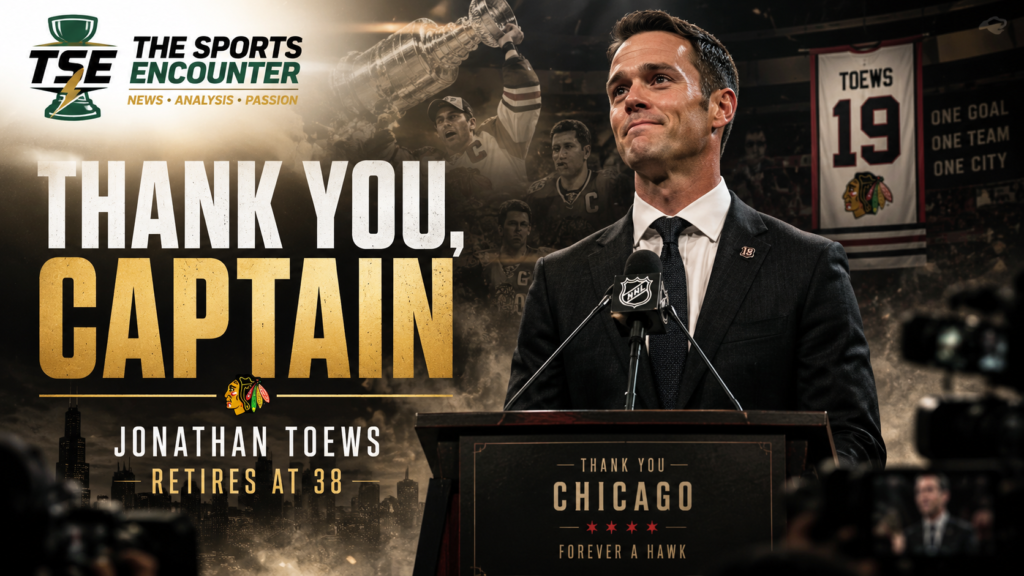
A generation of fans grew up with Toews as the face of responsibility and Kane as the face of magic. Together, and with a brilliant core around them, they made the Blackhawks impossible to ignore.
Modern fans watching new champions can understand that legacy through the pressure of current Stanley Cup moments. The Sports Encounter recently covered Carolina’s Stanley Cup triumph after a 20-year wait, another reminder that championship droughts do not end by accident. They end when the right leaders arrive.
The Hall of Fame Question Should Be Simple
Toews is not officially in the Hockey Hall of Fame yet because eligibility takes time.
But the argument around him should not be complicated.
Three Stanley Cups. Two Olympic gold medals. Conn Smythe Trophy. Selke Trophy. Mark Messier Leadership Award. Triple Gold Club. More than 900 NHL regular-season points. More than 100 postseason points. Captain of a dynasty.
That is not a borderline résumé.
That is a Hall of Fame résumé with a captain’s armband wrapped around it.
There will always be debates about peak scoring, career totals, era context, and individual awards. Fine. Hockey loves arguments. But Toews’ case rests on something bigger than numbers alone. He was the defining leader of the Blackhawks’ greatest modern era and one of the most trusted two-way centers of his generation.
In hockey, that combination is gold.
The Legacy of Captain Serious
Toews retires with a rare kind of legacy.
He was great enough to headline, but disciplined enough to share the spotlight. He was skilled enough to score, but mature enough to defend first. He was famous enough to become a symbol, but grounded enough to keep showing up as a worker.
That is why his career feels so complete.
Some stars are remembered for the goals they scored. Some are remembered for the trophies they lifted. Toews will be remembered for both, but also for the way he made winning feel organized.
There was a seriousness to him that became beautiful over time. Not cold. Not dull. Just deeply committed.
He helped rebuild a franchise, led a dynasty, delivered for Canada, fought through illness, came home to Winnipeg, and left the game with gratitude rather than noise.
Jonathan Toews Career Snapshot
- NHL seasons: 16
- Teams: Chicago Blackhawks, Winnipeg Jets
- Regular-season games: 1,149
- Regular-season points: 912
- Goals: 383
- Assists: 529
- Playoff games: 137
- Playoff points: 119
- Stanley Cups: 2010, 2013, 2015
- Conn Smythe Trophy: 2010
- Selke Trophy: 2013
- Mark Messier Leadership Award: 2015
- Olympic gold medals: 2010, 2014
- Triple Gold Club: Stanley Cup, Olympic gold, World Championship gold
Final Word
Jonathan Toews did not leave hockey as a player chasing one more applause line.
He left as a captain who had already given the sport his best years, his hardest shifts, his strongest leadership, and his deepest commitment.
Chicago will remember the Cups. Winnipeg will remember the homecoming. Canada will remember the gold-medal goals. Hockey will remember the standard.
Toews made greatness look serious because, to him, winning deserved seriousness.
That is why his NHL retirement feels less like an ending and more like the closing of a book that already belongs on the top shelf.
The Sports Encounter’s NHL coverage focuses on championship stories, player legacies, team identity, tactical shifts, fan culture, and the moments that shape hockey history.