


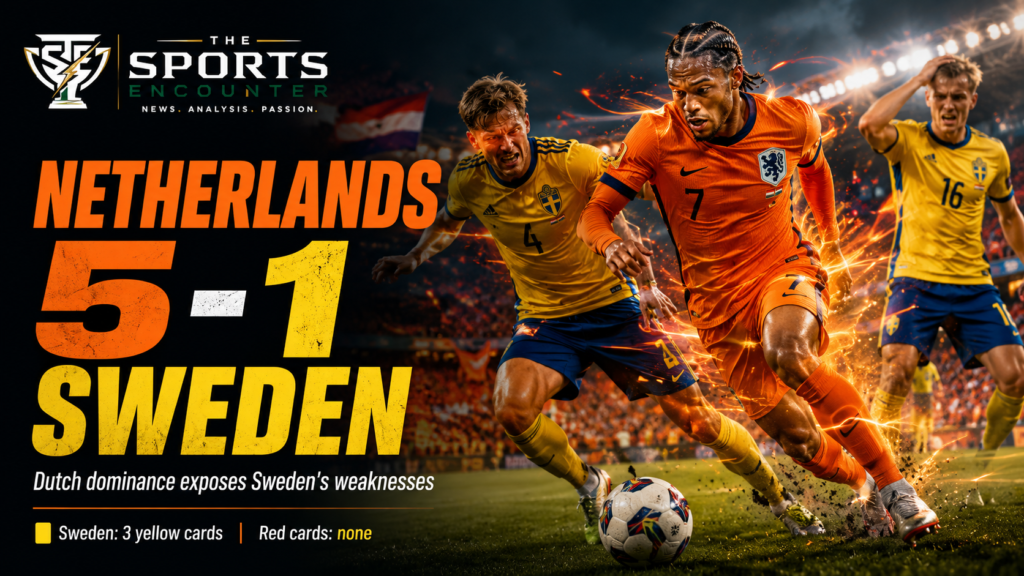
The Netherlands did not need a perfect statistical performance to deliver a perfect message.
Ronald Koeman’s side tore through Sweden 5-1 in their FIFA World Cup 2026 Group F clash at NRG Stadium in Houston, turning what looked like a dangerous European meeting into one of the clearest statement wins of the tournament so far.
Brian Brobbey scored twice inside the opening 17 minutes. Cody Gakpo then struck twice early in the second half. Crysencio Summerville added the fifth late on, while Anthony Elanga’s 59th-minute finish only softened the scoreline for Sweden.
For more tournament context, follow The Sports Encounter’s complete FIFA World Cup 2026 coverage.
Brobbey Sets the Tone Before Sweden Can Breathe
Sweden arrived with confidence after their 5-1 opening win over Tunisia, but the Netherlands took that momentum away almost immediately.
Brobbey opened the scoring in the fifth minute after Cody Gakpo created the chance. The goal gave the Dutch exactly what they needed: early control, crowd energy, and the freedom to stretch Sweden’s back three.
The second goal came in the 17th minute, this time with Denzel Dumfries providing the assist. That move captured the tactical story of the first half. Netherlands attacked Sweden’s wide channels with speed, timing, and better spacing. Sweden’s wing-backs struggled to decide whether to press high or protect the defensive line. That hesitation gave the Dutch runners too much room.
Brobbey punished it ruthlessly.
Dutch Dominance Came From Width, Timing, and Ruthless Finishing
The scoreline makes this look like a one-sided possession show, but the deeper story is sharper than that. Netherlands had 50.9% possession, only slightly more than Sweden’s 49.1%. Sweden even produced more total attempts and more shots on target.
Yet football is not won by shot volume alone.
The Netherlands created better chances, attacked cleaner zones, and finished with far greater authority. Their 4-3-3 gave them natural width, while Dumfries and Gakpo kept pulling Sweden toward one side before the next run opened space centrally.
This was a major improvement from the Dutch opener, where they twice lost control against Japan in a 2-2 draw. That earlier warning, covered in Kamada’s Late Equalizer Stuns Dutch in World Cup Thriller, clearly shaped this performance.
Here, the Netherlands played with more urgency after taking the lead. They did not invite pressure casually. They did not let Sweden turn the game into a long physical duel. Every time Sweden tried to push numbers forward, the Dutch found the next pass into space.
Gakpo Turns the Second Half Into a Dutch Show
If Brobbey owned the opening act, Gakpo controlled the second.
The Liverpool forward made it 3-0 in the 47th minute from another Dumfries assist. Seven minutes later, he scored again, this time after Summerville’s setup. At 4-0, the match had moved beyond recovery for Sweden.
Gakpo’s value came from more than two goals. He scored, assisted, occupied defenders, and kept Sweden’s shape under constant stress. His movement between the touchline and inside-left channel forced Sweden’s right side to defend two problems at once.
That is where the Netherlands looked most dangerous. Their wide players did not simply cross early. They carried the ball, waited for movement, then attacked the moment Sweden’s defensive line lost its spacing.
Sweden Had Chances, But Their Structure Let Them Down
Sweden’s problem was not a complete lack of attacking threat.
Viktor Gyokeres forced saves. Alexander Isak assisted Elanga’s goal. Yasin Ayari kept arriving in useful areas. Sweden recorded eight shots on target, which shows they did create moments.
The issue was control.
Sweden’s 3-5-2 looked vulnerable whenever the Netherlands moved the ball quickly into wide spaces. The back three often looked exposed, the midfield line failed to protect the half-spaces, and the wing-backs got caught between two jobs.
That left Sweden with a strange match profile. They had enough attacking moments to suggest quality, but their defensive structure gave the Netherlands too many clean looks at goal.
In tournament football, that gap is fatal.
What Sweden Lacked Against the Netherlands
1. Defensive Protection in Wide Areas
Sweden could not shut down Dumfries, Gakpo, and later Summerville. The Dutch repeatedly found space on the flanks, then attacked before Sweden could reset.
2. Midfield Control After Losing the Ball
Sweden’s midfield runners pushed forward, but their rest defense was poor. When they lost possession, the Netherlands moved into transition lanes too easily.
3. Calm Under Pressure
The yellow cards told part of the story. Gabriel Gudmundsson was booked in the 53rd minute, Yasin Ayari in the 75th, and Lucas Bergvall in the 80th. Sweden’s frustration grew as the match moved away from them.
4. Better Finishing When Chances Arrived
Sweden created attempts, but they did not turn pressure into scoreboard pressure early enough. Once the Netherlands moved 3-0 ahead, the match became too open for Sweden’s defensive shape to survive.
Cards: Sweden Lose Discipline as Netherlands Stay Clean
The disciplinary record underlined the difference in control.
Netherlands finished the match without a yellow card or red card. Sweden received three yellow cards:
Yellow cards
- Gabriel Gudmundsson, 53’
- Yasin Ayari, 75’
- Lucas Bergvall, 80’
Red cards
- None
Those bookings matter beyond this match. In a tight World Cup group, fair-play records can still become relevant if teams finish level on points and goal difference.
Group F Impact: Netherlands Take Control, Sweden Face Japan Pressure
The win moved the Netherlands to four points from two matches, putting them in a strong position before their final group game against Tunisia. Sweden remain on three points, but their goal difference took a serious hit after a night that exposed defensive problems.
Sweden’s next match against Japan now looks far more dangerous. Japan already showed their quality against the Netherlands, and Sweden cannot afford another loose defensive display.
The wider tournament has already produced several group-stage warnings. Canada’s attacking explosion in Jonathan David Hat-Trick Fires Canada to Historic World Cup Win and Switzerland’s strong display in Manzambi Turns the Match as Switzerland Crush Bosnia in Group B show how quickly early confidence can shift in this expanded World Cup.
Final Verdict
This was the Netherlands’ most convincing performance of the tournament so far.
Brobbey gave them power. Gakpo gave them class. Dumfries gave them width. Summerville gave them late energy. More importantly, the Dutch showed they had learned from the Japan draw by turning control into punishment.
Sweden, meanwhile, left Houston with a clear problem. Their forwards can still hurt teams, but their defensive spacing and transition control must improve quickly. Against elite wide movement, they looked stretched, rushed, and too easy to open.
The Netherlands now look like a team growing into the tournament.
Sweden look like a team with one big match left to save their World Cup direction.
FAQs
Who scored for Netherlands against Sweden?
Brian Brobbey scored twice, Cody Gakpo scored twice, and Crysencio Summerville added the fifth goal for the Netherlands.
Who scored for Sweden against Netherlands?
Anthony Elanga scored Sweden’s only goal in the 59th minute, assisted by Alexander Isak.
Were there any red cards in Netherlands vs Sweden?
No. There were no red cards in the match.
How many yellow cards were shown?
Sweden received three yellow cards. Gabriel Gudmundsson, Yasin Ayari, and Lucas Bergvall were booked. Netherlands received no yellow cards.
Why did Netherlands dominate Sweden?
Netherlands dominated through better wide play, sharper finishing, stronger movement in attacking zones, and better control after turnovers. Sweden created chances, but their defensive structure could not handle Dutch speed and width.