


For more than an hour, Switzerland looked like a team asking the same question without finding the answer.
They had possession. They had territory. They had Granit Xhaka trying to dictate rhythm from midfield. Still, Bosnia and Herzegovina stayed compact, stubborn, and alive in a Group B match that felt far closer than the final scoreline now suggests.
Then came the bench.
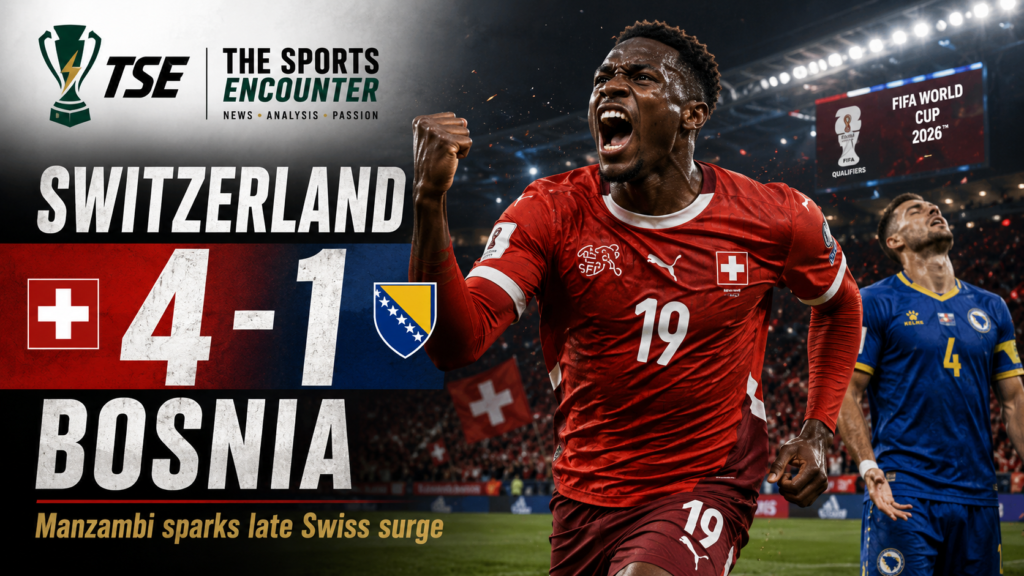
Johan Manzambi and Ruben Vargas entered the match and changed everything. What had been a slow Swiss push became a sudden late surge. Switzerland scored four times in the closing stages, Bosnia lost Tarik Muharemovic to a red card, and Group B was shaken into life.
The 4-1 win at SoFi Stadium in Inglewood gives Switzerland four points from two matches and places them in a strong position before their final group game against Canada. Bosnia, meanwhile, leave Los Angeles with one point from two matches and a far heavier task ahead.
For readers following the wider tournament picture, this result now sits alongside the biggest early Group B turning points in The Sports Encounter’s FIFA World Cup 2026 coverage hub.
Match Summary: Switzerland 4-1 Bosnia and Herzegovina
Switzerland were patient, perhaps too patient, for most of the contest. Bosnia defended deep, pressed in spells, and tried to make the match uncomfortable. For long stretches, that plan worked.
The first half ended goalless, and Bosnia had reason to believe they could repeat the kind of disciplined performance that earned them a draw against Canada in their opener.
But Switzerland’s second-half changes gave the game a completely different shape.
Manzambi broke the deadlock after coming on, reacting sharply inside the box and giving Switzerland the lead. Vargas then made it 2-0 with a composed finish before Manzambi struck again to complete his brace.
Bosnia did get one back through Ermin Mahmic, whose late volley was one of the cleanest hits of the match. It gave Bosnian fans a moment to keep, even on a painful night.
Xhaka then finished the job from the penalty spot deep into stoppage time.
The scoreline may look comfortable. The story was not. Switzerland had to wait, adjust, and trust the strength of their bench.
Johan Manzambi’s Night Changes Switzerland’s Mood
Every World Cup produces a player who arrives from the bench and leaves with the spotlight.
This was Manzambi’s night.
He did not need long to change the match. His first goal arrived soon after his introduction, and it carried more than scoreboard value. It broke Bosnia’s resistance, lifted Switzerland’s tempo, and forced a tired defense into spaces it had avoided for most of the match.
His second goal showed a different side of his game. Movement, timing, confidence, and the coldness to finish when the match was already bending Switzerland’s way.
At 20, Manzambi gave Switzerland something they badly needed: directness. Before he came on, Swiss attacks often looked neat but predictable. After he entered, Bosnia’s defenders had to turn, chase, and make decisions under pressure.
That is where the match cracked.
Ruben Vargas Gives Switzerland the Missing Edge
Manzambi will get the headlines, and rightly so, but Vargas was just as important to the change in rhythm.
His arrival stretched Bosnia’s back line and gave Switzerland more speed on the left side. Instead of circulating the ball safely, Switzerland began attacking the gaps behind Bosnia’s tired defenders.
Vargas scored Switzerland’s second and later helped create Manzambi’s second. His timing mattered. His energy mattered more.
This was a classic World Cup bench performance: not just fresh legs, but the right profile at the right moment.
Switzerland’s opening draw against Qatar had already shown that they can struggle when opponents sit deep. That match, covered in The Sports Encounter’s report on Qatar’s late equalizer against Switzerland, left questions about Swiss ruthlessness.
Against Bosnia, the answer came late, but it came loudly.
The Hydration Break Became a Tactical Turning Point
One of the most interesting parts of this match was not a goal. It was a pause.
The second-half hydration break became a tactical reset for Switzerland. Murat Yakin waited, watched Bosnia tire, then introduced speed at the exact moment the match needed disruption.
That detail matters in this World Cup.
The 2026 tournament is being played across different climates, time zones, and stadium conditions. Hydration breaks are not just player-care moments. Coaches are already using them as mini tactical windows.
Switzerland used theirs better than Bosnia.
Before that pause, Bosnia had their best spell. They pressed higher, created moments of concern, and briefly made Switzerland look uncomfortable. After it, the match belonged almost entirely to the Swiss bench.
That small detail may become a larger tournament trend. In a World Cup spread across North America, managing heat, fatigue, rhythm, and substitutions could decide more games than fans expect. The Sports Encounter explored some of those wider tournament challenges in its feature on the biggest challenges facing FIFA World Cup 2026 organizers.
Tarik Muharemovic Red Card Ends Bosnia’s Resistance
Bosnia were still alive after Switzerland’s opener. At 1-0, the match had tension. One counterattack, one set piece, one loose ball could have changed everything.
Then Muharemovic was sent off.
His red card for denying a clear Swiss attacking chance turned a difficult situation into a near-impossible one. Bosnia had already been stretched by Manzambi and Vargas. With 10 men, the spaces became too large and the pressure too constant.
Switzerland did what strong teams do in those moments. They did not simply protect the lead. They punished the weakness.
Vargas scored. Manzambi scored again. Xhaka added the penalty.
Bosnia’s structure, which had held for so long, collapsed in a brutal final spell.
Mahmic’s Volley Gives Bosnia a Moment of Pride
The scoreboard was cruel to Bosnia, but Mahmic’s late goal deserves its own space.
His strike came from the edge of the area after a corner was cleared only partially. He met the dropping ball cleanly and sent a fierce volley past the Swiss defense.
It did not change the result, but it changed the emotional texture of Bosnia’s night.
World Cup moments are not always about wins. Sometimes they are about a young player producing a flash of quality on the biggest stage. For Bosnia, that goal was a reminder that their tournament is not finished yet.
They now face Qatar in their final group match, knowing a win is essential. Their earlier draw with Canada gave them a platform. This defeat damaged it, but did not fully destroy it.
That Canada result also looks more important now. Readers can revisit The Sports Encounter’s report on Cyle Larin’s historic equalizer for Canada against Bosnia to understand how tight Group B looked before this Swiss surge.
What This Result Means for Group B
Switzerland now move to four points from two matches. That puts them in a strong position before the final group game against Canada.
Canada’s own 6-0 win over Qatar later in the day means Group B has suddenly become sharper at the top. Switzerland versus Canada now carries real weight. It may decide who controls the group and who faces a more difficult route in the next round.
Bosnia sit on one point and must beat Qatar. Even then, goal difference and other results may matter.
For Switzerland, the lesson is encouraging. They do not need every attacking answer from the starting XI. They have bench weapons. They have experience. They have a captain in Xhaka who can close matches under pressure.
For Bosnia, the lesson is harsher. Staying organized for 70 minutes is not enough at this level. A World Cup match can turn in five minutes, especially when fatigue, red cards, and elite substitutes arrive together.
Interesting Facts and Incidents from Switzerland vs Bosnia
1. Switzerland scored all four goals late
This was not a match Switzerland controlled on the scoreboard from the start. The game was goalless for most of the night before the Swiss attack exploded late.
2. Johan Manzambi became the story from the bench
Manzambi entered in the second half and scored twice. That made him the decisive player in a match that had been drifting toward frustration for Switzerland.
3. Ruben Vargas changed the width and tempo
Vargas scored one and helped create another. His introduction gave Switzerland a direct attacking route that Bosnia struggled to handle.
4. The red card changed the emotional tone
Muharemovic’s dismissal came when Bosnia were already under pressure. After that, Switzerland found more space and turned a tight match into a heavy defeat.
5. Mahmic still produced one of the best strikes of the game
Bosnia’s late goal was not a cheap consolation. Mahmic’s volley was a high-quality finish and one of the most memorable individual moments of the match.
6. Switzerland’s final game now becomes a major Group B test
The Swiss face Canada next. With both teams fighting for position, that match could decide the shape of the group.
Final Word
Switzerland’s 4-1 win over Bosnia was a reminder that World Cup matches do not always reveal themselves early.
For 70 minutes, Bosnia had the game where they wanted it: tight, physical, narrow, and tense. Switzerland had more of the ball, but not enough bite.
Then the bench arrived.
Manzambi gave Switzerland the sharpness. Vargas gave them the width. Xhaka gave them the authority at the end. Bosnia gave everything they had until the match slipped away in one punishing late stretch.
This was not just a Swiss win. It was a lesson in timing.
At the World Cup, the right substitution can turn a dull match into a statement. Switzerland found that moment. Bosnia felt the cost.