


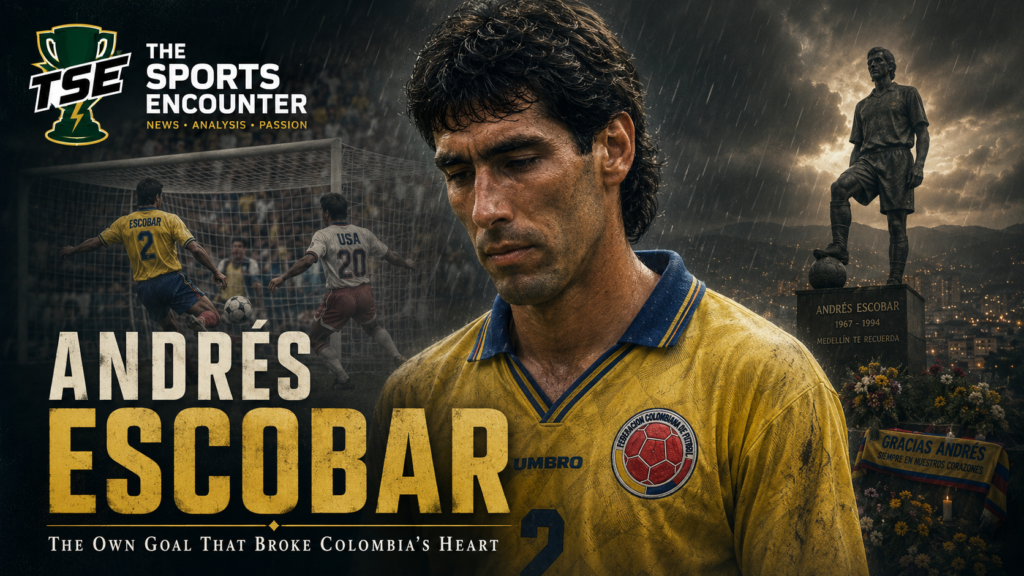
The mistake that should have stayed on the field
A defender stretches his leg.
A cross comes in.
The ball takes the wrong touch, rolls past his goalkeeper, and lands in the net.
In football, that moment usually becomes pain, regret, replay, debate, and then history. For Andrés Escobar, it became something far darker.
On June 22, 1994, Colombia faced the United States at the Rose Bowl in Pasadena. Colombia had arrived at the World Cup with huge expectations. This was a golden generation, filled with flair, confidence, and names that carried real weight across South America: Carlos Valderrama, Faustino Asprilla, Freddy Rincón, and Andrés Escobar.
They were expected to do something special.
Instead, Colombia walked into one of the most painful chapters in World Cup history.
For readers following The Sports Encounter’s wider tournament storytelling, this tragedy belongs beside the emotional highs and lows covered in our FIFA World Cup 2026 coverage hub, where the game is treated as more than scores, fixtures, and tables.
In the first half, John Harkes sent a dangerous ball across the Colombian box. Escobar tried to cut it out, the kind of defensive action he had made hundreds of times before. This time, the ball came off him and went into his own net.
The United States took the lead.
They later won 2-1.
Colombia’s World Cup dream was almost finished.
A few days later, Andrés Escobar was dead.
Colombia carried more than football into that World Cup
To understand why this story still hurts, we have to understand the weight Colombia carried in 1994.
This was more than a football team losing a group-stage match. Colombia had qualified in style, including a famous 5-0 win over Argentina in Buenos Aires. That result changed expectations overnight. People started seeing Colombia as a serious World Cup contender.
But pressure does strange things to sport.
The national team was not only carrying hope. It was carrying a country’s image, its pride, its fear, and its wounds. Colombia was still living through violence, drug trafficking, and deep social instability. Football had become a place where joy, money, identity, and danger mixed together in ways no player could fully control.
That is what makes Escobar’s story so painful.
He made a football mistake inside a world that had already lost its sense of proportion.
The 2-1 defeat that changed everything
The match itself was already difficult for Colombia before the own goal.
They had lost their opening game to Romania, which meant the United States match had become a must-win situation. Colombia needed control, composure, and a response.
Instead, the own goal gave the hosts a lead and changed the emotional temperature of the game.
Escobar did what defenders do. He reacted. He tried to stop danger. He put his body between the ball and the goal. On another day, the same movement would have been called brave defending.
On this day, it became the touch that followed him forever.
Earnie Stewart later scored the second goal for the United States. Colombia pulled one back through Adolfo Valencia, but it was not enough. The United States won 2-1, and Colombia’s tournament was effectively broken.
Colombia did beat Switzerland 2-0 in their final group match, but Romania’s result against the United States meant Colombia still went out.
A team that had arrived with dreams of glory left the tournament early, stunned and humiliated.
And Escobar, the quiet defender known as “The Gentleman of Football,” became the face of a national heartbreak he never deserved to carry alone.
Football has seen other great players carry one unbearable World Cup moment. That is why Escobar’s story naturally sits beside Roberto Baggio: The Man Who Died Standing, another 1994 World Cup story about a player remembered through pain instead of the full beauty of his career.
“Life does not end here”
What happened next says everything about Andrés Escobar’s character.
He did not hide behind excuses. He did not disappear from responsibility. He returned to Colombia and, according to several accounts, wanted to face the public with dignity.
He also wrote a column after the World Cup, accepting the pain of Colombia’s failure while trying to offer perspective. The message remembered most from that piece was simple and heartbreaking:
Life does not end here.
Those words became almost unbearable after what followed.
Because for Andrés Escobar, life did end there.
Not because of football.
Because violence invaded football’s grief.
Medellín, July 2, 1994
On July 2, 1994, while the World Cup was still going on in the United States, Escobar went out with friends in Medellín.
He was 27 years old.
He should have been entering the prime of his career. He should have had more tournaments, more club seasons, more mornings at training, more ordinary days with family and friends. He should have had the chance to be remembered first as a defender, not as a tragedy.
Instead, outside a nightclub parking area, he was confronted.
The argument reportedly turned around the own goal. Witness accounts later said the word “goal” was shouted during the shooting. Humberto Castro Muñoz, linked to drug-trafficking circles, confessed to the killing and was later convicted.
Football had lost a player.
Colombia had lost a son.
The world had lost a man for a mistake that belonged only to the game.
120,000 mourners and a country walking through grief
The scale of the mourning showed who Andrés Escobar really was to Colombia.
More than 120,000 people reportedly attended his funeral in Medellín. Some accounts describe Colombians walking for miles to say goodbye. Whether every detail of those retellings can be verified or not, the emotional truth is clear: his death moved a country.
This was not only the funeral of a footballer.
It was a public apology.
It was a nation trying to bury its shame with its grief.
It was Colombia saying, too late, that Andrés Escobar had deserved protection, not blame.
Imagine that scene.
Thousands upon thousands of people moving through Medellín, not for a trophy parade, not for a title celebration, but to honor a man whose final days were consumed by a football mistake. Parents came. Children came. Football fans came. Ordinary Colombians came because they understood something had gone terribly wrong.
They were not burying an own goal.
They were burying a gentleman.
The statue in Medellín
Years later, Medellín honored Andrés Escobar with a statue.
That statue matters.
It stands as a correction to the way the world too often remembers him. Escobar should never be reduced to one deflection at the Rose Bowl. He was a defender of intelligence and calm. He was respected by teammates and loved by fans. He represented a version of Colombian football built on elegance, discipline, and dignity.
A statue cannot bring back a life.
But it can challenge memory.
It can tell people passing by that this man was more than the worst moment attached to his name. It can remind a football culture that players are human beings before they are symbols, headlines, scapegoats, or targets.
In Medellín, his memory remains alive because people know the truth.
Andrés Escobar did not shame Colombia.
His murder did.
Why this story still hurts after three decades
Every World Cup creates heroes and villains. That is the language fans use. One player scores. One player misses. One goalkeeper saves. One defender slips. One referee changes the mood of a match.
But the story of Andrés Escobar shows the danger of turning sporting mistakes into moral crimes.
The modern World Cup remains a pressure chamber, with players carrying national hopes in front of global audiences. The same emotional pressure now surrounds every major tournament storyline, from opening-match drama to tactical collapses and refereeing debates, which The Sports Encounter continues to track through its soccer news and analysis coverage.
An own goal is painful. It can change a match. It can end a campaign. It can haunt a player for years.
But it should never make a man unsafe in his own country.
That is why Escobar’s story still belongs in every serious conversation about football pressure, fan culture, gambling, crime, and media responsibility. The game is emotional, but emotion without restraint becomes cruelty. National pride can inspire players, but when pride turns into rage, it stops being love.
Escobar paid the ultimate price for a moment that should have remained inside the white lines.
The man behind the tragedy
The cruelest part of this story is that Andrés Escobar was exactly the kind of player football should protect.
He was not reckless. He was not arrogant. He was not a symbol of selfishness or indiscipline. He was widely remembered as calm, professional, elegant, and respectful.
That is why his nickname carries so much weight.
The Gentleman of Football.
There is something devastating about that phrase now. It sounds like praise, but it also sounds like loss. Football had a gentleman, and the world around football failed him.
His own goal became famous because of what happened after it. But his life deserves a better frame.
He was a defender who tried to do his job.
He was a Colombian who came home when hiding might have been easier.
He was a man who believed life could continue after defeat.
And then it did not.
For more long-form football storytelling, historical context, and tournament coverage, readers can follow The Sports Encounter’s FIFA World Cup archive.
Final whistle
The 1994 World Cup continued after Andrés Escobar’s death. Matches were played. Goals were scored. Brazil eventually won the tournament. The global football machine moved on, as it always does.
But one story refused to disappear.
A defender stretched for a cross.
A ball went into the wrong net.
A country crashed out.
A young man returned home.
And 120,000 mourners later showed the world that Colombia’s grief was bigger than its anger had ever been.
Andrés Escobar’s story is remembered as one of football’s darkest tragedies, but it should also be remembered as a warning.
No match is worth a life.
No mistake should erase a man.
No player should ever walk off a football pitch carrying the fear that the final whistle may follow him home.
Andrés Escobar died at 27, but his memory still stands in Medellín, in Colombian football, and in every World Cup conversation about pressure, humanity, and the cost of forgetting that players are people first.