


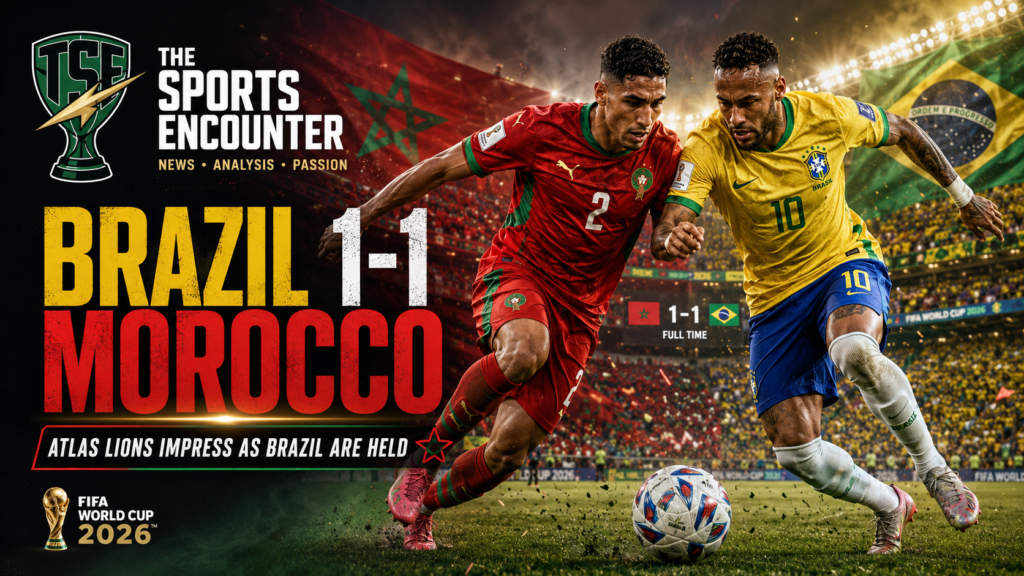
By the end of a tense 1-1 Group C draw, the message was clear: this Morocco team is not living off the memory of Qatar 2022. It is building something deeper, stronger, and more sustainable.
Brazil had the bigger name, the heavier shirt, and the richer World Cup history. Morocco had the sharper first-half structure, the braver midfield, and the clearer early identity. That made this result more than a draw. It felt like another marker in Morocco’s rise from surprise package to serious tournament force.
Ismael Saibari gave Morocco the lead in the first half after Brazil’s defense failed to deal with a sharp attacking move. Vinícius Júnior brought Brazil level with a brilliant finish, reminding everyone why the Seleção still carry world-class attacking danger even when they look unbalanced.
The match finished 1-1, but Morocco walked away with more than a point. They walked away with validation.
Morocco Started Like a Team That Belongs Here
There was nothing timid about Morocco’s opening.
They pressed with purpose, moved the ball with confidence, and refused to treat Brazil as an untouchable football giant. That mattered. Too many teams play Brazil’s shirt before they play Brazil’s players. Morocco did not fall into that trap.
Their midfield showed maturity from the start. They did not simply sit deep and wait for Brazil to make mistakes. They challenged the rhythm of the match. They blocked passing lanes, forced Brazil into uncomfortable areas, and attacked quickly when space opened.
Saibari’s goal came from that mindset.
It was not a lucky punch. It reflected Morocco’s early superiority. Brazil looked slow to settle, and Morocco punished them before the game could drift into the usual pattern of Brazilian possession and opponent survival.
That has become one of Morocco’s strongest modern traits. They can defend, but they are no longer just a defensive story. They can press. They can break. They can compete physically. They can hurt elite teams without needing 70 percent possession.
Against Brazil, that balance made them dangerous.
Brazil Found an Answer Through Vinícius Júnior
Brazil needed a spark, and Vinícius Júnior gave them one.
His equalizer was the kind of moment Brazil often rely on when the system does not fully click. One elite attacker receives half a yard, sees a chance before everyone else, and changes the emotional temperature of the match.
Vinícius was Brazil’s most important attacking player on the night. He carried threat from the left, stretched Morocco’s defensive line, and gave Brazil their clearest route back into the contest.
That is both good news and bad news for Brazil.
The good news is simple: Vinícius looks ready to carry a much heavier World Cup burden. He is no longer just one of Brazil’s exciting wide players. He is becoming the player through whom Brazil’s biggest attacking moments flow.
The concern is that Brazil still looked too dependent on individual quality. Their second-half improvement showed better control, but control alone does not win knockout-level matches. Brazil had more of the ball after tactical adjustments, but Morocco still looked organized enough to keep the game alive until the end.
For a team chasing its sixth World Cup title, Brazil need more collective rhythm around their stars.
Did Neymar’s Absence Hurt Brazil?
Yes, Neymar’s absence hurt Brazil, but maybe not in the simple way many fans will frame it.
Brazil did not miss Neymar only because he can dribble, score, or produce a final pass. They missed his ability to connect broken pieces of an attack.
When Brazil are disjointed, Neymar has often served as the bridge between midfield and forward line. He drops into pockets, draws defenders, slows the game when needed, and creates a passing angle when structure breaks down.
Against Morocco, Brazil had pace. They had wide threat. They had individual danger. What they lacked for long spells was attacking glue.
That is where Neymar still matters.
At the same time, Brazil cannot build a World Cup campaign around waiting for an injured star. Neymar’s calf problem may explain part of the creative gap, but it cannot become an excuse. Brazil have enough elite talent to solve matches in different ways.
Vinícius showed that the post-Neymar transition is already underway. The question is whether Brazil can build a cleaner team identity around him quickly enough.
If Neymar returns fit, he gives Brazil imagination and emotional weight. If he remains unavailable, Brazil must stop playing like a team missing someone and start playing like a team that knows exactly who now leads the attack.
Morocco’s Rise Is No Accident
This Morocco performance should not surprise anyone paying attention.
Morocco’s men’s team changed global perception at the 2022 FIFA World Cup by becoming the first African team to reach the semifinals. That run was not just emotional. It was tactical, disciplined, and brave. They beat major European powers and showed that African and Arab football could compete deep into the tournament on structure, not just spirit.
Since then, Morocco’s wider football system has continued to produce results.
The country won the U-23 Africa Cup of Nations in 2023, then took bronze at the 2024 Paris Olympics. Morocco’s U-20 team also lifted the FIFA U-20 World Cup in 2025, proving that the pipeline is real. The senior team later reached the Africa Cup of Nations final before losing to Senegal, another sign that Morocco’s rise now cuts across age groups and tournament levels.
That context matters when analyzing this 1-1 draw with Brazil.
This is no longer a golden month or a lucky generation. Morocco have built a football structure that produces competitive teams, disciplined players, and tournament-ready personalities. Their players do not look overwhelmed by big stages anymore. They look prepared for them.
Against Brazil, that confidence was visible in every early duel.
Morocco’s Best Performers
Saibari deserves the headline for the goal, but Morocco’s performance was collective.
Their midfield gave Brazil problems early by winning second balls and denying easy progression. The defensive line stayed compact after Brazil equalized. Bono, as usual, gave Morocco calm and presence in goal, making important interventions and helping his team survive Brazil’s stronger spells.
Achraf Hakimi also remains central to Morocco’s identity. His presence gives the team speed, leadership, and attacking width from deep. Even when he does not dominate every phase, opponents must respect his ability to turn defense into attack within seconds.
Morocco’s biggest strength, though, was not one player. It was trust.
They trusted the plan. They trusted their press. They trusted their defensive shape. They trusted their ability to stand toe-to-toe with Brazil without losing their own personality.
That is the difference between a team hoping for an upset and a team expecting to compete.
Brazil’s Best Performers
Vinícius Júnior was Brazil’s standout performer because he gave them life when the match was slipping away.
His goal did more than level the score. It reset Brazil’s confidence. Before that moment, Morocco looked sharper and more settled. After it, Brazil started to find more control and push Morocco deeper.
Alisson also gave Brazil stability at the back. In matches where Brazil’s defense looks vulnerable, a goalkeeper with elite positioning and composure becomes even more valuable.
Brazil’s second-half adjustments helped them regain territory, but their midfield still needs cleaner balance. Casemiro and Bruno Guimarães have experience and quality, yet Morocco disrupted them too often in the opening phase. Against stronger knockout opponents, Brazil cannot afford another slow midfield start.
What This Result Means for Group C
A draw keeps both teams alive and balanced, but it places pressure on Brazil.
Brazil will still expect to qualify from Group C, but this result removes any early comfort. They now need sharper execution in their next match and a clearer attacking structure.
For Morocco, the draw is a platform.
They avoided defeat against the group’s biggest name and showed enough quality to believe they can top the group, not just sneak through it. Their next match will test a different side of them: whether they can control expectation after proving once again that they can handle elite opposition.
That has been the next step in Morocco’s evolution.
In 2022, they shocked the world. In 2026, they are trying to convince the world that this is normal.
Final Verdict
Brazil will feel they dropped two points.
Morocco should feel they earned one and made a statement with it.
The Atlas Lions were organized, fearless, and technically sharp enough to trouble Brazil for long stretches. Brazil still have enough individual quality to survive difficult matches, especially through Vinícius Júnior, but the Neymar question remains real. Without him, they need faster combinations, better midfield control, and more attacking variety.
Morocco, meanwhile, look like a team with a bigger story still to write.
This was not a giant killing. It was not a miracle. It was a serious football team taking a serious point from a five-time world champion.
That may be the biggest compliment Morocco can receive.