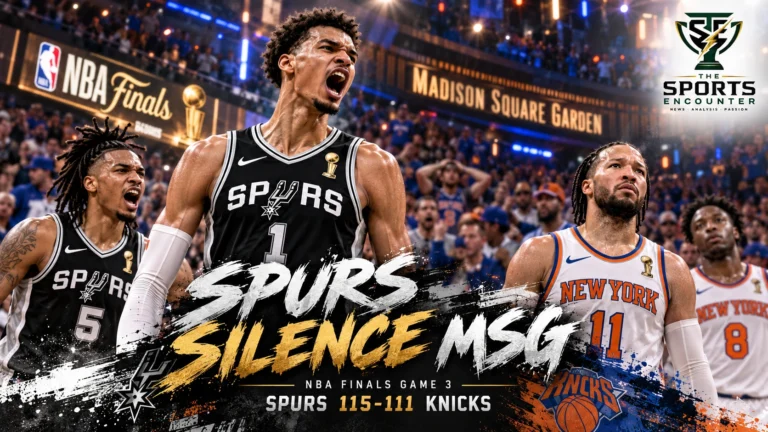
NEW YORK, United States, June 9, 2026: For one night at Madison Square Garden, Victor Wembanyama gave the San Antonio Spurs a convincing answer to the question that had followed them through the first two games of the NBA Finals.
Could they actually finish against the New York Knicks?
San Antonio had led late in Game 1. They had another opportunity in Game 2. New York escaped with both victories and arrived home with a 2-0 series lead, a 13-game postseason winning streak and an opportunity to put the Finals into territory from which no NBA team had ever returned.
Then Wembanyama produced 32 points, eight rebounds, six assists, two steals and three blocks.
Story at a glance
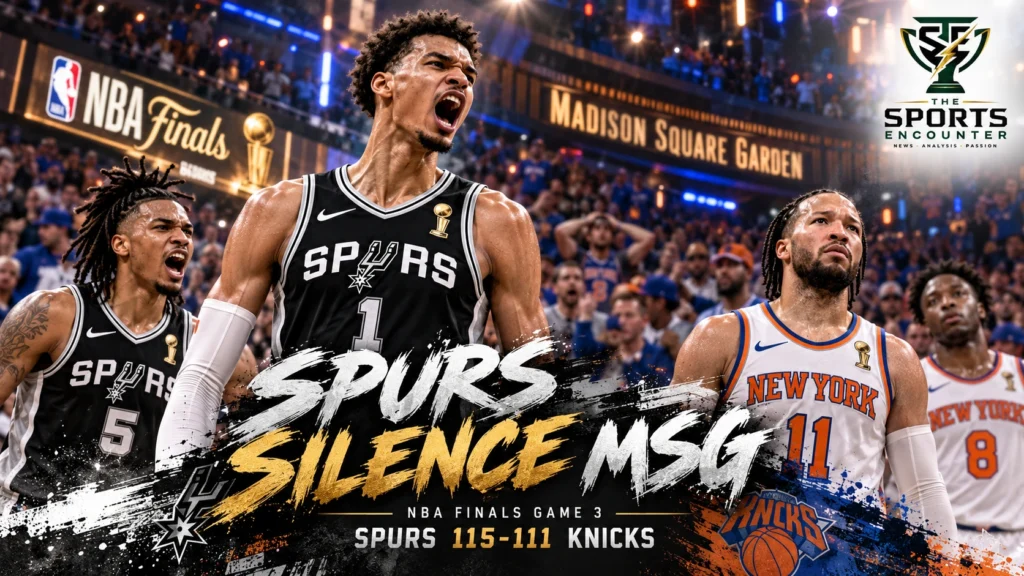
Spurs vs Knicks Game 3: Score, Venue and Series Situation
The complete statistical record is available through the official NBA Game 3 box score.
NBA Finals Game 3 Quarter-by-Quarter Score
The quarter scores explain why Game 3 felt like several games compressed into one.
Why Game 3 Felt Like a Must-Win for San Antonio
The Spurs were not mathematically facing elimination.
Wembanyama Set the Tone Before New York Could Settle
San Antonio’s first adjustment was not complicated.
Victor Wembanyama’s Complete Game 3 Stat Line
The most impressive number may be the last one.
Stephon Castle added 23 points, five rebounds and five assists.
The Spurs committed only eight turnovers, generated 28 assists, punished New York’s mistakes for 21 points and survived another Jalen Brunson surge to win Game 3 115-111.
For approximately 48 hours, the 2026 NBA Finals looked transformed.
San Antonio had finally won one of the close games it had been losing. Wembanyama had solved some of New York’s defensive tactics. Castle looked fearless in his first Finals. Madison Square Garden had been silenced during its first NBA Finals game since 1999.
Then history delivered the twist that makes Game 3 more interesting now than it was on the night it happened.
San Antonio discovered a formula that could hurt New York.
Two nights later, the Spurs used that formula to build a 29-point lead in Game 4.
They still lost.
The Knicks eventually won the Finals in five games, making San Antonio’s Game 3 triumph their only victory of the series.
That hindsight gives Game 3 a different meaning today. It was not the beginning of a Spurs comeback. It was the clearest glimpse of how close they were to changing the Finals, and of the difference between finding a championship formula and sustaining it under championship pressure.
For the full series context, The Sports Encounter’s NBA Hub tracks the entire 2026 Finals, New York’s championship and the league’s transition into the 2026-27 season.
Spurs vs Knicks Game 3: Score, Venue and Series Situation
| Detail | Game 3 |
|---|---|
| Competition | 2026 NBA Finals |
| Game | Game 3 |
| Date | June 8, 2026 local time |
| Venue | Madison Square Garden, New York |
| Final Score | San Antonio Spurs 115, New York Knicks 111 |
| Series After Game | Knicks led 2-1 |
| Attendance | 19,812 |
The complete statistical record is available through the official NBA Game 3 box score.
NBA Finals Game 3 Quarter-by-Quarter Score
| Team | Q1 | Q2 | Q3 | Q4 | Final |
|---|---|---|---|---|---|
| San Antonio Spurs | 33 | 24 | 35 | 23 | 115 |
| New York Knicks | 22 | 42 | 27 | 20 | 111 |
The quarter scores explain why Game 3 felt like several games compressed into one.
San Antonio dominated the first quarter.
New York produced a spectacular 42-point second quarter.
The Spurs answered with 35 points in the third.
Then the championship pressure arrived in the fourth, where San Antonio finally closed a game New York kept trying to steal.
Why Game 3 Felt Like a Must-Win for San Antonio
The Spurs were not mathematically facing elimination.
Emotionally, the situation was much closer to it.
New York had already beaten them twice in San Antonio.
The Knicks won Game 1 by 10 points and escaped Game 2 by a single point, taking a 2-0 lead despite San Antonio having genuine opportunities to close both games.
TSE’s earlier report on how the Knicks took control of the Finals before the series moved to New York captured the central problem.
The Spurs were competitive.
They were also losing the possessions that decide championships.
Game 1 had slipped despite San Antonio holding a late lead.
Game 2 hurt more because the Spurs were still ahead with 40 seconds remaining and again could not finish.
A Game 3 defeat would have put New York ahead 3-0.
No NBA team has ever recovered from that deficit to win a best-of-seven playoff series.
That is the pressure Wembanyama and a roster filled with young players carried into Madison Square Garden.
Wembanyama Set the Tone Before New York Could Settle
San Antonio’s first adjustment was not complicated.
Get Wembanyama involved immediately.
He scored nine points on perfect 4-for-4 shooting during the opening five minutes as the Spurs took a 19-9 lead.
That aggression mattered because the first two Finals games had too often allowed New York to dictate how and where Wembanyama received the ball.
The Knicks had been physical with his rolls, putting bodies between him and the rim and making catches uncomfortable.
Game 3 changed the geometry.
San Antonio improved the timing of its screens and created cleaner paths toward the basket.
Wembanyama responded by attacking the rim instead of settling for difficult perimeter shots.
He finished 11-for-18 from the field and 8-for-9 at the free-throw line.
Twenty-two of his 32 points came either at the rim or from free throws.
The NBA’s detailed Game 3 film study calculated that the Spurs produced 123.7 points per 100 possessions, dramatically better than their offensive performance across the first two Finals games.
Victor Wembanyama’s Complete Game 3 Stat Line
| MIN | PTS | REB | AST | STL | BLK | FG | 3PT | FT | TO |
|---|---|---|---|---|---|---|---|---|---|
| 38:44 | 32 | 8 | 6 | 2 | 3 | 11-18 | 2-4 | 8-9 | 1 |
The most impressive number may be the last one.
One turnover.
Wembanyama was not simply San Antonio’s leading scorer. He was making decisions under Finals pressure while rarely giving New York free possessions.
Wembanyama Made NBA Finals History at Madison Square Garden
His performance also carried historical weight.
At 22, Wembanyama became the second-youngest player to record at least 30 points, five rebounds and five assists in an NBA Finals game, behind only Magic Johnson.
He also became the first visiting player to post a 30-5-5 Finals game at Madison Square Garden.
By Game 3, he had accumulated 70 blocked shots in his first NBA postseason, breaking Dikembe Mutombo’s record for the most blocks in a player’s first playoff run since the league began officially recording blocks.
Those achievements explain part of the reason San Antonio remained central to the championship conversation even after losing the series. TSE later examined why the Spurs still opened as one of the favorites for the following season in its analysis of the 2026-27 NBA championship picture.
Stephon Castle Gave Wembanyama the Co-Star San Antonio Needed
Wembanyama’s 32 points would not have been enough without Stephon Castle.
Castle scored 18 of his 23 points in the first half.
He attacked early, helped San Antonio build its first-quarter advantage and refused to shrink inside a building waiting to celebrate New York’s first Finals home game in 27 years.
Then his scoring disappeared for much of the second half.
That made what happened late even more revealing.
With the Spurs leading 108-104 and the shot clock collapsing, Castle pulled up from 26 feet.
Three points.
San Antonio led 111-104 with 1:53 remaining.
It was one of the defining shots of the game.
Later, after OG Anunoby’s three-pointer cut the Spurs’ lead to two in the final seconds, Castle calmly made both free throws to close the scoring.
Stephon Castle’s Game 3 Numbers
| PTS | REB | AST | FG | 3PT | FT |
|---|---|---|---|---|---|
| 23 | 5 | 5 | 8-14 | 2-5 | 5-6 |
Castle and Wembanyama became the first pair of teammates aged 22 or younger to each score at least 20 points in an NBA Finals game.
Only Magic Johnson and Tony Parker were younger than the 21-year-old Castle when producing at least 20 points, five rebounds and five assists in a Finals game.
New York’s 42-Point Second Quarter Nearly Broke the Spurs Again
San Antonio’s opening quarter looked almost perfect.
The Spurs shot efficiently, Wembanyama was aggressive and New York struggled to match their rhythm.
San Antonio led 33-22.
Then Madison Square Garden woke up.
Anunoby’s three-pointer completed an 11-2 Knicks surge that cut the margin to 40-38.
Brunson eventually gave New York its first lead of the night.
By halftime, the Knicks had scored 42 points in the second quarter and turned an 11-point first-quarter deficit into a 64-57 advantage.
For San Antonio, this was the moment when Game 3 could easily have become Games 1 and 2 again.
The Spurs had once more started well.
New York had once more found a response.
The question was whether San Antonio’s young roster would begin to feel the weight of the previous two defeats.
Instead, the Spurs produced their best offensive quarter of the series.
The Third Quarter Was the Real Turning Point
San Antonio scored 35 points in the third quarter.
Seven of the eight Spurs who appeared in the period scored.
That distribution mattered because it prevented New York from turning Game 3 into a simple Wembanyama containment exercise.
Julian Champagnie stretched the floor.
Devin Vassell punished open coverage.
Dylan Harper provided additional ball handling.
Fox kept organizing the offense despite a difficult shooting night.
Wembanyama remained the gravitational center.
By the end of the quarter, San Antonio had regained a 92-91 advantage.
The lead was tiny.
The psychological shift was not.
The Fourth Quarter Showed the Version of San Antonio That Almost Changed the Finals
The Spurs held New York scoreless for the opening three and a half minutes of the final quarter.
That stretch allowed San Antonio to create a seven-point cushion.
More importantly, it forced the Knicks to chase.
New York shot just 7-for-27 in the fourth quarter.
The Knicks were 2-for-14 from three-point range.
Brunson scored 12 points in the period, but only two other Knicks scored from the field.
That was the defensive formula San Antonio needed.
Make Brunson work.
Stay attached to the supporting shooters.
Finish possessions.
Avoid giving the Knicks extra chances.
For one quarter, the Spurs did all four.
De’Aaron Fox Struggled, Then Hit the Shot That Mattered
Fox’s Game 3 box score is a good reminder that playoff influence cannot always be summarized by shooting percentage.
He shot only 4-for-14.
He missed all five of his three-point attempts.
He scored 12 points.
But he also delivered eight assists, two blocks and the shot that effectively ended New York’s final comeback attempt.
After Anunoby and Brunson had dragged the Knicks within striking distance, Fox hit a 16-foot jumper with 12.2 seconds remaining.
San Antonio led 113-108.
Anunoby answered with a three.
Castle made two free throws.
Game over.
That was exactly the type of possession San Antonio had failed to finish in the opening two games.
The Turnover Battle Changed Game 3
The cleanest statistical explanation for San Antonio’s victory may be the simplest.
| Statistic | Spurs | Knicks |
|---|---|---|
| Assists | 28 | 18 |
| Turnovers | 8 | 13 |
| Points Off Turnovers | 21 | 7 |
| Field Goal % | 46.4% | 45.5% |
| 3-Point % | 35.3% | 35.1% |
| Free Throws | 25-32 | 18-22 |
| Rebounds | 37 | 46 |
| Blocks | 7 | 6 |
New York actually won the rebounding battle by nine.
The Knicks scored more fast-break points.
They scored two more points in the paint.
The shooting percentages were almost identical.
And yet San Antonio won.
The 14-point gap in points generated from turnovers is the number that explains why.
A four-point game contained a 14-point possession-value advantage.
San Antonio took care of the basketball.
New York did not.
How Game 3 Reversed the Pattern From Games 1 and 2
Through the first two Finals games, the Knicks had averaged 24.5 assists against 12 turnovers.
San Antonio had averaged 19 assists and 14.5 turnovers.
Game 3 flipped both relationships.
The Spurs jumped to 28 assists while reducing themselves to eight turnovers.
New York dropped to 18 assists and committed 13 turnovers.
That shift tells us why Game 3 was more than Wembanyama simply making more shots.
The entire Spurs offense became cleaner.
They were moving the Knicks before attacking rather than repeatedly asking one player to solve a set defense.
They were delivering the ball to Wembanyama closer to productive areas.
And they were not feeding New York’s transition attack with careless possession loss.
Why Jalen Brunson’s 32 Points Were Not Enough
Brunson still produced the type of scoring performance New York had come to expect.
He finished with 32 points, five rebounds and five assists.
He shot 11-for-25 and hit three of five three-pointers.
He scored 12 points in the fourth quarter.
The problem was everything San Antonio made him carry around that production.
Brunson committed five turnovers.
He played through foul trouble.
The Knicks’ offense became increasingly dependent on his ability to manufacture something late.
That was manageable when Anunoby was rolling.
It became much harder when other starters disappeared.
OG Anunoby Was Brilliant, but New York’s Supporting Offense Collapsed
Anunoby delivered one of his best performances of the Finals.
He scored 28 points on 9-for-13 shooting.
He made three three-pointers.
He also contributed five rebounds and two blocks.
But Karl-Anthony Towns managed only 11 points on 4-for-10 shooting.
Mikal Bridges had perhaps his most difficult game of the postseason.
Two points.
One made field goal.
Twenty-eight minutes.
Foul trouble prevented Bridges from establishing any offensive rhythm.
That left New York asking Brunson and Anunoby to carry too much of the creation burden.
Game 3 Key Player Statistics
| Player | Team | PTS | REB | AST | FG | +/- |
|---|---|---|---|---|---|---|
| Victor Wembanyama | Spurs | 32 | 8 | 6 | 11-18 | +7 |
| Stephon Castle | Spurs | 23 | 5 | 5 | 8-14 | +6 |
| Dylan Harper | Spurs | 13 | 9 | 4 | 5-18 | -8 |
| De’Aaron Fox | Spurs | 12 | 3 | 8 | 4-14 | -7 |
| Julian Champagnie | Spurs | 12 | 1 | 3 | 4-9 | +8 |
| Jalen Brunson | Knicks | 32 | 5 | 5 | 11-25 | -9 |
| OG Anunoby | Knicks | 28 | 5 | 1 | 9-13 | -3 |
| Josh Hart | Knicks | 16 | 9 | 5 | 6-10 | -7 |
| Karl-Anthony Towns | Knicks | 11 | 8 | 1 | 4-10 | +6 |
| Mikal Bridges | Knicks | 2 | 5 | 2 | 1-5 | +11 |
Game 3 Ended New York’s Extraordinary 13-Game Playoff Winning Streak
There was another reason San Antonio’s victory felt so significant at the time.
New York had not lost a postseason game in 46 days.
The Knicks had won 13 straight, the second-longest single-postseason winning streak in NBA history behind the 2017 Golden State Warriors.
The Spurs did not simply win a Finals road game.
They ended a stretch during which the Knicks had started to look almost inevitable.
The fact that San Antonio did it during the first Finals game played at Madison Square Garden since 1999 made the result feel even bigger.
The Road Team Won the First Three Games, Something Almost Never Seen
Game 3 created another historical oddity.
The road team had won all three games of the Finals.
It was only the second time that had happened, following the 1993 series between Chicago and Phoenix.
New York won Games 1 and 2 in San Antonio.
San Antonio answered in New York.
Home-court advantage had disappeared from the opening three games.
That helped fuel the belief that the series might finally be turning.
Why the Spurs Believed They Had Finally Solved the Knicks
Game 3 gave San Antonio four things it had been searching for.
1. Wembanyama at the Rim
The Spurs found cleaner ways to send Wembanyama toward the basket rather than leaving him to create against a set defense from the perimeter.
2. A Second Young Scorer
Castle gave New York another aggressive downhill threat and hit the biggest three-pointer of the fourth quarter.
3. Ball Security
Eight turnovers meant New York received fewer easy transition opportunities.
4. Defensive Closing
The Spurs held New York to 20 fourth-quarter points and prevented the Knicks from ever taking the lead in the final period.
That combination looked repeatable.
In fact, San Antonio proved that it was repeatable for long stretches of Game 4.
That is what makes the eventual collapse so remarkable.
Game 4 Showed Game 3 Was Not a Fluke
Two nights later, the Spurs returned to Madison Square Garden and played even better for much of Game 4.
San Antonio scored 41 points in the first quarter.
They added 35 in the second.
The Spurs led by 27 at halftime and eventually extended the margin to 29.
The offense that had finally broken through in Game 3 was not disappearing.
It was accelerating.
San Antonio scored at an extraordinary rate early in the game, moved the ball confidently and appeared ready to turn the Finals into a best-of-three series.
Then the Knicks produced the largest comeback in NBA Finals history.
TSE’s detailed analysis of New York’s 29-point Game 4 comeback explains why that loss became the defining psychological wound of San Antonio’s series.
OG Anunoby’s tip-in with 1.2 seconds remaining gave the Knicks a 107-106 win.
Instead of 2-2, the series was 3-1.
Why the Game 3 Formula Could Not Save San Antonio
The most revealing lesson from hindsight is that San Antonio’s Game 3 solution was real.
It simply was not complete.
The Spurs learned how to generate efficient offense against New York.
They had not yet learned how to control a Finals game when the situation became uncomfortable.
Game 4 exposed the distinction.
San Antonio had the better offense for much of the night.
The Spurs had a 29-point advantage.
They had every reason to believe Game 3’s lessons had carried over.
Then the Knicks increased the physical pressure, Brunson took control, Anunoby caught fire and San Antonio’s possessions became progressively tighter.
The Spurs stopped attacking the game and began protecting the lead.
Game 3 proved they were capable of winning.
Game 4 proved they had not yet learned how to keep winning when a Finals opponent refused to disappear.
Game 5 Turned the Lesson Into a Championship
San Antonio went home for Game 5 facing elimination.
The Spurs led again.
They held a 16-point advantage at one stage.
New York came back again.
Continue the NBA Story

Brunson scored 45 points and carried the Knicks to a 94-90 victory that completed a 4-1 series win.
TSE’s Game 5 championship report documented the moment New York ended a 53-year title drought.
The complete official NBA Finals record shows the final sequence:
2026 NBA Finals: Complete Series Results
| Game | Result | Series |
|---|---|---|
| Game 1 | Knicks 105, Spurs 95 | New York 1-0 |
| Game 2 | Knicks 105, Spurs 104 | New York 2-0 |
| Game 3 | Spurs 115, Knicks 111 | New York 2-1 |
| Game 4 | Knicks 107, Spurs 106 | New York 3-1 |
| Game 5 | Knicks 94, Spurs 90 | New York wins 4-1 |
Why a 4-1 Finals Result Does Not Tell the Full Story
A reader looking only at the final series score could reasonably assume New York dominated.
That is not what happened.
Game 2 was decided by one point.
Game 3 was a four-point Spurs victory.
Game 4 was decided by one point after San Antonio led by 29.
Game 5 was decided by four.
Every game in the series was within five points during the final five minutes, according to NBA analysis.
Game 3 therefore belongs inside a broader explanation of why this was one of the strangest five-game Finals in recent memory.
San Antonio was much closer to extending the series than the 4-1 result suggests.
New York was simply better at owning the final possessions.
What Game 3 Revealed About the Champion Knicks
The Knicks lost Game 3.
In hindsight, some of the problems exposed that night helped define their response.
The turnovers were unacceptable.
Bridges disappeared offensively.
Towns was held to 11 points.
The fourth-quarter three-point offense collapsed.
New York could have treated the loss as evidence that San Antonio had finally solved them.
Instead, the Knicks responded by surviving the biggest Finals deficit ever overturned and then closing the championship on the road.
That capacity for recovery became New York’s defining trait.
The title eventually produced the kind of citywide celebration chronicled in TSE’s report on the Knicks’ championship parade and New York’s release after 53 years.
What Game 3 Revealed About the Spurs’ Future
San Antonio lost the championship.
Game 3 still supplied enormous evidence about what the franchise had built.
Wembanyama had already reached a Finals stage at 22.
Castle was producing historic performances at 21.
Dylan Harper had meaningful playoff responsibility.
Fox gave the group an experienced creator.
And the Spurs had emerged from a brutal Western Conference path that included a seven-game conference final against Oklahoma City.
TSE had followed that journey before the Finals in its report on the Thunder-Spurs battle that ultimately produced New York’s Finals opponent.
The Finals loss therefore looked less like the end of San Antonio’s window than the opening chapter of it.
Game 3 Also Became a Massive Television Moment
The significance of the game extended beyond the court.
Game 3 averaged approximately 23.8 million viewers on ABC and ESPN, according to NBA reporting, making it the most-watched Game 3 of the NBA Finals in 28 years.
The combination of New York’s return to the Finals, Wembanyama’s emergence and the dramatic opening two games had turned the series into a major national sports event.
TSE later examined that phenomenon in its analysis of the Knicks-Spurs Finals ratings surge.
So What Was the Real Meaning of Game 3?
On June 8, Game 3 looked like the night the Finals changed.
By June 13, it looked like the night San Antonio showed what could have been.
Both interpretations are true.
The Spurs found a way to get Wembanyama to the rim.
They unlocked Castle.
They protected the basketball.
They defended well enough in the fourth quarter.
They made the late shot that had been missing in San Antonio.
That is why the victory mattered.
It proved New York was beatable.
What San Antonio could not prove was that it could reproduce the emotional control required to beat the Knicks three more times.
New York could survive bad stretches.
It could survive massive deficits.
It could survive losing Game 3.
That resilience eventually became the difference between a talented finalist and a champion.
Game 3 remains San Antonio’s only victory from the 2026 Finals.
It also remains one of the clearest previews of why the Spurs were immediately viewed as capable of returning.
New York won the championship.
San Antonio left Madison Square Garden that night knowing it had found the formula.
The painful lesson of the rest of the Finals was that finding the formula and finishing the job are not the same thing.
Spurs vs Knicks Game 3 FAQs
Who Won Game 3 of the 2026 NBA Finals?
The San Antonio Spurs beat the New York Knicks 115-111 at Madison Square Garden.
What Was the Knicks-Spurs Series Score After Game 3?
New York still led the NBA Finals 2-1 after San Antonio’s victory.
How Many Points Did Victor Wembanyama Score in Game 3?
Wembanyama scored 32 points on 11-for-18 shooting. He also recorded eight rebounds, six assists, two steals and three blocks.
What Were Stephon Castle’s Game 3 Stats?
Castle finished with 23 points, five rebounds and five assists while shooting 8-for-14 from the field.
How Many Points Did Jalen Brunson Score in Game 3?
Brunson scored 32 points with five rebounds and five assists, but committed five turnovers.
How Did the Spurs Beat the Knicks in Game 3?
San Antonio improved its ball movement, got Wembanyama closer to the basket, committed only eight turnovers, generated 28 assists and outscored New York 21-7 in points off turnovers. The Spurs also held the Knicks to 20 fourth-quarter points.
Why Was Game 3 Historically Significant for Wembanyama?
He became the second-youngest player to record at least 30 points, five rebounds and five assists in an NBA Finals game, behind Magic Johnson.
What Record Did Stephon Castle and Wembanyama Set?
They became the first teammates aged 22 or younger to each score at least 20 points in the same NBA Finals game.
Did Game 3 End a Knicks Winning Streak?
Yes. San Antonio ended New York’s 13-game postseason winning streak, which was the second-longest single-postseason winning streak in NBA history.
What Happened in Game 4?
San Antonio built a 29-point lead, but New York completed the largest comeback in NBA Finals history and won 107-106 on OG Anunoby’s late tip-in.
Who Won the 2026 NBA Finals?
The New York Knicks defeated the San Antonio Spurs 4-1 and won their first NBA championship since 1973.
Who Won the 2026 NBA Finals MVP?
Jalen Brunson won Finals MVP after leading New York’s championship run and scoring 45 points in the Game 5 clincher.
Was Game 3 the Spurs’ Only Win of the Finals?
Yes. San Antonio’s 115-111 Game 3 victory was its only win in the five-game series.
NBA Finals
- Knicks-Spurs Ratings Boom Shows Why the NBA Still Owns the Big Stage
- 53 Years Coming: New York Knicks Parade Set to Turn Manhattan Orange
- New York Knicks Finish NBA Finals Rout in 5 Games, End 53-Year Title Wait
- Knicks Teach Spurs the Cruelest Lesson of the NBA Finals
- How Wembanyama and the Spurs Stole Game 3 at MSG, and Why It Still Couldn’t Save Their NBA Finals