



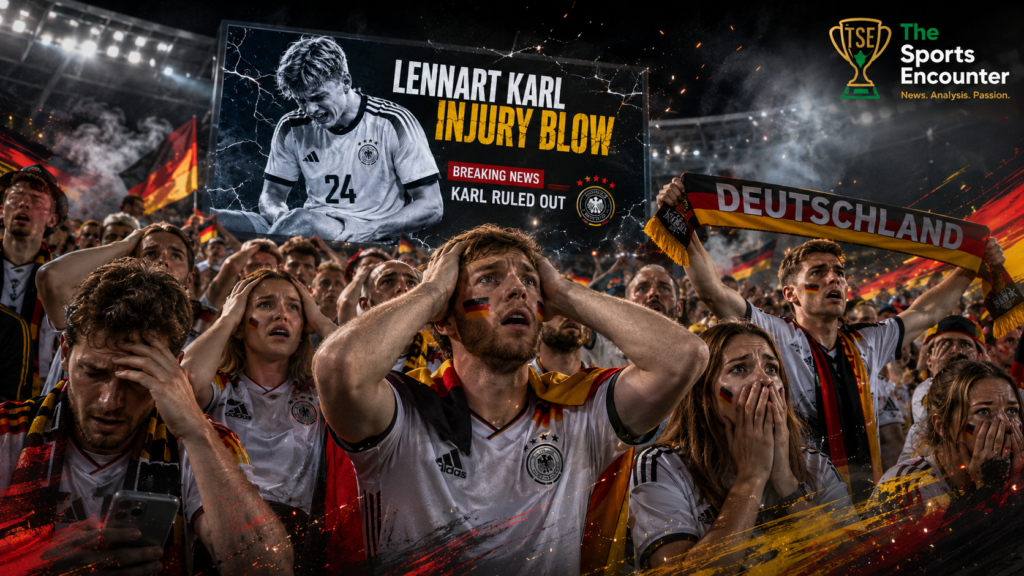
Germany’s FIFA World Cup 2026 campaign has taken an early hit before the official kickoff. Lennart Karl, one of the brightest young names in German football, has been ruled out of the tournament after suffering a muscle bundle tear in his left thigh during training in Chicago.
The 18-year-old Bayern Munich attacking midfielder was taken to hospital, and Germany coach Julian Nagelsmann confirmed that Assan Ouedraogo will replace him in the final squad. Reuters reported that Karl suffered the injury before Germany’s friendly against the United States.
For Germany, this is not the kind of injury that changes their identity overnight. They still have depth, experience, structure, and enough attacking quality to compete. But World Cups are rarely decided by starting XIs alone. They are shaped by timing, rhythm, squad mood, bench options, and the one player who can change a difficult match in 20 minutes.
That is where Lennart Karl’s absence could cost Germany more than it seems at first glance.
Why Lennart Karl Injury Hurts Germany Before the World Cup Starts
The first cost is tactical variety.
Karl was not just a young squad member brought along for experience. His rise at Bayern Munich had made him a serious tournament option. Reuters previously reported that he had scored five Bundesliga goals and delivered four assists while emerging as a strong contender for Germany’s World Cup squad.
That matters because Germany need different ways to break teams down.
In major tournaments, favorites often face opponents who defend deep, slow the game, and force them to create in tight spaces. Germany can control possession. The bigger test is whether they can turn control into pressure, and pressure into goals.
Karl gave Nagelsmann a player who could play with pace, personality, and directness. Nagelsmann described him as a player whose lightness, creativity, speed, and personality fit the team perfectly, according to Reuters-based coverage.
That kind of profile is valuable in a World Cup because it gives a coach one more way to change the temperature of a match.
Lennart Karl Was Germany’s Wildcard, Not Just a Prospect
The biggest mistake would be to judge Karl’s absence only through his age.
At 18, he was not expected to carry Germany through the tournament. But he did not need to carry Germany to matter. His role was likely to be more specific: stretch tired defenses, offer fresh movement, attack spaces between midfield and defense, and give Nagelsmann a fearless option from the bench or in selected matchups.
Every successful tournament team needs one or two players who are difficult to prepare for.
Karl had that quality.
Opponents can study Germany’s senior stars for months. They know their passing lanes, preferred movements, pressing patterns, and finishing zones. A teenager with confidence, form, and no heavy tournament scars can disturb that planning.
That is what Germany have lost.
Not a guaranteed starter. Not the face of the campaign. But a wildcard who could have turned one tight match.
And at the World Cup, one tight match can change everything.
How Much Will Lennart Karl Injury Cost Germany Tactically?
Tactically, the cost depends on how far Germany go.
In the group stage, Germany may survive without him. They open Group E against Curacao in Houston on June 14, followed by matches against Ivory Coast and Ecuador, according to Reuters.
Germany will expect to advance from that group. If they start well, Karl’s absence may feel manageable. If they struggle to score early, the discussion will grow louder.
The real cost may come later.
Knockout football is different. Matches become tighter. Coaches protect space. Players tire. Nerves take over. A game can sit at 0-0 or 1-1 deep into the second half, and that is when benches become decisive.
Karl could have been useful in exactly those moments.
His injury removes one attacking alternative and forces Nagelsmann to solve those situations with more familiar options. That does not make Germany weak, but it does make them slightly more predictable.
At elite level, slightly predictable is enough to matter.
Assan Ouedraogo Gives Germany a Replacement, But Not the Same Profile
Assan Ouedraogo’s late call-up is a good story in its own right. The RB Leipzig midfielder was reportedly on holiday in Marbella when Nagelsmann called him into the squad, and he described the moment as a childhood dream coming true.
Ouedraogo is talented, athletic, and technically strong. He also gives Germany another young player with energy and hunger.
But replacement does not mean duplication.
Karl’s value was linked to attacking disruption. Ouedraogo brings different qualities. He can help Germany in midfield balance, transition moments, and physical presence, but Nagelsmann may still need to redistribute the attacking role Karl was expected to fill.
That adjustment is not impossible. It is simply another problem to solve during a period when Germany would rather be fine-tuning than reshuffling.
The Emotional Cost of Lennart Karl Injury
There is also an emotional cost.
World Cup squads are not built only on tactics. They are built on belief, chemistry, and small human moments inside camp. Losing a young player days before the tournament can affect the group.
Reports described Karl as devastated after the injury, with teammates and Nagelsmann supporting him before his departure from the squad. Bavarian Football Works reported that Karl was emotional after realizing the seriousness of the injury and later received support from the German camp.
Germany must now make sure sympathy does not become sadness.
The best teams absorb bad news quickly. They acknowledge it, support the player, and then turn the setback into focus. Nagelsmann’s handling of this moment matters. If he frames it well, Karl’s absence could even sharpen the squad’s emotional edge.
But if Germany start slowly, the injury may become part of a wider pressure narrative.
That is the danger.
Why Germany Can Still Compete Without Lennart Karl
Germany are not suddenly out of contention because Karl is missing.
That point needs to be clear.
They remain one of the most technically complete teams in the tournament. They have experienced players, tactical flexibility, elite club-level performers, and a coach who understands modern tournament football.
Karl’s injury reduces their attacking range. It does not remove their core strength.
The bigger question is whether Germany already had enough unpredictability without him. After poor World Cup exits in 2018 and 2022, Germany need more than control. They need sharpness in both boxes, emotional calm, and match-winners who can handle pressure.
Karl could have helped with one part of that equation.
Now others must carry it.
What Is the Real Cost for Germany at FIFA World Cup 2026?
So, how much will Lennart Karl injury cost Germany in FIFA World Cup 2026?
The honest answer is this: it will not define Germany’s campaign by itself, but it could shape the margins.
In the group stage, the cost may be limited. Germany should still have enough quality to control games and progress. But in the knockout rounds, where one substitution, one dribble, or one burst of pace can break open a match, Karl’s absence could feel much heavier.
The biggest loss is not statistical. It is situational.
Germany have lost a young player who could have given them a different rhythm when matches became stuck. They have lost a potential breakout story, an element of surprise, a player who represented the freshness and confidence of a new German generation.
That is not a fatal blow.
But it is a real one.
For Karl, this is a cruel personal setback at the beginning of what still looks like a major career. For Germany, it is an early reminder that World Cups do not wait for perfect plans.
Nagelsmann now has to prove Germany can adapt before the tournament even begins.
If they go deep, Karl’s injury may be remembered as an unfortunate pre-tournament twist. If they fall short in a tight knockout match, it may be remembered as one of the small losses that quietly mattered more than expected.