SHARJAH, United Arab Emirates, October 21, 2026: Bangladesh enter their final league match against Afghanistan in the UAE ODI Tri-Series knowing that victory alone may not be enough to reach Friday’s final. Their 99-run defeat to Zimbabwe, followed by Afghanistan’s 158-run demolition of the same opponents, has left the Tigers facing a demanding net run rate equation at Sharjah Cricket Stadium.
Afghanistan sit at the top of the standings with two points and a net run rate of +3.160. Zimbabwe have also collected two points from their completed league fixtures but have slipped to -0.590, while Bangladesh remain pointless with an NRR of -1.980.
The result of Wednesday’s contest will determine which two teams advance to the final on October 23. Afghanistan have the strongest position, Bangladesh still have a route to qualification, and Zimbabwe must watch from the sidelines after completing their league campaign.
At a glance: Bangladesh need a substantial victory to overturn their NRR disadvantage. Under normal, uninterrupted 50-over conditions, a 41-run victory when batting first would move them ahead of Zimbabwe’s current NRR. A successful chase requires a different calculation based on the target and overs used.
Story at a glance

UAE ODI Tri-Series 2026: The Standings Before Afghanistan vs Bangladesh
The opening two matches have produced contrasting results that make the final league fixture particularly significant.
How Can Bangladesh Qualify for the UAE ODI Tri-Series Final?
Bangladesh cannot afford another defeat. An Afghanistan victory would leave Bangladesh without a point and send Afghanistan and Zimbabwe into the final.
How Afghanistan and Zimbabwe Turned Bangladesh’s Qualification Race Upside Down
Bangladesh’s problems began in the opening fixture in Abu Dhabi on October 17.
Sediqullah Atal and Ibrahim Zadran Give Afghanistan an Advantage at the Top
Bangladesh will be particularly concerned about Afghanistan’s opening batting resources.
Rashid Khan Presents Bangladesh’s Greatest Middle-Overs Challenge
Rashid Khan remains one of Afghanistan’s most influential match-winners.
UAE ODI Tri-Series 2026: The Standings Before Afghanistan vs Bangladesh
The opening two matches have produced contrasting results that make the final league fixture particularly significant.
| Team | Matches | Wins | Losses | Points | NRR |
|---|---|---|---|---|---|
| Afghanistan | 1 | 1 | 0 | 2 | +3.160 |
| Zimbabwe | 2 | 1 | 1 | 2 | -0.590 |
| Bangladesh | 1 | 0 | 1 | 0 | -1.980 |
Zimbabwe opened the tournament with a convincing victory over Bangladesh but subsequently suffered a heavy defeat against Afghanistan. Those two results have produced an unusual situation: Zimbabwe can still reach the final despite having no matches left to play.
The decisive question is whether Bangladesh can overcome Afghanistan by a sufficient margin to climb into the top two.
How Can Bangladesh Qualify for the UAE ODI Tri-Series Final?
Bangladesh cannot afford another defeat. An Afghanistan victory would leave Bangladesh without a point and send Afghanistan and Zimbabwe into the final.
A Bangladesh victory would leave all three teams with one win and one defeat, making the tournament’s NRR calculations particularly important.
Based on the current standings, the qualification possibilities are as follows.
| October 21 Result | Likely Finalists |
|---|---|
| Afghanistan win | Afghanistan and Zimbabwe |
| Bangladesh win but remain below Zimbabwe on NRR | Afghanistan and Zimbabwe |
| Bangladesh move above Zimbabwe on NRR, while Afghanistan remain above Zimbabwe | Afghanistan and Bangladesh |
| Bangladesh win by an exceptionally large margin that sends Afghanistan below Zimbabwe on NRR | Bangladesh and Zimbabwe |
For Bangladesh, the challenge is therefore not simply finding a way to win. They need to control the margin of victory or the speed of their chase.
Why 41 Runs Could Be the Critical Margin
The Sports Encounter’s calculation, using the completed scores and current standings, shows that Bangladesh would move ahead of Zimbabwe’s -0.590 NRR with a victory by at least 41 runs, provided they bat first and both teams’ innings count as 50 overs for NRR purposes.
For example, if Bangladesh score 250 and dismiss Afghanistan for 209, Bangladesh would win by 41 runs and finish with an NRR of -0.580.
That would put Bangladesh just ahead of Zimbabwe, while Afghanistan would remain comfortably ahead of both teams.
If Bangladesh chase, the required completion time depends on Afghanistan’s total. As an illustration, if Afghanistan score exactly 250, Bangladesh would need to reach 251 within 41 overs and three balls to move above Zimbabwe’s present NRR.
These are calculated scenarios rather than officially announced qualification targets. Rain, a shortened match, adjusted targets or competition-specific tiebreakers could change the equation.
How Afghanistan and Zimbabwe Turned Bangladesh’s Qualification Race Upside Down
Bangladesh’s problems began in the opening fixture in Abu Dhabi on October 17.
Zimbabwe recovered from a poor start to post 271/8, largely through Craig Ervine’s 93 and Brendan Taylor’s 81. The two veterans rescued their side with a 150-run partnership after the top order had fallen to 24/3.
Bangladesh’s bowlers had created an excellent opportunity. Taskin Ahmed finished with 3/44, but Zimbabwe rebuilt their innings and eventually reached a demanding total.
Tanzid Hasan provided a brisk response with 46 from 38 balls. However, Bangladesh’s batting collapsed to 172 all out in 33.4 overs. Brad Evans finished with 4/45 as Zimbabwe won by 99 runs.
The defeat continued a difficult period for Bangladesh against Zimbabwe. Earlier in July, Zimbabwe had won their bilateral ODI series 2-1 before Tanzid Hasan’s 94 helped Bangladesh avoid a series whitewash in Harare.
Bangladesh subsequently recovered to win that tour’s T20I series, with Tanzid again playing a decisive role in the series finale. But their latest ODI defeat has reopened questions about whether the batting unit can deliver under pressure.
Afghanistan’s 158-Run Victory Changes Everything
Afghanistan’s first appearance in the tournament could hardly have gone better.
Sediqullah Atal struck 102 from 110 deliveries, Ibrahim Zadran contributed 90 from 96, and Afghanistan posted 294 in their allotted 50 overs.
Rashid Khan then dismantled Zimbabwe’s middle and lower order, taking four wickets for just 17 runs from eight overs. Fazalhaq Farooqi added 2/15 as Zimbabwe were bowled out for 136 in 38.4 overs.
According to the Afghanistan Cricket Board’s official match report, Atal received the Player of the Match award for his century.
| Match | Scores | Result |
|---|---|---|
| Bangladesh vs Zimbabwe, October 17 | ZIM 271/8; BAN 172 | Zimbabwe won by 99 runs |
| Afghanistan vs Zimbabwe, October 19 | AFG 294; ZIM 136 | Afghanistan won by 158 runs |
| Afghanistan vs Bangladesh, October 21 | Yet to begin | Final league fixture |
Afghanistan’s victory strengthened their position for the final while removing much of the security Zimbabwe had gained from beating Bangladesh.
It also underlined Afghanistan’s increasing strength in 50-over cricket. Earlier this year, Rashid Khan helped Afghanistan secure direct qualification for the 2027 ODI World Cup, another milestone in the team’s development.
Sediqullah Atal and Ibrahim Zadran Give Afghanistan an Advantage at the Top
Bangladesh will be particularly concerned about Afghanistan’s opening batting resources.
Atal and Ibrahim demonstrated against Zimbabwe that they can build substantial partnerships without allowing the scoring rate to stagnate. Their contributions gave Afghanistan the foundation for a total that placed Zimbabwe under immediate pressure.
Atal’s recent form adds another dimension to the contest.
Earlier this month, he scored 111 from 332 deliveries to help Afghanistan save the one-off Test against Bangladesh in Abu Dhabi. His remarkable resistance was a major feature of The Sports Encounter’s detailed report on Afghanistan’s 142-over fourth-innings survival.
The demands of an ODI are very different, but Atal has already demonstrated an ability to adapt his batting to match situations.
Bangladesh cannot allow Afghanistan’s top order to settle into another partnership of the kind that gave Zimbabwe so little opportunity to control the October 19 match.
Rashid Khan Presents Bangladesh’s Greatest Middle-Overs Challenge
Rashid Khan remains one of Afghanistan’s most influential match-winners.
His four-wicket performance against Zimbabwe was another reminder that he can transform an innings without conceding significant runs.
Bangladesh have recent experience of his effectiveness. Afghanistan swept their three-match ODI series against Bangladesh 3-0 in October 2025, with Rashid collecting 11 wickets across the series.
That same series featured Rashid’s 200th ODI wicket. The Sports Encounter examined the achievement in its comparison of the fastest spinners to reach 200 ODI wickets.
For Bangladesh, the middle overs will require a careful balance between preserving wickets and maintaining the scoring tempo demanded by their qualification situation.
Excessive caution could leave too many runs to score in the closing overs. An aggressive approach without sufficient control could give Rashid the opportunity to dismantle the batting lineup.
Afghanistan’s wider ODI development has also been driven by their ability to combine attacking batting with sustained spin pressure. That formula was particularly effective in their landmark 2023 World Cup victory over England, revisited in The Sports Encounter’s Afghanistan vs England retrospective.
Bangladesh Without Litton Das: Can Tawhid Hridoy Lead a Recovery?
Bangladesh’s preparations have been complicated by the absence of regular ODI captain Litton Das.
The International Cricket Council confirmed on October 17 that Litton had been ruled out of the tri-series with a right hip joint injury.
Tawhid Hridoy has consequently taken charge of the side, with Bangladesh seeking greater stability in a batting lineup that failed badly against Zimbabwe.
Experienced all-rounder Mehidy Hasan Miraz also missed the opening match because of illness. His availability for the Afghanistan fixture requires confirmation from the team.
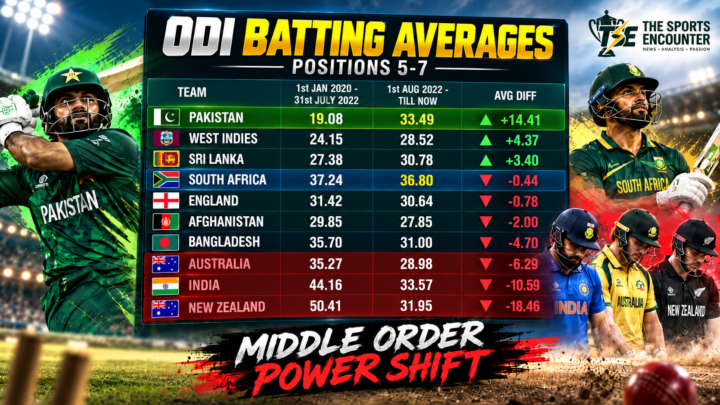
The importance of Bangladesh’s middle order extends beyond this tournament. In a recent statistical comparison, The Sports Encounter examined declining ODI batting averages at positions five through seven, including Bangladesh’s decrease from 35.70 in the earlier reporting period to 31.00 in the more recent period.
Those figures do not establish why Bangladesh’s batting collapsed against Zimbabwe, but they provide useful context for the scrutiny surrounding the team’s batting depth.
For Hridoy, Wednesday’s match represents an opportunity to demonstrate that Bangladesh can absorb the absence of senior players without losing their batting structure.
Three Battles That Could Decide Afghanistan vs Bangladesh
1. Bangladesh’s Fast Bowlers Against Afghanistan’s Top Order
Taskin Ahmed’s performance against Zimbabwe showed that Bangladesh can create early breakthroughs. The challenge is sustaining pressure after those initial wickets.
Against Zimbabwe, Bangladesh reduced their opponents to 24/3 but allowed Ervine and Taylor to build a match-defining partnership.
Against Afghanistan, Taskin and the other seamers must find a way to disrupt Atal, Ibrahim and Rahmanullah Gurbaz before they establish control.
2. Bangladesh’s Middle Order Against Rashid Khan
Rashid’s variations and economical spells can put considerable pressure on a chasing side.
The middle-order batters will need a clear understanding of the match situation, particularly if Bangladesh must complete a chase quickly to improve their net run rate.
Wickets lost against Rashid could force Bangladesh to abandon an aggressive qualification plan and concentrate simply on completing their innings.
3. The Toss and the Qualification Equation
The toss could have an unusually important tactical role because Bangladesh’s qualification requirements depend on how the match develops.
Batting first would give Bangladesh a clear victory-margin target. Chasing would require them to manage both the target and the number of overs used.
Afghanistan have more flexibility. Their existing net run rate advantage means they can approach the contest without the same pressure to pursue a particular scoring rate.
The two teams therefore enter the match with different strategic priorities, even though both are competing for the same place in the final.
Zimbabwe’s Final Hopes Rest on Afghanistan vs Bangladesh
Zimbabwe’s campaign has shown contrasting sides of its ODI cricket.
Continue the Cricket Story
 CricketBavuma’s Heroic 179 Turns South Africa’s 92/5 Nightmare Into Australia’s 422-Run Problem
 CricketArafat Minhas Announces Arrival on the International Stage as Pakistan Destroy England in Tri-Nation Series
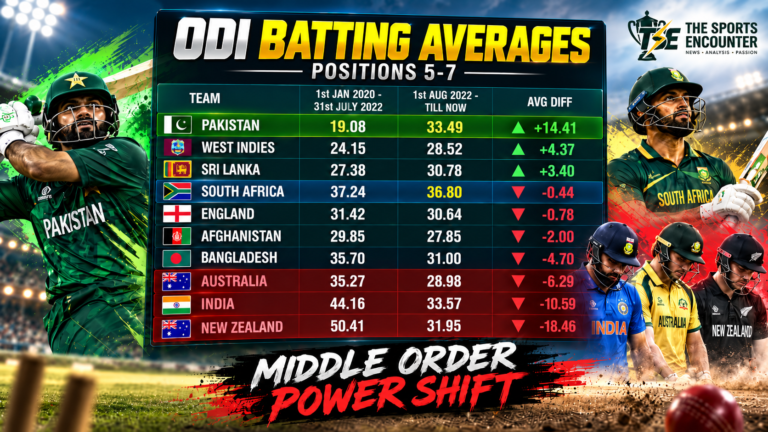 CricketODI Middle-Order Power Shift: Pakistan Surges, New Zealand Crashes as India’s and Australia’s Batting Depth Comes Under Scrutiny
Against Bangladesh, Ervine and Taylor demonstrated the value of experience, while Evans and the other bowlers maintained enough pressure to secure a comfortable victory.
Against Afghanistan, their batting could not withstand Rashid Khan and the supporting attack.
The result was a substantial swing in net run rate that removed Zimbabwe’s control over its own qualification.
Zimbabwe’s broader ODI performances this year have contained similar contrasts. During their September series against Australia, they produced competitive batting performances but struggled to finish matches consistently. The Sports Encounter examined those difficulties when Australia sealed the series in Harare.
Zimbabwe must now hope that Afghanistan either win Wednesday’s match or restrict Bangladesh’s victory margin sufficiently to keep the Tigers below them on NRR.
Afghanistan vs Bangladesh ODI: Match Date, Time and Venue
| Match Detail | Information |
|---|---|
| Competition | UAE ODI Tri-Series 2026 |
| Match | Afghanistan vs Bangladesh, 3rd ODI |
| Date | Wednesday, October 21, 2026 |
| Venue | Sharjah Cricket Stadium, Sharjah, UAE |
| Scheduled Start | 3:30 PM UAE / 4:30 PM Pakistan |
| Afghanistan Captain | Rahmat Shah |
| Bangladesh Acting Captain | Tawhid Hridoy |
| Final | Friday, October 23, 2026 |
The ICC’s match-official appointments list Sharjah Cricket Stadium as the venue for the October 21 fixture and the October 23 final.
Afghanistan vs Bangladesh ODI: Frequently Asked Questions
When is Afghanistan vs Bangladesh in the UAE ODI Tri-Series?
The third league match is scheduled for Wednesday, October 21, 2026.
Where will Afghanistan vs Bangladesh be played?
The match is scheduled at Sharjah Cricket Stadium in Sharjah, United Arab Emirates.
What time does Afghanistan vs Bangladesh start?
The scheduled start is 3:30 PM UAE time, equivalent to 4:30 PM in Pakistan and 5:30 PM in Bangladesh.
Can Bangladesh still qualify for the final?
Yes. Bangladesh must defeat Afghanistan and achieve a sufficiently strong net run rate to finish among the top two teams.
How many runs must Bangladesh beat Afghanistan by?
Under normal 50-over conditions, if Bangladesh bat first and both innings count as 50 overs for NRR purposes, a victory by at least 41 runs would move Bangladesh ahead of Zimbabwe’s current NRR.
Will Afghanistan qualify if they lose to Bangladesh?
Afghanistan have a substantial NRR advantage and could still qualify after a defeat. An exceptionally large defeat, however, could allow Zimbabwe to finish above them.
Can Zimbabwe reach the final without playing again?
Yes. Zimbabwe have completed both league fixtures and can qualify depending on the result and NRR impact of Afghanistan vs Bangladesh.
Why is Litton Das not playing for Bangladesh?
Litton Das was ruled out of the tri-series with a right hip joint injury. Tawhid Hridoy is leading Bangladesh in his absence.
Who were Afghanistan’s best performers against Zimbabwe?
Sediqullah Atal scored 102, Ibrahim Zadran made 90, Rashid Khan took 4/17 and Fazalhaq Farooqi claimed 2/15 in Afghanistan’s 158-run victory.
The Sports Encounter Verdict: Bangladesh Need a Complete Performance
Afghanistan enter Wednesday’s contest with the stronger recent ODI record against Bangladesh, greater momentum from their opening victory and a considerable net run rate advantage.
Bangladesh have the bowling resources to challenge Afghanistan, but their opening defeat highlighted the consequences of allowing an opponent to recover after early wickets.
The batting presents an even greater concern. Bangladesh cannot afford another collapse against a bowling attack featuring Rashid Khan, Mohammad Nabi, Fazalhaq Farooqi and Afghanistan’s other wicket-taking options.
Zimbabwe, meanwhile, have already experienced both extremes of this short tournament. One convincing victory gave them control of their campaign. One heavy defeat took that control away.
The final league fixture now offers Bangladesh a chance to recover from their opening setback, Afghanistan an opportunity to confirm their authority and Zimbabwe an anxious afternoon following the outcome from outside the boundary.
Bangladesh know the minimum requirement: win the match. The qualification equation demands something more.
Follow the latest match reports, scorecards and tournament analysis through The Sports Encounter’s Cricket coverage.