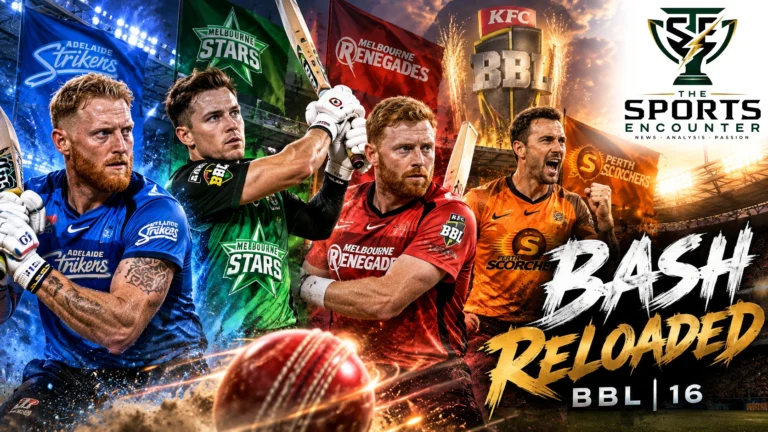
MELBOURNE, Australia, October 15, 2026: The Big Bash League is preparing for its most geographically ambitious opening night, a radically reshaped overseas-player market and a title defense that will test the depth of Australia’s most successful T20 franchise. BBL|16 starts in Chennai on December 12 when Melbourne Renegades face six-time champions Perth Scorchers, moves to Australian grounds three days later and ends with a final scheduled for Australia Day, January 26, 2027. Across eight teams, the central question is whether the Scorchers’ repeatable winning system can withstand a fresh wave of imported hitters, new coaches and ambitious challengers.
Finn Allen has left Perth for Melbourne Stars, Ben Stokes has joined Adelaide Strikers, Jonny Bairstow is set for a first Big Bash campaign with the Renegades, Adam Zampa has moved to Hobart, and Tim Seifert has switched to Sydney Sixers. Andrew Flintoff will coach Sydney Thunder after their last-place finish, while Matthew Mott replaces Greg Shipperd at the Sixers. Cricket Australia has abolished the overseas draft, rewritten elements of the salary structure and introduced a sharper slow-over-rate penalty. Those changes are why this season deserves a comprehensive scouting report rather than eight recycled squad lists.
BBL|16 at a Glance: Dates, Teams, Format and Defending Champions
| Question | Verified answer as of October 15, 2026 |
|---|---|
| Season | Men’s Big Bash League 2026-27, BBL|16 |
| Opening fixture | Melbourne Renegades vs Perth Scorchers, December 12, Chennai |
| First fixture in Australia | Brisbane Heat vs Sydney Sixers, December 15, the Gabba |
| Final | January 26, 2027, with a reserve day |
| Matches | 44 total: 40 regular-season games and four finals |
| Clubs | Adelaide Strikers, Brisbane Heat, Hobart Hurricanes, Melbourne Renegades, Melbourne Stars, Perth Scorchers, Sydney Sixers, Sydney Thunder |
| Finalists | Top four progress to the four-game finals series |
| Defending champions | Perth Scorchers, winners of BBL|15 |
| Roster construction | Open-market overseas signings replace the overseas draft; maximum three overseas players on a primary squad |
| Updated playing condition | Full powerplay restrictions apply for remaining deliveries once a bowling side breaches the innings timer |
The official Cricket Australia fixture release establishes the 44-match schedule and the unprecedented opening in India. The regular season runs through January 17, with the Qualifier starting the finals series on January 19. The final is fixed for January 26, rather than an approximate late-January date. Cricket Australia has scheduled Christmas Eve cricket at Junction Oval, Melbourne derbies at the MCG and additional games in Canberra, giving the 16th edition an identifiable geographic character.
Perth enter with six titles after defeating Sydney Sixers in the BBL|15 final. That result is more than a line on a historical honors board. Perth restricted the Sixers to 132 and completed the chase with 15 balls remaining. Yet two of the principal figures in their winning batting order, Allen and Josh Inglis, are not confirmed in Perth’s new contracted roster. Allen has signed elsewhere; Inglis was still listed as uncontracted in the current squad tracker. The defending champions therefore have continuity where they tend to invest most heavily, in their Australian all-rounders and fast bowlers, but a different problem at the top of their batting order.
Story at a glance
BBL|16 at a Glance: Dates, Teams, Format and Defending Champions
The official Cricket Australia fixture release establishes the 44-match schedule and the unprecedented opening in India. The regular season runs through January 17, with the Qualifier starting the finals series on January 19. The final is fixed for January 26, rather than an approximate late-January date. Cricket Australia has scheduled Christmas Eve cricket at Junction Oval, Melbourne derbies at the MCG and additional games in Canberra, giving the 16th edition an identifiable geographic character.
How the Big Bash Arrived at a Season Where Every Team Must Recalculate
Australian domestic T20 cricket has always contained a tension between club identity and brief tournament windows. Teams need to build combinations that survive changing international calls, unfamiliar overseas schedules, crowded festive fixtures and the odd match in which one player can transform a run chase in 20 deliveries. They also need enough recognizable names to draw families and casual spectators. BBL|16 pushes that balance further because the new contracting model offers direct recruitment rather than a centralized overseas draft.
The New BBL|16 Over-Rate Rule Could Change a Tight Finish
The familiar Big Bash tactical rhythm begins with a four-over powerplay and gives the batting team another two overs of power-surge restrictions later in the innings. BBL|16 adds a sharper incentive for fielding teams to finish on time. Cricket Australia has retained an 84-minute bowling innings timer. Once it expires, full powerplay fielding restrictions apply immediately for the remainder of the innings, even if the clock runs out midway through an over. Only two fielders may then remain outside the circle, subject to the relevant playing conditions.
The BBL|16 Designated Batter and Fielder Rule: A Major Tactical Change
BBL|16 introduces another innovation that deserves as much attention as the overseas opener or revised over-rate penalty. Clubs may name a designated batter and a designated fielder before the bat flip. Under the optional arrangement, the designated batter is allowed to bat but cannot bowl or field. The designated fielder replaces that player when the team is in the field and may keep wicket, but cannot bat or bowl. Teams that decline the option select a traditional XI.
Why Chennai Matters Before Australia Sees a Ball
December 12 is a remarkable experiment in league identity. A competition built around summer crowds at Perth Stadium, the Gabba, the MCG, Adelaide Oval, the SCG and Bellerive Oval begins in Chennai, at MA Chidambaram Stadium. The Renegades are the designated host against the defending champions, which turns a domestic opening fixture into an overseas commercial and cricketing test.
How the Big Bash Arrived at a Season Where Every Team Must Recalculate
Australian domestic T20 cricket has always contained a tension between club identity and brief tournament windows. Teams need to build combinations that survive changing international calls, unfamiliar overseas schedules, crowded festive fixtures and the odd match in which one player can transform a run chase in 20 deliveries. They also need enough recognizable names to draw families and casual spectators. BBL|16 pushes that balance further because the new contracting model offers direct recruitment rather than a centralized overseas draft.
The strategic effect is significant. Instead of waiting for a draft slot, a club can prioritize a specific role and negotiate with an overseas player directly. Adelaide pursued Stokes because they wanted top-order authority and an experienced all-rounder. TSE’s analysis of Matthew Short’s all-round performance in The Hundred shows how the Strikers captain can influence games with bat and ball, a versatility that could shape Adelaide’s new top order. Melbourne Stars secured Allen’s boundary hitting and the Overton brothers’ seam-bowling depth. Melbourne Renegades bought wicketkeeping security and powerplay intent through Bairstow, then added Michael Bracewell’s all-round versatility. Sydney Sixers targeted Seifert, Chris Jordan and Fergus O’Neill while promoting a new coaching identity. These deals address different weaknesses, which is why a single metric such as international caps is a poor way to compare their value.
Cricket Australia’s revised arrangements also remove the requirement to contract a minimum number of overseas players. Clubs may list a maximum of three and must allocate at least A$1.7 million of the A$3.18 million BBL|16 salary cap to their six highest-paid players collectively. Three of the marquee contracts must be domestic. That changes how teams can distribute money, but it does not mean every signed overseas player will appear in every game. International boards, injuries, tournament overlaps and personal commitments still determine availability. An elite name on a roster is an opportunity, not a promise of uninterrupted selection.
The squad lists in this guide are the confirmed and publicly reported signings at the October 15 research cutoff, not final 18-player lists or guaranteed playing XIs. Cricket Australia’s live tracker has been updated several times, and in one case its summary of the Stars’ new signings is more complete than its compact contracted-player line. The separately published club signing release corroborates Todd Murphy and both Overton brothers, so this guide includes them while clearly identifying the distinction. Names described as uncontracted are not automatically retired, unavailable or definitively lost; they cannot responsibly be placed in a projected XI without a later agreement.
The New BBL|16 Over-Rate Rule Could Change a Tight Finish
The familiar Big Bash tactical rhythm begins with a four-over powerplay and gives the batting team another two overs of power-surge restrictions later in the innings. BBL|16 adds a sharper incentive for fielding teams to finish on time. Cricket Australia has retained an 84-minute bowling innings timer. Once it expires, full powerplay fielding restrictions apply immediately for the remainder of the innings, even if the clock runs out midway through an over. Only two fielders may then remain outside the circle, subject to the relevant playing conditions.
This is not a cosmetic adjustment. Picture a bowling side defending 16 in the final over. Under ordinary field placements, a captain can station boundary riders at long-on, deep midwicket, deep square and third man according to the batter and bowler. If the timer expires, several of those protective options disappear. A slower ball directed toward the longer boundary becomes less secure when the defender normally stationed there must move inside the circle. Captains may become more reluctant to deliberate excessively between deliveries, change fields repeatedly or allow interruptions to accumulate. The revised rule is described in Cricket Australia’s official playing-conditions explanation.
The likely effect will differ by team. Nathan Ellis’s Hurricanes can rely on specialist death-over execution but need to stay ahead of the clock. The Stars’ combination of Siddle, the Overtons and varied spin options could require careful management of changes. Adelaide, with experienced all-rounders and a growing cohort of young bowlers, may benefit from simpler, clearer plans. A final-over powerplay is potentially worth more than an extra spinner in the squad if the fielding side has already lost the tactical flexibility to protect its preferred scoring zones.
The BBL|16 Designated Batter and Fielder Rule: A Major Tactical Change
BBL|16 introduces another innovation that deserves as much attention as the overseas opener or revised over-rate penalty. Clubs may name a designated batter and a designated fielder before the bat flip. Under the optional arrangement, the designated batter is allowed to bat but cannot bowl or field. The designated fielder replaces that player when the team is in the field and may keep wicket, but cannot bat or bowl. Teams that decline the option select a traditional XI.
This differs from the Indian Premier League’s impact-player system, in which a substitute can take a broader role after entering the game. The Big Bash arrangement is narrower and must be declared in advance. Its primary purpose is to permit specialist batting and fielding assignments without enabling an extra bowling option. For team selection, that means an experienced batter with reduced fielding duties might play alongside a young specialist fielder, but the arrangement does not magically provide a sixth frontline bowler.
Adelaide could benefit if it chooses to protect a veteran batter’s workload. The Renegades might explore a specialist hitting role around Bairstow depending on their wicketkeeping arrangement. Sydney Thunder, the Stars and Perth must decide whether a designated role improves their existing balance or simply removes useful all-round versatility. If a team chooses the designated option for someone who also bowls important overs, it forfeits those overs. That trade-off is more significant than the novelty of using a nominal 12th player.
Another implication concerns preparation. A captain must decide the substitution before observing how a pitch plays, creating a premium on accurate scouting and clear roles. In a competition where matches can begin on a slow surface and finish under heavy dew, the inability to revise that initial designation might become costly. Teams that use the rule thoughtfully could strengthen fielding and extend a specialist batter’s contribution; teams that choose it purely for publicity could lose flexibility at exactly the wrong moment.
Cricket Australia’s January and July 2026 explanations confirm that the designated batter and fielder option applies to the men’s BBL|16, beginning with the Chennai opener. It is not mandatory and is separate from the over-rate restrictions. The two changes together may influence late-over run scoring, but through very different mechanisms.
Why Chennai Matters Before Australia Sees a Ball
December 12 is a remarkable experiment in league identity. A competition built around summer crowds at Perth Stadium, the Gabba, the MCG, Adelaide Oval, the SCG and Bellerive Oval begins in Chennai, at MA Chidambaram Stadium. The Renegades are the designated host against the defending champions, which turns a domestic opening fixture into an overseas commercial and cricketing test.
Chennai carries an association with low-bounce or turning conditions at times, but that reputation does not establish exactly how the December surface will behave. The pitch preparation, weather, boundary dimensions and actual match-day surface must determine selection. It would be simplistic to announce that every spinner will dominate. What can be said in advance is that a team opening outside Australia must practice for different angles, overhead conditions, crowd expectations and batting rhythms. Perth will need to adapt without Finn Allen, while the Renegades have added Bracewell’s off-spin and Bairstow’s experience of Asian conditions.
Playing in India may expand the BBL’s visibility among cricket followers who usually spend December watching other competitions and international fixtures. It may also create practical questions about home advantage, supporter access and whether a high-profile overseas opener adds regular long-term engagement. The TSE analysis of Babar Azam’s commercial impact during BBL|15 already established that imported star power can influence attendance and social interest even when the batter’s individual numbers are underwhelming. Chennai is a much larger experiment in attracting an audience into a competition’s identity.
BBL|16 Team-by-Team Preview: History, Confirmed Squad and Tactical Outlook
Every review below separates known roster commitments, genuine player departures, unresolved contract statuses and editorial projections. The projected finishes are scenario-based assessments rather than claims of future results. An eight-team regular season involving only ten games per club can be reshaped by two close finishes, a rain-affected contest or an international call-up. The aim is to identify the factors a reader should track, not to make the result appear predetermined.
Adelaide Strikers: Ben Stokes Changes the Equation, but Can One Signing Repair Two Failed Seasons?
Coach: Tim Paine. Championship history: winners of BBL|07. 2026-27 starting point: trying to return to finals after consecutive disappointing campaigns. Principal additions: Ben Stokes and Mark Chapman. Confirmed exit: Jamie Overton to Melbourne Stars. Important unresolved names: Chris Lynn and Travis Head, among other players listed as uncontracted when the tracker was checked.
Adelaide Strikers Confirmed BBL|16 Squad
Alex Carey, Mark Chapman, Mackenzie Harvey, Thomas Kelly, Lloyd Pope, Jason Sangha, Liam Scott, Matthew Short, Ben Stokes, Tom Straker, Henry Thornton and Jerrssis Wadia. This is the publicly confirmed group rather than the completed 18-player roster. Players such as Chris Lynn, Travis Head, Hassan Ali, Cameron Boyce, Jordan Buckingham, Harry Manenti, Harry Nielsen, Alex Ross, Tabraiz Shamsi and Luke Wood appear on the uncontracted list and should not be portrayed as confirmed participants.
What Adelaide’s Championship History Tells Us
Adelaide’s first Big Bash title came in BBL|07, when its combination of organized bowling and committed top-order batting produced a memorable championship. Since then, supporters have seen enough individual brilliance to know the city can sustain a powerful T20 side, but the franchise has not repeatedly converted that potential into titles. The recent frustrations are especially meaningful because Adelaide Oval can generate a striking atmosphere around a fast-scoring team. The Strikers need to make their home ground a reliable competitive advantage again rather than depending on isolated innings to rescue middling totals.
There are two ways to misread their prospects. The first is to assume that the arrival of an international superstar automatically creates a top-four team. The second is to dismiss the Strikers because they have underperformed recently. The more revealing assessment begins with specific roles. Matthew Short remains the local batting foundation; Carey is an established wicketkeeper-batter with high-level experience; Stokes supplies potential powerplay authority and seam-bowling flexibility; Chapman can attack spin and change pace; and the emerging group of Scott, Wadia and Sangha gives Paine different ways to structure the middle overs.
Ben Stokes: Why Paine Wants a World-Class Allrounder Opening the Innings
Stokes is the most intriguing individual signing of the BBL|16 recruitment period. His status as a former England Test captain and the association with historic Ashes contests against Paine will generate attention before he walks to the crease. But the strongest sporting reason for watching him is the role Paine has outlined: batting at the top of the order. A player known worldwide for absorbing pressure in lengthy Test innings could now be asked to establish attacking momentum inside the first four overs of a domestic T20 match. That is an appealing tactical contrast, but no serious preview should mistake Stokes’ broader fame for a guaranteed strike rate.
An opening partnership involving Short and Stokes could be physically imposing and tactically flexible. Both can clear straight boundaries and contribute overs if necessary. Their challenge will be to avoid duplicating each other’s natural preference to assess the bowling before accelerating. If one takes responsibility for the first 12 deliveries and the other targets the weaker matchup, Adelaide could establish a repeatable plan. If both are dismissed attempting to dominate the same early spell, an inexperienced middle order may inherit the crisis. The precise batting order remains subject to team selection, but Cricket Australia’s interview with Paine indicates Stokes is being recruited to open.
Stokes’ full-season and finals availability is an important distinction from many overseas marquee deals. It allows Paine to plan a stable structure, although normal fitness considerations still apply. His bowling workload cannot simply be assumed from his all-rounder designation. Adelaide should determine what his body and training program permit and avoid constructing a death-over strategy dependent on an unconfirmed four-over contribution. If he bowls only a limited spell on some nights, Scott, Thornton, Straker and the spin options must still cover the innings. Stokes can change Adelaide’s ceiling while leaving the same structural questions in place.
Mark Chapman and the Left-Handed Matchup Advantage
Chapman arrives after giving up his New Zealand central contract to pursue more franchise opportunities. His value extends beyond quick runs. A left-handed batter of his profile can disrupt opposition plans built around right-handed top-order combinations, force captains to change the bowling angle and make boundary protection less straightforward in the middle overs. He can be used as an accelerator when spin arrives or as a repair batter after early wickets, depending on the exact lineup. Adelaide should resist the temptation to regard that flexibility as permission to move him unpredictably every game.
The wider question is how Chapman, Stokes, Short and Carey fit into a batting order without forcing Jason Sangha and Mackenzie Harvey into unnatural finishing roles. If Adelaide fields a heavyweight top four, it still needs a clear sixth- and seventh-wicket scoring plan. Wadia and Scott have all-round skills but are at different developmental stages from an experienced overseas closer. Harry Nielsen’s uncontracted status also means that Carey is the clear confirmed experienced wicketkeeper without justification for presuming a particular backup. Every selection choice has a bowling consequence: an extra specialist batter must come at the expense of an all-rounder or bowler.
Who Will Be Missed: Jamie Overton and the Unresolved Chris Lynn Question
Jamie Overton’s departure to Melbourne Stars is a genuine loss because he offers both lower-order power and hard-length seam bowling. Adelaide may replace his batting runs through Stokes and Chapman, but replacing the exact combination of athletic fielding, overs and finishing is harder. Overton could provide one of the deliveries that dismisses a set batter while simultaneously being the batter opponents fear at No. 7. His exit removes a kind of flexibility that becomes especially important after the power surge. Adelaide’s bowling construction should therefore be evaluated separately from the quality of its batting recruits.
Chris Lynn remains an important unresolved case. Cricket Australia’s tracker lists the BBL’s all-time leading run-scorer as uncontracted after his latest one-year deal expired. That status does not prove he will never return to Adelaide or that he has left professional T20 cricket. It does mean readers should not count his runs or experience in the confirmed squad. The same caution applies to Travis Head, whose international schedule has repeatedly prevented a Strikers appearance despite contractual connections. An imagined full-strength batting order that assumes both players are available would tell readers more about nostalgia than the actual BBL|16 roster.
Who Might Break Through: Wadia, Sangha, Pope and Straker
Jerrssis Wadia earned a full contract after making an impression as a replacement player. That progression is itself meaningful: a franchise that has acquired famous internationals is also rewarding someone who made a practical contribution in domestic conditions. The next challenge is not simply making a spectacular cameo but showing he can bat against a range of matchups, field reliably and take responsibility for overs if selected as an all-rounder. Sangha enters with the opportunity to establish a more secure place through runs that are useful rather than merely stylish. Pope’s wrist-spin can provide wickets, but his lengths need to hold up against batters willing to attack immediately.
Tom Straker and Henry Thornton give Adelaide seam options with different trajectories. Thornton has previous Big Bash experience under pressure; Straker represents another opportunity to develop domestic pace. Their performance may determine whether Adelaide’s expensive-looking batting can be supported by a trustworthy defending attack. It is relatively easy to recruit six-hitters. A club returns to finals when bowlers can defend eight in an over against a set batter or find a wicket before the surge. Wadia, Straker and Pope will be particularly important in the nights when the headline recruits do not dominate.
Adelaide’s Likely Brand of Cricket and Qualification Chances
Expect Adelaide to seek an authoritative start, vary left-right matchups and use spin as a genuine wicket-taking option rather than a merely defensive holding measure. Stokes and Short can attack pace; Chapman should add control against spin; Carey provides a different kind of batting insurance. The weak point is depth and the precise distribution of four-over bowling roles. If early top-order failures repeatedly expose an inexperienced finishing group, the marquee recruitment will appear impressive on posters and less impressive in the points table. If the young seamers improve, the Strikers can build one of the competition’s most versatile sides.
TSE assessment: an authentic top-four contender with a wide range of outcomes. Adelaide’s ceiling rises substantially through Stokes and Chapman, but calling them title favorites would overlook the defensive overs and late-innings roles that remain to be tested. The best predictor of progress is whether they can win a tight, modest-scoring match without a Stokes fifty. That is a stronger sign of tournament readiness than an occasional 210 built around one outstanding powerplay.
Brisbane Heat: James Hopes Inherits an Attack Built for Speed, but Must Find a Reliable Top Order
Coach: James Hopes. Championship history: BBL|02 and BBL|13 winners. Principal additions: Tom Curran and Tim Robinson, with Bevon Jacobs confirmed as a temporary international replacement. Retained experience: Usman Khawaja and Michael Neser have renewed contracts. Major unresolved names: Marnus Labuschagne, Jimmy Peirson and several previous overseas recruits remain listed as uncontracted.
Brisbane Heat Confirmed BBL|16 Squad
Xavier Bartlett, Max Bryant, Tom Curran, Lachlan Hearne, Spencer Johnson, Usman Khawaja, Matt Kuhnemann, Nathan McSweeney, Michael Neser, Matthew Renshaw, Tim Robinson, Callum Vidler, Hugh Weibgen and Jack Wildermuth. Bevon Jacobs is also confirmed as a replacement player while Curran misses the first three matches for family reasons. This status matters: the replacement arrangement should not be described as evidence that the Heat possess two full-season international batting recruits in addition to every other contracted player.
Two Titles and a Familiar Brisbane Problem
The Heat are among the BBL’s established champions, with trophies from its early years and the more recent BBL|13 campaign. The second title mattered because it demonstrated that Brisbane could build a coherent team around Australian domestic talent rather than rely on transient stars. Yet they have missed the finals since that success. Their pattern has included exciting individual performances alongside the kind of inconsistency that destroys short tournament campaigns. The Brisbane public knows what a competitive Heat side looks like: dangerous pace, aggressive top-order intent and a willingness to squeeze opponents when conditions offer bounce or movement at the Gabba.
The appointment of Hopes is therefore less about discovering Brisbane cricket than reconnecting it with a style that can survive batting setbacks. He becomes the Heat’s third coach in three years after Johan Botha’s resignation. Frequent coaching changes can produce fresh ideas, but they can also lead to different batting orders, new selection preferences and inconsistent expectations. Hopes must settle the fundamental roles early. An opening batter needs to know whether he is expected to take risks immediately; a middle-order player needs to know whether he is a stabilizer or an accelerator; a pace bowler must understand which phase he owns.
Tom Curran Adds Skills but Not Immediate Availability
Tom Curran arrives from Melbourne Stars after claiming 16 wickets in ten appearances in BBL|15. His strengths are not limited to pace. He has developed variations that can be useful when batters try to manipulate the angle of the ball late in an innings. Slower deliveries, yorker options and the ability to contribute lower-order runs make him a natural candidate for a specialist finishing role. Yet an honest curtain-raiser must begin with the availability note: Curran is expected to miss the first three matches for family reasons. A plan that assumes he bowls the 20th over in the opening week would be wrong.
That temporary absence is precisely why the signing of Bevon Jacobs matters. Jacobs gives Brisbane a short-term attacking batting option but does not replace Curran’s bowling overs. The Heat therefore need one tactical plan before Curran arrives and another after he joins the competition. Hopes could compensate through Bartlett, Neser, Spencer Johnson and Wildermuth, but the number of fast bowlers on a list is not identical to the number fit and selected for a particular game. A balanced XI requires six realistic bowling options, not five familiar names and a hope that someone makes up missing overs.
Tim Robinson: A Genuine New Big Bash Story
Tim Robinson, the New Zealand batter from Wellington, is set for his first Big Bash campaign. His profile points toward a more assertive top-order Heat lineup. Brisbane can pair him with experienced local batting or ask him to generate tempo after an early dismissal, but he will confront an adjustment between domestic and international T20 experience and Australian stadium conditions. The pace of the surface, size of boundaries and ability of opponents to hold a wider field after the initial powerplay all matter. A spectacular franchise debut is possible, but consistency through ten games is a different challenge.
Robinson also creates an interesting choice alongside Khawaja, Renshaw, Bryant, McSweeney and Weibgen. Khawaja can bring composure and specific strengths against pace, while Bryant is built to attack hard lengths. Renshaw can adjust his scoring zones and offer left-handed balance; McSweeney can manage rebuilding phases; Weibgen is a developing local talent whose exposure should be guided by a defined role. The question is whether the Heat can field enough attacking ability without putting a naturally constructive batter in a position where he must hit from his first ball. One mislabeled role can unsettle an entire batting card.
Who Will Be Missed, and What Remains Unconfirmed?
Brisbane have signed Khawaja again after his Test retirement and renewed the experienced Neser. Those decisions reduce two uncertainties visible earlier in the off-season. They do not resolve every previous contract. Labuschagne, Peirson, Colin Munro, Shaheen Shah Afridi, Zaman Khan and other players are listed as uncontracted in the tracker. It would be misleading to call every one of them an official departure. Some might return through later business, others may not fit the new squad plan or schedule. What matters is that the confirmed combination cannot presume their presence.
Shaheen’s previous stint is a reminder that recruiting an internationally famous bowler does not guarantee franchise success. He claimed only two wickets in four appearances in his previous Heat campaign before injury intervened. TSE’s earlier examination of Shaheen’s overseas form and rehabilitation provides context for why availability and execution matter more than a globally recognized reputation. The Heat’s 2026-27 attack appears more domestically anchored, with a larger share of responsibility likely falling on bowlers who understand Gabba conditions.
Brisbane’s Bowling Identity: Four Pace Problems for the Opposition
Bartlett brings new-ball skill and the ability to exploit seam movement. Spencer Johnson offers left-arm angle and pace. Neser contributes control, movement and lower-order resilience. Vidler presents the promise of young pace, while Wildermuth offers the ability to complete overs and bat usefully. Kuhnemann supplies the left-arm spin option that prevents the attack from becoming one-dimensional. On paper that is a compelling set of tools. The real test is to allocate bowling phases so specialists do not have to work outside their best roles too often.
At the Gabba, Brisbane can attack a visiting side whose batters have not adjusted to pace and bounce. But a league season also involves slower surfaces, small boundaries and nights when the new ball skids beautifully onto the bat. A successful Heat attack needs both wicket-taking aggression and the ability to cut off boundary options when nothing moves. That may require using Kuhnemann earlier, holding Johnson for a middle-over breakthrough or distributing Curran’s late overs carefully when he returns. Hopes should treat selection as a matchup question rather than automatically choose all the biggest quicks.
Three Young Players Who Could Change the Season
Callum Vidler has the chance to move from promising name to regular contributor, but fast-bowling development should not be judged solely through the speed gun. Wicket-taking length, control with an older ball and recovery between matches will be more valuable than one spectacular short spell. Weibgen’s batting progress could produce a similar breakthrough if he receives a repeatable position. Bryant, now an established domestic option, can make an impact through the speed of his scoring: a brief opening burst often changes what the No. 4 batter needs to do. Robinson is the most obvious newcomer to watch, but Vidler may be just as important to Brisbane’s results.
A healthy Heat attack could make batting opponents feel they are never fully out of danger. That does not guarantee a strong total from Brisbane’s own top order. There is a plausible version of this season in which the bowlers repeatedly hold opponents to 150 and the batting struggles to chase it. There is also a version in which Robinson and Bryant seize the powerplay, Khawaja or Renshaw maintain the middle and Curran gives the final five overs a reliable edge. Distinguishing between those versions is the central job for Hopes before December.
Heat Prediction: Finals-Level Bowling, Unsettled Batting
TSE assessment: Brisbane should be regarded as a credible top-four contender rather than an automatic qualifier. They have the bowling resources to upset any opponent and more than one route to a defendable total. Their risks are coaching transition, batting-role clarity, early Curran absence and the unresolved status of previous first-choice players. The crucial leading indicator will be how they bat when the opposition takes two wickets in the first four overs. If they consistently rebuild to a total their bowlers can protect, Hopes’ side will be dangerous. If every innings depends on one powerplay innings, a talented squad could again miss January’s most important matches.
Hobart Hurricanes: Zampa and Shai Hope Join a Proven Core, but Matthew Wade Leaves More Than a Place in the XI
Coach: Jeff Vaughan. Championship history: first title in BBL|14. Major signings: Adam Zampa, Shai Hope and Nick Hobson. Confirmed departures: Matthew Wade, retired from the competition; Chris Jordan, signed by Sydney Sixers. Core retained: Tim David, Ben McDermott, Mitch Owen, Nathan Ellis, Riley Meredith, Beau Webster and Nikhil Chaudhary.
Hobart Hurricanes Confirmed BBL|16 Squad
Marcus Bean, Iain Carlisle, Nikhil Chaudhary, Tim David, Nathan Ellis, Nick Hobson, Shai Hope, Ben McDermott, Riley Meredith, Mitch Owen, Will Prestwidge, Billy Stanlake, Tim Ward, Jake Weatherald, Beau Webster and Adam Zampa. The list retains an unusually broad blend of batting, wicketkeeping and bowling options. Rehan Ahmed, Jackson Bird, Hugo Burdon, Rishad Hossain, Charlie Wakim and Mac Wright were still uncontracted in the published tracker. Their uncertain status should not be confused with the confirmed retirements or moves elsewhere.
From First-Time Champions to a Serious Repeat Contender
Hobart’s BBL|14 title ended the long wait for the men’s Hurricanes and changed the standard by which the current group should be judged. For years, the franchise carried the reputation of a team with explosive batters that could light up a night without always controlling a tournament. Its championship season demonstrated greater collective maturity. The side did not merely need a brutal innings from one player; it could win through complementary contributions and high-quality death bowling. That history matters now because Vaughan is not rebuilding from failure. He is refreshing a proven core while protecting a hard-won team identity.
Hobart have kept most of the batting that underpinned their breakthrough. McDermott can set a controlled base or attack the seamers in front of square. Mitch Owen offers a more forceful tempo and can contribute with the ball. David has the boundary-clearing profile to shorten an improbable chase into something manageable. Webster gives batting depth and a different bowling option. Nikhil Chaudhary adds another route to quick runs and can support the spin department. This is an impressive list of familiar roles, but the key question is how the newcomers fit without disrupting the successful overlap between them.
Adam Zampa Supplies a Missing Dimension
Zampa’s move from the Renegades is one of the most consequential bowling transfers of the offseason. His reputation rests on his ability to take wickets through the middle overs even when batters are determined to attack spin. That skill becomes especially useful after the opening field restrictions, when bowling sides often need to stop the set batter from converting a good start into a match-winning score. Hobart already had Ellis, Meredith and other seam resources. Adding a specialist leg-spinner of Zampa’s standing gives Vaughan another way to change the innings before opponents can prepare for the power surge.
It will be tempting to frame every Zampa matchup as a guaranteed improvement, but selection still depends on pitch and conditions. A surface offering pace and seam movement might justify a seam-heavy XI; a used pitch could reward leg-spin and pace-off variation. Zampa’s value is partly that Hobart can now make that choice without asking a part-time spinner to bowl four demanding overs. His field settings and matchup planning may also help younger spinners learn when to attack rather than merely attempt to survive. Because the competition is short, the ability to win two middle-over passages could be the difference between qualification and an early finish.
Who Replaces Matthew Wade’s Leadership and Wicketkeeping?
Wade announced his BBL retirement after accepting a role on Australia’s men’s white-ball coaching staff. His departure removes a wicketkeeper, experienced batter and forceful on-field personality. A veteran keeping wickets gives bowlers another set of eyes on angles, pace changes and opponent intent. Replacing the runs alone would ignore that tactical contribution. It also alters the batting order because Wade could operate in different positions without reducing the team’s flexibility. Hobart’s answer is Shai Hope, returning after appearing during the title-winning BBL|14 campaign, when he played five games.
Hope brings international captaincy experience, a measured technique and a useful capacity to assess the pace of a surface. He should not be judged by whether he copies Wade’s batting style ball for ball. The more interesting question is whether Hobart can pair an innings manager with their established power hitters. If Owen, David and Chaudhary are encouraged to attack, Hope may occasionally need to rebuild around them. If the top order starts strongly, he must retain enough scoring intent to avoid slowing a powerful innings. His wicketkeeping also needs to create confidence for a varied pace and spin attack.
Nick Hobson and the Middle-Order Arithmetic
Hobson joins from Perth and offers experience of a dressing room shaped by a successful championship culture. Yet his departure is not a one-for-one exchange for Wade or Jordan. He is a batting option whose power and composure could be important when the Hurricanes lose wickets just before the surge. That is a distinct role from Hope’s keeping or Zampa’s bowling. If Hobart can field a batting lineup deep enough to attack the final five overs without fear, it will free Owen, McDermott and David to be more assertive earlier. But the club cannot select every established batter, every all-rounder and five specialist bowlers at once.
The lineup decisions will likely be more difficult for Hobart than the quality of the squad initially suggests. Does Tim Ward open consistently? Where does Weatherald fit if Hope takes a top-order slot? Can Webster cover enough overs for Hobart to include an additional specialist batter? How often does Zampa play alongside Chaudhary as a bowling option? Those are questions of balance rather than star power. A successful coach needs to make good players comfortable with not playing every game, while keeping their roles clear when they do return. The champions’ previous identity will not survive if every week brings a different combination for no compelling reason.
Nathan Ellis, Riley Meredith and the Art of Defending Small Margins
Ellis remains one of Hobart’s most important structural players because his death-over variety gives the Hurricanes a response when batters have already identified the pace and direction of the attack. His changes of pace, angles and field placements can make 12 off the final over a serious challenge rather than a routine chase. Meredith offers a different weapon through speed and bounce. Stanlake, if selected and fully fit, provides height and another release point. With Zampa added, these tools can operate at different moments rather than compete for the same type of overs.
There is one danger in an attack with so many options: bowling plans can become too elaborate. BBL|16’s new over-rate penalty will punish fielding teams that fail to finish inside the timer. Ellis may want to move his field repeatedly, but the side cannot allow that process to cost it powerplay restrictions at the death. Vaughan and his senior bowlers will need pre-agreed choices for set batters and left-right combinations. The same discipline applies to reviewing matches. One expensive over does not necessarily mean the bowler should abandon the delivery that makes him effective.
The Young Players Who Could Turn Depth Into a Competitive Advantage
Marcus Bean, Iain Carlisle and Will Prestwidge were on the fringes of a powerful pace group last season. Their new contracts present a chance to change that. Prestwidge could become useful as a bowler who can contribute more than one phase; Bean and Carlisle have opportunities when the schedule, conditions or rotation call for different seam resources. Tim Ward has renewed after a 200-run debut season and can make a serious claim for a stable opening role. These players offer Hobart insurance but also competition for places. Their development should be measured through role execution, not by how often an established name is left out.
Chaudhary remains a particularly appealing breakout candidate because he offers an attacking change of pace in an already powerful order. A lower-middle-order player who regularly scores 20 from ten balls can alter a competition more effectively than one who accumulates a visually impressive but strategically slow fifty. He must also contribute through fielding and tactical flexibility. Hobart’s depth suggests they can survive one injury or absence without changing their entire identity. That is the kind of resilience the title-winning group developed and a quality that should matter again in a compact schedule.
Hurricanes Prediction: A High-Ceiling Team With a Real Finals Case
TSE assessment: Hobart are among the most convincing challengers to Perth. Their major signings address specific needs, their domestic core is established and their captain can win difficult late-over situations. The principal dangers are disruption after Wade’s retirement, selecting the correct batting balance and preventing an abundance of options from becoming indecision. A successful Hurricanes season will look disciplined rather than permanently spectacular: wickets in the middle overs, reliable finishing and enough batting depth to survive days when a celebrated hitter fails. If Hope settles quickly and Zampa performs his usual tactical role, another final is entirely plausible.
Melbourne Renegades: Bairstow Opens a New Era, but Chennai Will Immediately Test Ronchi’s Rebuild
Coach: Luke Ronchi, replacing Cameron White. Championship history: BBL|08 winners. Confirmed major arrivals: Jonny Bairstow and Michael Bracewell. Confirmed departures: Tim Seifert to Sydney Sixers, Adam Zampa to Hobart, Fergus O’Neill to Sydney Sixers and Andrew Tye through retirement. Immediate assignment: a first-ever overseas BBL opener against the defending champions in Chennai.
Melbourne Renegades Confirmed BBL|16 Squad
Michael Archer, Jonny Bairstow, Jason Behrendorff, Michael Bracewell, Josh Brown, Harry Dixon, Brendan Doggett, Sam Elliott, Jake Fraser-McGurk, Caleb Jewell, Ollie Peake, Tom Rogers, Callum Stow and Will Sutherland. Nathan Lyon, Gurinder Sandhu, Hassan Khan, Muhammad Rizwan, Will Salzmann and Matthew Spoors are among names listed as uncontracted. That distinction is especially important for Sandhu, who was one of BBL|15’s leading regular-season wicket-takers but had not been confirmed again when the squad tracker was checked.
A Championship Club Searching for a Fresh Identity
The Renegades’ BBL|08 championship remains proof that the red side of Melbourne can win the competition. Yet the years since have produced plenty of frustration and more roster disruption than a club would prefer. The departure of White to the Stars adds a coaching rivalry to a city already divided by derby loyalties. Ronchi takes over a squad with serious batting talent but enough departures to require a new balance. Supporters will see a familiar red shirt; the actual way the team scores runs and takes wickets may change substantially.
There are two tempting but inadequate labels for the Renegades. One is to call them a batting-heavy underdog because of Brown and Fraser-McGurk. The other is to declare them contenders simply because Bairstow has played so much international cricket. Neither explains how the team will handle the 14th or 18th over of an innings. A roster can feature three spectacular openers and still lose when it requires steady singles against a left-arm spinner or cannot defend 35 from the final three overs. Ronchi needs to turn promising attacking instincts into a coherent distribution of roles.
Jonny Bairstow’s First Big Bash Season Is a Genuine Event
Bairstow has played high-profile cricket around the world and featured repeatedly in Ashes battles in Australia, but BBL|16 will be his first season in the competition. He is expected to keep wicket and is contracted to be available across the full campaign. That combination matters. Replacing Seifert requires more than acquiring another opening batter: the Renegades need a first-choice wicketkeeper capable of working with their bowlers and producing quick runs. Bairstow offers the possibility of addressing both issues through one overseas slot.
His Australian experience could help him judge hard pitches and larger boundaries, while his time in other franchise leagues should be useful in Chennai. But Bairstow will face a different challenge from international cricket: matches arrive quickly, opponents target specific matchups and there is little opportunity to bat through a difficult period for personal rhythm. He may have to attack an opening spell, keep wicket for 20 overs and then prepare to travel again almost immediately. Ronchi should avoid placing unrealistic responsibility on him merely because the signing attracted headlines.
Why Bracewell Could Be the More Important Tactical Signing
Michael Bracewell adds an off-spin option and batting experience to a side that has lost Adam Zampa. Those bowlers are not identical, and a direct comparison of their career reputations would miss the point. Bracewell gives Ronchi another left-right matchup tool, the ability to influence middle overs and additional batting options. He is reported to be available for the full season after altering his New Zealand contract arrangements. In a roster with aggressive batters, the value of a flexible all-rounder can become unusually high because he helps the captain compensate when the opening attack has one poor over.
Bracewell could become particularly influential in Chennai if the surface offers turn or grip, but the decision should follow pitch evidence rather than stereotype. On an Australian surface, his ability to attack a specific batter may be more valuable than automatically bowling four overs. Sutherland’s all-round ability means the team can have several ways to finish a bowling innings. This is the kind of flexibility the Renegades lacked when different players were pulled in and out of the lineup. The opportunity is to construct an attack that gives the opposition different speeds and angles, not merely four right-arm seamers and a spinner.
The Departures Create Four Different Types of Loss
Seifert’s transfer removes a proven wicketkeeper-batter and opens an immediate job for Bairstow. Zampa’s exit removes a specialist middle-over wicket-taking spinner. O’Neill’s move to Sydney Sixers takes away domestic seam depth and future development potential. Tye’s retirement ends the availability of an experienced T20 fast bowler whose knowledge of slower balls, angles and matchups could have helped younger colleagues. These are four distinct losses. Treating Bairstow as the replacement for all of them would overstate what one player can contribute.
White’s departure is another kind of loss: the coach who developed his own view of the squad is now working across town. Ronchi will need to establish relationships quickly and may favor different batting order or bowling plans. That creates opportunities for players who were previously peripheral, particularly Michael Archer, Callum Stow and Sam Elliott. It also presents a communication challenge to senior players. Clear selection criteria will matter when the new coach changes a role that a player had expected to keep.
Josh Brown, Fraser-McGurk and the Risk of an All-Attack Top Three
Brown’s game can damage bowlers who offer width or length in the arc. Fraser-McGurk brings a similarly fearless reputation, and Bairstow has enough experience to attack from ball one. The appeal of grouping them is obvious: a powerplay could decide a match before an opponent settles. But there is a trade-off. If all three attempt a high-risk scoring option against the same quality opening attack, the Renegades can find themselves three down before the field spreads. At that point, Sutherland, Bracewell, Jewell or Peake must manage a rebuilding job under scoreboard pressure.
The most intriguing Renegades selection question concerns the allocation of risk rather than the amount of aggression available. Can one opener take responsibility for the innings if two wickets fall? Does the side have a batting order that recognizes when to target a match-winning total and when to reach a defendable one? Caleb Jewell can offer a different profile from Brown or Fraser-McGurk, while Ollie Peake is a young player whose development should not be compromised by constant shuffling. The team that produces the biggest powerplay score in December will not necessarily be the team with the best net run rate in January.
Who Could Debut or Emerge?
Bairstow is the definite headline Big Bash debut prospect. Archer is no longer completely new to the Renegades after a replacement appearance, but his first full contract offers a different kind of breakthrough opportunity. Stow adds further spin depth. Elliott has moved beyond replacement status after impressing at the end of BBL|15, including a four-wicket performance against Perth. Harry Dixon and Peake offer younger batting options whose success would give the Renegades an identity beyond expensive overseas recruiting. A developing player becoming a regular contributor is often a better long-term sign than one import scoring a sensational 80 before leaving the league.
Renegades Prediction: A Volatile Side Whose Season Starts With a Tactical Examination
The Renegades can be capable of extremely fast batting, supplemented by a more varied attack than their initial power-hitting reputation suggests. Yet losing Zampa and Seifert requires real adjustment, and the head coach is new. Opening in Chennai against Perth offers an early examination of their composure: can Bairstow control a match when the pitch does not reward reckless hitting, and can their bowlers create pressure without relying on Zampa? TSE assessment: a dangerous outsider with a realistic path into the top four, but more volatility than the proven contenders. Their early wins will depend on how effectively Ronchi balances attack with the ability to absorb an unfavorable 15-ball period.
Melbourne Stars: Finn Allen Meets Maxwell and Stoinis in the Boldest Attempt Yet to Win a First Title
Coach: Cameron White, replacing Peter Moores as head coach. Championship history: the only club still seeking a first men’s BBL title. Major arrivals: Finn Allen, Todd Murphy, Jamie Overton and Craig Overton. Confirmed departure: Tom Curran to Brisbane Heat. Headline strength: top-order hitting alongside Glenn Maxwell and Marcus Stoinis. Headline risk: managing bowling roles and international availability.
Melbourne Stars Confirmed BBL|16 Squad
Finn Allen, Austin Anlezark, Hilton Cartwright, Sam Harper, Liam Hatcher, Campbell Kellaway, Glenn Maxwell, Todd Murphy, Jamie Overton, Craig Overton, Tom Rogers, Peter Siddle, Marcus Stoinis and Mitch Swepson. Cricket Australia’s compact live squad line has not always been synchronized with the adjacent list of signings; the individual official Overton signing report confirms Murphy and both brothers along with Allen. Haris Rauf, Scott Boland, Joe Clarke, Sam Hain, Mark Steketee and other previously associated names appear on the uncontracted list. Rauf has been linked with Adelaide, but a reported negotiation is not a confirmed transfer.
The Stars’ Historic Burden: So Much Talent, Still No Trophy
No Big Bash franchise attracts quite the same pre-season argument as Melbourne Stars. A squad featuring famous national-team players looks capable of winning the competition every summer, yet the club is still without a championship. The problem has not been a complete absence of talent. At various times, the Stars have fielded internationally recognized batters, bowlers and all-rounders. Their challenge has been turning strong individual reputations into a sustainable sequence of performances in the matches that decide a season. Melbourne’s green half knows that a heavy win in December means little if January ends without silverware.
The arrival of White makes that history a direct coaching challenge. His Renegades experience should provide knowledge of Melbourne conditions and the limitations of his new rival. He inherits a stronger-looking batting top order than many clubs can assemble, but there is more to coaching than selecting the biggest names. A side with Allen, Maxwell and Stoinis may still need a player who knows how to make 35 from 28 balls when a difficult surface demands restraint. White must build the habits required to survive a tight chase rather than simply maximize the number of spectacular shots attempted per innings.
Finn Allen’s Transfer Is About More Than 466 Runs
Allen produced 466 runs for Perth in BBL|15, making him the previous season’s leading run-scorer and a central part of the Scorchers’ championship campaign. The Stars won his signature on a three-year arrangement and immediately changed the balance of the competition’s batting power. One side loses its proven explosive opener; another gains one of the most feared early-over strikers in the format. Allen can force a fielding captain to think about boundary protection before the powerplay has even ended. His intent can also allow a partner to take fewer risks while maintaining an excellent scoring rate.
However, the demands will be different at the Stars. Perth’s system has made international hitters comfortable around a stable Australian core. Melbourne have their own star hierarchy, with established personalities who each prefer influential roles. Allen must fit alongside Harper, Maxwell and Stoinis without reducing the effectiveness of anyone. If he opens with a steadier batter, he may be encouraged to attack hard. If he opens with another natural accelerator, the pair need a clear understanding of which bowler each is targeting. The most important Allen statistic this season may not be his sixes but the proportion of matches in which the Stars reach the tenth over with wickets available.
Maxwell, Stoinis and Harper: A Rare Combination of Methods
Maxwell remains one of the most inventive white-ball batters in the game, capable of finding scoring areas that conventional field placements are not designed to protect. Stoinis offers power and experience across multiple batting roles, and can contribute seam overs according to availability and workload. Harper’s BBL|15 player-of-the-tournament award confirms that he enters this season with more than the status of a supporting batter. The Stars have also retained Cartwright and Kellaway, players whose importance could increase when international absences create opportunities.
A smart version of this batting lineup does not ask all of them to play in exactly the same fashion. Harper may become the pressure-release batter when Allen is attacking, or he may be tasked with a more forceful initial tempo. Maxwell can be protected for a phase where his unorthodox options make a bigger difference. Stoinis could be the finisher or a stabilizer after early damage, depending on the match situation. These decisions require consistency; repeatedly changing the order to accommodate whichever batter looked best in the previous game can make a talented squad less effective than a less celebrated one.
The Overton Twins Give Melbourne a Different Attacking Dimension
Jamie Overton joins from Adelaide, while brother Craig arrives as an additional English seam-bowling option. Their expected presence together is a notable BBL first involving twins, and it gives White more than a publicity angle. Jamie can contribute valuable lower-order hitting and energetic bowling. Craig offers a different seam-bowling profile and years of county experience. Both can help the Stars avoid a problem that has affected T20 teams throughout the world: fielding a powerful top six while leaving the final overs dependent on a single specialist bowler.
The arrangement also carries a calendar warning. Cricket Australia has indicated Jamie could be affected by England’s ODI series in South Africa beginning January 10, although he was understood to have committed to at least six Big Bash matches. That means White must not build a final-week bowling plan that assumes Jamie will necessarily be present. A coach who believes in his roster will have alternatives ready before international departures are confirmed. Craig and the local seamers may need to shoulder additional responsibility. The big-name combination is exciting, but a cohesive back-up strategy will decide how much competitive value it really delivers.
Todd Murphy and Mitch Swepson Could Decide the Difficult Nights
Murphy’s arrival from Sydney Sixers adds an off-spin option to complement Swepson’s leg-spin. The pair are different bowlers: one more likely to build pressure through control and subtle variation, the other capable of seeking attacking spin breakthroughs. On a surface where grip or bounce gives spinners leverage, fielding both could make the Stars difficult to dominate through the middle overs. On a very fast, true MCG pitch, selection might favor a different balance. The important point is that White has more tactical choices than an attack built solely around fast bowlers and occasional Maxwell overs.
Swepson’s first season with the Stars produced eight wickets and an economy rate of 7.30, according to Cricket Australia’s tracker. The figures suggest that his presence can be useful even when he is not taking multiple wickets in every match. Siddle provides veteran pace-bowling judgment and Anlezark offers a potential breakthrough pathway. Hatcher and Tom Rogers add other seam options, while the Overtons create additional flexibility. Yet bowling depth on paper still needs to become a reliable plan at the death. The new over-rate rule will make complicated last-minute discussions more costly, particularly with a captain managing multiple high-profile bowlers.
Who Will Be Missed, Who Might Debut and Who Is Ready for a Splash?
Curran’s move to Brisbane removes a bowler who took 16 wickets from ten games in BBL|15 and could contribute with the bat. Jamie Overton’s signing may replace part of that value, but not necessarily his precise deliveries at the death. Boland and Rauf remain unresolved rather than confirmed departures, and injuries or international commitments may further influence the pace attack. Craig Overton is the notable newcomer, while Murphy’s first appearance in Stars colors should be watched for the way it changes their bowling distribution. Allen’s first innings in green will probably attract the headlines; Kellaway and Anlezark are among players who could deliver the less predictable breakthroughs that decide the season.
Stars Prediction: Genuine Title Talent, but the Mental Test Remains
TSE assessment: Melbourne Stars are capable of finishing in the top four and challenging for the title. Few opponents will enjoy facing Allen, Maxwell and Stoinis in the same order. Yet an abundance of destructive batting does not automatically translate into a trustworthy chase or a defendable total. The critical indicators will be their ability to win low-scoring games, cover Jamie Overton’s possible absence and give the spin pair clear roles. Their championship drought is not a supernatural curse. It reflects the ordinary difficulty of winning the same tactical contests several times in succession under high pressure. White now has the resources to change that history, and fewer excuses if his team cannot.
Perth Scorchers: Six Titles, No Finn Allen, and the Hardest Test of a Winning System
Coach: Adam Voges. Championship history: six men’s Big Bash titles, including BBL|15. Major confirmed additions: Zak Crawley, Calvin Harrison and Will Malajczuk, alongside renewed contracts for Brody Couch and Joel Curtis. Confirmed departures: Finn Allen to Melbourne Stars, Nick Hobson to Hobart Hurricanes and the retired Matthew Kelly. Outstanding issue: Josh Inglis is not currently contracted.
Championship teams often speak of a settled culture, but Perth Scorchers have an unusually persuasive case that their structure influences results. The evidence is six titles. Their latest arrived against Sydney Sixers in January 2026, when a well-organized bowling effort restricted Sydney to 132 before a controlled six-wicket chase finished with 15 balls unused. A disciplined plan produced wickets, the batting lineup absorbed the target and the trophy remained in Western Australia.
There is still a useful question beneath the victory. How much of the system’s performance depends on having a particular player at the top? In BBL|15, Finn Allen hit a competition-leading 466 runs. His speed at the beginning of innings affected the number of balls left for the rest of the lineup. When an opener scores rapidly without surrendering control, even a middle order containing experienced finishers can bat with less desperation. That is the resource Perth have now lost.
Perth Scorchers Confirmed BBL|16 Squad
Players signed as of October 15: Ashton Agar, Mahli Beardman, Cooper Connolly, Brody Couch, Zak Crawley, Joel Curtis, Aaron Hardie, Calvin Harrison, Mitch Marsh, Will Malajczuk, Lance Morris, Joel Paris, Jhye Richardson and Ashton Turner.
Confirmed incoming players: Crawley, Harrison and Malajczuk. Confirmed exits: Allen, Hobson and Kelly. Uncontracted rather than confirmed departures: Laurie Evans, Sam Fanning, Luke Holt, Josh Inglis, Bryce Jackson and David Payne. Corey Rocchiccioli has since signed for Sydney Sixers and should be treated as a confirmed exit from Perth, rather than an available Scorchers option.
This distinction is central to reading any preseason squad list. The absence of Inglis from the contracted group is meaningful, particularly because he provides high-level wicketkeeping and attacking batting, but it is not equivalent to a verified decision that he will never represent Perth again. Similarly, an unsigned name on the initial tracker must not be converted into a supposed final-season casualty without a club announcement.
With 14 confirmed players, Perth have a strong core but do not yet possess a completely settled primary roster. That uncertainty affects batting depth, possible wicketkeeping arrangements and the final overseas combination. Fans should watch subsequent contract announcements rather than treat this early-October list as a final matchday squad.
The BBL|15 Final: Why Perth’s Sixth Title Was Not an Accident
The most revealing part of the Sixers final was Perth’s ability to create a low-risk chase after their bowlers had done the difficult work. David Payne’s early breakthroughs damaged the Sixers’ middle phase, while the home side kept the target within manageable boundaries. Marsh and Allen then assembled an opening partnership of 80. Inglis finished unbeaten on 29, while Marsh made 44 and Allen contributed 36. The chase was completed with six wickets standing.
That final exposed what makes Perth formidable. They can win without requiring five players to be exceptional on the same night. The bowling attack generates enough control to let the batting group choose appropriate risks. Turner can use bowlers tactically instead of simply following a preassigned schedule. Even younger quicks are expected to understand which delivery and field make sense at a given stage.
In their earlier Qualifier against the Sixers, Mahli Beardman had underlined the point by taking three wickets for 20. Perth’s system asked a young fast bowler to execute a demanding plan under finals pressure, and he delivered. That sort of trust matters when a title defense faces new combinations or absences.
Zak Crawley: The Allen Replacement Has a Different Method
Crawley has not arrived as an unknown quantity. He previously played six matches for Perth during BBL|13, making 155 runs at an average of 31, including an unbeaten 65. His new one-season agreement comes with stated availability through the finals. That is valuable to a team trying to protect its opening partnership from the volatility of overseas calendar changes.
Crawley’s approach differs from Allen’s. He is tall, strong through the drive and pull, and capable of exploiting pace that arrives in his hitting arc. But Allen’s league-leading 466-run season is an unreasonable default expectation to place on anyone. The practical question is whether Crawley can supply sufficiently brisk starts for Marsh, Connolly and Hardie to operate within the batting order’s established structure.
A well-timed 35 from 22 balls might be almost as useful to Perth as an individual half-century if it arrives on a surface where 165 is a winning score. On another evening, with a flat pitch and an opponent reaching 200, Perth will need an opener willing to absorb substantial risk. Crawley’s tactical versatility will be judged across those different match types.
Calvin Harrison Gives Voges a New Spin Combination
Harrison arrives after a productive English domestic season, having taken 22 wickets in the T20 Blast and ten more in The Hundred. Perth’s management has direct familiarity with him through Voges’ coaching involvement at Trent Rockets. He can provide legspin with different angles to Agar’s left-arm orthodox bowling and Connolly’s occasional contributions.
The pairing offers important matchup options. Against a lineup dominated by right-handers, a legspinner turning the ball away can ask different questions from a left-arm spinner attacking the stumps. Against an aggressive left-handed batter, line, pace and boundary placement become the decisive variables. Neither player guarantees spin-friendly conditions at home, but the combination may reduce Perth’s reliance on pace as the sole method of changing a game.
There is a second-order consequence: Turner could use pace more aggressively early or at the death because Harrison absorbs a meaningful share of middle-overs deliveries. This is the sort of roster decision that matters beyond a simple wickets tally.
Where the Pace Attack Can Still Frighten Opponents
Jhye Richardson, Lance Morris, Mahli Beardman, Joel Paris and Brody Couch give Perth a substantial range of seam options, provided fitness and selection availability cooperate. Richardson’s skill lies partly in his ability to threaten the stumps and use movement; Morris provides extreme speed; Paris supplies left-arm variation; Beardman is emerging as a genuine high-pressure option.
That variety is valuable, but it creates workload questions. A fast bowler returning from injury cannot automatically be assigned the same overs as a fully match-fit teammate. Perth must also manage any international commitments affecting Marsh or other Australian players. The actual XI will depend on who is available at each stage, not merely who appears in the October contract list.
The Scorchers XI’s July trip to Guyana offered a smaller but instructive case study. Perth recovered from 78 for eight to score 135, then defeated Guyana Amazon Warriors by 14 runs after Turner used spin extensively. TSE’s analysis of Perth’s Guyana comeback documented how Brody Couch’s lower-order hitting created a defendable total and the spin attack exploited pressure afterward. That XI was not identical to the BBL title-winning side, but it demonstrated the tactical flexibility Perth value.
The same campaign also exposed risk. Against Lahore Qalandars, Perth produced promising passages without completing the chase. TSE’s account of the Lahore defeat showed how a batting lineup can lose control when partnerships do not convert into the final acceleration. Those lessons transfer to short-format cricket even when the personnel and conditions differ.
Will Malajczuk and Joel Curtis: Breakthrough Candidates
Malajczuk offers the upside associated with an emerging domestic player who has gained a full Big Bash opportunity. Rather than announce that a teenager is destined to become the season’s new phenomenon, Perth should be assessed on the specific opportunity he receives. A top-order batter who faces ten or 15 deliveries in a pressure chase can still contribute meaningfully even when he does not produce the tournament’s most striking innings.
Curtis returns with wicketkeeping and batting potential, a combination that could become important if Inglis remains outside the squad. He should not automatically be described as Inglis’ full replacement. The relevant questions concern wicketkeeping quality, the batting position the coaching staff can offer and whether an additional overseas or domestic recruit changes the balance before December.
Perth’s Likely Style, Opening Fixture and Title Prospects
Perth begin in Chennai against Melbourne Renegades on December 12. That is a meaningful first test because a new opening batter and an altered overseas bowling combination will face unfamiliar conditions immediately. A low-scoring game would favor disciplined spin and precise changes of pace; a high-scoring game could test whether Crawley and Marsh replace enough of Allen’s rapid early scoring.
TSE assessment: Perth remain legitimate title favorites because the underlying quality and tactical infrastructure are exceptionally strong. Yet BBL|16 asks a genuine new question: can the champions keep their defining advantage after losing the competition’s leading run-scorer? If Crawley offers useful tempo and Harrison improves middle-over control, Perth can reach another final. If the top order repeatedly leaves too much work for Turner and Hardie, the pursuit of a seventh title may become considerably harder.
Sydney Sixers: Matthew Mott Takes Over a Three-Time Champion Without Moises Henriques
Coach: Matthew Mott. Championship history: three men’s BBL titles, with a record of regular finals appearances. Major additions: Ollie Davies, Fergus O’Neill, Tim Seifert, Chris Jordan, Corey Rocchiccioli and Jake Scott on the currently published list. Confirmed departures: Moises Henriques and Kane Richardson retired, while Todd Murphy joined Melbourne Stars. Unresolved: the new captaincy and several previously used players’ contracts and international availability.
The Sixers’ challenge is unusual because their most significant loss is measured in decisions rather than runs or wickets. Henriques was a long-serving captain who knew how to handle slow pitches, short spells, changing overseas availability and the peculiar pressure of finishing high enough to obtain a home final. His retirement removes the person who often acted as the team’s on-field strategic memory.
Mott brings substantial coaching experience, including success with Australia’s women’s team and England’s limited-overs setup. He inherits an excellent squad, but a proven player group does not remove the need to set new standards. Mott must decide how aggressively the Sixers should play with the bat, how their spin options are organized after Murphy’s exit and, most importantly, who makes the difficult decisions once matches tighten.
Sydney Sixers Confirmed BBL|16 Squad
Players currently listed as contracted: Sean Abbott, Joel Davies, Ollie Davies, Ben Dwarshuis, Jack Edwards, Chris Jordan, Hayden Kerr, Riley Kingsell, Fergus O’Neill, Josh Philippe, Corey Rocchiccioli, Jake Scott, Tim Seifert, Lachlan Shaw, Jordan Silk and Steve Smith.
Confirmed arrivals or returns to the primary squad: Ollie Davies from Thunder, O’Neill from Renegades, Seifert from Renegades, Jordan from Hobart, Rocchiccioli from Perth and Scott after earlier involvement as a replacement player. Confirmed departures: Henriques and Richardson through retirement, plus Murphy’s move to the Stars. Uncontracted or availability-uncertain in the published tracker: Babar Azam, Jafer Chohan, Sam Curran, Josh Hazlewood, Daniel Hughes, Ben Manenti, Mitch Perry, Harjas Singh, Mitchell Starc and Charlie Stobo.
Rocchiccioli is an important late addition to earlier roster snapshots. His signing increases the team’s listed primary squad to 16 and offers an experienced state-cricket spin option after Murphy left. The Sixers still have places available, so the published list is a strong snapshot rather than the final season roster.
What Three Championships and the BBL|15 Final Reveal
The Sixers won the inaugural Big Bash title in 2011-12 and followed with further trophies in BBL|09 and BBL|10. Their reputation has been built on doing the ordinary things exceptionally well: disciplined pace at the death, good fielding, and partnerships that keep a target manageable rather than making unnecessary risks in every over.
Last season they reached another final, only to be restricted to 132 by Perth at Optus Stadium. The defeat exposed the difficulty of relying on a small number of established match-winners against an equally experienced opponent. Steve Smith can transform a game, but he cannot cover every slow middle-over passage if early wickets fall and the rest of the batting lineup cannot sustain momentum.
Mott has a strong opportunity to update that model without discarding it. The Sixers can remain difficult to score against while bringing more power into the top and middle order. But doing so requires clarity about each batter’s role, particularly when Smith or Philippe is unavailable.
Seifert and Philippe: The New Opening-Aggression Question
Seifert is one of the most consequential acquisitions in the league. His unbeaten 62 in Manchester Super Giants’ 69-ball chase against Welsh Fire illustrates the danger he poses when given room to attack from the outset. His wicketkeeping skills provide another option, but the major attraction is the speed with which he can change the opening six overs. If paired with Philippe, the Sixers could attack more forcefully than fans associate with some of their older combinations.
The attractive version of this plan is straightforward: take 55 or 60 from the opening six overs while keeping enough wickets for Silk, the Davies brothers or Smith to finish. The risk is also evident. Two aggressive openers can create a batting order that suddenly finds itself 25 for three on a pitch offering seam movement.
The Sixers must decide whether Seifert is the first batter through the door when conditions favor risk or whether they want a steadier partner for the opening phase. That decision may change according to ground, opposition and personnel rather than remain fixed all season.
Ollie and Joel Davies: A Family Reunion With a Tactical Purpose
Ollie Davies arrives from Sydney Thunder and reunites with his brother Joel. The significance is greater than the family storyline. Ollie gives the Sixers another middle-order batter capable of accelerating against both pace and spin, while Joel can contribute with the bat, in the field and potentially through his bowling depending on selection.
Ollie’s arrival creates competition for spots previously occupied by familiar Sixers batters. It may also let the side play a hitter earlier rather than preserve every attacking player for the final five overs. On a strong SCG pitch, an aggressive No. 4 can turn a cautious 75 for two at halfway into a genuine 190-plus target.
The opposite scenario must be considered too. On a surface where gripping slow balls are difficult to hit, the best middle-order batter may be the one who rotates the strike for eight overs and attacks only when a specific bowler appears. Mott’s main job is not to demand aggression every ball; it is to give these players accurate, game-state-specific roles.
Fergus O’Neill, Jordan and Rocchiccioli Reshape the Bowling Plan
O’Neill moves to Sydney after limited opportunities with the Renegades. His value lies in being a professional seamer with control, a skill the Sixers have historically prized. He may not have the spectacular pace of some BBL quicks, but a well-executed over of five or six runs before the Power Surge can be decisive.
Jordan returns with his extensive experience of franchise cricket and the hard overs that determine games. He can bowl changes of pace, attempt yorkers and add lower-order hitting. Yet that experience does not make him immune to the league’s newer over-rate rules. A death bowler who needs lengthy field consultations will now be especially vulnerable if the innings clock is running down.
Rocchiccioli supplies an offspin option after Murphy’s departure. On days when the Sixers want to exploit a matchup, his selection could protect an over from Abbott or Dwarshuis for the last phase. It also gives Mott a potentially useful variation at the SCG, where boundary dimensions and conditions can reward carefully executed changes of pace.
Abbott and Dwarshuis remain the bowling spine. Abbott’s experience, adaptability and record within the competition give Sydney a reliable starting point. Dwarshuis provides left-arm variation. Jack Edwards and Kerr extend the all-round balance, though availability and match fitness must determine how many overs they can realistically cover.
The Players Who Will Be Missed: Henriques, Richardson and Murphy
Henriques’ retirement is the most difficult absence to replace because it affects the captaincy, tactics and leadership group. Richardson’s retirement removes a seasoned fast-bowling option who understood the league’s subtle demands. Murphy’s move to Melbourne Stars affects the spin distribution and makes the arrival of Rocchiccioli more significant.
Three other names should not be casually labeled departures. Babar Azam, Sam Curran and Mitchell Starc are listed as uncontracted, but the practical meaning differs from player to player. International duties, new deals and league scheduling could all affect the situation. Until firm information is announced, the correct description is unresolved availability, not a confirmed exit.
Babar’s previous campaign demonstrates how a player’s value to a franchise can differ from his batting statistics. His BBL|15 returns were modest, yet he attracted strong attention from South Asian fans and new audiences. TSE’s earlier examination of Babar’s commercial BBL impact offers useful context for the Sixers’ player-recruitment decisions, without treating marketing appeal as a substitute for runs.
Smith is signed, but his actual presence must still be read alongside Australia’s international schedule. A roster can contain one of the country’s greatest batters and still spend parts of the season without him. That possibility makes Seifert, Philippe and Ollie Davies even more important.
Who Could Debut or Make the Biggest Splash?
Seifert’s first appearance in Sixers colors is likely to attract immediate attention. O’Neill and Rocchiccioli could produce the more subtle breakthroughs by strengthening the middle overs. Ollie Davies has the potential to change the finishing shape of the batting order, while Kingsell, Scott and Shaw may earn crucial opportunities as the schedule becomes demanding.
For a younger player, six good deliveries in a pressure situation may matter as much as a flashy half-century. A specialist bowler who wins a matchup against the opposition’s most dangerous batter can generate a result that never appears fully in an ordinary season summary. The Sixers’ development program should be judged partly on whether such players receive meaningful roles.
Sixers Prediction: Finals Prospects Depend on the New Leadership System
TSE assessment: Sydney Sixers possess a realistic top-four squad and enough quality to return to the final. Abbott, Dwarshuis, Philippe, Seifert, Smith when available, and their versatile middle-order options represent considerable depth. The decisive issue is not a shortage of recognized names; it is how quickly a new captain and coach create an efficient system after Henriques. Against strong teams, the Sixers must avoid getting stuck between their patient old method and a more aggressive modern one.
Sydney Thunder: Flintoff, Warner and Ferguson Attempt to Repair a Last-Place Season
Coach: Andrew Flintoff. Championship history: BBL|05 winners; finalists in BBL|14. BBL|15 result: last place with two wins. Major return: Lockie Ferguson on a full-season agreement. Other confirmed roster development: Nic Maddinson re-signed. Key questions: leadership clarity, batting partnerships, bowling control, and whether Flintoff’s new identity survives poor opening results.
The Thunder are among the hardest teams to predict because the distance between their best individual performances and their worst team results has been substantial. David Warner scored 433 runs in BBL|15, yet Sydney won only two matches and finished bottom. That contrast is a warning against using a high-profile opener’s run total as proof that the batting unit is healthy.
Flintoff has accepted a rebuild rather than a low-risk championship appointment. He comes with global recognition from his England playing career, but his first full season in charge will be decided by rather less glamorous matters: the number of wickets Thunder lose during the powerplay, their bowling economy after six overs, the quality of their fielding and whether the captain can make clear decisions when the over-rate timer is close to expiring.
Sydney Thunder Confirmed BBL|16 Squad
Players contracted as of October 15: Cameron Bancroft, Sam Billings, Lockie Ferguson, Matthew Gilkes, Chris Green, Ryan Hadley, Sam Konstas, Nic Maddinson, Aidan O’Connor, Daniel Sams, Tanveer Sangha and David Warner.
Confirmed movement: Ferguson returns after missing BBL|15; Maddinson has recommitted. Ollie Davies has moved to Sydney Sixers, making his departure from Thunder definite. Uncontracted in the published tracker: Wes Agar, Charlie Anderson, Tom Andrews, Ravichandran Ashwin, Pat Cummins, Nathan McAndrew, Blake Nikitaras, Shadab Khan, Reece Topley and David Willey, among those appearing on previous lists. The label means there is no current contract confirmation, not that each player has signed elsewhere.
Thunder have 12 confirmed primary-list players in the latest club updates considered for this preview. That is a significant amount of remaining recruitment flexibility, but there is no guarantee that every future addition will improve the first-choice XI. A club can fill six available places and still fail to acquire the one middle-order specialist or death bowler it most needs.
Why Flintoff Chose a Genuine Rebuild
Flintoff was appointed to lead Thunder through BBL|16 and BBL|17. He subsequently left his England Lions position to concentrate on the franchise role. That decision increased the significance of the job: he will be judged on Thunder’s development and results rather than treated as a visiting celebrity offering an occasional piece of advice.
The club’s previous BBL|14 final appearance shows that the core organization is capable of reaching major matches, but BBL|15 demonstrated how quickly a short tournament can collapse when the batting or bowling units cease supporting one another.
TSE’s detailed examination of Flintoff’s decision to leave the England Lions established that he was prioritizing a demanding franchise assignment. His immediate challenge is to make that commitment visible in clearly defined player roles and observable improvements on the field.
The coach’s most useful first achievement may be cultural but measurable: an opening partnership that repeatedly survives four overs, a bowling unit that reaches the final five with options remaining, and a side that performs consistently whether Warner scores 70 or five. Those are attainable standards independent of public relations or an inspired one-off result.
David Warner: Runs, Leadership and the Need for Another Scorer
Warner’s 433 BBL|15 runs underline why he remains central to Thunder’s batting plans. He can score quickly against pace, identify an off-length delivery and change a chase in ten deliveries. But the number also reveals a concentration problem. When one opener accounts for such a large share of production, opposing teams can orient their plans around getting him out early.
Warner’s off-field legal proceedings during 2026 also created scrutiny around his leadership. He was convicted in a drink-driving case in August, an issue addressed in TSE’s report on the conviction and its professional consequences. The court matter does not determine Thunder’s XI or establish that his captaincy has been removed. The club must communicate any formal leadership change itself. The sporting question is whether Flintoff can create a reliable leadership group and maintain team focus.
Bancroft offers an alternative method to Warner’s immediate power, particularly when the pitch demands careful risk management. Konstas can be a forceful scorer and could develop into the franchise’s next sustained opening attraction. The coach must assess their partnerships rather than assume that every member of a star-studded top order will automatically hit form at the same moment.
Lockie Ferguson: What Thunder Missed Last Season
Ferguson’s return is one of the most important acquisitions across BBL|16. He took eight wickets in six matches during Thunder’s BBL|14 campaign, providing extreme pace and genuine wicket-taking threat. Injury prevented him from playing the following season. His new agreement provides stated full-season availability, including finals.
That certainty matters almost as much as the speed. A coach planning around a strike bowler needs to know whether the player can participate in the matches that decide qualification and then return for knockout fixtures. Overseas recruitment frequently fails through late calendar changes, even when the player produces excellent figures in the games he manages to play.
The tactical value of Ferguson is plain. When Warner’s batting gives Thunder 180, Ferguson can seek wickets rather than simply defend. When the team posts only 145, his ability to attack the top order becomes vital because early wickets may be the only path to sustained scoreboard pressure.
Thunder’s other bowlers need to complement him rather than attempt to imitate him. Daniel Sams can offer left-arm seam and lower-order batting; Green provides control and leadership through offspin; Sangha offers legspin with wicket-taking potential. The best versions of those combinations allow Ferguson to bowl attacking spells while others manage predictable run rates.
Sam Billings, Nic Maddinson and the Middle-Order Repair Job
Billings remains a crucial overseas batter and wicketkeeping option. He can construct an innings under pressure, but his ability to contribute is restricted if Thunder are constantly rebuilding after an early top-order collapse. If Warner is dismissed cheaply, someone must remain long enough to let the middle-order hitters play their natural games.
Maddinson’s recommitment strengthens that group. After returning to professional cricket following treatment for cancer, he appeared for Thunder during BBL|15 and showed he could still influence a match. The club has indicated that his availability for the new season should be broader. His value lies in both batting skill and experienced decision-making.
The middle order will also need to compensate for Ollie Davies’ move to the Sixers. He is a confirmed departure with a clear attacking role, not an unspecified roster omission. Thunder need someone to replace the ability to score rapidly against spin without requiring ten deliveries of preparation.
Potential solutions involve elevating Konstas or Gilkes, using Maddinson in a middle-order position, or recruiting another specialist batter. Which is best depends on the bowling attack and how many all-rounders the coach wants to field. Adding another hitter at No. 6 is not automatically useful if the batting side repeatedly loses three wickets in the first five overs.
Chris Green and Tanveer Sangha: The Route to Middle-Overs Control
Green provides a stable offspin option and substantial leadership experience, while Sangha offers a more attacking legspin method. Their effectiveness can be measured through how many overs Thunder complete without offering a boundary every two deliveries and whether they take wickets in the phase when aggressive opponents attempt to accelerate.
Flintoff will also need to decide how much bowling responsibility falls on Sams and whether his remaining pace options provide enough control at the end of an innings. Ferguson’s return cannot solve an attack’s entire death-overs problem by itself. The fast bowler is most valuable when the captain can use him at moments demanding a wicket, rather than reserve every delivery for damage control.
The coming over-rate restrictions raise the stakes. If Thunder lose time to prolonged discussions, they can face powerplay-type fielding limitations during overs where a captain normally wants boundary protection. For a team attempting to rebuild its bowling discipline, time management must become part of the strategy from match one.
Who Could Break Through for Thunder?
Konstas is an obvious candidate because of his attacking talent and name recognition, but a lasting BBL breakthrough requires more than one spectacular shot compilation. Coaches will want to see improved selection against slower deliveries and greater patience when the opposition removes obvious boundary options. His work alongside Warner could be valuable if he learns how to assess risk rather than simply copy an experienced opener’s aggression.
Sangha could become a defining player if he performs reliably when wickets are required after the powerplay. O’Connor and Hadley represent opportunities to deepen the bowling resources. Their eventual roles should be assessed against the final team sheet and match conditions rather than guaranteed before selection.
Flintoff himself will attract attention, but he will not face a delivery. His influence must be evident through selection, fielding standards and repeatable tactical choices. If Thunder begin winning close games instead of losing control after a strong beginning, that will be a more significant achievement than any preseason publicity.
Thunder Prediction: A Plausible Resurgence With a Wide Range of Outcomes
TSE assessment: Sydney Thunder have enough talent to finish substantially higher than eighth, especially if Warner and Konstas establish reliable opening partnerships and Ferguson remains available as promised. A top-four finish is possible, but it would be premature to place the team among the favorites before the remaining roster is confirmed. The safer expectation is visible improvement, stronger bowling at the death and fewer innings dependent almost entirely on Warner. Flintoff’s two-season commitment gives the rebuild time, but BBL|16 will provide an immediate and demanding examination.
BBL|16 Squad Changes That Could Decide the Competition
The most useful way to compare recruitment is to identify the precise role each major move changes. A famous player does not carry the same tactical effect in every XI. A new wicketkeeper can free another team selection; a wrist-spinner can give a captain flexibility through the middle; an opening batter may improve an entire chase by making the required rate manageable early.
| Move | New team | Practical upside | Key uncertainty |
|---|---|---|---|
| Ben Stokes | Adelaide Strikers | Experienced top-order batting and possible all-round balance | Managing workload and translating his role into sustained T20 production |
| Finn Allen | Melbourne Stars | Powerplay aggression after 466 BBL|15 runs | Whether the Stars balance all-out attack with wickets in hand |
| Jonny Bairstow | Melbourne Renegades | Experienced explosive batting and wicketkeeping options | Adjustment to the team’s combinations and conditions |
| Adam Zampa | Hobart Hurricanes | Specialist legspin and middle-over wicket threat | Bowling distribution and matchups with the existing attack |
| Tom Curran | Brisbane Heat | Seam variations and lower-order runs | Reported absence from initial matches |
| Zak Crawley | Perth Scorchers | Replaces opening-batting role vacated by Allen | Whether his scoring tempo maintains Perth’s powerplay advantage |
| Tim Seifert | Sydney Sixers | Opening acceleration and wicketkeeping versatility | How he combines with Philippe and Smith |
| Lockie Ferguson | Sydney Thunder | High-pace strike bowling across full campaign | Maintaining fitness and sufficient support at the death |
The table is a scouting framework, not a prediction that each recruit will play every fixture. Injury, fitness, international selection and subsequent contracting remain relevant constraints. It is also a reminder that a team can improve without making the season’s loudest signing. Perth’s retaining Beardman, Hobart’s balance around Ellis or Brisbane’s development of Vidler could prove as important as a famous overseas name.
What Brand of Cricket Will BBL|16 Produce?
The Powerplay May Become More Aggressive and More Dangerous
The arrival of Allen in Melbourne, Crawley in Perth and Bairstow at the Renegades encourages the expectation of aggressive starts. Yet their effects will differ. Allen looks to impose immediate boundary pressure; Crawley may use height and stroke reach to exploit particular lengths; Bairstow combines a long international experience with the ability to drive or pull at high pace.
That aggression is likely to provoke bowling responses. Captains may use swing early, push more hard lengths into the body, introduce spin sooner than expected or hold an unusually defensive field while remaining inside the powerplay regulations. A 60-run powerplay will still be valuable, but the wicket cost matters. Teams losing three wickets during the first six overs may find their eventual score lower than a more patient rival’s, even after a spectacular start.
Middle-Overs Spin Could Separate the Top Four From the Rest
Legspin recruitment is noticeable across several squads. Zampa at Hobart, Harrison in Perth, Swepson at Stars and Sangha at Thunder offer different opportunities to take wickets or control a phase commonly treated as preparation for the finish. The actual effect will depend on surfaces and batting lineups rather than player reputations alone.
For example, a side with two left-handers in the middle could change a captain’s preferred bowling order. A batter strong on the slog sweep may alter the risk profile of a legspinner pitching into that hitting arc. A tall boundary on one side can make a slower, higher trajectory delivery more effective than on a compact ground. Quality bowling decisions use these facts, not an inflexible rule that overs seven to 14 belong to particular names.
Over-Rate Penalties May Alter the Final Five Overs
Cricket Australia’s revised playing conditions create a more punitive consequence when the fielding side fails to finish within the innings timer. If the permitted time expires, powerplay fielding restrictions apply for the remainder of the innings, exposing captains to greater boundary risk. This makes fast organization central to defending scores.
Teams with several established bowlers can still struggle here if they repeatedly change fields or seek extended consultations between deliveries. Conversely, a younger bowling group with clear plans might gain an advantage by staying ahead of the clock. The most important data to watch will be late-innings over rates, fielding restrictions actually imposed and runs conceded after any penalty, rather than simply whether a team receives a warning.
The Overseas-Player Market Has Become a Tactical Competition of Its Own
The move away from a traditional overseas draft toward direct recruitment changes how clubs build their squads. The side with the strongest brand or largest headline signing does not necessarily gain the best combination. Clubs now need to identify their weakest role, locate an available international player who fills it and make sure the player can remain through the games that matter.
Availability is a strategic variable. Crawley’s full-season commitment is useful to Perth; Ferguson’s finals availability strengthens Thunder; questions surrounding other international contracts remain until officially resolved. A club can make an impressive opening-round signing and still fail in January if that player leaves before the postseason.
This extends beyond the BBL. TSE’s look at the ILT20’s international recruiting market demonstrates how several leagues compete for the same limited windows in professional players’ calendars. The overlap does not prove a particular BBL player will depart, but it explains why availability should be part of every serious squad assessment.
Australia’s Domestic Core Still Determines the Winner
Overseas stars create headlines; domestic continuity makes a short competition more manageable. The Scorchers’ title-winning record, the Sixers’ finals consistency and Hobart’s recent championship provide three different examples of locally grounded teams extracting value from targeted imports.
Captaincy is especially important. Turner, Ellis, Short and the leadership groups in Sydney and Melbourne must control changing pace plans and short-turnaround selection. A player who has rarely bowled at a particular ground may need fielders to provide information. A newcomer may require a defined matchup rather than a generic instruction to attack. The competitive advantage often belongs to the team that makes these practical decisions with the least confusion.
BBL|16 Team-by-Team Outlook: Who Looks Ready to Challenge for the Title?
The table below is an editorial assessment based on confirmed October contracts, previous performance and plausible team combinations. It is deliberately not presented as a statistically validated probability model or a final standings prediction.
| Team | Current assessment | Biggest strength | Risk to watch |
|---|---|---|---|
| Perth Scorchers | Title contender | Six-time champion’s stable bowling and leadership | Replacing Allen’s powerplay output and resolving remaining roster holes |
| Hobart Hurricanes | Title contender | Balanced pace, spin and hard-hitting middle order | Replacing Wade’s experience and allocating roles efficiently |
| Melbourne Stars | High-ceiling contender | Allen, Maxwell and Stoinis offer extreme scoring power | Bowling workload and turning talent into knockout consistency |
| Sydney Sixers | Strong finals candidate | Experienced core, new batting and bowling options | Coaching and captaincy transition after Henriques |
| Brisbane Heat | Finals challenger | Fast-bowling depth and athletic domestic core | Top-order runs and early overseas availability |
| Adelaide Strikers | High-variance challenger | Short, Stokes and Chapman can transform matchups | Settled batting roles, death bowling and unresolved senior contracts |
| Melbourne Renegades | Unpredictable challenger | Bairstow, Bracewell and powerful local batters | New coach, spin balance and consistency under pressure |
| Sydney Thunder | Rebuilding outsider | Warner’s run scoring and Ferguson’s pace | Team batting depth after a last-place season |
The fairest way to test these assessments is to revisit them after three matches per team. By then, the roles should be clearer, player availability more concrete and the effect of the new time penalties visible. A preseason label should never be used to dismiss an unexpected early performer or explain away evidence that contradicts the forecast.
Opening Fixtures, Derbies and Matches That Could Shape the Season
BBL|16 begins on December 12 in Chennai with Melbourne Renegades against Perth Scorchers at MA Chidambaram Stadium. Australia then hosts its first fixture on December 15, when Brisbane Heat meet Sydney Sixers at the Gabba. Thunder’s first match comes in Canberra against Adelaide Strikers on December 16, followed by their Sydney derby against the Sixers on December 19.
The Chennai opener will receive unusual attention because it is the competition’s first match staged outside Australia. Yet the BBL’s long-term commercial and sporting success will depend on how well the Australian summer fixtures maintain the excitement. Big crowds for the traditional derbies, competitive holiday fixtures and meaningful final-round matches matter just as much as an exceptional overseas opening night.
The Christmas Eve fixture between the Renegades and Hurricanes at Junction Oval reintroduces a rarely used holiday slot. The final regular-season weekend is scheduled for January 16-17, followed by the Qualifier on January 19 and the season decider on January 26. The four-team playoff structure rewards teams that have performed consistently through ten league games; finishing in the top two provides important advantages in the finals pathway.
Readers should rely on Cricket Australia’s running BBL|16 squad tracker for changing contract statuses. This preview uses it alongside later confirmed club announcements through October 15, rather than assuming its earliest published version was the final list.
The Questions That Will Decide BBL|16
Can Perth Replace Finn Allen Without Sacrificing Its Established Method?
Perth need Crawley and the existing top order to provide enough scoring power to prevent every chase from reaching Turner with an elevated required rate. The rest of the championship system remains impressive, but defending a title becomes more difficult when the previous season’s leading scorer moves to a rival.
Will the Stars’ Star Power Finally Produce a First Title?
Allen, Maxwell, Stoinis and the Overton brothers give the Stars the ability to dominate a game in several ways. Their test will come in the less spectacular matches, when 155 must be defended or 135 chased on a difficult surface. Championship identity is built through those situations as much as through totals above 200.
Can Adelaide Turn the Stokes Signing Into a Functional Batting Order?
Stokes gives Adelaide international stature and useful attacking options, but role clarity determines whether the signing makes the team stronger. If Short, Chapman and the surrounding batters understand how their positions change, the Strikers can improve substantially. If their plans are built around an uncertain expectation that one star will rescue every poor start, the same underlying problems may persist.
Is Hobart’s Spin-Pace Balance the Best in the Competition?
Hobart have the ingredients for a complete attack: Ellis’ death-overs skills, Meredith’s pace and Zampa’s legspin. Whether the combination becomes dominant will depend on fitness, matchups and how much batting depth the XI retains. The loss of Wade’s experience also makes wicketkeeping and game management unusually important.
Can Matthew Mott Replace Henriques’ Tactical Influence?
The Sixers need a new captain to make decisions under pressure while Mott builds his own structure. Their player acquisitions are strong enough to make a deep run plausible, but the outcome may depend on the smallest moments: when to use Abbott, who takes the Power Surge, and which batter carries responsibility in an awkward chase.
Can Flintoff Make Thunder Competitive Without Relying on Warner Every Night?
The most convincing Thunder improvement would be two or three additional batters producing sustained innings, allowing Warner’s contributions to become an advantage rather than a necessity. Ferguson’s return can repair part of the bowling attack, but a true rebuild requires several players to accept responsibility for winning close contests.
Continue the Big Bash League Story


Frequently Asked Questions About the Big Bash League 2026-27
When does BBL|16 start?
BBL|16 begins on Saturday, December 12, 2026, with Melbourne Renegades playing Perth Scorchers at MA Chidambaram Stadium in Chennai, India.
When is the BBL|16 final?
The final is scheduled for Tuesday, January 26, 2027. Cricket Australia has also provided a reserve day.
Who won BBL|15?
Perth Scorchers won their sixth men’s Big Bash title by defeating Sydney Sixers by six wickets in January 2026.
How many teams are in BBL|16?
Eight: Adelaide Strikers, Brisbane Heat, Hobart Hurricanes, Melbourne Renegades, Melbourne Stars, Perth Scorchers, Sydney Sixers and Sydney Thunder.
How many matches will be played in BBL|16?
The season is scheduled to contain 44 matches, comprising 40 regular-season fixtures and four finals.
Which team signed Ben Stokes for BBL|16?
Adelaide Strikers signed Ben Stokes. The team will be coached by Tim Paine, with Matthew Short among its central domestic players.
Which BBL team signed Finn Allen?
Melbourne Stars signed Finn Allen after his 466-run BBL|15 campaign with Perth Scorchers.
Is Jonny Bairstow playing in BBL|16?
Yes. The England batter and wicketkeeper has signed for Melbourne Renegades and is expected to make his Big Bash debut, subject to fitness and selection.
Who is Sydney Thunder’s coach?
Andrew Flintoff is the Sydney Thunder head coach for BBL|16. He signed a two-year agreement covering BBL|16 and BBL|17.
Who is Sydney Sixers’ new coach?
Matthew Mott has been appointed Sydney Sixers head coach following a period of change in the franchise’s coaching structure.
What is different about the BBL|16 over-rate rule?
Cricket Australia has strengthened the consequence for slow bowling innings. Once the official innings timer expires, full powerplay fielding restrictions apply for the remainder of that innings, making late bowling delays tactically expensive.
Is BBL|16 being played entirely in Australia?
No. The opening match is scheduled in Chennai, India, marking the first men’s Big Bash League fixture outside Australia. The remainder of the announced season is hosted at Australian venues.
Final Verdict: The Big Bash Has Changed Its Cast, but the Title Still Depends on the Details
Big Bash League 16 enters the Australian summer with an unusually compelling combination of continuity and upheaval. Perth have six championships and the most convincing long-term system. Hobart have an enviable balance of finishing power and wicket-taking resources. Melbourne Stars have perhaps the most attention-grabbing batting combination in the league. The Sixers remain strong but must rebuild their leadership. Brisbane, Adelaide, the Renegades and Thunder can all make the competition less predictable if their new personnel solve the problems revealed last season.
The league’s first fixture in Chennai turns the season into an experiment in international reach as well as cricket. Direct overseas contracting creates fresh recruitment possibilities, while the tougher over-rate rule could influence matches that would otherwise have been decided by ordinary bowling execution. Those innovations create new conditions, but they cannot remove the basic truth of T20 cricket: a team’s best plan must survive unpredictable wickets, changing surfaces, tired players and an opponent capable of hitting 35 from two overs.
We should expect powerplay attacks from Allen and Bairstow, tactical spin from Zampa and Harrison, fierce pace through Ferguson and Perth’s quicks, and emerging players determined to turn opportunities into permanent places. We should also expect some of the biggest names to misfire. That possibility is part of what makes a serious preseason forecast valuable. A good preview identifies where teams can recover when their headline player has an ordinary night.
Perth begin as the benchmark, but their sixth title offers no guaranteed protection from rivals who have spent the offseason attacking specific weaknesses. The Stars may carry the most spectacular ceiling. Hobart might have the most complete bowling spread. The Sixers are likely to value precision even as their batting becomes more aggressive. Thunder’s season will be watched closely because Flintoff has chosen a genuine rebuild and Ferguson has returned to provide the missing strike threat.
By the time the final arrives on January 26, 2027, the strongest argument for the champion will be visible in the details: scoring rate relative to wickets lost, fielding accuracy under the timer, availability management, bowling matchups and composure in the last five overs. BBL|16 looks capable of delivering extraordinary entertainment. The eventual winner will almost certainly need more than fireworks to secure the trophy.
Big Bash League
- Big Bash League 2026-27 Curtain-Raiser: BBL16 Goes Global as Eight Reinvented Teams Chase Perth’s Crown
- Mark Chapman Leaves New Zealand Central Contract for BBL Opportunity as Franchise Cricket Pull Grows
- Ben Stokes Joins Adelaide Strikers: What His BBL Move Means for His Future and the Big Bash’s Growing Oomph
- Is Babar Azam the Solution The Hundred Needs? His BBL|15 Impact Makes the Case
- Andrew Flintoff Leaves England Job for a Bigger Ambition at Sydney Thunder