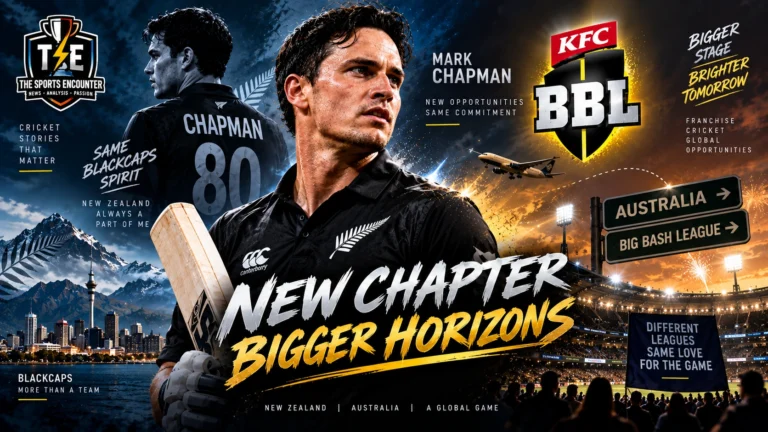
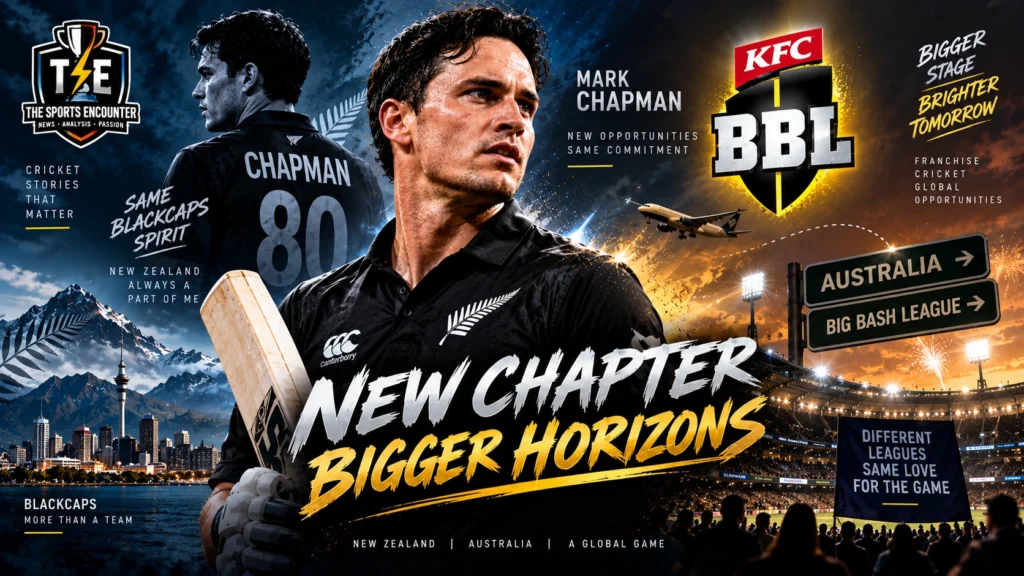
WELLINGTON: Mark Chapman has stepped away from his full New Zealand Cricket central contract for the 2026-27 season and moved onto a casual playing agreement, allowing the experienced left-hander to pursue an opportunity in Australia’s Big Bash League while remaining available for the Blackcaps.
The decision adds Chapman to a growing group of New Zealand internationals working under more flexible arrangements as franchise cricket occupies an increasingly important place in the global calendar.
New Zealand Cricket confirmed on September 8 that Chapman had chosen the casual contract specifically to pursue a BBL opportunity. The 32-year-old remains available for New Zealand’s upcoming home white-ball series against India, joining Finn Allen, Lockie Ferguson, Adam Milne and Tim Seifert among the nationally available players operating under casual agreements.
Chapman’s move also creates an immediate change to New Zealand’s contracted player group. Northern Districts fast bowler Matthew Fisher has been awarded his first central contract and takes the final place on the 20-player list for the 2026-27 season.
Story at a glance
Chapman Chooses Flexibility Without Walking Away From New Zealand
The most important part of Chapman’s decision is what it does not mean for his international career.
Chapman Becomes the Fifth New Zealand Player on a Casual Agreement
Chapman is no longer an isolated case.
New Zealand Cricket Had Initially Kept Chapman Centrally Contracted
The timing makes Chapman’s decision particularly interesting.
Why the BBL Opportunity Matters
The Big Bash League remains one of the most established franchise competitions in world cricket, and a full BBL campaign can provide both financial value and high-level T20 experience.
Chapman’s BBL Team Has Yet to Be Confirmed
One detail should remain clear while the story develops.
For readers following New Zealand, franchise cricket and the changing international calendar, The Sports Encounter’s Cricket Hub brings together our latest match reports, player stories and analysis.
Mark Chapman’s Contract Change at a Glance
| Detail | Information |
|---|---|
| Player | Mark Chapman |
| Age | 32 |
| Previous status | New Zealand central contract |
| New status | Casual playing contract for 2026-27 |
| Reason | To pursue an opportunity in Australia’s Big Bash League |
| New Zealand availability | Remains available for selection |
| Next major NZ assignment | Home white-ball series against India |
| Other casual-contract players | Finn Allen, Lockie Ferguson, Adam Milne and Tim Seifert |
| Central-contract replacement | Matthew Fisher |
| BBL franchise | Not publicly confirmed at time of publication |
Chapman Chooses Flexibility Without Walking Away From New Zealand
The most important part of Chapman’s decision is what it does not mean for his international career.
He has not retired from New Zealand duty, and NZC has explicitly confirmed that he remains available for selection.
Chapman is expected to be part of the selection conversation when India arrive in New Zealand for white-ball cricket, giving the Blackcaps continued access to a batter who has become increasingly valuable in their limited-overs plans.
In the official New Zealand Cricket announcement, Chapman made his international intentions clear.
“I’m thankful to New Zealand Cricket for their support now and throughout my career.”
He also said he was fully committed to performing during the upcoming India series.
That distinction matters because the modern franchise-versus-country debate is often presented as a simple choice.
New Zealand’s current contract structure suggests something more complicated.
Players such as Chapman can pursue significant franchise opportunities while remaining part of the national selection system. NZC, in turn, retains access to experienced international players without demanding year-round contractual control that could restrict their earning opportunities elsewhere.
Chapman Becomes the Fifth New Zealand Player on a Casual Agreement
Chapman is no longer an isolated case.
Finn Allen, Lockie Ferguson, Adam Milne and Tim Seifert are already operating under casual contracts for the 2026-27 period.
That makes Chapman the fifth player in the current group.
| New Zealand Player | 2026-27 Contract Status |
|---|---|
| Mark Chapman | Casual |
| Finn Allen | Casual |
| Lockie Ferguson | Casual |
| Adam Milne | Casual |
| Tim Seifert | Casual |
The pattern is difficult to ignore.
Allen is one of the most destructive short-format batters New Zealand has produced in recent years. Ferguson and Milne are experienced fast bowlers whose skills remain highly attractive to T20 franchises. Seifert provides wicketkeeping and aggressive top-order batting.
Chapman now joins that same group as a versatile middle-order player capable of adapting his tempo to different situations.
The development connects directly with one of the major themes already tracked through The Sports Encounter’s cricket coverage: how franchise contracts are increasingly influencing the careers and decisions of international cricketers.
New Zealand Cricket Had Initially Kept Chapman Centrally Contracted
The timing makes Chapman’s decision particularly interesting.
When NZC announced its original 20-player central contract list for 2026-27 in June, Chapman was included.
He and Michael Bracewell had asked not to be ranked for Test cricket and were effectively positioned as white-ball specialists within the central system.
The original NZC contract announcement confirmed that arrangement while also noting the board was continuing discussions around casual playing agreements.
Chapman’s subsequent move therefore represents an additional step.
He initially remained within the full central-contract structure as a white-ball player. The BBL opportunity has now made greater contractual flexibility more attractive.
Why the BBL Opportunity Matters
The Big Bash League remains one of the most established franchise competitions in world cricket, and a full BBL campaign can provide both financial value and high-level T20 experience.
Chapman’s decision should also be viewed within the increasingly crowded international calendar.
The 2026-27 BBL is scheduled across December and January, a period when New Zealand also have international commitments.
That overlap creates exactly the kind of scheduling problem that has pushed cricket boards and players toward more flexible contractual arrangements.
A centrally contracted player traditionally gives his national board much stronger control over availability.
A casual agreement allows the relationship to become more selective.
The ICC has also confirmed that Chapman is seeking additional franchise opportunities while remaining available to New Zealand, describing him as a player with around 150 international appearances across his career. The ICC’s official report on the contract change similarly emphasized that the move does not end his Blackcaps involvement.
Chapman’s BBL Team Has Yet to Be Confirmed
One detail should remain clear while the story develops.
New Zealand Cricket has confirmed the BBL opportunity, but Chapman’s Australian franchise has not yet been publicly announced.
That means speculation about which club he may join should remain separate from the confirmed contract story until an official franchise announcement is made.
What is already clear is the type of player an Australian team would be getting.
Chapman offers left-handed batting, experience against international attacks, flexibility across the middle order and occasional left-arm orthodox spin.
His ability to change tempo has made him useful in New Zealand teams where roles can shift depending on wickets, matchups and game state.
Chapman Has Already Built a Career Across International and Franchise Cricket
Chapman’s pathway has always been unusual.
Born in Hong Kong, he represented Hong Kong internationally before becoming eligible for New Zealand and making his Blackcaps debut in 2018.
He has since become a regular part of New Zealand’s limited-overs setup while also building experience across franchise competitions.
That international flexibility is increasingly reflected across the wider New Zealand squad.
Mitchell Santner, for example, has continued combining national leadership responsibilities with franchise commitments. His performances for Trent Rockets during The Hundred showed how easily New Zealand’s leading players now move between environments, including Santner’s explosive match-winning innings against MI London.
New Zealand players have also become familiar faces across the IPL, PSL, Major League Cricket, The Hundred and other short-format competitions.
The question for NZC is increasingly about managing that reality rather than trying to prevent it.
New Zealand’s Flexible Contract Model Is Becoming More Important
There is a practical reason New Zealand may have more incentive than some larger cricket nations to accommodate players.
Its domestic and international market cannot match the financial scale available in the biggest franchise competitions.
Trying to compete purely through salary would create an increasingly difficult contest.
Flexible contracts offer another solution.
NZC can maintain relationships with international-quality players while giving them periods of freedom to pursue franchise earnings.
The players retain a pathway back into international squads.
The national team retains access to skills that might otherwise disappear completely from the system.
New Zealand’s recent performances demonstrate why retaining that depth matters. During their ODI series in the Caribbean, Chapman remained part of a Blackcaps batting group that had to adjust repeatedly to difficult conditions, including the match covered in our analysis of New Zealand’s six-wicket win over West Indies in Providence.
Matthew Fisher Gets the Immediate Opportunity
Chapman’s decision also produces a winner inside New Zealand’s domestic system.
Northern Districts fast bowler Matthew Fisher has received his first central contract.
Rather than reducing the contracted list to 19 players, NZC promoted Fisher into the vacancy created by Chapman’s move.
That keeps the official central group at 20 and provides another developing player with greater security and closer access to the national setup.
The decision illustrates another potential benefit of the hybrid contracting model.
When an established player moves to a casual arrangement, central-contract resources can be redirected toward somebody who may depend more heavily on the national system for development and financial stability.
New Zealand therefore retains Chapman while simultaneously investing more heavily in Fisher.
Kane Williamson’s Retirement Has Already Changed New Zealand’s Senior Core
The contractual changes are taking place during a wider transition in New Zealand cricket.
Kane Williamson retired from international cricket earlier this year, ending the career of the country’s most accomplished modern batter.
The Sports Encounter examined the scale of that transition in our retrospective on Williamson’s career and New Zealand legacy.
His departure increases the importance of retaining experienced white-ball players such as Chapman, even if the contractual relationship changes.
New Zealand have already demonstrated that they can continue competing through transition. Their 2-1 Test series victory in England earlier this year showed the depth of the wider system, culminating in New Zealand’s 160-run victory at Trent Bridge.
White-ball cricket presents a different challenge because franchise leagues place greater direct pressure on player availability.
Franchise Cricket Is Reshaping the Meaning of an International Contract
Chapman’s move sits inside a much larger transformation.
A generation ago, a national central contract represented the clearest possible marker of security and status for an international cricketer.
That hierarchy has weakened.
Players can now build substantial careers across multiple franchise competitions while remaining available selectively for international cricket.
The rise of The Hundred, Major League Cricket, the IPL, PSL, BBL, CPL and newer competitions has created overlapping seasons and competing financial incentives.
The Sports Encounter saw the same broader franchise ecosystem during the 2026 Global Super League, where international and franchise identities mixed freely. Our coverage included Lahore Qalandars’ victory over a Perth Scorchers XI, another example of clubs and players operating across increasingly interconnected competitions.
The Hundred has produced similar movement. Players such as Trent Boult, Santner and other international stars featured throughout the competition, including the dramatic finish in which MI London defeated Birmingham Phoenix but still missed the Eliminator.
What Chapman’s Decision Means for New Zealand
The immediate consequence is relatively manageable.
Chapman remains available for the India series, so New Zealand are not losing him from their short-term white-ball plans.
The longer-term significance lies in precedent.
Five New Zealand internationals are now operating under casual agreements.
That number suggests the arrangement is becoming an established part of the country’s player-management strategy rather than an occasional exception.
It also raises a question NZC will continue facing: how much international availability can be preserved as franchise opportunities increase?
For now, the system appears built around negotiation rather than confrontation.
NZC gets access to Chapman.
Chapman gets access to the BBL market.
Matthew Fisher gets a first central contract.
The arrangement spreads opportunity across different levels of New Zealand cricket.
TSE Analysis: New Zealand Is Adapting to a Market It Cannot Ignore
Mark Chapman’s contract change tells a broader story about where cricket is heading.
Franchise leagues are no longer occasional additions around the international calendar. They are major employers competing directly for players’ time.
Boards therefore have fewer simple choices.
New Zealand appears to have accepted that retaining a player through a flexible relationship can sometimes be more valuable than insisting on complete contractual control and risking losing him entirely.
That approach comes with challenges. Selectors need clarity over availability. Coaches need continuity. Supporters want the strongest possible national team. Younger players also need to understand what commitments are expected if casual agreements become increasingly common.
Yet the alternative is equally difficult.
International boards cannot pretend the franchise economy does not exist.
Chapman’s move is particularly revealing because he was already operating as a white-ball specialist under the central system. Even that level of specialization did not provide enough flexibility once a BBL opportunity emerged.
New Zealand’s response was pragmatic.
They kept Chapman connected to the Blackcaps, promoted Fisher into the central-contract group and allowed another experienced player to pursue an overseas opportunity.
That may increasingly become the model for smaller cricket nations trying to protect both international competitiveness and player retention.
For broader coverage of the changing relationship between international and short-format cricket, readers can also explore The Sports Encounter’s analysis of how the international calendar continues to compete for space in an increasingly crowded cricket year.
Continue the Cricket Story
 CricketNew Zealand Cricket Abandons MLC Franchise Deal as Domestic Funding Takes Priority
 CricketPSL Eyes Six-a-Side Tournament to Reach Smaller Cities, but Can Another Cricket League Make Money?
 A Celebration of 5000 ODIsA Celebration of 5000 ODIs Match 60: Sri Lanka Set Just 139, but Malinga’s Four Wickets Leave New Zealand One Blow From Defeat
Frequently Asked Questions
Why has Mark Chapman left his New Zealand central contract?
Chapman has moved to a casual playing agreement for the 2026-27 season so he can pursue an opportunity in Australia’s Big Bash League.
Has Mark Chapman retired from international cricket?
No. Chapman remains available for New Zealand selection and is expected to be available for the upcoming home white-ball series against India.
Will Mark Chapman play in the BBL?
New Zealand Cricket has confirmed that his change of contract is intended to allow him to pursue a Big Bash League opportunity. His BBL franchise had not been publicly confirmed at the time of publication.
Which New Zealand players have casual contracts?
Mark Chapman joins Finn Allen, Lockie Ferguson, Adam Milne and Tim Seifert on casual playing agreements for the 2026-27 period.
Who replaced Mark Chapman on New Zealand’s central contract list?
Northern Districts fast bowler Matthew Fisher received his first central contract after Chapman moved to a casual agreement.
How many players are on New Zealand’s central contract list?
New Zealand Cricket maintains a 20-player central contract group for the 2026-27 season, with Fisher taking the place vacated by Chapman.
Was Mark Chapman originally given a central contract for 2026-27?
Yes. Chapman was included when NZC announced its original central contract list in June, having requested not to be ranked for Test cricket and effectively operating as a white-ball specialist.
Is Mark Chapman available for the India series?
Yes. New Zealand Cricket has confirmed that Chapman remains available for selection for the upcoming India tour of New Zealand.
What is a casual New Zealand Cricket contract?
A casual playing agreement allows New Zealand Cricket to maintain a contractual relationship with a player while providing greater flexibility around availability and overseas franchise commitments than a full central contract.
Why are more New Zealand players choosing casual contracts?
International players increasingly have opportunities in franchise competitions around the world. Casual agreements allow players to pursue some of those opportunities while remaining connected to New Zealand’s international selection system.