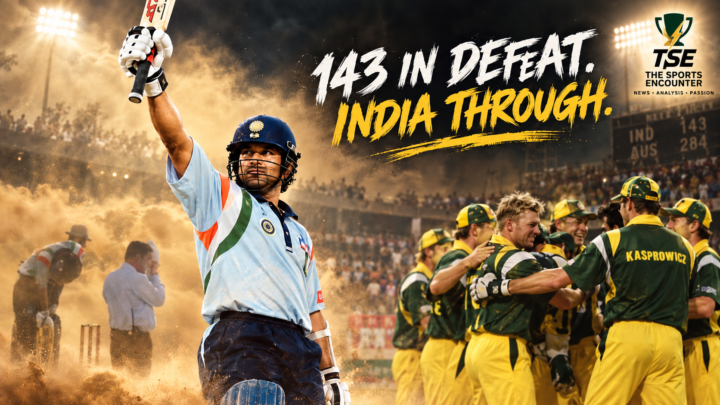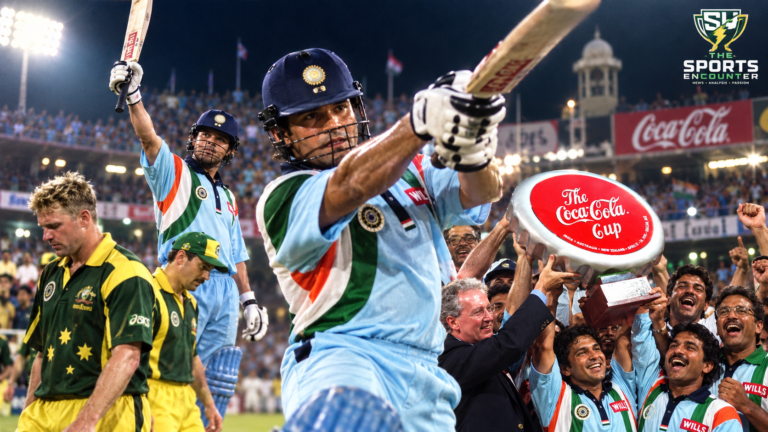
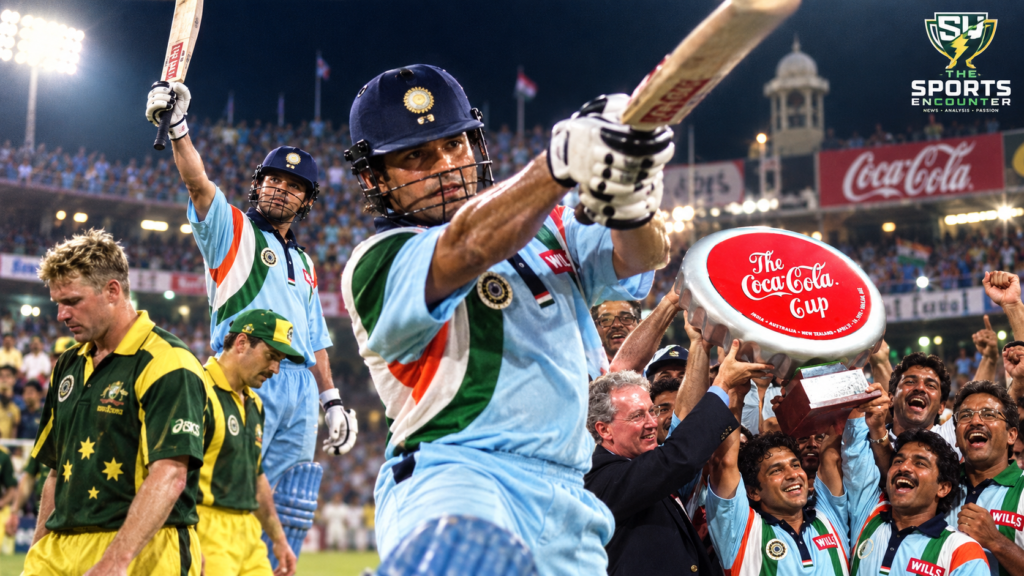
SHARJAH, United Arab Emirates, April 24, 1998: Sachin Tendulkar had already done the improbable once against Australia. Two nights after his 143 in a sandstorm-interrupted defeat carried India into the Coca-Cola Cup final, he walked back into Sharjah Cricket Stadium on his 25th birthday and made 134 from 131 balls as India chased 273 to beat Australia by six wickets with nine deliveries remaining.
The sequel transformed the famous Desert Storm innings from an extraordinary act of qualification into the opening half of something larger. Australia recovered from 26/3 through Steve Waugh and Darren Lehmann to post 272/9, but Tendulkar controlled India’s chase through partnerships with Nayan Mongia and Mohammad Azharuddin, neutralized Shane Warne again, and departed only when India needed 25 more runs. India finished the job at 275/4, and one of ODI cricket’s greatest two-match batting sequences was complete. The ICC describes Tendulkar’s back-to-back 143 and 134 in Sharjah as part of cricket folklore. icc
Why Match 49 Belongs in A Celebration of 5000 ODIs
The previous episode explains why India reached this final at all.
In Match 48: Tendulkar Loses the Match but Wins India a Final in the Desert Storm, Australia made 284/7, a sandstorm interrupted the chase, and India’s qualification equation became more important than the actual result.
Story at a glance
Why Match 49 Belongs in A Celebration of 5000 ODIs
The previous episode explains why India reached this final at all.
India vs Australia 1998 Coca-Cola Cup Final: Match at a Glance
ICC’s Sharjah history specifically identifies the final as one of the ground’s defining ODIs, with Tendulkar’s 131-ball 134 driving India’s pursuit of 273. Cloudinary
Australia Collapse to 26/3 Before the Final Has Settled
India’s decision to field produced an immediate reward.
Adam Gilchrist Gives Australia Their First Recovery
Gilchrist made:
Michael Bevan’s Run-Out Leaves Australia in Real Trouble
Bevan was already one of the great ODI problem-solvers.
Tendulkar made 143.
India lost.
They still reached the final ahead of New Zealand.
That innings has become so famous that the final can sometimes feel like an appendix to it.
It deserves better.
Two days later Tendulkar had to do it again.
Against the same attack.
At the same ground.
With a trophy this time.
He scored another hundred and India won.
The ICC records the two innings, 143 and 134, as back-to-back centuries scored in crucial matches across three days. The second came on Tendulkar’s 25th birthday and secured the tournament. icc
That is why Match 49 belongs beside Match 48.
The Desert Storm created the final.
The birthday hundred gave it an ending.
India vs Australia 1998 Coca-Cola Cup Final: Match at a Glance
| Detail | Information |
|---|---|
| Competition | Coca-Cola Cup 1998 |
| Stage | Final |
| Date | April 24, 1998 |
| Venue | Sharjah Cricket Stadium |
| Toss | India won and fielded |
| Australia | 272/9 in 50 overs |
| India | 275/4 in 48.3 overs |
| Result | India won by 6 wickets |
| Balls remaining | 9 |
| Player of the Match | Sachin Tendulkar |
| Australia top scorers | Steve Waugh 70, Darren Lehmann 70 |
| India top scorer | Sachin Tendulkar 134 |
| Best India bowling | Venkatesh Prasad 2/32 |
| Best Australia bowling | Damien Fleming 2/47 |
| Key India partnership | Tendulkar-Azharuddin, 120 |
| Tournament consequence | India won the Coca-Cola Cup |
| Historical hook | Tendulkar’s second century against Australia in three days |
ICC’s Sharjah history specifically identifies the final as one of the ground’s defining ODIs, with Tendulkar’s 131-ball 134 driving India’s pursuit of 273. Cloudinary
Australia Collapse to 26/3 Before the Final Has Settled
India’s decision to field produced an immediate reward.
Australia lost Mark Waugh for seven.
Ricky Ponting followed for one.
Tom Moody managed one.
After only 5.5 overs:
Australia 26/3.
Venkatesh Prasad and Ajit Agarkar had removed three of Australia’s first four batters before the innings had established any rhythm.
For India, this was the ideal opening.
For Australia, it forced a rebuilding job that would eventually consume most of the innings.
Adam Gilchrist Gives Australia Their First Recovery
Gilchrist made:
45 from 60 balls
6 fours
His innings was restrained by his standards, but that was what the situation demanded.
He and Michael Bevan added 59 for the fourth wicket.
Australia moved from 26/3 to 85/3.
The recovery mattered because another wicket inside the first 15 overs could have left Australia fighting merely to reach 200.
Gilchrist stopped that slide.
Then India found an unusual route to the breakthrough.
Hrishikesh Kanitkar dismissed him.
The score became 85/4.
Michael Bevan’s Run-Out Leaves Australia in Real Trouble
Bevan was already one of the great ODI problem-solvers.
He made 45 from 63 balls and helped Australia rebuild again.
Then a running mix-up ended his innings.
Australia were:
121/5 after 27 overs.
Twenty-three overs remained.
Half the side was gone.
At that stage, India had every reason to expect a target well below 250.
Steve Waugh and Darren Lehmann changed that expectation completely.
Steve Waugh Rebuilds Australia From 121/5
Waugh’s innings was constructed under pressure.
70 runs
71 balls
4 fours
1 six
Strike rate: 98.59
The scorecard does not fully capture the situation he inherited.
Australia had lost three wickets for eight runs early.
Two more wickets had followed before the 27th over ended.
Waugh had to rebuild without allowing India to squeeze the run rate down too far.
His answer was one of controlled aggression.
He accumulated.
He waited.
When India’s secondary bowlers missed, he scored.
Lehmann gave him the ideal partner.
Darren Lehmann Gives Australia the Acceleration the Innings Needed
Lehmann also made 70, but the method was different.
70 runs
59 balls
5 fours
1 six
Strike rate: 118.64
He provided the acceleration while Waugh anchored the recovery.
Their sixth-wicket partnership produced:
103 runs.
Australia moved from 121/5 to 224/5.
That stand changed the final.
India had reduced Australia to a position from which 220 might have been realistic.
Waugh and Lehmann pushed the target toward 273.
Australia had recovered strongly enough to give their bowlers a serious total to defend.
Hrishikesh Kanitkar Makes an Unexpected Impact With the Ball
Kanitkar is remembered most clearly for his winning boundary against Pakistan in Match 47.
In Sharjah, he made his biggest contribution before India began batting.
He bowled all 10 overs.
His figures:
10 overs
58 runs
2 wickets
Those wickets were Gilchrist and Steve Waugh.
Removing Waugh at 224/6 stopped the century partnership just as Australia appeared ready for an explosive finish.
Kanitkar was expensive at 5.80 per over, but in the context of a 272 total and a partnership threatening to accelerate further, his two wickets mattered.
Venkatesh Prasad Gives India the Control Australia Never Found
Prasad finished with the best figures of the innings:
10 overs
1 maiden
32 runs
2 wickets
Economy: 3.20
He removed Ponting early and Michael Kasprowicz late.
More importantly, he conceded barely three runs per over while Australia scored at 5.44 overall.
In a match remembered almost entirely for Tendulkar, Prasad’s control created part of the margin that made the chase manageable.
That is one of the quieter reasons India won.
Australia Batting: Complete Scorecard
Australia 272/9 in 50 Overs
| Batter | Dismissal | R | B | 4s | 6s | SR |
|---|---|---|---|---|---|---|
| Mark Waugh | c Nayan Mongia b Ajit Agarkar | 7 | 14 | 0 | 0 | 50.00 |
| Adam Gilchrist | c Nayan Mongia b Hrishikesh Kanitkar | 45 | 60 | 6 | 0 | 75.00 |
| Ricky Ponting | c Nayan Mongia b Venkatesh Prasad | 1 | 2 | 0 | 0 | 50.00 |
| Tom Moody | c Nayan Mongia b Ajit Agarkar | 1 | 5 | 0 | 0 | 20.00 |
| Michael Bevan | run out | 45 | 63 | 2 | 0 | 71.43 |
| Steve Waugh | c Ajit Agarkar b Hrishikesh Kanitkar | 70 | 71 | 4 | 1 | 98.59 |
| Darren Lehmann | c Rahul Sanghvi b Anil Kumble | 70 | 59 | 5 | 1 | 118.64 |
| Damien Martyn | run out | 16 | 18 | 1 | 0 | 88.89 |
| Shane Warne | not out | 6 | 7 | 0 | 0 | 85.71 |
| Michael Kasprowicz | c Hrishikesh Kanitkar b Venkatesh Prasad | 0 | 2 | 0 | 0 | 0.00 |
| Damien Fleming | not out | 1 | 2 | 0 | 0 | 50.00 |
Extras: 10
Total: 272/9 in 50 overs
Run rate: 5.44
Fall of wickets: 18/1 Mark Waugh, 19/2 Ponting, 26/3 Moody, 85/4 Gilchrist, 121/5 Bevan, 224/6 Steve Waugh, 255/7 Lehmann, 263/8 Martyn, 264/9 Kasprowicz.
India Bowling
| Bowler | O | M | R | W | Econ |
|---|---|---|---|---|---|
| Venkatesh Prasad | 10 | 1 | 32 | 2 | 3.20 |
| Ajit Agarkar | 8 | 0 | 61 | 2 | 7.63 |
| Anil Kumble | 10 | 1 | 46 | 1 | 4.60 |
| Hrishikesh Kanitkar | 10 | 0 | 58 | 2 | 5.80 |
| Rahul Sanghvi | 10 | 0 | 45 | 0 | 4.50 |
| VVS Laxman | 1 | 0 | 11 | 0 | 11.00 |
| Sachin Tendulkar | 1 | 0 | 12 | 0 | 12.00 |
India Had Historically Struggled With Targets This Large
A target of 273 was significant in 1998.
India’s ODI batting had plenty of talent, but chasing large totals was not yet something the side routinely did with confidence.
The psychological burden was greater because this was Australia.
Shane Warne.
Damien Fleming.
Michael Kasprowicz.
Steve Waugh’s relentless competitiveness.
And only two days earlier, Tendulkar had made 143 against this attack without winning the match.
India needed another large innings from somewhere.
There was little mystery about where they hoped it would come from.
Sourav Ganguly’s Slow Start Makes Tendulkar’s Role Even Bigger
Ganguly opened with Tendulkar but never settled.
He made:
23 from 42 balls
India reached 39 before Fleming removed him.
Tendulkar had faced relatively little bowling during the opening phase.
The chase had not collapsed, but the scoring rate needed attention.
Tendulkar supplied it.
Sachin Tendulkar Does Not Try to Recreate the Desert Storm
The most interesting feature of the 134 is that it was not simply a repeat of the 143.
The first innings had become a pursuit shaped by qualification calculations, a sandstorm and the need for extreme acceleration.
The final required something more controlled.
Tendulkar still attacked.
But he also occupied the crease for 131 balls.
His final numbers:
134 runs
131 balls
12 fours
3 sixes
Strike rate: 102.29
Against a target of 273 in that era, scoring above a run a ball across 131 deliveries gave India enormous control.
The ICC describes the innings as a measured masterclass that followed his stunning 143 two days earlier. icc
Nayan Mongia’s Promotion Protects India From Another Collapse
Nayan Mongia came in at No. 3.
It was an unconventional choice.
It worked.
He made:
28 from 41 balls
That does not look like a major innings until the partnership is considered.
Mongia and Tendulkar added:
89 runs for the second wicket.
India moved from 39/1 to 128/2.
Mongia did not need to dominate.
His job was to prevent Australia from taking the second and third wickets together.
He did exactly that.
The partnership gave Tendulkar a stable platform from which to control the chase.
Mohammad Azharuddin Gives Tendulkar the Partner Who Can Finish the Job
Azharuddin’s 58 may be the most important supporting innings of the final.
He scored:
58 from 64 balls
5 fours
Strike rate: 90.63
He and Tendulkar added:
120 runs for the third wicket.
That partnership took India from 128/2 to 248/3.
By the time Tendulkar departed, the final was effectively in India’s hands.
The partnership also reveals why Australia struggled despite possessing Warne and two frontline seamers.
Once Tendulkar and Azharuddin settled, Steve Waugh had too few genuine wicket-taking alternatives.
Australia’s Bowling Balance Becomes the Tactical Weakness India Exploits
Australia entered the final with only three specialist bowlers:
Damien Fleming.
Michael Kasprowicz.
Shane Warne.
The remaining 20 overs had to come from all-rounders and part-time options such as Tom Moody, Steve Waugh and Mark Waugh.
Tendulkar understood the structure.
He did not need to attack every delivery from the specialists.
He could manage those periods and increase the pressure when the secondary bowlers appeared.
The plan worked.
Moody conceded 63 from 9.3 overs.
Mark Waugh went for 20 from three.
Warne, the greatest attacking threat in the side, finished wicketless.
Once Australia failed to generate wickets through the middle, Tendulkar could dictate the chase rather than react to it.
Shane Warne Cannot Break Tendulkar’s Control
Warne bowled:
10 overs
61 runs
0 wickets
Those numbers became particularly striking because the Tendulkar-Warne contest had been one of cricket’s defining individual rivalries that year.
Earlier in 1998, Tendulkar had dominated Australia’s leg-spinner during the Test series in India.
Sharjah extended the pattern.
The ICC’s career retrospective on Tendulkar notes that he scored 446 runs at 111.50 against Australia in the 1998 Test series before continuing his dominance during the Coca-Cola Cup. icc
Warne was not destroyed every over.
Tendulkar simply prevented him from controlling the game.
In an ODI chase, that can be equally damaging.
Tendulkar Reaches Another Hundred, This Time With a Trophy in Sight
Two days earlier, reaching three figures had not ended the task.
Tendulkar needed to push India past the qualification threshold.
In the final, the equation was simpler.
Win.
His hundred came with India already increasingly comfortable.
The crowd had watched the same man dismantle Australia twice in three days.
ICC later noted that Tendulkar’s two Sharjah hundreds have remained among the defining images of his career. icc
There was another detail.
April 24 was his birthday.
He had turned 25.
Tendulkar became one of the rare ODI batters to score a century on his birthday, something the ICC has separately documented in its historical records. icc
Player of the Match: Tendulkar Completes the Two-Game Masterpiece
Tendulkar’s 134 was the clear Player of the Match performance.
The number alone explains part of it.
The context explains the rest.
India needed 273 in a final.
Australia had recovered strongly enough to make that target serious.
India lost Ganguly before 40.
Tendulkar then shared two substantial partnerships and remained until the score reached 248.
He left with only 25 required.
India still had 33 balls available.
This was not an innings that merely made victory possible.
It had almost completed the chase before anyone else needed to face the pressure of finishing.
Kasprowicz Finally Removes Tendulkar, but Australia Are Too Late
Michael Kasprowicz trapped Tendulkar lbw for 134.
India:
248/3 after 44.3 overs.
Australia had finally removed the player who had controlled almost everything.
The problem was arithmetic.
Twenty-five runs remained.
Thirty-three balls remained.
Seven wickets remained.
Azharuddin was already set.
The wicket offered emotional relief.
It did not restore control.
Azharuddin Falls, but India Refuse to Create Another Twist
Kasprowicz struck again at the end of the 47th over.
Azharuddin was gone for 58.
India:
261/4.
Twelve required from 18 balls.
Australia needed something close to a collapse.
Ajay Jadeja and Hrishikesh Kanitkar did not give them one.
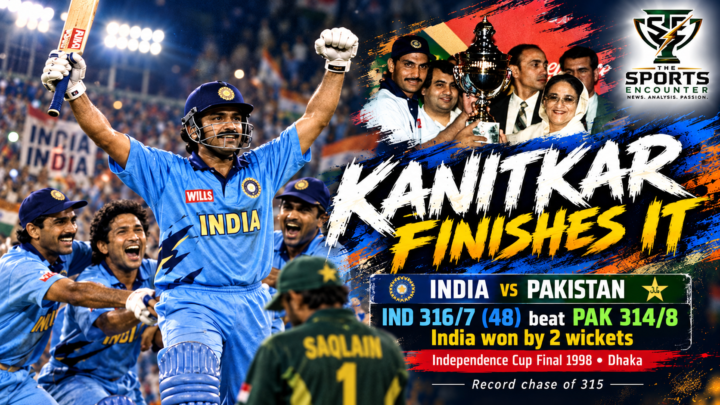
Kanitkar, who had struck the unforgettable winning boundary against Pakistan in Dhaka three months earlier, finished this tournament final with another boundary.
India reached 275/4 after 48.3 overs.
The trophy belonged to them.
India Batting: Complete Scorecard
India 275/4 in 48.3 Overs
| Batter | Dismissal | R | B | 4s | 6s | SR |
|---|---|---|---|---|---|---|
| Sourav Ganguly | c Tom Moody b Damien Fleming | 23 | 42 | 2 | 0 | 54.76 |
| Sachin Tendulkar | lbw b Michael Kasprowicz | 134 | 131 | 12 | 3 | 102.29 |
| Nayan Mongia | c Adam Gilchrist b Damien Fleming | 28 | 41 | 3 | 0 | 68.29 |
| Mohammad Azharuddin | c Adam Gilchrist b Michael Kasprowicz | 58 | 64 | 5 | 0 | 90.63 |
| Ajay Jadeja | not out | 11 | 14 | 0 | 0 | 78.57 |
| Hrishikesh Kanitkar | not out | 6 | 2 | 1 | 0 | 300.00 |
Did not bat: VVS Laxman, Ajit Agarkar, Anil Kumble, Venkatesh Prasad, Rahul Sanghvi
Extras: 15
Total: 275/4 in 48.3 overs
Run rate: 5.67
Fall of wickets: 39/1 Ganguly, 128/2 Mongia, 248/3 Tendulkar, 261/4 Azharuddin.
Australia Bowling
| Bowler | O | M | R | W | Econ |
|---|---|---|---|---|---|
| Damien Fleming | 10 | 1 | 47 | 2 | 4.70 |
| Michael Kasprowicz | 10 | 0 | 48 | 2 | 4.80 |
| Shane Warne | 10 | 0 | 61 | 0 | 6.10 |
| Tom Moody | 9.3 | 0 | 63 | 0 | 6.63 |
| Mark Waugh | 3 | 0 | 20 | 0 | 6.67 |
| Steve Waugh | 6 | 0 | 28 | 0 | 4.67 |
Result: India won by six wickets with nine balls remaining.
Player of the Match: Sachin Tendulkar.
Eight Turning Points That Decided the Coca-Cola Cup Final
1. Australia Fall to 26/3
India removed Mark Waugh, Ponting and Moody before the sixth over ended.
That early damage prevented Australia from dictating the innings.
2. Gilchrist and Bevan Repair the Collapse
Their 59-run stand stopped India from turning three wickets into complete domination.
3. Bevan’s Run-Out Leaves Australia 121/5
The run-out reopened the innings and forced Steve Waugh into a major rebuilding job.
4. Waugh and Lehmann Add 103
This was Australia’s defining partnership.
Without it, Tendulkar may have been chasing a far smaller target.
5. Prasad Concedes Only 32 in 10 Overs
In a 272-run innings, those 10 overs were exceptionally valuable.
They restricted Australia’s ceiling.
6. Mongia Helps Tendulkar Absorb the Middle Overs
The 89-run second-wicket stand ensured Tendulkar did not have to rescue another collapse.
7. Tendulkar and Azharuddin Add 120
This was the partnership that won the final.
Australia needed wickets and could not create them.
8. Tendulkar Falls Only After Taking India to 248
His dismissal came too late to change the result.
India needed only 25 more.
Why Australia Lost Despite Recovering From 26/3
Australia’s batting recovery was excellent.
Their bowling construction was less convincing.
Three specialist bowlers left Steve Waugh dependent on part-time overs once Tendulkar settled.
Warne could not break through.
Fleming removed Ganguly and Mongia, but the wickets were separated by 89 runs.
Kasprowicz did not strike until India had reached 248.
Australia therefore spent too much of the chase waiting for India to make a mistake.
Tendulkar did not.
The difference between the teams was not simply his 134.
It was that India generated wickets throughout Australia’s innings, while Australia failed to generate them during the part of the chase when the final was still balanced.
Why India Won More Comfortably Than the Scorecard Suggests
A six-wicket victory with nine balls left does not look overwhelming.
The chase itself was calmer than the target suggested.
India lost only two wickets in the first 44 overs.
Tendulkar stayed until 248.
Azharuddin remained until 261.
Australia never created the cluster of wickets needed to turn 273 into a pressure target.
Compare that with India’s one-run heartbreak against Australia in the 1987 World Cup, where a controlled chase unraveled late.
Sharjah produced the opposite pattern.
India protected the structure of the innings all the way to the finish.
Tendulkar’s 143 and 134 Form One Story, Not Two
This is the central reason Matches 48 and 49 should be read together.
Across the two games Tendulkar scored:
277 runs
in two innings against Australia.
One innings got India into the final.
The next won it.
The sequence also foreshadowed what Tendulkar would do throughout 1998.
He finished the calendar year with 1,894 ODI runs at an average of 65.31, scoring at a strike rate above 102, numbers the ICC describes as ahead of their time. icc
His Sharjah performances also moved him from sixth to third in the ICC ODI batting rankings, gaining 61 ranking points across the tournament. icc
The two centuries were therefore part of something larger.
1998 was becoming Tendulkar’s ODI year.
Sharjah became its defining location.
Australia Were About to Become the Dominant ODI Team of Their Era
There is another reason this performance has aged so well.
This was not a declining Australian side.
The core of a coming dynasty was already there.
Steve Waugh.
Ricky Ponting.
Adam Gilchrist.
Shane Warne.
Michael Bevan.
Darren Lehmann.
Damien Fleming.
Australia would win the 1999 World Cup and then retain it in 2003 and 2007.
TSE’s Match 14 revisits Steve Waugh’s decisive 120 against South Africa, one of the performances that kept Australia alive during the tournament that began that run of three consecutive world titles.
The ICC also places the Sharjah final immediately before that period of Australian world dominance, which strengthens the historical weight of Tendulkar’s performance. icc
He did this against a team on the verge of becoming the standard everyone else had to chase.
The Tendulkar-Warne Rivalry Was Already Becoming Personal Cricket Theater
Warne’s figures in the final were 0/61.
Tendulkar’s treatment of him carried extra significance because their duel had dominated discussion during Australia’s Test tour of India earlier that year.
In the Test series, Tendulkar scored 446 runs at 111.50.
Then came Sharjah.
Two more centuries against Australia.
The rivalry became one of those rare individual contests capable of giving an entire series another layer of anticipation.
Warne remained one of cricket’s greatest bowlers.
Tendulkar remained one of the few batters who could make even Warne appear defensive for extended periods.
The final reinforced that image.
Sharjah Became Permanently Connected With Tendulkar
Sharjah had already produced Javed Miandad’s last-ball six against India in 1986.
The ground had a substantial ODI history before Tendulkar arrived in April 1998.
The Desert Storm changed its association with Indian cricket.
The final completed it.
Years later, the ICC still describes Sharjah’s 1998 Tendulkar performances among the stadium’s defining moments. icc
The West Stand was renamed the Sachin Tendulkar Stand in 2023.
That decision reflected more than a career total.
Sharjah had one particular reason to remember him.
April 1998.
Match 49 Completes a Remarkable Three-Episode Run for India
TSE’s multi-nation tournament section has now produced three consecutive Indian victories or achievements with unusually memorable finishing stories.
Match 47 saw Sourav Ganguly make 124 before Kanitkar’s boundary completed what was then a world-record chase against Pakistan in Dhaka.
Match 48 produced Tendulkar’s 143 and the extraordinary sight of India effectively celebrating qualification despite losing to Australia.
Match 49 gave that strange defeat its reward.
India were champions.
Why the 134 May Matter More Than the More Famous 143
The 143 is the innings with the nickname.
The storm.
The qualification equation.
The famous television images.
The mythology.
The 134 had something the 143 did not.
A victory.
A trophy.
There is no need to diminish the Desert Storm to elevate the final.
The point is that the two innings solve different problems.
The first required Tendulkar to race against Australia, weather and net run rate.
The second required him to control a normal chase against the same elite opponent while carrying the expectation created by what he had just done.
Doing either was exceptional.
Doing both in three days created the legend.
What Happened Next?
Tendulkar’s 1998 continued at an extraordinary rate.
He finished the year with 1,894 ODI runs, still one of the landmark calendar-year batting performances in the format. icc
Australia recovered from Sharjah and within 14 months became world champions.
Steve Waugh’s side eventually turned near-elimination at the 1999 World Cup into the beginning of an unprecedented three-title run.
That Australian transformation is central to A Celebration of 5000 ODIs Match 14 and the extraordinary semifinal that followed.
India’s own ODI history would continue producing defining tournament moments, from the 1983 World Cup triumph over West Indies to later World Cup pressure matches.
Sharjah remains different.
For three days in April 1998, the story of an entire tournament became the story of one batter.
Continue A Celebration of 5000 ODIs
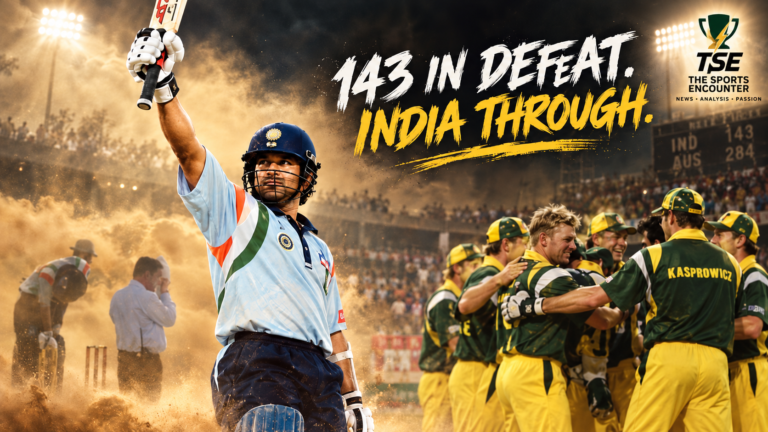 A Celebration of 5000 ODIsA Celebration of 5000 ODIs Match 48: Tendulkar Loses the Match but Wins India a Final in the Desert Storm
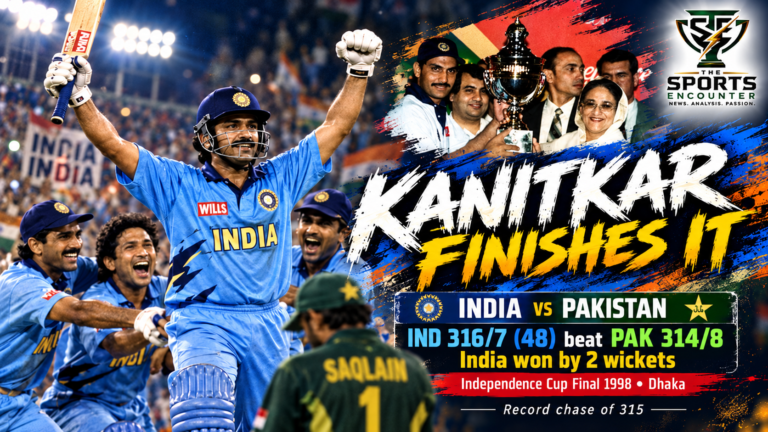 A Celebration of 5000 ODIsA Celebration of 5000 ODIs Match 47: Ganguly Carries 315 Into Reach Before Kanitkar Finds Four in the Dhaka Darkness
 A Celebration of 5000 ODIsA Celebration of 5000 ODIs Match 46: Miandad Turns Four From One Ball Into the Six That Changed India-Pakistan Cricket
Frequently Asked Questions
Who won the 1998 Coca-Cola Cup final?
India defeated Australia by six wickets at Sharjah Cricket Stadium.
What did Australia score in the final?
Australia made 272/9 from 50 overs.
What did India score?
India reached 275/4 in 48.3 overs, winning with nine balls remaining.
How many runs did Sachin Tendulkar score?
Tendulkar made 134 from 131 balls, with 12 fours and three sixes.
Was the final played on Tendulkar’s birthday?
Yes. April 24, 1998 was Tendulkar’s 25th birthday. His 134 made him one of the rare ODI batters to score a century on his birthday. icc
Who was Player of the Match?
Sachin Tendulkar was Player of the Match.
Who top-scored for Australia?
Steve Waugh and Darren Lehmann each scored 70.
What was Tendulkar’s score in the previous match?
He made 143 against Australia two days earlier. India lost that game but qualified for the final through net run rate after the sandstorm-adjusted chase.
How many runs did Tendulkar score across the two famous Sharjah innings?
He scored 277 runs, 143 and 134, across the two matches.
Why is this match included in A Celebration of 5000 ODIs?
The final completed one of ODI cricket’s greatest two-match individual sequences. Tendulkar’s 143 carried India into the final despite defeat, and his 134 two days later defeated the same Australian team and won the tournament.
A Celebration of 5000 ODIs
- A Celebration of 5000 ODIs Match 49: Tendulkar Turns the Desert Storm Into a Birthday Title Against Australia
- A Celebration of 5000 ODIs Match 48: Tendulkar Loses the Match but Wins India a Final in the Desert Storm
- A Celebration of 5000 ODIs Match 47: Ganguly Carries 315 Into Reach Before Kanitkar Finds Four in the Dhaka Darkness
- A Celebration of 5000 ODIs Match 46: Miandad Turns Four From One Ball Into the Six That Changed India-Pakistan Cricket
- A Celebration of 5000 ODIs Match 45: Fakhar Makes 402 Look Reachable Before Rain Seals Pakistan’s World Cup Lifeline