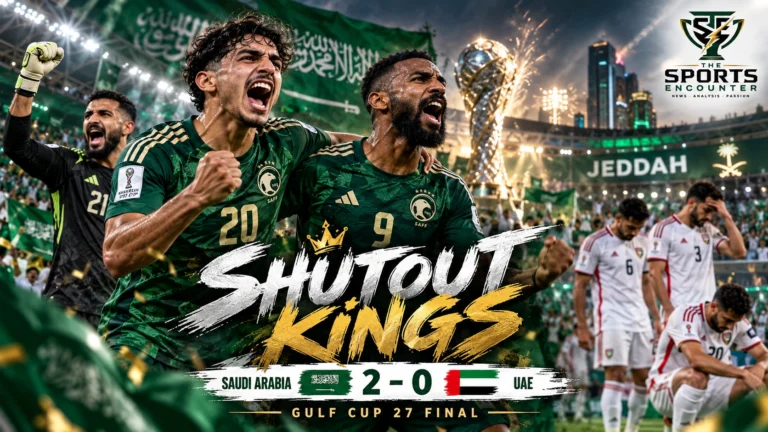
JEDDAH, Saudi Arabia, October 6, 2026: Saudi Arabia waited 22 years for another Arabian Gulf Cup title and then needed barely 13 minutes of the final to take control of it.
Hammam Al-Hammami scored in the 11th minute and Firas Al-Buraikan struck again two minutes later as the Green Falcons defeated the United Arab Emirates 2-0 at Alinma Stadium in King Abdullah Sports City, securing Saudi Arabia’s fourth Gulf Cup championship.
The score tells only part of the story.
Saudi Arabia entered the final having played 390 minutes at Gulf Cup 27 without conceding. The UAE arrived with nine goals and the tournament’s most efficient attack. That contrast formed the central question in The Sports Encounter’s detailed Saudi Arabia-UAE final preview.
Story at a glance
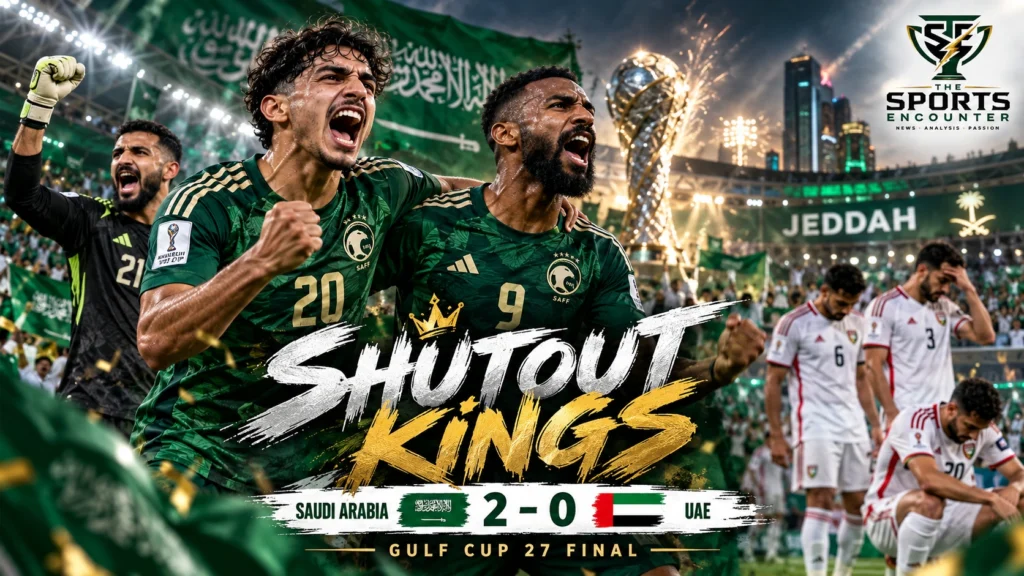
Saudi Arabia vs UAE Gulf Cup 27 Final at a Glance
The Saudi Arabian Football Federation’s Gulf Cup 27 tournament page documents the Green Falcons’ unbeaten route through Group A and their semifinal victory over Qatar.
How Did Saudi Arabia Decide the Final in the First 13 Minutes?
The opening phase destroyed the type of match the UAE wanted to play.
Firas Al-Buraikan Delivered When Saudi Arabia Finally Needed Goals
Al-Buraikan’s final goal completed an important tournament arc.
Hammam Al-Hammami Turned a Tournament Opportunity Into a Final Moment
Al-Hammami’s opener carries another layer of significance.
The UAE Nearly Found a Way Back Before Halftime
The final was not completely finished after the two early goals.
The answer was emphatic.
The UAE never broke the Saudi defensive line. Mohammed Al-Owais and the players in front of him completed another clean sheet, extending Saudi Arabia’s shutout run through all five tournament matches and 480 minutes of competitive football, including extra time in the semifinal against Qatar.
Saudi Arabia scored eight goals at Gulf Cup 27.
They conceded none.
Saudi Arabia vs UAE Gulf Cup 27 Final at a Glance
| Match Detail | Information |
|---|---|
| Final Score | Saudi Arabia 2-0 United Arab Emirates |
| Competition | 27th Arabian Gulf Cup |
| Stage | Final |
| Venue | Alinma Stadium, King Abdullah Sports City, Jeddah |
| Saudi Arabia Scorers | Hammam Al-Hammami 11′, Firas Al-Buraikan 13′ |
| Halftime | Saudi Arabia 2-0 UAE |
| Saudi Arabia Gulf Cup Titles | 4 |
| Previous Saudi Title | 2004 |
| Saudi Goals Conceded at Gulf Cup 27 | 0 |
The Saudi Arabian Football Federation’s Gulf Cup 27 tournament page documents the Green Falcons’ unbeaten route through Group A and their semifinal victory over Qatar.
How Did Saudi Arabia Decide the Final in the First 13 Minutes?
The opening phase destroyed the type of match the UAE wanted to play.
Zlatko Dalić’s side had navigated Gulf Cup 27 through control, efficiency and strong defensive spacing. The UAE had conceded only once before the final and had been particularly effective when matches remained structured.
Saudi Arabia never allowed that structure to settle.
Al-Hammami opened the scoring in the 11th minute with a shot from around the edge of the penalty area that took a deflection and wrong-footed UAE goalkeeper Khaled Eisa.
The psychological effect was immediate.
Two minutes later, Al-Buraikan found space behind the UAE defense and finished low with his left foot to make it 2-0.
A final that had been presented as a clash between Saudi Arabia’s defense and the UAE’s attacking efficiency suddenly required the Emiratis to score at least twice against a team that had not conceded once in the entire tournament.
That was the decisive transformation.
Firas Al-Buraikan Delivered When Saudi Arabia Finally Needed Goals
Al-Buraikan’s final goal completed an important tournament arc.
He had already scored twice in Saudi Arabia’s 3-0 group-stage victory over Oman, helping turn an opening 1-0 win against Kuwait into a far more convincing attacking performance.
Before the final, Al-Buraikan had made the Saudi objective clear.
“We are proud to play the final and we want to win the title,” he said during the buildup.
He then scored the goal that gave Saudi Arabia the breathing room to manage the remaining 77 minutes from a position of enormous tactical strength.
The development also reinforces a pattern that emerged during the group stage. TSE’s Group A finale analysis showed that Saudi Arabia did not need one attacking star to carry every game. Different players solved different problems.
Al-Buraikan became the forward who produced separation when it mattered most.
Hammam Al-Hammami Turned a Tournament Opportunity Into a Final Moment
Al-Hammami’s opener carries another layer of significance.
Saudi Arabia entered Gulf Cup 27 with established names such as Al-Owais, Mohamed Kanno, Abdullah Al-Hamdan and Al-Buraikan, but Georgios Donis also used the tournament to widen his pool ahead of future international competition.
Al-Hammami was among those opportunities.
He started the final on the left and rewarded the decision with the goal that opened the match.
A tournament can reveal depth in ways that friendlies rarely do. Pressure increases with every knockout round, and players who appear promising in lower-stakes situations still have to prove they can influence a final.
Al-Hammami now has that moment on his international résumé.
The UAE Nearly Found a Way Back Before Halftime
The final was not completely finished after the two early goals.
Saudi Arabia almost scored a third when Saleh Abu Al-Shamat struck the woodwork, but the UAE also produced a potentially match-changing moment before halftime.
A penalty was initially awarded to Dalić’s team in the 38th minute.
VAR overturned the decision.
That intervention mattered because a goal before halftime could have changed both the emotional and tactical direction of the second half.
At 2-1, Saudi Arabia would have needed to decide whether to protect the lead or continue attacking. The UAE would have returned after the interval believing that one more successful sequence could erase a disastrous start.
Instead, the score remained 2-0.
Saudi Arabia went into halftime with the same two-goal cushion created inside the opening 13 minutes.
Why Could the UAE Not Break Saudi Arabia’s Defensive Wall?
This was the central football question before kickoff.
The UAE had scored nine goals across four matches before the final. They had beaten Yemen 4-0, Bahrain 3-0 and Oman 1-0 while drawing 1-1 with Qatar.
TSE followed that progression from the 4-0 opening victory over Yemen through the 3-0 win that eliminated defending champions Bahrain and the draw with Qatar that secured first place in Group B.
The attack was real.
Saudi Arabia nevertheless gave the UAE far less comfortable access to the areas from which that attack had been productive.
The hosts protected the central spaces, forced the UAE to work through crowded attacking lanes and kept enough defensive numbers behind the ball to prevent one successful combination from becoming a sustained spell of pressure.
When the UAE did create a clear second-half opportunity, Al-Owais produced the save Saudi Arabia needed.
That has been the defining feature of the Green Falcons’ tournament.
The defensive structure reduced the number of major chances.
Al-Owais dealt with the dangerous ones that remained.
Mohammed Al-Owais Finishes Gulf Cup 27 Without Conceding
The final gives Al-Owais one of the cleanest tournament records a goalkeeper can produce.
Saudi Arabia beat Kuwait 1-0.
They beat Oman 3-0.
They beat Iraq 2-0.
They then played 120 goalless minutes against Qatar before winning the semifinal on penalties.
The UAE became the fifth opponent unable to score.
Across normal and extra time, Saudi Arabia therefore completed 480 minutes without conceding.
The achievement becomes even more impressive because the knockout phase brought two very different tests.
Qatar forced Saudi Arabia through 120 minutes of tension. Al-Owais then became the decisive figure in the shootout.
The UAE arrived with considerably more attacking momentum, but the final ended the same way from the Saudi goalkeeper’s perspective: no goal allowed.
TSE’s Gulf Cup 27 semifinal preview had identified Saudi defensive control as the tournament’s most reliable trend.
The trend survived every opponent.
Saudi Arabia’s Perfect Group Stage Became the Foundation of the Title
The final should not be separated from what happened during the previous two weeks.
Saudi Arabia began with a difficult 1-0 victory against Kuwait. Mohammed Abu Al-Shamat’s decisive second-half contribution gave Donis an opening win without suggesting that the hosts were yet operating at their best.
TSE’s report on that opening match showed a team learning its way into the competition.
Then came the 3-0 victory over Oman.
Then Iraq fell 2-0.
Saudi Arabia finished Group A with nine points, six goals scored and none conceded.
Qatar finally prevented them from winning in normal time, but still could not score.
The final added two more Saudi goals and another clean sheet.
| Saudi Arabia’s Gulf Cup 27 Run | Result | Stage |
|---|---|---|
| vs Kuwait | Won 1-0 | Group A |
| vs Oman | Won 3-0 | Group A |
| vs Iraq | Won 2-0 | Group A |
| vs Qatar | 0-0 after extra time, won 3-2 on penalties | Semifinal |
| vs United Arab Emirates | Won 2-0 | Final |
The UAE’s Best Tournament in Years Ends With Its Worst 13 Minutes
The defeat should not erase what the UAE achieved before the final.
Dalić’s team reached its first Gulf Cup final since 2018.
The UAE won Group B ahead of Qatar, eliminated defending champions Bahrain before the last group match and survived a difficult semifinal against Oman.
The AFC’s official semifinal report documented how narrow both routes to the final became, with the UAE beating Oman 1-0 while Saudi Arabia required penalties against Qatar.
Dalić had acknowledged after the semifinal that the UAE needed to improve for the final.
“Our performance in the final will be better,” he said.
The problem was not a lack of effort.
It was how quickly the game state turned against his team.
Once Saudi Arabia scored twice before the 14th minute, the UAE were forced into a type of contest they had not faced during their unbeaten run to the final.
Why the UAE’s Traveling Support Still Matters After Defeat
The final also became one of the strongest examples of Gulf football’s regional pull during the tournament.
The UAE initially arranged six special flights for supporters traveling to Jeddah. Demand was so strong that the operation eventually doubled to 12 aircraft.
TSE’s report on the fan-flight surge examined why the final had become larger than a normal international fixture, combining regional rivalry, national-team passion and growing commercial interest around Gulf football.
The result will disappoint those supporters.
Their presence still matters.
A regional competition grows in value when supporters are willing to cross borders in large numbers for one match. That creates demand for flights, tickets, hospitality, broadcasting and sponsorship while deepening the emotional value of the tournament itself.
The UAE’s pre-final assessment through Emirates News Agency had already anticipated a packed stadium and the challenge of confronting Saudi Arabia with home support behind them.
The atmosphere delivered.
The result belonged to the hosts.
What Does a Fourth Gulf Cup Mean for Saudi Arabia?
The immediate significance is historical.
Saudi Arabia had not won this competition since 2004.
Several generations of national-team players therefore passed through the program without lifting another Gulf Cup.
The 2026 team ends that wait.
The title also gives Donis something more useful than a trophy.
Saudi Arabia entered the tournament looking toward the next competitive cycle after the World Cup. Gulf Cup 27 offered an opportunity to test different players, combinations and roles without abandoning the expectation of winning on home soil.
Al-Hammami’s emergence in the final is one example of that process.
Al-Buraikan’s goals provide another.
Saudi Arabia also learned that its defensive base could survive very different opponents and different match states.
That matters going forward because tournament football often depends less on dominating every match than on possessing a structure that still works when the game becomes uncomfortable.
The Final Confirmed TSE’s Pre-Match Question in the Clearest Possible Way
The Sports Encounter’s final preview was built around a contrast.
Saudi Arabia’s defensive wall had survived 390 minutes.
The UAE had been the competition’s most productive attacking team.
Something had to give.
It was the UAE attack.
The Emiratis ended the tournament with nine goals, but none came against Saudi Arabia.
The Green Falcons ended with eight goals scored and zero conceded.
That makes the title difficult to explain as a final-night burst alone.
The two goals decided the trophy.
The 480 minutes without conceding explain why Saudi Arabia were in position to win it.
What Happens Next for Saudi Arabia and the UAE?
Saudi Arabia leave Gulf Cup 27 with silverware, a wider pool of trusted players and a defensive identity that Donis can carry into future international windows.
The next challenge will be separating what worked specifically in a home Gulf Cup from what can transfer against stronger continental opposition.
The UAE leave without the trophy, but Dalić’s opening period in charge has still produced clear progress.
His team reached a regional final, scored nine goals before it and showed enough structure to suggest that the early improvement is more substantial than one isolated result.
For the UAE, the lesson from Jeddah is harsher and more specific.
Against the strongest defensive team in the tournament, a poor opening quarter of an hour became impossible to recover from.
Saudi Arabia’s Gulf Cup 27 Title Was Built Before the Final
Finals create the images people remember.
Al-Hammami’s deflected opener will remain one of them.
Al-Buraikan finishing the second goal will remain another.
So will the celebration after the final whistle as Saudi Arabia ended a wait stretching back more than two decades.
The deeper explanation sits across five matches.
Kuwait could not score.
Oman could not score.
Iraq could not score.
Qatar could not score across 120 minutes.
The UAE, despite arriving as the tournament’s most dangerous attacking side, could not score either.
Saudi Arabia’s fourth Gulf Cup title therefore belongs as much to the 480-minute wall as it does to the two goals that finally placed the trophy in their hands.
Continue the Soccer Story


Frequently Asked Questions
Who Won the Gulf Cup 27 Final?
Saudi Arabia won the Gulf Cup 27 final by defeating the United Arab Emirates 2-0 in Jeddah.
Who Scored for Saudi Arabia Against the UAE?
Hammam Al-Hammami scored in the 11th minute and Firas Al-Buraikan made it 2-0 in the 13th minute.
How Many Gulf Cups Has Saudi Arabia Won?
Saudi Arabia now have four Arabian Gulf Cup titles.
When Did Saudi Arabia Last Win the Gulf Cup Before 2026?
Saudi Arabia’s previous Gulf Cup triumph came in 2004, meaning the 2026 victory ended a 22-year wait.
Did Saudi Arabia Concede a Goal at Gulf Cup 27?
No. Saudi Arabia completed the tournament without conceding during normal or extra time, keeping clean sheets against Kuwait, Oman, Iraq, Qatar and the UAE.
How Long Did Saudi Arabia Go Without Conceding at Gulf Cup 27?
Saudi Arabia played 480 minutes without conceding, including 120 minutes in the semifinal against Qatar.
Was the UAE Awarded a Penalty in the Final?
A penalty was initially awarded to the UAE in the first half, but the decision was overturned following VAR review.
How Did Saudi Arabia Reach the Gulf Cup Final?
Saudi Arabia won all three Group A matches before drawing 0-0 with Qatar after 120 minutes in the semifinal and advancing 3-2 on penalties.
How Did the UAE Reach the Final?
The UAE topped Group B after wins over Yemen and Bahrain and a draw with Qatar, then defeated Oman 1-0 in the semifinal.
When Was the Last UAE Gulf Cup Final Before 2026?
The UAE had not reached the final since 2018. Their previous Gulf Cup titles came in 2007 and 2013.
Saudi Arabia
- Saudi Arabia Beat UAE 2-0, End 22-Year Gulf Cup Wait Without Conceding All Tournament
- Gulf Cup 27 Final: Saudi Arabia’s 390-Minute Wall Meets UAE’s Goal-Scoring Precision
- Gulf Cup 27 Semifinals: Saudi Arabia’s Perfect Run Meets Qatar as UAE Face Oman’s Second Chance
- UAE Win Group B on Goal Difference as Yemen Turn Two Scoreless Games Into 5-2 Bahrain Shock
- Saudi Arabia Finish Perfect as Oman Catch Iraq and Force Gulf Cup 27 Fair-Play Tiebreak