
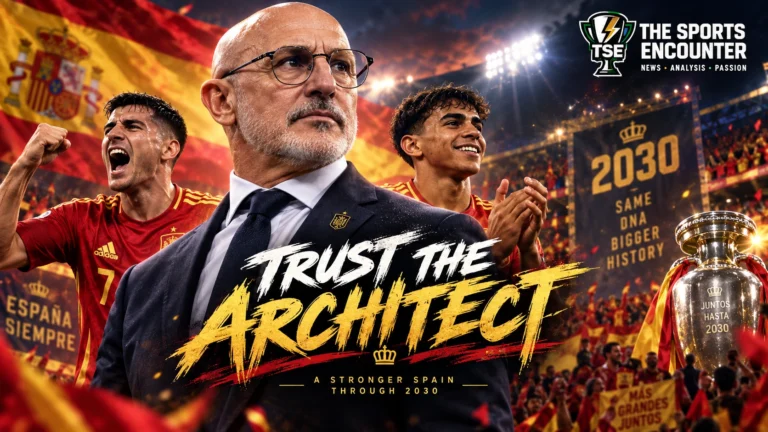
MADRID, Spain, September 15, 2026: Spain won the World Cup in July and could easily have treated the trophy as the natural end of one coaching cycle.
Instead, the Spanish federation appears ready to extend it by another four years.
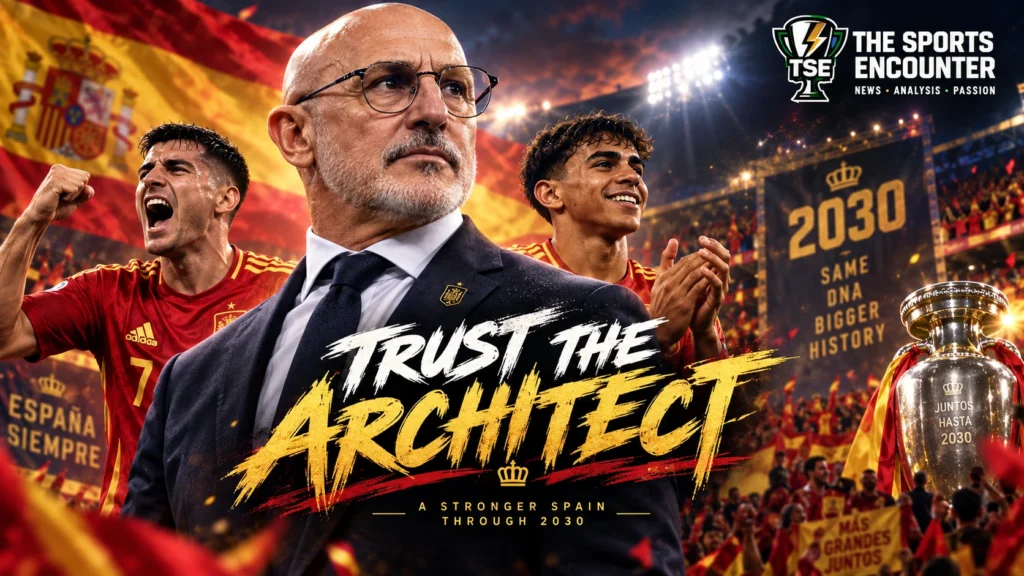
Luis de la Fuente has agreed to a new contract that would keep him in charge of the men’s national team through the 2030 FIFA World Cup, according to reports on Tuesday. His existing deal runs through Euro 2028, meaning the extension would carry Spain’s world champion coach into a tournament the country will partly host alongside Portugal and Morocco.
The Royal Spanish Football Federation had not formally announced the new agreement at the time of publication, so the precise contractual terms beyond its reported 2030 duration remain to be confirmed.
Story at a glance
How Long Is Luis de la Fuente’s New Spain Contract?
De la Fuente’s reported new agreement will keep him in charge through the 2030 FIFA World Cup.
Why Are Spain Extending Luis de la Fuente’s Contract Until 2030?
Results provide the simplest answer.
What Trophies Has Luis de la Fuente Won With Spain?
De la Fuente has won the UEFA Nations League, European Championship and FIFA World Cup as Spain’s senior coach.
How Did Luis de la Fuente Win the 2026 World Cup With Spain?
Spain’s title was built gradually rather than through one dominant formula.
What Is Luis de la Fuente’s Record as Spain Manager?
De la Fuente reached his 50th match as senior Spain coach in the World Cup final.
The broader decision, however, makes complete footballing sense.
De la Fuente took over the senior team in December 2022. He won the UEFA Nations League in 2023, transformed Spain into European champions in 2024 and then guided them to their second men’s World Cup title in 2026.
Spain defeated Argentina 1-0 after extra time in New Jersey, with Ferran Torres scoring in the 106th minute. Our World Cup final report showed how Spain controlled territory and possession for long stretches before finally breaking Argentina’s resistance.
The extension therefore looks less like a sentimental reward and more like an attempt to protect a football structure that is still evolving.
Lamine Yamal is 19.
Pau Cubarsí is still at the beginning of his international career.
Nico Williams, Pedri, Pedro Porro and several other core players should still be in or around their peak years when Spain host World Cup matches in 2030.
De la Fuente now has the chance to manage that transition rather than hand it to somebody else halfway through its development.
Luis de la Fuente Contract Extension: Key Facts
- Luis de la Fuente has reportedly agreed to remain Spain coach through the 2030 World Cup.
- His existing RFEF contract runs through Euro 2028.
- Spain won the 2026 FIFA World Cup under De la Fuente.
- Spain also won Euro 2024 and the 2023 UEFA Nations League under him.
- He became Spain senior coach in December 2022.
- Spain have lost only twice in 41 competitive matches under De la Fuente.
- He recorded 38 wins in his first 50 matches as senior coach.
- Spain will co-host the 2030 World Cup with Portugal and Morocco.
- Argentina, Paraguay and Uruguay will stage centenary celebration matches in 2030.
- Spain automatically qualify for the 2030 World Cup as a host nation.
How Long Is Luis de la Fuente’s New Spain Contract?
De la Fuente’s reported new agreement will keep him in charge through the 2030 FIFA World Cup.
His previous deal already covered the next European Championship in 2028.
The RFEF officially extended De la Fuente through Euro 2028 in January 2025 after his Nations League and European Championship successes.
The latest agreement would therefore add another major tournament cycle rather than completely rewriting his existing contract.
| De la Fuente Spain Timeline | Milestone |
|---|---|
| December 2022 | Appointed Spain senior coach |
| 2023 | Won UEFA Nations League |
| 2024 | Won UEFA European Championship |
| 2025 | Reached UEFA Nations League final |
| 2026 | Won FIFA World Cup |
| 2028 | Existing contract had covered Euro 2028 |
| 2030 | Reported new contract runs through World Cup |
Why Are Spain Extending Luis de la Fuente’s Contract Until 2030?
Results provide the simplest answer.
Spain have won three major trophies under De la Fuente and developed one of the strongest international teams in world soccer.
But the more important reason may be continuity.
International teams have far less training time than clubs. Changing coaches often means changing pressing structures, buildup patterns, squad hierarchies and selection principles with only a handful of international windows available before the next major tournament.
Spain currently have little reason to accept that disruption.
RFEF president Rafael Louzán publicly described De la Fuente earlier this year as “the perfect national coach for Spain.”
That endorsement came before the World Cup.
The case became considerably stronger after Spain lifted it.
De la Fuente’s pathway through the federation also matters. He spent years coaching Spain’s youth teams before receiving the senior job, creating an unusual degree of familiarity with the country’s development system.
The RFEF’s review of his coaching journey traces that progression from the Under-19 team through the Under-21s and eventually to the senior World Cup title.
What Trophies Has Luis de la Fuente Won With Spain?
De la Fuente has won the UEFA Nations League, European Championship and FIFA World Cup as Spain’s senior coach.
| Competition | Result |
|---|---|
| UEFA Nations League 2023 | Champions |
| UEFA Euro 2024 | Champions |
| UEFA Nations League 2025 | Runners-up |
| FIFA World Cup 2026 | Champions |
His international résumé also predates the senior team.
De la Fuente won the European Under-19 Championship in 2015 and the European Under-21 Championship in 2019, while also leading Spain to Olympic silver in Tokyo.
That history helps explain why he has managed generational change with relatively little institutional friction.
How Did Luis de la Fuente Win the 2026 World Cup With Spain?
Spain’s title was built gradually rather than through one dominant formula.
The opening stages exposed weaknesses.
The knockout rounds showed how quickly the team learned.
Spain eventually developed into a side capable of controlling possession without becoming dependent on possession.
That distinction became obvious when Spain beat Austria 3-0 in the first knockout round.
They then survived a much tighter contest against Portugal, where Mikel Merino’s stoppage-time winner ended Cristiano Ronaldo’s final World Cup.
By the semifinal, the transformation was complete.
Spain controlled France and won 2-0, with Mikel Oyarzabal and Pedro Porro scoring in a performance we described as Spain’s transition from controversy to total control.
The final demanded another adjustment.
Argentina defended deeper, Emiliano Martínez produced a record-breaking display and Spain needed extra time before Torres finally scored.
De la Fuente’s greatest World Cup achievement may therefore have been tactical adaptability rather than simply maintaining Spain’s traditional possession identity.
What Is Luis de la Fuente’s Record as Spain Manager?
De la Fuente reached his 50th match as senior Spain coach in the World Cup final.
He had won 38 of those first 50 matches, giving him one of the strongest winning records in national-team history.
Spain have also been defeated only twice in 41 competitive matches under him.
Those numbers become more significant when compared with the quality of the opposition Spain faced during the period.
They have beaten major European rivals, won knockout matches under different tactical conditions and converted a talented young squad into a team capable of surviving the psychological demands of a World Cup.
The final itself illustrated that maturity. Our Argentina vs Spain final preview focused heavily on Lionel Messi against Lamine Yamal, but the eventual match was decided as much by structure, patience and collective control as individual celebrity.
Why Is Luis de la Fuente So Important to Lamine Yamal’s Spain?
Yamal has become the most visible symbol of Spain’s new generation, but De la Fuente’s success lies partly in ensuring the national team does not become dependent on him.
At the World Cup, opponents increasingly doubled up against Yamal.
Spain responded by using the space those defensive adjustments created elsewhere.
Pedri could receive between the lines.
Nico Williams attacked from the opposite side.
Fullbacks advanced into different zones.
Rodri controlled the tempo behind them.
Our feature on how Yamal came of age during the 2026 World Cup examined how his influence extended beyond goals and assists.
That is important for 2030.
Yamal will be 23 during the tournament.
Spain’s next cycle will not be built around preserving a veteran star. It will be built around allowing an already elite young core to mature together.
How Important Is Rodri to Spain’s 2030 World Cup Plan?
De la Fuente provides continuity from the technical area.
Rodri provides it on the pitch.
The midfielder won the 2026 World Cup Golden Ball after controlling Spain’s defensive positioning, circulation and tempo throughout the tournament.
Our analysis of why Rodri was named the World Cup’s best player showed why his influence could not be reduced to goals or assists.
Rodri will be 34 in 2030.
That creates one of the central questions De la Fuente will have to solve during the next four years.
Spain need to maximize the remaining prime years of experienced leaders while developing successors without destabilizing the system.
That is another argument for coaching continuity.
A new manager in 2028 would need to understand those succession decisions almost immediately.
De la Fuente will have been managing them for years.
Will Luis de la Fuente Coach Spain at Euro 2028?
Yes, barring an unexpected change.
His existing agreement already runs through the European Championship in 2028.
That tournament therefore becomes the bridge between Spain’s 2026 triumph and the 2030 home World Cup.
It will also provide the clearest test of whether Spain’s current cycle can sustain success rather than peak once.
European champions often discover that defending a title is more difficult than winning it.
Opponents adapt.
Players age.
Young stars face different expectations.
Injuries alter combinations.
De la Fuente now has time to manage those changes rather than rebuild hurriedly before 2030.
Where Will the 2030 FIFA World Cup Be Held?
The 2030 World Cup will be primarily hosted by Spain, Portugal and Morocco.
Argentina, Paraguay and Uruguay will each stage one centenary celebration match before the competition continues across the three main host countries.
FIFA’s official 2030 World Cup guide confirms that Spain, Portugal and Morocco will host 101 matches, while the three South American countries stage the centenary games.
Spain will automatically qualify as a host.
That gives De la Fuente an unusual four-year runway.
He will not need to build the team around the pressure of a conventional World Cup qualifying campaign.
Instead, every Nations League match, friendly and Euro 2028 fixture can become part of the longer preparation for 2030.
Why Does the 2030 World Cup Matter More to Spain After Winning in 2026?
Hosting a World Cup already creates enormous pressure.
Hosting one as defending champion changes the scale entirely.
Spain will enter 2030 trying to protect the trophy in front of its own supporters while also dealing with expectations created by a generation that has already won Europe and the world.
Few national teams ever receive that combination of opportunity and pressure.
The connection between Spain’s past and present already became one of the strongest themes of the 2026 tournament.
Our feature From Johannesburg to New Jersey compared Andrés Iniesta’s 2010 winner with Ferran Torres’ extra-time goal 16 years later.
By 2030, Spain will have the opportunity to connect both of those championship generations with a third World Cup staged partly at home.
Which Spain Players Could Still Be Central at the 2030 World Cup?
The reason a four-year contract makes sense becomes clearer when looking at the squad’s age profile.
Yamal should be 23.
Cubarsí should be 23.
Pedri will still be around his prime years.
Nico Williams should remain within an elite attacking age range.
Pedro Porro will be 30.
Several members of the World Cup-winning group therefore have realistic chances of remaining important in 2030.
Porro’s emergence during the 2026 tournament illustrates how quickly the squad can still change. His decisive World Cup performances transformed his status, something we examined after Tottenham gave him a guard of honor following Spain’s title.
De la Fuente’s challenge is to keep creating those pathways rather than freezing the squad that won in New Jersey.
Is Luis de la Fuente Spain’s Most Successful Manager?
By trophy count with the senior national team, De la Fuente has already entered unprecedented territory.
He has won the Nations League, European Championship and World Cup.
Vicente del Bosque remains the manager most closely associated with Spain’s first golden era after winning the 2010 World Cup and Euro 2012, while Luis Aragonés began that cycle with Euro 2008.
De la Fuente’s legacy is developing differently.
He inherited a team that had failed to progress beyond the Round of 16 at the 2022 World Cup and gradually replaced frustration with adaptability.
Spain’s 2026 run demonstrated the result.
Our World Cup coverage followed that evolution from the early knockout rounds through France, Argentina and ultimately the title.
If De la Fuente remains through 2030, comparisons with Spain’s greatest coaches will become unavoidable.
What Does De la Fuente’s Extension Mean for Spain’s Next Four Years?
It gives Spain something international football rarely provides: time without immediate uncertainty over leadership.
There will still be difficult decisions.
Senior players will decline.
Younger players will demand places.
Tactical trends will change.
Opponents will study Spain’s pressing and buildup patterns more aggressively.
Winning the World Cup guarantees nothing about the next tournament.
But Spain will not spend the next two years wondering who should manage the transition.
That matters.
De la Fuente already knows the federation, the development structure, the senior dressing room and many of the players who could form the 2030 team.
He also knows what the current group looks like under maximum pressure.
The 2026 World Cup final proved that.
The next challenge is different.
Spain no longer need to prove they can become world champions.
They have to discover whether the same football project can remain ahead of the world for another four years.
For continuing Spain, World Cup and international soccer coverage, visit The Sports Encounter Soccer hub.
Continue the FIFA World Cup 2026 Story
Frequently Asked Questions About Luis de la Fuente’s Spain Contract
Has Luis de la Fuente extended his Spain contract?
De la Fuente has reportedly agreed to an extension that would keep him as Spain coach through the 2030 World Cup. The RFEF had not yet issued a formal announcement at the time of publication.
When does Luis de la Fuente’s current contract expire?
His existing RFEF contract runs through the end of Euro 2028.
Will Luis de la Fuente coach Spain at the 2030 World Cup?
The reported extension is designed to keep him in charge through the 2030 tournament, barring an earlier departure or contractual change.
How long has Luis de la Fuente been Spain manager?
He was appointed senior national-team coach in December 2022 and began his first full senior campaign in 2023.
How many trophies has Luis de la Fuente won with Spain?
He has won three major senior trophies: the 2023 UEFA Nations League, Euro 2024 and the 2026 FIFA World Cup.
Did Spain win the 2026 World Cup?
Yes. Spain defeated Argentina 1-0 after extra time in the final, with Ferran Torres scoring the winning goal in the 106th minute.
What is Luis de la Fuente’s record with Spain?
He recorded 38 victories in his first 50 matches as senior coach and Spain have lost only twice in 41 competitive matches under him.
Who did Spain beat in the 2026 World Cup final?
Spain defeated defending champions Argentina 1-0 after extra time in New York New Jersey.
Who will host the 2030 World Cup?
Spain, Portugal and Morocco will be the primary hosts. Argentina, Paraguay and Uruguay will each stage a centenary celebration match.
Does Spain automatically qualify for the 2030 World Cup?
Yes. Spain qualifies automatically as one of the official host nations.
How old will Luis de la Fuente be at the 2030 World Cup?
De la Fuente was born on June 21, 1961, so he will be 69 during the 2030 World Cup.
Will Luis de la Fuente coach Spain at Euro 2028?
Yes, under his existing contract. The reported new agreement would then extend his tenure from Euro 2028 through the 2030 World Cup.
Who are Spain’s key players for the 2030 World Cup cycle?
Lamine Yamal, Pau Cubarsí, Pedri, Nico Williams and other members of the 2026 champions are young enough to remain central, while De la Fuente will also need to manage the succession of senior leaders such as Rodri.
Spain
- Spain Trust the Architect: De la Fuente Set to Lead World Champions Into 2030
- Spain Crush Australia 89-66 to Join the Best Four in the FIBA World Cup 2026
- FIFA Hits Argentina with Heavy World Cup Sanctions as Paredes Gets 10-Game Ban
- Tottenham Teammates Give Pedro Porro Guard of Honour After Spain’s World Cup Triumph
- From Messi to Yamal, 19 years ago