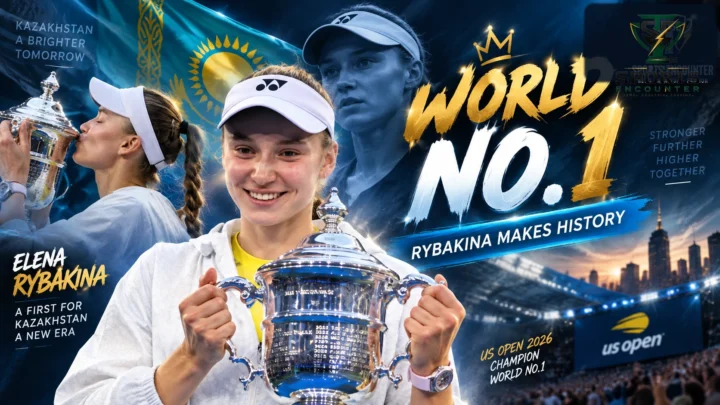

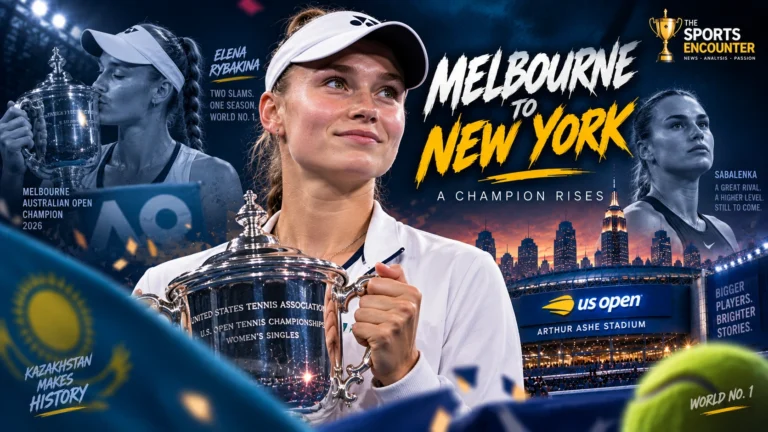
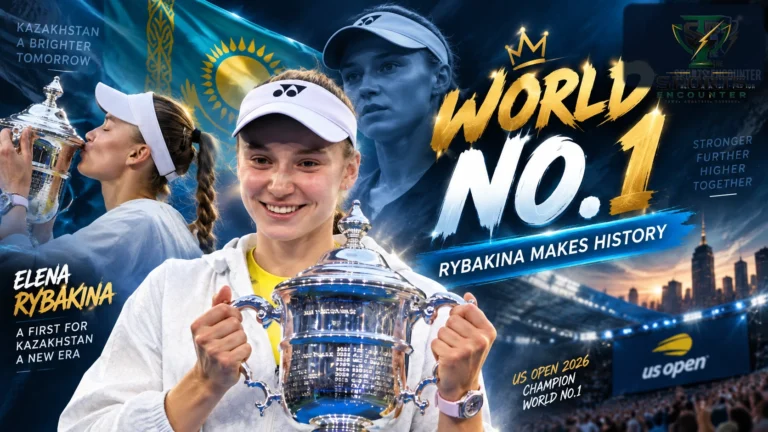
NEW YORK, United States, September 13, 2026: Elena Rybakina began the Grand Slam season by beating Aryna Sabalenka for the Australian Open title in Melbourne. She ended it by beating the same opponent in New York, lifting her first US Open trophy and completing the season as the incoming World No. 1.
Rybakina defeated Sabalenka 6-4, 5-7, 6-2 in the US Open women’s singles final at Arthur Ashe Stadium, winning her third Grand Slam title and her second major of 2026.
The score tells only part of the story.
Melbourne and New York became the two ends of a season in which Rybakina moved from perennial major contender to the leading player in women’s tennis. She defeated the same rival in both hard-court major finals, ended Sabalenka’s bid for a third consecutive US Open title and secured the ranking that had repeatedly remained just beyond her reach.
Story at a glance

Elena Rybakina’s 2026 Season at a Glance
The phrase “perfect year” needs some qualification. Rybakina did not go undefeated, and she did not win every tournament she entered.
Melbourne Changed the Direction of Rybakina’s Career
The Australian Open final in January already carried history between Rybakina and Sabalenka.
The Australian Open Was the Beginning, Not the Peak
Rybakina could easily have allowed Melbourne to become the defining result of her year.
Cincinnati Nearly Changed Everything
The climb was not smooth.
Osaka Was the First Sign That New York Could Become Something Bigger
Rybakina’s fourth-round meeting with Naomi Osaka carried more danger than the rankings suggested.
The updated WTA rankings on Monday will officially make Rybakina the 30th woman to reach No. 1 and the first player, male or female, representing Kazakhstan to lead the professional singles rankings.
Follow the wider season through The Sports Encounter’s tennis coverage and our dedicated US Open 2026 section.
Elena Rybakina’s 2026 Season at a Glance
| Milestone | Result |
|---|---|
| Australian Open | Champion, defeated Aryna Sabalenka 6-4, 4-6, 6-4 |
| Porsche Tennis Grand Prix | Champion |
| Indian Wells | Runner-up |
| Miami Open | Semifinalist |
| National Bank Open | Runner-up |
| US Open | Champion, defeated Sabalenka 6-4, 5-7, 6-2 |
| WTA Ranking | World No. 1 from September 14 |
The phrase “perfect year” needs some qualification. Rybakina did not go undefeated, and she did not win every tournament she entered.
What she did achieve was something much more meaningful than an artificial claim of perfection: she won both hard-court Grand Slams, defeated the same dominant rival in each final, rose to No. 1 and turned a season of pressure, injuries and missed ranking opportunities into the strongest year of her career.
Melbourne Changed the Direction of Rybakina’s Career
The Australian Open final in January already carried history between Rybakina and Sabalenka.
Three years earlier, Rybakina had taken the first set of the 2023 Melbourne final before Sabalenka recovered to win the championship.
The 2026 rematch followed another three-set path.
Rybakina won the opening set 6-4, lost the second 4-6 and then fell 0-3 behind in the deciding set.
This time she recovered.
She won six of the next seven games to take the final set 6-4 and claim her first Australian Open championship.
The official Australian Open report recorded 28 winners from Rybakina during the two-hour, 18-minute final.
It was her second Grand Slam title after Wimbledon in 2022, but the significance went beyond the trophy.
Melbourne removed one of the lingering questions around her career.
Rybakina had already demonstrated that she could win a major. What she had not yet demonstrated was that she could return to a major final, face the player who had beaten her on that stage before and solve the same problem under even greater expectations.
She did exactly that.
The Australian Open Was the Beginning, Not the Peak
Rybakina could easily have allowed Melbourne to become the defining result of her year.
Instead, it became the foundation.
The WTA’s official summary of her rise to No. 1 shows that she added the Porsche Tennis Grand Prix title in April, finished runner-up at Indian Wells and Toronto and reached the Miami semifinals.
Those results built the ranking base that eventually brought Sabalenka within reach.
They also showed why Rybakina’s season should be judged by consistency as much as championships.
Her serve remained one of the most destructive weapons on tour, and the WTA reported that she had already passed 350 aces for the season before the US Open ended.
The ranking race gradually stopped being theoretical.
Our analysis before the decisive week in New York showed how Rybakina entered the US Open controlling her own path to No. 1 while Sabalenka, Coco Gauff and Jessica Pegula increasingly depended on her results.
Cincinnati Nearly Changed Everything
The climb was not smooth.
Rybakina suffered an ankle problem in Cincinnati shortly before the US Open, raising legitimate questions about whether she would even be physically ready for New York.
The injury also cost her an earlier opportunity to take the No. 1 ranking.
She had needed to reach the Cincinnati final to overtake Sabalenka but retired in the quarterfinals instead.
That made the US Open both an opportunity and a physical test.
Rybakina arrived without certainty that her body would cooperate through seven matches.
By the end of the tournament, she had answered the question emphatically.
Osaka Was the First Sign That New York Could Become Something Bigger
Rybakina’s fourth-round meeting with Naomi Osaka carried more danger than the rankings suggested.
Osaka is a two-time US Open champion and remains one of the most dangerous hard-court players when her first-strike game is functioning.
Rybakina gave her almost no space.
She won 6-1, 6-4 to reach her first US Open quarterfinal.
TSE’s match analysis identified the ranking implication immediately: one more victory would guarantee Rybakina the No. 1 ranking regardless of what happened elsewhere in the women’s draw.
The tournament had shifted from a major-title campaign into something larger.
Zheng Qinwen Made Rybakina Earn No. 1
The ranking was secured in the quarterfinals, but not comfortably.
Qinwen Zheng took the first set 6-3 and threatened to delay Rybakina’s breakthrough again.
Rybakina responded with a 6-1 second set before winning the decider 6-4.
That victory sent her into her first US Open semifinal and mathematically guaranteed the World No. 1 position.
Our quarterfinal report traced the moment the ranking became official on court.
The WTA later confirmed that Rybakina will become the 30th woman in ranking history to reach No. 1 and the first player representing Kazakhstan, male or female, to occupy the top singles position.
The WTA’s official No. 1 announcement also placed the achievement within a remarkable 12-month run that began with her undefeated 2025 WTA Finals title.
For Rybakina, the milestone did not end the tournament.
She said as much after beating Zheng. Rankings were something she expected to appreciate more deeply later in her career. Her immediate concern was the next match.
Beating Gauff Showed How Much Rybakina Had Grown
Coco Gauff gave Rybakina one of her most difficult tests of the tournament.
The American took the opening set 6-3 in front of a strongly pro-Gauff Arthur Ashe Stadium crowd.
Rybakina adjusted rather than panicked.
She improved the quality of her first-serve points, applied greater return pressure and began controlling the center of the court more consistently.
The final two sets both went 6-4 in Rybakina’s favor.
TSE’s semifinal breakdown showed how her first-serve efficiency became increasingly decisive as the match progressed.
The win sent her into her first US Open final.
Waiting there was Sabalenka.
Melbourne Returned to New York
The symmetry was impossible to ignore.
Rybakina’s first Grand Slam final of 2026 had been against Sabalenka.
Her last Grand Slam final of 2026 would be against Sabalenka again.
There was even more at stake in New York.
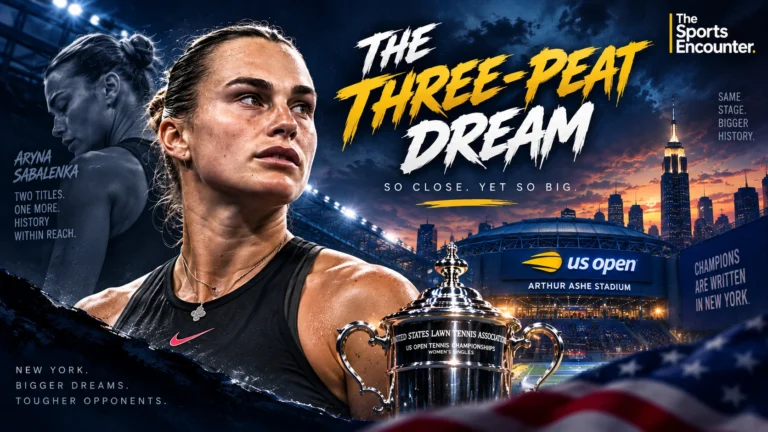
Sabalenka was the two-time defending champion and trying to become the first woman since Serena Williams to win three consecutive US Open titles.
Rybakina had already taken her No. 1 ranking.
Now she had an opportunity to take the championship as well.
Sabalenka had reached the final by overpowering Jessica Pegula, extending her New York winning streak and producing one of her strongest performances of the season.
The matchup therefore arrived with both players operating close to their best.
How Rybakina Beat Sabalenka in the US Open Final
The final statistics explain why Rybakina eventually separated herself.
| Final Statistic | Aryna Sabalenka | Elena Rybakina |
|---|---|---|
| Aces | 6 | 12 |
| First-serve percentage | 58.5% | 47.1% |
| First-serve points won | 69.4% | 85.4% |
| Second-serve points won | 50.0% | 58.7% |
| Break points converted | 1/3 | 3/12 |
| Return points won | 25 | 41 |
| Total points won | 90 | 103 |
The numbers contain one of the most revealing contradictions of the match.
Rybakina landed fewer than half of her first serves, yet she won 85.4% of the points when the first serve landed.
Sabalenka put more first serves into play but extracted far less value from them.
Rybakina also doubled Sabalenka’s ace count, created 12 break-point opportunities to Sabalenka’s three and won 16 more return points.
The official WTA match statistics show Rybakina finishing with a 103-90 advantage in total points.
The First Set: Rybakina Establishes the Pattern
Rybakina took the opener 6-4 by doing something that would matter throughout the match: making Sabalenka play under pressure on serve.
The defending champion could not consistently dominate the first ball after her serve, while Rybakina repeatedly found enough depth on return to prevent Sabalenka from dictating every exchange immediately.
That gave Rybakina the opening advantage.
The Second Set: Sabalenka Refuses to Surrender
Sabalenka’s response was worthy of a two-time defending champion.
She edged the second set 7-5 and forced the final into a decider.
For Rybakina, this was the moment when Melbourne could have become an uncomfortable memory.
The Australian Open final had also gone three sets.
Instead of allowing the match to become emotional, Rybakina returned to the patterns that had worked in the first set.
The Third Set: Rybakina Takes Control
The deciding set was the clearest phase of the final.
Rybakina won it 6-2.
Her serving efficiency improved when the match demanded it most, while Sabalenka struggled to find enough free points to prevent the pressure from accumulating.
Rybakina closed the tournament in the same manner that defined much of her season: controlled, aggressive and emotionally contained.
Rybakina Ended Sabalenka’s New York Reign
The victory did more than give Rybakina a trophy.
Sabalenka had won the US Open in 2024 and 2025 and arrived in the final attempting a rare three-peat.
Her winning streak in New York ended at 19 consecutive completed victories before the final.
Rybakina therefore stopped one of the tournament’s biggest historical pursuits while simultaneously completing her own rise.
The result also shifted the balance of one of the defining rivalries in women’s tennis.
Sabalenka still owns the overall head-to-head advantage, but Rybakina has now beaten her in the two Grand Slam finals they contested in 2026.
Australian Open and US Open in the Same Year Puts Rybakina in Rare Company
Winning both hard-court majors in the same season is uncommon.
Rybakina becomes only the third woman this century to win the Australian Open and US Open in the same calendar year, joining Angelique Kerber in 2016 and Sabalenka in 2024.
The achievement is especially revealing because Melbourne and New York require different forms of survival.
The Australian Open begins the major season when players are comparatively fresh.
The US Open arrives after eight months of travel, changing surfaces, accumulated physical strain and ranking pressure.
Rybakina won both.
That gives the season a structural symmetry that few champions ever achieve.
Three Grand Slams, Three Different Surfaces
Rybakina’s major résumé now contains:
- Wimbledon 2022 on grass;
- Australian Open 2026 on hard court;
- US Open 2026 on hard court.
Roland Garros is now the only major missing from a potential career Grand Slam.
That does not make a French Open title inevitable, but it changes the conversation around her career.
She is no longer best understood as a Wimbledon champion with an exceptional serve.
She is a three-time major champion, the winner of both hard-court Slams in the same year and the new World No. 1.
The No. 1 Ranking Is No Longer an Unfinished Story
Rybakina had approached the top ranking several times before New York.
Injuries, ranking mathematics and missed opportunities repeatedly kept it just beyond reach.
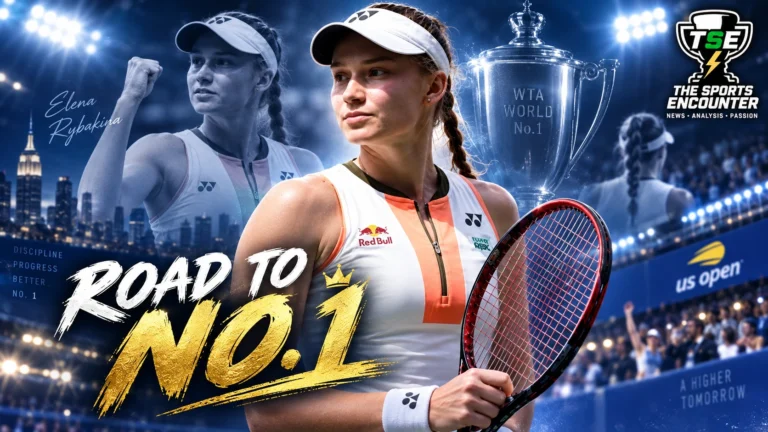
Our full examination of Rybakina’s road to No. 1 traced how those setbacks shaped the player who finally reached the summit in 2026.
The most important part of the achievement is that she did not back into the ranking through another player’s collapse.
She earned it while progressing through a Grand Slam draw and then won the tournament after the ranking was already secured.
That removes almost every qualification from the achievement.
She is not simply the new No. 1 by mathematics.
She is the Australian Open champion, US Open champion and the player who defeated the outgoing No. 1 in the season’s final major.
Why This Season Feels Different From Rybakina’s Earlier Success
Wimbledon 2022 announced Rybakina as a Grand Slam champion.
Her undefeated 2025 WTA Finals run suggested that another level was possible.
2026 confirmed it.
The difference is repetition.
A single major can arrive during two exceptional weeks.
Holding elite form across an entire season, recovering from physical setbacks, repeatedly reaching major finals and eventually taking the No. 1 ranking demands something broader.
Rybakina’s 2026 season contained all of those elements.
She did not dominate every tournament. She did something more sustainable: she remained close enough to the top often enough that, when the biggest opportunities arrived, she was ready to take them.
TSE Analysis: Melbourne and New York Show How Rybakina Changed
The most interesting comparison is not between the trophies.
It is between the player who won them.
In Melbourne, Rybakina had to recover from 0-3 in the third set against Sabalenka.
In New York, she had to recover after losing a tight second set against the same opponent.
Both matches tested the part of Rybakina’s game that statistics struggle to measure.
Her serve and groundstrokes have been elite for years. The change in 2026 has been the reliability of her decision-making when a major final stops moving in her direction.
She no longer appears to need everything to feel comfortable before she can control a match.
Zheng took a set from her. Gauff took a set from her. Sabalenka forced the final into a decider.
Rybakina solved all three situations.
That is why the US Open title completes the story rather than merely adding another trophy.
Melbourne proved she could revisit an old disappointment and change the ending.
New York proved she could sustain that growth across a season.
The No. 1 ranking confirms what the results were already saying.
Women’s tennis enters the final months of 2026 with Elena Rybakina at the top.
Continue the US Open 2026 Story
Frequently Asked Questions
Who won the 2026 US Open women’s singles title?
Elena Rybakina defeated Aryna Sabalenka 6-4, 5-7, 6-2 to win her first US Open championship.
How many Grand Slam titles has Elena Rybakina won?
Rybakina has won three major singles titles: Wimbledon 2022, the Australian Open 2026 and the US Open 2026.
Is Elena Rybakina the new World No. 1?
Yes. Rybakina secured the ranking by reaching the US Open semifinals and will officially become World No. 1 when the updated WTA rankings are released on September 14, 2026.
Who did Rybakina beat in the Australian Open final?
She defeated Aryna Sabalenka 6-4, 4-6, 6-4 in the 2026 Australian Open final.
Who did Rybakina beat in the US Open final?
Rybakina again defeated Sabalenka, this time 6-4, 5-7, 6-2.
Did Rybakina win both hard-court Grand Slams in 2026?
Yes. She won the Australian Open in Melbourne and the US Open in New York.
How many aces did Rybakina hit in the US Open final?
Rybakina hit 12 aces, twice Sabalenka’s total of six.
What percentage of first-serve points did Rybakina win in the final?
She won 85.4% of her first-serve points despite landing only 47.1% of her first serves.
Is Rybakina the first World No. 1 from Kazakhstan?
Yes. She becomes the first player, male or female, representing Kazakhstan to reach No. 1 in the professional singles rankings.
What Grand Slam does Rybakina still need for a career Grand Slam?
Roland Garros is the only major singles title missing from Rybakina’s collection.
US Open
- From Melbourne to New York: Rybakina Wins US Open and Completes Her Rise to World No. 1
- Grand Slam Player Council Opens New Phase in Tennis Pay and Power Battle
- What Was Aryna Sabalenka’s US Open Three-Peat Dream?
- Alexander Zverev Sweeps Aside Luciano Darderi in Straight Sets to Reach US Open 2026 Quarterfinals
- Karen Khachanov Beats Learner Tien in Five-Set US Open 2026 Thriller, Reaches Quarterfinals