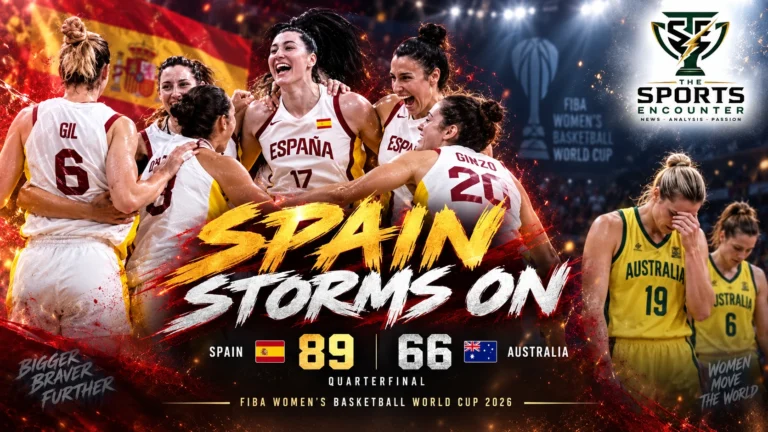
BERLIN, Germany, September 10, 2026: Spain turned a tied FIBA Women’s Basketball World Cup quarterfinal into a runaway win with one devastating first-quarter run, beating Australia 89-66 at Berlin Arena.
The score explains the margin. The player statistics explain how Spain created it.
For the wider tournament picture, see our FIBA Women’s World Cup group-stage roundup and the earlier Day 1 performance report.
Megan Gustafson led Spain with 16 points, Iyana Martin added 14 points, four assists and three steals, while Alicia Florez produced 10 points, five rebounds, four assists and two steals in an efficient all-around performance.
Story at a glance

Australia Entered the Quarterfinal Missing Three Key Players
Australia’s 23-point defeat also needs to be read in the context of a badly depleted rotation. The Opals entered the quarterfinal without captain Ezi Magbegor, Alanna Smith and Jade Melbourne.
Australia Women vs Spain Women Player Stats
This is where Spain’s advantage becomes clearer. Australia had productive individual performances, especially from Talbot, Wilson, Bibby and Stephanie Reid, but Spain received meaningful production from almost every part of its rotation.
Spain Won the Game With a 16-0 First-Quarter Run
The turning point came before the first quarter ended.
Spain’s Shooting Was Better Than the Final Three-Point Count Suggests
Australia actually made more three-pointers than Spain.
Megan Gustafson Gave Spain 16 Points in Just 16 Minutes
Gustafson’s line may be the most efficient scoring performance in the box score.
Australia received 13 points each from Alex Wilson and Chloe Bibby, while Steph Talbot delivered the strongest individual all-around line of the night with 11 points, 11 rebounds and seven assists.
The decisive sequence came much earlier. With the contest level at 15-15 in the first quarter, Spain produced the game’s biggest scoring run, 16 unanswered points, and established control that Australia never recovered.
Spain led 31-17 after the opening quarter and 58-37 at halftime. Australia won the third period, but the deficit was already too large.
The result sent Spain into the World Cup semifinals and ended Australia’s tournament one night after the Opals had survived a dramatic 82-80 knockout battle against Italy.
FIBA’s official Australia-Spain game page records the final score, quarter-by-quarter progression, shooting percentages, lead tracker and official box-score information.
Australia Entered the Quarterfinal Missing Three Key Players
Australia’s 23-point defeat also needs to be read in the context of a badly depleted rotation. The Opals entered the quarterfinal without captain Ezi Magbegor, Alanna Smith and Jade Melbourne.
Magbegor had torn the ACL in her right knee during Australia’s 82-80 win over Italy and was ruled out before the Spain game. Smith had been sidelined by a lower-leg injury suffered earlier in the tournament, while Melbourne was unavailable through illness.
| Australia player | Status vs Spain | Why it mattered |
|---|---|---|
| Ezi Magbegor | Did not play, torn right ACL | Australia lost its captain, interior defense, rebounding presence and one of its most reliable two-way players. |
| Alanna Smith | Did not play, lower-leg injury | Her absence further reduced Australia’s frontcourt size, defensive flexibility and experienced scoring. |
| Jade Melbourne | Did not play, illness | Australia lost another primary ball-handler and transition creator against Spain’s pressure. |
The absences did not erase Spain’s execution or explain the entire margin. Spain still created the decisive 16-0 run, shot 52.3 percent on two-point attempts and repeatedly punished Australia’s defense inside. But the missing personnel narrowed Sandy Brondello’s rotation and left Australia with fewer answers once Spain forced the game away from the Opals’ preferred shape.
The injury impact extended beyond the quarterfinal. Magbegor’s ACL tear also ended her 2026 WNBA season with the Seattle Storm, while Australia’s World Cup exit meant the Opals left Berlin with significant questions about recovery timelines, depth and the development of the younger players who had been pushed into larger roles.
Australia Women vs Spain Women Player Stats
This is where Spain’s advantage becomes clearer. Australia had productive individual performances, especially from Talbot, Wilson, Bibby and Stephanie Reid, but Spain received meaningful production from almost every part of its rotation.
Spain Player Stats vs Australia
| Player | MIN | PTS | REB | AST | STL | BLK | FG |
|---|---|---|---|---|---|---|---|
| Megan Gustafson | 16 | 16 | 2 | 0 | 1 | 0 | 7/11 |
| Iyana Martin | 24 | 14 | 2 | 4 | 3 | 0 | 5/11 |
| Maria Conde | 24 | 10 | 7 | 2 | 3 | 0 | 3/9 |
| Alicia Florez | 19 | 10 | 5 | 4 | 2 | 0 | 4/5 |
| Awa Fam | 29 | 9 | 8 | 4 | 0 | 1 | 2/8 |
| Raquel Carrera | 20 | 9 | 5 | 1 | 0 | 1 | 3/7 |
| Maite Cazorla | 26 | 7 | 2 | 5 | 1 | 0 | 2/6 |
Seven Spanish players scored at least seven points. Gustafson led the scoring despite playing only 16 minutes, Martin combined perimeter shooting with defensive pressure, and Spain received playmaking from several positions.
Florez was particularly efficient, making four of five field-goal attempts while contributing across scoring, rebounding, passing and defense.
Australia Player Stats vs Spain
| Player | MIN | PTS | REB | AST | STL | BLK | FG |
|---|---|---|---|---|---|---|---|
| Alex Wilson | 22 | 13 | 0 | 1 | 2 | 1 | 4/10 |
| Chloe Bibby | 23 | 13 | 3 | 2 | 1 | 0 | 5/8 |
| Steph Talbot | 32 | 11 | 11 | 7 | 2 | 0 | 5/9 |
| Stephanie Reid | 25 | 11 | 2 | 4 | 1 | 0 | 4/6 |
| Isobel Borlase | 29 | 8 | 8 | 2 | 1 | 0 | 2/12 |
Talbot’s double-double was Australia’s best complete individual performance. Her 11 rebounds and seven assists helped the Opals remain competitive in stretches even as Spain controlled the scoreboard.
Borlase faced a much more difficult night after scoring 30 points in Australia’s win over Italy. Spain held her to eight points on 2-of-12 shooting and forced her into five turnovers.
That change was significant. Australia had relied heavily on Borlase to survive the previous elimination game. Spain removed that source of momentum almost completely.
Spain Won the Game With a 16-0 First-Quarter Run
The turning point came before the first quarter ended.
Australia had stayed with Spain long enough to reach 15-15. From there, the game changed with remarkable speed.
Spain scored 16 unanswered points.
The run created separation, but its larger effect was tactical. Australia suddenly had to play a completely different game.
Instead of managing a close knockout contest possession by possession, the Opals had to accelerate. That increased the pressure on ball handling and shot selection while allowing Spain to play from ahead.
The first quarter finished 31-17.
Spain then scored another 27 points in the second period and entered halftime with a 58-37 advantage.
The quarterfinal was not mathematically over, but Australia now needed an exceptional second half against a team that had already controlled almost every important phase.
Spain’s Shooting Was Better Than the Final Three-Point Count Suggests
Australia actually made more three-pointers than Spain.
The Opals converted 11 of 29 attempts from beyond the arc. Spain made eight of 21.
The percentages were almost identical: 37.9 percent for Australia and 38.1 percent for Spain.
That makes the 23-point margin especially revealing.
Spain did not win because of a simple three-point barrage.
The decisive difference came inside the arc and at the free-throw line.
Spain converted 23 of 44 two-point attempts for 52.3 percent. Australia made 12 of 29 for 41.4 percent.
That gave Spain 22 more points from two-point field goals.
Spain also made 19 free throws compared with Australia’s nine.
Australia’s three-point advantage therefore could not compensate for Spain’s superior efficiency closer to the basket and greater production at the line.
Megan Gustafson Gave Spain 16 Points in Just 16 Minutes
Gustafson’s line may be the most efficient scoring performance in the box score.
She scored a team-high 16 points while playing only 16 minutes.
She made seven of 11 field-goal attempts and both of her free throws.
Her scoring mattered because Spain did not need to keep its primary creators on the floor for enormous minutes to maintain production.
Fresh players continued adding points, preventing Australia from finding a defensive rotation that could consistently reduce Spain’s output.
That depth had already been visible earlier in the tournament. Spain recovered from its upset loss to Mali and regained control of its group, a turnaround covered in The Sports Encounter’s analysis of Spain’s World Cup recovery.
Iyana Martin Kept Spain Moving at Both Ends
Martin entered the quarterfinal as one of Spain’s most influential players and produced another balanced performance.
She finished with 14 points, four assists and three steals while making three of seven three-point attempts.
Her value extended beyond the scoring total.
Spain repeatedly moved Australia into defensive rotations before attacking the opening that followed. Martin’s ability to score, pass and pressure the ball gave the offense another layer.
She also entered the tournament as one of Spain’s emerging young stars, and her production in Berlin became one of the stories of the competition.
Alicia Florez Turned 19 Minutes Into an All-Around Impact
Florez scored only six fewer points than Spain’s leading scorer, but her stat line reached well beyond points.
In 19 minutes she recorded:
- 10 points;
- five rebounds;
- four assists;
- two steals;
- four field goals from five attempts.
That combination produced one of Spain’s strongest efficiency performances of the quarterfinal.
It also explains why Australia’s defensive job became so difficult. Even when one Spanish player was contained, another contributor could attack the same possession from a different position or role.
Steph Talbot Produced a Double-Double in Defeat
Australia’s best individual performance belonged to Talbot.
She scored 11 points, grabbed 11 rebounds, distributed seven assists and added two steals.
FIBA listed Talbot with an efficiency rating of 23, the highest individual efficiency figure displayed for Australia on the official game page.
Her performance also reflected Australia’s refusal to disappear after falling 21 points behind by halftime.
The Opals won the third quarter 14-12.
Talbot continued rebounding, facilitating and creating enough structure for Australia to compete through the second half.
The problem was scale. Australia needed far more than a respectable third quarter. It needed to erase a deficit built during Spain’s 58-point first half.
Alex Wilson and Chloe Bibby Led Australia With 13 Points Each
Wilson and Bibby shared Australia’s scoring lead.
Bibby was particularly efficient, making five of eight field-goal attempts for 13 points.
Wilson also scored 13 and made four three-pointers, giving Australia valuable perimeter production.
Stephanie Reid added another 11 points, including three three-pointers.
Those numbers reinforce an unusual feature of the game: Australia received enough three-point scoring to remain dangerous, but Spain’s advantage in other areas was too large.
Isobel Borlase Could Not Repeat Her 30-Point Italy Performance
Borlase entered the quarterfinal after one of the performances of the World Cup.
She had scored 30 points as Australia survived Italy 82-80 in the qualification round, a game that required the Opals to withstand a huge Italian comeback.
The Australia-Italy thriller showed how dangerous Borlase could become when she attacked downhill and consistently reached the free-throw line.
Spain changed that equation.
Borlase finished with eight points, eight rebounds and two assists but made only two of 12 field-goal attempts.
Her five turnovers were equally damaging.
When Australia’s most explosive scorer from the previous round lost efficiency, the Opals needed the rest of the lineup to compensate. Wilson, Bibby, Talbot and Reid produced points, but not enough to match Spain’s deeper collective output.
Australia Won the Third Quarter but Barely Changed the Game
The third quarter was Australia’s best period.
The Opals held Spain to 12 points and scored 14 themselves.
Under normal circumstances, winning a World Cup quarter by two points against Spain would represent useful progress.
Here, it reduced a 21-point halftime deficit to 19.
That tells us how expensive the first half had become.
Spain did not need another explosive period. They needed to avoid the kind of collapse Australia had nearly benefited from against Italy.
They did exactly that.
Spain won the fourth quarter 19-15 and closed the game without allowing the score to create any late tension.
Australia’s World Cup History Against Spain Changed in Berlin
Australia entered the quarterfinal with a strong historical record against Spain at the Women’s World Cup.
The Opals had won their previous World Cup meetings, including the 2018 semifinal.
That history offered little protection once Spain established control in Berlin.
This was a different Spanish generation with a younger group playing significant roles alongside experienced internationals.
The wider tournament had already demonstrated how quickly established hierarchies were moving. Germany reached the semifinals by beating Belgium 93-74, a result examined in The Sports Encounter’s report on Germany’s historic quarterfinal win.
France also emerged as one of the tournament’s most dangerous shooting teams after setting a World Cup record with 22 three-pointers, covered in our analysis of France’s record perimeter performance.
Why Spain’s 89-66 Win Was More Than a Hot Shooting Night
The easiest explanation would be that Spain got hot early and Australia never recovered.
The box score shows something deeper.
Spain shot almost exactly the same percentage as Australia from three-point range.
The advantage came from the shape of the offense.
Spain finished much more efficiently from two-point range, reached the free-throw line more often, spread scoring across the rotation and repeatedly created useful contributions from players who were not carrying the entire offensive burden.
Australia’s best all-around player finished with a double-double.
Four Opals reached double figures.
Australia still lost by 23.
That is the clearest indication that Spain’s advantage was structural rather than dependent on one scorer.
What Happened to Spain After Beating Australia?
Spain’s World Cup did not end with the quarterfinal.
They advanced to face the United States in the semifinals, where the Americans won 76-66.
Spain then responded in the third-place game by beating Germany 81-58 to finish the 2026 FIBA Women’s Basketball World Cup with the bronze medal.
The complete knockout results can be followed through the official FIBA Women’s Basketball World Cup 2026 hub.
The tournament ultimately ended with the United States beating France 97-79 in the final. The Sports Encounter covered the championship game in our USA-France World Cup final report.
What the Australia vs Spain Player Stats Tell Us
The key numbers point in the same direction as the eye test.
Spain had more ways to score.
Gustafson supplied efficient interior production. Martin mixed scoring with passing and steals. Florez contributed in four statistical categories. Fam rebounded and created for others. Carrera and Cazorla added another layer of rotation depth.
Australia had strong individual lines too.
Talbot’s 11-point, 11-rebound, seven-assist performance deserves recognition. Wilson and Bibby led the team with 13 points each. Reid scored 11.
The difference was that Australia’s strongest individual efforts came while chasing a game Spain had already reshaped.
The 16-0 first-quarter run created the gap.
Spain’s balance made sure it stayed there.
TSE Analysis: Spain Made Australia’s Strengths Irrelevant
Australia’s three-point shooting was good enough to win many knockout games.
Eleven made threes at 37.9 percent is not the profile of a team that simply could not shoot.
The Opals also received scoring from several players and an exceptional all-around line from Talbot.
Spain won anyway because the categories Australia controlled were not valuable enough to outweigh everything Spain controlled elsewhere.
Spain scored far more efficiently from two-point range.
They earned a 10-point advantage at the free-throw line.
They built a 24-point maximum lead.
They led for 37 minutes and 24 seconds of a 40-minute game.
Most importantly, they forced Australia to chase before the match had developed into the kind of tense possession-by-possession quarterfinal the Opals would have preferred.
Australia had survived Italy through resilience.
Spain never gave resilience enough time to become a winning strategy.
For more tournament context, The Sports Encounter’s opening-day World Cup review tracked the early shape of the competition, while our analysis of Italy’s 55-52 battle with the United States showed how different knockout-level games can become when defenses control the pace.
Continue the NBA Story
 NBANBA Signs CFTC Prediction Market Pact, Brings Kalshi and Polymarket Inside Integrity Crackdown
 NBADončić’s 52 Rescue the Lakers as Thunder’s Perfect Start Comes at an Injury Cost Dončić’s 52 Rescue Lakers as Thunder Lose Three Players
 NBADale Brown Dies at 90: The Coach Who Built LSU Basketball, Defied March Madness Odds, and Changed Shaquille O’Neal’s Life
Frequently Asked Questions
What was the Australia vs Spain score at the 2026 FIBA Women’s World Cup?
Spain defeated Australia 89-66 in the quarterfinals at Berlin Arena on September 10, 2026.
Who scored the most points in Australia vs Spain?
Megan Gustafson led Spain and the game with 16 points in only 16 minutes. Alex Wilson and Chloe Bibby led Australia with 13 points each.
What were Steph Talbot’s stats against Spain?
Steph Talbot finished with 11 points, 11 rebounds, seven assists and two steals in 32 minutes. She made five of nine field-goal attempts.
What were Iyana Martin’s stats against Australia?
Iyana Martin recorded 14 points, four assists, two rebounds and three steals. She made five of 11 field-goal attempts, including three three-pointers.
What were Alicia Florez’s stats against Australia?
Alicia Florez scored 10 points with five rebounds, four assists and two steals while shooting four of five from the field.
What were Isobel Borlase’s stats against Spain?
Isobel Borlase finished with eight points, eight rebounds, two assists and one steal. She shot two of 12 from the field after scoring 30 points against Italy in the previous round.
What was the biggest run in Australia vs Spain?
Spain produced the game’s biggest scoring run at 16-0. That first-quarter surge helped turn a close contest into a 31-17 Spanish lead after 10 minutes.
How well did Australia shoot from three against Spain?
Australia made 11 of 29 three-point attempts for 37.9 percent. Spain made eight of 21 for 38.1 percent.
Did Australia get eliminated by Spain?
Yes. The 89-66 quarterfinal defeat ended Australia’s 2026 Women’s World Cup campaign, while Spain advanced to the semifinals.
Where did Spain finish at the 2026 Women’s World Cup?
Spain finished third. After losing 76-66 to the United States in the semifinals, Spain beat Germany 81-58 in the bronze-medal game.
For continuing basketball coverage, results and analysis, visit The Sports Encounter’s basketball coverage. FIBA’s official quarterfinal game center also provides the governing body’s record of the knockout round.
World Cup 2026
- World Cup 2026 Halo Is Sticking: Premier League Viewership Jumps 20% Among Young Americans
- FIBA Women’s World Cup 2026 Semifinal Results: France and USA Reach Final
- Germany 94-56 South Korea: FIBA Women’s World Cup 2026 Result and Stats
- FIBA Women’s World Cup 2026 Results: Mali Upsets Spain as Australia, Belgium Stay Perfect
- Fans Join Global Revolt Against Infantino as FIFA Presidency Faces Unprecedented Pressure