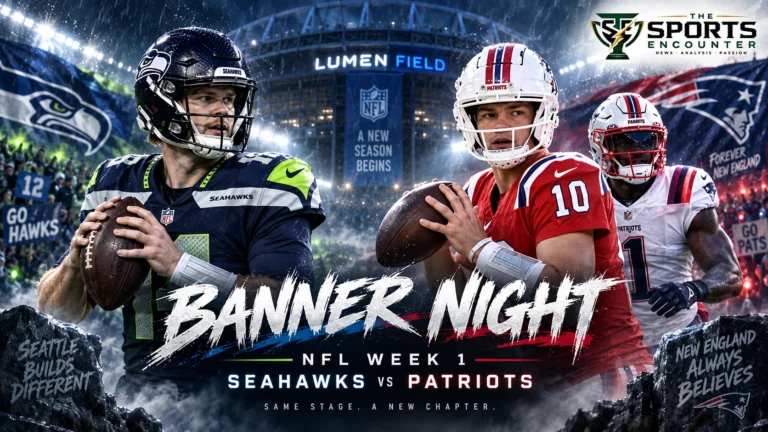
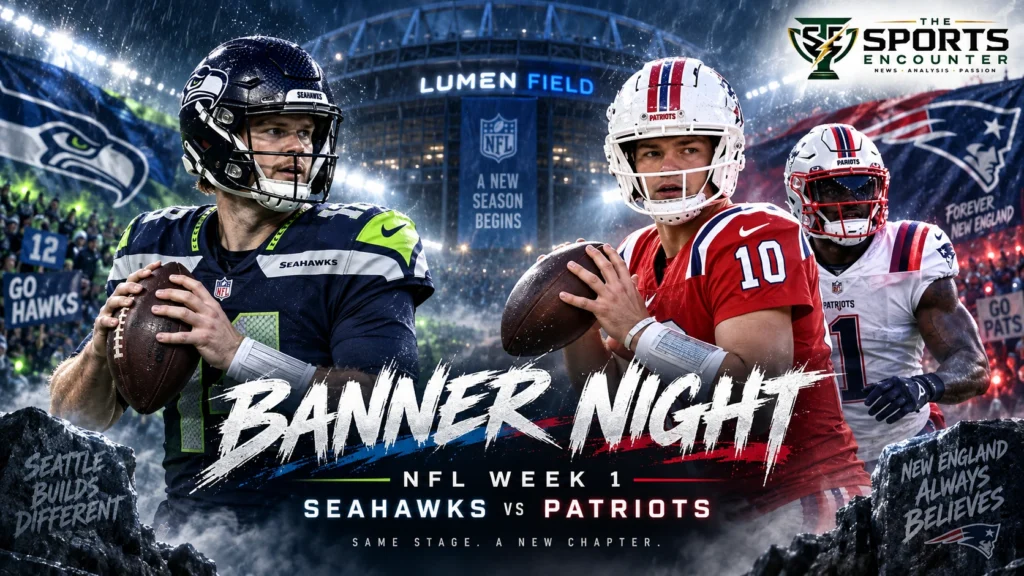
SEATTLE, United States, September 9, 2026: Seven months ago, the Seattle Seahawks left Santa Clara with the Lombardi Trophy after reducing one of the NFL’s most explosive young quarterbacks to a night of frustration. On Wednesday, the New England Patriots get the earliest possible chance to find out whether the lessons from Super Bowl LX actually changed them.
The 2026 NFL season opens at Lumen Field with the defending champions hosting the team they beat 29-13 in February, creating the first Week 1 Super Bowl rematch since Denver and Carolina opened the 2016 season after meeting in Super Bowl 50.
That alone would make Seahawks-Patriots one of the most compelling openers in years.
The seven months since the Super Bowl have made it considerably more interesting.
Story at a glance
Seahawks vs Patriots: Week 1 Match Details
The Patriots’ official Week 1 preview confirms that this will also be New England’s first game ever played on a Wednesday. Seattle’s official game center lists kickoff at 5:20 p.m. Pacific time at Lumen Field.
What Changed Since Super Bowl LX?
The easiest way to preview this game is to remember February.
Seattle’s Biggest Question: Can a Championship Offense Change Without Losing Its Balance?
The Seahawks return many of the players who made them champions, but one of their most important offseason changes happened on the sideline.
Sam Darnold’s Encore Is One of the Season’s Biggest Tests
Darnold enters 2026 in a position few would have predicted two years ago.
The Running Back Room Is Where Seattle Has Changed Most
The absence of Super Bowl MVP Kenneth Walker III changes more than the name beside “RB1.”
Seattle still has Sam Darnold, Jaxon Smith-Njigba, Devon Witherspoon and the defensive foundation that carried Mike Macdonald’s team to the championship, but the offense has changed coordinators and the backfield no longer looks the same. New England still has Drake Maye and Mike Vrabel, yet A.J. Brown now gives the Patriots the kind of proven perimeter weapon they lacked when Seattle compressed their passing game in February.
Both teams are also entering the season with injuries, altered depth charts and much higher expectations than they carried a year ago.
That makes Wednesday night more than a rematch.
It is the first meaningful test of whether Seattle can evolve quickly enough to defend a championship and whether New England has actually closed the gap that became obvious on the biggest stage.
The Sports Encounter examined that broader landscape in our 2026 NFL season curtain-raiser, where the central question was already clear: the Seahawks and Patriots earned the right to open the season because they were the last two teams standing, but neither can assume the league will remain where they left it.
Seahawks vs Patriots: Week 1 Match Details
| Detail | Information |
|---|---|
| Competition | 2026 NFL Regular Season |
| Week | Week 1 |
| Match | New England Patriots at Seattle Seahawks |
| Venue | Lumen Field, Seattle |
| Date | Wednesday, September 9, 2026 |
| Kickoff | 5:20 p.m. PT / 8:20 p.m. ET |
| Seattle 2025 record | Super Bowl LX champions |
| New England 2025 record | AFC champions |
| Super Bowl LX result | Seattle 29-13 New England |
The Patriots’ official Week 1 preview confirms that this will also be New England’s first game ever played on a Wednesday. Seattle’s official game center lists kickoff at 5:20 p.m. Pacific time at Lumen Field.
What Changed Since Super Bowl LX?
The easiest way to preview this game is to remember February.
The better way is to understand what no longer looks the same.
Seattle won the Super Bowl by controlling New England’s offensive rhythm, limiting explosive opportunities and forcing Drake Maye to operate against a defense that rarely gave him comfortable answers.
The Seahawks did not need Sam Darnold to turn the game into a quarterback shootout. Their defense dictated the terms, Kenneth Walker III supplied balance on offense, and Seattle kept New England from playing the kind of aggressive, vertical game that had powered the Patriots through the AFC.
New England spent the offseason trying to make that problem harder to recreate.
Seattle spent it trying to preserve the structure that created the problem in the first place.
That difference defines the rematch.
Seattle’s Biggest Question: Can a Championship Offense Change Without Losing Its Balance?
The Seahawks return many of the players who made them champions, but one of their most important offseason changes happened on the sideline.
Brian Fleury replaces Klint Kubiak as offensive coordinator after Kubiak left to become head coach of the Las Vegas Raiders.
Fleury now inherits an offense that does not need reinvention so much as intelligent evolution.
Seattle already knows what worked last season.
Sam Darnold was at his best when the offense kept him out of obvious passing situations, allowed play-action to create cleaner reads and used the running game to control down and distance. That structure limited the amount of football Darnold had to manufacture outside the design of the offense.
The new coordinator’s challenge is preserving those advantages without becoming predictable.
Seattle’s preseason offered glimpses of heavier personnel, multiple tight ends and an offense still interested in using play-action as a central tool. The full version will not be visible until Wednesday night.
That creates a fascinating Week 1 dynamic because New England has spent months preparing for what Seattle used to be while knowing that Fleury has had an entire offseason to change the answers.
Sam Darnold’s Encore Is One of the Season’s Biggest Tests
Darnold enters 2026 in a position few would have predicted two years ago.
He is now a Super Bowl-winning quarterback defending a championship rather than a veteran trying to prove he belongs as a long-term starter.
That changes the standard.
Seattle no longer needs evidence that Darnold can operate a winning offense.
It needs evidence that he can sustain one after defensive coordinators have spent an offseason studying exactly how the Seahawks protected his strengths and minimized his weaknesses.
The Sports Encounter’s NFL 2026 opening analysis identified Darnold as one of the central reasons Seattle remains firmly in the title conversation.
Wednesday will offer the first indication of whether the quarterback-coordinator transition changes his comfort level.
New England is an especially difficult opponent for that test because the Patriots can put elite coverage players behind a physical front and force quarterbacks to keep making correct decisions after their first read disappears.
The Running Back Room Is Where Seattle Has Changed Most
The absence of Super Bowl MVP Kenneth Walker III changes more than the name beside “RB1.”
Walker was part of the mechanism that allowed Seattle to dictate game state last season.
When the Seahawks ran effectively, Darnold did not have to live in third-and-long. Play-action remained credible. Seattle’s defense received longer rest periods. Opponents had fewer possessions in which to attack Macdonald’s structure.
That balance now has to be recreated differently.
Zach Charbonnet has dealt with a knee issue, increasing the importance of first-round rookie Jadarian Price and offseason addition Emanuel Wilson.
Price may become one of the most important new faces on the defending champions precisely because Seattle cannot afford for the running game to become an afterthought.
If New England forces Darnold into 40-plus conventional dropbacks, the Patriots will have moved the game toward a much more favorable environment.
Jaxon Smith-Njigba Is Now the Offensive Constant
Every championship offense needs at least one player who can survive changes around him.
For Seattle, that player increasingly looks like Jaxon Smith-Njigba.
His ability to win from different alignments gives Fleury freedom in how he builds the passing game. Smith-Njigba can work underneath, move into the slot, attack intermediate windows and create yards after the catch without requiring Seattle to structure the entire offense around one route tree.
That versatility matters even more after injuries reduced some of the receiving depth.
Jake Bobo’s knee injury created a quieter but meaningful problem for Seattle because Bobo contributed receiving depth, blocking and special-teams value. The Sports Encounter examined why Bobo’s injury affects more than the receiver rotation.
Against New England, the question is whether Seattle can create enough complementary offense around Smith-Njigba to stop Christian Gonzalez and the Patriots’ secondary from narrowing their attention.
New England’s Biggest Change Has a Name: A.J. Brown
If New England could have designed one offseason addition specifically to address what went wrong in the Super Bowl, a receiver like A.J. Brown would have been near the top of the list.
The Patriots acquired Brown from Philadelphia in June, giving Drake Maye a proven outside target who can win against physical coverage, threaten vertically and create offense after the catch.
That changes how Seattle can defend New England.
In February, the Seahawks could squeeze throwing windows knowing the Patriots lacked a receiver who consistently forced coverage to tilt outside.
Brown changes that geometry.
If Seattle leaves him isolated, Maye has a receiver capable of winning the matchup.
If the Seahawks roll additional coverage toward Brown, space opens elsewhere.
The strategic value is larger than his individual stat line.
New England does not need Brown to catch 12 passes for the trade to affect the game.
It needs him to force Seattle to defend more of the field than it had to defend in February.
Drake Maye Is No Longer Being Judged as a Young Quarterback
Maye’s third NFL season begins with a very different kind of pressure.
The Patriots are no longer asking whether they found their franchise quarterback.
They are asking whether that quarterback can finish a championship run.
Maye helped carry New England to the Super Bowl last season and established himself as one of the league’s most dangerous young passers. His combination of arm talent, movement and willingness to attack downfield makes him difficult to defend when the offense stays on schedule.
Seattle disrupted exactly that rhythm in February.
Maye was forced to hold the ball longer, reset after pressure and throw into coverage structures that rarely gave him the explosive windows he wanted.
Wednesday is therefore a useful test of development.
Has Maye improved against post-snap rotation?
Can he identify pressure earlier?
Can he take the five-yard answer rather than waiting for the 25-yard one?
Those questions matter more than whether he produces a spectacular highlight throw.
Christian Gonzalez vs Seattle’s Receivers Could Decide Entire Possessions
Christian Gonzalez enters the season as the highest-paid cornerback in football after New England reset the market with his new extension.
The timing could hardly be more relevant.
Only weeks earlier, Seattle had given Devon Witherspoon a record-setting deal of his own. Gonzalez then moved the positional benchmark again.
The Sports Encounter examined that extraordinary market escalation in our ranking of the highest-paid cornerbacks in NFL history.
Now Gonzalez and Witherspoon enter Week 1 on opposite sides of a game where coverage may determine everything.
Gonzalez gives New England the ability to play more aggressively elsewhere because he can survive difficult assignments without constant help.
If he can reduce Smith-Njigba’s impact, Seattle may be forced to ask secondary receivers and tight ends to consistently win against a deep Patriots defense.
Devon Witherspoon Remains the Heart of Seattle’s Defensive Identity
Seattle’s defense begins with structure, but Witherspoon gives that structure personality.
He can play outside.
He can move inside.
He can blitz.
He can tackle in space.
Most importantly, he allows Macdonald to disguise what coverage is actually coming because the defense does not have to declare his role before the snap.
Witherspoon recorded a sack in Super Bowl LX and spent much of the offseason negotiating the long-term contract that eventually made him the league’s highest-paid corner before Gonzalez surpassed him.
Our August analysis of Witherspoon’s contract situation explained why Seattle viewed him as part of the championship core rather than simply another talented defensive back.
The rematch may demand every part of that versatility because A.J. Brown changes the way New England can distribute targets.
The Battle Seattle Wants: Its Front Four Against Drake Maye
Seattle’s ideal defensive game does not require constant blitzing.
The Seahawks want the front to create pressure while the secondary retains enough bodies to close throwing lanes.
Leonard Williams remains central to that plan, and Seattle reinforced its commitment by giving the veteran defensive lineman a multi-year extension before Week 1.
Derick Hall also signed an extension during the offseason, while Dante Fowler Jr. joined the edge rotation.
That gives Macdonald enough pass-rush options to keep bodies fresh without constantly compromising coverage.
If Seattle can pressure Maye with four rushers, New England’s biggest offensive improvement may become less relevant.
A.J. Brown cannot exploit favorable coverage if Maye does not have enough time to let routes develop.
The Battle New England Wants: Make Seattle’s Offensive Line Prove It Again
The Patriots’ defensive route to victory is similarly straightforward.
They need to make the Seahawks’ offensive line work for every clean pocket.
Seattle’s offense becomes substantially easier to defend when early-down runs are stopped and Darnold has to operate from predictable passing situations.
Christian Barmore’s expected availability therefore matters.
He missed an early practice because of a knee issue but returned to full participation and appears positioned to play.
Interior pressure is one of the fastest ways to disturb Darnold because it removes the step-up space quarterbacks use when edge rushers travel around the pocket.
If New England can create that pressure without sacrificing coverage, the Patriots can force Seattle toward the exact kind of offensive game the Seahawks would prefer to avoid.
TreVeyon Henderson’s Absence Changes New England’s Offensive Balance
New England will not enter the opener with a completely healthy backfield.
TreVeyon Henderson has been dealing with an ankle injury and has been ruled out, placing greater responsibility on Rhamondre Stevenson.
That matters because the Patriots need some kind of rushing threat to keep Seattle from treating every meaningful down as a Maye passing situation.
The broader point is similar to Seattle’s own backfield question.
Both offenses are more dangerous when the quarterback does not have to carry every possession.
The Sports Encounter has tracked New England’s depth concerns throughout August, including the offensive-line issues that forced the Patriots to add veteran Greg Van Roten. Our preseason injury and signing roundup examined how quickly those problems were beginning to affect Week 1 planning.
New England’s Interior Offensive Line Is Another Pressure Point
Ben Brown has been ruled out with a knee injury, creating another early test for the Patriots.
Jared Wilson is expected to take on the center responsibility in his absence.
That creates a difficult assignment immediately.
Playing center in Seattle means handling crowd noise, protection calls and one of the league’s most sophisticated pressure structures at the same time.
The challenge is not only physical.
Macdonald’s defense tries to make offensive lines identify threats that may not actually rush, then replace them with pressure from somewhere else.
If communication breaks down, Maye may spend the evening solving protection problems before he can solve coverage.
Seattle’s Secondary Is Elite, but It Is Not Completely Settled
The Seahawks return Witherspoon and much of the championship core, but the defensive backfield has undergone enough change to give New England an obvious area to probe.
Riq Woolen and Coby Bryant are no longer part of the group.
Seattle has added Terrion Arnold and retained depth through several roster moves, but injuries have also complicated the picture.
Nick Emmanwori entered Week 1 dealing with an ankle injury and has been listed as questionable, while Ty Okada has battled a hamstring issue.
The Patriots should test those moving parts early.
If A.J. Brown can force coverage attention outside, New England can use motion, tight ends and slot routes to identify which Seattle defenders are communicating cleanly and which combinations remain vulnerable.
Seattle’s Championship Banner Changes the Emotional Start
There will be a ceremony before kickoff.
Seattle will raise its Super Bowl LX championship banner in front of a Lumen Field crowd seeing the team for the first time in a regular-season game since the title.
That atmosphere will be enormous.
It can also become dangerous if Seattle mistakes emotion for execution.
Banner nights often create an early surge, but football quickly strips away ceremony once the first third-and-seven arrives.
For New England, the symbolism is even sharper.
The Patriots will stand on the opposite sideline while Seattle celebrates the championship they lost.
That does not guarantee revenge.
It does guarantee that motivation will not be difficult to find.
The Seahawks Enter 2026 With New Ownership and Old Expectations
The championship offseason also brought a historic business change.
NFL owners approved the sale of the Seahawks to the Khosla family in August, with the transaction reportedly valued at $9.612 billion.
The Sports Encounter’s report on the record Seahawks sale examined why the deal represented more than a financial milestone.
The organization enters a new ownership era while defending a championship won under the previous structure.
That kind of transition can create uncertainty in some franchises.
Seattle has tried to remove football uncertainty by extending foundational players and retaining Mike Macdonald’s defensive identity.
The season will show how successfully those two eras connect.
Seattle’s 2026 Season Outlook: The Defense Keeps the Floor Extremely High
Repeat champions need more than star power.
They need a reliable identity that survives the weeks when the offense is not functioning perfectly.
Seattle has that.
The defense remains the reason the Seahawks enter 2026 with one of the highest floors in the NFC.
Witherspoon, Williams and the pass-rush rotation give Macdonald multiple ways to disrupt quarterbacks. The coverage structure remains flexible. The coaching staff retained most of the defensive system that carried Seattle through the postseason.
The harder questions exist on offense.
Can Darnold repeat?
Can Fleury preserve the best parts of Kubiak’s system?
Can the running game remain credible without Walker?
Can the offensive line withstand another full season against elite fronts?
If the answers are mostly yes, Seattle has a legitimate chance to return to the Super Bowl.
If two or three of those answers become no, the Seahawks could still be very good while discovering how narrow the gap is between defending a championship and merely reaching the playoffs.
New England’s 2026 Season Outlook: The Super Bowl Run Changed the Timeline
The Patriots are operating under a different kind of pressure.
Last season accelerated everything.
A young quarterback making a championship run usually buys an organization patience.
In New England, it raised expectations instead.
Mike Vrabel now has a roster that knows it can win the AFC.
Brown was acquired to improve the passing game.
Christian Gonzalez was paid like a franchise cornerstone.
The offensive line received reinforcement, including first-round tackle Caleb Lomu and veteran additions.
The Patriots are not building toward some distant window.
The window is open now.
That makes 2026 a fascinating season because New England must prove last year was the beginning of something sustainable rather than one perfectly timed run.
The AFC East Will Not Give New England an Easy Repeat
The Patriots enter as defending AFC champions, but even retaining the division may require another high-level season.
Buffalo remains dangerous around Josh Allen.
The Jets have changed leadership and quarterback direction.
Miami is rebuilding aggressively.
New England’s official schedule also contains eight teams that reached the 2025 postseason, including Seattle, Buffalo, Denver, Green Bay, Jacksonville, Pittsburgh, Chicago and the Los Angeles Chargers.
The first month is particularly unforgiving.
After Seattle, New England faces Pittsburgh, travels to Jacksonville and then visits Buffalo’s new stadium.
That makes Week 1 more consequential than a normal nonconference opener.
A loss would not define the season.
Continue the NFL Story

It would immediately increase the pressure attached to the next three weeks.
Seattle’s Schedule Will Test the Cost of Being Champion
The Seahawks face a different version of the same problem.
Champions do not receive a gentle path.
Every opponent spends the offseason studying what made the title team successful, and every game becomes somebody else’s measuring stick.
The Sports Encounter’s analysis of underrated 2026 NFL signings highlighted how contenders across the league spent the offseason targeting small roster weaknesses rather than simply chasing stars.
Seattle now has to withstand those improvements while dealing with the attrition that naturally follows a championship run.
The question is not whether the Seahawks remain talented enough.
They clearly do.
The question is whether the depth behind the championship core is strong enough for another 17-game season plus January.
Five Matchups That Could Decide Seahawks vs Patriots
1. A.J. Brown vs Seattle’s Coverage Rotations
Brown changes the structure of New England’s passing game.
Seattle must decide how often it trusts corners in isolation and how often it tilts help toward Brown. Every extra defender moved toward him creates another opportunity elsewhere.
2. Seattle’s Offensive Line vs Christian Barmore and the Patriots Front
If New England creates interior pressure, Darnold will have difficulty staying within the timing of Fleury’s offense. If Seattle protects cleanly, the Seahawks can force Gonzalez and the secondary to cover for longer than the Patriots would prefer.
3. Drake Maye vs Mike Macdonald After the Snap
This may be the most important tactical contest of the night.
Maye must diagnose what Seattle becomes after the snap, not simply what it appears to be before it.
4. Seattle’s New Backfield vs New England’s Run Fits
If Price, Charbonnet and the available backs produce efficient early-down runs, the Seahawks can keep the entire offense open. If New England wins first down, Darnold will face much more difficult third-down football.
5. Smith-Njigba vs Gonzalez
Whether Gonzalez shadows Smith-Njigba all night or New England uses him more selectively, Seattle’s best receiver against New England’s best cover player will influence how both coordinators distribute help.
What Seattle Must Do to Win
The Seahawks do not need to recreate Super Bowl LX exactly.
They do need to recreate its underlying logic.
Run well enough to keep play-action credible.
Protect Darnold from obvious passing downs.
Force Maye to repeatedly solve disguised coverage.
Create pressure without sacrificing the secondary.
Make New England prove it can sustain 10-play drives rather than living on explosive passes.
If Seattle does those things, the new Patriots personnel may matter less than expected.
What New England Must Do to Win
The Patriots need to change the kind of game Seattle is comfortable playing.
That starts with stopping the run.
If New England creates second-and-long and third-and-long, the Patriots can unleash Gonzalez, Barmore and the rest of the defensive structure without worrying as much about Seattle’s full playbook.
Offensively, Maye has to accept efficient completions rather than treating every snap as an opportunity for an explosive play.
Brown should help create those explosive chances naturally.
The quarterback does not need to force them.
New England also has to survive the opening emotional wave at Lumen Field. A turnover or protection error in the first 10 minutes could allow Seattle’s championship celebration to become game momentum.
The Hidden Question: Which Team Learned More From February?
This is what makes the rematch genuinely useful.
Seattle already knows its Super Bowl plan worked.
New England already knows its plan was not enough.
That creates an asymmetric preparation problem.
The Patriots spent the offseason looking for solutions.
The Seahawks spent it anticipating those solutions.
A.J. Brown is the obvious answer to one February weakness.
Seattle’s new offensive coordinator is an obvious source of uncertainty for New England.
The rest will not be visible until the game begins.
That is why Week 1 matters beyond the standings.
It will show which organization changed intelligently and which one merely changed.
The Sports Encounter Season Verdict
Seattle enters 2026 with the stronger proven formula.
The Seahawks have already shown that their defense, quarterback structure and situational football can survive the postseason and win the championship.
New England enters with the greater sense of unfinished business.
The Patriots were good enough to win the AFC and young enough to believe the best version of the roster has not appeared yet.
Brown improves Maye’s offense.
Gonzalez anchors a defense capable of winning difficult passing downs.
Vrabel has already shown he can get the roster deep into January.
The question is whether improvement on paper translates against the team that exposed New England’s limitations most clearly.
For Seattle, the question is almost the reverse.
Can a champion remain itself while replacing pieces, changing an offensive coordinator and absorbing the injuries and financial decisions that arrive after success?
That is why the opener feels bigger than a ceremonial rematch.
Seattle raises the banner before kickoff.
New England gets to look at it.
Then both teams begin the much harder job of proving February still matters in September.
Follow The Sports Encounter’s NFL coverage for Week 1 reports, tactical analysis, injuries, roster developments and the major stories shaping the 2026 season.